
Looking for Orthon
The Story of George Adamski, the First Flying Saucer Contactee, and How He Changed the World — A Cultural Biography of a Debunked Man
Core Thesis
Looking for Orthon is a biography of a man whose central claim this site classifies as Debunked, and it is one of the more interesting books in this library precisely because its author does not dispute that classification. On November 20, 1952, George Adamski left six companions beside a desert road near Desert Center, California, walked into the sand with a camera and a telescope, and returned an hour later saying he had met a long-haired human-looking Venusian named Orthon who had communicated by gesture and telepathy about the dangers of atomic testing. The photographs were subsequently traced to a chicken-brooder top and ordinary General Electric light bulbs; several of the six named witnesses later told investigators on the record that they had seen no spaceship and no spaceman. Colin Bennett's argument is that none of that settles the interesting question. His Adamski is 'a kind of unwitting performance artist' whose story — true or not — introduced the UFO image into postwar Western consciousness, gave the Cold War a vocabulary for its own anxieties, and shaped a counterculture that outlived him. The book is about what a fabrication can do.
About the Author
Colin Bennett was a British writer working in a distinctly literary and Fortean register rather than an investigative one. His subject across several books was less the truth-value of anomalous claims than their function — how strange stories move through a culture, what they do once they arrive, and why some take hold while others vanish. That orientation is why this book about a debunked contactee is not a debunking.
The introduction is by John Michell, which situates the book precisely. Michell was the central figure of the British earth-mysteries movement, author of The View Over Atlantis, and a writer with a career-long interest in the intersection of landscape, belief and the anomalous. His imprimatur signals a book operating in the Fortean-literary tradition rather than the evidentiary one.
Bennett's method is cultural biography. He works from Adamski's own books, from the surrounding contemporary record, and from the reception history, and he is candid throughout about the evidentiary problems — the photographs, the recanting witnesses, the Venus-is-uninhabitable objection that Mariner 2 supplied in 1962, ten years after Orthon.
The book's distinguishing formulation is the phrase 'unwitting performance artist.' It is doing a lot of work: it denies that Adamski was a straightforward fraud with a business plan, denies that he was a witness reporting an event, and proposes a third thing — a man who assembled a story from available materials, came to inhabit it, and produced a cultural artefact of enormous consequence without understanding what he was making. Whether that is true of Adamski specifically is arguable. That it is a more interesting hypothesis than either alternative is not.
Historical Context & Origins
Adamski's timing was extraordinary and the book is good on it. November 1952 sat five years after Kenneth Arnold's sighting coined 'flying saucer,' four months after the Washington, D.C. radar flap had put UFOs on every American front page, and three months before the CIA's Robertson Panel recommended debunking the subject. A story about a benevolent human-looking visitor warning about nuclear weapons arrived exactly when a frightened public was ready for one.
Flying Saucers Have Landed (1953), written with the British aristocrat and occultist Desmond Leslie, sold in enormous numbers and established the template every subsequent contactee followed. Its 'Nordic space brother' archetype — tall, fair, human-appearing, spiritually advanced, concerned about our weapons — became the default alien of the 1950s and remains a recognisable type today.
The debunking was thorough, early, and came substantially from inside the field. The photographic analysis identifying the scout ship as a chicken-brooder top with General Electric bulbs is among the most complete such reconstructions ever produced, and the recantations from Adamski's own named witnesses removed the last external support. This site's case file records all of it and stamps the case Debunked.
Venus itself ended the claim scientifically. Adamski's Orthon came from a Venus with a temperate climate and a civilised population; Mariner 2's flyby in December 1962 established surface temperatures around 460 degrees Celsius. Adamski lived until 1965 and did not revise the account.
The organised research community's response was to build a wall. NICAP under Donald Keyhoe spent the late 1950s and 1960s explicitly separating the investigation of unexplained aerial objects from contactee narratives, and Adamski was the specific example they were separating from. That division shaped American ufology permanently, and Bennett's book is partly an argument that the wall cost the field more than it saved.
There is a further piece of context that explains why Adamski was believable in 1952 in a way he would not be now, and Bennett handles it well. The public had no calibrated sense of what a spacecraft or a spaceman should look like, because no reference existed — no space programme, no photographs of Earth from orbit, no science-fiction visual vocabulary beyond pulp illustration and a handful of films. Into that vacuum a man produced photographs of a domed disc and a description of a tall fair humanoid, and there was nothing available to compare them against. Every subsequent claimant has had to compete with an audience that has seen Apollo footage, real spacecraft and fifty years of cinema, which is one reason the contactee format could only have worked when it did.
Core Arguments & Key Concepts
The truth of the claim is not the interesting question. Bennett's foundational move, and the one that makes the book worth reading alongside a debunking rather than instead of one. Adamski's story was false and enormously consequential, and the second fact is not explained by the first.
Adamski invented the modern alien. The 'Nordic space brother' — benign, human-form, spiritually advanced, nuclear-anxious — enters the culture through Adamski and remains one of its two dominant alien archetypes, the other being the Grey that Whitley Strieber's 1987 cover fixed. Two images, thirty-five years apart, account for most of what people picture.
He was performing, not defrauding. The 'unwitting performance artist' reading. Bennett argues Adamski's decades of consistency, his willingness to be ridiculed, and his failure to profit proportionately are hard to reconcile with straightforward fraud, and easier to reconcile with a man who had built a story and then lived inside it.
The story served real cultural needs. Postwar anxiety, nuclear dread, distrust of authority, spiritual hunger in a secularising society — Bennett reads Adamski's Venusians as a solution to all four, arriving from a direction organised religion and organised government could not supply.
The counterculture is downstream. The book's largest claim: that Adamski's synthesis of spiritual message, anti-authoritarian suspicion and cosmic optimism fed directly into the 1960s counterculture and, through it, into the New Age movement. This is asserted more than demonstrated, and it is the part a sceptical reader should hold loosely.
What the argument cannot license. Bennett's approach is a cultural-history method, and it does not and cannot bear on whether anything happened at Desert Center. A reader who comes away thinking the debunking has been softened has misread the book; Bennett accepts it and builds on top of it.
An argument the book makes implicitly and this site can make explicitly. Adamski is the strongest available demonstration that cultural influence and evidentiary quality are independent variables in this subject. His claim is among the most thoroughly destroyed in the entire literature, and his influence on how the phenomenon is imagined exceeds that of every genuinely well-documented case combined — Washington 1952, Lakenheath, Rendlesham, the Nimitz encounters, none of which supplied an image anyone can picture. A field that wants to be taken seriously has to reckon with the fact that its public face was built almost entirely by its worst evidence.
Key Cases & Evidence Discussed
The Desert Center contact (California, November 20, 1952). Adamski's solo walk into the desert with a camera and telescope, the claimed hour-long meeting with Orthon, the gestural and telepathic communication about atomic testing, and the six companions who waited at a distance. See this site's George Adamski's Desert Center Contact case file, stamped Debunked.
The photographs. The scout-ship images identified as a chicken-brooder top or lantern shade with General Electric light bulbs — one of the most completely reconstructed photographic hoaxes in the field's history.
The witnesses and the recantations. At least one of the six named companions later stated on the record to investigators that no spaceship and no spaceman had been seen. That is the case's decisive external failure.
Flying Saucers Have Landed (1953). Written with Desmond Leslie, the bestseller that turned a desert anecdote into a global phenomenon. This site covers it in its own breakdown.
The contactee succession. Daniel Fry (1954), Truman Bethurum (1954), George Van Tassel's Giant Rock conventions, Elizabeth Klarer (1980) — all working the template Adamski established, and all covered in this library.
The Palomar association. Adamski ran a hamburger stand on the road to Palomar Observatory and was routinely described in the press as connected to it, a confusion he did not correct and which supplied much of his early credibility. The detail is small and it explains a great deal about how the claim was received.
Critical Reception & Controversies
The book's reception has been muted and mostly favourable within the Fortean and literary-anomalist readership, and largely absent everywhere else. Cosimo is a small independent publisher, John Michell's introduction addressed a British earth-mysteries audience, and neither the UFO research community nor academic cultural history engaged with it substantially.
The objection from research-oriented readers is predictable and partly fair: a book about a comprehensively debunked contactee that declines to relitigate the debunking can read as evasion. Bennett's answer is explicit — he accepts the debunking — but a reader arriving from the evidentiary tradition may find the whole exercise beside the point.
The stronger substantive criticism concerns the counterculture claim. Asserting that Adamski's story 'fundamentally shaped modern counterculture' is a large historical thesis requiring the kind of demonstration a 228-page literary biography does not attempt. The influence on the contactee movement and on the alien archetype is well established; the influence on the 1960s more broadly is a plausible line of descent presented as a finding.
The 'unwitting performance artist' framing has also been criticised as too generous. Adamski sold books, lectured for fees, and maintained the claim for thirteen years past the point at which Venus had been ruled out. A reading that removes the possibility of deliberate deception is doing interpretive work the record does not compel, and Bennett does not seriously entertain the simpler explanation.
In the book's favour: it is one of very few treatments of any contactee that takes the cultural consequences seriously as a subject in their own right. The field's normal options are to defend a claim or to dismantle it, and the question of what a dismantled claim did on its way to being dismantled is almost never asked. That is a real gap and this book fills part of it.
Influence & Legacy
The book's contribution is a reframing rather than a finding, and the reframing has quietly become more common since. Recent academic work on UFO belief — Pasulka most prominently — treats the phenomenon's cultural and religious function as the primary object of study, and Bennett was making that move from outside the academy several years earlier.
Within this site's library it is the interpretive companion to the Adamski material rather than a source of case facts. This site's Desert Center case file handles the evidence; this book handles what the evidence's failure did not touch.
It also usefully complicates a habit this field falls into. A debunked case is normally treated as closed and discarded, which means the most influential claims in the subject's history — Adamski's above all — go unexamined precisely because they failed. A library that keeps only the surviving cases is a library that cannot explain how the subject got its vocabulary.
The specific durable insight is the archetype claim, and it is checkable. Ask anyone to picture an alien and they will describe either a tall fair humanoid or a large-eyed Grey. The first entered the culture through Adamski in 1952 and the second through Strieber's cover in 1987. Neither derives from an evidenced case. That is a genuinely significant fact about how this subject works, and this book is where it is argued at length.
One last note on why this book belongs in a library organised around evidence. The temptation with a case like Adamski's is to record the debunking and move on, and that is what most reference works do. But a subject's history is not only its defensible claims; it is also the record of what people believed, why they believed it, and what followed. Bennett's Adamski — a man of limited education running a roadside hamburger stand who produced an image that outlived every serious investigator of his generation — is a fact about the twentieth century whether or not anything landed at Desert Center, and a library that could not accommodate that would be a poorer one.
The Book
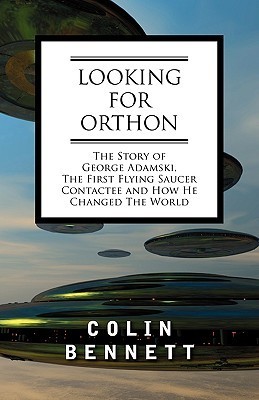
Looking for Orthon
The Story of George Adamski, the First Flying Saucer Contactee, and How He Changed the World — A Cultural Biography of a Debunked Man
Find on Amazon →As an Amazon Associate, OverClassified may earn from qualifying purchases made through this link, at no extra cost to you.
Why This Is Essential Reading
A biography of a hoaxer that is neither a defence nor a demolition, and better than either would have been. Colin Bennett accepts everything the debunkers established — the chicken-brooder top, the General Electric bulbs, the companions who recanted, the Venus that turned out to be 460 degrees — and then asks the question the debunking leaves untouched: how did this become one of the twentieth century's most consequential stories? His answer, that Adamski was 'a kind of unwitting performance artist' who gave the postwar West its first and most durable image of an alien, is more generous to the man than the record requires and more useful about the culture than any debunking is. The counterculture claim overreaches. The archetype claim does not, and it is worth the book. Read it after this site's case file, never instead of it.
Related Cases & Theories
Sources Cited
- Bennett, Colin. Looking for Orthon: The Story of George Adamski, the First Flying Saucer Contactee, and How He Changed the World, introduction by John Michell. Cosimo, Inc., 2008, 228 pp. ISBN-10 1605200670 / ISBN-13 9781605200675. amazon.com
- Google Books record, Looking for Orthon by Colin Bennett — Cosimo, 2008, 228 pp., John Michell introduction, and the publisher description characterising Adamski as 'a kind of unwitting performance artist' whose narrative shaped modern counterculture and introduced the UFO image to postwar Western consciousness. books.google.com
- AbeBooks bibliographic record, ISBN 9781605200675 — edition and format data. abebooks.com
- Bookshop.org listing, Looking for Orthon by Colin Bennett and John Michell — independent bibliographic confirmation of the introduction credit. bookshop.org
- Apple Books listing, Looking for Orthon by Colin Bennett — independent edition record. books.apple.com
- ThriftBooks edition record, Looking for Orthon — printing data and reader reception. thriftbooks.com
- Google Play Books listing, Looking for Orthon — further independent bibliographic confirmation. play.google.com
- Walmart listing, Looking for Orthon hardcover reissue, ISBN 9781944529802 — confirms the later hardcover edition. walmart.com
- Wikipedia, "George Adamski" — the November 20, 1952 Desert Center claim, the Palomar Gardens association, Flying Saucers Have Landed, the photographic analyses, the witness recantations, and his death in 1965. en.wikipedia.org
- Adamski, George, and Desmond Leslie. Flying Saucers Have Landed, 1953. OverClassified breakdown
- Fry, Daniel W. The White Sands Incident, 1954 — the contactee succession Adamski's template produced. OverClassified breakdown
- Klarer, Elizabeth. Beyond the Light Barrier, 1980 — the tradition's furthest extension. OverClassified breakdown
- Strieber, Whitley. Communion: A True Story, 1987 — the cover that fixed the second dominant alien archetype. OverClassified breakdown
- Pasulka, D. W. American Cosmic: UFOs, Religion, Technology, 2019 — the academic development of the cultural-function approach. OverClassified breakdown
- OverClassified case file, George Adamski's Desert Center Contact — source for the November 20, 1952 date, the six waiting companions, the Orthon contact claim, the chicken-brooder-top and General Electric bulb photographic identification, the witness recantations, and this site's Debunked assessment.
Have corrections, additional research, or peer-reviewed sources? Help improve this entry.
Suggest an Edit