
Truman Bethurum & the "Captain Aura Rhanes" Contacts
Before dawn on July 27, 1952, a 53-year-old highway-construction mechanic named Truman Bethurum, working the night shift for an asphalt batch plant atop Mormon Mesa, Nevada, said he woke to find eight or nine small, dark-haired men standing over his truck. Over the next several weeks, by his own account, they escorted him aboard a saucer called "the Admiral's Scow" on eleven separate occasions to meet its captain: a striking, olive-skinned woman he named Aura Rhanes, who told him she and her crew came from a planet called Clarion — a world she said orbited directly opposite the Earth, permanently hidden from every telescope on the far side of the Sun. The story became the 1954 bestseller Aboard a Flying Saucer, a fixture of the desert contactee lecture circuit, and, within three years, the stated grounds for his second wife's divorce petition. Unlike the betterknown contactee claims it closely parallels, Bethurum's case never produced a single photograph, physical sample, or corroborating witness of any kind — and its one specific, checkable factual claim, Clarion's exact location in space, was quietly revised twice, each time after the previous version was shown to be astronomically impossible.
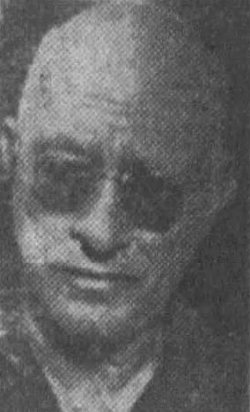
Pictured: Truman Bethurum photographed at George Van Tassel's Giant Rock Spacecraft Convention in 1954, the year his book Aboard a Flying Saucer was published — a contemporaneous press photograph (Daily News, April 5, 1954), in the public domain in the United States for lack of a copyright notice. No photograph of the claimed craft, its crew, or Aura Rhanes exists in any form; Bethurum never produced photographic evidence of any kind, unlike several other contactees of his era, and the only known depictions of the encounter are later artists' illustrations, not documentation.
Theoretical Alignment
This file, like this site's assessment of the George Adamski Desert Center Contact it closely parallels, uses the Psycho-Social Hypothesis in its broadest sense: not as a claim that Bethurum sincerely misperceived a real stimulus, but as the category that best captures the case's actual subject matter — how a single, entirely uncorroborated personal narrative, delivered by a man with an existing income-strained motive to supplement his wages, became a commercially successful book and a durable fixture of a movement that a more credentialed contactee (Adamski) had opened just eight months earlier. The Extraterrestrial and Interdimensional Hypotheses receive only minimal alignment because the case's one specific, testable physical claim — the exact orbital location of the planet Clarion — was not merely unverified but was revised twice by Bethurum himself after each earlier version was shown to be scientifically untenable, a stronger and more specific evidentiary position than simple absence of proof.
Background
Truman Bethurum was born August 21, 1898, in California, to Thomas Harrison Bethurum and a mother whose maiden name, per the California Death Index, was Harness. He had only a limited formal education and spent most of his working life as a truck driver, mechanic, and heavy-equipment operator — itinerant blue-collar labor that, by the early 1950s, had taken him through a string of jobs across the Southwestern United States. His first marriage, to Ruth Erna Keehne, began in 1922; the couple had at least one daughter, Doris Ethel Bethurum (later Franklin), born in 1925 and predeceasing her father in 1963. That marriage ended in divorce years before the events at the center of this file. In July 1945 Bethurum married a second time, to a woman named Mary, who would become directly relevant to this case a decade later.
In late July 1952, according to several detailed period retellings of the story, Bethurum was between jobs and financially strained during a period of labor unrest when a friend, identified as E. E. "Whitey" Edwards, offered him work as a batch-plant operator and night mechanic at an asphalt mixing plant the Wells Cargo Construction Company was running to support highway paving work near Mormon Mesa, a broad, flat-topped desert tableland in Clark County, Nevada, overlooking the Virgin and Muddy Rivers near the town of Overton. Bethurum accepted the job reluctantly, by these accounts, primarily out of friendship with Edwards and out of financial necessity — a detail this file treats as directly relevant background, since a man already working under strike-strained finances is one with an existing, ordinary motive to look for any additional income his story's aftermath might supply.
Nothing in Bethurum's pre-1952 record, as best this file can establish, suggests any prior interest in flying saucers, contactee literature, or the spiritual/esoteric movements that several other contactees of the era (including George Adamski, who had spent two decades running a self-styled Tibetan religious order before his own 1952 claim) had been embedded in for years beforehand. This is a genuine point of contrast worth stating plainly rather than glossing over: where Adamski's claim arrived after a long, escalating personal track record of prior sighting and photography claims, Bethurum's arrived, by all available evidence, without any comparable buildup — a single claim, seemingly out of nowhere, from an ordinary highway-construction worker with no prior public profile of any kind. Proponents of the case have sometimes cited this as a point in Bethurum's favor (an "ordinary man" with nothing to gain); this file weighs it differently in Observer Credibility below, where it is considered alongside the specific, non-ordinary things Bethurum did once the story existed.
Complete Timeline
Dates for the eleven individual 1952 contacts are drawn from Bethurum's own book and later retellings; some secondary accounts differ by a day on the first contact date (July 26–28 all appear in various sources), a minor and expected level of drift for a claim whose only source is the claimant's own memory, reconstructed for publication roughly two years after the fact.
| Date | Event |
|---|---|
| Aug 21, 1898 | Truman Bethurum born in California |
| 1922 | First marriage, to Ruth Erna Keehne |
| 1925 | Daughter Doris Ethel Bethurum born |
| Jul 1945 | Second marriage, to Mary |
| Jul 27, 1952 | First claimed contact. Bethurum, working the night shift for Wells Cargo Construction Company's asphalt batch plant atop Mormon Mesa, Nevada, says he was awakened before dawn by eight to ten small, dark-haired men and escorted to a landed disc-shaped craft, where he met Captain Aura Rhanes |
| Aug 3, 1952 | Second claimed contact, per Bethurum's own chronology |
| Aug 18, 1952 | Third claimed contact |
| Aug–Oct 1952 | Eight further claimed contacts over roughly three months, totaling eleven; several reportedly occurred near his home rather than the mesa itself |
| 1952 | Bethurum's account begins circulating informally through the Wells Cargo work camp and the desert contactee circuit surrounding Giant Rock, California |
| Sep 25, 1953 | The Redondo Beach Daily Breeze publishes Bethurum's account; reprinted October 3, 1953, as the paper's "best story of the year" |
| 1953 | A condensed version of the story appears in the UFO fanzine Saucers |
| Feb 19, 1954 | Bethurum lectures at the Neptunian Women's Club, Manhattan Beach, California |
| 1953 | Bethurum reportedly visits and discusses his claims directly with George Adamski, who becomes one of the few established contactees to voice support for Bethurum's account |
| 1954 | Aboard a Flying Saucer is published, bringing Bethurum national contactee-circuit recognition |
| 1955 | Bethurum's second wife, Mary, files for divorce, citing jealousy over Aura Rhanes in the petition; the couple divorces |
| 1955 | Bethurum says Aura Rhanes instructed him to begin soliciting public donations to establish a communal retreat, the Sanctuary of Thought |
| 1957 | The Voice of the Planet Clarion is published; the same year, Flying Saucer Pilgrimage by Bryant and Helen Reeve praises Bethurum's "unimaginative sincerity" after their own two-year, 23,000-mile field investigation of contactee claims |
| 1955–57 | Saucer News editor James W. Moseley investigates the wider contactee circuit, including Bethurum, and publicly concludes he is not a reliable source |
| 1958 | Facing Reality is published |
| 1960 | Bethurum marries his third wife, Alvira, at George Van Tassel's Giant Rock Spacecraft Convention |
| Mid-late 1950s | The Sanctuary of Thought opens near Prescott, Arizona, several years after fundraising began, as a modest communal retreat |
| May 21, 1969 | Truman Bethurum dies, aged 70, in San Bernardino County, California; buried at Twentynine Palms Cemetery |
| 1970 | The People of the Planet Clarion published posthumously |
| After 1969 | The Sanctuary of Thought dissolves without Bethurum's central presence to sustain it |
The July 27, 1952 Encounter at Mormon Mesa
By Bethurum's own account, first published in condensed form in 1953 and expanded into Aboard a Flying Saucer the following year, he had used a break in his overnight shift at the Wells Cargo batch plant to walk out onto Mormon Mesa in search of ancient seashells — the mesa, like much of the surrounding Moapa Valley, sits on ancient lakebed sediment where such fossils genuinely can be found, a small but real detail of local geography Bethurum's account gets right. He said he then fell asleep in or near his truck, and was woken before dawn, in the neighborhood of 4:00 AM, by a strange mumbling sound. Opening his eyes, he described seeing eight to ten small men, standing between roughly four feet eight inches and five feet tall, gathered nearby. He described them as dark-haired and dark-eyed with smooth, unlined, tanned or "Latin"-type complexions, dressed in matching dark uniforms with billed caps that Bethurum, drawing on the most familiar visual reference available to a highway worker of his era, compared to the uniforms worn by Greyhound bus drivers.
The men escorted him, he said, to a large disc-shaped craft resting nearby — a vessel he would come to call "the Admiral's Scow," describing it as roughly 300 feet in diameter, constructed of a burnished, silvery metal, with a raised rim running around its circumference. Aboard, he said, he was introduced to the vessel's captain: a woman he would name Aura Rhanes. This first meeting, per Bethurum's own telling, set the pattern for the ten further encounters that followed it over the coming weeks — conversational exchanges with Rhanes and her crew, conducted in colloquial English, covering the ship's operation, the crew's home world, and their views on Earth's affairs, rather than any sustained physical exploration of the vessel or any activity that produced a physical trace, sample, or photograph of any kind.
It is worth stating plainly what is, and is not, independently corroborated about this first night. What is corroborated, at the most basic factual level, is only that Bethurum was in fact employed by Wells Cargo Construction Company and was in fact working the overnight shift at the Mormon Mesa batch plant during this period — his employment itself is not disputed by any source this file located. Every other specific detail of the encounter — the men, their uniforms, the craft, Aura Rhanes, the entire content of the conversation — rests exclusively on Bethurum's own uncorroborated, retrospective testimony, first committed to print roughly a year after the fact and expanded further for book publication two years after that. No coworker, supervisor, or other person present at or near the work camp that night is ever named as having seen anything unusual, heard Bethurum's account contemporaneously, or otherwise corroborated any element of the story independent of Bethurum's own later retelling of it.
Eleven Contacts Over Three Months
Bethurum's own chronology places a second contact on August 3, 1952, and a third on August 18, with eight further meetings following over the next several weeks, for a total of eleven separate contacts by his own count, spanning roughly three months. Some later meetings, per Bethurum's retellings, occurred away from the mesa itself, closer to his home, with Rhanes and her craft materializing at times and locations of the crew's own choosing rather than Bethurum's. Across these later encounters, Bethurum elaborated considerably on the crew's described physical characteristics, technology, and worldview, and on Aura Rhanes specifically as an individual personality rather than simply the ship's commanding officer.
Bethurum described the crew members as uniformly polite, businesslike, and unthreatening, wearing trousers that struck him as having a distinctive blue-gray cast under the ship's interior lighting. He said the vessel operated silently, with no visible flame, exhaust, or conventional propulsion system, and that its interior included instrumentation and furnishings he struggled to describe in familiar terms. None of these details were ever subjected to independent examination of any kind: no measurement, no photograph, no physical sample, and no named second party present at any of the eleven meetings. The entire evidentiary weight of eleven separate encounters, spanning three months, rests on the same single, uncorroborated source as the first night.
Captain Aura Rhanes
Bethurum's most detailed and most consistently repeated descriptions across his books and lectures concern Aura Rhanes herself. He described her as noticeably shorter than her crew, with an olive complexion, jet-black hair, and a slender, "Latin"-type face, dressed in a bright red skirt, a black velvet blouse, and a black-and-red beret. He estimated her age, from appearance, at around forty, though he also reported her telling him she was in fact a grandmother by Clarion's own reckoning of age — a detail meant to underscore the claimed disparity between Clarionite life expectancy and outward appearance. He described her voice as distinctive and almost musical, and consistently portrayed her across eleven meetings as warm, businesslike, and personally engaged with him specifically, in a manner that reads, across his own published descriptions, considerably more personal and less purely informational than the tone most other contactees of the era used to describe their own claimed contacts.
This personal warmth in Bethurum's description of Rhanes became directly relevant to his own life within three years of the claimed contacts, when his second wife Mary's 1955 divorce petition cited jealousy over Aura Rhanes as a specific ground for the separation — Mary, herself reportedly a believer in some version of her husband's claims, is on record as having accused him of conducting what she characterized as an inappropriate relationship with the alien captain. Bethurum himself would go on to reference the divorce in later lectures, treating his wife's jealousy of a claimed extraterrestrial as a point of wry personal anecdote rather than as something requiring further explanation. Separately, at least one associate who worked with Bethurum during this period, an artist named Columba Krebs, is on record noting that Bethurum later hired a secretary whose appearance was said to resemble Aura Rhanes — a detail this file treats as a directly relevant biographical data point rather than incidental color, discussed further in Observer Credibility below.
The People and Geography of Clarion
Across his three books and his lecture circuit, Bethurum built out an increasingly detailed picture of Clarion and its people, largely attributed to what Aura Rhanes and her crew told him directly. He described Clarion as slightly smaller than Earth, sharing Earth's own sun, with oceans, lakes, rivers, and constructed dams, and flora and fauna that differed from Earth's in color and texture while serving broadly similar ecological functions. He described a single, unified planetary civilization — "one race and one religion," organized around a version of the Golden Rule — with no racial distinctions, no poverty, no profiteering, and no wars, strife, or juvenile delinquency of any kind. Clarionites, per Bethurum, lived roughly a thousand Earth years, were each trained as specialists in a single field rather than generalists, and were governed by leaders selected for knowledge, wisdom, and technical competence rather than by anything resembling Earth's electoral or hereditary systems — a system Bethurum explicitly and repeatedly contrasted, in his lectures, with what he called the graft and favoritism of Earth governments.
He described Clarionite technology as built around a mastery of gravity control rather than combustion or nuclear power, which the crew avoided specifically because of its destructive radioactive potential — a detail squarely of a piece with the broader contactee-movement preoccupation with nuclear anxiety in the years immediately following Hiroshima and Nagasaki and the opening of full-scale atmospheric hydrogen-bomb testing. Their interplanetary vessels, or "Scows," used this gravity control for anti-gravitational propulsion producing no G-force on passengers; a device he called a "retroscope" reportedly allowed the crew to review past events in color and sound; and a technology he described as "telementation" permitted direct thought transference. He reported the crew describing Earth as "the newest and lowest in evolution" among the many inhabited worlds they said they had contact with, while also describing close relations with the inhabitants of Mars specifically. Per Bethurum's account, Rhanes indicated that the secret of Clarionite gravity technology was, in her words, "so simple that we have walked right over it," but that it would only be shared with Earth once permanent global peace had been achieved — a conveniently unfalsifiable condition common across the broader 1950s contactee genre, in which advanced alien technology is reliably always one unmet moral precondition away from disclosure.
None of these details about Clarion's society, technology, or philosophy are independently checkable by their nature — they describe an internally consistent but entirely unfalsifiable claimed culture, in the same broad genre as Adamski's descriptions of Venusian and lunar civilizations published the previous year. The one specific, genuinely testable physical claim embedded within this broader picture — where, exactly, in space Clarion is supposed to be located — is a different matter, and is addressed on its own below, because it is the single point at which Bethurum's account crosses from unfalsifiable narrative into a claim that could actually be, and was, checked against known astronomy.
The Testimony of the Astronomers
Bethurum's account, like several other contactee narratives of the era, occasionally claimed indirect scientific validation — assertions that professional astronomers privately acknowledged the plausibility of a hidden planet, without any named scientist, institution, or publication ever actually going on record to that effect. No credentialed astronomer is known to have endorsed any version of Bethurum's Clarion claim at any point, in any published form. This file located no exception to that pattern in the available literature, despite Bethurum's own recurring suggestions, echoed in some sympathetic contactee-era writing, that the scientific community privately knew more than it publicly admitted.
A Planet That Kept Moving
The single most evidentially significant feature of this case, and the primary reason this file departs from a merely "unresolved" or "disputed" rating, is the specific, documented, three-stage revision of Clarion's claimed location in space — each revision occurring only after the prior version had been shown, by ordinary astronomical reasoning available at the time, to be untenable.
In Bethurum's earliest tellings, Clarion was described as located within the solar system but permanently hidden from Earth observation because it was concealed behind the Moon — a claim that fails on elementary orbital mechanics grounds any working astronomer of the era could and did point out: no stable planetary body can remain permanently hidden "behind" the Moon from Earth's perspective, since the Moon is a comparatively tiny body orbiting Earth itself, not a fixed screen large enough to permanently occlude a planet-sized object from every vantage point on Earth across a full year of orbital motion.
When this version proved impossible to sustain, Bethurum's account shifted to a second, more sophisticated-sounding claim: that Clarion occupied Earth's own orbital path around the Sun, positioned at all times directly opposite Earth on the far side of the solar disc — a genuine, centuries-old astronomical concept sometimes called a "Counter-Earth" or, in nineteenth-century astronomy, "Vulcan" (a since-abandoned hypothetical intra-Mercurial planet, unrelated to but sometimes conflated with the counter-Earth idea). This is a more scientifically literate-sounding claim than the first, but it fails for reasons that were already well understood well before 1952: a body sharing Earth's exact orbit on the precisely opposite side of the Sun is gravitationally unstable over any extended timescale, since the gravitational influence of other planets (chiefly Venus and Jupiter) would perturb such a body out of perfect opposition within a relatively short astronomical period, at which point it would become observable; and by the mid-twentieth century, spacecraft-independent methods including the gravitational effects such a body would necessarily exert on the orbits of Venus and Mercury, plus direct visual and photographic surveys conducted during total solar eclipses (when the region immediately around the Sun becomes briefly observable), had already failed to detect any such object, a body of evidence that only grew stronger with the crewed and uncrewed space exploration of the following decade.
When this second version, too, drew scientific criticism, Bethurum's account shifted a third time, relocating Clarion out of the solar system entirely and into another, unspecified star system — at which point the claim ceased to be checkable against any available evidence at all, and equally ceased to explain how Rhanes's craft could make what Bethurum's own narrative described as frequent, short-notice visits to a Nevada work camp. This file treats this specific three-stage pattern — a testable claim, refuted, replaced by a second testable claim, refuted, replaced by a third claim constructed specifically to be untestable — as the single strongest piece of evidence bearing on this case's overall credibility, because it is not merely an absence of proof (the ordinary condition of nearly every claim on this site) but an observed, repeated pattern of factual retreat in direct response to disproof, a behavior far more consistent with an evolving fabrication responding to its critics than with a consistent memory of a single real event.
Publication and the Contactee Circuit
Word of Bethurum's claims spread first informally, through the Wells Cargo work camp itself, and then into the small but active desert contactee circuit already forming around Giant Rock, California, where George Adamski's own November 1952 claim would shortly make the surrounding movement a great deal larger. Bethurum's story reached a genuinely mass audience for the first time on September 25, 1953, when the Redondo Beach Daily Breeze ran his account; the paper thought highly enough of the story's reader response to reprint it eight days later, on October 3, 1953, promoting it as the paper's own "best story of the year." A shortened version appeared the same year in the UFO fanzine Saucers, giving the story its first exposure to a national UFO-enthusiast readership specifically.
Bethurum became an active public lecturer on the strength of this exposure well before his book was published, giving at least one documented talk on February 19, 1954, at the Neptunian Women's Club in Manhattan Beach, California — a booking that illustrates how quickly a claim with no institutional vetting of any kind could move directly into paid civic-group speaking engagements in this era, exactly the commercial pathway several other contactees of the period, including Adamski, also followed. Also in 1953, by several accounts, Bethurum traveled to meet George Adamski directly and discussed his claims with him; Adamski, already the movement's most visible figure following his own November 1952 case, is reported to have offered active support for Bethurum's account — one of relatively few instances of one established contactee explicitly vouching for another's claims, rather than the more typical pattern (visible in the rivalries discussed in Historical Precedents below) of contactees maintaining polite public distance from each other's specific, competing claims.
Aboard a Flying Saucer was published in 1954, cementing Bethurum's place in the movement and giving his account its widest and most durable circulation. The book followed the by-then-established contactee template closely enough — a first-person narrative delivered with sincere, unadorned prose rather than literary polish, presented as straightforward reportage rather than as fiction or metaphor — that it found a ready audience among readers who had already been primed by Adamski's own bestseller the previous year. Two further books followed: The Voice of the Planet Clarion in 1957 and Facing Reality in 1958, each elaborating further on Clarion's society and technology and further building Bethurum's standing as a fixture of the lecture and convention circuit. A fourth book, The People of the Planet Clarion, was published posthumously in 1970, the year after his death.
Marriage, Divorce, and the Sanctuary of Thought
The domestic consequences of Bethurum's claims are among the case's better-documented biographical details, and this file treats them as directly relevant to assessing his credibility rather than as incidental personal color. His second wife, Mary, married in July 1945, filed for divorce in 1955, citing jealousy over Aura Rhanes specifically in the divorce petition; she is reported, by more than one source, to have accused her husband of conducting an inappropriate relationship with the alien captain he described in such personal and admiring terms across eleven separate meetings. Bethurum himself referenced the divorce in his later public lectures, treating it as an amusing anecdote about his wife's jealousy of a woman from another planet rather than as an episode inviting any closer scrutiny of what, exactly, about his own conduct or storytelling had produced that reaction in someone who knew him personally and, by most accounts, was herself sympathetic to some version of his broader claims. Separately, artist Columba Krebs, who worked with Bethurum during this period, is on record stating that he later hired a secretary reported to resemble Aura Rhanes in appearance — a detail this file finds directly relevant to, rather than separate from, the pattern of personal conduct surrounding the claim.
In 1955, the same year as his divorce, Bethurum said Aura Rhanes had instructed him to begin soliciting financial contributions from the public to establish a communal spiritual retreat, to be called the Sanctuary of Thought. Framed as a project for "Friends of Peace" and grounded in meditation, relaxation, and biblical principles including the Golden Rule, the Sanctuary sought land at an elevation of 5,000 to 7,000 feet among tall pines, with facilities eventually envisioned for as many as fifty residents. It took several years of solicited donations to actually open, finally establishing itself near Prescott, Arizona later in the decade. The organization never developed into anything resembling a durable religious movement on the scale of some contemporaries, and dissolved after Bethurum's death in 1969, having depended entirely on his own personal presence and continued lecturing to sustain both its membership and its finances. This file notes, without asserting it as conclusive proof of intent, that the sequence here — an uncorroborated personal claim, a bestselling book, a national lecture circuit, and finally a fundraising appeal to the public explicitly attributed to instructions from the claimed alien contact herself — describes a financially self-reinforcing structure regardless of whether any individual step within it was made in good faith.
In 1960, five years after his divorce from Mary, Bethurum married a third time, to a woman named Alvira, in a ceremony held at George Van Tassel's Giant Rock Spacecraft Convention — a fitting venue given how thoroughly the contactee circuit had by then become the center of his social and professional life, and a detail that further illustrates how completely his identity had been absorbed into the movement his 1952 claim had helped him join.
Bethurum Among the Contactees
Bethurum's reception within the 1950s contactee movement itself was mixed in ways that track the movement's own internal divisions. George Adamski, whose own November 1952 claim had opened the movement's most visible chapter just months after Bethurum's own alleged first contact, is reported to have supported Bethurum's account following their 1953 meeting — a notable data point given how selectively Adamski otherwise engaged with the wider contactee scene; this site's own case file on Adamski documents that he largely avoided the annual Giant Rock conventions that became the movement's central gathering point, attending only once, in 1955. Bethurum, by contrast, embraced the Giant Rock circuit fully, becoming a recurring lecturer there and eventually marrying his third wife at one of its conventions in 1960.
Independent scrutiny of Bethurum's claims was considerably more skeptical than Adamski's endorsement. James W. Moseley, the editor of Saucer News whose investigation would go on to substantially discredit Adamski's own Desert Center photographs (documented in this site's Adamski file), also investigated the broader contactee circuit including Bethurum during the mid-to-late 1950s, and concluded that Bethurum was not a reliable or honest source. Moseley's judgment carries particular weight in this file's overall assessment given his demonstrated record, on the Adamski case specifically, of conducting real, verifiable field investigation (locating and directly interviewing the cinematographer Adamski had falsely claimed authenticated his photographs; obtaining an on-record witness retraction) rather than reflexive dismissal.
A more sympathetic assessment came from engineer Bryant Reeve and his wife Helen, whose 1957 book Flying Saucer Pilgrimage documented a genuinely substantial two-year, 23,000-mile personal investigation of the era's leading contactee claims, including Bethurum's, Adamski's, and George Hunt Williamson's. The Reeves' assessment of Bethurum specifically praised what they called his "unimaginative sincerity" — a phrase this file reads carefully rather than at face value, since it describes an impression of the man's personal manner and demeanor during interview, not an independent verification of any specific factual claim he made. The same tension appears repeatedly across this site's coverage of 1950s contactees generally: witnesses and investigators who met these men in person often came away with a strong personal impression of sincerity, precisely because a consistent, unwavering personal manner is not, in itself, evidence that the underlying claim is true — a distinction this file returns to directly in Observer Credibility below.
Bethurum's refusal of independent verification, when it was actually offered, is a further and more concrete data point than any assessment of his personal manner. He is reported to have declined to submit to a polygraph examination, and separately declined to submit a document he claimed had originated on Clarion for independent physical or documentary analysis — two specific, concrete opportunities to test his claims against methods available at the time, both declined. This file treats a refusal of offered, low-cost verification very differently from a simple absence of evidence never offered in the first place: the former is an active choice against a specific test, while the latter is merely the ordinary condition of most uncorroborated testimony.
Key Witnesses
Truman Bethurum
The case's only claimed witness, and the sole source of every specific detail across all eleven claimed contacts. No coworker at the Wells Cargo work camp, no family member, and no independent bystander is ever named as having witnessed any element of the encounters directly or contemporaneously. Bethurum refused a polygraph examination and declined to submit his claimed Clarion document for independent analysis when both were available options; his own central testable claim — Clarion's location in space — was revised twice, each time only after the prior version had been shown to be astronomically untenable. His claims produced a bestselling book, a national lecture circuit, and, beginning in 1955, a public fundraising appeal for a communal retreat attributed to instructions from the claimed alien contact herself.
Aura Rhanes
The captain Bethurum said he met on all eleven occasions, described consistently across his books as an olive-skinned, black-haired woman in a red skirt and black velvet blouse. Aura Rhanes has no independent existence outside Bethurum's own testimony: no other person ever claimed to have seen or spoken with her, and no physical evidence of any kind (photograph, recording, or artifact) is associated with her. Consistent with this site's established practice for claimed contact entities without independently verifiable identities (see this site's treatment of "Orthon" in the George Adamski Desert Center Contact file, which similarly carries no key-figures card), no key-figures.html card has been created for Aura Rhanes; she is documented here, and referenced elsewhere on this site, as a named element of Bethurum's own claim rather than as a registered historical figure.
The Five Observables Assessment
Because this case's central claims were never subjected to any external test capable of confirming or denying the described craft's performance, the assessment below documents only what Bethurum himself claimed, without independent corroboration of any kind.
The Five Observables framework is applied to the performance characteristics claimed in this case:
Assessment: Bethurum's own narrative describes a craft that landed, sat stationary during his visits, and departed, powered (per his account of what the crew told him) by gravity control rather than reaction propulsion. This is marked "Claimed Only" rather than "Present" because it is a description offered entirely secondhand, through Bethurum's own retelling of what he says the crew told him about their own technology, rather than anything he directly observed the craft doing — no sudden acceleration, no unusual velocity, and no trans-medium transition are described anywhere in the account, and no instrumented or photographic data of any kind exists to evaluate any of it. This case's Five Observables profile is, by design, minimal: it is a claim built almost entirely around conversational content rather than any observed craft performance.
Evidence Assessment
Unlike most case files on this site, evaluating this case does not primarily involve weighing thin or ambiguous physical evidence. It involves weighing a single, uncorroborated personal narrative — entirely without photographs, physical samples, or a second witness of any kind — against a specific, documented pattern of factual retreat on the one claim within it that was ever testable.
Points Cited by Proponents
- Bryant and Helen Reeve's 1957 Flying Saucer Pilgrimage, following a genuinely substantial two-year field investigation of contactee claims, described Bethurum personally as sincere
- George Adamski, the movement's most prominent figure, is reported to have supported Bethurum's account after meeting him in 1953
- Bethurum's employment at the Wells Cargo Mormon Mesa batch plant during the claimed period is independently uncontested
- The case's historical significance within the broader 1950s contactee movement is undisputed regardless of the underlying claim's truth
Findings Against the Case
- No coworker, family member, or bystander is ever named as an independent witness to any of the eleven claimed contacts
- No photograph, recording, or physical sample of any kind was ever produced, unlike several comparable contactee cases of the same era
- The claimed location of the planet Clarion was revised twice by Bethurum himself, each revision following the scientific refutation of the prior version
- Bethurum refused a polygraph examination and declined to submit his claimed Clarion document for independent analysis
- Saucer News editor James W. Moseley, whose field investigation independently discredited Adamski's own photographic evidence, separately concluded Bethurum was not a reliable source
- The claims produced a direct, traceable financial benefit: a bestselling book, a national paid lecture circuit, and a public fundraising appeal explicitly attributed to instructions from the claimed alien contact
- Bethurum's own wife cited the claim itself, and specifically his description of Aura Rhanes, as grounds for their 1955 divorce — a personally costly outcome he nonetheless continued to reference and profit from in subsequent lectures rather than revisit
Why "Debunked"
This case receives a DEBUNKED classification. This site reserves that rating for cases where independent examination produces specific, largely conclusive counter-evidence rather than merely an absence of proof, and this file's own reasoning for applying it here is deliberately different in kind from the physical-evidence identification that earned the same rating on the George Adamski case — Bethurum's account left no comparable photograph for a rocket engineer to trace back to a lantern shade and light bulbs, because it left no photograph at all.
What this case does have, in place of a physically debunked artifact, is a documented, three-stage pattern of factual retreat on the single claim within the entire narrative that was ever independently testable: Clarion's location in space, moved first from "hidden behind the Moon" to "directly opposite the Sun in Earth's own orbit" and finally to an unspecified other star system, each revision occurring specifically after the prior version had been shown untenable by ordinary astronomical reasoning available at the time. This file weighs that pattern as functionally equivalent in evidentiary seriousness to a specific physical debunking, because it demonstrates the same underlying fact by a different route: that the claim, when tested against reality, failed the test, and was then quietly adjusted rather than defended or withdrawn.
Layered on top of that core finding are three further, independently damaging facts. First, Bethurum actively declined two specific, concrete opportunities for independent verification — a polygraph examination and document analysis of his claimed Clarion artifact — rather than simply lacking evidence that was never offered. Second, unlike Adamski's case, which retained at least six named companions physically present (even if most saw nothing corroborating), Bethurum's account has zero named witnesses of any kind at any point across eleven separate claimed meetings spanning three months; every single fact in this case traces back to one uncorroborated source. Third, the claim's financial trajectory — a bestselling book, a national paid lecture circuit, and finally a direct public fundraising appeal for a religious retreat, attributed explicitly to instructions from the claimed alien contact — describes a self-reinforcing commercial structure that a reasonable evaluator must weigh when assessing the account's reliability, independent of any judgment about Bethurum's personal sincerity.
This file does not conclude that Bethurum was necessarily a cynical, self-aware fraud from the outset; that question is examined directly, and left genuinely open, in the Conventional Explanation Candidate section below. What the available evidence does support, with reasonable confidence, is that the specific claims in Aboard a Flying Saucer do not describe a real physical encounter with a genuine non-human intelligence — a narrower and more defensible conclusion than a claim about Bethurum's own state of mind, and the one this file's DEBUNKED rating is actually meant to convey.
Sensor & Instrumentation Detection Profile
No radar, aviation, military, or scientific instrument of any kind is associated with this case at any point. Bethurum never reported his claims through Project Blue Book or any other official channel during the events themselves; his story reached the public exclusively through newspaper coverage, his own books, and his lecture circuit. No photographic evidence exists to analyze, in sharp contrast to several comparable contactee cases of the same period (including Adamski's, whose photographs at least permitted independent forensic examination that ultimately discredited them). The complete absence of any instrumented or documentary record of any kind is itself the most basic and most consequential fact about this case's evidentiary profile: there is, quite simply, nothing beyond Bethurum's own retrospective testimony to examine.
Environmental & Geospatial Context
Mormon Mesa is a broad, flat-topped desert tableland in Clark County, Nevada, roughly 65 miles northeast of Las Vegas, overlooking the Virgin and Muddy Rivers near the town of Overton in the Moapa Valley. The mesa's remote, sparsely populated character in 1952 — accessible primarily to highway construction crews and geologically interesting to fossil-hunters for its exposed ancient lakebed sediment — placed Bethurum's claimed solo encounter far from any potential unrelated witness, exactly the kind of isolated setting that recurs across this site's coverage of solo-witness contactee claims generally.
No specific atmospheric or astronomical phenomenon is required to explain this case, since its central evidentiary problem is not a plausible misidentification of a genuine but mundane stimulus; it is an entirely uncorroborated personal narrative with a documented pattern of factual revision on its one testable claim. The desert setting's chief evidentiary relevance is simply that it provided total privacy for a claimed encounter under circumstances that made independent corroboration structurally impossible from the outset — a lone night-shift worker on an isolated mesa, awake and alone during the specific predawn hours he described, is a setting no different, evidentially, from a claim made in a private room with the door closed.
Observer Credibility & Occupational Profile
Bethurum's occupational background — truck driver, mechanic, heavy-equipment operator — carries no specific credential bearing directly on the reliability of extraordinary personal testimony, in either direction; this file does not treat blue-collar labor as either enhancing or diminishing credibility on its own, and notes that proponents of the case have sometimes framed Bethurum's "ordinary man" status as a point in his favor precisely because it lacks the kind of institutional platform (a claimed scientific credential, a public teaching role) that might otherwise supply an independent financial motive. This file finds that framing incomplete rather than wrong: Bethurum did not need a prior public platform to have an ordinary financial motive, and the record shows he found one quickly — a friend's job offer accepted specifically out of financial necessity during a period of labor unrest, followed within roughly a year by a nationally reprinted newspaper feature, a paid lecture circuit, a book contract, and eventually a direct public fundraising appeal.
Two further, more specific behavioral data points weigh directly against Bethurum's reliability as a witness. First, his declination of both a polygraph test and independent document analysis, when both were specifically available to him, is meaningfully different from simply lacking evidence never offered — it is an active choice against verification he could have accepted at comparatively low personal cost, had his account been able to withstand it. Second, and independently, his demonstrated pattern of revising Clarion's location specifically in response to scientific criticism shows a witness responsive to disproof in a manner consistent with someone managing an evolving narrative under pressure, rather than one consistently reporting a single, fixed memory of an actual event. Neither of these facts requires speculating about Bethurum's inner state of mind; both are observable, external behaviors documented across multiple independent secondary sources.
This file also weighs, without over-reading it, the personal-manner testimony offered by Bryant and Helen Reeve following their 1957 field investigation, who found him personally sincere. As this file notes above in Bethurum Among the Contactees, a consistent, sincere-seeming personal manner and a documented pattern of unverified, evolving, financially beneficial claims are not mutually exclusive — a distinction this site's own Adamski file draws explicitly regarding Edward Ruppelt's parallel assessment of Adamski, and one this file applies with equal weight here. James Moseley's contrary, considerably more skeptical assessment, reached through the same kind of direct field investigation that discredited Adamski's photographic evidence, is treated in this file as carrying comparable or greater evidentiary weight than an impression of sincerity alone, precisely because it engages with Bethurum's specific claims rather than his manner of presenting them.
Physical & Material Assays
No physical artifact of any kind is associated with this case. Bethurum claimed to possess a document he said had originated on the planet Clarion, but he declined to submit it for independent analysis when the opportunity was available, and its current whereabouts, if it ever physically existed, are unknown; it has never been examined by any independent researcher, laboratory, or institution in any published account this file located. No plaster casts, no metal samples, no photographic plates, and no recordings of any kind exist for this case — a genuinely thinner physical record than several comparable contactee claims of the same era, including Adamski's (whose photographs, however discredited, at least existed to be examined) and George Van Tassel's (whose claims produced the physical Integratron structure, whatever one concludes about its underlying premise).
The complete absence of any physical evidence, seventy years after a claim whose central artifact — the "Clarion document" — was reportedly in Bethurum's own possession at the time and specifically declined for testing, is itself a significant and directly attributable evidentiary gap rather than an ordinary accident of time. Unlike cases where a genuinely promising physical trace was simply lost to decades of poor recordkeeping or changing hands, this case's one claimed physical artifact was, by the available accounts, deliberately withheld from the one kind of examination that might have resolved the question either way.
Historical Precedents & Archive Matches
Bethurum's case belongs to the specific wave of contactee narratives that followed directly from George Adamski's November 1952 claim, discussed at length in this site's own George Adamski Desert Center Contact file. That file documents Adamski establishing, and arguably originating, the entire "contactee" template: a benevolent, human-looking visitor; communication through gesture, telepathy, or fluent English; a warning about the dangers of nuclear weapons; and a broader message of cosmic spiritual brotherhood. Bethurum's account follows this template closely — friendly, human-appearing crew; nuclear anxiety as a stated motive for the visit; a female captain whose warmth and personal engagement, if anything, exceed Adamski's more distant portrayal of Orthon — while adding its own distinctive elements, chiefly Clarion's specific claimed astronomical location and the sheer number of claimed repeat contacts (eleven, against Adamski's original single meeting plus one claimed follow-up).
George Van Tassel, whose Giant Rock conventions became the movement's central organizing hub from 1953 onward, claimed his own contact with an entity he called "Solganda" within roughly a year of Adamski's Desert Center encounter; Orfeo Angelucci and Daniel Fry published their own Adamski-pattern narratives in the same period; Howard Menger and Buck Nelson extended the same basic template into the early 1960s. Bethurum's case sits comfortably within this cluster both chronologically and structurally, and his full, active participation in the Giant Rock convention circuit — unlike Adamski's more selective, arm's-length relationship with the same movement — makes his case, if anything, a more central and representative example of the broader contactee-movement pattern than Adamski's own founding case.
The specific "hidden planet" conceit at the center of Bethurum's claim also echoes a recurring theme across the wider 1950s and 1960s contactee literature: George Hunt Williamson's 1953 channeled material separately referenced a "lost world" he associated with the asteroid belt between Mars and Jupiter, under several names including, by some accounts, Clarion itself — a detail suggesting the broader contactee subculture treated the specific name "Clarion" as something closer to shared cultural vocabulary than as a claim uniquely originating with Bethurum alone, a pattern of cross-pollination and borrowed detail this site's coverage of the movement generally has found repeatedly across independently published contactee accounts of the era.
Material Analysis
This case's material evidence is, in the most literal sense, absent rather than merely thin or contested. Unlike nearly every other contactee case this site has covered in comparable depth, there is no photograph, recording, plaster cast, metal fragment, or documented physical artifact of any kind to examine, trace, or independently test.
The Missing Photographic Record
Several of Bethurum's contemporaries in the contactee movement, most notably Adamski, produced photographs that became the central, examinable evidence in their respective cases — evidence that ultimately proved decisive against Adamski's claims once independently traced to ordinary household objects. Bethurum produced no equivalent photographic record at any point across eleven claimed contacts over three months, despite the same general opportunity (a claimed period of extended, repeated proximity to the craft) that other contactees used to produce their own claimed images. The only visual depictions of Bethurum's claimed encounter that this file located are later artists' illustrations — including an illustration published in Gavin Gibbons's 1957 book They Rode in Space Ships — created for publication rather than as documentation, and explicitly understood by their own publishers as artistic renderings rather than photographic evidence.
The Withheld Clarion Document
The one physical artifact Bethurum did claim to possess — a document he said originated on Clarion — represents this case's single closest approach to testable physical evidence, and its significance rests entirely on the fact that it was never tested. Bethurum's declination of independent analysis, discussed above in Observer Credibility, means this file cannot report any finding about the document's actual composition, origin, or authenticity one way or the other; what can be reported, and what this file weighs directly, is the decision to withhold it from examination when the offer existed.
Points Favoring the Claim's Physical Basis
- Bethurum's underlying employment at the Mormon Mesa batch plant during the claimed period is independently uncontested
- Mormon Mesa's genuine geological character (exposed ancient lakebed fossil deposits) matches the small, checkable detail in Bethurum's own account of why he was on the mesa that night
- The claimed Clarion document, had it ever been submitted, could in principle still have been tested; its non-existence in accessible form today does not retroactively prove it never existed
Points Against the Claim's Physical Basis
- No photograph, recording, or sample of any kind exists for a claim spanning eleven separate encounters over roughly three months
- Bethurum actively declined independent testing of the one artifact he claimed to possess, rather than simply lacking an opportunity to have it tested
- The only surviving visual depictions of the encounter are later artists' illustrations created for book publication, not contemporaneous documentation
- No coworker, family member, or bystander is named as having independently observed any element of any of the eleven claimed encounters
The Conventional Explanation Candidate
Three genuinely distinct conventional explanations account for this case, and this file finds meaningful support for elements of more than one of them rather than a single, fully dispositive answer — a rarer outcome on this site than a single clean candidate, but the honest one here given the specific mix of evidence available.
Deliberate Fabrication for Fame and Profit
The strongest single candidate, on the available evidence, holds that Bethurum invented some or all of the specific claims in his account, whether from the outset or through progressive embellishment across the eleven claimed contacts and subsequent retellings, with the immediate and traceable financial benefit — a nationally reprinted newspaper feature within a year, a paid lecture circuit shortly after that, a book contract the year after that, and eventually direct public fundraising — as at least a contributing motive. This candidate accounts cleanly for the refusal of polygraph testing and document analysis (a fabricated claim has an obvious reason to avoid tests capable of exposing it), for the specific pattern of revising Clarion's location in direct response to scientific criticism (a behavior consistent with active narrative management rather than a fixed memory), and for the case's complete absence of any independent corroboration despite eleven separate opportunities for a companion, coworker, or bystander to have been present. Bethurum's existing financial strain at the exact moment he accepted the Wells Cargo job further supplies an ordinary, mundane motive that requires no unusual psychological explanation.
Sincere Confabulation or Delusion
A softer variant holds that Bethurum may have genuinely believed some version of his own account, whether originating in an ordinary dream or hypnagogic experience during a fatigued overnight shift (fatigue-related hypnagogic hallucination during predawn solo work is a well-documented phenomenon, and the specific circumstances Bethurum describes — alone, on a night shift, having just fallen asleep, waking abruptly to a strange sound — match its classic presentation closely) later elaborated, consciously or not, into the fuller eleven-contact narrative under the reinforcing pressure of public interest, financial reward, and his own repeated retelling. The Reeves' 1957 assessment of Bethurum's personal sincerity, following genuine field investigation, offers some support for this reading. This file finds it a less complete explanation than deliberate fabrication on its own, however, because it does not as naturally account for the specific, repeated pattern of revising Clarion's claimed location precisely when confronted with scientific criticism — a response pattern more consistent with an active, aware narrator managing objections than with someone reporting a single fixed memory, however sincerely held. The two candidates are not mutually exclusive: an initial hypnagogic experience, genuinely and sincerely misunderstood at the time, could plausibly have been followed by conscious embellishment once its commercial potential became apparent — a combination this file considers at least as plausible as either candidate alone.
Cultural Contagion from the Adamski-Originated Contactee Wave
A third candidate, not exclusive of the first two, holds that Bethurum's claim was shaped less by any individual psychological process than by the surrounding cultural moment: Adamski's own contact claim, made public just months before Bethurum's alleged first encounter and rapidly building toward the publishing phenomenon Flying Saucers Have Landed would become in 1953, had already established a specific, replicable template — a benevolent, human-looking crew; a female or male figure with individual personality; a nuclear-anxiety motive; a hidden home world — that a claim emerging from the same general Southern California/Nevada desert milieu, in the same narrow historical window, would very naturally echo, whether through direct conscious imitation, unconscious cultural absorption, or simple genre convention. This candidate is well supported by the close structural match between Bethurum's account and Adamski's template, and by the broader wave of near-identical contactee claims (Van Tassel, Angelucci, Fry, Williamson) emerging from the same social circle within roughly the same two-year window; it does not, on its own, address the specific financial and behavioral evidence (the polygraph refusal, the revised planetary claim, the fundraising appeal) that more directly bear on Bethurum's own individual conduct, and this file treats it as best understood as an explanation for why this particular kind of claim emerged from this particular time and place, working alongside either of the first two candidates rather than replacing them.
Genuine Contact (At Face Value)
Included for completeness, as this site does for every case, the candidate that holds Bethurum's account largely as stated — a genuine, repeated contact with a non-human intelligence — finds no persuasive support in the available evidence. It requires treating the documented, three-stage revision of Clarion's claimed astronomical location as coincidental rather than responsive to criticism, requires no explanation for the complete absence of any corroborating witness across eleven separate occasions, and requires accepting Bethurum's refusal of both offered verification methods as unrelated to the truth of his claims rather than as the more parsimonious alternative reading.
Deliberate Fabrication for Fame and Profit
PlausiblePLAUSIBLE. Best accounts for the polygraph and document-analysis refusals, the direct traceable financial benefit, and the pattern of revising the claim's one testable detail specifically in response to disproof.
Sincere Confabulation or Delusion
InconclusiveINCONCLUSIVE. Consistent with the initial circumstances (a fatigued, alone, night-shift worker) and with contemporaneous assessments of Bethurum's personal sincerity, but does not on its own explain the specific pattern of revision under scientific criticism.
Cultural Contagion from the Adamski-Originated Contactee Wave
Plausible (as a contributing factor)PLAUSIBLE as a contributing factor. Well supported by the close structural match to Adamski's template and the surrounding wave of near-identical claims, though it does not independently explain Bethurum's specific individual conduct.
Genuine Contact (At Face Value)
ImplausibleIMPLAUSIBLE. Requires treating the documented revision of Clarion's astronomical location as coincidental rather than responsive to criticism, and requires no explanation for the complete absence of any corroborating witness or physical evidence.
Related Cases
The cases below sit within the same 1950s "contactee" cluster this case belongs to, offering direct points of comparison on evidentiary strength, personal conduct, and the broader movement Bethurum's claims helped populate.
Confirmed Documents & Official Records
A 13-page file held under the FBI Vault's "Frequently Requested" category. This file does not represent, and should not be read as, an official government investigation into the truth of Bethurum's claims — the Bureau's general 1950s practice regarding contactee claims of this kind was to file public correspondence and press coverage for monitoring purposes, not to adjudicate them. No Project Blue Book or other formal U.S. government investigation of the Mormon Mesa claim itself is known to exist; Bethurum never reported his claims through any official channel. Because no government or official body is cited anywhere in this file as evidence bearing on whether this case is genuine, this file finds the site's Skepticism Disclaimer for official government/Pentagon statements is not applicable here — there is no official finding, favorable or unfavorable, for that disclaimer to qualify.
Publicly released (FOIA)Search Government & Military Archives Directly
Further Reading — Recommended Literature
Aboard a Flying Saucer
Bethurum's own original account of his eleven claimed contacts with Aura Rhanes and the crew of the Admiral's Scow — essential primary-source reading for understanding exactly what was claimed and how it was framed for a mass audience.
Flying Saucer Pilgrimage
A genuine two-year, 23,000-mile field investigation of the era's leading contactees, including Bethurum, Adamski, and George Hunt Williamson — the source of the era's most-quoted assessment of Bethurum's personal sincerity.
UFO Religion: Inside Flying Saucer Cults and Culture
A scholarly field study of the contactee movement's religious and cultural dimensions, directly assessing why the Sanctuary of Thought and comparable ventures failed to outlast their founders.
The Encyclopedia of Extraterrestrial Encounters
A comprehensive A-Z reference situating Bethurum's claims within the full scope of documented alien-contact literature, contributed to by dozens of researchers across the field's competing perspectives.
The UFO Encyclopedia: The Phenomenon from the Beginning
The standard reference work covering Bethurum, the wider contactee movement he helped populate, and the broader historical and skeptical context of 1950s ufology.
DISCLOSURE: Some links above are affiliate links. If you purchase through them, OverClassified receives a small commission at no additional cost to you. This helps support independent research.
Essential Viewing

Astonishing Legends: "Aboard a Flying Saucer" Part 1
Episode 265 of the Astonishing Legends podcast covers Bethurum's background, his job at the Mormon Mesa batch plant, and the July 27, 1952 first contact claim in detail.
Astonishing Legends: "Bethurum Part 2 — UFOs and the Occult"
The concluding episode of the podcast's two-part Bethurum coverage, following the story through publication, the contactee circuit, and its wider connections to occult and esoteric UFO literature.
Sources
- "Truman Bethurum," Wikipedia. en.wikipedia.org
- "Biography:Truman Bethurum," HandWiki (Wikipedia mirror with citation detail). handwiki.org
- "Bethurum, Truman (1898-1969)," Encyclopedia.com. encyclopedia.com
- "Truman Bethurum," The Wanderling (first-hand recollection of a 1954 Bethurum lecture, plus case chronology). the-wanderling.com
- "Truman Bethurum, Contactee (1898-1969), July 1952," Dragon at the End of Time. dragonattheendoftime.com
- "The Golden Age of Flying Saucers: Aboard a Flying Saucer," (excerpted primary narrative detail on the Wells Cargo job and first contact). thegoldenageofflyingsaucers.blogspot.com
- "Truman Bethurum," Ufology Wiki. ufology.wikidot.com
- "Q&A On The People From The Planet Clarion," Unariun Wisdom (detailed compilation of Bethurum's own claimed descriptions of Clarion society and technology). unariunwisdom.com
- "Extraterrestrial/UFO Religion," CDAMM (Comparative Database of Astonishing Claims and Miracles/Contested Data Archive; religious-studies framing of the contactee movement's Cold War context). cdamm.org
- "Truman Bethurum," Find a Grave (California Death Index and Social Security Death Index citation detail: birth, death, burial, and family record). findagrave.com
- Bethurum, Truman. Aboard a Flying Saucer. DeVorss & Co., 1954.
- Bethurum, Truman. The Voice of the Planet Clarion. Time-Bethurum Publications, 1957.
- Bethurum, Truman. Facing Reality. Truman Bethurum, 1958.
- Bethurum, Truman. The People of the Planet Clarion. DeVorss & Co., 1970 (posthumous).
- Reeve, Bryant & Helen. Flying Saucer Pilgrimage. Amherst Press, 1957.
- Reece, Gregory L. UFO Religion: Inside Flying Saucer Cults and Culture. I.B. Tauris, 2007.
- Story, Ronald D., ed. The Encyclopedia of Extraterrestrial Encounters. NAL Trade, 2001.
- Clark, Jerome. The UFO Encyclopedia: The Phenomenon from the Beginning. Omnigraphics, 1998.
- Federal Bureau of Investigation. "Truman Bethurum" file (13 pp.), released via FOIA, FBI Vault. vault.fbi.gov
- "George Adamski," Wikipedia (for Adamski/Bethurum relationship and comparative contactee context). en.wikipedia.org
- "George Van Tassel," Wikipedia. en.wikipedia.org
- "George Hunt Williamson," Wikipedia. en.wikipedia.org
- "Giant Rock," San Bernardino County history feature. main.sbcounty.gov
- "Mormon Mesa," Topo Map, Clark County, Nevada. topozone.com
- File:Truman Bethurum in 1954 at Giant Rock.png, Wikimedia Commons (Daily News, April 5, 1954; public domain, no copyright notice). commons.wikimedia.org
- File:Truman Bethurum from flap of Aboard a Flying Saucer (cropped).jpg, Wikimedia Commons. commons.wikimedia.org
- "Astonishing Legends, Episode 265: Aboard a Flying Saucer Part 1" (Sept. 10, 2023). youtube.com
- "Astonishing Legends, Episode 266: Bethurum Part 2 — UFOs and the Occult" (Sept. 23, 2023). youtube.com
See something inaccurate? Have additional information or sources?
Suggest an Edit →Last Updated: August 2026