
The Encyclopedia of Extraterrestrial Encounters
Core Thesis
The Encyclopedia of Extraterrestrial Encounters is Ronald D. Story's second major reference-work project, published in 2001, more than two decades after his landmark The Encyclopedia of UFOs (1980) — a genuinely distinct book rather than a reissue, alphabetically organized across more than 400 entries covering UFOs, alien abductions, Area 51, the Bermuda Triangle, and government cover-ups, illustrated with more than 300 photographs and drawings. Like Story's earlier encyclopedia, this is a multi-contributor work assembling entries from a genuinely broad cross-section of the field's leading voices — Carl Sagan, Budd Hopkins, Whitley Strieber, Stanton Friedman, Ann Druffel, Raymond Fowler, Kevin Randle, Martin Kottmeyer, Erich von Däniken, and NICAP/MUFON figures including Walter Andrus, with entry length and citation density varying noticeably by contributor (Randall Fitzgerald's byline anchors many shorter entries, while Kottmeyer's contributions run longer with more academic-style citation). This site cites the book directly across three separate case files — Daniel Fry, Truman Bethurum, and the Deception Island Sightings — reflecting its genuine, repeated usefulness as a comparative general reference for situating individual cases within the field's broader documented record.
About the Author
Ronald D. Story (born 1946) is the founder of the original UFO Encyclopedia Project and, this site's own key-figures research already documents, one of the field's most consequential reference-work editors. Before turning to encyclopedia work, Story wrote The Space-Gods Revealed (Harper & Row, 1976) — this site's own essential-reading coverage of that book documents it as the first full-length, claim-by-claim rebuttal of Erich von Däniken's Chariots of the Gods?, carrying a foreword by Carl Sagan and contributions from Frank Drake, William Hartmann, and Thor Heyerdahl — a debunking project that makes von Däniken's own later contributor credit in this 2001 encyclopedia a notable point of professional continuity across a genuine intellectual disagreement.
Story's most influential single piece of original research, also documented in his existing key-figures profile, was a 1979 survey of ninety leading ufologists asking for the single strongest piece of UFO evidence available; the Father Gill case at Boianai, Papua New Guinea, was cited more often than any other, a finding that helped cement that case's reputation as one of the field's most persuasive multi-witness reports and demonstrates Story's standing as someone whose own editorial judgment carried real weight across the field's competing factions.
This 2001 encyclopedia followed Story's 1980 Encyclopedia of UFOs by more than two decades, reflecting both the field's continued evolution (abduction research, the modern Area 51/black-budget secrecy narrative, and post-Cold War government-disclosure themes had all substantially developed in the intervening years) and Story's own sustained position as a trusted convening editor capable of assembling contributions from figures across the field's genuine ideological range, from committed believers to working scientists like Sagan.
Historical Context & Origins
The book's 2001 publication places it in a notably different UFO-research landscape than Story's 1980 original: the intervening two decades had seen the rise of abduction research as a distinct sub-field (Budd Hopkins and Whitley Strieber, both contributors to this volume, were central figures in that development), a substantial expansion of declassified Cold War government UFO files, and growing public interest in Area 51 and black-budget secrecy narratives — all reflected in this encyclopedia's expanded entry list relative to its 1980 predecessor.
This site's own Daniel Fry / White Sands Contact case file cites this book as a comparative general reference, part of a small cluster of encyclopedic sources (alongside Jerome Clark's The UFO Encyclopedia) this site's own research uses to situate individual contactee-era claims within the field's broader documented record rather than relying on any single reference work exclusively.
This site's own Truman Bethurum case file similarly cites this encyclopedia as general reference material, while this site's own Deception Island Sightings case file (Case File #212, July 3, 1965, Disputed) cites it specifically "for situating this Antarctic wave within the broader context of the international 1965 UFO flap it preceded" — a genuinely useful comparative function for a case as geographically and institutionally unusual as a claimed sighting near a British Antarctic research station.
Core Arguments & Key Concepts
As a multi-contributor reference work rather than a single-author argument, the book's implicit organizing position is inclusivity across the field's genuine ideological range: by assembling entries from both committed proponents (Hopkins, Strieber, Friedman) and working scientists and skeptics (Sagan, Kottmeyer) within the same alphabetical structure, the encyclopedia treats the UFO phenomenon as a legitimate subject for documentation across competing interpretive frameworks, rather than advocating a single settled conclusion.
The book's practical structural argument, evident in its entry-length variation by contributor, is that different topics warrant different depths of treatment: shorter, more encyclopedic entries (many under Randall Fitzgerald's byline) handle biographical and case-summary material, while longer, more heavily cited entries (Martin Kottmeyer's contributions specifically) handle more contested or analytically complex topics requiring closer argument and sourcing.
Story's own editorial history, per this site's independent key-figures research, suggests a consistent underlying argument across both his major reference works: that the field benefits more from comprehensive, multi-voice documentation than from a single editorial position imposed on every entry — a philosophy that produces a genuinely useful general reference at the cost of the kind of unified analytical through-line a single-author book like Curtis Peebles's Watch the Skies! can provide instead.
Key Cases & Evidence Discussed
This site's own Deception Island Sightings (Case File #212, July 3, 1965, Disputed) is the case this book is cited for in the most specific, well-defined way: situating a claimed UFO wave near a British Antarctic research station on Deception Island, Antarctica within the broader international 1965 UFO flap it preceded, a genuinely useful piece of comparative context for a case whose remote location makes typical local-press or witness-network corroboration unusually difficult to establish.
This site's own Daniel Fry / White Sands Contact case file and Truman Bethurum & the "Captain Aura Rhanes" Contacts case file both cite this encyclopedia as general comparative reference material, part of this site's own broader practice of cross-checking contactee-era claims against multiple independent reference works rather than relying on a single source.
The book's inclusion of Erich von Däniken as a contributor, alongside Story's own earlier career writing The Space-Gods Revealed specifically to rebut von Däniken's ancient-astronaut claims, connects this encyclopedia to this site's own broader Ancient section coverage of ancient-astronaut theory, illustrating how a single reference work can include contributors representing genuinely opposed positions within the same alphabetically organized volume.
Critical Reception & Controversies
As a multi-contributor encyclopedia rather than a single-author argument, this book has drawn less sustained critical review than a comparable monograph would; its reception is best measured by its practical adoption as a reference work, reflected in its citation across at least three of this site's own independently researched case files for genuinely different comparative purposes.
Reader response on Amazon is positive (4.5 out of 5 stars across 11 ratings at time of research), consistent with a specialized reference work whose readership skews toward researchers and enthusiasts seeking a comparative source rather than a cover-to-cover popular read.
The book's real strength — genuine ideological range among its contributors — is also its structural limitation: a reader cannot expect the same analytical rigor or consistent evidentiary standard from every entry, since a Carl Sagan or Martin Kottmeyer contribution and a more credulous contactee-sympathetic entry sit within the same alphabetical structure without an editorial framework reconciling their different standards of evidence. This article treats that variability as an inherent feature of the multi-contributor encyclopedia format generally, not a defect unique to this book, and recommends readers weigh each entry's specific contributor and citation density rather than treating the volume as a single uniform authority.
Influence & Legacy
The book's most concrete, documented legacy on this site is its practical function as a cross-referenced general encyclopedia: cited directly across the Daniel Fry, Truman Bethurum, and Deception Island Sightings case files for three genuinely distinct comparative purposes, reflecting its real, repeated usefulness as exactly the kind of broad reference work this site's own research process consults alongside deeper single-case investigation.
Within Ronald D. Story's own career, this book represents the second half of a two-decade encyclopedic project bookending his most influential original research (the 1979 ufologist survey establishing the Father Gill case's evidentiary reputation) and his early debunking work on von Däniken — together, the full arc documents a career spent as much on curating and organizing the field's collective knowledge as on advancing any single interpretive position of his own.
As a genre, this encyclopedia sits alongside Jerome Clark's The UFO Encyclopedia as one of the field's two most comprehensive general reference works, and this site's own citation pattern — drawing on both, for different specific cases, rather than treating either as singularly authoritative — reflects the genuinely complementary role multiple independent reference encyclopedias can play in research that takes cross-verification seriously.
The Book
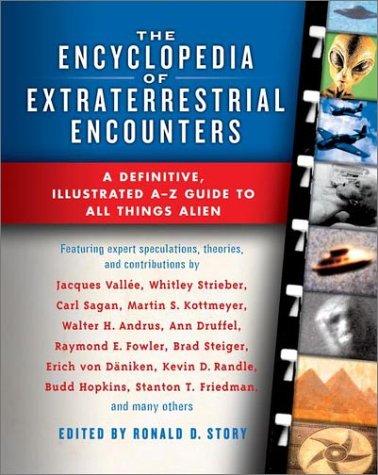
The Encyclopedia of Extraterrestrial Encounters
Find on Amazon →As an Amazon Associate, OverClassified may earn from qualifying purchases made through this link, at no extra cost to you.
Why This Is Essential Reading
The Encyclopedia of Extraterrestrial Encounters earns its place on this list as a genuinely useful, if unevenly rigorous, general reference work — the kind of book this site's own research has independently found valuable across three separate, distinct case files precisely because encyclopedic breadth across many contributors, despite its inherent inconsistency in evidentiary rigor entry to entry, provides comparative context no single-case investigation can supply on its own. Read individual entries with attention to their specific contributor and citation style rather than treating the volume as one uniform voice, and pair it, as this site's own research already does, with Jerome Clark's complementary The UFO Encyclopedia and with deeper single-case sources for any specific claim that matters to your own research.
Related Cases & Theories
Sources Cited
- Story, Ronald D., ed. The Encyclopedia of Extraterrestrial Encounters. NAL Trade, 2001 (ISBN-13 9780451204240). amazon.com
- "The Encyclopedia of Extraterrestrial Encounters." Open Library (bibliographic record: publisher, publish date, cover art). openlibrary.org
- "The Encyclopedia of Extraterrestrial Encounters: A Definitive, Illustrated A-to-Z Compendium." Goodreads (reader ratings and reviews, contributor list). goodreads.com
- "Making Contact (book)." Wikipedia (context on Ronald D. Story's broader editorial bibliography and the field's reference-work tradition). en.wikipedia.org
- This site's own resources library: Full Reading List, where this book is cited across three separate case-file pages.
- This site's own case file: Deception Island Sightings, for this book's cited use situating the case within the 1965 international UFO flap.
- This site's own case file: Daniel Fry / White Sands Contact, for this book's use as comparative reference.
- This site's own case file: Truman Bethurum & the "Captain Aura Rhanes" Contacts, for this book's use as comparative reference.
- This site's own key-figures entry: Ronald D. Story, for his full editorial career and the 1979 ufologist survey.
- This site's own essential reading entry: The Encyclopedia of UFOs, for Story's earlier 1980 reference work.
- This site's own essential reading entry: The Space-Gods Revealed, for Story's earlier rebuttal of contributor Erich von Däniken's ancient-astronaut claims.
- This site's own essential reading entry: The UFO Encyclopedia, for Jerome Clark's complementary general reference work.
Have corrections, additional research, or peer-reviewed sources? Help improve this entry.
Suggest an Edit