
A History of Military Encounters with UFOs
Explanations and Combat Strategies — A Military-History Publisher Takes On the UAP File
Core Thesis
The interesting thing about this book is where it was published. Air World is an imprint of Pen & Sword, a British house whose list is otherwise regimental histories, aircraft monographs and campaign studies, and whose readership is military-history enthusiasts rather than ufologists. In December 2024 it issued Robert Allred's survey of a century of military encounters with unidentified objects — foo fighters, Roswell, the 1952 Washington intercepts, nuclear-weapons-site interference, Rendlesham Forest and the US Navy encounters since 2004 — presented in the register of ordinary military history, with hundreds of sources cited and formerly classified documents among them. The survey is competent and the framing is where it goes wrong. The publisher's description calls the existence of UFOs "an incontrovertible fact," and the subtitle promises combat strategies against something whose nature the book has not established.
About the Author
Robert Allred studied at the University of California, Berkeley, including a summer session at the University of Sussex taking courses in English history and landscape. He lives in the San Francisco Bay Area and keeps a ranch in California.
He is not a ufologist and does not present himself as one. He is a military-history writer with three titles from the same publishing group: American Indians at War, Mysteries of the Norman Conquest, and this volume — a range suggesting a generalist working from documentary sources rather than a specialist in any of the three fields.
That has real advantages and a real cost. The advantage is distance: an author with no institutional position in ufology has nothing to defend and no faction to please, and the book reads that way.
The cost is that the UAP literature has a long history of contaminated sources, and knowing which documents are genuine, which are contested and which are outright fabrications is specialist knowledge. A generalist working from "hundreds of sources" is dependent on the reliability of secondary literature he is not positioned to audit.
The publisher is the more significant credential here. Pen & Sword has been publishing military history since 1990, its Air World imprint covers aviation, and its editorial standards are those of trade military publishing. This is not a self-published UAP title; it is a mainstream military-history house treating the subject as a legitimate topic.
That decision is itself a data point about where the subject sits in 2024, and it is worth registering separately from any judgment about the book's contents.
Historical Context & Origins
The military encounter has been the load-bearing element of the UAP case since the beginning, and its authority has always come from the same place: the witness is a trained operator inside an institution with radar, recorders and a chain of command, so the testimony arrives attached to instruments and paperwork.
The record starts in earnest with the foo fighters of 1944–45 — luminous objects reported by Allied aircrew over Europe and the Pacific, investigated at the time, and never resolved. This site covers them in a dedicated volume.
The postwar decade produced the incidents that still anchor every survey of this kind: Roswell in 1947, the Mantell crash and the Gorman dogfight in 1948, and the Washington intercepts of July 1952, in which radar returns over the capital drew fighters that reported being outrun.
The nuclear thread runs alongside it. Malmstrom in March 1967, where a flight of Minuteman missiles went off alert during a reported sighting, is the case the whole argument rests on, and Robert Hastings's UFOs and Nukes is the standing collection of it.
Rendlesham Forest in December 1980 is the British anchor: USAF personnel from RAF Bentwaters/Woodbridge, a deputy base commander's memorandum, and a tape recording made on the night. This site has three volumes on it, including Halt's own.
The modern phase begins with the Nimitz encounters of November 2004 off San Diego and runs through the 2017 New York Times reporting, the 2021 ODNI preliminary assessment, and the establishment of the All-domain Anomaly Resolution Office. The subject became a defence-policy question rather than a fringe one.
One further piece of context explains why a survey like this can be written at all. Military encounters generate paperwork by default — a scramble order, a radar tape, an incident report, a log entry — and a great deal of that paperwork has become available through the Freedom of Information Act since the 1970s. The documentary base for military UAP claims is genuinely larger and more checkable than for civilian ones, which is why almost every serious book in this field is built on it.
It is also why the field's most damaging errors have been documentary rather than testimonial. The MJ-12 papers, the Aztec crash and a series of purported memoranda were accepted for years on the strength of looking like military records, and untangling them took specialists. That history is the reason a survey's real quality is decided by which documents it declines to use, not by how many it cites.
That is the shift this book is a product of. A Pen & Sword imprint would not have published this in 2010; the terminology change from UFO to UAP, the congressional hearings and the Pentagon office made a military-history treatment commercially and editorially possible.
Core Arguments & Key Concepts
Military encounters span more than a century and every continent. The survey claim, and the book's organising structure. It is broadly defensible and it is what a general reader will get most from.
Different states have read the same phenomenon differently. A genuinely useful comparative point: the Soviet Union, China and the Western democracies developed distinct institutional responses to the same reports, and that divergence is itself evidence about what the reports are being used for.
The documentary base is substantial and partly declassified. The book's strongest ground. There really are hundreds of relevant documents — Project Blue Book files, the Halt memo, FOIA releases, the ODNI assessment — and assembling them in one narrative is a service.
The existence of the phenomenon is incontrovertible. The publisher's phrase, and it needs splitting. That trained personnel have repeatedly reported and recorded objects they could not identify is not seriously disputed. That there exists a single coherent phenomenon behind those reports is a different proposition and is not established by the same evidence.
UFOs have outperformed military aircraft. The kinematic claim, repeated from 1952 to 2004. It rests throughout on estimates of speed and acceleration derived from sensors and observers whose range assumptions are the contested element — and range is the one quantity that has to be right before any of the others mean anything.
Nuclear installations have been a persistent focus. The correlation is real in the report record and the causal reading is not established. Missile fields are also the most heavily instrumented, most closely watched and most rigorously reported airspace in the country, which is a competing explanation for why more is recorded there.
Combat strategies are worth considering. The subtitle's promise and the book's weakest move. Strategy against an adversary requires knowing its capabilities, intentions and constraints. The book's own evidence establishes none of the three, and the concluding turn toward invasion preparedness is speculation in the vocabulary of doctrine.
Key Cases & Evidence Discussed
The foo fighters, 1944–45. Luminous objects reported by Allied aircrew over Europe and the Pacific, investigated during the war and never resolved — the earliest well-documented military encounters.
Roswell, July 1947. The debris recovery near Roswell Army Air Field, the base press release, its retraction, and the Project Mogul explanation offered in the 1990s.
The Washington intercepts, July 1952. Radar returns over the capital on two consecutive weekends, scrambled interceptors, and the atmospheric-inversion explanation offered at the Air Force press conference — the incident that produced the Robertson Panel.
The Gorman dogfight, 1948. A North Dakota Air National Guard pilot's twenty-seven-minute pursuit of a light over Fargo, and the lighted-weather-balloon explanation.
Malmstrom AFB, March 1967. Minuteman missiles going off alert during reported sightings at Malmstrom — the foundation of the nuclear-interference argument.
Rendlesham Forest, December 1980. USAF security police from RAF Bentwaters/Woodbridge, Charles Halt's memorandum to the Ministry of Defence, and the tape recorded in the forest.
The Nimitz encounters, November 2004. David Fravor's intercept off the Nimitz, the FLIR footage, and the sensor-artefact and parallax explanations advanced since.
Comparative national responses. Soviet, Chinese and Western handling of the same class of reports — the book's most distinctive contribution, and the part least well covered elsewhere.
Critical Reception & Controversies
The book is too recent and too far outside academic review to have accumulated substantial critical assessment; the notices it has drawn are from the military-history trade rather than from the UAP literature.
The first thing to say in its favour is that a mainstream military-history imprint publishing it at all is a change worth registering. Pen & Sword's editorial process is not the process of a UFO publisher, and the book reads like military history rather than like advocacy for most of its length.
The overreach is in the framing rather than the narrative, and it is specific. "Incontrovertible fact" collapses two claims that have to stay separate: that trained personnel have repeatedly recorded objects they could not identify — which is true and largely uncontested — and that there is a single phenomenon behind those records, which is exactly what remains unresolved.
The kinematic claims need the caution the book does not consistently supply. Every assertion that an object outran an interceptor or accelerated impossibly depends on an estimate of range, and range is the quantity that observers and sensors get wrong. The 2004 Navy footage has been the subject of detailed parallax and sensor-artefact analyses that turn on precisely this, and any survey repeating the kinematics without the caveat is passing on an unexamined inference.
The generalist's dependence on secondary sources is the structural risk. This literature contains documents that are genuine, documents that are contested, and documents that are known fabrications, and telling them apart is specialist work. Citing hundreds of sources is only a virtue if the sources have been triaged, and a reader has no way to check that from the citations alone.
The concluding turn is where a sympathetic reader will part company. Moving from a survey of unresolved reports to combat strategy and invasion preparedness requires assumptions about capability and intent that nothing in the preceding chapters supports. It is speculation, and putting it in doctrinal vocabulary does not change that.
A word on the limits of this assessment. Everything above is drawn from the publisher's own description, the imprint's editorial context and the cases the book advertises covering; this article has not audited the volume's citations against the primary record, and a reader who wants to know how the MJ-12 papers or the Aztec material are handled will have to check the endnotes. The test to apply is simple and worth stating for any survey of this kind: look at what the author declines to use. A century of military encounters can be narrated honestly, but only by an author willing to leave out the documents that would make the story better.
The fair summary is that this is a decent general survey with a framing problem. A reader wanting the military record with the sourcing rigour this subject needs should go to Fawcett and Greenwood, Need to Know and UFOs and Nukes, all of which work closer to the documents.
Influence & Legacy
The book's significance is mostly as an artefact of its moment. In 2024, after the congressional hearings and the establishment of a Pentagon office, a mainstream military-history publisher could put a UAP survey on its list beside squadron histories, and that would not have happened fifteen years earlier.
It also marks the arrival of the general military-history reader as an audience for this material. That reader comes with different habits from the ufology audience — more comfortable with archives and orders of battle, less practised at the specific source-criticism this subject demands — and books written for that reader will need to supply the triage that specialists do for themselves.
The comparative-national material is the part most worth developing. How the Soviet, Chinese and Western military systems each processed the same class of reports is genuinely under-covered, and it is a question that can be researched in ordinary archival terms rather than by adjudicating any individual sighting.
The lasting caution is about what happens when a subject becomes respectable. The framing that got this book onto a military-history list — incontrovertible fact, combat strategies, invasion preparedness — is exactly the framing that outruns the evidence, and it is being adopted precisely because the institutional caution that used to surround the subject has relaxed. Respectability is not the same as resolution, and a survey that assumes an adversary before establishing there is one has skipped the step everything else depends on.
The Book
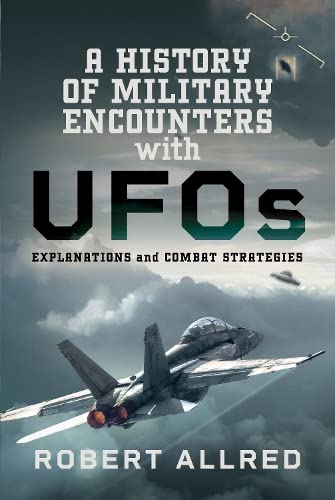
A History of Military Encounters with UFOs
Explanations and Combat Strategies — A Military-History Publisher Takes On the UAP File
Find on Amazon →As an Amazon Associate, OverClassified may earn from qualifying purchases made through this link, at no extra cost to you.
Why This Is Essential Reading
Read it as a general survey and read past the subtitle. Robert Allred has assembled a century of military UAP encounters — foo fighters, Roswell, the 1952 Washington intercepts, Malmstrom, Rendlesham, Nimitz — into a competent narrative for a general military-history readership, and the fact that a Pen & Sword imprint published it is itself part of the story of where this subject arrived in 2024. Two things need holding at arm's length. "Incontrovertible fact" runs together the uncontested claim (trained personnel have repeatedly recorded things they could not identify) with the unresolved one (that there is a single phenomenon behind those records). And the promised combat strategies require knowing an adversary's capabilities and intentions, which the book's own evidence does not establish — the concluding turn toward invasion preparedness is speculation in doctrinal clothing. For the same record worked closer to the documents, go to Clear Intent, Need to Know and UFOs and Nukes.
Related Cases & Theories
Sources Cited
- Allred, Robert. A History of Military Encounters with UFOs: Explanations and Combat Strategies. Air World (Pen & Sword Books), 30 December 2024, 280 pp. ISBN-10 1399063766 / ISBN-13 9781399063760. amazon.com
- Casemate Publishers product page — the Air World imprint, December 2024, 280 pages, 6.1 × 9.2 in., 15 colour photographs, 1 monochrome photograph and 8 maps, $39.95 hardcover, and the publisher's description covering foo fighters, Roswell, the 1952 Washington sightings, nuclear interference, Rendlesham and the post-2004 Navy encounters, with "hundreds of sources cited, including formerly classified documents." casematepublishers.com
- Casemate Publishers author page, Robert Allred — his Berkeley and Sussex studies, his residence in the San Francisco Bay Area, and his three titles: American Indians at War, this volume, and Mysteries of the Norman Conquest. casematepublishers.com
- Google Play Books listing — the ebook edition at 248 pages, and the description stating that USAF jets attempting to intercept in 1952 "were outrun by the UFOs," that the evidence makes UFO existence "an incontrovertible fact," and that the book closes on US preparations for a potential invasion scenario. play.google.com
- AbeBooks catalogue record, ISBN 9781399063760 — independent bibliographic listing and cover-art source. abebooks.com
- ThriftBooks catalogue record — independent listing of the title. thriftbooks.com
- OverDrive library catalogue record — evidence of public library distribution of the digital edition. overdrive.com
- Wikipedia, "Foo fighter" — the 1944–45 aircrew reports over Europe and the Pacific and their wartime investigation. en.wikipedia.org
- Wikipedia, "1952 Washington, D.C. UFO incident" — the July 1952 radar returns, the scrambled interceptors, the Air Force press conference and the temperature-inversion explanation. en.wikipedia.org
- Wikipedia, "Rendlesham Forest incident" — the December 1980 encounters at RAF Woodbridge and Bentwaters, the Halt memorandum and the recorded tape. en.wikipedia.org
- Wikipedia, "USS Nimitz UFO incident" — the November 2004 encounters off San Diego, the FLIR footage and the sensor and parallax analyses advanced since. en.wikipedia.org
- Wikipedia, "Unidentified anomalous phenomena" — the terminology shift from UFO to UAP and its institutional context. en.wikipedia.org
- Wikipedia, "All-domain Anomaly Resolution Office" — the Department of Defense office whose establishment made a mainstream military-history treatment of this subject commercially possible. en.wikipedia.org
- Wikipedia, "Pen and Sword Books" — the British military-history publisher whose Air World imprint issued the volume. en.wikipedia.org
- Wikipedia, "Robertson Panel" — the CIA-convened panel that followed directly from the 1952 Washington incident and set US policy on UFO reporting for a decade. en.wikipedia.org
Have corrections, additional research, or peer-reviewed sources? Help improve this entry.
Suggest an Edit