
UFOs Before Roswell
European Foo-Fighters 1940–1945
Core Thesis
UFOs Before Roswell: European Foo-Fighters 1940–1945 is Graeme Rendall's book-length investigation of the "foo fighter" phenomenon — the glowing, maneuvering lights Allied night-fighter aircrews reported pacing their planes over Europe in the war's final year, a case this site covers in full at The Foo Fighters (WWII Aerial Phenomena). Rendall's central, carefully sourced argument runs directly against decades of "accepted wisdom": that the phenomenon did not begin in November 1944 with the U.S. Army Air Force's 415th Night Fighter Squadron, as a December 1945 magazine article claimed and every UFO book since the 1950s has repeated, but years earlier, with less rigorously documented reports among RAF Bomber Command aircrew over Germany and Italy. Reviewer Nigel Watson, writing for the long-running UFO journal Magonia, called it "easily the most comprehensive and exhaustively researched book about foo-fighters" — a judgment this article's Critical Reception section below treats as well-earned for the book's aviation-technology research specifically, while noting the same review's own substantive criticisms of what the book leaves out. The book carries a foreword by Sean Cahill, a retired U.S. Navy Chief Master-at-Arms who served aboard the USS Princeton during the November 2004 "Tic Tac" encounter alongside the carrier strike group built around the USS Nimitz — a deliberate framing choice linking WWII's earliest large-scale military UAP wave to the best-documented modern one.
About the Author
Graeme Rendall is a British UFO historian whose research specializes in archival, document-driven reconstruction of specific historical UFO episodes rather than broad interpretive theorizing. Beyond this book, his other published research covers the 1954 French UFO wave and Cold War-era aircrew intercept-and-identification reports, a consistent methodological throughline: primary military and press records first, interpretation second.
UFOs Before Roswell's foreword author, Sean Cahill, brings a different kind of authority to the book: he is a named, on-the-record participant in one of the best-documented modern military UAP encounters, the November 2004 "Tic Tac" incident involving the USS Nimitz carrier strike group, in which he served as Chief Master-at-Arms aboard the USS Princeton. Cahill has since become a public advocate for UAP transparency, appearing in the History Channel documentary series Unidentified: Inside America's UFO Investigation and working alongside former AATIP director Luis Elizondo. His foreword situates Rendall's WWII-era research as the documented origin point of a continuous eighty-year military pattern rather than an isolated historical curiosity.
Rendall's approach in this book leans heavily on primary wartime and immediate postwar sources: squadron records, contemporaneous press coverage (including the specific December 1945 magazine article he identifies as the actual source of the mistaken "it started in November 1944" consensus), and detailed technical knowledge of the German aircraft (the Me 163 Komet rocket interceptor and Me 262 jet fighter) that postwar "secret weapon" theorists have repeatedly proposed as the real explanation.
Historical Context & Origins
The book directly engages the specific historical case this site covers at The Foo Fighters (WWII Aerial Phenomena) (Case File #160, Credible): beginning in late November 1944, radar-equipped Beaufighter crews of the 415th Night Fighter Squadron, flying out of an airfield near Dijon, France, reported fast, glowing lights pacing their aircraft through evasive maneuvers over the Rhine Valley. That case file itself already notes, more briefly than Rendall's book-length treatment, that "scattered, less systematically documented reports of unexplained lights pacing aircraft had reportedly circulated among RAF Bomber Command crews over the Ruhr Valley and among Allied pilots in North Africa as early as 1942 and 1943" — the exact earlier pattern Rendall's research develops in far greater depth, tracing specific RAF and Italian-theater incidents this site's own shorter case-file treatment references only as general context.
The book arrives into a decades-long historiographical problem Rendall identifies precisely: that the "foo fighters began in November 1944" claim traces to a single December 1945 magazine article, subsequently copied uncritically by UFO book after UFO book from the 1950s onward without anyone tracing the claim back to its actual, and incomplete, original source — a specific, documented case of secondhand ufological "common knowledge" outrunning the primary record, comparable in kind (though different in scale and stakes) to this site's own repeated emphasis, elsewhere in its case-file research, on tracing claims back to primary sources rather than relying on repeated secondary summaries.
Rendall's research also engages directly with the postwar "secret Nazi weapon" theory that first surfaced in a December 13, 1944 SHAEF press statement (documented in this site's own case file) and has recurred in UFO and fringe-history literature ever since, including in Renato Vesco and David Hatcher Childress's Man-Made UFOs 1944–1994, cited on the same case file's Further Reading list. Where Vesco and Childress lend that theory credence, Rendall's book takes the opposite position, arguing the theory fails on basic technical grounds.
Core Arguments & Key Concepts
Rendall's central chronological argument is that the foo fighter phenomenon predates its commonly cited November 1944 origin by roughly two years, based on less centrally catalogued but real RAF Bomber Command reports over the Ruhr Valley and Allied pilot reports in the North African and Italian theaters from 1942–43 — sightings that were never formally investigated or named at the time but that Rendall's archival research connects to the same underlying phenomenon later formalized by the 415th Night Fighter Squadron's more famous, better-documented reports.
The book's second major argument, per Magonia reviewer Nigel Watson, is a systematic technical demolition of the "secret German weapon" theory: Rendall demonstrates that Allied aircrews frequently misidentified conventional German aircraft, including the Me 163 Komet rocket interceptor and Me 262 jet fighter, and that both aircraft types "never operated at night" in the manner described in many foo-fighter reports or appeared in locations inconsistent with their actual wartime deployment — a direct, technically grounded rebuttal to any theory requiring foo fighters to be misidentified German hardware. Rendall extends this into a broader critique of postwar engineers' claims about advanced Nazi flying-saucer projects, which Watson's review paraphrases as "full of fantastic claims with no substance."
A third argument, drawing on physiologist Jeffrey Lindell's research (as summarized in the Magonia review), considers whether at least some foo-fighter reports resulted from perceptual and vestibular effects specific to high-stress, high-altitude night flying — "conflicting sensory information which can lead to both visually and perceptually induced vertigo syndromes" — a mundane-but-not-dismissive explanation this site's own case file independently arrives at from a different angle, citing a February 1945 U.S. Navy investigation into "the degree of visual hallucinations experienced by aviators operating at night" launched in direct response to reports like the 415th's.
Ultimately, per Watson's review, Rendall does not commit to a single definitive explanation across all reported incidents; instead he tentatively situates the strongest, most behaviorally anomalous sightings within the framework of Luis Elizondo's "five observables" for modern UAP analysis — the same five-observables framework this site applies to every case file in its own catalogue, including its own foo-fighters case, where instrument-corroborated, multi-minute pursuit behavior tracking an aircraft's own evasive turns is flagged as the specific detail no known 1944-vintage atmospheric or psychological effect fully explains.
Key Cases & Evidence Discussed
This site's own The Foo Fighters (WWII Aerial Phenomena) (Case File #160, November 1944 – August 1945, Credible) is this book's central and only subject; the case file's own Quick Stats, Timeline, and named witnesses — pilot Lt. Edward Schlueter, radar operator Lt. Donald J. Meiers, intelligence officer Lt. Fred B. Ringwald, and Lt. Samuel A. Krasney's wingless cigar-shaped-object report — are all incidents Rendall's more extensive research situates within the fuller two-to-three-year timeline his book argues for, rather than treating November 1944 as the phenomenon's true starting point.
This site's own case file also independently documents the Pacific-theater dimension of the same phenomenon — XX and XXI Bomber Command B-29 crews logging an estimated 300-plus "ball of fire" sightings from more than 140 individual crew members — a body of reports outside Rendall's specifically European-theater title scope but part of the same wartime phenomenon his book's introduction situates in broader context.
The book's discussion of the December 13, 1944 SHAEF press statement raising the possibility of a "new German weapon" — the moment that triggered the first public wave of alarm, per this site's own case-file timeline — is a case Rendall's technical rebuttal directly targets, tracing exactly which specific German aircraft postwar theorists have proposed and demonstrating, aircraft type by aircraft type, why each proposed candidate fails to match the reported behavior or wartime deployment record.
Critical Reception & Controversies
The book's single substantive professional review identified for this article comes from Nigel Watson at Magonia (February 2022), a respected, decades-old British UFO-research journal known for skeptically-minded but genuinely engaged case analysis. Watson's assessment is strongly positive on research depth — "easily the most comprehensive and exhaustively researched book about foo-fighters" — but identifies two specific, substantive limitations: prime witnesses were never tracked down and interviewed while their memories were fresh (and are now, decades later, virtually all deceased, a limitation of timing rather than of Rendall's own effort), and the book omits deeper psychological and sociological analysis of the phenomenon, with Watson writing plainly, "It is a shame this book does not go into the psychology or even sociological aspects."
Reader response on Amazon is strongly positive (4.7 out of 5 stars across 72 ratings at time of research), though at least one reader review flagged a structural readability issue: extensively researched supporting material that, in the reviewer's view, would have been better placed in endnotes was instead left in the main text, and the same review noted the book reads, in places, more like a general history of WWII European aviation than a UFO-specific study — a fair characterization of a book whose actual method is aviation-history research applied to a UFO question, rather than UFO-genre writing applied to aviation history.
Set against the book it directly rebuts on the same case file's own Further Reading list, Man-Made UFOs 1944–1994, Rendall's technical demolition of the secret-German-weapon theory represents the more rigorously sourced and more skeptically defensible position of the two: Vesco and Childress's engineering claims about advanced Nazi flying-saucer programs are, per Rendall's own research, unsupported by the documented wartime deployment and performance record of the actual aircraft postwar theorists have proposed as candidates.
This site's own independent case-file research on the same topic reaches a broadly compatible conclusion from a different angle — treating perceptual/psychological effects under wartime flight stress and unexplained atmospheric phenomena as the leading, though individually incomplete, conventional explanations, while declining (as Rendall's book itself ultimately does) to declare the case definitively solved given the specific instrument-corroborated pursuit behavior neither explanation fully accounts for.
Influence & Legacy
The book's most significant documented contribution to the historical record is chronological: by tracing the "November 1944 origin" claim back to its actual 1945 magazine-article source and demonstrating it was uncritically repeated by UFO literature for over seven decades without independent verification, Rendall's research corrects a specific, traceable factual error embedded across a large swath of the field's own secondary literature — the kind of primary-source correction this site's own sourcing standards treat as especially valuable precisely because it is rare and independently checkable, rather than one more restatement of an unverified claim.
Sean Cahill's foreword functions as a deliberate bridge connecting this book to the modern UAP disclosure movement: by lending his name and his own on-the-record status as a 2004 USS Nimitz "Tic Tac" encounter witness to a book about 1940s military sightings, Cahill frames Rendall's WWII-era research as the documented opening chapter of a continuous eighty-year pattern of unresolved military aerial encounters, rather than an isolated historical footnote — the same continuity this site's own catalogue of case files, spanning from the foo fighters through Nimitz to more recent Navy encounters, is independently organized to demonstrate.
On this site specifically, this book is cited directly on the Foo Fighters case file's own Further Reading list as "the most detailed dedicated study of the European foo fighter wave," a description this article's own research confirms is accurate relative to the broader available literature on the topic.
The Book
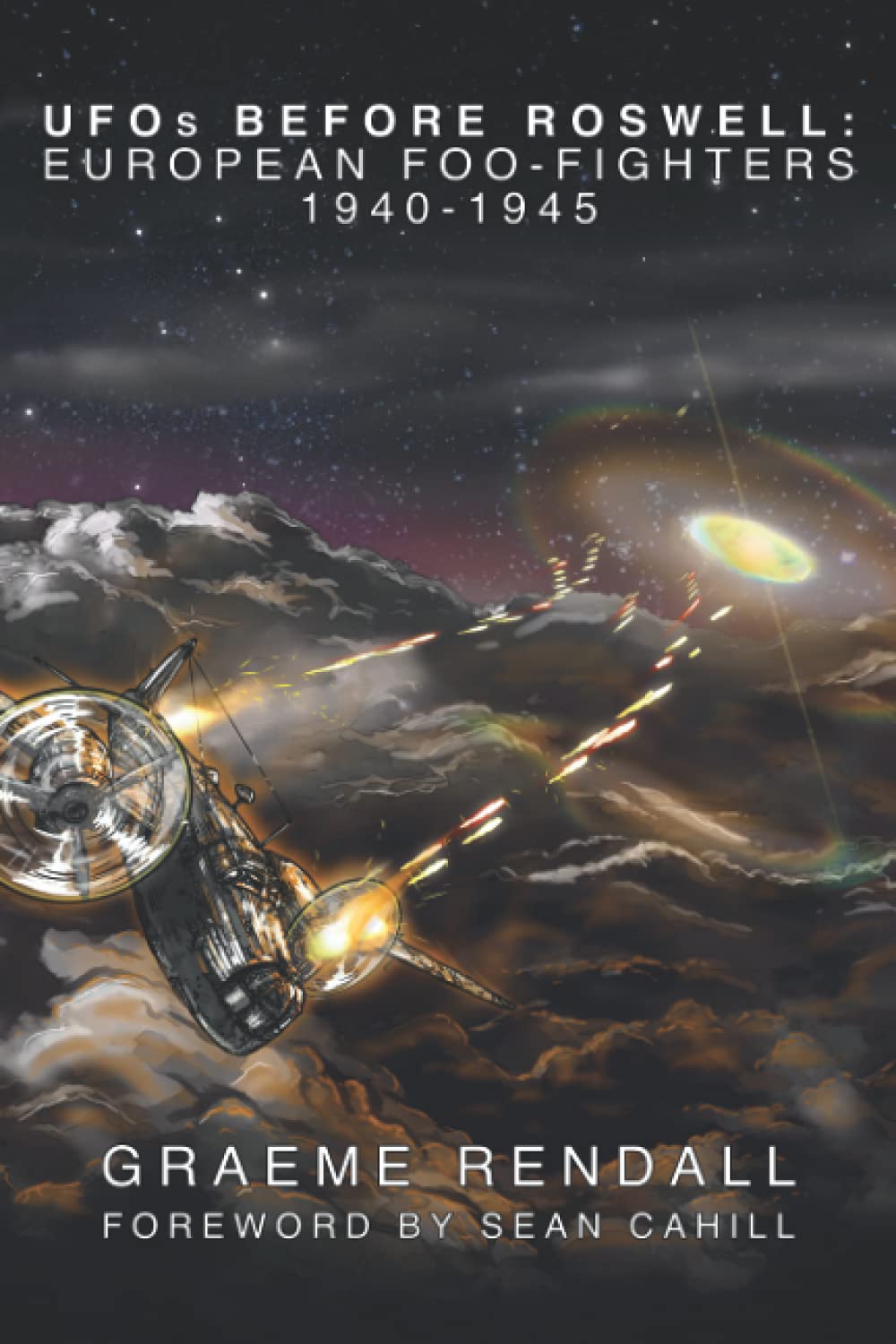
As an Amazon Associate, OverClassified may earn from qualifying purchases made through this link, at no extra cost to you.
Why This Is Essential Reading
UFOs Before Roswell earns its place on this list as the single most thoroughly researched dedicated study of the WWII foo-fighter phenomenon available — a book that corrects a decades-old, uncritically repeated factual error about the phenomenon's true starting date, and that dismantles the "secret Nazi weapon" theory on real technical grounds rather than by assertion. Read alongside this site's own Foo Fighters case file for the fullest available account of the earliest large-scale, multiply-witnessed, officially investigated UAP wave in modern military history, and alongside Sean Cahill's own foreword for the deliberate, credible thread it draws from the 415th Night Fighter Squadron's 1944 reports to the flight deck of the USS Nimitz sixty years later. Its own reviewers' fair criticism — that it treats the phenomenon more as an aviation-history puzzle than a psychological or sociological one — is worth keeping in mind, but does not undercut the real, traceable historical correction the book's research provides.
Related Cases & Theories
Sources Cited
- Rendall, Graeme. UFOs Before Roswell: European Foo-Fighters 1940–1945. Foreword by Sean Cahill. Independently published, 2022 (ISBN-13 9798464991583). amazon.com
- Watson, Nigel. "Tracking the Foo Fighters." Magonia Review of Books (pelicanist.blogspot.com), February 2022. pelicanist.blogspot.com
- "UFOs Before Roswell: European Foo-Fighters 1940-1945." Goodreads (reader ratings and reviews). goodreads.com
- "Sean Cahill." Coffee or Die Magazine / History.com (biography: USS Princeton, 2004 Nimitz Tic Tac encounter, Unidentified documentary series). coffeeordie.com
- "Foo fighter." Wikipedia (general phenomenon overview, terminology origin, wartime press coverage). en.wikipedia.org
- "UFOs Before Roswell: European Foo-Fighters 1940-1945." Amazon.com (product listing, 4.7/5 across 72 ratings at time of research). amazon.com
- "415th Night Fighter Squadron." American Air Museum in Britain / Imperial War Museums (unit history: activation, Mediterranean and European theater service, Beaufighter and P-61 operations). americanarchive.iwm.org.uk
- This site's own resources library: Full Reading List, where this book is cited on the Foo Fighters case file's own Further Reading list.
- This site's own case file: The Foo Fighters (WWII Aerial Phenomena), for the full documented case this book investigates.
- This site's own case file: USS Nimitz / Tic Tac Encounter, for the 2004 encounter connected to this book via Sean Cahill's foreword.
- This site's own key-figures entry: Graeme Rendall, for his other published UFO-history research.
- This site's own essential reading entry: Man-Made UFOs 1944–1994, for the opposing secret-weapon theory this book's research rebuts.
Have corrections, additional research, or peer-reviewed sources? Help improve this entry.
Suggest an Edit