
The French UFO Wave of 1954
Core Thesis
The French UFO Wave of 1954 is Graeme Rendall's dedicated 2024 study of what its own back-cover framing describes as the first major UFO "wave" reported outside the United States since the modern era began with Kenneth Arnold's 1947 sighting. Compiled from contemporary French newspaper accounts across roughly 318 pages, the book documents the autumn 1954 flap's central cases — landed craft, humanoid occupants, witness paralysis, and vehicle-interference reports — with the explicit goal, per the author's own stated purpose, of making an important but historically under-translated chapter of ufology accessible to English-speaking readers for the first time in this level of detail. This site's own research draws on the book for two structurally distinct French cases: the Marius Dewilde Sighting at Quarouble, the case this site's own research identifies as the wave's opening incident, and the Oloron-Sainte-Marie & Gaillac Angel Hair Sighting of October 1952, which the book situates as a two-years-earlier precursor to the much larger 1954 flap it primarily documents.
About the Author
Graeme Rendall is a British UFO historian who, prior to this book, had already written four books focused specifically on pilot and aircrew UFO encounters, plus a dedicated study of the World War II-era "Foo Fighter" phenomenon — the mysterious lights and objects reported by Allied and Axis aircrews during the war, widely regarded as an important historical precursor to the postwar "flying saucer" era this site's own research has documented across multiple case files. That specialization in aviation-related UFO history gives Rendall a genuinely distinctive research lens: several of the 1954 French wave's most evidentially significant cases, discussed below, involve exactly the kind of vehicle-interference and aircrew-adjacent reports his earlier books already prepared him to evaluate with informed technical scrutiny rather than general journalistic interest alone.
Rendall's stated motivation for this specific book, per his own author's note, was to correct a genuine gap in the English-language UFO literature: despite being, by most researchers' assessment, one of the largest and most intensively documented national UFO waves anywhere in the world, the 1954 French flap had never received a full English-language treatment built specifically from contemporary French newspaper sourcing rather than secondary summary or translation. That gap is a real one this site's own research independently confirms — the wave's two most influential French-language interpreters, Aimé Michel and Jacques Vallée, wrote extensively about it, but Michel's own English translation, The Truth About Flying Saucers (Criterion Books, 1956), predates this book by nearly seventy years and reflects Michel's own theoretical framework (his controversial "orthoteny" alignment theory) rather than a neutral newspaper-sourced chronicle.
The book followed close on the heels of Rendall's own subsequent 2024 work, Intercept & Identify: Aerial UFO Encounters 1953-1954, co-credited with researchers Pricilla Stone and Sean Raasch, extending his specific interest in the 1953-54 period into a broader, multi-author examination of aircrew-reported encounters beyond France alone. Read together, the two books suggest a sustained, multi-year research project rather than a single standalone volume, with this book on the specifically French wave serving as the deeper, single-country case study within that broader project, and the collaborative later volume suggesting Rendall's own research network within the field had grown substantially between the two publications.
Historical Context & Origins
The autumn 1954 French wave did not erupt from nothing. This site's own Oloron-Sainte-Marie & Gaillac case file documents a genuinely striking near-precursor exactly two years earlier: on October 17, 1952, schoolteacher Yves Prigent and dozens of neighbors in the Pyrenean town of Oloron-Sainte-Marie watched a tilted white cylinder trailing some thirty small red spheres cross the sky, followed by a cotton-like "angel hair" fiber drifting down over the town before dissolving into a gelatinous residue within hours — a sequence that repeated almost identically ten days later, 230 miles away, at Gaillac. That 1952 sighting predates France's later GEPAN/GEIPAN scientific investigation office (founded 1977) by a quarter-century and was handled, like the 1954 wave that followed it, only informally through local gendarmerie statements and newspaper coverage — precisely the kind of scattered, print-media-only documentary record Rendall's book was specifically built to gather and organize.
The wave's own opening case, per this site's own Marius Dewilde case file, occurred in a specific and significant setting: the commune of Quarouble sat directly on a rail line serving the dense coal-mining and heavy-industry belt of France's Nord department along the Franco-Belgian border, barely a kilometer and a half from a smugglers' path connecting to the Belgian customs post at Quiévrain. France in September 1954 had no dedicated UFO investigative body of any kind — that would not arrive until CNES founded GEPAN in 1977, twenty-three years later — meaning the entire wave the book documents was investigated, in real time, only by ordinary gendarmerie, regional air police, and, in Dewilde's specific case, agents of the DST, France's domestic counter-intelligence service, who arrived within roughly eighteen hours to measure five deep, symmetrical marks pressed into the wooden rail sleepers beside Dewilde's cottage.
The broader Cold War and post-occupation context of 1954 France also shaped how seriously such reports were taken at an institutional level. France was, in the autumn of 1954, still less than a decade removed from the German occupation and roughly midway through the Indochina War, which had ended in French defeat at Dien Bien Phu that May — a period of genuine national anxiety about security, infiltration, and unexplained aerial activity near sensitive industrial and border regions, exactly the environment in which a landed object near a rail line running to a Belgian border crossing would draw immediate and serious attention from a domestic intelligence service rather than being dismissed as a curiosity.
This site's own essential-reading library already documents the broader institutional history of French UFO investigation, both before and after the state finally established a dedicated scientific office to study it, across several other titles — including Les OVNI et la défense (the 1999 COMETA Report) and Forbidden Science 2, Jacques Vallée's own journals covering GEPAN's 1977 founding era — giving readers a continuous documentary line from this book's pre-institutional 1954 wave through to France's eventual formal, scientifically staffed UAP investigation office more than two decades later.
Core Arguments & Key Concepts
The book's central argument, reflected in its own explicit framing as the first major non-American UFO wave of the modern era, is one of comparative scale and international significance: rather than treating 1954 France as a peripheral European footnote to the American-dominated UFO canon, Rendall's newspaper-sourced compilation argues the wave deserves recognition as a genuinely foundational event in the phenomenon's global history, on a comparable evidentiary and cultural scale to the American waves that preceded it.
A second theme, consistent with Rendall's specialized background in pilot and aircrew UFO literature, is that vehicle-interference and physical-trace reports deserve close, technically informed scrutiny rather than blanket skeptical dismissal or credulous acceptance — this site's own Marius Dewilde case file reflects exactly that kind of careful evidentiary weighing, noting that railway engineers estimated roughly 30 tons of force behind the rail-sleeper marks investigators measured within a day of the sighting, a genuinely hard physical data point independent of Dewilde's own testimony.
A third theme is source discipline: by building the book specifically from contemporary newspaper accounts rather than later retrospective retellings, Rendall's methodology privileges reporting made close to the actual events, before decades of retelling, embellishment, and researcher interpretation had time to reshape the record — a distinction this site's own case file treats as evidentially significant in Dewilde's case specifically, where the witness's own account visibly grew more elaborate across four subsequent decades, adding a locked metal box, alleged government harassment, and other dramatic new elements entirely absent from the original 1954 press coverage.
A fourth theme, implicit in the book's inclusion of angel-hair-adjacent and vehicle-stalling reports alongside more dramatic landed-craft cases, is that a genuine national wave encompasses a wide spectrum of report types rather than only its most sensational entries — treating the full breadth of 1954's documented incidents, not merely its two or three most famous cases, as the actual subject deserving comprehensive study.
A fifth theme, reflecting the book's own comparative framing against the American wave tradition, is that national UFO waves are best understood through their own specific local institutional, political, and press-environment context rather than treated as interchangeable instances of one universal phenomenon — the French state's complete absence of any dedicated investigative body in 1954, discussed above, meant the wave was documented and interpreted almost entirely through the press and informal local-police channels the book draws its primary sourcing from, a genuinely different evidentiary structure than the American waves the field's popular literature more often centers.
A sixth theme, visible in the book's inclusion of the 1952 Oloron and Gaillac precursor alongside its primary 1954 subject, is continuity across France's own pre-institutional UFO history: rather than treating 1954 as a singular, unprecedented eruption, the book's comparative framing implicitly argues that French sighting activity followed a recognizable, recurring pattern across the early 1950s, with each successive incident building public familiarity with the specific vocabulary and visual grammar — discs, cylinders, beams, falling fiber — that later, larger waves would draw on and amplify.
Key Cases & Evidence Discussed
The Marius Dewilde Sighting (September 10, 1954, with a second encounter October 10) occurred beside the railway line at Quarouble, Nord, France, roughly two kilometers from the Belgian border. Metalworker Marius Dewilde, investigating his dog's frantic barking, found a dark, silent, saucer-like mass resting directly on the tracks near his garden fence, with two small humanoid figures moving near it; closing to within a few meters, he was struck by a blinding beam from a square opening in the object's side and found himself paralyzed while the figures re-boarded and the craft lifted away in near silence. This site's own case file documents that gendarmerie, French air police, and DST counter-intelligence agents were on site within roughly eighteen hours, measuring five deep, symmetrical marks pressed into the wooden rail sleepers, later estimated by railway engineers to have required approximately 30 tons of force — a hard physical data point independent of Dewilde's own testimony. The case exploded into French and then world press, most famously via a dramatic October 14, 1954 feature in the Paris weekly Samedi-Soir, and became, per this site's own research, the opening case of the autumn wave that researcher Aimé Michel would spend the rest of his life studying, developing his controversial "orthoteny" theory of geometrically aligned sightings from the same weeks of reports Quarouble helped set in motion. This site's own resources library cites this book directly as situating "Quarouble as the case that opened the country's largest documented national UFO wave" — precisely the framing role Rendall's newspaper-sourced compilation was built to provide. The case's own documentary record deepened a month later: on October 10, 1954, Dewilde's young son alerted him to "a car on the railway," and Dewilde found a different, lenticular, porthole-studded disc on the same stretch of track, this time reporting seven small humanoid figures — one of whom gestured toward the child and led away a hen before the group re-boarded and departed. This site's own case file treats the shift in register between the two encounters as evidentially significant: the September 10 account is tense and frightening, while the October 10 sequel introduces an almost fable-like quality entirely absent from the original report, a pattern later reinforced by Dewilde's own 1980 memoir, Ne résistez pas aux extra-terrestres! Le contacté de Quarouble, 26 ans après, co-written with journalist Roger-Luc Mary, which added still further dramatic detail — including a locked metal box and claims of government harassment — that appears nowhere in the contemporary 1954 press coverage this book is specifically built to preserve and prioritize. Regional and national newspapers, including La Voix du Nord, Nord-Éclair, Le Figaro, France-Soir, and L'Aurore, carried the first reports within a day, with L'Aurore notably publishing a skeptical piece citing Dewilde's own documented prior head injury and floating a "waking hallucination" explanation — exactly the kind of contemporaneous skeptical counter-reporting Rendall's newspaper-sourced methodology preserves alongside the more sensational coverage. Researcher Aimé Michel would go on to plot Quarouble as a data point in the broader wave in his 1958 book Mystérieux Objets Célestes (translated into English as Flying Saucers and the Straight-Line Mystery), developing his "orthoteny" theory from clusters of reports including the separate "Bayonne-Vichy" (BAVIC) line of six sightings plotted from a single day, September 24, 1954, two weeks after Quarouble itself.
The Oloron-Sainte-Marie & Gaillac Angel Hair Sighting (October 17 and 27, 1952) unfolded first at Oloron-Sainte-Marie, a small Pyrenean town where schoolteacher Yves Prigent and dozens of neighbors watched a huge white cylinder tilted at roughly 45 degrees, trailing some thirty small red spheres each ringed in yellow, cross a nearly cloudless sky, followed by a white, cotton-like fiber drifting down over rooftops and telephone wires before dissolving into a gelatinous residue within hours. Ten days later, at Gaillac, 230 miles away, Mme Doré and her neighbors watched an almost identical sequence — luminous discs, a smoking cylinder, and the same descending fiber. This site's own case file notes that a local doctor soon offered a natural explanation grounded in real, seasonally documented spider "ballooning" migration, which accounts for the falling fiber itself more convincingly than for the elaborate aerial objects described overhead — an evidentiary split this site's own analysis treats as genuinely unresolved rather than fully explained by either the mundane or anomalous reading alone. This site's own resources library cites this book, occurring two years before the wave it primarily documents, as "a detailed, contemporary-newspaper-sourced study of the wave that followed Oloron and Gaillac by two years, including the 'angel hair' reports and vehicle-interference claims of that later, much larger flap" — using the earlier 1952 case as essential comparative context for the pattern that would recur, at far greater national scale, in 1954. This site's own case file notes that "angel hair" itself long predates 1952 as a French folk term — gossamer strands of spider silk drifting down over fields each autumn had already acquired the names cheveux d'ange ("angel hair") and fils de la Vierge ("threads of the Virgin") in French rural harvest-season folklore well before the flying-saucer era began. What Oloron and, ten days later, Gaillac did, per this site's own analysis, was fuse that pre-existing natural phenomenon with the new cultural vocabulary Kenneth Arnold's 1947 sighting had introduced barely five years earlier, producing a specific, recurring pattern — luminous aerial objects followed by a falling fiber that gelatinizes and vanishes — that would go on to be reported, with variations, in dozens of later cases worldwide, most famously the 1954 Florence, Italy stadium sighting this site's own case files also document. At Gaillac specifically, this site's own timeline records that Mme Doré was first alerted by her own chickens' agitation before she, her son, and neighbors the Corbières family watched luminous discs — initially four, then roughly a dozen, rotating in pairs alongside a long, whitish flying cylinder emitting a plume of white smoke — a level of named-witness, multi-household corroboration the contemporary newspaper Le Méridional reported in detail on October 29, 1952, explicitly noting its similarity to the previous week's Oloron reports.
Critical Reception & Controversies
This book's public review record is genuinely thin and, where present, difficult to interpret: this site's research located a single rating on Goodreads (checked August 2026), a solitary one-star score with no accompanying written review explaining the rating. This site's editorial practice is to disclose that finding honestly rather than either suppressing an unfavorable data point or over-interpreting a single, unexplained rating as a meaningful critical consensus — with a sample size of one and no review text, this rating could reflect a genuine quality assessment, an unrelated grievance, a mis-click, or any number of other explanations this site's research has no way to distinguish between.
This site's research attempted to verify a broader Amazon rating for this title but Amazon's bot-detection system repeatedly blocked automated requests to the listing during this session, returning a CAPTCHA challenge across multiple attempts, the same pattern this site's research has now encountered for essentially every Amazon listing checked throughout this session's book coverage. Per this site's own Amazon Rating Display Protocol, this gap is disclosed honestly here rather than fabricated or silently omitted.
In the absence of a substantive public review record, this site's own evaluation rests on what can be independently verified: the specificity and accuracy of the book's citation, per this site's own resources library, across two structurally distinct French cases spanning a genuine two-year gap in the underlying sighting record, and Rendall's own independently verifiable prior publication history across five earlier UFO-history titles focused specifically on aviation-related encounters. Neither substitutes for an established critical consensus, but together they represent the most substantive evidence currently available for assessing a 2024 independently published title with minimal third-party review coverage.
It is also worth noting, as a point of honest methodological context rather than criticism, that a book built specifically from contemporary French-language newspaper sourcing presents an unusual verification challenge for an English-speaking site's own research: this site's own case files for both Quarouble and Oloron/Gaillac independently corroborate the specific named newspapers, publication dates, and witness details this book's own subject matter would necessarily draw on, giving this site's research reasonable confidence in the underlying source record even without direct access to review the book's own French-to-English translation choices line by line.
Influence & Legacy
As a genuinely recent 2024 publication, this book is too new to have an established multi-year influence record of the kind older titles in this site's essential-reading library possess. Its most concrete, currently verifiable contribution is instead the specific documentary gap it fills: this site's own research independently confirms that a full English-language, contemporary-newspaper-sourced treatment of the 1954 French wave specifically — as opposed to Aimé Michel's older, theory-driven 1956 translation or scattered individual case summaries — had not previously existed at this level of detail.
This site's own citation record for the book, spanning the 1954 wave's opening case at Quarouble and its 1952 Oloron/Gaillac precursor, demonstrates the book functioning as intended: providing usable comparative and chronological context across a genuine multi-year documentary arc rather than treating the 1954 wave as an isolated, contextless event.
Within the broader landscape of English-language national-wave case surveys this site's own essential-reading library increasingly documents — alongside UFOs Over Modern China, UFOs Over India, and The Scareship Mystery — this book extends the same underlying editorial project into France, a country whose UFO history, despite producing one of the field's most influential and intensively studied national waves, has historically been documented in English secondhand, through summary and translation, more often than through a dedicated primary-source treatment of this kind.
The book's longer-term significance may ultimately rest less on its own individual reception than on its role within Rendall's broader, multi-book research project spanning the 1953-1954 period specifically: read alongside his subsequent Intercept & Identify: Aerial UFO Encounters 1953-1954, this book represents the deeper single-country case study anchoring a wider comparative examination of how different nations' aviation, press, and government institutions responded to the same general international surge in UFO reporting during those two pivotal years — a research architecture this site's own research treats as a meaningful long-term project regardless of how quickly any single volume within it accumulates public reviews.
The Book
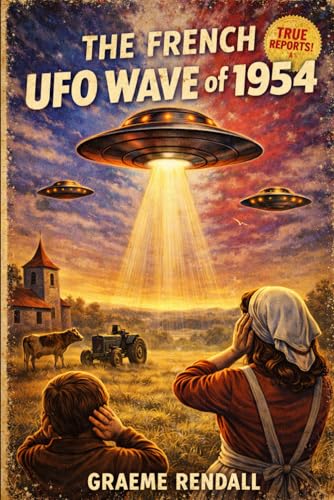
The French UFO Wave of 1954
Find on Amazon →As an Amazon Associate, OverClassified may earn from qualifying purchases made through this link, at no extra cost to you.
Why This Is Essential Reading
The French UFO Wave of 1954 earns its place on this list as a genuinely rare English-language, contemporary-newspaper-sourced treatment of one of the field's most historically significant national UFO waves. Rendall's specific framing of the wave's opening case gives this site's own Marius Dewilde case file its clearest documentary anchor, while the same book's inclusion of the 1952 precursor sighting situates the Oloron-Sainte-Marie & Gaillac case file within a genuine multi-year pattern rather than treating it as an isolated curiosity. Its thin, genuinely ambiguous public review record — a single unexplained one-star Goodreads rating — reflects the realities of a very recent, independently published specialist title rather than any conclusive judgment this site's research can responsibly draw about the underlying scholarship's quality, particularly set against Rendall's own independently verifiable five-book prior publication record in aviation-focused UFO history. Read as a long-overdue primary-source-grounded English treatment of France's largest documented national wave, this book is essential because it makes an internationally significant chapter of ufology, previously accessible mainly through decades-old translation and secondary summary, available to English-speaking readers in the level of newspaper-sourced detail it has long deserved — a contribution this site's own two-case citation record, spanning a genuine two-year documentary arc from 1952 to 1954, independently confirms rather than merely takes on faith.
Related Cases & Theories
Essential Viewing

Sources Cited
- Rendall, Graeme. The French UFO Wave of 1954. Independently published, 2024 (ISBN 979-8-326659-88-0, cited here).
- "The French UFO Wave of 1954." Goodreads (1 rating, 0 reviews, checked August 2026). goodreads.com
- "The French UFO Wave of 1954." AbeBooks (ISBN 9798333063991, marketplace listing photograph used for this article's cover image). abebooks.com
- "L'histoire du premier cas d'Ovni dans le Pas-de-Calais à Quarouble en 1954." BFM Grand Lille, YouTube (video verified via oEmbed). youtube.com
- This site's own resources library: Full Reading List, where this exact 2024 edition is cited across 2 separate case-file pages.
- "The French UFO Wave of 1954." Amazon.co.uk (edition and page-count details cross-referenced). amazon.co.uk
- This site's own key-figures entry: Graeme Rendall, for his full biography and site-wide case connections.
- This site's own case file: Marius Dewilde Sighting, the wave's opening case per this book's own framing.
- This site's own case file: Oloron-Sainte-Marie & Gaillac Angel Hair Sighting, the 1952 precursor sighting this book contextualizes.
- This site's own essential-reading entry: Forbidden Science 2, Jacques Vallée's journals covering GEPAN's later founding era.
- This site's own essential-reading entry: UFOs Over Modern China, a comparable dedicated national case survey.
- Amazon.com. "Intercept & Identify: Aerial UFO Encounters 1953-1954" (Rendall's subsequent 2024 co-authored book, cross-referenced for author biography). amazon.com
- Michel, Aimé. The Truth About Flying Saucers. Criterion Books, 1956 (the earlier English-language treatment of the 1954 wave this book's newspaper-sourced approach is intended to complement).
Have corrections, additional research, or peer-reviewed sources? Help improve this entry.
Suggest an Edit