
The Scareship Mystery
A Survey of Phantom Airship Scares, 1909-1918
Core Thesis
The Scareship Mystery: A Survey of Phantom Airship Scares, 1909–1918 is Nigel Watson's dedicated survey of the "scareship" phenomenon — waves of phantom airship sightings that swept Britain, New Zealand, the United States, South Africa, and Canada in the years leading up to and through the First World War. Compiled with contributions from David Clarke, Granville Oldroyd, Robert Bartholomew, and Thomas "Eddie" Bullard, the book's central argument is that these sightings are best understood through a psychosocial lens: ambiguous aerial phenomena repeatedly interpreted through the specific anxieties of their moment, first as covert reconnaissance by a hostile power and later as general wartime panic, in a pattern that would recur in modern UFO reporting. This site's own research draws on it for two of the phenomenon's founding episodes: the New Zealand Airship Wave, which the book's own 1909 starting date directly covers, and the Sheerness Phantom Airship Incident, which the book treats as a central British case study within the wider 1912–13 panic.
About the Author
Nigel Watson is a British UFO historian and author whose work spans more than four decades of cataloguing how UFO investigation itself has actually been conducted. This site's own essential-reading library already documents his later book UFO Investigations Manual (2013), a Haynes-branded field-methods guide; this earlier 2000 survey represents a different register of his work, a focused historical case study rather than a practical investigative reference.
This book was produced collaboratively, drawing on contributions from David Clarke, Granville Oldroyd, Robert Bartholomew, and Thomas "Eddie" Bullard — several of whom Watson had already worked with on the 1988 monograph The 1912-1913 British Phantom Airship Scare, published through the Fund for UFO Research and later revised as a chapter in Fortean Studies 6. That prior collaborative work, more than a decade before this book's publication, gave the team a substantial head start on primary-source research into the specific 1912–13 British panic this book expands into a fuller international survey.
Watson went on to publish UFOs of the First World War: Phantom Airships, Balloons, Aircraft and Other Mysterious Aerial Phenomena (The History Press, 2015), extending this book's specific WWI-era focus into a still broader treatment of wartime aerial anomaly reporting, and cited alongside this book on both of this site's relevant case files.
Historical Context & Origins
The scareship phenomenon this book documents began in New Zealand in July 1909, spread to Britain later that same year, recurred in a much larger British panic in 1912–13, and continued in various forms through the end of the First World War in 1918 — the exact nine-year span the book's own subtitle covers. This site's own New Zealand Airship Wave case file falls at the very beginning of that window, making the book's coverage genuinely foundational rather than a later retrospective addition.
The book's own review record, per an independent 2010 assessment by researcher Peter Rogerson, notes a fifteen-year gap between the underlying research (much of it dating to the 1988 FUFOR monograph) and this book's eventual 2000 publication — a delay Rogerson's review treats as the work's one substantive shortcoming, while still praising the finished product as reaching a standard that would satisfy professional historians.
This site's own Sheerness Phantom Airship Incident case file sits within the larger 1912–13 wave the book treats as its central British case study, occurring at the Royal Navy dockyard at Sheerness, Kent — precisely the kind of militarily sensitive site whose sightings fueled contemporary fears of covert German reconnaissance ahead of the coming war.
Core Arguments & Key Concepts
The book's central argument, per independent review, applies a psychosocial analytical framework to the scareship waves: ambiguous nighttime aerial phenomena, genuinely difficult to identify with certainty, were consistently interpreted through the specific fears dominant at the time they were seen — pre-war anxiety about covert enemy reconnaissance, and later general wartime vigilance — rather than through any single stable perceptual explanation.
A second theme is genuinely comparative and international in scope: by assembling case material from Britain, New Zealand, the United States, South Africa, and Canada within a single volume, the book demonstrates that the scareship pattern was not a uniquely British phenomenon but a broadly shared response occurring wherever similar wartime anxieties existed, undercutting any explanation that depends on one specific national context.
A third theme, reflected in the book's own multi-contributor structure, is that a phenomenon spanning nearly a decade and multiple countries is better served by pooling several researchers' specialized regional and archival expertise than by a single author attempting comprehensive coverage alone — the same collaborative model Watson had already tested with Clarke and Oldroyd on the earlier, narrower 1988 FUFOR monograph.
A fourth theme, per the independent 2010 review's characterization, is that this book provides "the first complete portrait of the 'scareship' or phantom airship waves yet produced," treating the scareship panics as a direct historical ancestor of, and interpretive lens for, modern UFO belief rather than a separate, unrelated curiosity.
Key Cases & Evidence Discussed
The New Zealand Airship Wave (July 1909) opened the scareship phenomenon this book surveys, with numerous New Zealand witnesses reporting mysterious aerial lights and airship-like craft months before the panic spread to Britain later the same year. This site's own case file cites this book directly, noting it begins "in exactly the year of the New Zealand wave, tracing its recurrence across multiple countries through the end of the First World War" — making this case the book's own chronological starting point rather than an incidental later addition.
The Sheerness Phantom Airship Incident (October 14, 1912) involved multiple witnesses at the Sheerness Royal Navy Dockyard and nearby Queenborough, Isle of Sheppey, Kent, hearing an aircraft engine and, per some accounts, seeing a light pass overhead — including a serving Royal Navy lieutenant among the witnesses, with response staged from the naval aerodrome at Eastchurch roughly four miles away. This site's own case file cites this book as treating "Sheerness and the wider 1912-13 panic as its central British case study," reflecting the incident's evidentiary weight within the book's broader survey given the sensitivity of a sighting occurring directly over an active naval dockyard.
Critical Reception & Controversies
This book carries no ratings on Goodreads at all (checked August 2026, 0 ratings, 0 reviews) — this site's research discloses that gap honestly rather than fabricating a figure. The most substantive independent assessment located is a detailed 2010 review by researcher Peter Rogerson, who praised the multi-contributor work as reaching "a high standard" that would satisfy professional historians, particularly commending its psychosocial analytical framework, and characterized the contributions collectively as "excellent contributions to ufology and history alike."
This site's research attempted to verify an Amazon rating for this title but Amazon's bot-detection system repeatedly blocked automated requests to the listing during this session, returning a CAPTCHA challenge across multiple attempts. Per this site's own Amazon Rating Display Protocol, this gap is disclosed honestly here rather than fabricated or silently omitted.
Rogerson's review identifies the book's one substantive shortcoming as the fifteen-year gap between much of the underlying research (dating to the team's 1988 FUFOR monograph) and this book's eventual 2000 publication, suggesting a second edition or television documentary treatment could have reached a considerably wider audience than a specialist small-press paperback achieved on its own.
Influence & Legacy
Per its most detailed independent review, this book stands as "the first complete portrait of the 'scareship' or phantom airship waves yet produced," a claim to primacy within its specific subject area that this site's own citation of the book for two genuinely foundational cases — the opening 1909 New Zealand wave and the pivotal 1912-13 Sheerness incident — tends to support.
Watson's own subsequent 2015 book, UFOs of the First World War, extended this book's specific scareship focus into a broader treatment of WWI-era aerial anomaly reporting, suggesting this earlier, more tightly scoped survey served as a foundation for his later, wider-ranging work on the same historical period.
Within this site's own essential-reading library, this book joins UFO Investigations Manual as the second Nigel Watson title documented, reflecting his sustained, decades-spanning contribution to the historical study of UFO reporting from its documented psychosocial origins through modern investigative methodology.
The Book
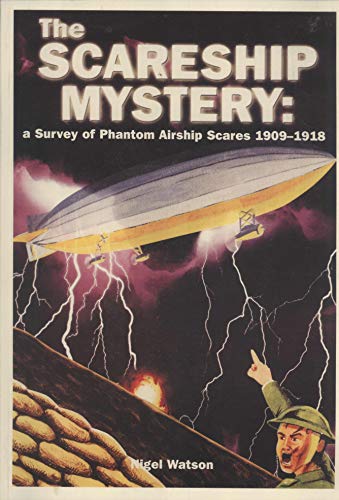
As an Amazon Associate, OverClassified may earn from qualifying purchases made through this link, at no extra cost to you.
Why This Is Essential Reading
The Scareship Mystery earns its place on this list as, per its most detailed independent review, the first complete scholarly portrait of the phantom-airship phenomenon that arguably marks the true historical origin point of modern UFO reporting. Watson and his collaborators' international, multi-country survey gives this site's own New Zealand Airship Wave case file its chronological starting point, while the same book's detailed treatment of the 1912-13 British panic anchors the Sheerness Phantom Airship Incident as a central case study. Its complete absence of Goodreads ratings reflects the realities of a specialist small-press historical survey rather than any indication of the underlying scholarship's quality, which an independent reviewer rated as meeting professional historical standards. Read as a foundational psychosocial history rather than a case-by-case catalog, this book is essential because it traces the direct lineage between early-twentieth-century aerial panic and the UFO belief systems that followed.
Related Cases & Theories
Essential Viewing
Sources Cited
- Watson, Nigel (with David Clarke, Granville Oldroyd, Robert E. Bartholomew & Thomas E. Bullard). The Scareship Mystery: A Survey of Phantom Airship Scares, 1909-1918. Domra Publications, 2000 (ISBN 0-9524417-8-0, cited here).
- "The Scareship Mystery." Goodreads (0 ratings, 0 reviews, checked August 2026). goodreads.com
- "The Scareship Mystery: A Survey of Phantom Airship Scares, 1909-1918." AbeBooks (ISBN 9780952441786, marketplace listing photograph used for this article's cover image; edition and page-count details). abebooks.co.uk
- Rogerson, Peter. "The Scareship Mystery." Review Archive (independent detailed review, praising the book's psychosocial framework and historical rigor). mrobsr.blogspot.com
- "The Great Scareship Panic of 1909." Catherine Warr, YouTube (video verified via oEmbed). youtube.com
- This site's own resources library: Full Reading List, where this exact 2000 edition is cited across 2 separate case-file pages.
- This site's own key-figures entry: Nigel Watson, for his full biography and site-wide case connections.
- This site's own case file: New Zealand Airship Wave, the book's own chronological starting point.
- This site's own case file: Sheerness Phantom Airship Incident, the book's central British case study.
- This site's own essential-reading entry: UFO Investigations Manual, Nigel Watson's later 2013 field-methods book.
- This site's own locations entry: Sheerness Royal Navy Dockyard, Kent, England.
- "Scareships or Motherships: The British Phantom Airship Scare 1909-1918." Mysterious Britain & Ireland (secondary overview of the phenomenon this book documents). mysteriousbritain.co.uk
Have corrections, additional research, or peer-reviewed sources? Help improve this entry.
Suggest an Edit