
UFO Investigations Manual
UFO Investigations from 1892 to the Present Day
Core Thesis
UFO Investigations Manual: UFO Investigations from 1892 to the Present Day is British ufologist and historian Nigel Watson's 2013 attempt to do something distinctive in UFO literature: publish a genuine field-methods handbook, produced by Haynes — the publisher best known for its car-repair manuals — that treats evaluating a UFO report with the same practical, step-by-step rigor Haynes normally applies to fixing an engine. Rather than arguing for or against extraterrestrial visitation, the book combines a chronological history of UFO investigation stretching back to 1892 with a working investigator's toolkit: classification systems for encounter types, chapters on physical-trace evidence and how to assess it, and guidance for conducting an actual field investigation or organized sky-watch. This site's own research draws on the book for exactly that practical value: both citing case files use it specifically as a methodological reference for evaluating ambiguous physical and instrumented evidence — "angel hair," chaff, ground traces, and FLIR sensor footage — rather than as a source of case-specific historical detail.
About the Author
Nigel Watson has researched and investigated historical and contemporary UFO reports since the 1970s, holding a BA in Psychology from the Open University and a BA (Hons) in Film and Literature from the University of Warwick, and lives in Plymouth, England. His combination of psychology training and decades of hands-on field investigation experience shapes this book's own consistently measured, methodology-first approach, distinguishing it from more case-advocacy-driven UFO literature.
Watson is a genuinely prolific UFO historian rather than a single-book author: his other works include Portraits of Alien Encounters (1990), The Scareship Mystery: A Survey of Phantom Airship Scares, 1909–1918 (2000), UFOs of the First World War (2015), and Captured by Aliens? A History and Analysis of American Abduction Claims. Working with researchers David Clarke and Granville Oldroyd, he co-authored the Fund for UFO Research's 1988 study of the 1912–13 British phantom airship scare, giving him a direct, published research relationship with one of this site's own most frequently cited UFO historians. He has also written for Fortean Times, Flying Saucer Review, and, notably, The Skeptic magazine — a publication venue that signals a deliberately critical, evidence-first approach carried directly into this book's own even-handed tone.
This breadth of historical writing across more than four decades gives UFO Investigations Manual a specific kind of authority: it is not the work of an investigator formed by a single famous case, but a synthesis of an entire career spent cataloguing how UFO investigation itself has actually been conducted, by multiple organizations across multiple countries, since the practice began.
Historical Context & Origins
Haynes Publishing released the book in 2013 as part of a deliberate expansion of its famous car- and motorcycle-repair manual format into popular-culture and paranormal subjects, packaging serious research content inside the same recognizable step-by-step manual branding that had made Haynes a household name for mechanical repair. This site's research finds the format choice itself editorially significant: presenting UFO investigation as a learnable, systematic skill rather than a purely speculative pursuit is itself part of the book's argument.
The book's subtitle promise — investigations "from 1892 to the present day" — situates 2013 UFO research within a much longer historical arc than most popular treatments attempt, reaching back to pre-Roswell aerial mystery reports and the phantom airship scares Watson had already spent decades studying in his other books, before working forward through the Cold War era and into the contemporary period of citizen-investigator sky-watches and smartphone-era video evidence.
Publication came at a moment when British ufology's own institutional landscape had shifted substantially: BUFORA's membership and activity had declined from its 1970s–80s peak, and much contemporary UK UFO investigation had moved toward individual researchers and smaller regional groups — a context this site's research finds relevant to why a practical, self-directed "how to investigate it yourself" manual had genuine appeal by 2013, in a way it might not have during ufology's more institutionally organized decades.
Core Arguments & Key Concepts
The book's central methodological argument, per independent review of its content, is that UFO evidence deserves the same disciplined evaluation standards applied to any other category of anomalous claim: the book is described as thorough on international sighting-classification schemes and includes long, detailed chapters specifically on physical evidence and how to examine it, treating evidence assessment as a teachable skill rather than an intuitive judgment call.
A second theme is Watson's consistently even-handed tone: one independent review specifically notes the book maintains "a carefully neutral tone about all but the most outlandish theories," walking readers through classification systems, competing extraterrestrial and non-extraterrestrial explanations, and practical investigation techniques without either mocking believers or dismissing the phenomenon outright — while the same review observes this studied neutrality tends, in practice, to steer readers toward the two most common prosaic explanations for any given case: misidentified weather balloons or classified aircraft.
A third, more subtle argument runs through the book's specific attention to internal logical consistency: the same review highlights Watson's treatment of the sheer scale problem in abduction-claim statistics, noting that the widely circulated estimates of how many Americans have been abducted would logically require "a parade of literally thousands of spaceships shuttling people in and out of their homes every night" — using arithmetic, rather than ideological dismissal, to test a specific popular claim's plausibility.
This site's own research treats the book's core value as exactly this kind of case-agnostic evaluative framework: it does not argue for a specific verdict on any individual sighting, but supplies the classification schemes, evidence-handling standards, and logical-consistency checks a reader can apply to any case independently — precisely the reason both of this site's own citing case files reach for it specifically when discussing ambiguous physical or instrumented evidence rather than case history.
Key Cases & Evidence Discussed
The Florence Stadium Sighting case file, set at the Stadio Comunale Artemio Franchi in Florence, Italy, cites this book directly as "a practical, methodologically grounded guide to evaluating exactly the kind of physical-trace evidence ('angel hair,' chaff, ground traces) central to this case, from a working British UFO investigator" — using the manual's evidence-assessment chapters as an interpretive framework for the specific category of ambiguous fibrous and chaff-like material central to that case, rather than as a source describing the Florence incident itself.
The Campeche Military FLIR Incident case file similarly cites the book as "a field-methods guide to evaluating exactly the kind of ambiguous instrumented sensor evidence, chain-of-custody gaps, and competing witness/analyst claims that define this case" — applying the manual's investigative standards to a modern, sensor-derived evidentiary problem quite different in character from the book's own historical case examples, which this site's research finds is precisely the kind of general applicability the book was designed to offer.
Critical Reception & Controversies
On Goodreads, the book carries a solid 3.70-out-of-5 average from 33 ratings and 8 written reviews (checked August 2026). Reviewer Tony Calder observed that "the book tries (mostly successfully) to maintain a non-judgemental approach" while remaining factual and readable, and reviewer Simon praised it as "a surprisingly sober and down-to-earth introduction to the UFO phenomenon," specifically citing its thorough categorization schemes and detailed references as useful for veteran UFO enthusiasts. Physicist and science writer Brian Clegg offered a more mixed assessment, describing it as "an illustrated assessment of UFO history" while raising questions about its handling of scientific rigor around some of the alternative explanations it surveys.
This site's research attempted to verify an Amazon rating for this title but Amazon's bot-detection system repeatedly blocked automated requests to the listing during this session, returning a CAPTCHA challenge across multiple attempts. Per this site's own Amazon Rating Display Protocol, this gap is disclosed honestly here rather than fabricated or silently omitted.
A Gizmodo review specifically praised the book's societal-pattern analysis across UFO waves while noting frankly that "the prose can be a bit dry at times," adding that the book's extensive archival photographs and illustrations compensate for its denser passages. The same review positioned it as most useful for readers "interested in the history of UFOs as a cultural phenomenon or plan to investigate some sightings yourself" — a description this site's own research finds matches precisely how both of this site's citing case files actually use the book: not as a narrative account of any specific case, but as a practical reference for evaluating evidence.
Influence & Legacy
The clearest evidence of this book's ongoing utility on this site specifically is its citation pattern: unlike most essential-reading titles this site documents, which are cited for their coverage of a specific historical case, this book is cited by two structurally very different modern cases — a physical-trace sighting from Italy and an instrumented FLIR-sensor incident from Mexico — purely for its general evidence-evaluation methodology, evidence of a genuinely durable, case-agnostic reference value.
Watson's broader body of work, including his direct research collaboration with David Clarke on the 1912–13 phantom airship scare, connects this book to a wider tradition of methodical, archive-grounded British UFO history this site's own case files draw on repeatedly, giving UFO Investigations Manual particular credibility as a distillation of that same research tradition into a genuinely practical, teachable format.
As a Haynes-branded manual specifically, the book also occupies a distinctive cultural niche: presenting UFO investigation using the same trusted step-by-step format millions of readers already associate with competent, no-nonsense practical instruction lends the subject a form of mainstream legitimacy that purely narrative UFO books rarely achieve, regardless of the underlying content's own evidentiary conclusions.
The Book
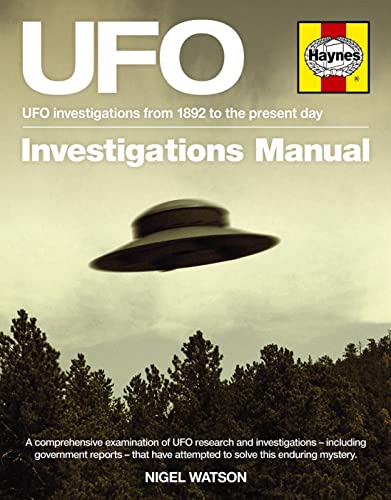
As an Amazon Associate, OverClassified may earn from qualifying purchases made through this link, at no extra cost to you.
Why This Is Essential Reading
UFO Investigations Manual: UFO Investigations from 1892 to the Present Day earns its place on this list not for documenting any single famous case, but for supplying a genuinely practical, case-agnostic evidence-evaluation framework this site's own research has found directly useful for two structurally different modern cases. Nigel Watson's decades of hands-on UFO field investigation, combined with his own psychology training and his direct research collaboration with fellow historian David Clarke, give this Haynes-branded manual real methodological credibility, applied here by this site's own Florence Stadium case file to physical-trace evidence and by its Campeche Military FLIR case file to instrumented sensor footage. Its solid 3.70/5 Goodreads reception, praised consistently for its measured, non-judgmental tone even where reviewers found the prose occasionally dry, reflects a reference work readers value for its usefulness rather than its narrative drama. Read not as a case-history book but as a genuine field manual, in the Haynes tradition its own branding invokes, this book is essential precisely because its evaluative framework outlasts any single sighting it was originally written to help explain.
Related Cases & Theories
Essential Viewing

Sources Cited
- Watson, Nigel. UFO Investigations Manual: UFO Investigations from 1892 to the Present Day. Haynes Publishing, 2013 (ISBN 978-0-85733-400-8, cited here).
- "UFO Investigations Manual." Goodreads (rating 3.70/5, 33 ratings, 8 written reviews quoted, checked August 2026). goodreads.com
- "UFO Investigations Manual." AbeBooks (ISBN 9780857334008, marketplace listing photograph used for this article's cover image; listing since expired, no archived mirror found).
- "UFO Investigations Manual is a Practical Guide to Close Encounters." Gizmodo (independent book review). gizmodo.com
- "Aliens in the UK? Britain's Most Shocking UFO Encounters – Investigator Nigel Watson." Anything Goes With James English, YouTube (video verified via oEmbed). youtube.com
- This site's own resources library: Full Reading List, where this exact 2013 edition is cited across 2 separate case-file pages.
- This site's own key-figures entry: Nigel Watson, for his full biography and site-wide research connections.
- This site's own key-figures entry: David Clarke, Watson's direct research collaborator on the 1912–13 phantom airship scare.
- This site's own case file: Florence Stadium Sighting, which cites this book for evaluating its physical-trace evidence.
- This site's own case file: Campeche Military FLIR Incident, which cites this book for evaluating its instrumented sensor evidence.
- "Nigel Watson." The Skeptic magazine, author archive (his own published critical writing on UFO investigation). skeptic.org.uk
- "Nigel Watson (Author of UFO Investigations Manual)." Goodreads author page (bibliography and biographical summary). goodreads.com
Have corrections, additional research, or peer-reviewed sources? Help improve this entry.
Suggest an Edit