
The Paul Bennewitz Disinformation Operation
Between 1980 and 1986 a credentialed Albuquerque instrument physicist, whose home and laboratory sat on the boundary of a nuclear-weapons installation, was supplied with an escalating stream of fabricated material about underground alien bases, secret treaties and an impending invasion. He believed it, spread it, and never recovered. The campaign against him is one of the few things in this entire subject that is documented rather than merely alleged — and what it was protecting was almost certainly nothing extraterrestrial at all.
This file is unusual for this archive, and the difference is worth stating at the outset rather than leaving a reader to infer it. Nearly every other case here asks whether an observed object was something unexplained. This one does not. The verifiable, well-evidenced phenomenon at the centre of this page is a sustained counterintelligence campaign run by a United States Air Force investigative unit against a private American citizen — an event established by its own participants' public admissions, by government records released under the Freedom of Information Act, by contemporaneous correspondence, and by two pieces of peer-reviewed academic analysis. Nothing on this page asserts that any non-human intelligence was involved in anything. The lights Bennewitz filmed remain unresolved and are assessed separately, and far more sceptically, in this archive's own Kirtland AFB Sighting file. What is being documented here is the operation, its human cost, and the very large mark it left on what the public now believes about UFOs.
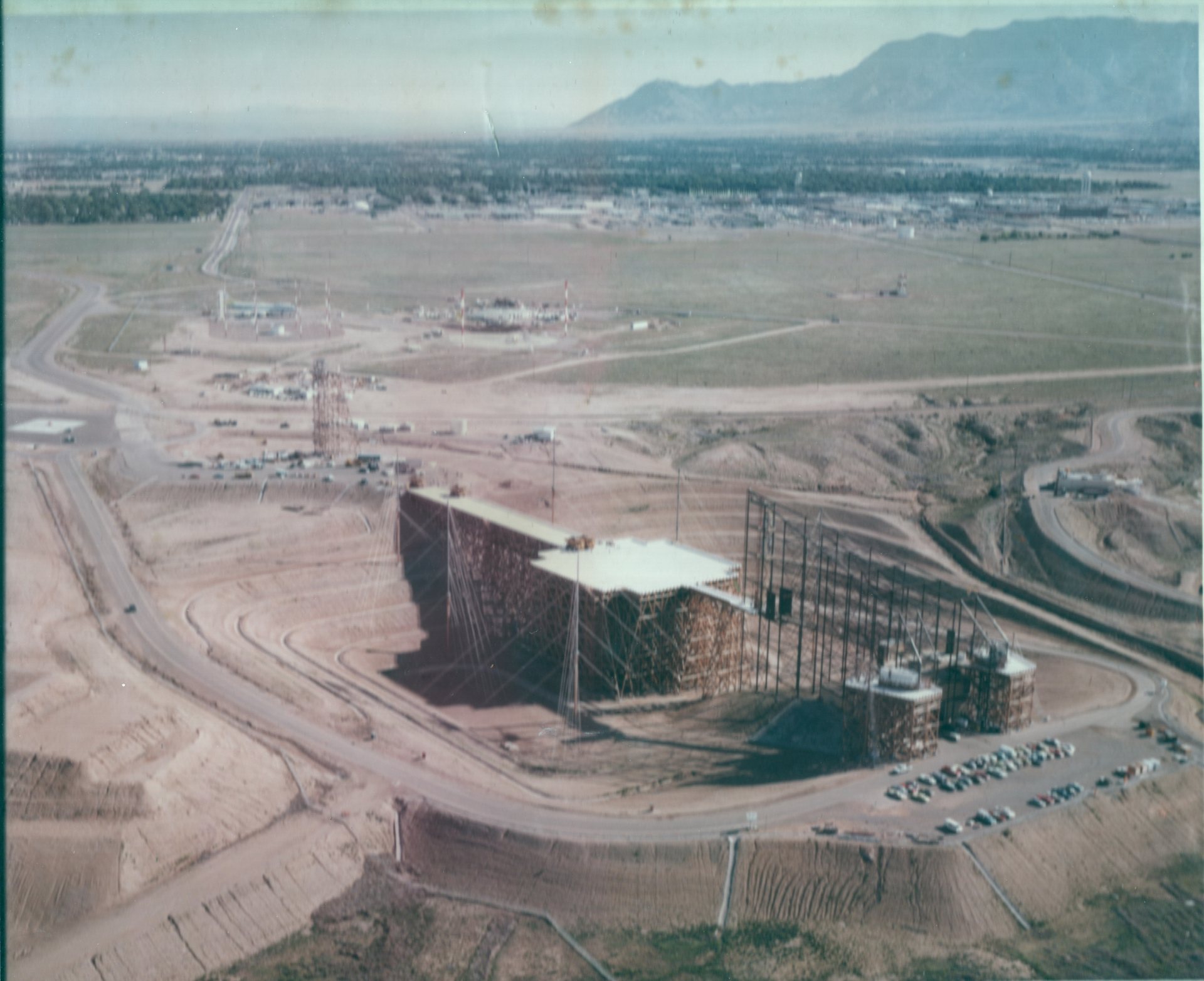
Pictured: the ATLAS-I “Trestle” electromagnetic-pulse test facility on Kirtland Air Force Base, photographed by the U.S. Air Force in 1978 during load testing — the structure its own base history office calls the largest free-standing wooden structure on the planet, constructed between September 1973 and April 1979 at a cost of $59.6 million to subject in-flight aircraft to threat-level simulated nuclear electromagnetic pulse. This is a real, mundane, then-classified electromagnetic installation operating on the same base, in the same years, roughly two miles from Paul Bennewitz's home antennas. It is not a photograph of Bennewitz, of anything he recorded, or of any event described on this page, and this file makes no claim that this specific facility was the source of his signals. No rights-clear photograph of Bennewitz, of his equipment, of his films, or of the still-restricted Manzano Weapons Storage Area is known to exist; his photographic material has never been released into the public domain by his estate.
Theoretical Alignment
These three figures are the most lopsided on this site, and deliberately so. The Extraterrestrial and Interdimensional scores are near zero not because this file dismisses those hypotheses in general, but because nothing in this file's evidentiary record bears on them at all. The material Bennewitz received — the underground bases, the two warring alien species, the human-alien treaties, the invasion timetable — did not come from the sky. It came from a filing cabinet. Its origin is not a matter of inference: William Moore described his own participation in supplying it from a conference podium in 1989, and Richard Doty has described his own participation repeatedly in interviews across four decades.
The Psycho-Social score is correspondingly the highest this archive has assigned to any file. The psycho-social hypothesis holds that a substantial share of UFO belief is produced by cultural, psychological and social transmission rather than by contact with anything unearthly. This case is the cleanest documented instance of that mechanism operating anywhere in the subject's history — with the significant refinement that the transmission here was not diffuse cultural drift but a deliberate, resourced, institutional act. That refinement matters. A psycho-social reading of most cases is a hypothesis; here it is a matter of record, and the record identifies an author.
One caution belongs alongside those numbers so they are not over-read. A 95% psycho-social alignment for this file is a statement about the disinformation, not a retroactive verdict on the aerial and electromagnetic phenomena Bennewitz originally reported. Those were a separate matter, they preceded the campaign, and this archive scores them separately and unfavourably at Case File #116. Conflating the two — treating “the disinformation was real” as though it settled “the lights were nothing,” or the reverse — is the single most common analytical error made about this case, and both versions of it are made regularly.
Background
Paul Frederic Bennewitz Jr. was born on 29 September 1927. He joined the Coast Guard at seventeen during the Second World War, took a master's degree in physics, and in 1969 founded Thunder Scientific Corporation in Albuquerque, New Mexico — a manufacturer of precision temperature and humidity calibration instrumentation whose customers included NASA and the U.S. Air Force. According to Greg Bishop's account in Project Beta (2005), Bennewitz had intended to continue on to a doctorate, but the company grew successfully enough that it absorbed his time entirely. Thunder Scientific still trades today, privately held and still headquartered in Albuquerque.
Two facts about where he lived and worked do almost all the explanatory work in this case, and they are easy to underweight. The first is proximity. Bishop describes the Thunder Scientific laboratory as sitting directly on the boundary of Kirtland Air Force Base, close enough that a person at the back wall was within arm's reach of the perimeter; the family home, in Albuquerque's Four Hills neighbourhood, stood roughly a mile from the Manzano Weapons Storage Area with a clear line of sight to it. The second is competence. Bennewitz was not a hobbyist with a pair of binoculars. He designed and built precision measuring instruments for a living, held government contracts, and constructed his own antennas and receiving equipment. Bishop's description of the technical array inside the Bennewitz home is of something functionally close to a listening station, sited immediately adjacent to one of the most sensitive installations in the United States.
What sat on the other side of that fence line is a matter of public record and matters enormously here. Manzano Base began construction in 1947 as the classified “Site Able,” was renamed and transferred to Air Force operational control on 22 February 1952, and became one of the original six U.S. National Stockpile Sites — roughly 122 earth-covered concrete igloos and a network of tunnels driven into the Manzano foothills. Bishop describes it, in the period Bennewitz was watching it, as the largest underground repository of nuclear-weapons components in the Western world. Adjoining it, out of civilian sight to the southeast, lay the Coyote Canyon test complex, a Sandia National Laboratories instrumented range in use since the 1950s for explosive, impact, drop-tower, sled-track and related weapons-effects work. On the base proper, the Air Force Weapons Laboratory had just completed ATLAS-I — the “Trestle” — a $59.6-million laminated-timber platform constructed between September 1973 and April 1979, built from over 410,000 pieces of lumber in more than 15,000 laminated members precisely because it had to hold an aircraft as large as a B-52 while two pulsers drove it with up to 4.5 megawatts, simulating the electromagnetic pulse of a nuclear detonation. Its own base history office calls it the largest free-standing wooden structure on the planet. EMP testing there ran until 1990. Laser-guided weapons and electromagnetic-pulse defence work were both being developed on this ground in these years.
The point of assembling that inventory is not to suggest any one facility explains what Bennewitz recorded. It is to establish the baseline against which his reports were received by the people he reported them to. A civilian with a homemade wideband receiver, sited on the fence of a nuclear stockpile site that adjoined an active electromagnetic-effects range, announcing that he was intercepting anomalous transmissions, was not primarily a curiosity to the base's counterintelligence detachment. He was a counterintelligence problem — and the problem was not that he might be wrong. It was that he might be right about the wrong thing.
Bennewitz was also, by 1979, genuinely interested in UFOs. He was a member of the Aerial Phenomena Research Organization (APRO), then one of the two large American civilian UFO research bodies, run from Tucson by Coral Lorenzen and Jim Lorenzen. That membership is not incidental colour. It is the channel through which almost everything that followed reached him, and it is the reason a counterintelligence unit that wanted feedback on his activities had a ready-made place to recruit it.
Complete Timeline
| 29 Sep 1927 | Paul Frederic Bennewitz Jr. born. He later serves in the Coast Guard from age seventeen during the Second World War and takes a master's degree in physics. |
| 1969 | Bennewitz founds Thunder Scientific Corporation in Albuquerque, manufacturing precision humidity and temperature calibration instruments for customers including NASA and the U.S. Air Force. The laboratory sits on the Kirtland AFB boundary. |
| Sep 1973 – Apr 1979 | The U.S. Air Force Weapons Laboratory constructs ATLAS-I (“Trestle”) on Kirtland at a cost of $59.6 million — a full-scale simulator for threat-level nuclear electromagnetic-pulse attacks on in-flight aircraft — alongside ongoing Sandia work at the adjoining Coyote Canyon test complex. It is completed five months before Bennewitz begins recording; EMP testing there continues until 1990. |
| Sep 1979 | Per Bishop's account, Bennewitz and his wife Cindy begin seeing multicoloured lights moving over the Manzano foothills inside the base, roughly a mile from their Four Hills home. He begins filming with telephoto-equipped 8mm cameras and recording radio signals on self-built antennas. |
| 5 May 1980 | Separately and independently, Myrna Hansen reports a UFO encounter near Cimarron, New Mexico — the case documented in this archive at Case File #326. Bennewitz will later arrange and attend her hypnotic regression sessions. |
| 8 Aug – 3 Sep 1980 | Kirtland security police, a Sandia guard and a New Mexico state patrolman file the reports later consolidated into an AFOSI complaint form — a separate matter from Bennewitz's civilian investigation, assessed in this archive at Case File #116. |
| 24 Oct 1980 | Bennewitz approaches Maj. Ernest Edwards, commander of Kirtland's 1608th Security Police Squadron, presenting his films and recordings as evidence of a genuine threat to the weapons-storage site. Edwards instructs guards to keep reporting unusual activity — drawing AFOSI District 17 into direct contact with Bennewitz's investigation for the first time. |
| 26 Oct 1980 | AFOSI agent Richard Doty and Jerry Miller — a former Project Blue Book field investigator then serving as chief scientific advisor at Kirtland's Air Force Test and Evaluation Center — review Bennewitz's material at his home. The visit is recorded on an OSI internal form dated 28 October 1980. |
| 10 Nov 1980 | Bennewitz formally briefs Air Force officers at Kirtland on his findings. |
| 17 Nov 1980 | Date borne by the document later circulated as the “Project Aquarius” teletype, presented as an AFOSI headquarters message to District 17 concerning analysis of Bennewitz's film. Its penultimate paragraph contains the first reference to “MJ Twelve” to circulate widely in UFO research. |
| Late 1980 | APRO assigns William Moore — co-author of The Roswell Incident, published that summer — to look into Bennewitz's claims. Moore states in 1989 that he was by then also in contact with AFOSI sources, and had agreed to report on Bennewitz's activities in exchange for access to classified UFO material. |
| Feb 1981 | Moore's own account: he receives a copy of the Aquarius teletype. He states he was shown an original by Doty shortly after it came off the machine, and later given an altered copy to pass to Bennewitz. |
| 1981 | APRO receives an anonymous letter, purportedly from a Kirtland airman, describing a UFO landing and occupant sighting by Civil Air Patrol cadet Craig Weitzel. Researcher Brad Sparks concludes in 1987 that Doty authored it; Moore states in 1989 that Doty wrote it and that it was “bait” aimed at APRO. |
| Sep 1982 | Moore's account: one of three known copies of the Aquarius teletype is taken from his briefcase during a break-in to his car in San Francisco. A copy surfaces publicly months later. |
| 10–11 Jan 1983 | CAUS attorney Peter Gersten meets Doty in New Mexico across two meetings. In the second, Doty describes crash retrievals, recovered bodies, NSA communication with extraterrestrials, government “moles” inside UFO organisations, and treaties permitting animal mutilation — then asks Gersten directly how he knows he is not being given information to spread. |
| Early 1983 | A wire-service report picked up nationally describes Bennewitz as believing he is decoding computer communications from the observed craft, and links his Manzano-area observations to rumours of an underground base near Dulce, New Mexico and to regional cattle-mutilation reports. |
| 9 Apr 1983 | Doty meets documentary producer Linda Moulton Howe at Kirtland and shows her a purported presidential briefing paper describing crash retrievals, a live extraterrestrial biological entity, and named projects including Aquarius and MJ-12. Nothing he offers is ever delivered. Moore states in 1989 that this was a counterintelligence operation intended to keep the Bennewitz story out of an HBO documentary. |
| 4 Apr 1983 | In a letter to Gersten, D. Hall reports that Moore privately admitted doing a “cut and paste job” on the Aquarius document and then retyping it — the contemporaneous documentation later cited by Robert Hastings in 1989. |
| 5 Dec 1983 | Air Force spokesperson Susan Cooksey writes to Albuquerque television station KOB-TV stating that AFOSI reviewed a circulated document purporting to summarise the Bennewitz photographs and “confirmed it is a hoax.” |
| Dec 1984 | Jaime Shandera, working with Moore, receives an anonymous roll of 35mm film containing the purported Majestic-12 briefing document dated 18 November 1952. The Aquarius teletype, circulated four years earlier, had already put “MJ Twelve” into the research community's vocabulary. |
| 1985 | Investigator Benton Jamison locates Craig Weitzel, who confirms seeing a high-altitude silver object in 1980 and reporting it to Doty — but knows nothing of the landing, the occupant, or the “Mr. Huck” visit described in the anonymous APRO letter. |
| 15 Apr 1986 | The National Security Agency formally denies a FOIA request for “Project Aquarius” records on classification grounds. |
| 1987 | Barry Greenwood publicly identifies Doty as the pseudonymous MJ-12 source “Falcon” in Just Cause. Doty has denied being Falcon; Moore told a 1989 audience that Falcon was someone else. The identification remains contested. |
| Aug 1988 | Bennewitz is hospitalised at a psychiatric facility. Bishop's account describes a preceding period of acute deterioration; Moore's 1989 account describes visiting him in hospital and attempting to tell him the material had been disinformation. |
| 1 Jul 1989 | At the MUFON symposium in Las Vegas, Moore delivers “UFOs and the U.S. Government: Part I,” publicly stating that he agreed to play what he called the disinformation game and that supplying information on Bennewitz's activities was part of the bargain. The paper is published in MUFON UFO Journal No. 259. His career in ufology effectively ends. |
| 1990s | CUFON researchers obtain, under FOIA case 96-F-1327, real DARPA documents on an actual Project AQUARIUS — an over-the-horizon radar and ocean-surveillance effort under the umbrella Project MAY BELL, with no UFO content whatever. |
| 23 Jun 2003 | Paul Bennewitz dies in Albuquerque, aged 75. An obituary runs in the Albuquerque Journal on 29 June. |
| 2005 | Greg Bishop publishes Project Beta, the first book-length reconstruction of the campaign, built on FOIA releases and direct interviews with both Doty and Moore. |
| 2010 / 2013 | Mark Pilkington publishes Mirage Men; a documentary of the same name, featuring Doty at length, follows in 2013. |
| 11 Jul 2013 | Journalist Alejandro Rojas publishes an open letter to the U.S. Air Force asking whether it was involved in the acts Doty has publicly described, and if not, what action was taken. AFOSI processes his FOIA request (case 2013-03291-F, fulfilled 2 August 2013) but declines to comment further. |
| 2019 | Doty gives an extended interview to George Knapp at a Laughlin, Nevada conference, acknowledging that he fed disinformation to Bennewitz and others while disputing the characterisation that he drove Bennewitz mad. |
| 2021–2023 | Adam Gorightly publishes Saucers, Spooks and Kooks; Anton and Vugrin treat the case in the peer-reviewed Journal of Anomalistics; Mark D. West publishes a philosophical analysis of it in the Social Epistemology Review and Reply Collective. |
Who Paul Bennewitz Was, and Why It Mattered
Almost every popular retelling of this case reaches for the same shorthand: a UFO believer who got in over his head. The shorthand is wrong in a way that inverts the causation, and correcting it is the first thing this file needs to do.
Bennewitz's credentials were real and checkable. A master's degree in physics; twenty years running an instrumentation firm with federal customers; an aerobatics rating; a working knowledge of radio-frequency measurement good enough to build his own receiving equipment. He was fifty-two years old in the autumn of 1979, financially secure, and by Bishop's account so absorbed in his company that he had little social life outside it. This is not the profile of someone easy to dismiss, and the Air Force did not dismiss him. It is precisely because his technical claims could not be waved away that he became a problem worth spending years on.
That is the pivot on which the whole case turns, and it is stated most clearly by the people closest to it. Moore's 1989 account attributed the emissions Bennewitz was detecting to classified electromagnetic-pulse and related testing at Kirtland, and specifically to the Coyote Canyon area of the Kirtland/Sandia complex. Bishop's reconstruction argues that the Air Force's concern was the exposure of then-secret aircraft development, low-observable work among it. Anton and Vugrin's 2022 analysis, drawing on the German sociologist Ingbert Judt's study of the affair, describes the equipment in the Bennewitz home as effectively a powerful listening device sited next door to the base, and quotes Judt's summary of the decision actually taken: rather than prohibit Bennewitz from continuing — which, Judt notes, would have been legally straightforward — the choice was to reinforce his belief in extraterrestrials, actively, by feeding him falsified signals and documents.
Every one of those accounts, written decades apart by people with no common interest, converges on the same structure. A private citizen with genuine technical capability had begun to detect something real about a classified installation. He had already, on his own, assembled an extraordinary interpretation of it. The institutional response was not to correct the interpretation but to make it larger, stranger and less credible — because a man convinced of an alien invasion is not a man anyone will take seriously about anything else, including whatever he had actually detected.
It is worth being blunt about what that implies, and equally blunt about what it does not. It implies that the underlying secret was something a determined civilian with an antenna could plausibly stumble onto from a mile away, in 1979, in Albuquerque. Every candidate the documented record actually names for that secret — EMP and weapons-effects testing, low-observable aircraft development, the security posture of a nuclear stockpile site — is terrestrial, human-built and thoroughly mundane. None of them requires or implies a non-human intelligence. It does not imply that anyone has ever produced a document identifying which of those candidates was the real one. Nobody has. That gap is real, and it is named again in this file's Conventional Explanation Candidate section rather than papered over.
What He Was Actually Detecting, and What He Concluded From It
Bishop's account dates the beginning to September 1979: Bennewitz and his wife watching multicoloured lights moving over the mountains inside the base, about a mile from their second-storey deck. Over the following months he accumulated what Bishop describes as hundreds of photographs and thousands of feet of 8mm film, shot through telephoto lenses large enough to dwarf the cameras behind them. He also recorded radio signals on antennas of his own construction, and became convinced that the two were connected — that the lights were emitting the signals.
The first official evaluation of that material is one of the more interesting and least-quoted facts in the case. When Doty and Jerry Miller reviewed it at the Bennewitz home on 26 October 1980, Miller — a former Blue Book field investigator, the nearest thing to a professional aerial-phenomena assessor on the base — is reported by later researchers who interviewed him to have said the film clearly showed some type of unidentified aerial object, while finding the accompanying electronic recordings inconclusive, and reaching no determination on whether any of it amounted to a genuine security threat. That assessment is worth sitting with. The Air Force's own scientific advisor looked at a civilian's films of unidentified objects over a nuclear storage site and did not call them nothing.
Where Bennewitz went from there is the tragedy. By early 1983, per a wire-service report carried nationally, he had concluded that he was decoding actual computer communications from the craft. He had connected the Manzano lights to rumours of an underground base near Dulce, New Mexico, and to the cattle-mutilation reports then circulating across the rural Southwest. He came to believe that aliens were implanting devices in human beings, that abductions were occurring at industrial scale, and that an invasion was imminent. He wrote to newspapers, to television stations, to United States senators, and to President Reagan.
Two things need to be held together here, and popular accounts almost always drop one of them. The first is that a meaningful part of that structure was Bennewitz's own. Both Moore's 1989 account and the reconstruction in the standard reference literature state plainly that Bennewitz had already begun assembling an alarming interpretation before anyone fed him anything; the fabricated material built on a foundation he had laid himself. The second is that the elaboration — the specific races, the specific base, the specific treaties, the specific timetable — did not come from him. It arrived from outside, in documentary form, from people he trusted.
This archive's assessment of the underlying aerial and electromagnetic reports themselves is deliberately unenthusiastic and lives at Case File #116, which rates the August 1980 security-police sightings as Disputed at 43/100. Nothing here upgrades that. The films have never been publicly released, independently examined, or subjected to any analysis a reader can check. Miller's reported remark is a secondhand recollection of a private viewing, not a published finding. What can be said with confidence is narrower and stranger than either the believers' or the debunkers' version: something was being observed and recorded near a nuclear weapons storage site by a competent instrument engineer, the Air Force took it seriously enough to send two people to his living room, and the institutional response that followed was not an investigation.
October 1980: A Civilian Investigator Walks Into a Counterintelligence Office
On 24 October 1980 Bennewitz took his material directly to Maj. Ernest Edwards, commander of Kirtland's 1608th Security Police Squadron. His purpose, by every account, was straightforwardly patriotic: he believed he had documented a threat to a nuclear weapons facility and believed the Air Force would want to know. Edwards responded by asking Manzano's guards to continue reporting unusual sightings.
That request is the hinge. It formally connected a civilian's private investigation to the base's own reporting chain, and it put that connection in front of AFOSI District 17 — the counterintelligence detachment covering an installation that then hosted classified laser, low-observable, electromagnetic-effects and nuclear-weapons work simultaneously. Two days later Doty and Miller were in Bennewitz's home. On 10 November he briefed Air Force officers formally.
Read as an ordinary institutional sequence, none of this is sinister. A citizen reports a possible security concern; the base's scientific advisor and an investigator go and look. What makes the sequence consequential is what did not happen next. No formal investigation of the underlying emissions was opened and disclosed. No correction was issued to Bennewitz. Instead, within weeks, a document dated 17 November 1980 entered circulation bearing the appearance of an AFOSI headquarters teletype about the analysis of his film — and containing, in its penultimate paragraph, the first reference to a body called “MJ Twelve” ever to circulate widely in UFO research.
It is important to be precise about what is established regarding that document and what is not. AFOSI headquarters has denied sending the message and characterised it as a forgery. Lawrence Fawcett and Barry Greenwood, who pursued it through FOIA, reported that the alleged originating office described it as a fabrication. Moore, in his 1989 paper, described the circulated version as a retyped copy of a genuine AFOSI message with spurious additions, and identified among those additions the references to NASA and to the U.S. Coast and Geodetic Survey, which he said read as NSA in the original. A letter to attorney Peter Gersten dated 4 April 1983, cited by Robert Hastings in his 1989 analysis, reports that Moore privately acknowledged doing a cut-and-paste job and retyping the document. What has never been produced, by anyone, is the unaltered original. Hastings pressed that point at the time and it has never been answered.
The Shape of the Campaign, 1980–1986
The campaign against Bennewitz is usually described as though it were a single act — a forged document handed over, a man broken. It was not. What the documented record describes is a sustained, multi-year, multi-channel operation with a recognisable internal logic, and understanding that logic is more instructive than cataloguing individual fabrications.
Recruitment inside the research community
The first move was not against Bennewitz at all. It was against the organisation he belonged to. In 1981 APRO received an anonymous letter purporting to come from a Kirtland airman, describing a UFO landing and an occupant sighting witnessed by a Civil Air Patrol cadet named Craig Weitzel, and adding rumours that a crashed UFO was stored inside Manzano. Brad Sparks concluded in 1987, after comparing three documents, that Doty had written it. Moore confirmed in 1989 that Doty wrote it, and described its function in plain operational terms: it was bait, aimed at APRO, because AFOSI knew Bennewitz had close ties there and wanted someone inside who could report on his activities. Moore, then APRO's board member in charge of special investigations, was the person to whom the letter was routed for action.
The bait worked in the narrow sense that it produced a relationship. It also, incidentally, generated a durable piece of false UFO history: when investigator Benton Jamison located Craig Weitzel in 1985, Weitzel confirmed that he had genuinely seen a high-altitude silver object in 1980 and had genuinely reported it to Doty — and knew nothing whatever of the landing, the occupant, or the threatening visit from a “Mr. Huck” that the anonymous letter described. A real, minor sighting had been inflated into a close encounter and attached to a real person's name without his knowledge. That pattern — a genuine kernel, elaborated beyond recognition — recurs throughout.
Escalating documentary fabrication
The Aquarius teletype was the first and most consequential document, but not the last. Over the following years, according to Bishop's reconstruction and Doty's own subsequent statements, the material supplied to Bennewitz grew into a complete cosmology: an underground alien base beneath Archuleta Mesa near Dulce; secret treaties between the United States government and extraterrestrial species; two distinct alien races, one of them hostile; cattle mutilation reframed as alien harvesting; human abduction as an ongoing programme of implantation and behavioural control; and an invasion whose timetable was running out.
West's 2023 academic account preserves one detail of that material that deserves recording because of what it reveals about its construction. The narrative given to Bennewitz described beings called “Ebans” who had created two human races, one of them “Sweads” established in the Zeta Reticuli system, with a limited war running between creators and creations for some three centuries. The terms themselves are tells. “Sweads” derives transparently from the tall blond “Swedes” of 1950s contactee lore; “Ebans” from the acronym EBE, extraterrestrial biological entity. This was not invented from nothing. It was assembled out of the UFO community's own existing vocabulary and handed back to it wearing an official letterhead — which is, precisely, what makes disinformation effective and what makes it so hard to unpick afterwards.
Redirection away from the actual site
The third element is the one that best demonstrates this was an operation rather than a prank. West's account, following Bishop, describes Bennewitz returning from trips to Dulce and telling his Air Force contacts that he now suspected the alien base he had learned about through a contactee's hypnotic regressions was located there. The response was to encourage it — because an investigator permanently fixed on a mesa near the Colorado border is an investigator no longer pointing his antennas at Coyote Canyon.
The contactee in question was Myrna Hansen, whose May 1980 case this archive documents separately at Case File #326, and whose regression sessions — arranged through Bennewitz and conducted by Dr. R. Leo Sprinkle — produced the underground-facility narrative that became the seed of the entire Dulce mythology. Adam Gorightly, interviewed in 2021 about Saucers, Spooks and Kooks, notes that elements from those sessions — the greys, the abduction tropes, the underground bases — passed into UFO lore as we now have it, while adding an honest caveat that how much of the session content was cross-pollination or investigator contamination remains an open question. This file adopts that caveat rather than resolving it: a hypnotic regression conducted in 1980 by a believer, attended by a man already convinced of an alien threat, is not a source from which anything can be extracted with confidence.
Operations against adjacent researchers
The fourth element is that Bennewitz was not the only target, and the campaign's boundaries were drawn by what threatened to reach the public rather than by who was being deceived. On 9 April 1983 Doty met Linda Moulton Howe — an Emmy-winning documentary producer then under contract to HBO — at Kirtland, and showed her a document presented as a briefing paper for the President of the United States, on condition that she neither copy it nor take notes. Howe has given a consistent account of that meeting ever since, published it in An Alien Harvest (1989), and made a sworn statement about it when Doty later denied it in correspondence with researcher Larry Bryant in 1988. Doty does not dispute that the April 1983 meeting occurred. The film footage he described was never delivered; HBO withheld production funding pending a written verification that never came; the documentary was never made.
Moore's 1989 account frames that episode explicitly as part of the same campaign: he described becoming aware in early 1983 that Doty was involved with a team running an elaborate disinformation scheme against a prominent researcher connected to a television film company, and stated that the concern driving it was that Bennewitz's story about intercepting low-frequency emissions from the Coyote Canyon area would end up in a feature-length documentary. Whatever else is disputed in this case, the shape of that concern is not: the thing that had to be stopped was a story about electromagnetic emissions from a specific patch of a specific military base reaching a national audience.
The Documents, and What Can Actually Be Established About Them
This section exists because the documentary record of this case is routinely described in ways that overstate it in both directions, and the distinctions are worth drawing carefully.
What is established
That a document dated 17 November 1980, presented as an AFOSI teletype concerning Bennewitz's film, circulated in the UFO research community from 1981 onward, and that it contains the first widely-circulated reference to “MJ Twelve”: established, and the text is public. That AFOSI headquarters denies sending it and has characterised it as a forgery: established through the FOIA correspondence pursued by Fawcett and Greenwood and reported contemporaneously. That Moore distributed an altered version: established by Moore's own 1989 paper, in which he describes the circulated document as a retyped real message with spurious additions, and corroborated independently by the 4 April 1983 Gersten letter cited by Hastings. That an Air Force spokesperson told an Albuquerque television station in December 1983 that AFOSI had reviewed a circulated document summarising the Bennewitz photographs and confirmed it a hoax: established, though note that this statement addresses one specific circulated document and resolves nothing about Bennewitz's original film.
And one further finding, obtained by patient FOIA work and rarely mentioned, which is arguably the most useful document in the entire case. Researchers at the Computer UFO Network (CUFON) spent more than a decade pursuing “Project Aquarius.” The NSA initially quoted $15,000 for a records search and later refused to release material on the grounds that even the project name's disclosure could be expected to cause grave damage to national security — language that, understandably, read to researchers as confirmation of something enormous. In the 1990s, under FOIA case 96-F-1327, DARPA released the actual Project AQUARIUS reports through the Assistant Secretary of Defense. Project AQUARIUS was a component of Project MAY BELL, an ocean-surveillance and tactical early-warning programme investigating over-the-horizon detection of aircraft, missiles, ships and submarines using high-frequency monostatic and bistatic radar. The NSA subsequently clarified that the material it had withheld describes a database coincidentally named Aquarius, unrelated to the DARPA project and not a Project Aquarius document at all.
That is what fifteen years of chasing the most tantalising name in the file actually produced: real classified radar research with no UFO content, and an unrelated database that happened to share a codeword. CUFON's own published conclusion is characteristically measured — either the name was an effective diversionary choice or a random one — but the practical lesson is unambiguous, and it is the lesson this whole case teaches. A refusal to release records is not evidence of what the records contain.
What is contested
The identity of “Falcon,” the pseudonymous intelligence source behind the MJ-12 story, is genuinely unresolved and this file does not resolve it. Barry Greenwood identified Doty as Falcon in Just Cause in 1987; Robert Hastings reported in 1989 that a ranking member of the production team behind the television special UFO Cover-Up? Live! had confirmed it. Doty has denied being Falcon. Moore told the 1989 MUFON audience that Falcon was someone else entirely and that Doty was a middle-man who subsequently allowed himself to be taken for Falcon. These accounts cannot all be correct, the people making them had incentives, and no document settles it. Readers should treat any confident assertion about Falcon's identity — in either direction — as an opinion.
What this file will not repeat
A cluster of the most colourful claims about this operation circulate constantly and are not stated as fact here, because independent verification could not be obtained for any of them. Claims about elaborate physical staging in the New Mexico desert — props positioned to reinforce the underground-base story, projection systems producing saucer shapes — appear in the secondary literature sourced to statements attributed to Doty himself, with no supporting document, photograph, contemporaneous witness or primary record traceable behind them. Allegations of specific criminal conduct against named individuals, including break-ins and deception of sitting United States senators, likewise rest on later testimony rather than on any independently documented finding, and are addressed in this file only in the form in which they are actually documented: as allegations that a journalist put to the Air Force in writing in 2013, to which the Air Force made no substantive reply. Where this archive cannot verify a claim, the honest course is to leave it out rather than to launder it through a hedge, and that is what has been done.
What the Participants Have Said on the Record
An unusual feature of this case — arguably the reason it is documentable at all — is that two of the people involved described their own participation publicly. Their statements are the spine of the record and are reported here as what they are: first-person accounts, quoted and attributed, not independently verified in every particular.
William Moore, 1 July 1989
Moore's paper “UFOs and the U.S. Government: Part I,” delivered at the MUFON symposium in Las Vegas and published in MUFON UFO Journal No. 259, is the single most cited primary source in this case. In it he described his reasoning for agreeing to cooperate with his Air Force contacts in terms he chose himself: that he would play the disinformation game and get his hands dirty just often enough to convince those directing the process that he was doing what they wanted, while burrowing far enough into the arrangement to learn who was directing it and why — a plan that, he wrote, required secrecy above all, since disclosure would have seen him cut off before he learned anything.
He stated that supplying information to the government on Bennewitz's activities was part of that equation. He described being asked to pass Bennewitz an altered document, being told it had been sanitised to protect sensitive projects, and being given to understand that Bennewitz would wave it publicly as proof, at which point it would be denounced as counterfeit and his credibility would suffer further. He noted that by 1982 Bennewitz's theories contained virtually all the elements then circulating as rumour in the UFO community — implants, underground bases, mutilations. And he described visiting Bennewitz at a low point and watching him deteriorate.
The speech ended Moore's standing in the field. Dennis Stacy's contemporaneous write-up in Magonia in October 1989 records the reaction as it happened. This file treats Moore's statements as strong evidence of the operation's existence — a public self-incriminating admission before a hostile audience is not a thing people invent — and as weaker evidence of his own motives, which only he can attest to. Anything characterising Moore's intentions beyond what he said himself is attributed here to whoever is characterising them.
Richard Doty, 1983 to the present
Doty's public statements span more than four decades and are the most complicated element of the record. He has acknowledged in interviews, on camera, and in print that he participated in supplying false material to Bennewitz and to other researchers. He is the central figure of Pilkington's Mirage Men book and of the 2013 documentary made from it. He gave an extended interview to George Knapp at a Laughlin conference in 2019 in which he acknowledged the surveillance and the disinformation, while disputing the version of the story in which he drove Bennewitz insane.
His testimony requires an unusual handling rule, and this archive applies the same one its key-figures profile already uses. Where his statements are corroborated by documents, by other participants, or by contemporaneous records, they are reported as corroborated. Where they are the only source — which covers most of what he has said about why the campaign was run, and essentially everything he has said about what was being protected — they are reported as his account and nothing more. This is not a slight. It is the necessary consequence of a situation in which the primary witness to a disinformation operation is a person whose documented professional function, during the period in question, was producing convincing falsehoods about this exact subject. Bishop and Pilkington both built substantially on his testimony, and both bodies of work are strongest precisely where documents corroborate him.
West's 2023 analysis states the resulting epistemic problem more sharply than any UFO-community source has managed, and it is worth stating in full because it is the honest bottom of this case. If Doty and Moore told the truth in their admissions, then the conspiracy theory Bennewitz believed was false. If they were lying, it does not follow that what Bennewitz believed was true. And there is no principled place to stop: the pertinent question, as West puts it, is when the disinformation ends, and that question has no clear answer.
“Project Beta”: Bennewitz's Own Manifesto and Its Descent Into Modern UFO Lore
At some point in the mid-1980s Bennewitz compiled his conclusions into a document he titled “Project Beta” — the source of the title of Bishop's book — and circulated it. It set out the mythology in its developed form: a grey species at war with humanity, a battle fought in an underground installation at Dulce, a threat requiring immediate action. He sent his warnings, in various forms, to newspapers, television stations, senators and the President.
What happened to that material afterwards is the part of this case with the widest consequences, and it is the reason a file about one man in Albuquerque belongs in a general UFO archive at all. The contents did not stay with Bennewitz. They entered general circulation in the UFO research community of the 1980s, were absorbed, elaborated and re-transmitted by others, and became load-bearing components of a mythology that outlived everyone involved. The Dulce underground base; grey aliens; human-alien treaties; abduction with implantation; government complicity in cattle mutilation; a hidden policy body with a numerical codename — these are not fringe curiosities today. They are, collectively, close to the default popular understanding of what the UFO cover-up is supposed to consist of.
Every serious treatment of this case reaches the same conclusion about that inheritance, and they reach it independently. Bishop's book is subtitled, exactly, “the creation of a modern UFO myth.” Anton and Vugrin conclude that the effect of these campaigns was not limited to the UFO scene but spread far and wide, contributing its part to the modern UFO myth — and note, importantly, that the primary target was never the general public but UFO researchers themselves, who were regarded as a threat to the security of secret projects. West observes that the tales concocted in the course of the operation have served as the basis for a variety of broadly-reported contactee stories continuing to the present day, and that they continue to influence believers despite the public admissions. Gorightly's book and the documentary made from it argue the same case in more detail, and the film's own description names the through-line explicitly: the themes and memes spread into the 1980s UFO scene, reached television and film, and shaped how a new generation understood the subject.
Two implications follow, and this archive accepts both.
The first is uncomfortable for UFO research. A significant fraction of what the field spent the 1980s and 1990s investigating, arguing about and building careers on can be traced back to material that at least two participants have publicly said was fabricated. That is not a comfortable thing for a UFO encyclopedia to publish. It is, as far as this archive can determine, true, and refusing to publish it would be the kind of selective omission this site exists to avoid.
The second is uncomfortable for institutional defenders. If the documented account is correct, a United States government agency's own conduct is a substantial cause of a body of public belief that the same government has since spent decades characterising as unfounded. Whatever the operation's original security rationale, its actual long-run effect was to manufacture durable public conviction in exactly the thing officialdom says is not happening. That is worth stating plainly, because it is the strongest argument in this entire archive for reading official statements on this subject with real caution — not as a matter of temperament, but as a matter of documented institutional track record.
A Necessary Caveat on Official Statements in This Case
This archive applies a standing caution wherever an official government, military or Pentagon statement is cited as bearing on whether a case is genuine or explained, and this file is an unusually pointed instance of why that caution exists.
Several official statements appear above. AFOSI headquarters denied sending the Aquarius teletype and called it a forgery. An Air Force spokesperson told KOB-TV in December 1983 that a circulated Bennewitz-related document had been confirmed a hoax. The NSA asserted that its withheld Aquarius material is not UFO-related. Each of these is reported here because each is genuinely informative, and in the Aquarius case the denial is corroborated from the other direction by Moore's own admission of alteration — which is exactly the circumstance in which an official denial deserves real weight.
But the limits need stating, and they are unusually sharp here. The institution issuing these statements is, by the documented account, the same institution that ran the operation. Its denial of one document is not independent confirmation of anything about the rest. Government and military bodies investigating unidentified phenomena have a documented history of incomplete, delayed and later-revised explanations — the CIA's own 1997 acknowledgment that a substantial share of Cold War-era UFO reports were misattributed reconnaissance flights it chose not to correct at the time is the canonical example, and it is structurally the same behaviour this file describes. There is no independent way for an outside researcher to audit AFOSI's own account of its own conduct in the 1980s. And in 2013, asked directly and in writing to address what one of its former agents had been saying publicly for years, the Air Force declined to say anything at all.
None of that means any specific official statement quoted above is false. It means those statements are inputs to weigh, not verdicts, and that a healthy share of experienced researchers — not just casual sceptics — treat official explanations on this subject with real caution for exactly these reasons. This file is, in a sense, the best available evidence for why.
The Human Cost
It is easy to write about this case as an intelligence-history curiosity and lose the person at the centre of it. That would be a failure of the archive's purpose, so this section states what happened to Paul Bennewitz as directly as the record supports.
Bishop's account of the later years describes a man in visible deterioration: Moore visiting during one of the peaks of what Bishop calls Bennewitz's emotional roller-coaster, finding guns and knives distributed around the house, extra locks installed on the doors, and Bennewitz insisting that beings were coming through his walls at night and injecting him with chemicals. He had by then come to expect an alien invasion. West's summary of the same material notes that Moore was still providing limited briefings to the Air Force while watching this happen.
In August 1988 Bennewitz was hospitalised at a psychiatric facility. Moore's 1989 account describes visiting him there and attempting to tell him that the information he had been given was disinformation. Anton and Vugrin, citing Bishop, record that after his release his family kept him away from his former acquaintances and from the UFO subject entirely. He returned, for a period, to his activities before that separation took hold. He died in Albuquerque on 23 June 2003, aged seventy-five; an obituary ran in the Albuquerque Journal six days later.
Two things should be said about causation, because this is exactly the kind of claim that gets overstated.
The first is that the published accounts are consistent and mutually independent on the direction of the effect. Anton and Vugrin, writing in a peer-reviewed journal, state that for Bennewitz the affair ended with his mental breakdown. West states that the counterfactual information drove Bennewitz to a nervous breakdown and that the campaign ultimately led to his breakdown and hospitalisation. Bishop's book makes the same case at length. Gorightly records that Moore himself later described the people involved as having pushed false stories that had driven Bennewitz to a state he characterised, in Gorightly's paraphrase, as bonkers. These are not a single claim repeated; they are separate authors working from overlapping but distinct material.
The second is that no medical record of Paul Bennewitz has ever been published, no clinician has ever publicly assessed him, and no document establishes a causal chain in the way a court or a physician would require. He was a man under extraordinary and sustained psychological pressure who also had whatever private history and vulnerabilities any person has, none of which are public and none of which this archive knows. Doty has stated in interviews that Bennewitz did this to himself. That statement is on the record and is reported here as his position. It sits against a documented, admitted, years-long campaign whose stated design was to keep supplying a man with material his contacts knew to be false, and readers can weigh the two.
What can be said without qualification is narrower and still damning enough. A private American citizen who volunteered information to his government about what he believed was a threat to a nuclear facility was, over the following years, supplied with fabricated material by people he trusted; he believed it; he became severely unwell; he was hospitalised; his standing never recovered; and he died fifteen years later with no institution having acknowledged anything. Every clause of that sentence is supported by the record above.
The Accountability Question
Thirty years after the events, a journalist tried to close the loop, and what happened is itself part of this file's evidence.
In 2013 Alejandro Rojas, then writing for Open Minds, worked through AFOSI's public affairs office on Freedom of Information Act requests relating to the Bennewitz case. The documents he received were not new: they were the same material first released to Barry Greenwood and other researchers in the early-to-mid 1980s, re-requested and confirmed under FOIA case 2013-03291-F, fulfilled on 2 August 2013. No new record was produced.
On 11 July 2013 Rojas published an open letter to the U.S. Air Force. It asked two questions, and their construction is worth noting because it is a model of how to handle this material responsibly. It did not assert that the Air Force had done anything. It asked, first, whether the Air Force had been involved in the acts its former agent had publicly described committing; and second, if it had not been, what action had been taken regarding that conduct while he was a serving AFOSI agent. Rojas had been told he would be able to speak with someone who could give an official response. Once the documents arrived, he was told there was nothing further to say.
That silence is not proof of anything, and this file does not present it as proof. An agency declining to litigate thirty-year-old personnel matters in public is ordinary institutional behaviour, and there may be reasons for it that have nothing to do with the substance. But it is worth recording precisely because of the shape of the situation: a former agent had spent years publicly describing an operation against a named American citizen; a journalist asked the agency in writing whether it had happened; the agency processed the paperwork and said nothing. As far as this archive can determine, that remains the position today. No official acknowledgment, no correction of the record, no statement to the Bennewitz family, and no accounting of what was actually being protected has ever been issued.
That last absence is the one that matters most for assessing this case honestly, and it is the reason the credibility score below is not higher than it is. The operation is documented. Its purpose is not. Everything the public knows about why comes from its participants.
How Researchers and Academics Read the Case Today
This case has an unusual property for the UFO field: it has been taken seriously outside it. Setting out how it has been read is useful, because the readings disagree in instructive ways.
Greg Bishop, whose Project Beta (2005) remains the standard account, reconstructed the campaign from FOIA releases and direct interviews with both Doty and Moore over a period of years. Bishop's thesis is that the operation served the Air Force's goal of keeping the development of then-secret aircraft out of public awareness. His book is the origin of most of the detailed chronology used by everyone since, and it is also the most sympathetic portrait of Bennewitz as a person that exists.
Mark Pilkington's Mirage Men (2010) and the 2013 documentary drawn from it place the Bennewitz affair inside a wider argument that UFO folklore has been repeatedly and deliberately cultivated as cover for conventional military secrecy. Anton and Vugrin cite Pilkington for the specific finding that the primary target of these campaigns was the research community rather than the public.
Adam Gorightly's Saucers, Spooks and Kooks (2021), and the documentary adapted from it, trace the downstream propagation in the most detail — how specific tropes moved from the Bennewitz material into 1980s ufology and thence into mass entertainment. Gorightly has also documented what he describes as demonstrable factual errors in Doty's own later denials, which is one reason this file treats uncorroborated Doty statements the way it does.
Andreas Anton and Fabian Vugrin, writing in the peer-reviewed Journal of Anomalistics in 2022, situate the affair in the institutional lineage running from the 1953 Robertson Panel's recommendation that civilian UFO groups be monitored. Their reading is that the Bennewitz campaign represents an almost overzealous implementation of that recommendation, and that a two-way system developed in which information extracted from the research community was converted into official-looking documents and returned to it. They are direct about the motive: to discredit the UFO scene by feeding false information, and thereby protect military secrets.
Mark D. West, in the Social Epistemology Review and Reply Collective in 2023, uses the case as a philosophical test of how conspiracy theories should be evaluated. His conclusion is that Bennewitz was genuinely the victim of a conspiracy — just not the conspiracy he believed in — and that the affair demonstrates why even outlandish claims warrant evidence-based assessment rather than reflexive dismissal, since real conspiracies sometimes lie behind them. West invokes the line attributed to Churchill about truth being attended by a bodyguard of lies, and his final assessment is that the outcome was personally tragic for Bennewitz with long-lasting effects on the UFO community and on present debates about unidentified aerial phenomena.
Curt Collins, whose Blue Blurry Lines research site has documented the same two figures' involvement in the separate 1980 Cash-Landrum case in granular, document-by-document detail, provides the most useful corrective to any reading that treats the Bennewitz affair as isolated. Collins's 2022 work reproduces a five-page typed report supplied to Moore in December 1981 asserting that the Cash-Landrum object was a jointly developed USAF/NASA craft with an experimental nuclear system, and traces how that framing was promoted through the research community while the witnesses' own injury litigation proceeded. Whatever one concludes about motive, the pattern of the same material reaching multiple cases is documented.
Where these accounts converge is on the existence, duration and general shape of the campaign. Where they diverge is on what it was protecting — stealth aircraft, electromagnetic-effects testing, nuclear-site security posture — and none of them can settle that, because no document naming the protected programme has ever surfaced. That divergence is honest and this file preserves it rather than picking a favourite.
What This File Does Not Claim
Because this case is so frequently over-claimed in both directions, it is worth stating the boundaries explicitly rather than leaving them implied.
This file does not claim that any non-human intelligence was involved in any part of this story. Nothing in the evidentiary record supports that, and the material asserting it is the material two participants have said was fabricated.
This file does not claim that the lights Bennewitz filmed have been explained. They have not. His films have never been publicly released or independently examined, and this archive's separate assessment of the related 1980 security-police reports at Case File #116 stands unchanged at Disputed.
This file does not claim to know what the campaign was protecting. Three plausible candidates appear in the literature. No document names any of them, and the people who would know are the people whose unsupported testimony cannot be relied on.
This file does not assert, as its own editorial conclusion, that any named living individual committed a crime, acted from malice, or bears personal legal responsibility for Paul Bennewitz's illness or death. What it reports is what documents show, what participants have said about themselves on the record, and what named researchers and academics have concluded, attributed to them. Where a serious allegation exists only in the form of a claim by one person about another, it is identified as such or omitted.
What this file does claim is that a documented, admitted, multi-year counterintelligence campaign was conducted against a private American citizen; that it fed him material its originators knew to be false; that it coincided with and by multiple published accounts contributed to his psychological collapse; that its content became a foundational layer of modern UFO belief; and that no institution has ever acknowledged or accounted for it. Every one of those claims is supported above.
Key Witnesses
The word “witness” carries a different meaning in this file than in a sighting case. Nobody listed below is a witness to an aerial phenomenon. They are the people whose direct, first-hand participation or observation constitutes the evidentiary record of the operation itself.
Paul Bennewitz
The subject of this file. A master's-level physicist running a federally-contracted instrumentation company on the Kirtland boundary, who from September 1979 filmed unidentified lights over the Manzano foothills and recorded radio signals on equipment he built himself. He reported what he found to the base in good faith on 24 October 1980. Over the following years he received an escalating body of fabricated material, absorbed it into an increasingly extreme worldview, wrote to senators and the President, was hospitalised in August 1988, and died in 2003 without ever receiving an official account of what had been done. He left no public testimony of his own about the campaign, because as far as the record shows he never fully understood that there had been one.
William Moore
The single most important first-hand source, by virtue of having publicly described his own role. Assigned by APRO to investigate Bennewitz's claims in late 1980, Moore stated at the MUFON symposium on 1 July 1989 — in a paper published as “UFOs and the U.S. Government: Part I” in MUFON UFO Journal No. 259 — that he had agreed to cooperate with Air Force sources, that reporting on Bennewitz's activities was part of that arrangement, and that he passed Bennewitz an altered document he had been told was sanitised. He described his own reasoning as an attempt to burrow into the operation and identify who was directing it. The admission ended his standing in the field and he subsequently withdrew from it. Statements about Moore's motives beyond what he himself said are attributed on this page to whoever is making them.
Richard Doty
The documented field agent, and the reason much of the record exists at all. Doty compiled and signed the AFOSI complaint form consolidating the August 1980 Manzano security-police sightings, reviewed Bennewitz's material at his home with Jerry Miller on 26 October 1980, and has acknowledged across four decades of interviews, on camera and in print, that he supplied false material to Bennewitz and to other researchers. He is the central figure of Pilkington's Mirage Men and its 2013 documentary and gave an extended interview to George Knapp in 2019. His accounts of why the campaign was run, and of what it protected, rest on his testimony alone and vary between tellings; this archive reports them as his statements rather than as findings. He has disputed the characterisation that he drove Bennewitz to breakdown, stating that Bennewitz did this to himself. See this archive's full profile for the detailed corroborated-versus-uncorroborated breakdown.
Linda Moulton Howe
An independent first-hand witness to the campaign's reach beyond Bennewitz. Howe met Doty at Kirtland on 9 April 1983 while under contract to HBO for a documentary, and was shown a document presented as a presidential briefing paper on condition that she neither copy it nor take notes. Nothing offered to her was delivered, HBO withheld funding pending a written verification that never arrived, and the film was never made. She published her account in An Alien Harvest (1989), has repeated it consistently since, and made a sworn statement about the meeting when it was later denied in correspondence with researcher Larry Bryant in 1988. That the meeting took place is not disputed by any party.
Jerry Miller
The only person with a formal Air Force scientific-assessment role known to have examined Bennewitz's original material. Miller accompanied Doty to the Bennewitz home on 26 October 1980, a visit recorded on an OSI internal form dated 28 October 1980. Researchers who later interviewed him report that he assessed the film as clearly showing some type of unidentified aerial object, found the electronic recordings inconclusive, and reached no determination on whether the activity constituted a security threat. His assessment has never been published as a formal document, and this archive treats it as a secondhand recollection of a private viewing rather than as a finding of record.
Maj. Ernest E. Edwards
The officer Bennewitz approached directly on 24 October 1980, and therefore the point at which a civilian investigation became an institutional matter. Edwards responded by instructing Manzano's guards to continue reporting unusual activity — an ordinary and arguably conscientious decision that nonetheless put Bennewitz's work in front of the base's counterintelligence detachment. No evidence places Edwards in the subsequent campaign, and none is implied here; his significance is as the documented point of contact.
Myrna Hansen
Included because her case is causally upstream of a large part of what Bennewitz went on to believe, not because she was a participant in the campaign. Hansen's 5 May 1980 report near Cimarron, New Mexico, and the regression sessions arranged through Bennewitz and conducted by Dr. R. Leo Sprinkle, produced the underground-facility narrative Bennewitz treated as confirmation of his own theories — and which became a documented seed of the later Dulce mythology. This archive assesses that case separately and very sceptically at Case File #326 (Disputed, 14/100), and notes Gorightly's caveat that the degree of investigator contamination in those sessions is an open question.
The Five Observables Assessment
All five observables are recorded as not applicable, and that is a substantive finding rather than a formality. The Five Observables framework, developed to characterise the flight performance of unidentified craft, has no object to characterise here: the subject of this file is a counterintelligence campaign, not an aerial encounter. Marking these “Absent” would misleadingly imply that a craft was observed and found to lack these signatures; marking any of them “Present” or “Speculative” would import a claim this file does not make.
There is a real observational record adjacent to this file — Bennewitz's own photographic and film material from 1979 onward, and the separate August 1980 Manzano security-police reports. Neither can populate this grid. Bennewitz's films have never been publicly released, independently examined, or described in enough technical detail by any accessible source to support a performance assessment; the only characterisation on record is a secondhand recollection of Jerry Miller's private viewing. The security-police reports are assessed on their own terms at Case File #116. Producing observable ratings from that material would be an act of invention, and this grid declines to perform it.
Evidence Assessment
Supporting the Documented Operation
- A public, self-incriminating admission by a named participant. William Moore described his own role from a conference podium on 1 July 1989, before a hostile audience of his own peers, at the cost of his standing in the field. The paper was published in MUFON UFO Journal No. 259 and reported contemporaneously in Magonia in October 1989.
- Four decades of on-record acknowledgment by the documented field agent. Richard Doty has acknowledged supplying false material to Bennewitz and other researchers in print, on camera, in a feature documentary, and in an extended 2019 broadcast-journalism interview.
- Contemporaneous documentary corroboration of the key forgery. AFOSI headquarters denied sending the November 1980 Aquarius teletype and characterised it as a forgery; the 4 April 1983 letter to attorney Peter Gersten reports Moore's private admission of a cut-and-paste and retype; Moore's own 1989 paper independently describes the circulated version as an altered copy with spurious additions. Three independent strands agreeing.
- A first-hand account from an unrelated professional witness. Linda Moulton Howe's account of the 9 April 1983 Kirtland meeting has been consistent since 1989, was made under oath when challenged, and the fact of the meeting is not disputed by any party.
- Government records released under FOIA. The September 1980 AFOSI complaint form, the 28 October 1980 OSI internal form recording the Doty–Miller visit, and the NSA's April 1986 Aquarius denial are all in the public record, obtained by named researchers through documented requests.
- Independent forensic work by researchers with no stake in the outcome. Brad Sparks's 1987 three-document comparison attributing the anonymous APRO letter, and Benton Jamison's 1985 location of Craig Weitzel — who confirmed a real but far more modest sighting and knew nothing of the letter's dramatic content.
- Peer-reviewed academic treatment. Anton and Vugrin (Journal of Anomalistics, 2022) and West (Social Epistemology Review and Reply Collective, 2023) both treat the campaign as established fact and analyse its implications, working from the primary material rather than from UFO-community summaries.
- A demonstrable, traceable downstream effect. The specific content supplied — Dulce, greys, treaties, implants, MJ-12 — is traceable into the general UFO literature of the following decade and thence into mass culture, a propagation documented independently by Bishop, Pilkington, Gorightly, Anton and Vugrin, and West.
Limits, Gaps and Counter-Considerations
- No document names the operation or authorises it. Nothing in the public record establishes a tasking order, a programme name, a chain of approval, or an institutional objective. The campaign's existence is established; its official architecture is not.
- The stated motive rests entirely on participant testimony. Every account of what was being protected — stealth development, EMP and weapons-effects testing, nuclear-site security posture — traces back to Moore's or Doty's own statements, or to researchers' inference from them. No document corroborates any of the three.
- The primary witness is a self-described disinformation practitioner. Doty's testimony varies between tellings; Gorightly has documented what he describes as demonstrable factual errors in Doty's own later denials. The methodological problem West identifies — that there is no principled point at which one can say the disinformation ended — has no solution.
- No medical or clinical record supports the causal claim about Bennewitz's health. That the campaign contributed to his breakdown is the consistent published conclusion of multiple independent authors; it is not a documented medical finding, and Doty has stated the opposite on the record.
- The “Falcon” identification is genuinely unresolved and the disagreement runs between people who were present. No document settles it.
- Bennewitz's own contribution is real and easy to understate. Both Moore's account and the standard reference literature state that Bennewitz had begun assembling an alarming interpretation before any fabricated material reached him. A campaign that amplifies an existing belief is not the same as one that creates it, and the record supports the former.
- No original of the altered document has ever been produced. Hastings pressed this point in 1989 and it has never been answered, which leaves open whether the underlying genuine message said anything of interest at all.
- The institution has never confirmed anything. The Air Force's 2013 non-response is not an admission, and treating institutional silence as confirmation would be exactly the reasoning error this case exists to warn against.
Why “Verified”
This file carries a Verified stamp and a score of 90/100, and because that is an unusual rating in this archive the reasoning needs to be explicit about what is being rated.
What is being scored is the documented existence and character of the disinformation campaign — not any UFO or non-human-intelligence claim. This archive's credibility score normally expresses how well-evidenced a case's central anomalous claim is. There is no anomalous claim here. The central claim is that a U.S. Air Force counterintelligence detachment conducted a sustained operation of documentary fabrication against a private American citizen between roughly 1980 and 1986. That claim is evidenced to a standard almost nothing else in this subject reaches: a named participant publicly admitted it at personal cost; the documented field agent has acknowledged it across four decades in multiple independent venues; government records obtained under FOIA corroborate the surrounding chronology; a contemporaneous 1983 letter and a contemporaneous 1989 journal write-up document the admissions as they happened; an unrelated professional witness has given a consistent, sworn, undisputed account of one episode; and two peer-reviewed academic papers treat it as established and analyse it as such. Applied to any other question in this archive, that evidentiary profile would score in the nineties.
Why 90 and not higher. Ten points are withheld for a specific and non-trivial gap: the operation's institutional architecture and purpose remain undocumented. No tasking order, programme name, approving authority or stated objective has ever surfaced. Everything the public knows about why comes from the two people who ran the field end of it, one of whom is by his own description an unreliable narrator on precisely this subject. A case whose that is established but whose why is entirely testimonial should not score in the high nineties, and the Air Force's 2013 refusal to address the matter means this gap is unlikely to close from the documentary side.
Why not “Credible” or “Disputed.” Disputed would be wrong: the campaign's existence is not disputed by any serious party, including the agency's own former agent. Credible would understate a case with multiple independent participant admissions and peer-reviewed academic treatment. Verified is the honest stamp, with the scope restriction stated plainly on the page.
What this score explicitly does not extend to. It does not extend to the aerial or electromagnetic phenomena Bennewitz originally reported, which remain unresolved and are rated Disputed at 43/100 at Case File #116. It does not extend to any claim contained within the fabricated material — Dulce, the treaties, the species, the invasion — all of which this file treats as fabrication. It does not extend to any claim Doty has made about crash retrievals, recovered entities or classified programmes, none of which is corroborated by anything. And it does not extend to any assertion of personal legal culpability by any named individual, which is a question for courts and not for an archive.
The one-sentence version: this is a Verified rating on a documented government deception operation, not on a UFO.
Sensor & Instrumentation Detection Profile
The instrumentation question in this case is inverted relative to every other file in this archive. Elsewhere the question is what sensors captured the phenomenon. Here, the private citizen's own instrumentation was the phenomenon, from the perspective of the institution that responded to it.
Bennewitz's own equipment. Per Bishop's account, the observational side consisted of 8mm motion-picture cameras fitted with telephoto lenses large enough to dwarf the camera bodies, operated from a second-storey deck roughly a mile from the Manzano foothills, together with still photography — producing hundreds of photographs and thousands of feet of film over the period from September 1979. The electronic side consisted of receiving equipment and antennas of his own design and construction. Anton and Vugrin, drawing on Judt, describe the resulting array as functionally equivalent to a powerful listening post, and identify that fact as the reason he became a security consideration rather than a nuisance. The specific frequency coverage, sensitivity, antenna geometry and recording method have never been published in any accessible source, and no independent engineer has ever examined the equipment. Any technical claim about what his receivers could or could not have detected is therefore unsupported, and none is made here.
What was operating on the other side of the fence. This is documented, and it is the most useful instrumentation fact in the case. The Air Force Weapons Laboratory's ATLAS-I (“Trestle”) facility — a $59.6-million laminated-timber platform constructed between September 1973 and April 1979, driven by two pulsers generating up to 4.5 megawatts and grounded through 400 miles of wire mesh — was completed at Kirtland five months before Bennewitz began recording, and EMP testing there continued until 1990. Its function was to subject in-flight aircraft to threat-level simulated nuclear electromagnetic pulse. Adjoining it, the Sandia Coyote Canyon test complex had operated since the 1950s with explosively-driven shock tubes, aerial cable target-impact sites, drop towers, a centrifuge complex, a 5,000-foot sled track, a burn site and a laser strain seismometer. Bishop notes that laser-guided weapons and electromagnetic-pulse defence systems were both pioneered on this ground.
What follows, and what does not. Moore's 1989 account specifically attributes the emissions at issue to the Coyote Canyon area of the Kirtland/Sandia complex, and this archive's profile of Doty records that Moore's account tied them to electromagnetic-pulse and related classified testing. That is a participant's attribution, not a measurement. No emission log, no spectrum record, no test schedule and no correlation study has ever been published, and no independent analyst has ever compared Bennewitz's recordings — which are not public — against any documented test activity. What can be said is that a facility class capable of producing extremely energetic, unusual, intermittent electromagnetic events was operating within a few miles of his antennas, in the right years, under classification. That is a strong contextual fit and it is not proof.
Official sensors bearing on the aerial reports. None usable. The August 1980 security-police reports and the associated radar question are addressed at Case File #116 rather than here. Bennewitz's civilian investigation ran parallel to that reporting chain, not inside it, and produced no instrumented record that any institution has released.
Environmental & Geospatial Context
The geography of this case is not incidental background; it is close to the whole explanation, and it is worth setting out precisely.
Kirtland Air Force Base occupies the high desert immediately southeast of Albuquerque, at roughly 35.04° N, 106.55° W and an elevation near 5,350 feet. The Manzano Weapons Storage Area sits in the foothills at approximately 35.009° N, 106.550° W — about 122 earth-covered concrete igloos and tunnel complexes across some 2,880 acres of mountainside, merged administratively with Kirtland and the adjoining Sandia Base on 1 July 1971. The Coyote Canyon test complex extends southeast of that, deliberately out of civilian line of sight.
Bennewitz's home was in Four Hills, an affluent residential neighbourhood on rising ground at the eastern edge of Albuquerque, roughly a mile from the Manzano foothills with a direct sightline to them. Bishop's description of standing on that deck at night is of a vantage point with an unobstructed view into the base's least-accessible ground. The Thunder Scientific laboratory sat directly on the base boundary. In practical terms, one man's residence and workplace between them commanded both optical and radio-frequency access to the perimeter of a national stockpile site — a situation that would be recognised as a counterintelligence problem at any comparable installation anywhere in the world.
The high-desert atmosphere is itself a relevant environmental factor, though in a direction that cuts against over-interpretation. Albuquerque sits above 5,000 feet with frequent exceptional visibility, strong diurnal temperature swings, and the associated potential for atmospheric refraction, temperature-inversion effects and unusually long-range visibility of distant lights. The Manzano ridgeline is a known lightning magnet in summer. None of this explains anything specific in Bennewitz's material — which nobody outside a small circle has seen — but any assessment that treats a light over a mountain ridge at distance, at night, at altitude, as necessarily anomalous is not being careful.
The archive's own proximity analyses put the numbers on the nuclear dimension. This location's distance to a nuclear facility is effectively zero: the site is a nuclear weapons installation, one of the original six National Stockpile Sites, and from 1992 the base hosted the Kirtland Underground Munitions Maintenance and Storage Complex, described by Nuclear Watch New Mexico as the largest nuclear weapons storage facility in the nation and possibly the world. For the broader pattern in which cases cluster near such sites, and for the honest caution that this correlation most likely reflects where documentary evidence gets generated and preserved rather than where phenomena occur, see this archive's Nuclear Facility Proximity Analysis.
A note on the three computed fields in the Forensic Data Profile below. This archive mechanically appends lunar illumination, nearest airport and historical reanalysis weather to every case file’s Forensic Data Profile, computed from that case’s indexing date and mapped coordinates. This file’s indexing date — 24 October 1980 — is an administrative anchor marking the day Bennewitz’s investigation entered the base’s institutional chain, not the date of any observation. The computed values below are therefore accurate for that date and that location and are simply not evidentially relevant to a multi-year documentary campaign. They are retained rather than suppressed because this archive does not hand-edit those fields, and because stating plainly what they are not is more useful than a blank.
Observer Credibility & Occupational Profile
Credibility assessment in this file operates on three separate groups, and they need to be rated separately because they are doing different evidentiary work.
Paul Bennewitz. His technical credentials are genuine and verifiable: a master's degree in physics, twenty years directing a precision-instrumentation company with NASA and Air Force customers, hands-on radio-frequency competence. As an observer of his own equipment's output he was better qualified than almost anyone who has appeared in this archive. That is precisely why the case matters. But credibility is not a single quantity, and this archive's established practice is to treat sincerity and accuracy as separable. Bennewitz's sincerity is not in question by any party, including the people who deceived him. His accuracy, in the later period, is: by 1983 he was reporting that he was decoding computer communications from alien craft and identifying human-alien activity in photographs that other observers described as showing rock formations. A high occupational credential is not a shield against a belief system built on a foundation someone else is deliberately reinforcing. The honest reading is that he was a highly competent technician whose interpretive framework was systematically corrupted, and that the corruption had help.
The self-admitting participants. Moore's and Doty's statements are the load-bearing testimony here, and their credibility profile is unusual in a specific way worth naming. A self-incriminating public admission made at real personal cost is among the strongest forms of testimony there is, and Moore's 1989 speech is exactly that — which is why its core is treated as established. What neither man's testimony can do is establish anything about which they had an interest, a later reputation to manage, or a security obligation. Doty's forty years of statements are the richest single source on this case and also the least independently checkable; the archive's own profile sets out the corroborated-versus-uncorroborated split in detail. The correct posture is not to discount him but to check every claim against something else before repeating it.
The documenting researchers. The secondary layer of this case is unusually strong by the standards of the subject. Bishop conducted years of FOIA work and direct interviews with both participants. Fawcett and Greenwood pursued primary documents through formal requests and published them. Sparks performed a real comparative document analysis. Jamison located and interviewed a named individual whose story had been fabricated around him. Hastings published a detailed, sourced, adversarial critique in 1989 naming his own evidence. Collins has reproduced primary documents item by item. Anton, Vugrin and West wrote in peer-reviewed venues with citation trails a reader can follow. This is not a case that rests on anonymous sources and recollection; nearly every substantive link in it is attributable to a named person who showed their work.
Linda Moulton Howe. A credentialed, award-winning documentary producer at the time of the 1983 meeting, whose account has been consistent across four decades, was sworn when challenged, is supported by her own contemporaneous correspondence with Doty and with HBO, and is not disputed as to the fact of the meeting by the other participant. That is a strong witness profile by any standard.
Physical & Material Assays
No physical or material assay exists in this case, and unlike most files where that sentence appears, here it is a structural feature rather than a gap in the investigation.
There is no landing trace, no metallurgical sample, no soil analysis, no isotopic work, no radiation measurement and no biological effect to assess, because no physical event is alleged. The operation's artefacts are documents, and documents are assessed by provenance and internal evidence rather than by laboratory analysis.
Two adjacent material questions are worth recording, because both are commonly assumed to have been settled and neither has been.
The photographic and film material. Bennewitz's hundreds of photographs and thousands of feet of 8mm film are the one genuinely physical evidentiary body in this case. None of it has been publicly released. No independent photographic analyst has ever examined it. No frame has been published in a form permitting scrutiny of exposure, motion blur, parallax, focal length or plate characteristics. The only assessment on record is a secondhand recollection of Jerry Miller's private viewing in October 1980. Whatever that material is or is not, it has never been analysed in any sense the word usually carries, and any claim that it has — in either direction — is unsupported.
The documents themselves. The Aquarius teletype has never been subjected to a published forensic document examination. What exists instead is better than nothing and weaker than an assay: the alleged originating office's denial, the distributor's own admission of alteration, a contemporaneous third-party letter reporting that admission, and the never-answered question of where the unaltered original is. Typeface analysis, header-format comparison against genuine AFOSI traffic of the period, and paper or reproduction analysis have not, to this archive's knowledge, ever been performed and published by anyone. That is a real and remediable gap in the record, and it is named here in case anyone with access to genuine period AFOSI message formats ever wishes to close it.
Historical Precedents & Archive Matches
The Bennewitz campaign did not arise from nothing, and placing it in its institutional lineage is the best defence against reading it as either an aberration or a conspiracy without precedent.
The Robertson Panel, 1953. Anton and Vugrin trace the lineage directly to the CIA-convened Robertson Panel, whose report recommended a programme of public “education” aimed at reducing public interest in flying saucers through mass media, on the explicit reasoning that a credulous public was susceptible to hostile propaganda — and, separately, recommended monitoring civilian UFO research groups on the grounds that they had potentially great influence on mass thinking and could conceivably be used for subversive purposes. Their assessment of the Bennewitz affair is that it reads as an almost overzealous implementation of exactly those recommendations, with the significant twist that the method used was not debunking but the opposite: promoting extraterrestrial belief inside the research community specifically in order to discredit it.
The U-2 and OXCART precedent. The single closest structural analogue is one the government itself has acknowledged. The CIA's own 1997 study accepted that a substantial fraction of Cold War-era UFO reports were in fact misidentified high-altitude reconnaissance flights, and that the agency did not correct the misidentification at the time. That is the same mechanism in a weaker form: a real classified aviation programme, a public that misread it as something exotic, and an institution content to let the misreading stand. The Bennewitz case differs in going a decisive step further — from permitting a misinterpretation to manufacturing one.
Green Fireballs, 1948–49, same base. This archive's Green Fireballs file documents an earlier wave concentrated over exactly this ground — Kirtland, Sandia, Los Alamos — investigated through the 17th District of the Air Force Office of Special Investigations under Col. Doyle Rees, the same district office designation that appears in this file thirty years later. The recurrence is not evidence of anything anomalous; it is evidence that this specific patch of New Mexico has generated unexplained aerial reports, and institutional anxiety about them, for as long as it has held nuclear weapons.
The Cash-Landrum parallel. Curt Collins's Blue Blurry Lines research documents the same two figures supplying a “secret government project” framing for the December 1980 Cash-Landrum case, including a five-page typed report dated 29 December 1981 asserting an experimental USAF/NASA craft with an experimental nuclear system, and an APRO Bulletin claim to the same effect in August 1982. Collins traces how that narrative was promoted while the witnesses' own injury litigation proceeded to dismissal in 1986. Whatever one concludes about intent, the same material reaching a second, unrelated case in the same period is documented.
Archive matches within this site. Beyond #116, #326 and Green Fireballs, the pattern this file documents connects directly to this archive's Government Deception Hypothesis theory page, and to the MJ-12 document tradition covered in the essential-reading breakdowns of Case MJ-12 and Top Secret/Majic. The Bennewitz affair is not one node in that network; it is, on the documented record, close to its origin point.
Material Analysis
The material record of this case consists almost entirely of paper, and the analytical question is not what any object was made of but which documents are genuine, which are altered, and which are wholly invented. That question can be worked systematically, and doing so produces a clearer picture than the usual narrative treatment.
Documents whose authenticity is not in question
The two-page AFOSI Complaint/Report Form dated 8 September 1980, titled for alleged sightings of unidentified aerial lights in a restricted test range and covering 8 August to 3 September 1980, was released to Barry Greenwood of Citizens Against UFO Secrecy in December 1982 in response to a FOIA request, stamped For Official Use Only, and signed by Special Agent Richard C. Doty. Its authenticity as a genuine government record is not disputed. Note carefully what that establishes: that the Air Force generated a real internal report about real reported sightings. It does not establish that the sightings were anomalous, and one detail inside it is itself contested — Larry Fawcett's later check with New Mexico state police sources found no record of the state patrolman's August 10 report the form describes. The OSI internal form dated 28 October 1980 recording the Doty and Miller visit to the Bennewitz home is likewise a genuine record.
The altered document
The Aquarius teletype occupies a category of its own: not a forgery from scratch, on the available evidence, but a genuine message with material added. Moore's own 1989 characterisation is that it is a retyped version of a real AFOSI message with a few spurious additions, and he identified specific additions — the references to NASA and to the U.S. Coast and Geodetic Survey as covert reporting channels, where he said the original read NSA. The line carrying the operational payload is the one asserting that Project Aquarius results were classified Top Secret with restricted access to “MJ Twelve.” That single sentence, added to an otherwise real document, is the origin point of the entire MJ-12 tradition in UFO research. It is a near-perfect demonstration of why altered documents are more effective than invented ones: every surrounding detail checks out.
Documents that appear to have been fabricated outright
The anonymous 1981 letter to APRO, describing the Weitzel landing and occupant, is the clearest case. Sparks concluded from a three-document comparison in 1987 that Doty wrote it; Moore confirmed in 1989 that Doty wrote it and described its purpose as bait; and Jamison's 1985 interview with Weitzel established that its central content did not happen. Three independent lines, one conclusion. The escalating material later supplied to Bennewitz — the Ebans and Sweads narrative, the treaties, the base — has no documentary provenance at all and is described by every author who has examined it as fabricated.
The negative finding that closes the loop
The most decisive piece of material analysis in this case is the one that took fifteen years and produced a disappointment. “Project Aquarius” was the most tantalising string in the whole affair, and the NSA's refusals — a $15,000 search estimate, then a denial invoking grave damage to national security — read to a generation of researchers as confirmation that something enormous sat behind it. When the real documents finally emerged through DARPA under FOIA case 96-F-1327, Project AQUARIUS turned out to be a component of Project MAY BELL: over-the-horizon radar research for detecting submarine-launched ballistic missiles, low-flying aircraft, ships and submarines. No UFO content. The NSA subsequently clarified that its own withheld material concerns a database that coincidentally shares the name and is not a Project Aquarius document at all. The lesson generalises well beyond this case and this archive states it plainly: a classification refusal is evidence that something is classified, and nothing more.
Supporting Non-Terrestrial Origin
- Nothing in this file's material record supports a non-terrestrial origin for anything, and this archive will not manufacture a point to fill the slot. The documents at issue are typed on paper by human beings; the only question ever in play is which humans.
- The nearest thing to an open question is adjacent rather than internal: the underlying aerial and electromagnetic reports from 1979–1980 have never been resolved, and Jerry Miller is reported to have assessed Bennewitz's film as showing some type of unidentified aerial object. That is an unresolved observation, not evidence of origin, and it is assessed on its own terms at Case File #116.
Supporting Terrestrial Origin
- Two named participants have publicly stated that the extraterrestrial material supplied to Bennewitz was fabricated by human beings for an institutional purpose.
- The alleged originating office denies producing the key document and characterises it as a forgery; the distributor has admitted altering and retyping it; a contemporaneous 1983 letter records that admission independently.
- The invented terminology in the supplied narrative — “Sweads” from 1950s contactee “Swedes,” “Ebans” from the acronym EBE — is derived from the UFO community's own pre-existing vocabulary, which is what human authorship looks like.
- “Project Aquarius,” pursued for fifteen years as the case's most promising thread, resolved on release to a real, mundane, entirely terrestrial DARPA over-the-horizon radar programme with no UFO content.
- Every candidate the documented record names for the protected secret — EMP and weapons-effects testing, low-observable aircraft development, nuclear-site security posture — is a human technology programme, and all three were demonstrably present on this base in these years.
- The Weitzel episode demonstrates the mechanism directly: a real, modest, terrestrial sighting inflated into a close encounter in a document its own named subject knew nothing about.
The Conventional Explanation Candidate: Protection of Conventional Classified Programmes at Kirtland
In a normal case file this section asks what mundane thing a witness might have seen. Here the question inverts, and the inversion is the most important analytical move on this page. The mundane explanation is not an alternative to the strange story — it is the story. The candidates below are not competing accounts of an unexplained object; they are competing accounts of what secret a documented deception operation was defending. Every one of them is terrestrial, human-built and unremarkable, and this archive's assessment is that the correct answer is almost certainly among them.
That conclusion deserves to be stated without hedging, because it cuts against how this case is usually told. The Bennewitz affair is routinely presented in popular treatments as evidence that the government is concealing an extraterrestrial reality — on the reasoning that an operation this elaborate must have been protecting something extraordinary. The documented record points the other way. An operation of exactly this shape, on this timescale, with these participants, is what you would expect an installation to run to protect an aircraft development programme, an electromagnetic-effects test schedule, or the security posture of a nuclear stockpile site from a technically capable neighbour who had begun measuring it. Nothing about the campaign's elaborateness argues for an exotic secret; it argues for an embarrassing one.
Candidate 1: Low-observable and classified aircraft development
This is Bishop's own conclusion in Project Beta: that the campaign served the Air Force's goal of keeping the development of then-secret aircraft, stealth among them, out of public awareness. The period fits closely. The F-117's existence was one of the most tightly held aviation secrets of the era, and the general problem of civilians observing unfamiliar aircraft and reporting them as UFOs is not speculative — it is the exact mechanism the CIA acknowledged in 1997 regarding U-2 and OXCART flights. Against this: Kirtland was not the F-117's operational or primary flight-test location, and no document places a specific airframe programme at the centre of the Bennewitz problem. The candidate is plausible on general grounds and is supported by the most thorough single investigator of the case, but no document names it.
Candidate 2: Electromagnetic-pulse and weapons-effects testing
This is the candidate with the best fit to the specific thing Bennewitz was doing, and it comes from a participant. Moore's 1989 account attributes the emissions at issue to the Coyote Canyon area of the Kirtland/Sandia complex, and his account as recorded in this archive's Doty profile ties them to electromagnetic-pulse and related classified testing. The physical context is documented and strong: ATLAS-I, a full-scale nuclear-EMP simulator, was completed on this base in April 1979 — five months before Bennewitz began recording — and ran until 1990, alongside a Sandia test complex conducting instrumented weapons-effects work since the 1950s. A man with self-built wideband receiving equipment a mile from that ground, reporting anomalous intermittent transmissions, is a coherent and almost banal counterintelligence problem. Against this: no emission log, test schedule or correlation analysis has ever been released; Bennewitz's own recordings are not public; and no independent analyst has ever compared the two. The fit is contextual, not demonstrated.
Candidate 3: The security posture of the Manzano nuclear stockpile site itself
The third candidate needs no exotic technology at all. What Bennewitz was demonstrating, simply by doing what he did, was that a private citizen with commercially available optics and homemade radio equipment could sit a mile from one of the most sensitive nuclear facilities in the Western world and generate a detailed observational record of activity inside its perimeter. That capability, publicised, is itself a disclosure — and the surviving AFOSI complaint form from the same period, with its note that hostile intelligence jamming could not be ruled out, shows the installation's own people thinking in exactly those terms about the August 1980 events. Against this: it explains the institutional alarm well but explains the specific method less well, since a vulnerability finding would more naturally produce a security review than a six-year mythology. It may well be a component rather than the whole answer.
Candidate 4: An extraordinary or non-terrestrial secret
Stated for completeness and because it is the version most widely believed. This is the reading in which the campaign was protecting something genuinely exotic — recovered craft, non-human biology, a real contact programme — and the disinformation was a bodyguard around a true core. It is worth taking seriously enough to say precisely why it fails on the evidence. Every specific claim of this kind associated with this case traces to material that participants have publicly stated was fabricated, or to uncorroborated assertions by the one participant whose documented professional function was fabrication. No document supports it. The NSA's Aquarius refusals, which for fifteen years were the strongest apparent evidence for it, resolved to an unrelated radar programme and a coincidentally-named database when the records were finally released. And the structural argument — that so much effort implies a large secret — is precisely the inference the operation was designed to produce in anyone who examined it. That is not a reason to dismiss the hypothesis in general; it is a reason to record that this particular case provides no support for it.
Low-observable / classified aircraft development
PlausibleEndorsed by the case's most thorough investigator, fits the period and the acknowledged U-2/OXCART precedent exactly, but no document places a specific airframe programme at the centre of the Bennewitz problem and Kirtland was not the principal stealth flight-test site.
EMP and weapons-effects testing at Coyote Canyon
Highly PlausibleThe best fit to what Bennewitz was actually doing, attributed by a participant in his own published account, and supported by documented physical context — ATLAS-I and the Sandia test complex, in the right place at the right time. Unproven only because no emission log, test schedule or comparison against his recordings has ever been released.
Nuclear-site security vulnerability at Manzano
Plausible as a componentRequires no exotic technology: a civilian was demonstrably able to surveil a national stockpile site from a mile away with homemade equipment, and the period's own AFOSI paperwork shows the installation thinking about hostile intelligence collection. Explains the alarm better than it explains the method, and is likely part of the answer rather than all of it.
An extraordinary or non-terrestrial secret
Unsupported by any evidence in this caseEvery specific claim of this kind here traces to material publicly stated by participants to be fabricated, or to uncorroborated testimony from the one participant least able to corroborate it. The most promising apparent lead, “Project Aquarius,” resolved on FOIA release to mundane over-the-horizon radar research. The inference that elaborate effort implies an exotic secret is the exact inference the operation was built to produce.
Which specific programme was protected
Inconclusive — no document has ever named itThe three terrestrial candidates above are not mutually exclusive and the real answer may combine them. What cannot be done honestly is to pick one and present it as established. No tasking order, programme name or authorisation has ever surfaced, and the Air Force declined in 2013 to say anything on the record.
Related Cases
Confirmed Documents & Official Records
The single most useful document set in this case. After fifteen years of NSA refusals that researchers read as confirmation of a UFO programme, DARPA released the genuine Project AQUARIUS reports — a component of Project MAY BELL investigating over-the-horizon detection of submarine-launched missiles, low-flying aircraft, ships and submarines by high-frequency radar. No UFO content. (CUFON's own domain has been intermittently unreachable; linked here to a verified archived copy.)
Declassified / civilian FOIA releaseThe FBI's own released file on the Majestic-12 documents, whose earliest widely-circulated reference — “MJ Twelve” — entered UFO research through the altered Aquarius teletype supplied in the course of this campaign. The Bureau's recorded assessment of the documents was that they were bogus.
Declassified / FBI Records VaultReleased to Barry Greenwood of Citizens Against UFO Secrecy in December 1982 and signed by Special Agent Richard C. Doty. It documents the parallel official reporting chain running alongside Bennewitz's civilian investigation, and is assessed in detail in this archive's separate Kirtland AFB Sighting file.
For Official Use Only — released under FOIAThe 377th Air Base Wing History Office's own September 2021 survey of the installation's built history, approved for public release. Its Trestle entry supplies this file's figures for the ATLAS-I electromagnetic-pulse facility — constructed September 1973 to April 1979 at $59.6 million, two pulsers to 4.5 megawatts, EMP testing ending in 1990 — the mundane classified environment this campaign is generally understood to have been protecting.
Unclassified federal publicationSearch Government Archives Directly
Further Reading — Recommended Literature
Project Beta: The Story of Paul Bennewitz, National Security, and the Creation of a Modern UFO Myth
The standard account, built from years of FOIA work and direct interviews with both self-admitting participants. Essential, and the source of most of the chronology everyone else has used since.
Mirage Men: A Journey into Disinformation, Paranoia and UFOs
Places the Bennewitz affair inside a wider argument that UFO folklore has been repeatedly cultivated as cover for conventional military secrecy. Adapted into the 2013 documentary of the same name.
Clear Intent: The Government Coverup of the UFO Experience
Written by the FOIA researchers who obtained the Kirtland AFOSI paperwork and who pursued the Aquarius document's provenance in real time. The contemporaneous documentary baseline for this whole affair.
An Alien Harvest
Contains the author's own first-hand published account of the April 1983 Kirtland meeting — a primary source for the campaign's reach beyond Bennewitz, written by the person it was directed at.
Case MJ-12: The True Story Behind the Government's UFO Conspiracies
A sceptical dissection of the MJ-12 document tradition whose first widely-circulated reference entered UFO research through the altered teletype supplied during this campaign.
DISCLOSURE: Some links above are affiliate links. If you purchase through them, OverClassified receives a small commission at no additional cost to you. This helps support independent research.
Essential Viewing
Saucers, Spooks and Kooks Teaser Trailer
Official teaser for the documentary adapted from Adam Gorightly's 2021 book, which takes this case as its central subject — naming Paul Bennewitz explicitly and tracing how the campaign's themes spread into the 1980s UFO scene and from there into popular culture.
Mirage Men — Trailer — Stockholm International Film Festival 2013
The festival's own trailer for the 2013 documentary adapted from Mark Pilkington's book, in which the AFOSI agent at the centre of this case appears at length. Opens on Linda Moulton Howe, an independent first-hand witness to the April 1983 Kirtland meeting.
A note on one source deliberately cited but not carded: the complete video of William Moore's 1 July 1989 MUFON address — the single most important primary source in this case — is available in full on the Eyes On Cinema channel and is listed in the Sources below. It is not given a video card here because that exact video already appears elsewhere in this archive, and this site does not reuse a video card across pages.
Sources
- Bishop, Greg. Project Beta: The Story of Paul Bennewitz, National Security, and the Creation of a Modern UFO Myth. Paraview Pocket Books / Simon & Schuster, 2005. Publisher's page, including the authorized Chapter 1 excerpt used here for Bennewitz's biography, the September 1979 observations, and the description of Manzano and Coyote Canyon: simonandschuster.com
- Bishop, Greg. Project Beta — Library of Congress catalog sample text (master's degree in physics, Coast Guard service, Four Hills residence, 8mm film and photographic totals): catdir.loc.gov
- Moore, William L. “UFOs and the U.S. Government: Part I.” MUFON UFO Journal No. 259 (November 1989), pp. 9–18. The paper version of the address delivered at the MUFON symposium, Las Vegas, 1 July 1989 — the primary self-admission on which this file's core rests.
- Anton, Andreas, and Fabian Vugrin. “‘UFOs exist and everyone needs to adjust to that fact.’ (Dis)Information Campaigns on the UFO Phenomenon.” Journal of Anomalistics 22 (2022): 18–35. Peer-reviewed; source for the Robertson Panel lineage, the Judt quotation, and the verbatim Moore 1989 passage: anomalistik.de (PDF)
- West, Mark D. “Conspiracy Theory and the ‘Bodyguard of Lies’: The Bennewitz Matter.” Social Epistemology Review and Reply Collective 12, no. 8 (2023): 21–32: social-epistemology.com
- Stacy, Dennis. “Moore and the Military.” Magonia 34 (October 1989). Contemporaneous reporting of the MUFON speech, with direct quotation: magoniamagazine.blogspot.com
- Hastings, Robert. “The MJ-12 Affair: Facts, Questions, Comments” (1989). Source for AFOSI headquarters' forgery characterisation, the 4 April 1983 Gersten letter, and the contested “Falcon” identification: sacred-texts.com
- Computer UFO Network (CUFON). “Pursuit of Project Aquarius.” Documents the NSA refusals and the eventual DARPA release under FOIA case 96-F-1327 establishing Project AQUARIUS as over-the-horizon radar research under Project MAY BELL. Linked to a verified archived copy, the live domain having been intermittently unreachable: web.archive.org
- Rojas, Alejandro. “Open letter to the U.S. Air Force regarding allegations of UFO disinformation.” Open Minds, 11 July 2013. Source for the two questions put to the Air Force and its refusal to comment further: openminds.tv
- Collins, Curt. “Cash-Landrum UFO Disinformation: Rick Doty & Bill Moore.” Blue Blurry Lines, 22 June 2022. Reproduces the 29 December 1981 typed report and the August 1982 APRO Bulletin claim: blueblurrylines.com
- Brewer, Jack. “Adam Gorightly Discusses ‘Saucers, Spooks and Kooks’.” The UFO Trail, 23 February 2021. Interview source for the Hansen-regression propagation and Gorightly's contamination caveat: ufotrail.blogspot.com
- Gorightly, Adam. Saucers, Spooks and Kooks: UFO Disinformation in the Age of Aquarius. Daily Grail Publishing, 2021.
- Whalen, Ryan. “Review: In an Age of Disinformation, ‘Saucers, Spooks and Kooks’ is the Real Disclosure Film.” The Debrief. Source for the documentary's argument about the campaign's continuing cultural effect: thedebrief.org
- Randle, Kevin. “The Myth of MJ-12: Appendix A.” The UFO Chronicles, 30 June 2014. Records Fawcett and Greenwood's finding that the alleged originating office described the Aquarius document as a fabrication: theufochronicles.com
- Pilkington, Mark. Mirage Men: A Journey into Disinformation, Paranoia and UFOs. Skyhorse, 2010.
- Mirage Men (2013), dir. John Lundberg, Roland Denning and Kypros Kyprianou; written by Mark Pilkington: imdb.com
- Thunder Scientific Corporation, “About Thunder.” The company Bennewitz founded, still privately held and headquartered in Albuquerque: thunderscientific.com
- “Paul F. Bennewitz” (obituary). Albuquerque Journal, 29 June 2003. Source for the 23 June 2003 date of death; indexed at Newspapers.com, where access is paywalled.
- 377th Air Base Wing History Office. The Historic Landscape of Kirtland Air Force Base. Kirtland AFB, New Mexico, September 2021; approved for public release, via the U.S. Government Publishing Office. The authoritative source used here for ATLAS-I/Trestle's construction dates (September 1973 – April 1979), $59.6 million cost, pulser output and 1990 end of EMP testing — figures which differ from the 1972–1980 and “over $60 million” values widely repeated online: govinfo.gov (PDF)
- GlobalSecurity.org. “Sandia National Laboratories Technical Areas.” Source for the Coyote Test Field's facilities inventory — shock tubes, aerial cable sites, drop towers, centrifuge complex, 5,000-foot sled track: globalsecurity.org
- Sandia National Laboratories. Biologic surveys for the Sandia National Laboratories, Coyote Canyon Test Complex, Kirtland Air Force Base, Albuquerque, New Mexico. U.S. Department of Energy technical report, via OSTI: osti.gov
- Nuclear Watch New Mexico. “Kirtland Air Force Base Nuclear Weapons Complex.” Independent dossier on the base's nuclear infrastructure, including the Manzano and KUMMSC storage history: nukewatch.org
- Eyes On Cinema. “William S. ‘Bill’ English and Bill Moore's MUFON speech on July 1, 1989” — complete video of the address, archived: archive.org
- Knapp, George. “Spying, disinformation accusations follow UFO figure Rick Doty — an exclusive interview.” Mystery Wire / KLAS-TV, recorded 2019 at the UFO Mega Conference, Laughlin, Nevada. Source for the 2019 on-record acknowledgments and for the disputed characterisation of Bennewitz's decline: mysterywire.com
- Judt, Ingbert. “Manipulation und Misstrauen in der UFO-Politik: Von der Bennewitz-Affäre zur Exopolitik-Bewegung.” In Schetsche, M. & Anton, A. (eds.), Diesseits der Denkverbote: Bausteine für eine wissenschaftliche UFO-Forschung, pp. 201–231. LIT Verlag, 2013. The German sociological study quoted by Anton and Vugrin on the decision not to silence Bennewitz but to reinforce his belief.
- OverClassified, Case File #116: Kirtland AFB Sighting and Case File #326: The Myrna Hansen Abduction Case — this archive's separate assessments of the parallel official sighting record and of the regression case that seeded the Dulce narrative.
See something inaccurate? Have additional information or sources?
Suggest an Edit →Last Updated: September 2026