
The Green Fireballs of New Mexico
Beginning in late November 1948, residents, airline pilots, and military personnel across central New Mexico began reporting a brilliant green fireball that streaked silently and near-horizontally through the night sky, without the sound or recoverable debris expected of a large meteorite. What alarmed the authorities was the geography: the sightings clustered around Los Alamos and Sandia Base, centers of the United States atomic-weapons program. University of New Mexico meteor astronomer Dr. Lincoln La Paz saw one himself on December 12, 1948, and told a classified February 16, 1949 conference at the Los Alamos Scientific Laboratory, attended by Dr. Edward Teller, Dr. Norris Bradbury and Dr. Frederick Reines, that it was "most certainly not a conventional meteorite fall." A second Los Alamos conference in October 1949, with Air Force research staff present, led to Project Twinkle, an Air Force camera-and-theodolite watch run from 1950 to 1951 that gained no useful data. (Dr. Joseph Kaplan, whom Edward Ruppelt places at a Los Alamos conference, does not appear on the February 16 attendee list.)
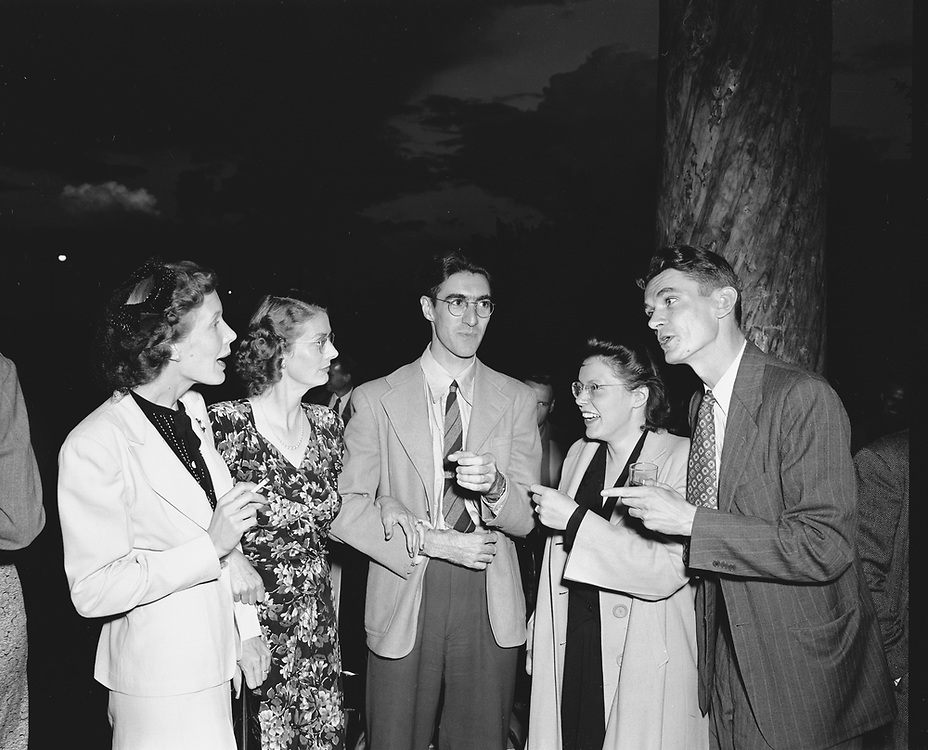
Pictured: Los Alamos Laboratory scientists and staff (including Betty Brixner, Robert D. Richtmyer, Elizabeth Graves, and Charles Critchfield) at a social gathering at Fuller Lodge in Los Alamos, August 1946 — not a photograph of an actual green fireball, nor of the classified February 1949 conference itself, but a genuine period photograph of the same close-knit Los Alamos scientific community, taken roughly two years before that community would confront the phenomenon. No photograph of an actual green fireball is known to exist in any public archive — the purpose-built Project Twinkle camera network described in this file spent two years trying and failing to obtain one — and the 1949 conference itself was never photographed; only a declassified text transcript survives.
Theoretical Alignment
The Green Fireballs case resists easy sorting into any single framework, and this file's modest ETH score reflects that honestly rather than inflating it for drama. No witness, including the physicists who watched from their own front porches, ever described a structured craft, an occupant, or a clearly artificial trajectory change — only a brilliant, uniformly green light behaving in ways that the era's foremost meteor specialist insisted a meteor should not. The non-trivial ETH figure exists because the phenomenon was never conventionally solved even by the scientists most motivated to solve it, and because Los Alamos scientists, in an informal lunch-time conversation with Edward Ruppelt around 1952, floated the idea of unmanned test vehicles sent down from a craft hovering high above the Earth. The modest Psycho-Social score reflects not crowd hysteria — the primary 1948–49 witnesses were overwhelmingly trained pilots, counterintelligence agents, and research scientists making sober, contemporaneous reports — but the genuine Cold War anxiety (fear of Soviet reconnaissance devices hovering over America's only atomic-weapons production sites) that shaped how urgently the case was investigated.
Background
By late 1948, central New Mexico held a concentration of nuclear secrets unmatched anywhere else. Los Alamos National Laboratory, the birthplace of the atomic bomb, remained the country's primary nuclear-weapons design laboratory under director Dr. Norris Bradbury, who had succeeded J. Robert Oppenheimer in 1945. On the edge of Albuquerque, Sandia Base handled weapons engineering and assembly work, and adjoining Kirtland Air Force Base hosted the Air Force Office of Special Investigations' 17th District. As Ruppelt put it, "within 100 miles of Albuquerque were two installations that were the backbone of the atomic bomb program. Los Alamos and Sandia Base." At the University of New Mexico in Albuquerque, Dr. Lincoln La Paz had founded the Institute of Meteoritics in 1945, giving the region a professional meteor specialist.
The broader national mood was tense. The Berlin Blockade, then in its sixth month, had brought the United States and the Soviet Union to their most dangerous postwar confrontation yet. Less than a year earlier, Captain Thomas Mantell had died pursuing an unidentified object over Kentucky, and the Air Force's Project Sign, soon to be reorganized as Project Grudge, was still groping toward a policy on "flying saucer" reports. Any unexplained aerial phenomenon appearing repeatedly over the country's most classified atomic-weapons facilities was going to be treated as a potential security matter, and it was.
Complete Timeline
| Date | Event |
|---|---|
| 1945 | Dr. Lincoln La Paz founds the Institute of Meteoritics at the University of New Mexico, becoming the region's foremost professional authority on meteors and meteorites. |
| Late November 1948 | Residents around Albuquerque begin reporting brief "green flares" or streaks in the night sky, initially dismissed by some observers as ordinary flares or fireworks. |
| December 5, 1948, ~9:27 PM | A USAF C-47 transport at 18,000 feet, 10 miles east of Albuquerque, piloted by Captain Goede, sees a green ball of fire rise from near the eastern slopes of the Sandia Mountains, arch upward a little and level out; the crew had seen an identical object twenty-two minutes earlier near Las Vegas, New Mexico (Ruppelt). |
| December 5, 1948, ~9:35 PM | The captain of Pioneer Airlines Flight 63, a DC-3 approaching Las Vegas, New Mexico, from the east, calls Kirtland Air Force Base tower: a fireball approached nearly head-on, changing from orange-red to green, "as big, or bigger, than a full moon," and he turned sharply to avoid it (Ruppelt). Interviewed by OSI the next day, the pilot, Van Lloyd, and his copilot described it differently, as a white flash and then a whitish-orange object (Carpenter's chronology). |
| December 6–14, 1948 | La Paz and Kirtland intelligence officers interview witnesses across northern New Mexico; by Ruppelt's account they identify eight separate fireballs on December 5 and search the predicted impact area of the brightest without finding anything. |
| December 8, 1948, 6:33 PM | Kirtland OSI agents flying near Las Vegas, New Mexico, see a green light "much more intense" than a standard green flare, on a flat trajectory, lasting about two seconds before burning out (their report, quoted by Ruppelt). |
| December 12, 1948, ~9:01 PM | Dr. La Paz, driving with Lt. Allan B. Clark of the Sandia Base Civil Air Patrol unit and Maj. Charles L. Phillips, sees a bright green fireball near Starvation Peak, close to Bernal, moving east to west almost horizontally, and measures its path with a transit. By his own plot (per Carpenter's chronology) it traveled a nearly level 25-mile path at about 50,000 feet or less at about 10 miles per second. |
| December 20, 1948, 11:35 PM | Los Alamos security personnel report a greenish-white light that glides down and levels off; La Paz plots it as descending at about 45 degrees before flying horizontally six miles north of Los Alamos. |
| December 29, 1948 | In a memo, La Paz writes that an object with the path and peculiarities reported on December 20 "was not a falling meteorite." |
| December 1948 – January 1949 | Reports continue through December and January; by Ruppelt's account the fireballs appeared "almost nightly" for a time. |
| January 13, 1949 | Army Intelligence at Fourth Army Headquarters in Texas circulates a memo suggesting the phenomena could represent "radiological warfare experiments by a foreign power," explicitly citing their recurrence near sensitive installations as grounds for continued scientific investigation. |
| January 30, 1949, 5:45 PM MST | The brightest fireball of the wave; La Paz says he interviewed more than 100 eyewitnesses within two hours, and later plotted a nearly horizontal path about 143 miles long from New Mexico into West Texas (Carpenter's chronology). No sound is reported. |
| February 16, 1949 | A Secret "Conference on Aerial Phenomena" meets at 1:00 PM in room P-162 of the Los Alamos Scientific Laboratory. The attendee list names Fourth Army intelligence officers (Maj. Winn, Maj. Godsoe, Capt. Neef), Cmdr. Mandelkorn of AFSWP, La Paz, FBI agent Maxwell, AEC security official Morgan, and from the University of California-run laboratory Norris Bradbury, Holloway, Hoyt, Manley, Frederick Reines and Edward Teller. La Paz presents his case and Teller questions him closely. |
| 1948–1949 | Lt. Col. Doyle Rees, commanding the 17th District of the Air Force Office of Special Investigations at Kirtland, oversees the OSI inquiry; reports and correspondence reach the Air Force's Director of Special Investigations, Brig. Gen. Joseph F. Carroll. |
| September–October 1949 | A classified Chief of Staff letter, "Light Phenomena" (September 14), sends Lt. Col. Frederic C. E. Oder of the Air Force's Cambridge Research Division to a second Los Alamos conference on October 14, 1949, which concludes that the available information is "not sufficiently quantitative" and that instrumental observation is essential. |
| February–March 1950 | La Paz declines (February 2) to run a study. Holloman AFB sets up an observation post on February 21; on March 16 an Air Materiel Command letter directive confirms a three-part program: Askania theodolite triangulation by Land-Air, Inc., Mitchell cameras with spectrum gratings, and Signal Corps frequency measurements. |
| April 1, 1950 – March 31, 1951 | Land-Air keeps watch with two Askania stations, first at Vaughn, New Mexico, then from about November 1950 at Holloman Air Force Base. The grating cameras are little used after their operators are withdrawn for the Korean War, and the Signal Corps equipment is never used. |
| April 27 & May 24, 1950 | "Some photographic activity" occurs, but the two cameras do not record simultaneously, "so that no information was gained" (Elterman). Later researchers cite an analysis from a single station's data putting the objects near 150,000 feet, which cannot be confirmed without triangulation. |
| August 30–31, 1950 | Aerial phenomena are seen over Holloman during a missile launch (August 30) and after a V-2 launch (August 31); "much film was expended," but "proper triangulation was not effected." |
| September 11, 1950 | Holloman arranges for Maj. Gover, commanding the 93rd Fighter Squadron at Kirtland, to be on call to pursue aerial objects; he is "not authorized to shoot." |
| 1950–1951 | Dr. Louis Elterman of the Geophysics Research Division's Atmospheric Physics Laboratory is the project scientist; Fred Whipple of Harvard studies weather and Moon-phase correlations of the reports. |
| November 27, 1951 | Elterman's final report finds the results "essentially negative," attributes most sightings to aircraft, balloons, rockets, birds, clouds and meteors, finds "no indication" that the green fireballs are "anything but natural phenomena," and recommends no further spending. |
| 1952 | Capt. Edward J. Ruppelt, head of Project Blue Book since 1951, reviews the green fireball and Project Twinkle files and later hears Los Alamos scientists speculate, over lunch, that the fireballs could be unmanned probes. |
| 1956 | Ruppelt's memoir, The Report on Unidentified Flying Objects, devotes a full chapter to the Green Fireballs, Project Twinkle, and Project Grudge, bluntly summarizing Twinkle's outcome: "Project Twinkle was a bust. Absolutely nothing was photographed." |
| October 19, 1985 | Dr. Lincoln La Paz dies, never having accepted that the fireballs were natural; he had suggested they might be U.S. or foreign artificial devices. |
| July 10, 2026 | The U.S. Department of War includes a copy of the February 16, 1949 conference transcript in the fourth release of UAP records under PURSUE, drawing renewed media coverage. The transcript was not new: a 24-page copy had been reproduced online since at least 2005 (Patrick Gross). |
First Reports: Late November 1948
The earliest green fireball reports around Albuquerque in late November 1948 were unremarkable enough to be dismissed. Residents described brief green streaks or flares in the night sky, and initial explanations leaned toward ordinary military flares, fireworks, or run-of-the-mill meteors — explanations that, for a few weeks, satisfied nearly everyone who heard them. What changed that calculus was not any single dramatic sighting but persistence: as December 1948 opened, the reports did not taper off the way a novelty or a brief meteor shower normally would. They intensified, and they began arriving from witnesses whose professional judgment was considerably harder to dismiss than a startled resident glancing out a window.
December 5, 1948: Two Aircrews, One Night
The case's decisive turn came on the night of December 5, 1948. At 9:27 PM, an Air Force C-47 flying at 18,000 feet ten miles east of Albuquerque, with Captain Goede at the controls, saw a green ball of fire that "had started low, from near the eastern slopes of the Sandia Mountains, arched upward a little, then seemed to level out," in Ruppelt's retelling. The crew had seen an identical object twenty-two minutes earlier near Las Vegas, New Mexico, and called Kirtland tower.
A few minutes later the captain of Pioneer Airlines Flight 63, a DC-3 heading west toward Las Vegas, called Kirtland Air Force Base tower. He and his copilot had seen what they first took for a shooting star but which seemed too low and too flat; it approached nearly head-on, changing from orange-red to green, and he turned the DC-3 sharply, thinking a collision was imminent. "Just before he swerved the DC-3, the fireball was as big, or bigger, than a full moon" (Ruppelt). Carpenter's chronology, drawn from the OSI files, names the pilot as Van Lloyd and his copilot as James Smith, and notes that when OSI agent Melvin Neef interviewed them the next day they described it differently, as a white flash followed by a whitish-orange object, and could give no estimate of its size or range.
These two same-night reports, one military and one civilian, together with others phoned in from across northern New Mexico, turned the "green flares" from a local curiosity into a matter Kirtland's intelligence officers escalated. "By morning a full-fledged investigation was under way," Ruppelt wrote, and the officers called in Dr. Lincoln La Paz.
Dr. La Paz Enters the Investigation
Few scientists were better positioned to judge the December 5 reports than Lincoln La Paz, founder of the University of New Mexico's Institute of Meteoritics and an experienced recoverer of meteorite falls. He set out to plot the fireballs' paths from witness bearings and search where they should have landed. By Ruppelt's account, La Paz and Kirtland intelligence officers determined that eight separate fireballs had been seen on December 5, traced the brightest eastward to the Texas border, and searched its predicted impact area repeatedly without finding anything; La Paz told Ruppelt this was the first time he seriously doubted they were meteorites.
His objections, as he later laid them out to the Los Alamos conference and to Ruppelt, were consistent: the trajectories were too flat, the color was a vivid green unlike the pale yellowish green of documented green meteors (he carried a color chart and found witnesses consistently picked the vivid shade), there was no sound, and no fragments were ever found. He had observed 414 Geminid meteors since 1915, he noted, and none had been green (Carpenter's chronology, from La Paz's memos).
December 12, 1948: La Paz Witnesses One Himself
On the evening of December 12, 1948, La Paz saw a fireball himself. Returning from an unsuccessful debris search near Las Vegas with Lt. Allan B. Clark of the Sandia Base Civil Air Patrol unit and Maj. Charles L. Phillips, the Air Force-CAP liaison officer, he was on Highway 84 near Starvation Peak, just before Bernal, at about 9:01 PM when he saw a bright green fireball moving east to west only three or four degrees above the horizon, on an almost horizontal path; it broke into several fragments and burned out. They stopped, La Paz measured the path with a transit, and they heard no sound. Triangulating with observers at Los Alamos, he plotted a nearly level 25-mile path at about 50,000 feet or less and a speed of about 10 miles per second (some 36,000 mph), according to Carpenter's chronology of his notes; he wrote that he was "now convinced the various 'green flare' incidents reported to the O.S.I. are not meteoric in nature." At the February conference he gave a wider range for the green fireballs generally, "something between 3 miles per second and 12 miles per second," depending on the map used.
At the February 16, 1949 conference, La Paz used this event to make his case. He called it the only incident he could personally vouch for and said it "was most certainly not a conventional meteorite fall." He stressed its "very remarkable hue of green, not heretofore observed, to my knowledge, in the case of any conventional meteor falls," and the silence: "this possibly is the most implausible feature of all, that although it produces light visible at distances of the order of 400 miles, it doesn't make a sound." Press coverage of the 2026 re-release also quotes him describing a light that appeared "in full intensity instantly." Teller asked whether the intensity stayed constant and how long it lasted ("almost exactly two seconds," La Paz said), and later reasoned that the size of the shock wave, and hence the sound, depends on the object's velocity and size, so that a small enough object might be silent.
The Wave Intensifies: December 1948 – January 1949
Sightings continued through December 1948 and January 1949. On December 20, Los Alamos security personnel watched a greenish-white light glide down and flatten out into level flight; La Paz plotted it as descending at about 45 degrees from around 50,000 feet to about 12,000 feet before flying horizontally, six miles north of Los Alamos, and wrote on December 29 that it "was not a falling meteorite." On January 13, 1949, Col. Eustis Poland, intelligence officer (G-2) at Fourth Army Headquarters, forwarded a memo reporting that New Mexico agencies believed a foreign power might be making "sensing shots" with a self-disintegrating device, or conducting "radiological warfare experiments," or that the United States might be "carrying out some top-secret experiments," and asking that a scientific board be sent. On January 30, the wave produced its brightest fireball; La Paz said he interviewed more than 100 eyewitnesses within two hours. In late January, air samples collected by Dr. William Crozier at the New Mexico School of Mines in Socorro contained microscopic copper spherules, which La Paz took as evidence of artificial objects while Crozier was more cautious (Carpenter's chronology, from La Paz's correspondence).
Alarm at the Top: OSI and the Fear of Foreign Surveillance
The investigation was run largely out of Kirtland Air Force Base by the 17th District of the Air Force Office of Special Investigations under Lt. Col. Doyle Rees, with OSI special agents such as Melvin Neef doing much of the field work alongside Army intelligence officers from Sandia Base. Their reports and correspondence went up to the Air Force's Director of Special Investigations, Brig. Gen. Joseph F. Carroll. By Ruppelt's account, almost everyone involved, "including the intelligence officers at Kirtland AFB, Air Defense Command people, Dr. La Paz, and some of the most distinguished scientists at Los Alamos," had seen at least one fireball. On December 19, La Paz, OSI and FBI agents set up cameras and transits at Los Alamos checkpoints, and an AEC radio engineer watched with an SK-1M air-search radar, but nothing unusual was detected.
The February 16, 1949 Los Alamos Conference
The "Conference on Aerial Phenomena" met at 1:00 PM on February 16, 1949, in conference room P-162 of the Los Alamos Scientific Laboratory. Los Alamos security chief Sidney Newburger opened it and stated that the subject was classified Secret. The attendee list names three Fourth Army intelligence officers (Maj. Winn, Maj. Godsoe and Capt. Neef), Commander Mandelkorn of the Armed Forces Special Weapons Project, La Paz, FBI agent Maxwell, AEC security official Morgan, and, from the University of California-run laboratory, director Norris Bradbury, Holloway, Hoyt, Manley, Frederick Reines and Edward Teller. Joseph Kaplan is not on the list; La Paz told the meeting that Kaplan, on an earlier visit to the University of New Mexico, had said "certainly these could not have been conventional meteor falls." Ruppelt's 1956 account of a mid-February conference that included Kaplan and Project Sign, lasted two days and decided the fireballs were "a natural phenomenon of some kind" does not match the February 16 transcript and may conflate it with the later October 1949 conference.
The transcript, reproduced online in 24 pages by Patrick Gross since at least 2005 and re-released by the Department of War in July 2026, records a genuine scientific argument. La Paz walked the group through the December 12 sighting and his objections on trajectory, color, silence and missing debris, and noted that the Geminid shower had been his own first explanation before he rejected it. He told Teller: "Nothing like this, to my knowledge, has ever been observed in the case of meteorite drops." Asked for an explanation, he offered one he said had got his "ears promptly boxed": that these were "defensive manoeuvers of some higher U.S. command." Commander Mandelkorn found it "incredible" that a solid object at 8 to 10 miles altitude would make no sound, and Teller suggested an object "as small as an inch or smaller" might be silent. The transcript does not record a formal conclusion. The speculation that the fireballs were unmanned probes sent down from a craft hovering high above the Earth does not come from this meeting; it comes from an informal lunch-time discussion Ruppelt had with Los Alamos scientists around 1952.
By Ruppelt's account the conference recommended that the Air Force's Cambridge Research Laboratory take over the investigation and set up a project to photograph the fireballs and measure their speed, altitude and size. According to Elterman's final report, the immediate trigger was a September 14, 1949 Chief of Staff letter, "Light Phenomena," and a second Los Alamos conference on October 14, 1949, attended by Lt. Col. Frederic C. E. Oder of the Cambridge Research Division, which concluded that instrumental observation was essential. That became Project Twinkle.
Project Twinkle: A Camera Network Built to Catch a Fireball
Project Twinkle was the Air Force's main instrumented attempt to resolve the case. After La Paz declined to run a study (February 2, 1950), and after Holloman Air Force Base set up its own observation post (February 21), a March 5, 1950 conference at Wright-Patterson and a March 16 Air Materiel Command directive set up a three-part program: Askania cinetheodolite triangulation by the contractor Land-Air, Inc.; Mitchell cameras with spectrum gratings operated by Holloman personnel; and electromagnetic-frequency measurements with Signal Corps equipment. Land-Air kept watch at two Askania stations from April 1, 1950, first at Vaughn, New Mexico, where reports had been frequent, and from about November 1950 at Holloman Air Force Base. The project scientist was Dr. Louis Elterman of the Geophysics Research Division's Atmospheric Physics Laboratory.
Ruppelt, writing in 1956, described a plan for three cinetheodolite stations of which "only one was available," moved reactively from place to place: "Project Twinkle was a bust. Absolutely nothing was photographed." Elterman's report is somewhat different but no more encouraging. "Some photographic activity occurred on 27 April and 24 May, but simultaneous sightings by both cameras were not made, so that no information was gained." Phenomena seen over Holloman during a missile launch on August 30, 1950 went unrecorded because Land-Air was not notified, and on August 31, after a V-2 launch, "much film was expended" but "proper triangulation was not effected." The grating cameras "functioned very little" after their military operators were withdrawn for the Korean War, and the Signal Corps monitoring was never set up because the phenomena did not justify the $50,000 a year it would cost. From September 11, a fighter commander at Kirtland was on call to pursue objects but was "not authorized to shoot." The second contract period (to March 31, 1951) produced no camera sightings at all. Later researchers cite an analysis of a single station's April 1950 film that put objects near 150,000 feet and about 30 feet across; without a second station, that figure could not be triangulated.
A Program That Photographed Nothing
Elterman's final report, dated November 27, 1951, found the results "essentially negative." Most observations, it said, were attributable to "ordinary man-made objects such as airplanes, balloons, smoke rockets, etc.," and many to natural causes such as birds, planets, meteors and clouds; there was "no indication that even the somewhat strange observations often called 'Green Fireballs' are anything but natural phenomena." Fred Whipple of Harvard had found that of 72 reported observations, 45 came with the Moon up, and that on the 53 report nights with weather data for Las Cruces, only 10 were clear. Yet the report also conceded that the year of vigilance "does not permit a conclusive opinion," and it recommended "no further fiscal expenditure." Ruppelt, who reviewed the files after taking over Project Blue Book in 1951, called Twinkle "a bust." A program that never got simultaneous camera coverage cannot show whether the fireballs were absent or simply missed.
The 2026 Declassification: A Transcript Resurfaces
On July 10, 2026, the U.S. Department of War published the fourth release of Unidentified Anomalous Phenomena records under the Presidential Unsealing and Reporting System for UAP Encounters (PURSUE), about 40 files, including a copy of the February 16, 1949 conference transcript. News coverage presented it as newly declassified, but the transcript had long been available: a 24-page reproduction has been online on Patrick Gross's site since at least 2005, and Joel Carpenter's chronology for Project 1947 drew on La Paz's papers and Air Force, DOE and FBI files. The re-release did not resolve the mystery, but it brought the case renewed attention.
Key Witnesses
Dr. Lincoln La Paz
The case's central investigator and, on December 12, 1948, one of its witnesses. La Paz applied his meteorite-recovery methods to the green fireballs and concluded that they were not meteoric: too flat in trajectory, too vivid in color, silent, and never followed by debris. He suspected artificial devices (U.S. or foreign) rather than anything exotic, and in 1951 told Air Force researchers they might be "of our own military origin, but if not, they are a matter of serious concern." He declined in February 1950 to run the Air Force study that became Project Twinkle. He died in 1985.
Dr. Edward Teller
Teller attended the February 16, 1949 conference and pressed La Paz on the December 12 sighting's intensity and duration. He also suggested that a small enough object, "as small as an inch or smaller," might pass without an audible shock wave. La Paz later told Ruppelt that Teller, like Kaplan, thought the fireballs were natural meteors.
Dr. Norris Bradbury
Oppenheimer's successor as laboratory director, Bradbury attended the February 1949 conference at his laboratory and questioned La Paz about green meteors, colors and sound.
Dr. Frederick Reines
A Los Alamos physicist since 1944, Reines is on the February 16, 1949 attendee list, years before his discovery of the neutrino with Clyde Cowan, for which he shared the 1995 Nobel Prize in Physics.
Dr. Joseph Kaplan
A UCLA upper-atmosphere physicist, Kaplan had visited the University of New Mexico early in the wave and, per La Paz at the February 1949 conference, said "certainly these could not have been conventional meteor falls." He is not on the February 16 attendee list; Ruppelt places him at a Los Alamos conference. By the time Ruppelt met him around 1951–52, Kaplan, who asked "What ever happened to the green fireballs?", was not convinced by La Paz's view that they might be man-made. No role for him in running Project Twinkle is documented in Elterman's report.
Lt. Col. Doyle Rees
As commander of the 17th OSI District at Kirtland, Lt. Col. Rees oversaw the OSI investigation of the green fireballs; La Paz's reports on the fireballs were addressed to him, and Rees approved the all-out ground search after the January 30, 1949 fireball.
Brig. Gen. Joseph F. Carroll
Founding head of the Air Force Office of Special Investigations, Carroll received correspondence on the green fireball investigation from Kirtland (Carpenter's chronology cites "Carroll-Tyler" and "Tyler-Carroll" letters of December 1948), placing the case within the counterintelligence chain responsible for the atomic-weapons installations.
C-47 Aircrew (Captain, recorded as "Goede")
On the night of December 5, 1948, this C-47 crew, flying at 18,000 feet ten miles east of Albuquerque, reported a green ball of fire near the Sandia Mountains, having seen an identical object twenty-two minutes earlier near Las Vegas, New Mexico. Ruppelt names the pilot as "a Captain Goede."
Pioneer Airlines Flight 63 Captain (recorded as "Van Lloyd")
Minutes after the C-47 crew's report on December 5, 1948, this DC-3 captain called Kirtland tower to report a fireball approaching nearly head-on, "as big, or bigger, than a full moon" (Ruppelt). Carpenter's chronology, drawn from OSI files, names him as Van Lloyd and notes that the next day he and his copilot described a white flash and a whitish-orange object instead.
The Five Observables Assessment
The Five Observables framework, developed by former AATIP director Luis Elizondo, is used to classify UAP encounters by performance characteristics exceeding known technology of their era. Applied to the Green Fireballs, the framework returns a genuinely mixed result:
Assessment: Anti-Gravity Lift is rated absent: no witness, including the trained physicists among them, ever described a visible propulsion mechanism of any kind. Instant Acceleration is rated speculative on the strength of La Paz's own repeated, specific testimony that the December 12, 1948 fireball appeared "in full intensity instantly" rather than building gradually — a genuinely unusual claim from a rigorous professional observer, though also explainable as simple combustion ignition rather than true instantaneous acceleration. Hypersonic Velocity is rated speculative because La Paz's own plot of the December 12 event gave about 10 miles per second (some 36,000 mph), and at the conference he gave 3 to 12 miles per second for the green fireballs generally; this file treats that figure cautiously, since it derives from a single ground-triangulation exercise rather than instrumented radar or photographic confirmation, and speeds of that order were never independently reproduced by Project Twinkle's later camera program. Low Observability is rated absent: every fireball in the case was, by definition, extremely conspicuous, visible to over 100 independent witnesses in the January 30, 1949 event alone. Trans-Medium travel is rated absent; no water or space transition was ever reported. Taken together, the data support a genuinely unresolved phenomenon rather than either a clear exotic craft or an open-and-shut conventional explanation.
Evidence Assessment
Supporting Anomalous Origin
- The most qualified scientific witness in the case, a professional meteor astronomer, personally observed a fireball, measured its path with a transit, and told the February 1949 conference it "was most certainly not a conventional meteorite fall."
- Multiple independent, professionally trained witnesses (commercial and military aircrews) reported green fireballs on the same night, December 5, 1948, though the airline crew's description changed when OSI interviewed them the next day.
- Repeated, methodical searches of calculated impact zones, using techniques that had reliably recovered real meteorites elsewhere, produced no fragments, including an all-out ground and air search after the January 30, 1949 fireball.
- Project Twinkle, a 1950–51 camera watch designed to triangulate the phenomenon, never obtained a usable record of one.
- The February 1949 conference at Los Alamos, with Teller, Bradbury and Reines present, ended without a recorded conclusion; Teller could only suggest that a very small object might be silent.
Supporting Conventional Explanation
- The wave's onset in early December 1948 coincides with the annual Geminid meteor shower's active period, a documented natural source of unusually bright, sometimes green-tinted fireballs.
- Green-colored meteors are a genuinely documented natural phenomenon, typically attributed to nickel and magnesium emission lines during atmospheric entry.
- Ruppelt reports that a 1949 Los Alamos conference decided the fireballs were "a natural phenomenon of some kind," Teller and Kaplan reportedly favored natural meteors, and Project Twinkle's 1951 final report saw "no indication" that the green fireballs were "anything but natural phenomena."
- Most meteors, including genuinely bright bolides, are entirely consumed in the atmosphere and leave no recoverable fragment, meaning the absence of debris is not, on its own, decisive evidence against a natural origin.
Why "Disputed"
This file rates the Green Fireballs case DISPUTED because its two strongest facts point in opposite directions. On one side, it is one of the best-credentialed sighting waves in the catalogue: a career meteor specialist saw and measured one himself and argued, on specific grounds (flatness, color, silence, no debris), that they were not meteors, and Kirtland's OSI, Army intelligence and Los Alamos security took the reports seriously enough to convene a Secret conference with Teller and Bradbury. On the other side, no fragment, photograph or radar return was ever obtained; La Paz's speeds and paths rest on his own plots of witness bearings; the airline crew's account changed within a day; Twinkle's camera watch never once recorded simultaneously; and the official verdict, from Ruppelt's account of the 1949 conferences to Elterman's 1951 report, was that the fireballs were probably natural. A case this thoroughly investigated that still produced no instrumental record is what this site's "Disputed" rating exists to describe.
Sensor & Instrumentation Detection Profile
For a case this institutionally significant, the instrumented record is thin. Every sighting in the original wave was naked-eye or cockpit observation. La Paz brought the only rigorous method available, transit measurements and witness-bearing triangulation adapted from his meteorite-recovery work. A short radar-and-camera watch at Los Alamos on December 19, 1948, using an SK-1M air-search radar, detected nothing unusual. The Air Force's purpose-built response, Project Twinkle (1950–1951), deployed Askania cinetheodolites near Vaughn and Holloman Air Force Base and Mitchell cameras with spectrum gratings; the planned Signal Corps frequency monitoring was never set up. The cameras never recorded an event simultaneously from two stations, so no object was triangulated.
Environmental & Geospatial Context
The core-wave reports mostly describe clear desert night skies; Ruppelt says proponents of the meteor explanation argued that the many sightings reflected "unusually clear" weather across the Southwest that winter. Whipple's later check for Project Twinkle, covering 53 report nights between December 1948 and March 1951, found only 10 clear at Las Cruces, which he thought might point to moonlit clouds. Geospatially, the sightings clustered within roughly 100 miles of Albuquerque, encompassing Los Alamos, Kirtland and Sandia, and later Vaughn and Holloman, a pattern that maps closely onto the period's atomic-weapons infrastructure. December also falls within the Geminid meteor shower, La Paz's own first explanation, which he rejected after observing that the Geminids he watched were not green and fell steeply.
Observer Credibility & Occupational Profile
Few cases in this catalogue can match the credentials of the Green Fireballs witness pool: airline and military aircrews reporting through official channels; OSI agents of the 17th District under Lt. Colonel Doyle Rees, who flew their own night patrols and saw one on December 8; the meteor specialist Dr. Lincoln La Paz of the University of New Mexico's Institute of Meteoritics, who saw one himself; and, by Ruppelt's account, "some of the most distinguished scientists at Los Alamos." The February 1949 conference included future Nobel laureate Dr. Frederick Reines, Dr. Edward Teller and laboratory director Dr. Norris Bradbury; Joseph Kaplan, though not on that meeting's attendee list, had also discussed the reports with La Paz.
Physical & Material Assays
No physical trace of any green fireball was ever recovered. La Paz applied the impact-zone search methods that had located real meteorites elsewhere, including an all-out ground and air search across eastern New Mexico and West Texas after the January 30, 1949 fireball, without finding a fragment. The one physical claim is the copper spherules found in air samples taken by Dr. William Crozier at the New Mexico School of Mines on January 25–26, 1949. They are documented in La Paz's correspondence as summarized in Joel Carpenter's chronology (and discussed by Kevin Randle), but no analysis tying them to a particular fireball was published, and Crozier himself was cautious.
Historical Precedents & Archive Matches
The Green Fireballs case came barely a year after the Roswell incident and Thomas Mantell's fatal January 1948 pursuit, while Project Sign was turning into Project Grudge. Unlike those cases, it was run mainly by Kirtland's OSI district, Army intelligence and the Los Alamos and Sandia security apparatus rather than by Wright-Patterson's UFO desk, reflecting fears of Soviet activity over the atomic-weapons infrastructure months before the Soviet Union's first atomic test in August 1949. Project Twinkle's later camera watch at Holloman links it to the White Sands 1951 radar-visual-photographic sighting documented at the same base.
Material Analysis
No fragment of any green fireball has ever been recovered or catalogued, despite repeated searches by La Paz using methods that had located real meteorite falls, and Project Twinkle obtained no photographs or spectra. The only material claim is the copper spherules in Crozier's January 1949 air samples, documented in La Paz's correspondence (per Carpenter's chronology); no published analysis connects them to a specific fireball.
Supporting a Genuinely Unusual Stimulus
- A professional meteoriticist's own field-proven recovery methodology, applied dozens of times to calculated impact zones, never once produced a fragment.
- Project Twinkle obtained no photographic or spectrographic record of a green fireball.
Supporting a Mundane, Fully-Consumed Meteoric Origin
- The overwhelming majority of bright meteors, including genuine bolides far larger than most reported green fireballs, are entirely vaporized in the atmosphere and leave no recoverable material at all.
- Project Twinkle's practical failures — cameras that never recorded simultaneously, grating-camera operators withdrawn for Korea, no Signal Corps monitoring, and (per Ruppelt) a single camera moved reactively — are well documented and offer a mundane, non-conspiratorial explanation for why no photograph was obtained, regardless of what the fireballs actually were.
The Conventional Explanation Candidate: Natural Bolide / Meteor Swarm Misidentification
The explanation that Ruppelt says a 1949 Los Alamos conference reached, and that Project Twinkle's 1951 report endorsed, holds that the green fireballs were an unusual but natural meteoric phenomenon. La Paz himself first suspected the Geminid shower, which peaks around December 10–12. Green coloration in bright meteors is real, generally attributed to emission lines of elements such as nickel and magnesium, and flat-looking trajectories can result from viewing geometry; the proponents at the conference also argued that the winter had been unusually clear. Twinkle's report added that many sightings were probably balloons, aircraft, rockets, birds or moonlit clouds. This candidate deserves serious weight because it was the view of several of the scientists best placed to judge it.
Where the Bolide Theory Falls Short
Its central weakness is that the era's single most qualified witness — La Paz himself, whose entire career was built on correctly distinguishing meteors from everything that resembles one — personally rejected it after direct observation, on three specific and consistently repeated technical grounds: a trajectory too flat for a body falling under gravity, a color distinctly more saturated than the pale green of documented meteors, and a total absence of the sound and shockwave that meteorite falls of the reported scale reliably produce. The February 1949 conference recorded no answer to his objections; the later "natural phenomenon" verdicts (in Ruppelt's account and in Twinkle's report) are judgments, not refutations, and Project Twinkle's search for corroborating instrumented data found none.
Ball Lightning / Rare Atmospheric-Electrical Phenomenon
A second candidate proposes a rare atmospheric-electrical phenomenon akin to ball lightning — a genuinely documented, if poorly understood, natural effect that can produce a glowing, colored, silently moving sphere. This candidate has some appeal for explaining the total absence of sound, since ball lightning is not associated with sonic booms. It struggles considerably, however, against the case's best-documented core evidence: ball lightning events are typically brief, localized, and associated with thunderstorm activity, none of which matches the clear-sky, multi-mile, sustained horizontal transits that La Paz and dozens of other witnesses independently described, and it offers no ready explanation for the phenomenon's specific, repeated concentration directly over Los Alamos, Sandia, and Kirtland rather than randomly across the broader region.
Classified or Foreign Military Ordnance
A third candidate, taken seriously enough by Army Intelligence to circulate formally on January 13, 1949, holds that the fireballs represented either a classified U.S. weapons test or a foreign (implicitly Soviet) reconnaissance or radiological-warfare device, given their persistent concentration over the nation's atomic-weapons infrastructure. This candidate is historically important as a genuine measure of Cold War anxiety, but it has never been substantiated: no U.S. program has ever been declassified or acknowledged as the source, no debris or hardware consistent with a foreign device was ever recovered, and the sightings' multi-year persistence across a wide, unpredictable geographic pattern is a poor match for a single covert test program, which would more plausibly produce a tighter cluster of events around specific, deliberate test dates.
Natural Bolide/Meteor Swarm Misidentification
Plausible InconclusivePlausible: favored by the official verdicts (Ruppelt's account of the 1949 conferences; Twinkle's 1951 report). Inconclusive: never reconciled with La Paz's specific trajectory, color, and acoustic objections, and never independently confirmed by Project Twinkle's dedicated instrumentation.
Related Cases
Confirmed Documents & Official Records
The Department of War's official public release portal for declassified UAP records, including the fourth tranche (July 2026) including a copy of the February 16, 1949 Los Alamos green fireball conference transcript (previously available through FOIA).
DECLASSIFIEDThe official announcement of the fourth PURSUE release, which included the declassified 1949 Los Alamos Atomic Energy Commission conference file discussed throughout this case.
UNCLASSIFIED (announcement)National Archives finding aid for the roughly 130,000 pages of Project Sign, Project Grudge, and Project Blue Book case files transferred from Wright-Patterson AFB, including the Green Fireballs and Project Twinkle documentation (Record Group 341).
UNCLASSIFIED (declassified)LANL's own account of the green fireball FOIA record, confirming the National Security Research Center's holdings on the case and the steady stream of public requests it still receives.
UNCLASSIFIEDSearch Government Archives Directly
Further Reading — Recommended Literature
The Report on Unidentified Flying Objects
Written by the first Project Blue Book chief to systematically review the Green Fireballs and Project Twinkle files; his blunt "it was a bust" verdict on Twinkle remains the most influential single account of the case's outcome.
Watch the Skies!: A Chronicle of the Flying Saucer Myth
A rigorously documented, skeptically minded history of American UFO cases that situates the Green Fireballs within the broader Project Sign-to-Grudge institutional transition of 1948–49.
Field Guide to Meteors and Meteorites
A technical reference on actual meteor trajectory, color, and flight behavior, directly relevant to weighing La Paz's own professional objection that the fireballs' descending-then-leveling flight path was atypical of ordinary meteoritic bodies.
DISCLOSURE: Some links above are affiliate links. If you purchase through them, OverClassified receives a small commission at no additional cost to you. This helps support independent research.
Essential Viewing
Newly Released UFO Files Detail Mysterious "Green Fireballs"
Local news coverage (LOCAL 12) of the July 2026 PURSUE declassification, including the 1949 Los Alamos conference transcript.
New UFO Files: "Green Fireballs" Among Other Mysterious Objects
National news coverage (The National Desk) of the same 2026 declassification release, focused specifically on the green fireball documents.
The Report on UFOs, Part 4: Green Fireballs, Project Twinkle, Little Lights, and Grudge
An audiobook reading of Edward J. Ruppelt's own primary-source chapter on the case, direct from his 1956 memoir.
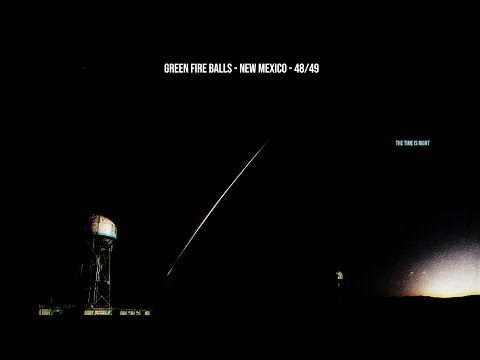
Green Fireballs over New Mexico (48/49)
A narrative overview of the 1948–49 wave, the La Paz investigation, and the February 1949 Los Alamos conference.
Sources
- "Green fireballs," Wikipedia. en.wikipedia.org
- Ruppelt, Edward J. The Report on Unidentified Flying Objects, Doubleday, 1956, Chapter Four ("Green Fireballs, Project Twinkle, Little Lights, and Grudge"). en.wikisource.org
- National Investigations Committee on Aerial Phenomena (NICAP). "The Nuclear Connection: The New Mexico Sightings." nicap.org
- Newsweek. "UFO Files Reveal 1949 Los Alamos 'Green Fireball' Mystery," 2026. newsweek.com
- HISTORY.com. "When Mysterious Green Fireballs Worried the US Government." history.com
- Los Alamos National Laboratory. "FOIA Requests at the National Security Research Center," The Vault, 2024. lanl.gov
- CBS News. "Pentagon Releases New Batch of UFO Files: 'Unlike Anything I Had Seen,'" July 2026. cbsnews.com
- National Archives and Records Administration (NARA). "Project BLUE BOOK — Unidentified Flying Objects" research guide. archives.gov
- U.S. Department of War. "Presidential Unsealing and Reporting System for UAP Encounters (PURSUE)." war.gov
- U.S. Department of War. "Department of War Publishes Fourth Release of Unidentified Anomalous Phenomena Files," July 10, 2026. war.gov
- Hangar 1 Publishing. "The Green Fireballs: The True Story of a Cold War UFO Mystery." hangar1publishing.com
- Randle, Kevin D. "A Different Perspective: Project Blue Book — Episode 6 — Green Fireballs," A Different Perspective blog, February 2019. kevinrandle.blogspot.com
- UFO Connect. "Project Twinkle: The U.S. Air Force's Green Fireball Investigation." ufoconnect.com
- "Lincoln La Paz," Wikipedia. en.wikipedia.org
- "Joseph Kaplan," Wikipedia. en.wikipedia.org
- "Norris Bradbury," Wikipedia. en.wikipedia.org
- "Frederick Reines," Wikipedia. en.wikipedia.org
- "Kirtland Air Force Base," Wikipedia. en.wikipedia.org
- Wikimedia Commons. "Cocktail party attendees at Fuller Lodge, 1946" (Los Alamos National Laboratory photographic archive). commons.wikimedia.org
- Clark, Jerome. The UFO Encyclopedia, 4th Edition, Relevant Information LLC (entry on "Green Fireballs").
- Peebles, Curtis. Watch the Skies!: A Chronicle of the Flying Saucer Myth, Smithsonian Institution Press, 1994, Chapter 3.
- Jacobs, David M. The UFO Controversy in America, Indiana University Press, 1975, pp. 60–64.
- Randle, Kevin D. Project Blue Book Exposed, Barricade Books, 1996.
- "Conference on Aerial Phenomena," Los Alamos Scientific Laboratory, February 16, 1949 (transcript, 24 pages), reproduced by Patrick Gross. ufology.patrickgross.org
- Elterman, Louis. Project Twinkle Final Report, Geophysics Research Division, Air Force Cambridge Research Center, November 27, 1951 (transcription by Project 1947). project1947.com
- Carpenter, Joel. "Green Fireball Chronology," Project 1947 (compiled from La Paz's papers and Air Force, DOE and FBI files). project1947.com
- NASA JPL Horizons ephemeris queries (Moon, Albuquerque, December 5 and 12, 1948). ssd.jpl.nasa.gov
Corrections (October 2026)
A fact-check against the February 16, 1949 conference transcript, Elterman's 1951 Project Twinkle final report, Ruppelt's 1956 chapter, Joel Carpenter's document-based chronology and JPL Horizons led to the following changes. The page said the transcript was declassified and made public "only" in July 2026 and that the conference had been known for 75 years only through secondhand summary; in fact a 24-page copy has been online since at least 2005, and the 2026 PURSUE release re-released it. The idea that the fireballs were unmanned probes from a hovering spacecraft was attributed to that transcript; it comes from Los Alamos scientists' informal lunch-time talk with Ruppelt around 1952. Joseph Kaplan is not on the February 16 attendee list (Ruppelt places him at a conference he describes as lasting two days), the meeting was not convened by the Air Force (it was opened by Los Alamos security, with Fourth Army intelligence officers, AFSWP, FBI and AEC present), and the transcript records no formal "probably natural" conclusion. La Paz's December 12 speed was given as 39,000–43,000 mph; his own plot gave about 10 miles per second (some 36,000 mph), and at the conference he gave 3 to 12 miles per second. His companions were Maj. (not Capt.) Charles L. Phillips and Lt. Allan B. Clark. Doyle Rees was a lieutenant colonel. Project Twinkle's history was rebuilt from Elterman's report: it followed an October 14, 1949 Los Alamos conference and a March 1950 directive, and Land-Air's contract ran from April 1, 1950 to March 31, 1951, first at Vaughn and then at Holloman. The cameras never recorded simultaneously, so the April 27 and May 24, 1950 "triangulations" of 30-foot objects at 150,000 feet were removed (the figure comes from a single-station analysis). Also removed or corrected as unsupported: a "December 1949" authorization; a $20,000 contract; Oder and Kaplan as co-initiators and Anthony Mirarchi as field leader; an F-86 intercept on August 31, 1950; Signal Corps equipment that "recorded no anomalous signature" (it was never deployed); 1949 sighting counts of 26, 17 and 12; a list of nine December sighting nights; a December 20 letter calling the fireballs "atypical of meteors" (La Paz's documented December 29 memo said the December 20 object "was not a falling meteorite"); a "5,200 Å" figure at the conference; Rees's "three categories"; and the claim that New Mexico had no radar watch (an SK-1M radar watch at Los Alamos on December 19, 1948 found nothing). The copper particles are now attributed to Crozier's January 1949 air samples as documented in La Paz's correspondence, not to Kevin Randle alone. The lunar figure is now from JPL Horizons, not a computed 18%.
Following this review, the rating was changed from Disputed 55 to Disputed 48 (October 27, 2026), because the higher rating had rested partly on claims corrected or removed above.
See something inaccurate? Have additional information or sources?
Suggest an Edit →Last Updated: August 2026