
Mirage Men
A Journey into Disinformation, Paranoia and UFOs
Core Thesis
Mirage Men: A Journey into Disinformation, Paranoia and UFOs is British writer and publisher Mark Pilkington's years-long, travel-and-interview-based case that a substantial share of "hardcore" American ufology — not just the single Paul Bennewitz operation this site's own Project Beta entry documents in full — may trace back to deliberate U.S. intelligence-community disinformation, run to protect classified aerospace and stealth programs and to identify and manipulate civilian researchers, rather than to either genuine extraterrestrial evidence or straightforward hoaxing. Where Greg Bishop's book is the single fullest documented account of what AFOSI did to one man, Pilkington and filmmaking partner John Lundberg treat Bennewitz as one case study inside a much wider pattern that also takes in the disputed MJ-12 documents, the 2005 Project Serpo hoax, and Richard Doty's own decades of shifting public statements — built on original interviews with Doty and other self-described former intelligence operatives that neither this site's Project Beta entry nor its Top Secret/Majic entry draws on directly. It belongs on this list as the broadest, most methodologically self-aware statement of the disinformation thesis itself: an argument that has become genuinely influential across ufology while also drawing a real, pointed criticism that an everything-is-disinformation framework can become just as unfalsifiable as the conspiracy thinking it sets out to explain.
About the Author
Mark Pilkington was born February 26, 1973, in London and has worked since the early 2000s as a writer, publisher, curator, and musician focused on the fringes of belief, culture, and science. In 2001 he and filmmaker John Lundberg organized a two-year series of events at London's Horse Hospital venue under the name Strange Attractor; in 2003, working with designer Ali Hutchinson, Pilkington edited and published Strange Attractor Journal One, the anthology that became the first release of Strange Attractor Press, which he still runs and which became a limited company in 2010. His writing has appeared as a contributing editor for Fortean Times and in The Guardian, Frieze, Sight & Sound, and The Wire, and he has hosted programs on London's Resonance FM. His first book, Far Out: 101 Strange Tales from Science's Outer Edge (2007), collected science columns he wrote for The Guardian between 2003 and 2005; outside publishing and writing, he also performs and records as an electronic musician with several experimental groups.
Mirage Men, Pilkington's second book, grew directly out of research trips across the United States he made with Lundberg, meeting self-described current and former intelligence operatives, UFO researchers, and conference regulars over several years before the book's 2010 publication by Constable & Robinson in the UK, with a Skyhorse Publishing edition, retitled Mirage Men: An Adventure into Paranoia, Espionage, Psychological Warfare, and UFOs, appearing in the U.S. the same year. Its central relationship — and the book's single most consequential piece of access — is with Richard Doty, the retired AFOSI special agent at the center of the Bennewitz operation this site's own Project Beta entry documents, whom Pilkington and Lundberg interviewed on camera and on the record over multiple visits. Pilkington also wrote the 2013 documentary adaptation of the same title, directed by Lundberg with Roland Denning and Kypros Kyprianou, in which he appears on screen alongside Doty, Greg Bishop, and researcher Linda Moulton Howe.
Pilkington holds no academic credential in intelligence history, forensic document analysis, or aerospace engineering — the disciplines his own thesis most directly touches — and his authority instead rests on roughly a decade of Fortean-adjacent magazine journalism and small-press publishing, plus the specific access he and Lundberg built with Doty and other sources over years of travel most academic or mainstream-press researchers never attempted. Reviewers sympathetic and skeptical alike have generally credited that access as the book's real achievement while noting, as this entry's Critical Reception section addresses directly, that access to a self-admitted career disinformation agent creates its own, not fully resolvable evidentiary problem.
Historical Context & Origins
By the time Pilkington began the research that became Mirage Men, the factual foundation for a disinformation-centered reading of ufology was already partly on the record: William Moore had publicly admitted at a 1989 MUFON symposium to knowingly participating in AFOSI's operation against Paul Bennewitz, and Greg Bishop's 2005 book Project Beta, covered in full in this site's own Project Beta entry, had assembled the fullest documented account of that specific operation from declassified Air Force Intelligence Service records and direct interviews with Doty and Moore. Pilkington's book, published five years later, takes that documented case as its starting point rather than its main subject, and asks a broader question: how much of the rest of the field's most dramatic material — the disputed MJ-12 documents, alleged crash-retrieval leaks, and internet-era hoaxes like Project Serpo — might trace to the same kind of operation, run by the same small circle of people, rather than to independent leaks or fabrications.
The book arrived at a moment when the U.S. government's own declassified record already supported treating some UFO folklore as a deliberate intelligence product rather than a cover-up of something else: CIA-linked programs from the Cold War, including U-2 and SR-71 overflight testing, had generated a real, documented category of "UFO" reports that were misidentified secret aircraft, and Kirtland Air Force Base, the site of the original Bennewitz operation, sat adjacent to genuinely classified electronic-warfare and, later, stealth-related testing — the exact kind of program this site's own Government Deception Hypothesis theory page argues such disinformation operations exist to protect. Pilkington situates his own research inside that same institutional history rather than presenting it as a novel discovery, tracing the same counterintelligence logic back through the Cold War's broader psychological-operations culture.
Pilkington and Lundberg's own path into the material ran through Strange Attractor, the London small press and event series Pilkington co-founded with Lundberg in 2001, and through Pilkington's UFO-adjacent reporting for Fortean Times; both men had covered UFO culture as a subject of Fortean interest for years before beginning the interviews with Doty and other sources that became this book's spine. The book's two-title publication — A Journey into Disinformation, Paranoia and UFOs in the UK from Constable & Robinson, An Adventure into Paranoia, Espionage, Psychological Warfare, and UFOs in the US from Skyhorse Publishing, both released in 2010 — reflects how the same research was marketed somewhat differently on each side of the Atlantic, though the text itself is substantially the same 352-page account in both editions.
Three years after publication, Pilkington wrote the 2013 documentary version of Mirage Men, directed by Lundberg with Roland Denning and Kypros Kyprianou, which premiered at the UK's Sheffield Doc/Fest on June 13, 2013, before playing Fantastic Fest in Austin that September and reaching U.S. theaters in March 2014. The film extended the book's Doty-centered material to a much wider audience than the book alone had reached, and, like Project Beta's own author, Greg Bishop, appears prominently in the film's own account of the same underlying Bennewitz case — making the two books' shared documentary adaptation a direct, verifiable link between this entry and this site's own Project Beta coverage.
Core Arguments & Key Concepts
Pilkington's central and most quotable argument — given its own chapter title, "Weapons of Mass Deception," in the book's closing pages — is that UFO belief itself has periodically been a deliberate tool of U.S. counterintelligence rather than merely an embarrassment officials sought to manage. Rather than debunking claims of crashed saucers and alien bases, the book argues, intelligence officers including Doty found it more useful to validate and amplify them: a target who believes he has stumbled onto genuine alien evidence can be fed fabricated "confirmation" indefinitely, discredited on demand if he goes public, and used to draw out other researchers and, potentially, foreign intelligence services testing the same rumors — a variant of the classic counterintelligence "canary trap" technique of feeding slightly different false details to different suspected leakers to see which version resurfaces.
A second argument extends this logic specifically to the MJ-12 documents this site's own Top Secret/Majic entry covers from Stanton Friedman's authenticity-defense side: Pilkington treats the papers' December 1984 surfacing, and Doty's own disputed identification by multiple researchers as "Falcon," one of the alleged sources behind them, as of a piece with the earlier "Project Aquarius" material fed to Bennewitz, rather than as a separate mystery. The book does not claim to resolve the MJ-12 authenticity question definitively any more than Friedman's own book does from the opposite direction; its contribution is to place the documents inside the same operational pattern of validate-then-exploit disinformation the Bennewitz case demonstrates conclusively.
The book also treats Doty's activity as continuing well past the 1980s, most notably through the 2005 Project Serpo hoax — an elaborate, anonymously circulated claim of a secret 1965 human-alien exchange mission that researchers, examining the messages' shared IP address, traced back to Doty's own email account. Pilkington presents Serpo as evidence that the same individual, using the same basic techniques, remained an active source of fabricated UFO material two decades after the Bennewitz operation and well into the internet era, arguing this continuity is itself evidence against reading Bennewitz as an isolated, one-off episode.
Methodologically, Pilkington is explicit that the book is not a case for the extraterrestrial hypothesis, a flat debunking of it, or a claim that disinformation explains every reported sighting; reviewers have specifically credited this stance, with one describing his posture as an "ambiguously engaged blend of UFO fanboy, fascinated journalistic observer, and feet-on-the-ground sceptic." The book's own final position is that the cultural machinery of UFO belief — regardless of whether any individual sighting has a genuine anomalous cause — has been valuable enough to Cold War and post-Cold War intelligence work that understanding who built and fed that machinery, and why, matters more than resolving any single case.
Key Cases & Evidence Discussed
The Paul Bennewitz disinformation operation, centered on this site's own Kirtland AFB Sighting case file (#116, August 1980) and the adjoining Kirtland Air Force Base, supplies this book's evidentiary anchor and its interview access to Doty, but receives comparatively brief treatment here relative to this site's own dedicated Project Beta entry, which readers wanting the full documented reconstruction should consult directly.
The disputed MJ-12 documents, examined at book length from the authenticity-defense side in this site's own Top Secret/Majic entry, are folded into this book's wider pattern rather than treated as a separate controversy: Pilkington reads the documents' 1984 surfacing and Doty's own disputed "Falcon" identification as consistent with the same validate-and-amplify operational method the Bennewitz case demonstrates on firmer, better-documented ground.
The 2005 Project Serpo hoax — an anonymously circulated claim of a secret 1965 human-alien exchange mission, traced by independent researchers to an IP address tied to Doty's own email account — is the book's clearest example of the same operational pattern persisting into the internet era, two decades after the original Bennewitz operation and contemporaneous with Pilkington's own research for this book.
This site's own Washington, D.C. 1952 UFO flap (Case File #015) appears in the book's earlier historical chapters as part of Pilkington's broader survey of Cold War-era UFO history, alongside period cases now conventionally explained as radar temperature-inversion artifacts and misidentified aircraft — groundwork the book uses to establish how far back the entanglement between genuine military secrecy and UFO reporting actually runs, before its later chapters narrow to the specific, documented Bennewitz-era operation.
Critical Reception & Controversies
Trade and genre press reaction at publication was largely favorable, and largely favorable on similar grounds: Publishers Weekly's 2010 review credited Pilkington's reliance on "declassified documents and government records" rather than blurry photographs, judging the result more rigorous than "other books on this subject." Fortean Times rated the book highly and called it highly readable, and Booklist, the American Library Association's review journal, recommended it to "believers and skeptics alike." None of these reviews substantially disputes the book's core documented claims about Doty and Bennewitz, which by 2010 were no longer seriously contested.
The more substantial critical tension concerns scope rather than the Bennewitz case's underlying facts. Writing in The Washington Post in October 2010, reviewer Joshua Blu Buhs offered a genuinely two-sided verdict, noting the book "occasionally devolves into conspiracy-mongering" with government agents seemingly behind every rock, while still judging it "ultimately persuasive, if not definitive" as an account of UFO stories functioning as bureaucratic "weapons of mass deception." That double-edged assessment — real investigative access paired with a narrative structure that can read as its own kind of conspiracy thinking — is the same tension later, more pointed commentary returns to directly.
That tension has been named explicitly in later commentary on the disinformation thesis this book helped popularize. Writing in 2026 about the pattern of documented military UFO disinformation Pilkington's book traces from Bennewitz through more recent whistleblower claims, researcher Ross Garber observed that a disinformation apparatus "designed so that genuine disclosures, disinformation operations, whistleblower testimony, and damage control would all look the same from the outside" leaves an analyst unable to distinguish between them — a condition Garber calls "the central finding," not a failure of the method, but one that leaves an everything-is-disinformation framework structurally difficult to falsify from the outside, ironically similar in shape to the very conspiracy thinking the framework sets out to explain.
A related, more skeptical line of criticism, raised at review length by biblical-studies scholar and paranormal-claims critic Michael Heiser, grants the book's documentation of "government, military, and intelligence insiders" staging UFO events while questioning its internal logic at points: if the operational goal was protecting classified programs by discouraging serious investigation, Heiser argues, continuing to actively manufacture and circulate ever more elaborate alien mythology for decades seems, on its face, like an odd way to achieve that end, and he further notes that Pilkington's own selective trust in some sources over others (including Doty himself) is not obviously better justified than the trust ordinary believers place in their own preferred witnesses.
It is worth stating plainly what the book itself does not claim: unlike this site's own Project Beta entry, whose central factual claims rest on declassified Air Force Intelligence Service records and Moore's own corroborated 1989 confession, several of this book's wider connections — particularly its extension of Doty's operational pattern to the MJ-12 documents and to episodes beyond the documented Bennewitz case — rest more heavily on Doty's own retrospective, first-person testimony and on Pilkington's own interpretive framework than on independently verifiable government records, a distinction this entry's own comparison to Project Beta is meant to make clear rather than obscure.
Influence & Legacy
The 2013 documentary adaptation of Mirage Men extended the book's research to a far wider audience than the book alone reached, playing festivals on three continents before its March 2014 U.S. theatrical release, and was later excerpted in Adam Curtis's BBC documentary HyperNormalisation (2016), which cites the same Doty-era disinformation material as part of its own much broader argument about manufactured political narratives — a genuinely notable crossover of this book's specific UFO research into a mainstream documentary essay about propaganda and perception management generally.
Science-fiction novelist Ernest Cline has credited the Mirage Men documentary as a direct influence on his 2015 novel Armada, one of a small number of concrete, named instances of this book's research shaping popular fiction rather than only nonfiction UFO discourse.
Within ufology specifically, this book, alongside Greg Bishop's Project Beta, has become one of the two standard references for the disinformation-centered reading of the field's own internal history, cited on this site's own Government Deception Hypothesis theory page and, under its UK ISBN, on this site's own Psycho-Social Hypothesis theory page as well — a dual citation that itself reflects how broadly this book's central argument has been read across otherwise distinct explanatory frameworks for UFO belief.
More recent commentary has extended this book's central framework to newer claims: 2026 analysis of statements attributed to a former Acting Director of the Pentagon's All-domain Anomaly Resolution Office describing fabricated alien-technology briefings given to senior officers explicitly places those claims inside the same operational pattern this book first laid out at length, treating Mirage Men as the founding modern statement of a disinformation playbook researchers now argue has continued, in some form, for nearly eighty years.
The Book
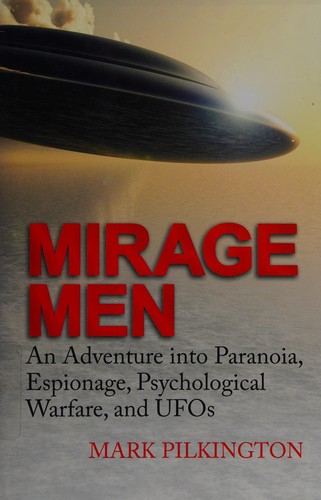
As an Amazon Associate, OverClassified may earn from qualifying purchases made through this link, at no extra cost to you.
Why This Is Essential Reading
Mirage Men earns its place on this list not because it resolves the UFO question, but because it is the fullest, most self-aware attempt to ask how much of ufology's most explosive material — not only the documented Bennewitz case this site's own Project Beta entry covers in full, but the disputed MJ-12 documents this site's own Top Secret/Majic entry defends from the opposite direction, and internet-era hoaxes like Project Serpo — might trace to the same small circle of intelligence-community sources using the same basic methods. Mark Pilkington's years of direct access to Richard Doty give the book real reporting weight the Bennewitz case alone does not fully explain, but that same access is also the book's clearest limitation: much of its widest reach depends on the retrospective testimony of a man whose entire documented career is producing convincing fabrications, and reviewers from the Washington Post in 2010 to researcher Ross Garber's 2026 commentary have named the same underlying risk — that a framework built to explain disinformation can become just as resistant to falsification as the conspiracy thinking it sets out to diagnose. Read alongside this site's own Project Beta and Top Secret/Majic entries, it completes a genuinely useful three-part record: one book that proves a specific disinformation operation beyond serious dispute, one book that argues, at length and in good faith, for a contested set of documents' authenticity, and this book, which asks the widest and hardest-to-verify question of the three — and is honest enough, in its own reception if not always its own prose, about how far that question can actually be answered.
Related Cases & Theories
Essential Viewing

Mirage Men Official Trailer (2014) - American UFO Documentary HD
Rotten Tomatoes Indie — The official U.S. theatrical trailer for the 2013 documentary adaptation of this book, written by Mark Pilkington and directed by John Lundberg. Verified via YouTube oEmbed before inclusion.

Mirage Men teaser trailer
RolandD (Roland Denning, co-director) — The original teaser trailer for the documentary, posted directly by co-director Roland Denning. Verified via YouTube oEmbed before inclusion.
Sources Cited
- Pilkington, Mark. Mirage Men: A Journey into Disinformation, Paranoia and UFOs. Constable & Robinson, 2010 pbk. (ISBN 9781845298579 / 1845298578, matching this site's own resources library citation under this exact edition; U.S. edition as Mirage Men: An Adventure into Paranoia, Espionage, Psychological Warfare, and UFOs, Skyhorse Publishing, 2010). amazon.com
- "Mirage Men." Wikipedia (book and 2013 documentary: publication history, thesis, Sheffield Doc/Fest premiere, festival run, and critical reception). en.wikipedia.org
- "Mark Pilkington (writer)." Wikipedia (biography: birth February 26, 1973; Strange Attractor Press co-founding; Fortean Times contributing editor role; bibliography). en.wikipedia.org
- "About." Strange Attractor Press (Pilkington and John Lundberg's 2001 Horse Hospital events, 2003 first Strange Attractor Journal, 2010 incorporation). strangeattractor.co.uk
- "Mirage Men." Skyhorse Publishing (U.S. edition product page and publisher description). skyhorsepublishing.com
- "Mirage Men." IMDb (2013 documentary: director John Lundberg, writer Mark Pilkington, co-directors Roland Denning and Kypros Kyprianou, runtime, festival and release dates). imdb.com
- "Mirage Men: An Adventure into Paranoia, Espionage, Psychological Warfare, and UFOs." Publishers Weekly, 2010 (contemporary review of the U.S. edition). publishersweekly.com
- Buhs, Joshua Blu. "Three books on UFOs." The Washington Post, October 12–13, 2010 ("occasionally devolves into conspiracy-mongering...but ultimately it is persuasive"). washingtonpost.com
- Gyrus. Review of Mirage Men. Dreamflesh, December 29, 2010 ("ambiguously engaged blend of UFO fanboy, fascinated journalistic observer, and feet-on-the-ground sceptic"). dreamflesh.com
- Heiser, Michael S. "Review of Mirage Men." drmsh.com (critical review questioning the internal logic of the disinformation thesis and Pilkington's own selective trust in sources). drmsh.com
- Garber, Ross. "From Mirage Men to Military Deception: The Documented Pattern of Military Alien Psyops." The Garber Files (Substack), 2026 (extending this book's disinformation framework to recent AARO-adjacent whistleblower claims, and naming the framework's own unfalsifiability risk directly). garberfiles.substack.com
- "Reviews." miragemen.wordpress.com (compiled pull-quote reviews including Fortean Times, Booklist, and other named reviewers at first UK/US publication). miragemen.wordpress.com
- "Mirage men." Open Library edition record (Skyhorse Pub., 2010, ISBN 9781602398009, distinct U.S. printing from the Constable & Robinson edition cited on this site). openlibrary.org
- This site's own essential-reading entry: Project Beta, for the fully documented Bennewitz disinformation operation this book widens into a broader thesis.
- This site's own essential-reading entry: Top Secret/Majic, for the disputed MJ-12 documents this book folds into the same disinformation pattern.
- This site's own case file: Kirtland AFB Sighting (Case File #116), the operation's evidentiary anchor.
- This site's own case file: Washington, D.C. 1952 UFO Flap (Case File #015), part of this book's earlier Cold War-era historical survey.
- This site's own theory page: Government Deception Hypothesis (GDH-001), which draws directly on this book's account of intelligence-community disinformation methods.
- This site's own key-figures entries: Mark Pilkington and Richard Doty, for full biographical detail and further case connections beyond this book.
- This site's own resources library: Full Reading List, where this exact 2010 UK edition (ISBN 1845298578) is cited in connection with the Psycho-Social Hypothesis theory page.
Have corrections, additional research, or peer-reviewed sources? Help improve this entry.
Suggest an Edit