
The Columbia, Missouri Physical Trace Case
Just after midnight on June 28, 1973, James Richards, 41, and his 16-year-old daughter Vanea Richards watched an oval, silver-white object descend into the trees beside their mobile home outside Columbia, Missouri, snapping a limb seventeen feet up and scorching leaves higher still. A responding officer dismissed the ground marks as rabbit tracks and left. Eleven days later, at the personal direction of J. Allen Hynek, physical-trace specialist Ted Phillips and his wife Ginger Phillips arrived with cameras, tape measures, and plaster of paris, and documented a very different picture: a precise, measured pattern of ground imprints, a twisted and pulled tree limb, and heat-damaged foliage that continued dying for weeks afterward.
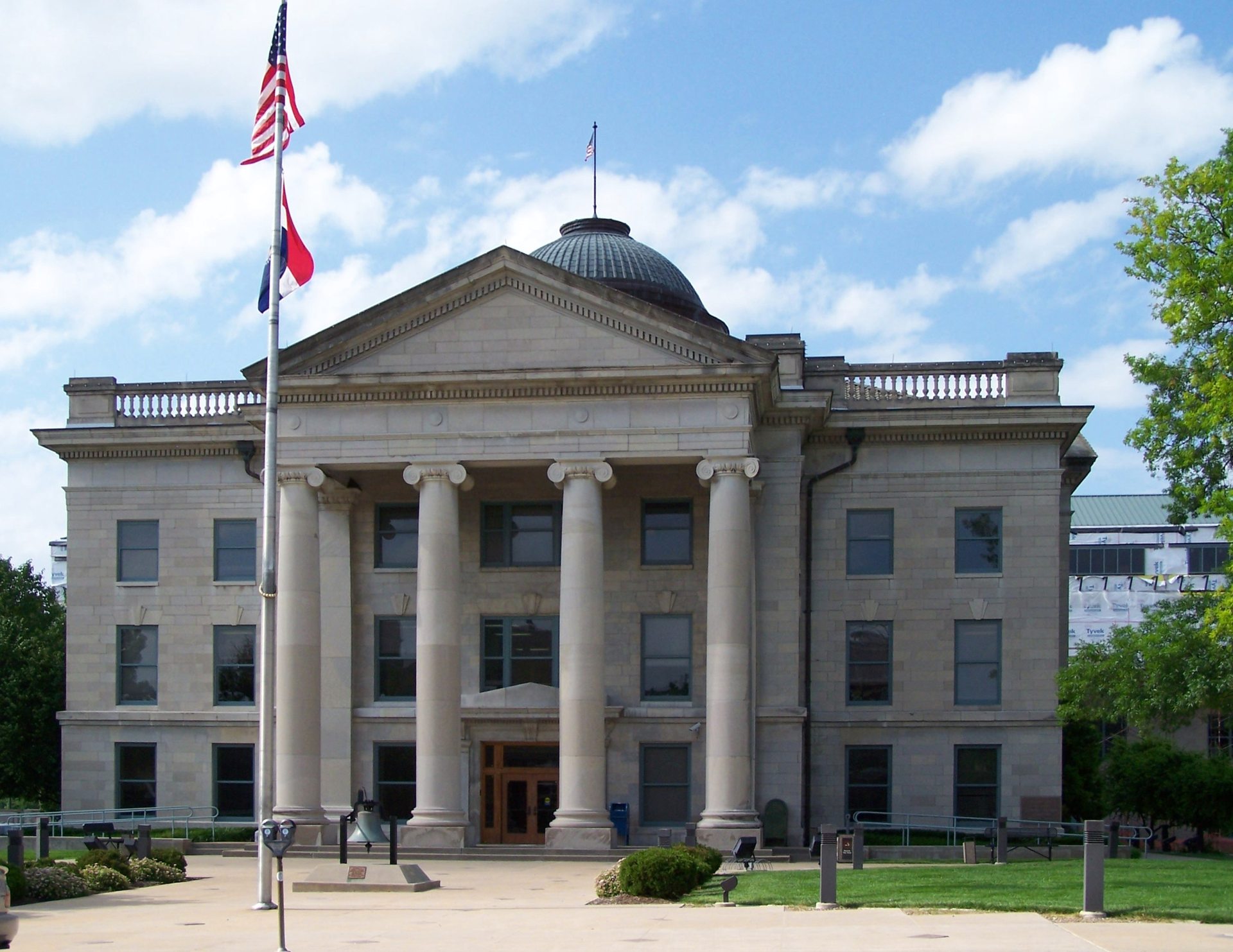
Pictured: the Boone County Courthouse in downtown Columbia, Missouri, the county seat nearest the Richards family's rural mobile home — not the actual encounter site, which sat on private land roughly half a mile outside town and is not identified by any public source down to a specific address. No public-domain or rights-clear photograph of the Richards property, the physical trace evidence itself, or the object as described is known to survive; Ted Phillips's own field photographs and plaster casts from his July 1973 site visits remain held within CUFOS's archival case files rather than freely licensed for reproduction.
Theoretical Alignment
The Columbia case aligns most naturally with a straightforward Extraterrestrial Hypothesis reading — a structured, luminous object of stated dimensions performing a controlled, low-altitude approach and departure, with measurable physical consequences left behind — but the alignment is moderate rather than strong, because nothing in the record establishes intelligent controlled flight beyond the object's repositioning, and a natural electrical phenomenon could in principle produce a broadly similar visual and physical footprint. Interdimensional framing finds little purchase here: there is no discontinuity narrative, no missing time, and no occupant or communication claim of any kind. Psycho-Social explanations register only modestly; the witnesses' matching, internally consistent account and the independently documented, measurable trace evidence make a purely subjective or misperceived origin harder to sustain than in a typical lights-in-the-sky report, though it remains a live possibility given that the trace evidence was not examined until eleven days after the event.
Background
The summer of 1973 produced one of the largest UFO waves in American history, with thousands of reports flooding local police departments, newspapers, and the newly emerging network of civilian UFO research groups across the Midwest and South. Missouri sat near the center of that wave. Only months earlier, beginning in February 1973, the town of Piedmont, Missouri, roughly 140 miles southeast of Columbia, had logged more than 500 UFO reports to local police in a matter of weeks — a wave serious enough that Southeast Missouri State University physics professor Harley Rutledge launched a multi-year instrumented field study, Project Identification, to investigate it directly. Governor Mike Parson would decades later formally recognize several southeastern Missouri towns, Piedmont among them, as the state's historic "UFO capitals" in commemoration of that 1973 wave. Columbia, roughly two hours' drive to the northwest and home to the flagship campus of the University of Missouri, was a different kind of town entirely — a mid-sized university city rather than a small rural community already primed by months of local sighting reports — which makes the Richards family's account a comparatively isolated data point rather than one report folding into an already-active local flap.
By 1973, J. Allen Hynek, the former scientific consultant to the U.S. Air Force's Project Blue Book, had spent more than two decades studying UFO reports and had grown convinced that a genuine, unexplained residue of cases survived even the most skeptical scrutiny. With Blue Book shuttered in 1969 and no federal UFO investigation program left in existence, Hynek founded the Center for UFO Studies (CUFOS) in 1973 together with insurance executive and longtime NICAP volunteer Sherman J. Larsen, intending to build the kind of methodical, scientifically credentialed investigative network the Air Force program had never been. Hynek had already spent five years cultivating a loose, informal research network he called his "invisible college" — working scientists, engineers, and field investigators willing to take UFO reports seriously without publicly declaring themselves believers. One of the earliest and most important members of that network was a young Missouri engineer named Ted Phillips, whom Hynek had specifically tasked, since 1968, with developing a rigorous methodology for documenting one narrow category of evidence: the physical marks a landed or hovering object left behind on the ground and surrounding vegetation. By the time the Richards family's report reached him in the summer of 1973, Phillips had already spent five years building exactly the kind of trace-documentation practice this case would call for.
Complete Timeline
| Date | Event |
|---|---|
| June 28, 1973, ~12:30 AM CST | Vanea Richards, 16, hears a loud "thrashing" sound and sees trees moving outside the north window of the family's mobile home, roughly 80 feet from the kitchen. She alerts her father, James Richards, 41, an Animal Care Technician at the University of Missouri, who joins her at the window. |
| ~12:30–12:35 AM | Both witnesses observe two tapered beams of brilliant, silvery-white light roughly 50 feet from the house and about 5 feet apart. The beams fade, and an oval, glowing object — described as 12 to 15 feet in diameter — becomes visible at approximately the same location, illuminating the surrounding yard "bright as day." |
| ~12:35–1:15 AM | The object hovers and repositions multiple times, at one point moving roughly 200 feet away before returning close to the residence. Its coloring shifts — described as silver-white at the center with a blue band of light and an orange glow around the outer edge. Nearby trees sway as if in a powerful wind; one limb bends nearly to the ground, and a smaller limb snaps off. The family's dogs, uncharacteristically, remain silent throughout. |
| ~1:15 AM | Richards places distress calls, reaching telephone directory-assistance operators and a Flight Service Station employee at Columbia Regional Airport. Multiple third parties later corroborate the timing of these calls and describe Richards as frightened but composed — corroboration of his demeanor and the timeline, not of the object itself. |
| ~1:45–2:00 AM | The object finally disappears and local law enforcement arrives, roughly two hours after the encounter began. The responding officer examines the ground, attributes the marks to rabbits, tells Richards essentially to forget the matter, and leaves without further investigation. |
| Following days | Word of the sighting circulates locally. The report eventually reaches J. Allen Hynek's circle of Midwest field investigators, who route it to Ted Phillips, Hynek's physical-trace specialist, based elsewhere in Missouri. |
| July 9, 1973 | Ted Phillips and his wife Ginger Phillips conduct the first professional site examination, eleven days after the sighting. They photograph and measure a broken, twisted tree limb roughly 16.5–17 feet above the ground, document heat-browned leaves 25 to 35 feet up, locate a complex pattern of ground imprints roughly 50.5 feet beyond a fence line, and make plaster casts of the impressions. A Geiger-counter survey detects no elevated radiation. |
| July 14, 1973 | J. Allen Hynek personally travels to the site with Ted and Ginger Phillips, five days after their first visit, to examine the trace evidence firsthand. Investigators note the surrounding vegetation is already in "significant decline" compared to its condition on July 9. |
| July 28, 1973 | Ted and Ginger Phillips conduct a follow-up visit, documenting continued die-back of leaves and trees in the area directly beneath the object's reported flight path. |
| 1974 | The case is entered into the developing UFO-database literature; the National Investigations Committee on Aerial Phenomena's later chronology of the 1973 wave lists the Columbia report under classification "C2" (Close Encounter of the Second Kind, i.e. physical evidence present), citing a 1974 symposium proceedings reference. |
| 1975 | Ted Phillips publishes Physical Traces Associated with UFO Sightings: A Preliminary Catalog through CUFOS, formalizing the ground-trace documentation methodology — developed and refined across cases including Columbia — into the field's first systematic reference catalog. |
| March 10, 2020 | Ted Phillips dies in Missouri at age 78, having personally investigated more than 4,000 physical-trace cases across more than 90 countries over a 56-year career that began, and largely stayed rooted, in his home state. |
The Encounter
Just after midnight on June 28, 1973, sixteen-year-old Vanea Richards was still awake in the family's mobile home, located on a rural property roughly half a mile southeast of Columbia, Missouri, in Boone County. She heard what she later described as a loud, sustained "thrashing" sound coming from a stand of trees roughly 80 feet north of the kitchen window, as though something heavy were moving through the branches. She went to the window to look and called for her father, James Richards, then 41 years old and employed as an Animal Care Technician at the nearby University of Missouri. Also present in the home that night was Vanea's three-year-old son, Jamie, though he was not treated as a formal witness by investigators given his age.
When James Richards reached the window, both he and Vanea saw two brilliant, tapered beams of silvery-white light, positioned roughly 50 feet from the house and about 5 feet apart, angled toward the ground near the trees Vanea had heard moving. Within moments the beams faded, and in their place an oval, glowing object became visible at close to ground level — James Richards estimated it at 12 to 15 feet in diameter. The light was intense enough, he later told investigators, that the surrounding yard was illuminated "bright as day." As the object hung in place, its coloring became more distinct: a silver-white core, ringed by a band of blue light, with a softer orange glow extending around the outer edge.
Over the next several minutes the object did not simply hover motionless. Witnesses described it repositioning more than once — moving away to a distance of roughly 200 feet before returning to a position close to the house, then shifting again. Throughout this period, the trees nearest the object's position swayed and thrashed as though caught in a powerful, localized wind, even though no comparable wind was affecting the rest of the property. At one point a large limb bent down until it nearly touched the ground; a smaller limb, higher up, snapped and fell. The family's dogs, which under ordinary circumstances would have been expected to bark at any late-night disturbance this close to the house, remained conspicuously silent for the entire encounter — a detail Richards, given his professional familiarity with animal behavior, specifically flagged to investigators as unusual.
The encounter continued, by the family's account, for roughly ninety minutes in total, the object appearing, repositioning, and reappearing before finally vanishing for good sometime close to 2:00 AM. Partway through the event, at approximately 1:15 AM, Richards attempted to reach outside help. He placed calls that were fielded by telephone directory-assistance operators and, separately, by a Flight Service Station employee at Columbia Regional Airport. None of these third parties saw the object themselves — their evidentiary value lies not in confirming the sighting but in independently corroborating the timeline and Richards's demeanor during the event itself, which multiple operators later described as frightened but coherent and composed, not panicked or theatrical.
Local law enforcement arrived at the property roughly two hours after the encounter began, by which point the object was long gone. The responding officer examined the yard, found what he characterized as animal tracks — specifically attributing them to rabbits — and, according to the family's later account, told Richards to essentially forget the whole matter before leaving. No photographs, measurements, or samples were taken by law enforcement at any point. This dismissive initial response stands in sharp contrast to what a team of specialized investigators would document at the same site less than two weeks later, and it is one of the more striking features of the case: the same physical evidence that a patrol officer glanced at and waved off as rabbit activity was, when examined systematically by Ted Phillips using tape measures, plaster of paris, and a Geiger counter, found to be a precisely measurable, internally consistent pattern that a full-grown adult reporter could barely reproduce by jumping on the same ground.
The Investigation
Word of the Richards family's report worked its way, over the following days, into the informal but increasingly well-organized network of Midwest field investigators that J. Allen Hynek had spent years cultivating. That network would be formalized later that same year into the Center for UFO Studies, but in the summer of 1973 it still functioned largely as Hynek's personal "invisible college" — working professionals, most with no public UFO-research profile at all, whom Hynek trusted to investigate reports methodically and report back. Among the most important of these was Ted Phillips, a Missouri-based engineer and professional photographer who had been investigating UFO reports since 1964 and had come to Hynek's personal attention through the 1966 Roaring River State Park case in southern Missouri. The two men met in person in October 1968, when Hynek lectured at the University of Missouri — the same institution James Richards would later work for — and shortly afterward Phillips and his wife, Ginger, traveled to Chicago at Hynek's invitation. It was there that Hynek asked Phillips to specialize specifically in physical trace evidence: the marks, burns, imprints, and vegetation damage a landed or low-hovering object left behind, as distinct from the far more common and far less verifiable lights-in-the-sky report.
By the time the Columbia case reached him, Phillips had spent nearly five years refining that specialty. He and Ginger arrived at the Richards property on July 9, 1973, eleven days after the sighting, equipped for a systematic examination rather than a casual visit. They photographed the site extensively, measured the broken and twisted tree limb — found roughly 16.5 to 17 feet above the ground, its break pattern consistent with a downward pulling and twisting force rather than a clean snap — and documented a set of leaves between 25 and 35 feet up that had turned brown in a manner consistent with heat exposure rather than ordinary seasonal browning. On the ground, they located and measured a complex, repeating pattern of imprints roughly 50.5 feet beyond the property's fence line, each impression measuring approximately 0.5 by 0.4 feet across and 0.2 to 0.3 feet deep. They made plaster casts of several of these imprints for permanent record, and ran a Geiger-counter survey of the site that returned no reading above normal background radiation.
Hynek himself traveled to the site five days later, on July 14, accompanying the Phillipses on a second visit rather than relying solely on their report — a level of personal, in-person involvement Hynek reserved for cases he considered evidentially significant. By this second visit, investigators noted the surrounding vegetation had visibly declined further since the July 9 examination: additional leaves had wilted, and the die-back extended beyond the immediate area first documented. A third visit on July 28 confirmed the trend continuing, with trees and leaves in the affected zone showing significant, ongoing decline weeks after the original sighting — a slow-motion physical consequence no hoax staged in a single night could easily explain, though it does not by itself rule out delayed effects of conventional storm or insect damage coincidentally overlapping the reported site.
The Columbia case would go on to be logged in the developing UFO-database literature of the mid-1970s: the National Investigations Committee on Aerial Phenomena's own chronology of the 1973 wave lists the Columbia, Missouri report under the classification code "C2" — NICAP's own shorthand for a Close Encounter of the Second Kind, meaning a close-range sighting accompanied by physical evidence — with a citation to a 1974 symposium proceedings entry. That same broad methodology, tested and refined across cases including Columbia, would be formalized two years later in Phillips's landmark 1975 CUFOS catalog, discussed at length below.
Key Witnesses
James G. Richards
The first adult witness, alerted by his daughter's report of a "thrashing" sound outside the family's mobile home. Richards, 41 at the time, described the object in specific, measured terms — its estimated diameter, its shifting color banding, its repositioning over roughly ninety minutes — and placed contemporaneous distress calls to telephone operators and a Flight Service Station employee at Columbia Regional Airport, whose independent accounts corroborate his timeline and demeanor. His occupation working directly with animals at the University of Missouri is relevant to the case's evidentiary weight in two directions: it makes him professionally familiar with normal wildlife sign (relevant to his flagging the family dogs' uncharacteristic silence as anomalous, and to the sharp contrast between his account and the responding officer's "rabbit tracks" dismissal), while his stated employer is independently verifiable and he had no evident financial or publicity motive in reporting the incident. According to the family's account, he told the responding officer he wanted the matter investigated properly rather than dismissed — a request that was not honored until Ted Phillips arrived eleven days later.
Vanea Richards
James Richards's sixteen-year-old daughter and the first member of the household to notice the disturbance, hearing the "thrashing" sound in the trees before the lights or the object itself became visible. Her account of the object's appearance, color changes, and movement closely matches her father's independently given description, and the two witnesses' consistency across separate interviews is one of the case's more notable features, given the absence of any apparent coordination motive between a working adult and his teenage daughter. Vanea's own three-year-old son, Jamie, was present in the home during the encounter but was not treated as a formal witness given his age.
The Five Observables Assessment
The Five Observables framework, developed by former AATIP director Luis Elizondo, is used to classify UAP encounters based on performance characteristics that exceed known technology. As a 1973 case with no instrumented data of any kind, Columbia can only be assessed against this modern framework speculatively, based on witness description alone.
Assessment: Nothing in the witness testimony describes instant acceleration, hypersonic speed, deliberate low observability, or trans-medium travel — the object, as described, hovered, repositioned at modest apparent speed, and eventually simply disappeared from view rather than departing at any documented velocity. Anti-gravity lift is speculative at best: the object was reportedly airborne and stationary or slow-moving near ground level with no visible support structure, which is consistent with (though far from proof of) some unconventional lift mechanism, but is equally consistent with a stationary luminous atmospheric phenomenon that was never a solid craft in the engineering sense at all. Columbia is, in short, a poor fit for a framework built around high-performance flight characteristics; its evidentiary interest lies almost entirely in the physical trace evidence, not in any described flight performance.
Evidence Assessment
Supporting Anomalous Origin
- Two independent family witnesses gave closely matching, internally consistent descriptions of the object's shape, color banding, and duration, without an apparent coordination motive
- Physical trace evidence — a twisted and broken tree limb, heat-consistent leaf browning, and a measured pattern of ground imprints — was documented by a credentialed specialist investigator using photography, measurement, and plaster casting, not simply eyeballed
- The vegetation damage continued to worsen over the following weeks, observed across three separate site visits (July 9, 14, and 28), a slow-motion effect difficult to attribute to a single-night hoax
- Third-party telephone operators and an FAA Flight Service Station employee independently corroborated the timing of Richards's distress calls and described his demeanor as frightened but composed
- James Richards's occupational familiarity with animal behavior lends some weight to his flagging the family dogs' uncharacteristic silence, and directly undercuts the responding officer's own "rabbit tracks" explanation
- No evident financial motive, publicity-seeking, or prior involvement with UFO research on the family's part
- The case was independently significant enough to draw J. Allen Hynek personally to the site, a level of direct involvement he did not extend to the great majority of reports reaching his network
Supporting Conventional Explanation
- The professional trace examination did not begin until eleven days after the sighting, leaving a substantial window in which weather, animals, or human activity could have altered or even created ground marks and vegetation damage unrelated to the reported object
- No soil, vegetation, or material sample from the site is documented as having undergone laboratory chemical analysis, unlike comparable trace cases such as Delphos, Kansas or Trans-en-Provence
- Only two adult-equivalent witnesses (a father and his teenage daughter, from the same household) observed the object directly; no independent, unrelated witness corroborated the sighting itself, and the nearest neighbor was asleep throughout
- A responding law-enforcement officer, examining the same ground the same night, attributed the marks to rabbits rather than anything unusual — a direct, contemporaneous skeptical assessment from a disinterested party, whatever its investigative rigor
- Ball lightning and other rare atmospheric electrical phenomena are independently documented, if uncommon, and can in principle account for a hovering, color-shifting luminous mass with localized heat effects on nearby vegetation
- No radar, photographic, or instrumented data of any kind exists to corroborate the object's described size, shape, or behavior independent of testimony
Why "Disputed"
The Columbia case receives a DISPUTED classification because it sits squarely between two defensible readings, and the record as it survives cannot cleanly resolve which is correct. On one side: two consistent family witnesses, a physical trace examined and measured by one of the era's most methodical specialist investigators, a documented multi-week pattern of continuing vegetation decline, and enough evidentiary weight to draw Hynek himself to the site in person. On the other: an eleven-day gap between the sighting and any expert examination of the ground, no laboratory analysis of any recovered material, only a single household's testimony with no unrelated corroborating witness, and a contemporaneous, if cursory, skeptical assessment from the responding officer that directly contradicts what Phillips would document less than two weeks later.
What is not disputed: something happened at the Richards property in the early hours of June 28, 1973, that left measurable, photographed, and plaster-cast physical evidence in its wake, examined by an investigator whose entire career was built on the premise that eyewitness testimony alone could never be trusted without independently verifiable physical corroboration. Whether that evidence points to a genuine, unexplained aerial phenomenon or to a rare natural process compounded by an unlucky eleven-day investigative delay remains, on the honest state of the public record, unresolved.
Sensor & Instrumentation Detection Profile
No radar, photographic, or other instrumented sensor data exists for this case. The Richards property was a private rural residence with no on-site recording equipment of any kind in 1973, and no military or civilian radar facility is documented as having tracked any correlating target over central Missouri that night. The only "instrumentation" applied to the case at all was retrospective and indirect: Ted Phillips's field camera, measuring tape, plaster-casting materials, and a handheld Geiger counter, all deployed eleven days after the fact to document the aftermath rather than the event itself. This absence of any contemporaneous instrumented data is one of the case's clearest evidentiary limits, and is characteristic of nearly all pre-AATIP civilian ground-trace cases from this era.
Environmental & Geospatial Context
The encounter occurred on a wooded rural property in Boone County, central Missouri, roughly half a mile southeast of the Columbia city limits — a landscape of rolling farmland and hardwood tree cover typical of the region, at the edge of a mid-sized university town rather than deep countryside. Late June places the encounter in full summer canopy, with dense leaf cover on the trees involved, consistent with witness descriptions of substantial foliage available to be scorched and broken. No witness or investigator account describes a storm, high wind, or precipitation on the night in question, which somewhat weakens (without eliminating) an explanation resting on ordinary summer thunderstorm wind shear coincidentally damaging the same trees. Central Missouri's humid continental climate does produce genuine, if statistically rare, ball-lightning and related electrical-discharge reports during the warm summer months, providing at least plausible atmospheric conditions for that category of conventional explanation. The property's proximity to Columbia Regional Airport (Richards's 1:15 AM call was fielded by a Flight Service Station employee there) places it within a monitored aviation corridor, though no aircraft-related radar or flight-log data from that night has been located or published.
Observer Credibility & Occupational Profile
James Richards, the primary adult witness, held a verifiable position as an Animal Care Technician at the University of Missouri — a stable, checkable occupation with no evident connection to UFO research, science fiction, or any field that would predispose him toward an elaborate hoax or an unusually suggestible interpretation of an ordinary event. His professional background specifically working with animals gives some added weight to two details in his account: his explicit observation that the family dogs remained silent throughout an event that would ordinarily be expected to provoke barking, and his implicit rejection of the responding officer's "rabbit tracks" explanation, an assessment he would have been reasonably well positioned to evaluate himself. Vanea Richards, 16, was the first to notice the disturbance and gave an account matching her father's in its essential details across separate retellings. Neither witness had any prior public involvement with UFO research or reporting, and neither is documented as having sought or received payment, book deals, or sustained media attention from the case. The investigating team brought considerably more institutional credibility: J. Allen Hynek was, at the time, chairman of the Astronomy Department at Northwestern University and the recently retired scientific consultant to the U.S. Air Force's two-decade UFO investigation program; Ted Phillips was a trained engineer and professional photographer with nearly a decade of field-investigation experience by 1973, already recognized within Hynek's network as the leading specialist in physical trace documentation; and Ginger Phillips accompanied her husband on all three documented site visits as his consistent field-investigation partner.
Physical & Material Assays
The physical trace evidence is, by a wide margin, the strongest single element of the Columbia case, and it is also the specific category of evidence that Ted Phillips built his entire investigative career around documenting. Three distinct categories of physical trace were recorded during the July 1973 site visits.
Ground imprints: Phillips located and measured a complex, repeating series of imprints in the hard summer ground roughly 50.5 feet beyond the property's fence line. Individual impressions measured approximately 0.5 by 0.4 feet across and 0.2 to 0.3 feet in depth — substantial enough that, according to Phillips's own account, a reporter of roughly 300 pounds who attempted to reproduce a comparable depression by jumping repeatedly on the same ground could barely break the surface. Plaster casts were made of several impressions, preserving their shape for permanent record, though no published account documents a formal soil-composition or mineral analysis of the cast material comparable to what would later be performed on the Delphos, Kansas ring soil.
Tree and limb damage: A large limb, located roughly 16.5 to 17 feet above the ground, was found broken in a manner Phillips's examination characterized as showing evidence of twisting and downward pulling rather than a clean wind-snap or a straight cut — a distinction load-bearing to the case's central evidentiary question, since a twisted, pulled break pattern is harder to attribute to ordinary storm wind (which tends to produce cleaner snaps or splintered breaks along the grain) or to a deliberate hoax (which would more plausibly involve a saw or an axe, leaving a straight cut edge investigators would likely have noted). Smaller limbs nearby showed additional, consistent breakage.
Vegetation scorching and progressive die-back: Leaves between roughly 25 and 35 feet above the ground were documented as browned in a pattern investigators attributed to heat exposure rather than ordinary seasonal color change — notable both for the height involved (well above the object's own reported diameter of 12–15 feet, suggesting either a taller effective energy signature than the visible object itself or radiant heat carrying upward through the canopy) and for its progression over time. Investigators documented the affected area's continued decline across three separate visits spanning nearly three weeks — July 9, July 14, and July 28 — with additional leaves wilting and dying between each visit rather than the damage having simply occurred once and then remained static.
Radiological testing: A Geiger-counter survey of the site returned no reading above normal background radiation. This is a genuinely informative negative result — it rules out one specific category of energetic signature some UFO researchers have associated with anomalous propulsion systems — but it is also, by itself, equally consistent with an entirely conventional, non-nuclear origin for the physical damage, whether natural or man-made.
Taken together, the trace evidence is genuinely substantial by the standards of 1970s civilian field investigation: multiple, mutually consistent categories of physical damage, professionally measured and documented, with an unusual and hard-to-fake progressive component. What it lacks, relative to the field's later benchmark cases, is any laboratory chemical or material analysis of a recovered sample — the step that would ultimately distinguish cases like Delphos, where independent chemists decades apart identified specific organic compounds in the ring soil, from cases like Columbia, where the trace evidence's physical dimensions were carefully measured but its underlying material composition was never independently tested.
Historical Precedents & Archive Matches
Columbia sits within a specific, well-defined sub-genre of UFO case that Ted Phillips himself did more than any other researcher to formalize: the ground-trace or "CE2" case, in which a close-range sighting leaves behind physical, measurable evidence rather than testimony alone. Phillips's landmark 1975 CUFOS catalog, Physical Traces Associated with UFO Sightings: A Preliminary Catalog, gathered 561 such cases from around the world, establishing for the first time a standardized documentation methodology — precise measurement, photography, soil and material sampling where possible, and systematic follow-up visits to track any longer-term effects — that Columbia's own investigation exemplifies closely, including the multi-visit tracking of progressive vegetation decline that is a recurring feature across Phillips's broader catalog.
The most directly comparable case in Phillips's own personal casebook is the Delphos, Kansas ring sighting of November 2, 1971 — the case that first established Phillips's national reputation, and one he continued tracking personally for more than a decade. Both cases share the essential CE2 structure: a modest, non-sensationalized family sighting; a persistent, measurable ground trace; and a delayed but methodical professional examination (32 days after the fact at Delphos, 11 days after the fact at Columbia). Where Delphos ultimately surpassed Columbia in evidentiary depth was in laboratory analysis: soil samples from the Delphos ring underwent two separate independent chemical analyses, in the late 1980s and again in 1998–99, that identified specific organic compounds in the altered soil, whereas no comparable material analysis is documented for the Columbia trace evidence.
Internationally, the 1966 Tully, Queensland "saucer nests" case — formally catalogued by Phillips as one of the earliest non-American entries in his 1975 catalog — established an early template for documenting flattened, swirled vegetation as physical trace evidence, a category that overlaps with, though is not identical to, Columbia's combination of broken limbs and scorched foliage. The 1981 French case of Trans-en-Provence, investigated by France's official government UAP research body GEPAN (predecessor to today's GEIPAN), represents the closest thing the physical-trace genre has to a positive laboratory result: soil samples from that landing site showed detectable biochemical alterations to nearby alfalfa plants that GEPAN's own scientists could not fully explain through conventional means, a bar of evidentiary rigor Columbia's 1973 examination, conducted six years earlier by a civilian volunteer investigator working without government laboratory support, was never in a position to meet.
Closer to home, this site's own case file on the Council Bluffs, Iowa Molten Metal Fall of December 1977 cites Phillips's 1975 catalog directly as the CUFOS-era reference work that established ground-trace and physical-residue documentation as a distinct investigative discipline — a discipline Columbia's own 1973 investigation helped that catalog's methodology mature toward. And the broader Missouri context matters here too: the Piedmont Missouri Wave, unfolding in the same state only months before Columbia, gave Hynek's Midwest investigative network an unusually high volume of active Missouri cases to draw comparative context from during the very summer the Richards family's report reached them — though Piedmont's own evidentiary profile centered on instrumented visual tracking by physicist Harley Rutledge's team rather than the physical ground-trace evidence that defines Columbia.
Material Analysis
The material record at Columbia consists entirely of physical alterations to the natural environment — wood, foliage, and soil — rather than any recovered artifact, fragment, or residue sample. This distinguishes it from cases like Roswell or the Council Bluffs molten-metal fall, where a physical object or substance was recovered for potential laboratory testing, and places it instead in the same evidentiary category as Delphos, Trans-en-Provence, and the broader CE2 ground-trace literature Ted Phillips's catalog defined.
Wood and Vegetation Evidence
The broken, twisted limb at 16.5–17 feet and the heat-consistent leaf browning at 25–35 feet together form the case's most distinctive physical signature. No sample of the affected wood or foliage is documented as having been retained for long-term laboratory analysis (unlike, for instance, the biochemical alfalfa analysis performed on Trans-en-Provence plant matter), which means the "heat exposure" characterization of the leaf damage rests on Phillips's trained field assessment rather than a verified spectroscopic or chemical finding. This is a genuine evidentiary limitation, not a dismissal: field-based visual assessment of heat versus disease versus ordinary senescence in leaf discoloration is a real, if imperfect, skill, and Phillips's decades of comparative experience across hundreds of similar cases by 1973 lend his contemporaneous judgment more weight than an untrained observer's would carry, without elevating it to laboratory-grade proof.
Soil and Ground-Imprint Evidence
The plaster casts made of the ground imprints preserve their physical shape and dimensions for the historical record, but no published account documents a chemical or mineralogical analysis of the underlying soil comparable to the fulvic-acid and calcium-oxalate findings later identified in the Delphos ring soil, or the biochemical plant-tissue findings at Trans-en-Provence. Whether such analysis was ever attempted and simply went unpublished, or was never pursued at all given the resource constraints of 1970s volunteer civilian investigation, is not established in the available public record.
Absence of Recovered Material
No metal fragment, residue, or any other recovered physical artifact is associated with this case — only alterations to pre-existing natural material (the trees, the ground) rather than something newly deposited by the object itself. This is consistent with the great majority of CE2 ground-trace cases in Phillips's own catalog, where the evidentiary value lies in the pattern and force of the damage rather than in any substance left behind for chemical fingerprinting.
Supporting Non-Terrestrial or Anomalous Origin
- The twisted, pulled break pattern on the main limb is difficult to reconcile with either ordinary wind-snap damage or a straightforward hoax involving a cutting tool
- Heat-consistent leaf browning at 25–35 feet, well above the object's own reported diameter, suggests an energy signature extending beyond the visible boundary of the described object
- Progressive vegetation decline documented across three separate visits over nearly three weeks is difficult to attribute to a single staged event
- The measured, repeating ground-imprint pattern was dense and firm enough that a 300-pound adult could not easily reproduce a comparable mark by jumping on the same ground
- An experienced specialist investigator, working from a five-year-old established methodology, found the damage pattern consistent with dozens of other cases in his growing physical-trace catalog
Supporting Terrestrial Origin
- No chemical, mineralogical, or spectroscopic laboratory analysis of any recovered soil, wood, or foliage sample is documented, unlike comparable benchmark trace cases
- The eleven-day gap between the sighting and Phillips's first examination left substantial time for weather, insects, disease, or human activity to alter or compound the trace evidence before it was professionally documented
- A responding law-enforcement officer, examining the same ground on the night of the event itself, attributed the marks to ordinary rabbit activity
- Storm-related or coincidental wind damage to the same trees, followed by unrelated normal seasonal leaf browning, remains a physically plausible if speculative alternative explanation for the vegetation findings, notwithstanding the absence of a documented storm that specific night
- The heat-browning characterization is a field judgment call rather than a laboratory-confirmed finding
The Conventional Explanation Candidate
No single conventional explanation for Columbia commands the kind of documented, near-conclusive evidentiary support that Project Mogul provides for Roswell's debris field, or that a specific dated balloon launch provides for some other disputed cases on this site. Instead, several distinct conventional readings each explain part of the record while leaving other parts of it awkwardly unaddressed. Four candidates deserve serious, separate consideration.
Ball Lightning or Atmospheric Electrical Phenomenon
Ball lightning is a genuine, if rare and still incompletely understood, natural phenomenon: a luminous, roughly spherical or ovoid mass of light, sometimes reported with color banding, that can persist near ground level for seconds to a few minutes before dissipating, occasionally in the vicinity of thunderstorm activity. It offers a plausible mechanism for several elements of the Columbia account — the object's overall shape and shifting color banding, its apparent hovering near ground level, and even localized heat effects on nearby vegetation. Where the explanation strains against the record is duration and behavior: documented ball lightning events are almost always measured in seconds to a couple of minutes, not the roughly ninety minutes of intermittent, repositioning activity the Richards family described, and the absence of any reported thunderstorm that specific night removes the atmospheric trigger event ball lightning is most reliably associated with. It remains a serious candidate for the luminous phenomenon itself, but a poor fit for the encounter's full reported duration and behavior.
Hoax or Fabrication
A staged hoax by the Richards family, whether to attract attention or for some other motive, cannot be ruled out from the surviving public record. Working against it: no evidence of financial gain, sustained media pursuit, or prior interest in UFO research on the family's part; independent third-party corroboration (telephone operators, an FAA employee) of Richards's timeline and frightened, non-theatrical demeanor during the event itself; and physical trace evidence — specifically the twisted, pulled limb-break pattern and the progressive, multi-week vegetation decline — that would have been difficult to fabricate convincingly with 1973-era tools and harder still to sustain believably across three separate investigator visits spanning nearly three weeks. A hoax remains structurally possible, particularly given that no independent, unrelated witness saw the object itself, but it fits the available physical evidence considerably worse than it fits the bare testimony alone.
Genuine Misperception, With Coincidental Storm or Wind Damage
Under this reading, the Richards family genuinely saw an unusual light — distant vehicle headlights distorted by atmospheric conditions, aircraft lighting, or some other conventional light source misjudged in distance and size during a disorienting nighttime encounter — while the tree and vegetation damage Phillips documented eleven days later derived from an unrelated cause: ordinary storm wind, animal activity, disease, or seasonal die-back that happened to affect the same general area independent of anything the family actually saw. This candidate has the advantage of not requiring any single unusual mechanism to explain both the light and the trace evidence at once, but it requires two separate coincidences to align closely in both time and space — a genuinely unusual light source appearing at almost exactly the same location and same short window in which unrelated tree damage also happened to occur — and it does not comfortably explain the specific twisted-and-pulled character of the limb break Phillips documented, which is a less typical signature of ordinary wind-snap damage.
Genuine Anomaly
Under this reading, the Richards family witnessed and the trace evidence records the presence of an actual, structured, low-hovering object or discrete energetic phenomenon not attributable to any known 1973-era technology or fully cataloged natural process — consistent with, though not proof of, the broader category of unexplained close encounters that motivated Hynek's own creation of the CE1–CE3 classification system and CUFOS itself. This candidate is best supported by the multi-category, professionally measured, progressively worsening physical trace evidence, and by the case's significance being judged high enough to bring Hynek personally to the site. It is weakened by the same evidentiary gaps affecting every other candidate: no laboratory material analysis, no instrumented data, and an eleven-day investigative delay that leaves genuine uncertainty about exactly what conditions existed at the site in the hours immediately following the sighting.
Ball Lightning / Electrical Phenomenon
InconclusiveA real, documented natural phenomenon that fits the object's shape, color banding, and some heat effects, but poorly fits the roughly ninety-minute reported duration and the absence of any documented storm that night.
Hoax or Fabrication
ImplausiblePossible in principle, but poorly supported: no financial or publicity motive, independently corroborated timeline and demeanor, and physical trace evidence difficult to convincingly fabricate and sustain across three separate investigator visits.
Misperception with Coincidental Tree Damage
InconclusiveAvoids requiring one unusual mechanism to explain everything at once, but requires two separate coincidences to align closely in time and place, and does not comfortably explain the twisted, pulled character of the limb break.
Genuine Anomaly
InconclusiveBest fits the multi-category, professionally measured, progressively worsening physical trace evidence and the case's significance to Hynek personally, but remains unsupported by any laboratory or instrumented data.
Related Cases
Confirmed Documents & Official Records
National Archives finding aid covering UAP-related textual holdings, including Project Blue Book (RG 341); relevant background context only, since Blue Book had already closed in 1969 and the Columbia case was never formally investigated by any federal agency. This case is a purely civilian CUFOS investigation with no documented military or government involvement of any kind.
UNCLASSIFIEDSearch Government Archives Directly
Further Reading — Recommended Literature
Physical Traces Associated with UFO Sightings: A Preliminary Catalog
The CUFOS catalog that formalized the ground-trace documentation methodology this case's own investigation exemplifies, compiled by the same investigator who personally examined the Columbia site.
The Hynek UFO Report
Hynek's own account of the CUFOS-era close encounter cases his investigative network compiled, drawing on the same period and methodology as the Columbia investigation.
The UFO Experience: A Scientific Inquiry
The book that introduced the Close Encounter classification system (CE1–CE3) under which Columbia is formally categorized as a CE2, physical-evidence case.
The Edge of Reality: A Progress Report on Unidentified Flying Objects
A contemporaneous dialogue between two of the era's most credentialed UFO researchers, published the same year as Phillips's trace catalog and reflecting the same CUFOS-era investigative moment.
UFOs Explained
The leading contemporary skeptical counterpoint to the CUFOS school, published the year after Columbia, applying rigorous conventional-explanation scrutiny to the same wave of 1970s close-encounter reports.
DISCLOSURE: Some links above are affiliate links. If you purchase through them, OverClassified receives a small commission at no additional cost to you. This helps support independent research.
Essential Viewing
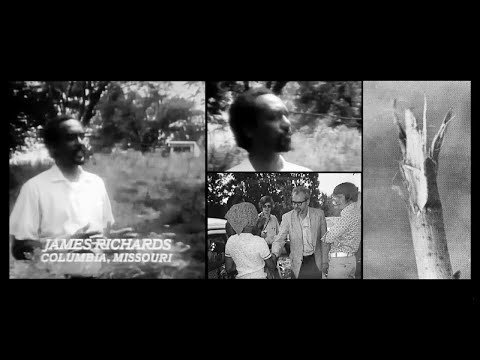
UFO Landing Witnessed by James G. Richards & Daughter
Case-specific account of the June 28, 1973 sighting and Ted Phillips's subsequent physical-trace investigation, from Eyes On Cinema.
Radio Friends with Paul Pepper: Columbia, Missouri UFO 1973
University of Missouri public-radio affiliate KBIA's segment with local UFO researcher Bill Wickersham discussing the 1973 Columbia case specifically.
Sources
- UFO Insight. "The Columbia, Missouri Mobile Home UFO Incident." ufoinsight.com
- UFO Casebook. "Columbia, Missouri — June 28, 1973." ufocasebook.com
- National Investigations Committee on Aerial Phenomena. "RSID: UFO Wave of 1973" — chronology database, Columbia, MO entry (730628), classification C2, ref. SYM74 p.46. nicap.org
- Kevin Randle. "A Different Perspective: Ted Phillips Has Died." March 2020. kevinrandle.blogspot.com
- The UFO Chronicles. "Founder of the Center for UFO Physical Trace Research, Ted Phillips Has Died." April 2020. theufochronicles.com
- The Oz Files. "In Search of the Mark of the UFO (A Tribute to Ted Phillips and UFO Physical Trace Research)." May 2020. theozfiles.blogspot.com
- Phillips, Ted. Physical Traces Associated with UFO Sightings: A Preliminary Catalog. Center for UFO Studies, 1975.
- Hynek, J. Allen. The UFO Experience: A Scientific Inquiry. Henry Regnery Company, 1972.
- Hynek, J. Allen. The Hynek UFO Report. Dell Publishing, 1977.
- Hynek, J. Allen & Vallée, Jacques. The Edge of Reality: A Progress Report on Unidentified Flying Objects. Henry Regnery Company, 1975.
- Klass, Philip J. UFOs Explained. Random House, 1974.
- Wikipedia. "Center for UFO Studies" — CUFOS founding history, 1973. en.wikipedia.org
- St. Louis Post-Dispatch. "Gov. Mike Parson names UFO capitals in Missouri after famed 1973 sightings." July 2023. stltoday.com
- OverClassified. Piedmont Missouri Wave case file — parallel 1973 Missouri UFO wave context.
- OverClassified. Delphos Ring Sighting case file — Ted Phillips's benchmark physical-trace investigation.
- OverClassified. Trans-en-Provence case file — GEPAN's laboratory-analyzed physical-trace benchmark.
- OverClassified. Council Bluffs, Iowa Molten Metal Fall case file — cites Phillips's 1975 catalog directly.
- OverClassified. Essential Reading: Physical Traces Associated with UFO Sightings — full profile of Phillips's 1975 catalog.
- YouTube (Eyes On Cinema). "UFO landing witnessed by James G. Richards & daughter on June 28, 1973; investigated by Ted Phillips." youtube.com
- YouTube (Radio Friends with Paul Pepper / KBIA). "Bill Wickersham, UFO Enthusiast, 'Columbia, Missouri UFO 1973.'" youtube.com
- TheSkyLive. "Moon Phase on June 20, 1973: Waning Gibbous." theskylive.com
- Wikipedia. "June 1973 lunar eclipse." en.wikipedia.org
- National Archives. "UAP Textual and Microfilm Records Research Guide." archives.gov
See something inaccurate? Have additional information or sources?
Suggest an Edit →Last Updated: August 2026