
The Council Bluffs, Iowa Molten Metal Fall
On the evening of December 17, 1977, eleven residents of Council Bluffs, Iowa — including on-duty police and fire department personnel — independently watched a reddish, hovering object drop something into Big Lake Park. What they found minutes later was a mass of glowing, molten metal, ultimately weighed at 35 to 55 pounds, still boiling down the edge of a frozen levee. The case would go on to become physicist Jacques Vallée's single best-documented example among ten benchmark UFO material-sample cases in his 1998 peer-reviewed survey — and a sample was still being independently re-analyzed with modern isotopic techniques as recently as 2022.
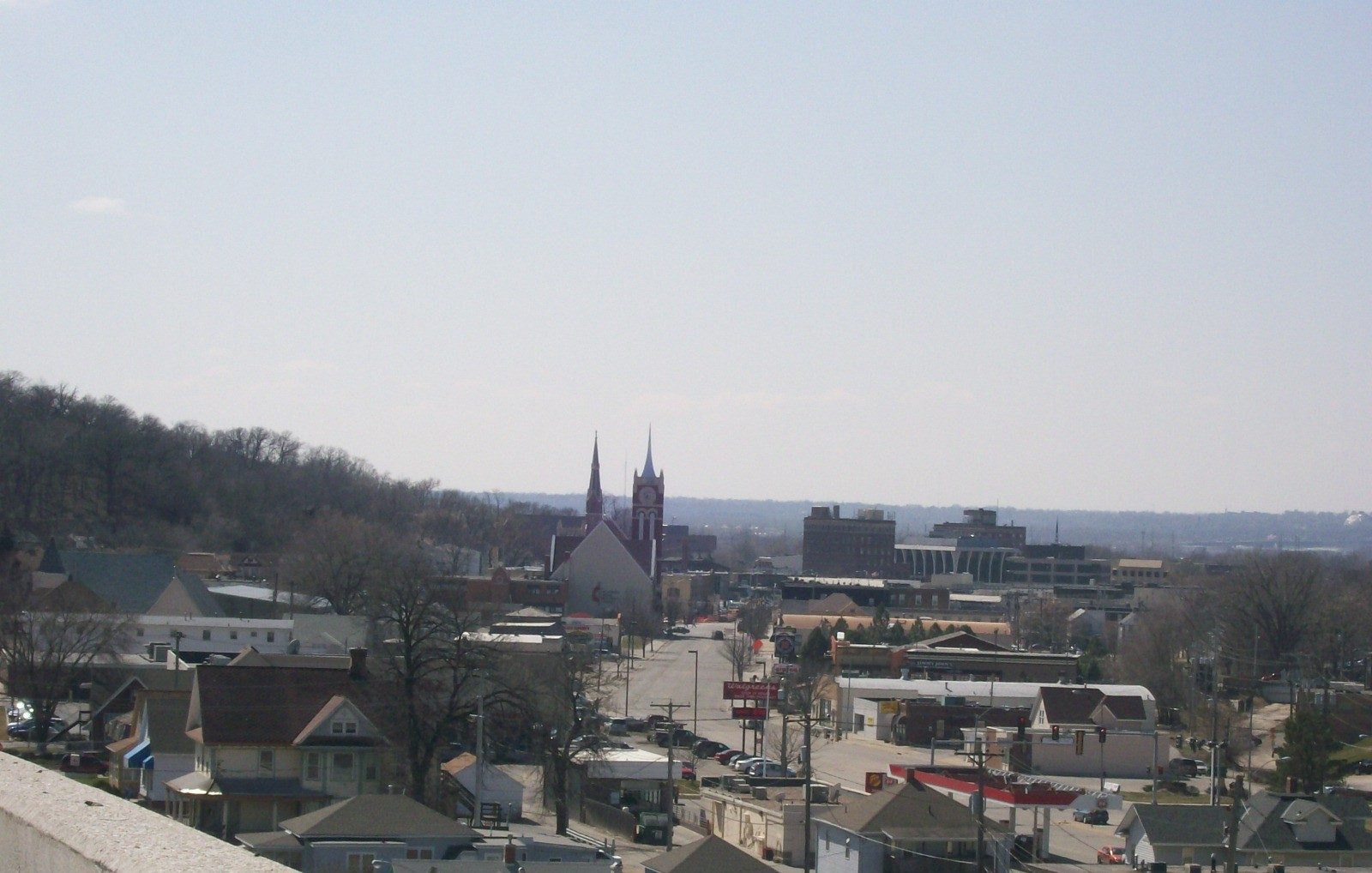
Pictured: East Broadway looking west toward downtown Council Bluffs, Iowa — the city where the case occurred, not Big Lake Park or the recovered metal itself. Responding officer Dennis Murphy is reported to have photographed the still-glowing deposit at the scene with a Polaroid camera, and those images are cited in local historical accounts, but no freely licensed, publicly reproducible copy of that photograph, the levee site itself, or the metal sample is known to exist online; the Council Bluffs Police and Fire Departments' own 1977 photographs remain in local archival hands rather than under an open license.
Theoretical Alignment
The case aligns only weakly with any single major hypothesis. It offers none of the direct occupant contact, telepathic communication, or symbolic imagery that typically anchors interdimensional (IDH) readings, and its eleven independent witnesses — including two on-duty public-safety officers who arrived within minutes and found the metal still hot — make a purely psycho-social (PSH) misperception explanation weak. The extraterrestrial hypothesis (ETH) is the most commonly assumed frame in popular retellings, largely by default, but the case's own physical evidence does not actually support it: the recovered material was ordinary terrestrial carbon steel and slag, not an exotic alloy. Vallée himself explicitly declined to endorse ETH or any other single theory in his analysis, framing the case instead as an unresolved physical anomaly whose delivery mechanism — not its material chemistry — is the genuine mystery.
Background
Council Bluffs is a city of roughly 60,000 people in Pottawattamie County, Iowa, sitting on the southeastern bank of the Missouri River directly across from Omaha, Nebraska, and Omaha's Eppley Airfield. Big Lake Park, on the city's northern edge, is a roughly 191-acre municipal park built around a natural lake, with a levee running along its eastern edge near a smaller body of water locally known as Gilbert's Pond.
By December 1977, the modern UFO-material-evidence research tradition was still young. Only two comparably well-documented "molten metal ejection" cases existed in the literature at the time: the 1954 Campinas, Brazil sighting (tin-based residue) and the 1975–76 Bogotá, Colombia case (aluminum-based residue, later analyzed by Jacques Vallée himself alongside physicist Harold Puthoff). No comparable case had ever involved on-duty law-enforcement and fire department personnel arriving at the impact site within minutes, while the material itself was still visibly molten. That combination of witness quality, response speed, and physical residue — rather than anything exotic about the metal's composition — is what would make Council Bluffs stand out among the ten cases Vallée would later select for his 1998 comparative study.
The night was cold and overcast: a National Weather Service-consistent report cited by Vallée recorded a 2,500-foot cloud ceiling, 10 miles visibility, a temperature of 32°F, and wind out of the west-northwest at 16 mph gusting to 25 mph. The ground at Big Lake Park was frozen to a depth of at least four inches — a detail that would later become physically important to ruling out one of the case's leading mundane explanations.
Complete Timeline
| Date | Event |
|---|---|
| ~7:32 PM | A Braniff Airways flight lands at Eppley Airfield, Omaha, directly across the Missouri River — a routine arrival later cited by investigators to help rule out a falling-aircraft-debris explanation. |
| ~7:45 PM | Kenny Drake, his wife Carol, and Kenny's 12-year-old nephew Randy James, driving toward a retail store on North 16th Street, see a reddish object roughly 500–600 feet up falling straight down before disappearing behind the trees of Big Lake Park. A bright bluish-white flash follows, with "arms of fire" shooting more than ten feet into the air. |
| ~7:45 PM (same moment) | Separately, Mike Moore and his wife Criss, crossing 16th Street on their way downtown along Broadway Avenue, independently see a large, hovering, round red object below the treetops with lights blinking in sequence around its perimeter. Criss Moore later described it: "a big round thing hovering in the sky below the tree tops. It was hovering. It wasn't moving." |
| ~7:45–7:50 PM | An unidentified middle-aged couple, who later telephoned investigators but declined to be publicly identified, report having seen "a bright red object rocket to the ground near Big Lake." Four teenagers in a small foreign car speak briefly to the Drake party at the scene but never file a formal report. |
| ~7:50 PM | The Drakes reach the impact site on a dike near Gilbert's Pond and find a large area of the levee covered in glowing, red-orange molten metal, running and boiling down the slope. Kenny Drake places a 911 call. |
| ~8:00 PM | Assistant Fire Chief Jack E. Moore and police officer Dennis Murphy arrive at the scene — roughly fifteen minutes after the initial sighting. Moore finds the center of the metal mass too hot to touch; it remains so for approximately another hour. Murphy photographs the deposit. |
| Same evening | Investigators contact Eppley Airfield and Offutt Air Force Base. Both deny any aircraft crash, engine failure, or abnormal flight activity in the vicinity at the time. |
| Following days | Samples of the recovered metal, slag, and white ash are sent to the Ames Laboratory at Iowa State University and to the Griffin Pipe Products Company, a local foundry, for independent analysis. |
| December 20, 1977 | The Omaha World-Herald publishes "Mystery Flaming Object Definitely Not Meteorite," reporting Assistant Fire Chief Jack Moore's account and the early laboratory findings. |
| December 21, 1977 | The Griffin Pipe Products Company completes its own compositional test, reporting carbon at 0.70%, manganese at 0.56%, and silicon at 0.52%, with other elements only in trace amounts. |
| 1977–1978 | Ames Laboratory director Dr. Robert S. Hansen and analytical spectroscopist Edward DeKalb complete X-ray fluorescence, electron-beam microprobe, and emission-microscopy testing, concluding the metal is "chiefly iron with very small amounts (less than 1%) of alloying metals such as nickel and chromium" — carbon steel of a type common in manufacturing. |
| September 30 – October 3, 1997 | Physicist Jacques Vallée presents his comparative survey of ten UFO material-sample cases, including Council Bluffs, at the Physical Evidence Related to UFO Reports Workshop in Tarrytown, New York. |
| September 1997 | Vallée contacts secondary witness Robert E. Allen, an Air Force veteran and local astronomy columnist who had taken ground measurements at the impact site. Allen confirms the case remains unsolved twenty years on and shares his correspondence with U.S. Air Force Space Systems, which had concluded the material was not consistent with re-entering man-made space debris. |
| Autumn 1998 | Vallée publishes "Physical Analyses in Ten Cases of Unexplained Aerial Objects with Material Samples" in the peer-reviewed Journal of Scientific Exploration (Vol. 12, No. 3, pp. 359–375), presenting Council Bluffs as Case No. 9 and, in his own concluding words, the one case among the ten where "the conditions of witness availability and reliability, on-site testimony by law enforcement officers, chain of custody and timely analysis were met." |
| January 2022 | Stanford pathologist Garry Nolan, Vallée, Sizun Jiang, and Larry Lemke publish "Improved instrumental techniques, including isotopic analysis, applicable to the characterization of unusual materials with potential relevance to aerospace forensics" in Progress in Aerospace Sciences (Vol. 128), re-examining a preserved Council Bluffs sample (designated CB_JV-1) using Secondary Ion Mass Spectrometry (SIMS) and Multiplexed Ion Beam Imaging (MIBI-SIMS). |
| 2022 findings | The re-analysis finds titanium, iron, and chromium isotope ratios "consistent with terrestrial-normal values," while also documenting compositional variability across subsamples (aluminum and silicon exceeding iron in some spots) suggesting incomplete mixing within the original molten mass — a finding that both confirms the material's terrestrial isotopic character and complicates the simpler "chiefly iron" picture from 1977. |
The Sighting and the Recovery
What makes December 17, 1977 unusual among physical-trace UFO cases is not any single dramatic detail but the sheer density of independent, near-simultaneous corroboration packed into about five minutes. At 7:45 p.m., three separate observation points — the Drake family driving on North 16th Street, the Moores crossing the same street toward downtown along Broadway, and an unidentified middle-aged couple who later phoned in their account — registered essentially the same event from different vantage points. The Drakes saw an object falling; the Moores saw the same or a related object hovering, motionless, with lights blinking in sequence around its rim, "below the tree tops," in Criss Moore's words. Four teenagers in a small foreign car spoke to the Drakes at the time but never filed a formal statement, leaving their account outside the documented record.
The physical sequence itself was violent and brief: a bright flash, described by multiple witnesses as bluish-white, followed by flames reported at eight to ten feet high shooting up from the impact point on the levee near Gilbert's Pond. When the Drakes reached the site within minutes, they found, in Vallée's own phrasing drawn from the original police report, a molten mass "running, boiling down the edges of the levee" over an area measuring roughly four feet wide by nine feet long, with a smaller secondary burn patch about two feet by four feet located some 27 feet away on the side of the dike. The impact point left a shallow indentation only two to three inches deep — no true crater — with small metal spherules scattered across the ground, concentrated toward the northeast.
Kenny Drake's 911 call brought Assistant Fire Chief Jack E. Moore and police officer Dennis Murphy to the scene within about fifteen minutes — a response time fast enough that both officials personally observed and touched the still-cooling metal while it remained hazardously hot. Moore later stated the center of the mass was too hot to touch on arrival and stayed that way for roughly another hour, meaning Council Bluffs firefighters and police were themselves primary physical witnesses to the material's thermal state, not merely responders documenting a cold, already-inert deposit found by civilians. Officer Murphy is reported to have photographed the glowing mass at the scene using a Polaroid camera — contemporary documentation cited in local historical accounts, though no publicly reproducible copy has surfaced online. A third witness who examined the recovered metal, Robert E. Allen, brought professional-grade scrutiny of his own: a U.S. Air Force veteran who wrote a weekly astronomy column for a local newspaper, Allen took ground measurements at the impact point that indicated the falling object had traveled on a line from the southwest toward the northeast, matching the northeastward scatter of the metal spherules.
Within hours, investigators had already begun ruling out the most obvious mundane explanations. Calls were placed to Eppley Airfield, directly across the Missouri River in Omaha, and to Offutt Air Force Base, the Strategic Air Command headquarters south of the city. Both denied any aircraft crash, engine failure, or unusual flight activity in the area at the time; a Braniff Airways flight had landed routinely at Eppley around 7:32 p.m., before the sighting, and no airline operating into the field reported an arrival on the runway heading that would have brought an aircraft anywhere near the impact site. Because these institutional denials functioned to rule out, rather than assert, a conventional origin for the event, they are treated in this case file as one input among several rather than as the final word — see the note on official statements below, which applies the same caution to a later Air Force assessment discussed in the Conventional Explanation Candidate section.
The 1977 Field Investigation: Testing the Mundane Explanations
What distinguishes Council Bluffs from most physical-trace UFO reports is that the leading conventional explanations were not simply asserted by skeptics decades later — they were actively tested, on the ground, within the same investigative window as the event itself, and the results of that testing were later folded directly into Jacques Vallée's 1998 peer-reviewed paper. Four hypotheses were examined in turn.
A deliberate hoax involving poured molten metal was checked first. Investigators contacted every metal firm in the Council Bluffs–Omaha metropolitan area with any plausible capacity to hold metal in a molten state. Only the Griffin Pipe Products Company had the relevant capability, and its works manager, Linton Stewart, told investigators the company "dropped the bottoms" from its cupolas on Friday afternoons and did no pouring again until Monday — meaning no molten metal existed on-site that Saturday evening at all. Moreover, carbon steel's melting point near 2,500°F would have required transporting the material in a six-inch-thick brick-lined oven on a large truck to the remote levee, an operation nobody reported seeing, hearing, or finding equipment for. The conclusion reached at the time: negative.
A thermite-and-scrap-metal hoax was considered next. Iowa State University metallurgist Prof. Frank Kayser observed that someone could, in principle, collect splatter from an ordinary welding or casting operation, surround it with thermite powder, and ignite it to reach the roughly 1,000°C range, with water spraying afterward to produce a cooling rate consistent with the material's wrought-iron microstructure. But the physical conditions at the scene ruled this out: the metal was still fully molten when the earliest witnesses arrived, meaning any thermite reaction would have had to be actively underway or only just completed at the moment of discovery; the ground was frozen to a depth of at least four inches with the air at 32°F, so any water-spray cooling method would have generated substantial visible ice, which nobody reported; and a check with area chemical-supply and construction firms turned up no source of thermite anywhere nearby. Negative.
Aircraft debris was the third hypothesis, given the impact site's proximity to Eppley Airfield. Investigators considered whether a component could have fallen from an aircraft on approach along a runway heading of roughly 320 degrees. But the airport confirmed no abnormal aircraft activity at the relevant time, and every airline operating into Eppley Field reported no arrival on a runway that would bring an aircraft anywhere near the impact site — the one confirmed landing, Braniff's flight, had touched down at 7:32 p.m., before the sighting began. Physically, an aircraft on approach would also be flying too low and too slowly for aerodynamic heating to bring any falling metal component anywhere near its melting point. Negative.
Meteoritic impact was the fourth and final conventional candidate tested. No significant crater was found — only the shallow two-to-three-inch indentation — and the material remained in a molten state for an unusually long period, behavior inconsistent with the rapid cooling typical of a small meteoritic fragment. Most decisively, the composition itself argued against a meteorite: nickel content was very low, whereas meteoritic iron characteristically carries a substantially higher nickel fraction, and the spectrographic analysis found none of the trace components — such as cobalt or specific isotopic signatures — that would be expected as an integral part of genuine meteoritic material. Negative.
Having tested and eliminated all four leading mundane explanations through direct, contemporaneous investigation rather than retrospective assumption, Vallée was left to conclude in 1998 that the Council Bluffs incident, alone among his ten benchmark cases, combined a fully corroborated eyewitness account, official on-duty law-enforcement and fire-department testimony, an unbroken chain of physical custody, and prompt, competent laboratory analysis — and that, twenty years on, it remained genuinely unsolved.
Key Witnesses
Kenny Drake & Carol Drake
Driving with their 12-year-old nephew Randy James toward a retail store on North 16th Street around 7:45 p.m., the Drakes watched a reddish object fall straight down and vanish behind the treeline of Big Lake Park, followed by a bluish-white flash and flames shooting more than ten feet into the air. Kenny Drake's 911 call is what brought Assistant Fire Chief Jack E. Moore and police officer Dennis Murphy to the scene within roughly fifteen minutes, while the metal was still molten. Jacques Vallée cited the Drakes' prompt, consistent account as part of what made this case's evidentiary chain unusually strong among the ten he reviewed in 1998.
Mike Moore & Criss Moore
Crossing 16th Street toward downtown along Broadway Avenue at the same moment as the Drake sighting, the Moores independently observed a large, motionless, hovering red object below the treetops with lights blinking in sequence around its perimeter. Criss Moore's own words — "a big round thing hovering in the sky below the tree tops. It was hovering. It wasn't moving" — are among the case's most specific and directly quoted eyewitness descriptions, and their account from an entirely separate vantage point independently corroborates the object's presence moments before the molten-metal deposit was discovered a few blocks away.
Assistant Fire Chief Jack E. Moore
The on-duty assistant fire chief who took Kenny Drake's 911 call and personally reached the impact site within about fifteen minutes — official, on-duty testimony rather than a secondhand civilian report. Moore found the center of the metal mass too hot to touch on his arrival, and it remained so for roughly another hour, giving direct professional confirmation of the material's molten, high-temperature state at a time close enough to the event to rule out any theory requiring a long delay between deposit and discovery.
Officer Dennis Murphy
The responding patrol officer who examined the still-glowing deposit alongside Assistant Fire Chief Moore and is reported to have photographed the scene. His presence as a second, independent on-duty official witness — distinct in training, chain of command, and vantage point from the fire department — is part of why Vallée singled this case out for having met the bar of "on-site testimony by law enforcement officers" that most physical-trace cases in the literature lack entirely.
Robert E. Allen
A U.S. Air Force veteran who wrote a weekly astronomy column for a Council Bluffs newspaper, Allen brought a measure of technical rigor uncommon among secondary witnesses: he personally took ground measurements at the impact site indicating the object's path ran from southwest to northeast, consistent with the northeastward scatter of metal spherules. Two decades later, in September 1997, Allen corresponded directly with Jacques Vallée, confirming the case remained unsolved and sharing his own correspondence with U.S. Air Force Space Systems, which had concluded the recovered mass was inconsistent with re-entering man-made space debris.
The Five Observables Assessment
The Five Observables framework, developed by former AATIP director Luis Elizondo, is used to classify UAP encounters based on performance characteristics that exceed known technology:
Assessment: This case offers essentially no performance data of the kind the Five Observables framework was built to classify. No radar or instrumented tracking exists; the object was seen hovering motionless by one witness pair and falling by another, which together suggest neither extreme acceleration nor hypersonic flight, and no witness described the object crossing between air and water or any other medium. The single arguable observable is Low Observability, rated speculative only because no reliable size, altitude, or shape data beyond "round" and "500–600 feet up" exists to rule it in or out. This framework, designed around modern sensor-documented military encounters, is a poor fit for a 1977 case whose evidentiary strength rests entirely on eyewitness reliability and recovered physical material rather than instrumented performance data.
Evidence Assessment
Supporting a Genuine Unexplained Event
- Eleven independent witnesses, from at least three separate vantage points, converged on essentially the same account within the same few minutes
- Two on-duty public-safety officials — Assistant Fire Chief Jack E. Moore and Officer Dennis Murphy — personally examined the still-molten material within about fifteen minutes of the event, functioning as trained, professional witnesses rather than secondhand civilians
- Samples were sent to two independent laboratories (Ames Laboratory at Iowa State University, and Griffin Pipe Products Company) within days, establishing an unusually short and well-documented chain of custody for a UFO physical-trace case
- All four leading mundane explanations — a poured-metal hoax, a thermite hoax, aircraft debris, and meteoritic impact — were actively investigated on the ground in 1977 and each was ruled out on specific physical and logistical grounds, not merely dismissed
- Eppley Airfield and Offutt Air Force Base both confirmed no aircraft crash or abnormal flight activity occurred in the area at the time
- U.S. Air Force Space Systems itself concluded, per its own four-point technical reasoning, that the material was not re-entering man-made space debris
- The case was independently reviewed and published in the peer-reviewed Journal of Scientific Exploration in 1998, and the surviving sample was re-analyzed with modern isotopic instrumentation in a second peer-reviewed paper in 2022
- Physicist Jacques Vallée explicitly ranked this as the single best-documented case among the ten he surveyed, citing its unmatched combination of witness reliability, official testimony, and chain of custody
Supporting a Mundane (If Unlocated) Origin
- The recovered material itself is chemically unremarkable: ordinary carbon steel and iron-aluminum slag consistent with common industrial manufacturing, not an exotic alloy
- The 2022 isotopic re-analysis found titanium, iron, and chromium isotope ratios "consistent with terrestrial-normal values," with no anomalous isotopic signature of any kind
- No witness ever reported seeing a solid, structured craft — only a hovering light with blinking perimeter lights, and separately, a falling reddish object
- A 2022 independent methodological review (Metabunk) flagged real presentational problems in the Nolan/Vallée/Jiang/Lemke paper, including placeholder sample-dimension fields, an uncredited commercial diagram, and a citation that misrepresents its own source — concerns about the paper's execution, though not ones that overturn its terrestrial-isotope finding itself
- The exact mechanism by which ordinary-composition molten steel came to fall onto a frozen Iowa park has never been conventionally explained, but "unexplained delivery mechanism" is a narrower and more modest anomaly than "unexplained exotic material"
- Forty-nine years on, no new witness, document, or physical lead has emerged; the case remains open by default rather than through active, ongoing investigation
Why "Credible"
Council Bluffs earns a CREDIBLE classification because its evidentiary chain — not its material chemistry — is unusually strong for a UFO case of any kind, and because no conventional explanation, despite genuine, contemporaneous effort, has ever actually accounted for how the metal got there. Eleven independent witnesses, observing from at least three separate vantage points within the same few minutes, is already an atypically corroborated sighting. That two of those witnesses were an on-duty assistant fire chief and a police officer, both of whom personally handled or examined the still-hazardously-hot material within about fifteen minutes of the event, elevates the case further: this is not a story assembled from memory decades later, but a live emergency response to a physical event, logged in real time by trained public officials acting in their professional capacity.
Equally important is what did not happen: nobody in 1977 simply asserted that the case was inexplicable and left it there. Investigators actively tested a poured-metal hoax, a thermite hoax, aircraft debris, and a meteorite, and eliminated each for specific, checkable reasons — a foundry's own pouring schedule, the physical impossibility of transporting molten steel without detection, confirmed airport records, and a composition incompatible with meteoritic material. That kind of contemporaneous, methodical elimination of alternatives is rare in this field, and it is precisely why physicist Jacques Vallée selected Council Bluffs as the strongest of his ten benchmark material-sample cases in a peer-reviewed 1998 paper, and why a second peer-reviewed team returned to re-examine the surviving sample with far more sophisticated instrumentation in 2022.
The case is not rated higher — not VERIFIED — because the recovered material itself provides no positive evidence of a non-terrestrial or otherwise exotic origin. Both the 1977 and 2022 laboratory analyses agree that the metal is ordinary, terrestrial carbon steel and slag, isotopically unremarkable. What remains genuinely unresolved is not what the material is, but how it arrived: a question forty-nine years of intermittent inquiry, two peer-reviewed papers, and the elimination of every proposed mundane mechanism have still not answered.
Sensor & Instrumentation Detection Profile
No radar, infrared, or other instrumented sensor data exists for this case; it predates any documented military or civil radar tracking of the object. The only quasi-instrumented data point is Robert E. Allen's own ground-based trajectory measurement at the impact site, which indicated a southwest-to-northeast flight path consistent with the scatter pattern of recovered metal spherules — a genuine but informal field measurement, not sensor telemetry. Eppley Airfield's own air-traffic records were checked and showed no anomalous returns or unscheduled activity at the relevant time.
Environmental & Geospatial Context
The evening was overcast with a 2,500-foot cloud ceiling and 10 miles of visibility, temperature at 32°F, with wind from the west-northwest at 16 mph gusting to 25 mph. The ground at Big Lake Park was frozen to a depth of at least four inches — cold enough that any water-based cooling process (as would be needed for the thermite-hoax hypothesis) would have generated substantial visible ice, which no witness reported. Council Bluffs sits on the Missouri River floodplain directly across from Omaha, Nebraska, placing the impact site within a few miles of Eppley Airfield and roughly ten miles from Offutt Air Force Base, both of which were contacted the same night and found no correlating activity.
Observer Credibility & Occupational Profile
The witness pool is unusually mixed in occupation and vantage point for a UFO physical-trace case. Kenny and Carol Drake and Mike and Criss Moore were ordinary civilian residents with no apparent stake in the outcome, observing from two independent vantage points. Assistant Fire Chief Jack E. Moore and Officer Dennis Murphy were trained public-safety professionals acting in their official, on-duty capacity, examining the material within minutes rather than recalling it from memory years later — a meaningfully higher evidentiary bar than most civilian UFO witness testimony. Robert E. Allen, a U.S. Air Force veteran and an amateur astronomy columnist, brought technical measurement skills atypical of secondary witnesses, and his direct correspondence with Air Force Space Systems two decades later shows sustained, methodical engagement rather than a single, uncorroborated account. The case's academic credibility is anchored by Jacques Vallée, a computer scientist and astronomer with a career-long record of peer-reviewed UAP research, and by Garry Nolan, a Professor of Pathology at Stanford University and one of the most highly cited scientists in the country, whose 2022 re-analysis subjected the surviving sample to instrumentation far more sophisticated than was available in 1977.
Physical & Material Assays
The 1977 field investigation recovered three distinct material types from the impact site: a solid metal component, a foamy slag, and a white ash. The Griffin Pipe Products Company's December 21, 1977 assay of the solid metal found carbon at 0.70%, manganese at 0.56%, and silicon at 0.52%, with other elements present only in trace amounts. The Ames Laboratory at Iowa State University, under the direction of Dr. Robert S. Hansen with analytical spectroscopy work led by Edward DeKalb, used X-ray fluorescence, electron-beam microprobe, and emission-microscopy techniques to reach a fuller characterization: the solid metal was "chiefly iron with very small amounts (less than 1%) of alloying metals such as nickel and chromium"; the slag was "a foam material containing metallic iron and aluminum with smaller amounts of magnesium, silicon and titanium"; and the white ash was calcium, with some magnesium. The overall determination was carbon steel, "probably man-made," of a type common in manufacturing — a composition that, by its very low nickel content and the absence of components integral to genuine meteoritic material, explicitly excluded a meteoritic origin.
Forty-five years later, the 2022 re-analysis by Garry Nolan, Jacques Vallée, Sizun Jiang, and Larry Lemke applied Secondary Ion Mass Spectrometry (SIMS) and Multiplexed Ion Beam Imaging (MIBI-SIMS) to a preserved sample, designated CB_JV-1, testing isotope ratios that simply were not measurable with 1977-era instrumentation. The titanium, iron, and chromium isotope ratios were found consistent with terrestrial-normal values — no anomalous isotopic signature of the kind that would suggest an exotic manufacturing process or non-terrestrial origin. The broader elemental mapping also documented meaningful compositional variability across different subsamples, with aluminum and silicon exceeding iron in some spots, a pattern the authors interpreted as evidence of incomplete mixing within the original molten mass rather than a uniform, engineered alloy.
Historical Precedents & Archive Matches
Council Bluffs is Case No. 9 in Jacques Vallée's 1998 Journal of Scientific Exploration survey of ten benchmark UFO material-sample cases — a deliberately curated list built from a much larger catalogue (over 15,000 unexplained aerial-phenomena reports compiled by researcher Larry Hatch) narrowed down to incidents meeting four strict criteria: solid grounds for an unusual aerial event, documented circumstances of the specimen's actual recovery, evidence linking the specimen to the observed object, and analysis by a laboratory of known reliability. The other nine cases span four decades and three continents: Ubatuba, Brazil (1933 or 1934, misdated as 1957 in most popular accounts, involving extraordinarily pure magnesium fragments still under study at Stanford); the 1947 Maury Island, Washington hoax, which Vallée retained "for completeness" despite an FBI hoax finding because the original samples' composition was never independently released; a 1952 Washington, D.C. fragment examined years later by Wilbert Smith but never independently verified; the 1954 Campinas, Brazil sighting (tin-based residue); the 1956 Väddö Island, Sweden case (tungsten carbide and cobalt, "outstanding quality but not unusual for the early 1950s" per investigator Illobrand von Ludwiger); the 1967 Maumee, Ohio incident (92% magnesium fibrous material); an early-1970s Kiana, Alaska recovery (silvery, apparently poured-molten material); the 1975–76 Bogotá, Colombia case (aluminum-based residue Vallée personally analyzed with Harold Puthoff); and a circa-1978 case near Puebla, Mexico (iron with trace silicon, manganese, and chromium closely resembling Council Bluffs' own slag).
Among these, Council Bluffs and the Puebla case are the only two whose recovered material falls into what Vallée termed the "slag-like" category — iron-based residue resembling industrial byproduct — as distinct from the "light silvery alloy" category (magnesium- or aluminum-based) that dominates the rest of the list, including the site's own previously published Ubatuba Magnesium Fragments case, another of Vallée's ten benchmark physical-evidence cases and the one whose extraordinarily pure magnesium composition remains, in Vallée's own words, "puzzling" after 65-plus years of repeated independent re-analysis. Vallée's own summary judgment across all ten cases, published in 1998, remains the single most important piece of historical context for evaluating Council Bluffs on its own terms: "We have encountered no case of unknown elements and no case with advanced technology materials exhibiting an unusual structure. However, the samples, as analyzed, appear to be consistent with the accounts given by witnesses, lending credibility to the reports in spite of their sometimes extraordinary details." Among all ten, only Council Bluffs combined that evidentiary consistency with official law-enforcement testimony and an unbroken chain of custody — the specific distinction that earned it Vallée's direct endorsement as his best-documented case.
Material Analysis
The physical evidence in this case consists of three components recovered from the impact site at Big Lake Park: a solid metal fraction, a foamy slag, and a white ash. Unlike many UFO material-sample cases, where recovery occurs long after the event or passes through several unofficial hands before reaching a laboratory, the Council Bluffs samples moved from the scene to two separate testing facilities — the Griffin Pipe Products Company and Iowa State University's Ames Laboratory — within days, while the event and the identities of the recovering officials were still fresh and independently documented in contemporaneous local press coverage.
The 1977 Laboratory Findings
Griffin Pipe's December 21, 1977 test, run on the solid metal component, reported carbon at 0.70%, manganese at 0.56%, and silicon at 0.52%, with all other elements present only at trace levels — a composition entirely consistent with ordinary carbon steel. The Ames Laboratory's more extensive testing, using X-ray fluorescence, electron-beam microprobe, and emission-microscopy techniques under Dr. Robert S. Hansen and Edward DeKalb, characterized all three components: the solid metal as "chiefly iron with very small amounts (less than 1%) of alloying metals such as nickel and chromium"; the slag as a foam material of metallic iron and aluminum with smaller amounts of magnesium, silicon, and titanium; and the white ash as calcium with some magnesium. Every finding pointed toward ordinary industrial-grade steel, not an exotic or unidentified alloy.
The 2022 Isotopic Re-Analysis
The 2022 paper by Nolan, Vallée, Jiang, and Lemke represents the first attempt to bring modern mass-spectrometry techniques to bear on a preserved Council Bluffs sample. Using Secondary Ion Mass Spectrometry (SIMS) and Multiplexed Ion Beam Imaging (MIBI-SIMS), the authors measured isotope ratios for titanium, iron, and chromium and found them "consistent with terrestrial-normal values" — a result that, had it come back anomalous, would have been the single strongest piece of physical evidence for a non-terrestrial origin in the site's own published record. It did not. The broader elemental mapping also found greater compositional heterogeneity across different subsamples than the 1977 analysis had characterized, with aluminum and silicon exceeding iron by weight in some spots — interpreted by the authors as evidence of incomplete mixing within the original molten mass, consistent with a rapidly cooling, chemically heterogeneous slag rather than a deliberately engineered alloy.
It is worth noting honestly that the 2022 paper itself has drawn a real, substantive methodological critique from independent reviewers (most notably a detailed public review on the skeptical forum Metabunk), which flagged that the published paper listed the sample's own dimensions and weight as unfilled placeholder text, reused a commercial diagram without attribution, cited Wikipedia in several places, and in one case cited a reference (on superconducting-generator windings) to support an unrelated speculative point about liquid-metal propulsion systems that the cited source does not actually address. These are legitimate criticisms of the paper's editorial rigor and should be weighed honestly; they do not, however, contradict or overturn its central, uncontested finding — that the isotope ratios measured are terrestrial-normal — which is the one specific claim this case file relies on from that paper.
Supporting a Non-Mundane Delivery Mechanism
- Eleven independent witnesses, including two on-duty public-safety officials, corroborate the same event within the same few minutes
- All four tested mundane explanations (poured hoax, thermite hoax, aircraft debris, meteorite) were actively ruled out on specific physical and logistical grounds in 1977, not merely dismissed
- Eppley Airfield and Offutt Air Force Base both confirmed no correlating aircraft activity
- Chain of custody from recovery to laboratory testing spans only days, an unusually short and well-documented interval for this category of case
- The case has been independently reviewed by credentialed scientists in two separate peer-reviewed publications 24 years apart (1998 and 2022)
Supporting Terrestrial (Composition, if Not Delivery) Origin
- Both the 1977 and 2022 analyses agree the recovered material is ordinary carbon steel and iron-aluminum slag, not an exotic alloy
- 2022 isotopic testing of titanium, iron, and chromium found no anomalous ratios of any kind
- No structured craft, only lights, was ever described by any witness
- The 2022 paper's own presentational shortcomings (flagged by independent skeptical review) mean its conclusions, while directionally clear, deserve to be weighed alongside legitimate questions about the paper's execution
The Conventional Explanation Candidate
Because Council Bluffs' recovered material is chemically mundane, the case's real analytical weight falls on whether any conventional mechanism can explain how ordinary molten carbon steel came to fall onto a frozen Iowa park levee, witnessed by eleven people including two on-duty public officials. Five candidate explanations are assessed below, four of them tested directly by 1977 investigators and one representing the residual, unexplained scenario.
Hoax: Deliberately Poured or Thermite-Ignited Metal
The most straightforward mundane explanation — that someone deliberately produced and deposited the molten metal as a prank — was directly tested in 1977 and found wanting on two separate technical grounds. A poured-metal hoax required access to molten steel at 2,500°F, and the only local foundry capable of holding metal at that temperature, Griffin Pipe Products, was confirmed to be inactive that Saturday evening under its own works manager's account of the plant's pouring schedule; transporting such material to a remote park levee undetected, in a six-inch-thick brick oven on a large truck, is logistically implausible and left no supporting evidence of any kind. A thermite-based hoax, using scrap steel ignited to a lower but still substantial temperature, ran into a different problem: the ground was frozen four inches deep and the air was 32°F, meaning the water-spray cooling method needed to produce the observed metal microstructure would have generated conspicuous ice that nobody reported, and no local source of thermite powder was ever located.
Aircraft Debris or Engine Component
Given the impact site's proximity to Eppley Airfield, a falling piece of aircraft equipment was a natural early hypothesis. It was checked and found unsupported: the airport confirmed no abnormal activity, no airline reported a flight on a runway heading that would carry an aircraft near the impact site, and the sole confirmed landing (Braniff, 7:32 p.m.) both preceded the sighting and used a different approach. Physically, an aircraft component falling from altitude would not experience enough aerodynamic heating at typical approach speeds and altitudes to reach the melting point of steel.
Meteoritic Impact
A small meteorite fragment was considered and ruled out on compositional and physical grounds: the recovered material's very low nickel content is inconsistent with typical meteoritic iron, no components integral to genuine meteoritic material turned up in spectrographic analysis, no true crater was found, and the metal remained molten for a duration inconsistent with the rapid cooling expected of a small, naturally occurring impactor.
Re-Entering Space Debris
U.S. Air Force Space Systems, consulted by secondary witness Robert E. Allen, concluded the material was not consistent with re-entering man-made space debris, citing four specific points: re-entering spacecraft debris does not typically impact the ground still molten; the 35-to-40-pound mass left no impact crater; the reported sighting altitude of only 500 to 600 feet is far too low for genuinely re-entering debris, which would no longer be glowing at that height; and the material showed none of the structural indications (such as honeycomb panels or heat-shield fragments) characteristic of spacecraft hardware.
Because this is an official U.S. Air Force assessment being used here as evidence bearing on the case's genuineness — in this instance, one that argues against a mundane explanation rather than for one — it is worth noting explicitly that institutional statements of this kind, however specific and technically reasoned, are not neutral, infallible, or the final word. Government and military bodies investigating aerial phenomena have a documented history of incomplete or later-revised explanations, an institutional incentive toward whichever account is least operationally sensitive, and, in many cases, no way for outside researchers to independently audit the completeness of the underlying assessment. That caution cuts in both directions here: the Air Force Space Systems opinion should not be treated as definitive proof this was not space debris any more than a different agency's denial elsewhere on this site should be treated as definitive proof a different case was resolved. It is one credible input, consistent with the independent physical and eyewitness evidence, not a conclusive verdict standing alone.
Genuine Unidentified Aerial Phenomenon
With the four leading mundane mechanisms eliminated on specific technical grounds, and no fifth conventional candidate proposed anywhere in the literature in the 49 years since, the residual explanation is that an unidentified object of unknown origin deposited ordinary, terrestrial-composition molten metal onto the Big Lake Park levee by a mechanism nobody has yet identified. This is deliberately not the same claim as "the object was extraterrestrial" — Jacques Vallée's own 1998 paper explicitly declines to endorse any single theory of origin, instead proposing, as one testable idea worth further study, that liquid metal might serve as a current-collection medium in some form of unconventional propulsion or power system, an idea he immediately qualifies by noting that none of the specific liquid metals actually used in real terrestrial "liquid metal" engineering (mercury, gallium, sodium-potassium and gallium-indium alloys) match the iron-based composition found at Council Bluffs. The honest position, consistent with Vallée's own summary judgment across all ten of his benchmark cases, is that the delivery mechanism remains a genuine, unresolved anomaly — not evidence of any specific technology, human or otherwise.
Hoax (Poured or Thermite)
ImplausibleDirectly tested in 1977 on two independent technical grounds — the only locally capable foundry was confirmed inactive that evening, and the freezing ground conditions rule out the water-cooling method a thermite hoax would require.
Aircraft Debris
ImplausibleNo airport or airline record places an aircraft near the impact site at the relevant time, and aerodynamic heating at typical approach altitudes and speeds could not bring falling debris to steel's melting point.
Meteorite
ImplausibleComposition (very low nickel, no meteoritic trace components), the absence of a true crater, and an unusually long molten duration are all incompatible with a small natural impactor.
Re-Entering Space Debris
Implausible (per official assessment, weighed cautiously)U.S. Air Force Space Systems' own four-point technical reasoning argues against this candidate, though as with any single institutional assessment, it is treated here as one credible input rather than a final, unaudited verdict.
Genuine Unidentified Phenomenon
InconclusiveThe only candidate left standing after direct, contemporaneous elimination of every proposed mundane mechanism — genuinely unresolved, not confirmed as anomalous technology of any specific kind.
Related Cases
Related Records & Search Resources
No dedicated Project Blue Book or FOIA case file specific to the Council Bluffs incident has been located in the public record; the case originated as a local police/fire response and a subsequent independent scientific study rather than a federal UFO-report investigation. U.S. Air Force Space Systems' own informal technical assessment of the recovered material, discussed in this file's Conventional Explanation Candidate section, was shared through personal correspondence with witness Robert E. Allen rather than published as a formal report.
Search Government Archives Directly
Further Reading — Recommended Literature
Confrontations: A Scientist's Search for Alien Contact
Vallée's own field-investigation memoir from the years surrounding his ten-case physical-evidence survey, examining forty UFO cases from around the world with the same methodical, skeptical rigor he applied to Council Bluffs.
Dimensions: A Casebook of Alien Contact
Vallée reexamines the historical record behind modern UFO belief and lays out the interdimensional hypothesis (IDH) framework this case file's Theoretical Alignment section weighs against the extraterrestrial hypothesis.
Physical Traces Associated with UFO Sightings: A Preliminary Catalog
The Center for UFO Studies' original catalog of ground-trace and physical-residue cases, compiled the same year Phillips began his decades-long specialization in exactly this category of evidence Council Bluffs would later exemplify.
Passport to Magonia: From Folklore to Flying Saucers
Vallée's foundational early work connecting UFO reports to centuries of folklore, establishing the comparative, cross-case methodology he would later apply to his ten benchmark material-sample cases.
UFO's: A Scientific Debate
Proceedings of the 1969 AAAS symposium bringing together proponents and skeptics of UFO research, including physical-evidence and material-analysis questions of exactly the kind this case file examines.
DISCLOSURE: Some links above are affiliate links. If you purchase through them, OverClassified receives a small commission at no additional cost to you. This helps support independent research.
Essential Viewing
The Council Bluffs UAP — Material Evidence
Produced by the Sol Foundation, the academic organization Garry Nolan helped establish to study UAP material evidence, this video walks through the case's physical-evidence chain directly.

The 1977 Council Bluffs, Iowa — UFO Incident
A dedicated case rundown from Midwest Shadow Files covering the sighting, the recovery, and the decades of subsequent scientific analysis.
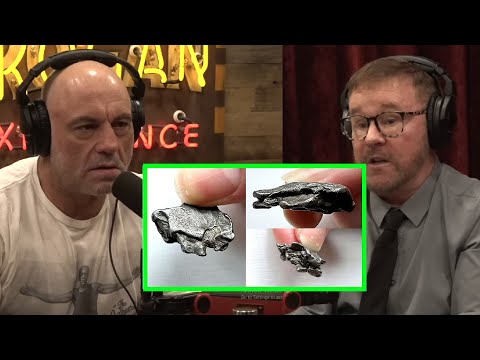
Garry Nolan Discusses the Council Bluffs Molten Metal Case
A clip of Stanford pathologist Garry Nolan discussing the case and its 2022 isotopic re-analysis in a long-form conversation.
Sources
- Vallée, Jacques F. "Physical Analyses in Ten Cases of Unexplained Aerial Objects with Material Samples." Journal of Scientific Exploration, Vol. 12, No. 3 (Autumn 1998), pp. 359–375. jacquesvallee.net
- Nolan, Garry P., Jacques F. Vallée, Sizun Jiang, and Larry G. Lemke. "Improved instrumental techniques, including isotopic analysis, applicable to the characterization of unusual materials with potential relevance to aerospace forensics." Progress in Aerospace Sciences, Vol. 128 (January 2022). sciencedirect.com
- "Mystery Flaming Object Definitely Not Meteorite." Omaha World-Herald, December 20, 1977 (cited in Vallée, 1998)
- The Historical Society (Council Bluffs, Iowa). "UFO Crash at Big Lake Park — Council Bluffs." thehistoricalsociety.org
- Council Bluffs Nonpareil. "Big Lake UFO sighting marks 46th anniversary in Council Bluffs." nonpareilonline.com
- Ufoscoop. "Physical Analyses in Ten Cases of Unexplained Aerial Objects with Material Samples." ufoscoop.com
- The UFO Chronicles. "Analysis of Council Bluffs UFO / UAP Debris." December 2021. theufochronicles.com
- Unidentified Phenomena. "Council Bluffs UFO Incident (1977)." unidentifiedphenomena.com
- Metabunk forum. "Is 'Improved Instrumental Techniques...', Nolan, Vallee, Jiang, Lemke 2022 a useful paper?" Independent methodological review of the 2022 re-analysis paper. metabunk.org
- Daily Grail. "Researchers analysed material from an unsolved UFO case with modern scientific equipment." February 2022. dailygrail.com
- Podcast UFO. "UFO Ejects Metal Over Iowa." podcastufo.com
- Randle, Kevin. "A Different Perspective: Jacques Vallee and Ten Unexplained UFO Cases and Metallic Debris." December 2021. kevinrandle.blogspot.com
- UFOs — Scientific Research. "A catalogue of UAP related 'fragments' which have been analysed." ufos-scientificresearch.blogspot.com
- Jacques Vallée. "Advanced Research." Author's own research archive. jacquesvallee.net
- Society for Scientific Exploration. Journal of Scientific Exploration, Volume 12, Number 3 (1998). scientificexploration.org
- Semantic Scholar. "Physical Analyses in Ten Cases of Unexplained Aerial Objects with Material Samples." Citation record. semanticscholar.org
- Xufos. "The Council Bluffs UFO Incident: Iowa's Mysterious Molten Metal Landing 1977." xufos.com
- Jack and Kitty. "Unsolved Mystery in Council Bluffs, Iowa: UFO, Fireball, or Hoax?" [Link removed 2026-08-25: page no longer resolves on jackandkitty.com and no archived copy or replacement was found.]
- Iowa MUFON. "Iowa MUFON Introduction and Cases." mufoncentralregion.org
- Wikimedia Commons. "File:CouncilBluffsDowntown.JPG." Public domain photograph used as this case file's hero image. commons.wikimedia.org
- City of Council Bluffs, Iowa. "Big Lake Park." Official parks department page. councilbluffs-ia.gov
- Vallée, Jacques F. Confrontations: A Scientist's Search for Alien Contact. New York: Ballantine Books, 1990 (cited within the 1998 paper's Bogotá case discussion)
See something inaccurate? Have additional information or sources?
Suggest an Edit →Last Updated: August 2026