
The UFO Verdict
Examining the Evidence
Core Thesis
The UFO Verdict: Examining the Evidence is Robert Sheaffer's first book — a twenty-two-chapter survey, published by Prometheus Books in 1981, that lays down the case-by-case skeptical method he would practice for the next four-plus decades: take each celebrated UFO claim on its own specific, checkable facts rather than argue the abstract question of extraterrestrial visitation in the round. Its organizing concept, introduced in the book's own Chapter 16, is what Sheaffer calls the "jealous phenomenon" — his term, borrowing the less common sense of "jealous" as "suspiciously watchful," for the way UFOs (like ESP and other paranormal claims) seem to appear only to the right witness at the right unrepeatable moment and vanish precisely when rigorous, repeatable verification becomes possible. Reviewing it in Skeptical Inquirer that same year, UCLA astronomer George O. Abell called this observation "absolutely correct" and the book itself "by far one of the best works on the subject" he had seen — a verdict rendered four years before Sheaffer had even founded Bay Area Skeptics, and thirty-four years before Bad UFOs would extend the same method into the smartphone era.
About the Author
Robert Sheaffer was born in 1949 in Chicago, Illinois, and graduated from Northwestern University in Evanston. When The UFO Verdict appeared in 1981 he was roughly thirty-two years old and, by his own account on The Debunker's Domain, working as a data communications engineer in Silicon Valley — not a credentialed astronomer, physicist, or research scientist, a fact this site's own Bad UFOs entry notes honestly about his later career and that applies equally here, near its very beginning. He is a longtime member of Mensa.
By 1981, Sheaffer already had four years of standing inside organized skepticism's UFO wing specifically: he had begun contributing to Skeptical Inquirer in 1977, the same year he became a founding member — alongside aerospace journalist Philip J. Klass and engineer James Oberg — of the UFO Subcommittee of the newly formed Committee for the Scientific Investigation of Claims of the Paranormal (CSICOP, since renamed the Committee for Skeptical Inquiry), the organization whose own publishing wing, Prometheus Books, put this book into print. What this book predates is arguably more revealing than what it follows from: Sheaffer would not become a founding director of Bay Area Skeptics until June 1982, a year after this book's publication, and would not begin the 1977–2017 run of his "Psychic Vibrations" column that later defined his public identity until it had already been underway for four years when this book appeared. In a 2022 talk for the National Capital Area Skeptics titled "UFOs: Then, Now, and Next," Sheaffer looked back on exactly this period, describing himself as a young skeptic active in the Washington, D.C. area during the 1970s and crediting Klass directly as his mentor in the investigative method this book puts into practice for the first time at book length.
That practice ran alongside, rather than instead of, an ordinary career: Sheaffer's own self-description as an engineer rather than a scientist is a structural feature of his skeptical identity that this book already displays in embryonic form, three and a half decades before Bad UFOs would make the same point about sustained amateur diligence over institutional credentials to a new generation of readers. Where the 1981 book differs is in ambition: The UFO Verdict is not a column compilation but a from-scratch general survey, its twenty-two chapters — per George O. Abell's contemporary Skeptical Inquirer review, cited in full below — alternating between broad treatments of UFOlogy's history, its psychology, its relationship to science, and its personalities, and case-specific chapters offering, in Abell's phrase, "probable solutions (sometimes due to Sheaffer's own investigations)."
Sheaffer's later book-length bibliography traces directly back to this one: an expanded, updated version appeared in 1998 as UFO Sightings: The Evidence, also from Prometheus Books, before he moved to self-publishing with Psychic Vibrations: Skeptical Giggles from the Skeptical Inquirer (2011) and Bad UFOs: Critical Thinking About UFO Claims (2015). Outside ufology, he later wrote Resentment Against Achievement (1988) and The Making of the Messiah (1991), both also published by Prometheus Books — but The UFO Verdict is where his skeptical career as a published book author begins.
Historical Context & Origins
Sheaffer published The UFO Verdict into a UFO culture still riding the wave Steven Spielberg's Close Encounters of the Third Kind had set off in 1977 and that Jimmy Carter's 1976 campaign pledge to release government UFO files (a pledge tied to his own 1969 sighting, which Sheaffer had already identified as the planet Venus in a July–August 1977 Humanist article) had pushed into presidential politics. CSICOP itself was barely five years old, founded in 1976 largely in response to a broader wave of paranormal claims — astrology, Uri Geller's spoon-bending, psychic prediction — of which UFOs were only the most culturally visible strand; the UFO Subcommittee Sheaffer helped found in 1977 was itself a response to how large a share of that broader wave UFO claims specifically represented.
The book also arrived nine years after J. Allen Hynek's The UFO Experience (1972) had given the field its now-standard Close Encounters classification system and a measure of scientific respectability — Hynek, a former Air Force consultant turned public UFO advocate, occupied almost exactly the opposite career trajectory from the one Sheaffer's book represents, and Northwestern University's astronomy department, which Hynek had chaired, is the same department under whose university Sheaffer himself had studied. Where Hynek's book built a taxonomy for taking reports seriously, Sheaffer's answered it directly: a taxonomy is not evidence, and each case in it deserves the same specific, checkable scrutiny regardless of which classification bin it lands in.
Structurally, The UFO Verdict also predates most of the shelf this site's own Essential Reading section otherwise documents from the skeptical side: it appeared six years before Timothy Good's proponent-side Above Top Secret (1987), thirteen years before Curtis Peebles's Watch the Skies! (1994), and thirty-four years before Sheaffer's own Bad UFOs (2015) would revisit essentially the same project for a post-Roswell-Slides, post-Kean-book UFO culture. In 1981, by contrast, the abduction genre that would later dominate popular UFO publishing — Whitley Strieber's Communion, Budd Hopkins's Missing Time — had not yet been written; Sheaffer's targets here are still overwhelmingly photographic and sighting cases, the genre that had defined UFO reporting since 1947.
Core Arguments & Key Concepts
The book's central organizing device, laid out in its own Chapter 16, is the concept of the "jealous phenomenon" — Sheaffer's term for the way UFOs, like other claimed paranormal effects, seem governed by an uncanny concern for thwarting exactly the kind of controlled, repeatable verification that would settle the question. A Boeing 747 is not a jealous phenomenon, in Sheaffer's formulation: anyone can watch one land at a fixed time and place, on instruments as well as by eye. A UFO report, by contrast, is characteristically a one-off, uncorroborated by instrumentation, and gone by the time skeptical follow-up becomes possible — a pattern Sheaffer treats as itself diagnostic, not merely inconvenient.
Per Abell's contemporary review, the book's twenty-two chapters interleave two kinds of material: general treatments of UFOlogy's history, its internal psychology, the people and organizations that constitute it, and its relationship (or lack of one) to institutional science, alternating with chapters built around specific cases and Sheaffer's own proposed "probable solutions." A chapter on the unreliability of eyewitness testimony anchors this method in relatively uncontroversial cases from outside ufology entirely: the astronomer Simon Newcomb's 1860 account of army officers who mistook a routine, dim apparition of Mars for something inexplicable, and Percival Lowell's own well-documented, wishful-thinking observations of nonexistent canals on that same planet — offered as proof that even trained observers, including scientists, misperceive celestial objects in exactly the confident, detailed way UFO witnesses do.
A second consistent theme, again per Abell, is a documented parallel between the evidentiary structure of modern UFO reports and the eyewitness and physical "evidence" historically offered for fairies and witches — not to mock either belief, but to show that vivid, sincere, and even photographically "documented" testimony has repeatedly turned out to be unreliable across very different cultural moments, and that sincerity alone was never a reliable filter in those earlier cases either.
A third, more provocative chapter, per Abell's review, takes up Chapter 13's question directly: what are the actual odds of extraterrestrial visitation, given what was known in 1981 about interstellar distances and the energy required to cross them? Sheaffer does not rule out intelligent life elsewhere in the galaxy, and does not treat the search for it (via radio astronomy, for instance) as unreasonable — but he argues the specific claim that alien spacecraft are already here, repeatedly, visiting isolated witnesses under exactly the evidentiary conditions the "jealous phenomenon" framework predicts, is one of the least likely explanations available for any given report, precisely because it is also the most extraordinary.
A fourth theme is a media-and-institutional critique that runs in two directions at once: Sheaffer faults the press for a double standard that prominently covers bizarre initial reports while burying or ignoring later mundane explanations, but he reserves sharper criticism for UFO organizations and publications themselves, which he portrays — per Abell's own summary of this argument — as rarely discussing the prosaic explanations already on record for their own "best cases," and as extending credibility to witnesses and claims that a more skeptical editorial standard would have retired.
Key Cases & Evidence Discussed
The book's most extensively documented case, per Abell's review, is the 1978 New Zealand UFO sightings — the same wave this site's own Kaikōura Lights (Case File #333) file covers — where Sheaffer directly engaged the work of Bruce Maccabee, a U.S. Navy optical physicist and UFO analyst Abell describes as "very competent and thorough" despite not being generally skeptical himself. Sheaffer offered what Abell called "plausible prosaic explanations" for the sightings while noting that Maccabee's own meticulous report revealed what Abell termed "a predilection toward nonprosaic ones" — a case study, within the book itself, of how two careful investigators working from the same instrumented data could still diverge sharply on interpretation.
Per a Goodreads reader summary of the book's contents, The UFO Verdict also takes up the Rex Heflin UFO Photographs (Case File #235, 1965) and the Exeter UFO Incident (Case File #083, 1965) in Exeter, New Hampshire — two of the photographic and mass-witness cases that, alongside Roswell, anchored the genre of UFO reporting the book was written to address. The same summary describes Sheaffer's treatment of the Betty and Barney Hill Abduction (Case File #006, 1961), where Betty Hill's own hand-drawn star map — per Abell's review, "so crude that it can be interpreted in a multitude of ways" — became Sheaffer's central example of how thin corroborating physical evidence for even the field's most famous case actually was, notwithstanding the case's outsized cultural influence on everything that followed it.
This site's own Bad UFOs entry independently documents that Sheaffer's shadow-geometry critique of the McMinnville Trent photographs (Case File #037, 1950) and his aircraft-reflection reading of the Mariana UFO Film (Case File #058, 1950) both predate his 2015 book, "drawn instead from his earlier UFO Verdict and UFO Sightings: The Evidence" — meaning this 1981 book, not the better-known 2015 one, is where those specific analyses were first published. The same is true of his identification of gulls as the likely source of the Tremonton, Utah UFO Film (Case File #189, 1952), a reading this site's own case file traces running "from his 1981 book through its 1998 update."
The book's Venus identification for Jimmy Carter's 1969 sighting (Case File #071) had already been published four years earlier in The Humanist, but the case's continued prominence — Carter was, by 1981, a recently departed U.S. president whose UFO report remained a matter of public record — made it exactly the kind of high-profile, still-unresolved-in-the-public-mind claim this book's method was built to address, and Sheaffer's byline on the original identification made him the obvious skeptical voice on it for years afterward.
Critical Reception & Controversies
The book's most substantive contemporary review appeared in Skeptical Inquirer itself, in the Fall 1981 issue, written by George O. Abell, then a professor of astronomy at UCLA and author of several widely used astronomy textbooks — a genuine subject-matter expert rather than a movement loyalist reviewing a fellow traveler's book uncritically. Abell's verdict was emphatic: "The UFO Verdict is by far one of the best works on the subject I have seen, and I strongly recommend it to both the believers and the skeptics." He specifically endorsed Sheaffer's astronomical competence, writing that he could "confirm most of what he says about eyewitness testimony about celestial objects," and called the "jealous phenomenon" framing "absolutely correct."
Abell's review was not uncritical, however, and its specific complaints are worth preserving rather than smoothing over. He objected to what he called Sheaffer's "slightly crusaderish stance," writing that the author "reads a little like a prosecutor trying to convince the jury that the accused should be sent to the chair," and said he would have preferred "a lower-key approach—one that would present the evidence and documentation and let the argument sell itself." He also singled out the book's forty-five photographs and diagrams as its "poorest feature," criticizing Prometheus Books for printing the plates on the same low-quality paper stock as the text rather than on glossy tip-in pages, rendering some images "of such poor quality and at such a reduced scale as often to be almost useless." Abell additionally caught one factual slip: Sheaffer's book credited NBC with producing the television series In Search Of, when the series was actually produced by Landsberg Productions and merely syndicated through NBC — a minor error, but one Abell felt worth correcting in print.
A second contemporary review, by Ronald A. Schorn in Sky & Telescope (November 1981), was more unreservedly positive, reportedly calling the book "a useful, informative, interesting, and well-written work" and, in the magazine's own promotional summary of the review, suggesting that "if you're only going to have one book on UFOs, this is the one" — a striking endorsement from a mainstream astronomy publication with no institutional stake in CSICOP's skeptical project.
What the available record does not preserve, in contrast to the well-documented and genuinely mixed reception this site's own Bad UFOs entry traces for Sheaffer's 2015 book, is a comparably detailed contemporary response from within the UFO research community itself to this specific 1981 title. Abell's own review anticipates exactly that asymmetry, conceding plainly that "the true believer will not be swayed by Sheaffer's arguments" — a prediction consistent with the pattern this site's own research has since documented for Sheaffer's later work, where proponent readers and reviewers have repeatedly pushed back on his conclusions even when praising his research, but for which no comparably specific 1981-era proponent critique of this particular book has turned up in the sources available for this entry.
Influence & Legacy
The most direct measure of this book's influence is bibliographic: Sheaffer's entire subsequent book-length ufological output runs through it in a straight line, from the 1998 expanded update UFO Sightings: The Evidence through to Bad UFOs in 2015, each one applying the same claim-by-claim method this 1981 debut established first. The "jealous phenomenon" concept coined here in Chapter 16 remained part of his vocabulary for describing paranormal claims generally across that entire span.
Within this site's own catalogue specifically, this book's influence is concretely traceable rather than merely asserted: this site's own Bad UFOs entry independently documents that Sheaffer's shadow-geometry critique of the McMinnville photographs and his aircraft-reflection reading of the Mariana film both trace back to this 1981 book rather than to his later, better-known one, and that his "gull" explanation for the Tremonton film runs continuously from this book through its 1998 update. This entry's own key-figures cross-reference on this site now links directly back to this article alongside the existing link to Bad UFOs, preserving both halves of Sheaffer's roughly four-decade documented arc on this site in one place.
Institutionally, the book's publication sits inside the same broader legacy this site's own Bad UFOs entry already documents in fuller detail: the UFO Subcommittee of CSICOP/CSI that Sheaffer helped found alongside Philip J. Klass and James Oberg in 1977, and Bay Area Skeptics, which he helped establish the year after this book appeared. Sheaffer himself revisited this exact early period publicly in a 2022 National Capital Area Skeptics talk, "UFOs: Then, Now, and Next," which paired a retrospective on his 1970s formation as a skeptic — including his mentorship under Klass — with an update on a case he considered newly solved, framing his own four-decade career, this book's own 1981 starting point included, as a single continuous project rather than three separate books.
Read against Bad UFOs, this book's own legacy is best understood as the difference between a method's origin and its mature expression: where the 2015 book is explicitly a column-and-blog compilation assembled from decades of already-published dispatches, The UFO Verdict is where Sheaffer, still four years from founding Bay Area Skeptics and only recently arrived at Skeptical Inquirer, first had to build the case-by-case method from the ground up inside a single, from-scratch, twenty-two-chapter argument — the same argument Abell's 1981 review judged, on its own individual merits, one of the best UFO books he had encountered.
The Book
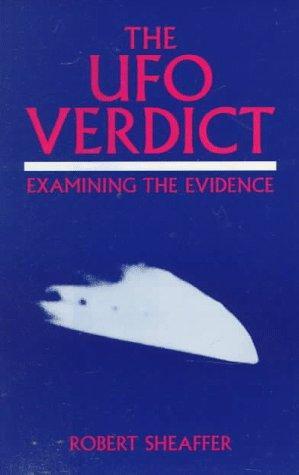
As an Amazon Associate, OverClassified may earn from qualifying purchases made through this link, at no extra cost to you.
Why This Is Essential Reading
The UFO Verdict earns its place on this list as the origin point of a skeptical method this site's own case-file library has traced across five decades of citations — not as a polished, decades-refined summary like Bad UFOs, but as the rawer, more ambitious first attempt at building that method from scratch, complete with the "crusaderish" overreach and cheap photo reproduction a sympathetic expert reviewer felt obliged to flag even while calling it one of the best books on the subject he had read. Robert Sheaffer was not yet a veteran movement figure when he wrote it — he was a data-communications engineer four years into his Skeptical Inquirer byline, a year away from co-founding Bay Area Skeptics, applying lessons learned directly from his mentor Philip J. Klass to a subject still riding Close Encounters's cultural wave — and that unfinished, first-attempt quality is precisely what makes it essential reading alongside his later work rather than redundant with it: this is the book where the McMinnville shadow-geometry critique, the Mariana reflection analysis, and the Tremonton gull explanation this site's own case files still cite were worked out for the first time, three and a half decades before a newer generation of readers would meet the same investigator through Bad UFOs instead.
Related Cases & Theories
Essential Viewing
Sources Cited
- Sheaffer, Robert. The UFO Verdict: Examining the Evidence. Prometheus Books, Buffalo, N.Y., 1981 (ISBN 0879751460 / 9780879751463, cited here; 242 pp. plus 16 pages of plates, LC# 80084406). openlibrary.org
- Sheaffer, Robert. The UFO Verdict: Examining the Evidence, 1986 Prometheus Books paperback reissue (ISBN 0879753382 / 9780879753382), cover art edition. abebooks.com
- Abell, George O. "Book Reviews: The UFO Verdict: Examining the Evidence." Skeptical Inquirer, Vol. 6, No. 1 (Fall 1981), pp. 59–62 (full contemporary review quoted throughout this entry). centerforinquiry.s3.amazonaws.com
- "The UFO Verdict: Examining the Evidence." Internet Archive (item record: publisher, ISBN, physical description, LC number). archive.org
- "The Ufo Verdict: Examining the Evidence." Goodreads (publication details and reader-summarized case content, incl. Rex Heflin, Exeter, and Betty and Barney Hill). goodreads.com
- "Robert Sheaffer." Wikipedia (biography: birth, education, career, CSICOP/Bay Area Skeptics timeline, bibliography). en.wikipedia.org
- "Robert Sheaffer." Skeptical Inquirer author page (official contributor bio). skepticalinquirer.org
- The Debunker's Domain (debunker.com), Robert Sheaffer's personal site (self-description, career, and affiliations). debunker.com
- "Robert Sheaffer's Books." The Debunker's Domain (full bibliography with publishers, years, and this book's original reception, incl. the Sky & Telescope blurb). debunker.com
- "April 2: UFOs: Then, Now, and Next." National Capital Area Skeptics, March 2022 (event description of Sheaffer's retrospective talk on his 1970s formation as a skeptic and mentorship under Philip J. Klass). ncas.org
- "UFOs: Then, Now, and Next (Robert Sheaffer)." National Capital Area Skeptics (NCAS), YouTube, 2022 (video cited in Essential Viewing below). youtube.com
- "The UFO verdict : examining the evidence / Robert Sheaffer." Smithsonian Institution Libraries catalog record. si.edu
- "The Ufo Verdict: Examining the Evidence." AbeBooks (bibliographic listings for both the 1981 hardcover and 1986 paperback editions). abebooks.com
- This site's own essential-reading entry: Bad UFOs by Robert Sheaffer, this book's 2015 successor, for the fuller documented arc of Sheaffer's later career and its own citation trail across seven of this site's case files.
- This site's own key-figures entry: Robert Sheaffer, for his full biography and site-wide case connections.
- This site's own case file: The Kaikōura Lights, which documents the 1978 New Zealand sightings this book covers via Bruce Maccabee's original investigation.
- This site's own resources library: Full Reading List.
Have corrections, additional research, or peer-reviewed sources? Help improve this entry.
Suggest an Edit