
The UFO Enigma
The Definitive Explanation of the UFO Phenomenon
Core Thesis
The UFO Enigma: The Definitive Explanation of the UFO Phenomenon is Donald H. Menzel's third and final UFO book, co-written with psychiatrist Ernest H. Taves and published by Doubleday in January 1977, roughly six weeks after Menzel's death on December 14, 1976. This is a different, earlier book from Peter A. Sturrock's unrelated 1999 volume of a similar title, reviewed separately in this site's own essential-reading entry on Sturrock's The UFO Enigma: A New Review of the Physical Evidence — the two books share four words of title and nothing else, written 22 years apart by authors on opposite sides of the field's central argument. With an introduction by former Smithsonian Astrophysical Observatory director Fred L. Whipple, Menzel and Taves's book closes out a UFO-skeptic bibliography that began with 1953's Flying Saucers and continued through 1963's The World of Flying Saucers, applying the same case-by-case method — temperature inversions, optical mirages, astronomical misidentification, hoax and psychological explanations — to a further decade of famous sightings while framing the UFO phenomenon as one front in a broader 1970s battle against what the authors call society's drift toward irrationalism. Its title's promise of a single "definitive explanation" is also its most contested claim: this site's own Betty & Barney Hill Abduction case file, which cites this exact edition directly, still treats the book's own astronomical explanation for the Hills' initial sighting as effectively ruled out by the radar corroboration and erratic flight path Menzel and Taves's account does not fully address — a genuine, documented limit on a book whose subtitle claims finality.
About the Author
Donald Howard Menzel (April 11, 1901 – December 14, 1976) was, by any conventional measure, one of the most credentialed scientists ever to build a public career debunking UFO reports. Born in Florence, Colorado, he earned undergraduate and master's degrees in chemistry from the University of Denver, a second master's in astronomy, and a 1924 Ph.D. in astrophysics from Princeton under Henry Norris Russell. He joined Harvard in 1932, served as a Navy lieutenant commander in intelligence work during World War II, became acting director of the Harvard College Observatory in 1952 and its permanent director in 1954, and remained on the Harvard faculty until his 1971 retirement. He was, per his own National Academy of Sciences biographical memoir, "one of the first practitioners of theoretical astrophysics in the United States," with foundational published work on the solar chromosphere, stellar chemistry, and the physics of gaseous nebulae.
Menzel's entry into ufology dates to the widely publicized July 1952 Washington, D.C. radar-visual sightings, which he addressed in Life magazine's April 1952 "Have We Visitors From Space?" feature and then at book length in 1953's Flying Saucers, arguing that temperature inversions and optical mirages explained the reports. A second, considerably wider casebook, 1963's The World of Flying Saucers (co-written with science editor Lyle G. Boyd), extended the method to a fresh decade of cases; this site's own entry on that book documents both its genuine achievements — the shadow-direction critique of the Barra da Tijuca photographs, later independently confirmed by the 1968 Condon Report — and its overreaches, including a Nash-Fortenberry explanation physicist James E. McDonald called "an almost entirely ad hoc assumption." Decades after Menzel's death, researcher Stanton Friedman discovered in Menzel's own papers at the Harvard Archives that he had simultaneously held a Top Secret Ultra clearance and worked for more than thirty years as a classified cryptologic consultant to the National Security Agency and Defense Intelligence Agency — a dual role this site's own Washington D.C. 1952 case file already treats as a documented complication of any simple reading of "an independent scientist who happened to agree with the Air Force." Colleagues who dealt with Menzel directly were also sharply divided on his temperament: UFO historian David Halperin's own research found "veteran UFOlogists" describing him as "a nasty man…dogmatic and opinionated," and "contemptuous of anyone who dared disagree with him." Menzel died of cancer at a Boston hospital on December 14, 1976, having lived just long enough to see this final book through to press but not to see it published.
Ernest Henry Taves (February 1, 1916 – August 16, 2003) brought a genuinely different professional background to this book than either of Menzel's earlier co-authors. Born in Aberdeen, Idaho, he studied at Oregon State University before earning his medical degree from New York University School of Medicine and a Ph.D. from Columbia University; as a graduate student at Columbia he had studied and written about the parapsychology experiments Dr. J. B. Rhine was then running at Duke University, giving him a genuine, if early and informal, insider's exposure to the same territory of unverified extraordinary claims this book treats skeptically. After U.S. Army Medical Corps service in occupied Japan (1946–1948), where he reached the rank of captain as chief of the neuropsychiatric section at the 155th Station Hospital in Yokohama, Taves built a private psychoanalytic practice, first in New York City and then, from 1954, in Cambridge, Massachusetts — the same city as Menzel's Harvard Observatory — before giving up clinical practice in 1972 to write full-time.
Taves's contribution to this book, a chapter on "UFOs and the Media," is narrower than his professional background might suggest; UFO historian David Halperin has noted that the "psychoanalytic perspective" the book's marketing implicitly promised from a working psychiatrist never really materializes in the finished text. Taves's skeptical career continued well past this book and past Menzel's death: he became a founding member, alongside Philip J. Klass, James E. Oberg, and Daniel Cohen, of the UFO Subcommittee of the newly formed Committee for the Scientific Investigation of Claims of the Paranormal (CSICOP, now the Committee for Skeptical Inquiry) and a Scientific and Technical Consultant to the organization, and he went on to review two later UFO books for Skeptical Inquirer — Raymond Fowler's The Andreasson Affair in 1979 and its 1982 sequel, and Whitley Strieber's Communion in 1987. Outside ufology he wrote two books on early Mormon history, Trouble Enough: Joseph Smith and the Book of Mormon (1984) and This Is the Place: Brigham Young and the New Zion (1991), applying the same skeptical historical method to religious origin claims that this book applies to UFO reports. He died of a heart attack in a Naples, Florida hospital on August 16, 2003, at 87.
Historical Context & Origins
By the mid-1970s, the cultural landscape this book responded to had shifted considerably from the one Menzel's earlier UFO books addressed. The 1969 Condon Report had already delivered its contested, largely dismissive verdict and given the Air Force its rationale for closing Project Blue Book, but rather than settling the question, the years that followed saw a broader popular surge in UFO belief, ancient-astronaut speculation following Erich von Däniken's bestselling Chariots of the Gods? (the subject of this site's own separate essential-reading entry), and Charles Berlitz's 1974 Bermuda Triangle mythology — phenomena this book explicitly groups together and pushes back against as symptoms of a single cultural drift toward what its own text calls society's "New Nonsense." That framing situates the book less as a narrow UFO casebook than as Menzel and Taves's contribution to a wider mid-1970s scientific backlash against popular irrationalism, the same institutional moment that saw the 1975 "Objections to Astrology" manifesto signed by 186 scientists and, in 1976, the founding of CSICOP itself, the organization Taves would go on to serve as a founding UFO Subcommittee member.
The book's own publication history is inseparable from Menzel's declining health. He died on December 14, 1976, and The UFO Enigma reached bookstores the following month, carrying an introduction by his longtime Harvard and Smithsonian Astrophysical Observatory colleague Fred L. Whipple — making this, in effect, Menzel's own posthumous closing statement on a subject he had publicly debated for a quarter century, rather than a book he lived to see reviewed. Structurally, the book covers roughly a decade's worth of publicized American UFO sightings from the early 1960s through the mid-1970s, working, per its own surviving table of contents, through chapters including "Fright and Flying Saucers," "The Elusive UFO," and "Flying Saucers of the Bible" — the last of these directly addressing the ancient-astronaut and biblical-UFO claims popularized by von Däniken and others in the years immediately preceding this book's writing.
The book also arrived at a genuine institutional hinge point for organized UFO skepticism. Where Menzel's 1953 and 1963 books had been comparatively solitary efforts, this one was published in the same period that Philip J. Klass was consolidating his own position as the field's most visible professional skeptic following his 1974 UFOs Explained, and just months before CSICOP's UFO Subcommittee formalized a next generation of skeptical investigators — Klass, Taves, James Oberg, and Daniel Cohen — that would carry Menzel's basic method forward without him. This site's own entry on Menzel's 1963 book already anticipates this one directly, noting that his UFO-skeptic bibliography "ran, across three books and twenty-four years, from 1953's Flying Saucers through this 1963 volume to that final 1977 title" — a throughline this entry completes from the other end.
Despite its subtitle's claim to be "the definitive explanation," the book was not received as a decisive final word even within organized skepticism itself. UFO historian David Halperin's later retrospective assessment found it "so mediocre, so diffuse, so unoriginal" that "large chunks" appeared "recycled verbatim from Flying Saucers," Menzel's book from nearly a quarter century earlier — a documented, specific charge of self-repetition rather than a fresh, comprehensive synthesis of the intervening decades' cases, discussed further in Critical Reception below.
Core Arguments & Key Concepts
The book's organizing method continues directly from Menzel's two earlier books: rather than proposing one physical mechanism to cover most sightings, it works case by case through a wide explanatory toolkit — temperature-inversion mirages, aurora and other atmospheric-optical effects, the autokinetic effect (the visual illusion that makes a stationary point of light appear to move), meteors and fireballs, misidentified aircraft, and outright hoax — matching each sighting to whichever conventional cause its specific circumstances seem to support, consistent with the case-by-case template this site's own entry on The World of Flying Saucers already documents as Menzel's signature approach.
A second, more polemical argument runs through the book's framing rather than any single case: Menzel and Taves explicitly link UFO belief to a broader mid-1970s surge in what they call societal "irrationalism," grouping UFO reports alongside astrology, parapsychology, ancient-astronaut theory, and Bermuda Triangle mythology as symptoms of the same underlying failure of critical thinking. Taves's own earlier academic exposure to J. B. Rhine's Duke parapsychology experiments is put to direct use here, lending his half of the book's argument against parapsychology's credibility a genuinely informed, if also personally dismissive, edge that UFO historian David Halperin has separately characterized as "just scummy" toward his own former field of study.
The book's "Flying Saucers of the Bible" chapter takes direct aim at the ancient-astronaut argument popularized by Erich von Däniken's Chariots of the Gods? — the subject of this site's own separate essential-reading entry — disputing the claim that biblical and other ancient religious accounts describe literal extraterrestrial visitation, and applying the same evidentiary skepticism to Charles Berlitz's Bermuda Triangle claims that the book applies throughout to specific UFO sightings.
On individual cases, the book's treatment of the 1961 Betty and Barney Hill encounter — discussed in full in Key Cases below — is its most consequential single argument: Menzel and Taves propose that the initial sighting was an astronomical misidentification (most likely the planet Jupiter, then visible near the Moon), that Barney's hypnotically recovered abduction narrative reflected psychological suggestion and "contagion" from Betty's own detailed dream journal rather than an independent memory, and that Marjorie Fish's later celebrated star-map correlation between Betty's sketched star pattern and the real position of Zeta Reticuli was coincidental rather than evidentiary.
Structurally, the book moves from its media-and-irrationalism framing chapters, through its survey of atmospheric and optical explanatory mechanisms, into extended individual-case treatments, and closes by restating Menzel's now three-decades-old central claim: that the entire UFO phenomenon, examined case by case with sufficient patience, resolves into known physical causes, witness error, and outright fabrication, without requiring any genuinely novel physical mechanism or extraterrestrial hypothesis.
Key Cases & Evidence Discussed
The Betty & Barney Hill Abduction (Case File, September 1961) receives this book's fullest and most directly tested individual treatment. This site's own resources library cites this exact 1977 edition (ISBN 0385035969) specifically for "the definitive skeptical viewpoint on the Hill case, proposing optical illusions, psychological contagion, and star map coincidences" — and the case file itself finds the astronomical-misidentification component of that argument wanting: its own Conventional Explanation Candidate section marks "Astronomical Misidentification" as effectively ruled out, noting that "the object's erratic movement, descent, hover, and rapid departure are inconsistent with Jupiter or a meteor, and the Pease Air Force Base radar detection of an anomalous object that night argues against any purely astronomical explanation." The book's separate psychological and star-map arguments fare somewhat better in this site's own assessment, which independently notes that the hypnotic-regression evidence is "epistemologically limited" without fully resolving the case either way — a genuinely mixed verdict on a book whose own subtitle promises finality.
The book's "Flying Saucers of the Bible" chapter engages Erich von Däniken's ancient-astronaut thesis, the subject of this site's own Chariots of the Gods? entry, disputing the claim that biblical texts and other ancient religious accounts record literal extraterrestrial contact — a direct, book-length rebuttal target rather than a passing mention.
Charles Berlitz's Bermuda Triangle mythology, popularized in his 1974 bestseller, receives a similarly skeptical treatment in the book's broader "irrationalism" framing; this site's own key-figures entry on Berlitz, written in connection with his later, unrelated Roswell Incident (1980, co-written with William Moore), documents the same pattern of uncritical, sensationalized nonfiction this book challenges from the opposite direction.
More broadly, per its own publisher description, the book works through "the most publicized sightings" of American ufology from the early 1960s through the mid-1970s, applying its temperature-inversion, optical-mirage, and hoax toolkit to that decade's reports in the same case-by-case structure this site's own entry on Menzel's 1963 book documents him using across his earlier casebook.
Critical Reception & Controversies
The most substantive contemporary review came from a source this site already treats as a key figure in its own right: Robert Sheaffer, reviewing the book in the October 1978 issue of Reason under the title "Gods of Aquarius; The UFO Enigma," called it "a powerful antidote to the rising tide of irrationalism" and "extremely valuable" reading for anyone contesting occult belief, praising its dissection of classic UFO cases and its critique of sensationalized media coverage. Sheaffer's praise was not uncritical, however: he noted plainly that Menzel "was an irascible man" whose writing could tip into pontificating, and specifically flagged the book's heavy reliance on meteorological-optical explanations as overextended, since such explanations "can account for only a minuscule number of reported sightings" relative to the full range of cases the book addresses — a specific, named methodological limitation from a reviewer otherwise sympathetic to the book's skeptical project, and the same reviewer this site's own Bad UFOs entry profiles in full for his own later skeptical career.
A considerably harsher retrospective assessment comes from UFO historian David Halperin, who found the book "so mediocre, so diffuse, so unoriginal" that "large chunks" read as "recycled verbatim" from Menzel's 1953 debut, Flying Saucers — a specific, checkable charge of self-repetition that directly undercuts the book's own subtitle claim to be a fresh "definitive explanation" rather than a restatement of a quarter-century-old argument. Halperin was equally unsparing about Taves's contribution specifically, writing that the promised psychoanalytic perspective from a working psychiatrist "never really materializes," and characterizing Taves's dismissal of his own former parapsychology-adjacent academic background as "just scummy" rather than genuinely engaged critique.
This site's own research independently documents a further, case-specific limitation in the book's central Hill-case argument: the Betty & Barney Hill Abduction case file's Conventional Explanation Candidate section rules out the book's astronomical-misidentification theory for the initial sighting specifically because of the object's documented erratic movement and the Pease Air Force Base radar detection that night — independent, verifiable evidence the book's own "optical illusion" argument does not fully account for. This mirrors a broader, well-documented pattern in Menzel's career that this site's own entry on his 1963 book already traces: physicist James E. McDonald's dismissal of an earlier Menzel explanation as "an almost entirely ad hoc assumption," and UFO researcher Rich Reynolds's broader assessment, published on The UFO Chronicles, that Menzel "went to excruciating lengths to fit UFO sightings into a framework of astronomical and meteorological explanations that stretched credulity and Ockham's Razor to the breaking point," arguing pointedly that Menzel and Philip J. Klass "were debunkers, not skeptics."
Set against those criticisms, the book's genuinely favorable contemporary reception should not be understated: its authors' combined credentials — a Harvard Observatory director and a practicing psychiatrist with real, if idiosyncratic, exposure to parapsychology research — carried real institutional weight, and Fred Whipple's introduction from a similarly credentialed Smithsonian astronomer lent it a mainstream scientific imprimatur few other UFO-skeptical books of the era could claim. The genuine tension this entry documents — a book praised on release as "extremely valuable" by one of the field's most careful later skeptics, while separately criticized as recycled and methodologically overextended by both a sympathetic historian and this site's own case-file research — is best read as consistent with, rather than contradictory to, the mixed critical record this site's other Menzel entries have already established.
Influence & Legacy
This book's most directly verifiable influence is preserved on this site itself: this exact 1977 edition, under ISBN 0385035969, is cited on this site's own Betty & Barney Hill Abduction case file as the source for the astronomical, psychological, and star-map skeptical explanations that case file continues to weigh against the sighting's radar corroboration nearly five decades later — a working citation, not a historical footnote.
As the third and final installment of Menzel's UFO-skeptic bibliography, this book completes a throughline this site's own entry on his 1963 book already anticipates directly, describing a career that "ran, across three books and twenty-four years, from 1953's Flying Saucers through" the 1963 volume "to that final 1977 title." Read together, the three books document the same case-by-case skeptical method being applied across three successive decades of UFO reports by the same central author, ending only with his death.
Institutionally, this book's most durable legacy runs through its surviving co-author rather than through Menzel, who did not live to see it published. Ernest Taves became a founding member of CSICOP's UFO Subcommittee alongside Philip J. Klass, James Oberg, and Daniel Cohen in the years immediately following this book's release — the same institutional partnership this site's own Bad UFOs and UFOs Explained entries document from Robert Sheaffer's and Klass's own sides — and continued reviewing UFO-adjacent books for Skeptical Inquirer into the late 1980s, extending this book's method to Raymond Fowler's The Andreasson Affair and Whitley Strieber's Communion.
Menzel's own death just weeks before publication meant this book, rather than any planned retirement statement, effectively closed out his quarter-century public skeptical career; Philip J. Klass succeeded him as the field's most prominent professional skeptic in the years that immediately followed, a generational handoff this site's own entry on Menzel's earlier book already documents from Klass's side.
The Book
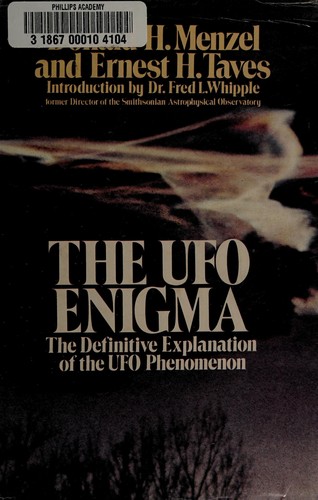
As an Amazon Associate, OverClassified may earn from qualifying purchases made through this link, at no extra cost to you.
Why This Is Essential Reading
The UFO Enigma earns its place on this list as the closing chapter of the most institutionally credentialed skeptical UFO career of the mid-twentieth century — Donald H. Menzel's own posthumous last word, delivered with psychiatrist Ernest Taves's help just weeks after Menzel's own death, and not to be confused with Peter Sturrock's unrelated, much later book of a similar title reviewed separately in this site's own entry on The UFO Enigma: A New Review of the Physical Evidence. Its record, documented honestly across this entry's Critical Reception section, is genuinely uneven in exactly the way that makes it worth reading closely rather than simply filing under "skeptical classic": Robert Sheaffer's own 1978 review found it "extremely valuable" even while flagging its overreliance on meteorological explanations, while UFO historian David Halperin later judged large portions "recycled verbatim" from Menzel's 1953 debut, and this site's own Betty & Barney Hill Abduction case file independently rules out the book's central astronomical explanation for that case's radar-corroborated sighting. Read it not as the settled "definitive explanation" its own subtitle promises, but as the final, imperfect data point in a three-book, twenty-four-year skeptical career — essential precisely because its author's institutional standing, his classified NSA/DIA double life, his real analytical successes, and his real documented overreaches are all, by this point in his bibliography, fully on the record.
Related Cases & Theories
Essential Viewing
The Menzel Gap
The UFO Professor — An examination of the so-called "Menzel Gap" — the 1953–1968 disruption in the Harvard College Observatory's photographic sky-survey archive that began the same year Menzel became director, a documented episode in his biography distinct from but often discussed alongside his public UFO skepticism. Verified via YouTube oEmbed before inclusion.
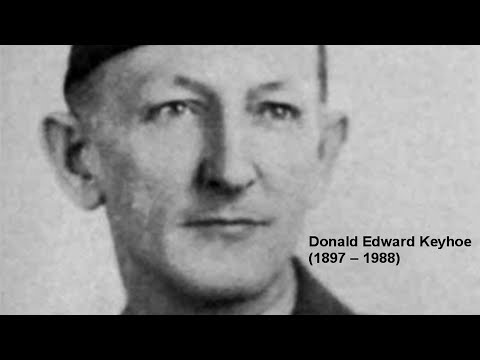
Major Donald E. Keyhoe: Armstrong Circle Theatre / U.F.O: Enigma of the Skies
Donald Edward Keyhoe — The full January 22, 1958 CBS television broadcast in which Donald Menzel appeared alongside NICAP director Donald Keyhoe and Col. Spencer Whedon to debate the UFO question on air — a rare surviving recording of Menzel in direct public argument with his era's leading UFO advocate. Verified via YouTube oEmbed before inclusion.
Sources Cited
- Menzel, Donald H., and Taves, Ernest H. The UFO Enigma: The Definitive Explanation of the UFO Phenomenon. Doubleday & Company, Garden City, NY, 1977 (ISBN 0385035969 / 9780385035965, matching the exact edition already cited on this site's own Betty & Barney Hill Abduction case file). amazon.com
- "The UFO enigma." Open Library (bibliographic record: Doubleday, 1977, 297pp, LCCN 76016255, OCLC 2597609, cover ID 10009635). openlibrary.org
- "Donald Howard Menzel." Wikipedia (biography: birth/death, education, Harvard Observatory directorship, UFO-skeptic bibliography including this book). en.wikipedia.org
- "Ernest H. Taves." Wikipedia (biography: birth/death, education, Army Medical Corps service, psychoanalytic practice, CSICOP UFO Subcommittee founding membership, bibliography). en.wikipedia.org
- "Ernest H. Taves." Skeptical Inquirer author page (contributor bio and bibliography of later book reviews for the magazine, 1979–1987). skepticalinquirer.org
- Sheaffer, Robert. "Gods of Aquarius; The UFO Enigma." Reason, October 1978 (contemporary review: "a powerful antidote to the rising tide of irrationalism," "extremely valuable," and specific criticism of Menzel's temperament and over-reliance on meteorological-optical explanations). reason.com
- Halperin, David J. "UFOs and Parapsychology – Donald Menzel, Ernest Taves." davidhalperin.net (retrospective critical assessment: "so mediocre, so diffuse, so unoriginal," recycled content from Flying Saucers, and analysis of Taves's chapter and background). davidhalperin.net
- Reynolds, Rich. "UFO Iconoclasts: Skeptics or Debunkers?" The UFO Chronicles, April 2012 (critical assessment of Menzel's and Philip Klass's shared explanatory method as "debunkers, not skeptics"). theufochronicles.com
- "The UFO Enigma- the Definitive Explanation of the UFO Phenomenon." Wyoming History Day / American Heritage Center, University of Wyoming (archival collection record: partial chapter list including "Fright and Flying Saucers," "The Elusive UFO," and "Flying Saucers of the Bible"). wyominghistoryday.org
- "Committee for Skeptical Inquiry." Wikipedia (CSICOP's 1976 founding and the UFO Subcommittee co-founded by Ernest Taves, Philip J. Klass, James Oberg, and Daniel Cohen). en.wikipedia.org
- This site's own case file: Betty & Barney Hill Abduction, which cites this exact book directly and independently rules out its central astronomical-misidentification argument for the initial sighting.
- This site's own essential-reading entry: The World of Flying Saucers, Menzel's 1963 casebook and this book's direct methodological predecessor.
- This site's own essential-reading entry: UFOs Explained, Philip J. Klass's 1974 book and Menzel's institutional skeptical successor.
- This site's own essential-reading entry: Bad UFOs, Robert Sheaffer's 2015 casebook; Sheaffer reviewed this exact 1977 book directly in 1978.
- This site's own essential-reading entry: The UFO Enigma by Peter A. Sturrock (1999), a different, later, unrelated book sharing a similar title.
- This site's own essential-reading entry: Chariots of the Gods?, Erich von Däniken's 1968 ancient-astronaut book directly rebutted in this book's "Flying Saucers of the Bible" chapter.
- This site's own key-figures entries: Donald H. Menzel and Ernest H. Taves, for full biographical detail and further site-wide case connections.
- This site's own resources library: Full Reading List, where this exact edition (ISBN 0385035969) is cited in connection with the Betty & Barney Hill Abduction case file.
Have corrections, additional research, or peer-reviewed sources? Help improve this entry.
Suggest an Edit