
Operation Animal Mutilation
Report of the District Attorney, First Judicial District, State of New Mexico
Core Thesis
Operation Animal Mutilation is the final report of a year-long, federally funded inquiry into livestock mutilations in New Mexico, written by its director, retired FBI agent Kenneth M. Rommel, Jr., and dated June 1980. It is not a trade book. It is a typed government document issued by a district attorney's office, and it is the single most cited skeptical source on the subject. Its conclusion is blunt. Rommel examined 117 New Mexico reports, 90 from before his project and 27 during it, and wrote that he had not found one that could be confirmed as a "classic mutilation." The damage, he argued, was done by scavengers and predators after the animals died, and the mystery was built by newspapers, by untrained investigators and by repetition. The report matters because nearly every later book on the subject either leans on it or is written against it, and because the people who worked the cases in the field, above all State Police officer Gabe Valdez, never accepted it. A note on this breakdown: it was written from an online transcription of the report's six chapters hosted by the French archive RR0, checked against the FBI's released Animal Mutilation file. The transcription omits the appendix and the photographs, and this site has not handled a paper copy.
About the Author
What can be documented about Rommel comes mostly from the report itself. In its introduction he writes that he spent 28 years as an FBI special agent. Ten of those years were in counter-espionage, working against Soviet and satellite intelligence services. The other eighteen were in criminal work, fifteen of them given almost wholly to bank robberies and other violent major crimes, on assignments inside and outside the continental United States. He retired from the Bureau in May 1979 and took the mutilation job shortly afterwards. An FBI memorandum in the Bureau's released file confirms the outline, describing him as a former agent appointed to head the special unit.
He was hired because the grant required someone like him. According to the report, its terms called for a director with at least twenty years of senior investigative experience, access to the best testing laboratories, and working relationships with federal, state and local police. District Attorney Eloy F. Martinez judged that Rommel met them. Rommel says he arrived knowing little about mutilations beyond newspaper accounts, and that he had "no preconceived opinions on how it was going to turn out." That statement is disputed, as the reception section below shows.
He was not a veterinarian or a pathologist, and the report does not pretend otherwise. His method was a detective's: collect the official files, interview the people quoted in the press, send samples to laboratories, and ask specialists what the evidence meant. He lined up the State Police crime laboratory, the state's chief medical investigator and Clair Hibbs of the state veterinary diagnostic service, and received offers of help from specialists at the University of New Mexico. He then, by his own account, never needed to call any of them to a scene.
After the report he stayed out of the field but not out of the argument. Steve Terrell of the Santa Fe New Mexican reported in 2015 that Rommel died in 2012, and that in a 1994 interview he was still a skeptic, expressing a wry sympathy for people "whose lives are so dull and boring" that dead cattle excited them. This site could not locate an obituary, a birth date, or a fuller account of his Bureau postings from a source it could open, and has left those details out.
Historical Context & Origins
By 1979 the mutilation story was a decade old and nationally known. The report's introduction notes that it was Colorado's news story of the year in 1975 and repeats, without endorsing it, an estimate that 10,000 cattle had been mutilated. Senator Floyd Haskell of Colorado had pressed the FBI to investigate; the Bureau declined for lack of jurisdiction outside Indian lands, as its released file records. New Mexico was said to be badly hit, with more than 100 reports since 1975 and more than 60 claimed for Rio Arriba County alone.
The local picture was shaped by one town. Dulce, on the Jicarilla Apache reservation, produced the cases that drew reporters: tripod-like tracks leading to a carcass in June 1976, a bull whose liver was described as white and mushy in April 1978, cattle with fractured legs said to have been dropped from the air, and orange lights over the ridges. Valdez investigated most of them, often with retired Sandia scientist Howard Burgess, and in July 1978 the two ran a night-time test in which cattle were passed under ultraviolet light and five were found carrying a fluorescent substance. This site's biological sampling hypothesis page covers that material in detail.
On February 1, 1979, Martinez's office applied to the federal Law Enforcement Assistance Administration for $44,170. Before the grant was decided, Senator Harrison Schmitt and U.S. Attorney R. E. Thompson convened a conference on livestock mutilation in Albuquerque on April 20, 1979. A public morning session was followed by a closed afternoon meeting of law officers from several states and the FBI. Wikipedia's account, citing Mark Pilkington's Mirage Men, adds that Paul Bennewitz attended and reported lights over Kirtland Air Force Base. The report says the grant was awarded four days later.
The project ran from May 28, 1979 to May 27, 1980, with Rommel working out of the district attorney's office in Española. Rommel announced his findings before the report existed: Tom Adams's newsletter Stigmata, citing the Albuquerque Journal, records a press conference on April 15, 1980. The FBI's own interest was narrower. Its Albuquerque office had been authorized in March 1979 to look at mutilations on Indian lands, found nothing it could investigate, and when it forwarded a bound copy of Rommel's report to headquarters in July 1980 it noted only that the document "adds nothing new" to that question.
Core Arguments & Key Concepts
The burden of proof sits with the claim of human action. Rommel set five objectives, and the third governs the rest: decide whether mutilations were a major law enforcement problem. Since scavengers are known to strip carcasses, he reasoned, the only thing that could mark a crime was real surgical removal of tissue. If the wounds on a given animal were ragged, torn or toothmarked, he stopped there and did not try to establish the cause of death. He compared this to arriving at a bank to find the alarm had gone off by mistake.
A smooth edge proves nothing without a microscope. The report argues that scavenger damage can look like a knife cut from a few feet away, and quotes a University of Missouri pathologist to the effect that scavengers often "make a clean cut" resembling a surgeon's. The only reliable test, Rommel says on veterinary advice, is microscopic: hair follicles sliced across cleanly indicate a blade. Investigators who wrote "surgical precision" in a report were, in his view, recording a conclusion and not an observation.
Every trait of the "classic mutilation" has an ordinary cause. The missing parts, eyes, tongue, lips, udder, genitals and rectum, are the soft tissues scavengers reach first. Blood is absent because it settles and clots inside a dead animal and what spills is eaten. Dark stains read as burns are dried blood. Carcasses that scavengers avoid may be diseased. Decay runs fast or slow with weather and cause of death. On the quiet family dog, Rommel offers the report's best-known line, that it is "hard to bark when your mouth is full of fresh meat."
The press and the police built the mystery together. A whole chapter retells the New Mexico cases purely from newspaper and magazine coverage, to show what an ordinary resident had been told. The next chapter sets the official reports beside it and finds some of them as sensational as the journalism. Rommel leans on sociologist James R. Stewart of the University of South Dakota, who found that reports in Nebraska and South Dakota rose and fell with the column inches devoted to them, in a paper titled "Collective Delusion."
There is no conspiracy, and no more money should be spent. Rommel found "not one shred of hard evidence" for the most popular New Mexico theory, that a well-funded group, perhaps the government, was sampling cattle. His reasoning is that five years of secrecy across many agencies is implausible and that large rewards went unclaimed. He gives the cult and extraterrestrial theories a paragraph between them. His first recommendation is that no further law enforcement money go to the subject, though he adds that anthropologists, psychologists and sociologists might usefully study it.
Key Cases & Evidence Discussed
The 90 earlier New Mexico cases. Rommel wrote to the Livestock Board, the State Police and every county sheriff and assembled files on 90 reports from February 1975 to May 1979, including six horses and a buffalo calf. Only 26 were from Rio Arriba County, against the 60 or more the grant application had assumed. He classed 69 as explicable at least in part: 18 resolved by the original investigators, 28 with recorded scavenger activity, and 19 where a known cause of death or advanced decay ruled out the "classic" label. The remaining 21 had too little evidence to judge either way. That last group is the nearest the report comes to an unexplained residue, and Rommel does not present it as one.
The Dulce evidence. The chapter takes the Dulce material apart item by item, referring to Valdez only as the officer from Dulce. Rommel notes that all four tripod-track cases were investigated by the same officer, that the reports were filed weeks or months after the events, the first of them six months later, and that no casts of the tracks were taken. He obtained the flakes said to have fallen from a UFO near Taos in July 1978, which the press had linked to the powder on the Dulce cattle, and sent them to the FBI Laboratory. The laboratory identified them as white enamel paint of an exterior house-paint type. Rommel's covering letter of March 5, 1980 and the laboratory's reply are both in the FBI's released file.
The drugged steer. In May 1979 officers told reporters that chlorpromazine and an anticoagulant had been found in a mutilated Torrance County bull. Rommel found the Livestock Board's report on the animal: a sickly 220-pound steer with toothmarks, torn skin and dog tracks leading away. Dale Spall, the chemist at Los Alamos who ran the tests, told him the chlorpromazine was a trace too small to affect the animal and that the citric acid level proved normal on retesting. The inspector recalled the steer had been on medicated feed. Rommel concedes he does not know for certain how the drug got there.
Truchas, July 1979. Of the fifteen scenes Rommel visited himself, this is the one he dwells on. A cow found dead with udder, anus and tongue missing had left a trail of diarrhoea through pasture growing larkspur, lupine and oak brush, all poisonous to cattle. A hair on the fence was identified as dog hair, and a witness had seen a dog feeding on the carcass. The Rio Grande Sun nonetheless ran two stories, the second saying two serious investigators had verified a mutilation. Rommel reports that Burgess and Valdez each told him they had been misquoted; the reporter, Gail Olson, told him her quotations were accurate when printed.
Snippy and Colorado. Rommel reopens the 1967 death of the horse known as Snippy in the San Luis Valley, the subject of this site's Snippy case file. He traced Wallace Leary, who had cleaned the skeleton and found what he took for a bullet's entry and exit in the pelvis, and he quotes the 1967 findings of Robert O. Adams of Colorado State University that infection, birds and coyotes accounted for the carcass. He also cites the Colorado Bureau of Investigation: about 40 hide samples examined, two cut with a sharp instrument, and 1,557 agent-hours in six months without identifying a suspect.
Arkansas, Montana and the other states. The Arkansas section is the most damaging to the proponents' case. A State Police sergeant told Rommel that the officer who had filed the most mutilation reports had been dismissed and that his reports contained false statements. Succinylcholine found in a dead horse turned out to be a drug used in castration, and the horse had been castrated the day before. A Washington County sheriff's experiment in September 1979 watched a dead calf for more than 30 hours while blowflies, skunks and buzzards removed the tongue and an eye and cored the anus. For Montana, Rommel calls Mystery Stalks the Prairie by Keith Wolverton and Roberta Donovan a "sensationalized account" and cites the state laboratory's finding of nothing suspicious. He did not examine any Montana animal himself, a limit this site's Montana wave file stresses. His state summaries are not uniformly dismissive: Iowa authorities believed about a dozen cases were human-caused, Louisiana listed fifteen as unexplained, and Nebraska had prosecuted one man.
Critical Reception & Controversies
Support came from the professionals Rommel had consulted and from skeptical writers. The report prints statements from veterinary pathologists in Kansas, Missouri, Montana, Oklahoma, South Dakota, Texas and Utah, all attributing the damage they had seen to scavengers. Stigmata records that James Randi in OMNI and David Rorvik in Penthouse endorsed the findings within months. The Encyclopedia of Occultism and Parapsychology calls the investigation "more definitive work" than what preceded it, and Robert Todd Carroll's Skeptic's Dictionary calls it the "most thorough examination" of the subject. Daniel Kagan and Ian Summers treated Rommel at length in Mute Evidence; Isaac Koi's index of the literature counts over a hundred pages there touching on him. This site has not read those pages and does not characterize them further.
The first objection is that the verdict came before the evidence. David Perkins, a Colorado researcher, wrote that Rommel dismissed the subject, and Perkins's files, at a breakfast meeting; Stigmata No. 9, published before the report, quotes Perkins's claim that Rommel admitted reaching his conclusions "almost immediately after accepting the job." Linda Moulton Howe writes in An Alien Harvest that Rommel told her in October 1979, while she was filming A Strange Harvest, that natural predators explained everything, and she calls the result a "biased spring 1980 report." Schmitt, according to Stigmata, did not expect it to be definitive. Rommel's own text gives critics material: by January 15, 1980, four months before the project ended, he had told the FBI that none of his cases involved anything but common predators.
The second objection is that he never saw a real case. Rommel agrees that no classic mutilation occurred during his year, and turns the point around by asking which of his cases his critics had examined. Christopher O'Brien reports in Stalking the Herd that Valdez told him northern New Mexico went quiet for the six to eight months of the active investigation and that he believed the mutilators had moved elsewhere. Dulce rancher Manuel Gomez told the Albuquerque Journal, in a passage O'Brien reprints, "Mr. Rommel never did come out here to talk to me." The report shows the breakdown from the other side. On October 11, 1979 Valdez reported a classic case at Dulce; Rommel set out with the crime laboratory, and Valdez called to say the owner did not want them on her land. Valdez also told Rommel he had seen other cases that year and had not passed them on because they were not classics.
The third objection concerns method and completeness. Tom Adams of Project Stigma, who bought a copy for ten dollars in July 1980, declined a point-by-point rebuttal but named two failings: the report almost ignores the unmarked helicopters reported near many sites, and its state summaries accept officials' letters at face value. He noted that Rommel listed Mississippi, Virginia and Washington among states with no cases when Stigmata had published reports from all three, and that Canada is barely mentioned. Researcher Tommy Blann, quoted by O'Brien, pointed out that Rommel made microscopic analysis the decisive test yet published no micrographs. O'Brien also quotes a Royal Canadian Mounted Police corporal, Lyn Lauber, who said he would like to see Rommel explain the RCMP's confirmed cases as predators. A further point comes from the report's own allies. Rommel says anthropologist Nancy Owen's Arkansas study "independently confirmed" his observations, but Adams wrote that Owen helped produce Rommel's final report, and a 2021 lecture notice from the Historic Santa Fe Foundation states that her research was funded in part by the First Judicial District Attorney's office.
Critics also disliked the tone. The report is sarcastic about named reporters and unnamed officers, and Rommel was not gentle in person. A Rio Grande Sun article preserved in the FBI file reports complaints that he was "brusque" and "too flippant," and an editorial clipped in the same file nicknamed him the Desert Fox and questioned the cost. Greg Bishop quotes Valdez saying the closest Rommel got to a cow was a steak, which the fifteen documented site visits contradict. Perkins, for his part, told the New Mexican that the inquiry was "lame" but that officials at the time treated mutilations as a public safety problem, with armed ranchers shooting at helicopters.
Influence & Legacy
The report was the last publicly funded inquiry of its kind that this site's research turned up, and the FBI's Albuquerque office recorded its own case as closed. O'Brien writes that an ABC 20/20 segment was shelved after the report appeared, on the word of a producer as relayed by Perkins, and that the document gave skeptical journalists and officials what he calls plausible deniability. Adams compared it to the University of Colorado UFO study led by Edward Condon, covered in this site's Condon Report file, and the comparison has stuck among proponents: an official study that closed a subject without persuading the people closest to it.
It also fixed the terms of the debate. Later work defines itself against Rommel. The National Institute for Discovery Science, founded by Robert Bigelow, where Valdez worked from 1996 and Colm Kelleher was deputy administrator, stated in a paper reprinted by O'Brien that its data "contradict the conclusions of the 1980 Rommel Report." Greg Valdez's 2014 book on his father's files argues, per Wikipedia's summary, for a government testing program linked to the 1967 Gasbuggy nuclear test, the same environmental-monitoring theory Rommel rejected. This site's Bennewitz and Myrna Hansen files follow what grew from the Dulce cases after 1980, and the Skinwalker Ranch file cites Rommel as the standing counterargument to the mutilations reported there.
The document itself is scarce. It was sold by the district attorney's office in 1980, and this site found no reprint. Amazon lists it as out of print, with a single customer rating, and one used copy was on offer through AbeBooks when this article was written. The FBI Vault, often named as the place to read it, holds the Bureau's correspondence about the report and not the report. Most readers who quote Rommel have met him through the letter in that file or through summaries, which is one reason the claim that he admitted to unexplained anomalies circulates. The chapters consulted here do not support it: he lists 21 older cases as too thinly documented to judge and says he confirmed no classic mutilation at all.
The Book
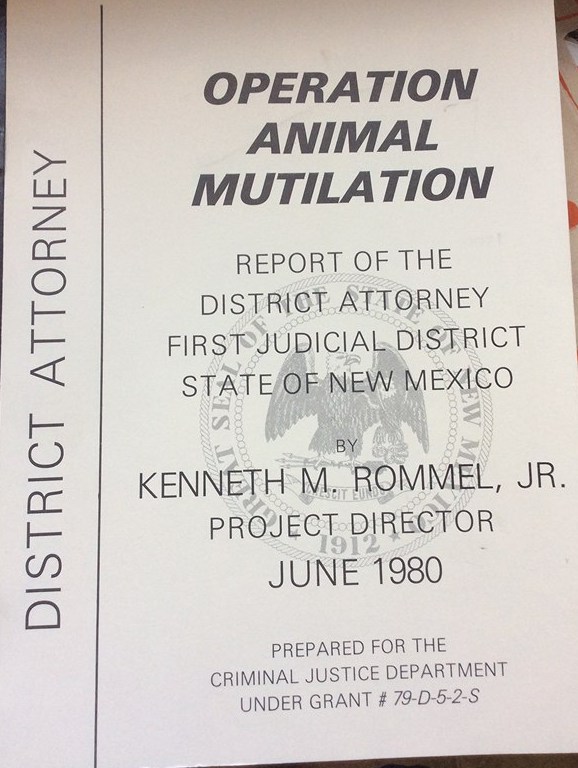
Operation Animal Mutilation
Report of the District Attorney, First Judicial District, State of New Mexico
Find on Amazon →As an Amazon Associate, OverClassified may earn from qualifying purchases made through this link, at no extra cost to you.
Why This Is Essential Reading
Operation Animal Mutilation belongs on this list because it is the primary document of the skeptical case, and because it is far better than its reputation among proponents suggests. Rommel did real work. He counted the cases, read the files behind the headlines, sent the Taos flakes to a laboratory, found the castrated horse and the medicated steer, and published the names of the experts he relied on. Anyone who cites the Dulce evidence should read what he found when he checked it. Its weaknesses are also real. He examined no case that Valdez or the ranchers considered genuine, he stopped investigating each death once the wounds looked ragged, he printed no microscopy, and his contempt for the people he was studying shows on most pages. Read it beside Stalking the Herd and Mute Evidence, and read the report, not the summaries.
Related Cases & Theories
Essential Viewing
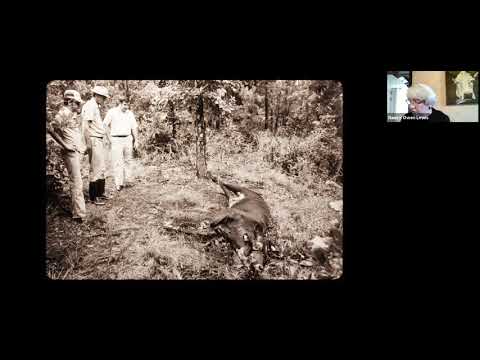
Pastures Possessed: The Cattle Mutilation Conspiracy
Historic Santa Fe Foundation — A September 2021 lecture by anthropologist Dr. Nancy Owen Lewis, whose 1979 Arkansas study Rommel quotes at length, on the New Mexico and Arkansas mutilation reports and the theories around them. Verified via YouTube oEmbed before inclusion.
Old cattle mutilation stumped Feds
KRQE — A 2010 report from Albuquerque station KRQE on the FBI's 130-page cattle mutilation file, the same file that holds Rommel's 1980 letter and the Bureau's note on his report. Verified via YouTube oEmbed before inclusion.
Sources Cited
- Rommel, Kenneth M., Jr. Operation Animal Mutilation: Report of the District Attorney, First Judicial District, State of New Mexico. Santa Fe, June 1980. Read for this article in the English transcription of its six chapters hosted by RR0 (appendix and photographs not included). rr0.org
- "Operation animal mutilation: Report of the district attorney first judicial district, state of New Mexico." Amazon listing, ASIN B0006XK0LK (297 pages, 1980, out of print; cover photograph and customer rating read from the listing, October 2026). amazon.com
- "Operation animal mutilation: report of the district attorney first judicial district, state of New Mexico." WorldCat record, OCLC 6799836 (print book, 1980; record details read from search results, as the site's bot check blocked direct loading). search.worldcat.org
- Federal Bureau of Investigation. "Animal Mutilation," FBI Vault, Part 5 (Rommel's letter to the Director of March 5, 1980; FBI Laboratory report on the Taos flakes; Albuquerque memoranda of January and July 1980; Rio Grande Sun clippings from 1979). vault.fbi.gov
- Federal Bureau of Investigation. "Animal Mutilation" (searchable mirror of the same five-part file, used here for its text layer). Internet Archive. archive.org
- Adams, Thomas R., ed. Stigmata No. 9, Project Stigma, Paris, Texas, 1980 ("The Rommel Probe: Worst Fears Realized"; April 15, 1980 press conference; Perkins and Schmitt remarks). archive.org
- Adams, Thomas R., ed. Stigmata No. 11, Fourth Quarter 1980 (review of the report, of the Randi and Rorvik articles, and of Nancy Owen's Arkansas report). archive.org
- Terrell, Steve. "Sunday Spotlight: Santa Fe man aims to solve mystery of cattle mutilations." Santa Fe New Mexican, January 17, 2015 (Rommel's death in 2012, his 1994 remarks, David Perkins's comments). santafenewmexican.com
- O'Brien, Christopher. Stalking the Herd: Unraveling the Cattle Mutilation Mystery. Adventures Unlimited Press, 2014 (ISBN 978-1-939149-06-0), with an introduction by David Perkins and a foreword by Greg Bishop; source for the Valdez, Gomez, Blann, Lauber and NIDS material. See this site's breakdown.
- Howe, Linda Moulton. An Alien Harvest, 2nd ed., 2014 (caption to the reproduced Schmitt letter, on her October 1979 conversation with Rommel). See this site's breakdown of the 1989 first edition.
- "Cattle mutilation." Wikipedia (grant, objectives, Schmitt conference and Bennewitz's attendance, Valdez's account as given to O'Brien). en.wikipedia.org
- "Gabe Valdez." Wikipedia (career, 1996 move to NIDS, death in 2011, Greg Valdez's 2014 book). en.wikipedia.org
- Carroll, Robert Todd. "Cattle 'mutilation.'" The Skeptic's Dictionary, last updated October 27, 2015. skepdic.com
- "Cattle Mutilations." Encyclopedia of Occultism and Parapsychology, as hosted by Encyclopedia.com. encyclopedia.com
- Koi, Isaac. "1980.0600 'Operation Animal Mutilation'" (index of books discussing Rommel and the report, with page counts). isaackoi.com
- "Operation Animal Mutilation: Report of the District Attorney First Judicial District State of New Mexico." AbeBooks listing of a used softcover copy offered by PsychoBabel & Skoob Books, viewed October 2026 (seller's photograph shows the same June 1980 cover). abebooks.com
- Historic Santa Fe Foundation. "Pastures Possessed: The Cattle Mutilation Conspiracy," lecture by Dr. Nancy Owen Lewis, September 9, 2021 (speaker note on the funding of her New Mexico and Arkansas research). youtube.com
- Greenewald, John. "FBI Files: Cattle & Animal Mutilations." The Black Vault (history of the FBI's releases on the subject). theblackvault.com
- Kagan, Daniel, and Ian Summers. Mute Evidence. Bantam, 1984 (not re-read for this article; cited through O'Brien and Koi). See this site's breakdown.
Have corrections, additional research, or peer-reviewed sources? Help improve this entry.
Suggest an Edit