
Mute Evidence
The Cattle Mutilations Mystery Solved
Core Thesis
Mute Evidence: The Cattle Mutilations Mystery Solved is journalists Daniel Kagan and Ian Summers's 504-page account of the year they spent in 1980 traveling across the American West, Midwest, and Canada to investigate the cattle-mutilation wave, interviewing the self-styled "mutology network" of proponent researchers alongside ranchers, sheriffs, and veterinarians. Where Linda Moulton Howe's An Alien Harvest argues for a genuine, unexplained pattern pointing toward deliberate non-human biological-material collection, this site's own research finds Kagan and Summers's book reaches the opposite verdict: a skeptical one, concluding the phenomenon's reported wound patterns are attributable to ordinary predator and scavenger activity compounded by "inept observation and unfounded rumor," a finding that explicitly corroborates rather than disputes the federally funded 1979–1980 Kenneth Rommel investigation. This is a meaningfully different book from Howe's, not a milder version of the same argument, and this entry is written to make that distinction explicit rather than assume the two books simply occupy different points on the same believer spectrum.
About the Author
Ian Summers did not come to the cattle-mutilation story as a UFO researcher. Through the 1970s he worked as an editor and "packager" of illustrated science-fiction and fantasy books, credited alongside artist Wayne Douglas Barlowe and writer Beth Meacham on the 1979 illustrated volume Barlowe's Guide to Extraterrestrials, part of a wave of large-format genre art books that era's publishing world produced. According to the fullest secondary account this site's research could locate, Summers's specific route into this book began as a guest on a late-night talk-radio program devoted to paranormal topics, where a caller raised the subject of cattle mutilations; when he subsequently read a January 1980 article on the phenomenon in Omni magazine, he contacted Daniel Kagan, a fellow New York City-based writer, to pursue it as a book project.
Daniel Kagan's own documented body of work situates him as a working nonfiction journalist on contemporary social and cultural subjects rather than a career paranormal investigator: the same year Mute Evidence appeared, Kagan also published Cocaine: Seduction and Solution (Clarkson N. Potter, 1984), a nonfiction account of the era's cocaine epidemic. Together, Kagan and Summers spent most of 1980 in the field — traveling to ranches, sheriff's offices, and veterinary practices across several Midwestern and Southern states and into Canada, and meeting directly with the small community of self-described "mutologists" who had built an informal investigative network around the phenomenon over the preceding decade.
This site's research was unable to confirm further biographical detail for either author beyond what is documented above: no confirmed birth year, formal journalism credential, or later-career record could be located for either man with confidence, and neither appears to have a dedicated Wikipedia biography of his own (Wikipedia's own "Cattle mutilation" article identifies them only in passing, as "journalists Daniel Kagan and Ian Summers"). Rather than pad that gap with inference, this article states it plainly: Mute Evidence is best read as the product of two credentialed working writers' single, intensive year of fieldwork on one specific story, not as the career-spanning body of work a more institutionally documented author like Howe or Rommel left behind.
Historical Context & Origins
This book documents the same genre this site has already traced to its origin point in detail: the September 1967 death of a horse in Colorado's San Luis Valley, misnamed "Snippy" by the press, whose case file on this site (The Mutilation of Snippy the Horse, Case File #237, rated Debunked, 18/100) concludes that a veterinarian's discovery of infected bullet wounds and two students' later confession resolved the case's central claim. That 1967 case metastasized through the 1970s into thousands of subsequently reported livestock deaths, prompting a wave of local and national press coverage and an FBI file consisting mainly of clippings and inter-agency correspondence the Bureau has since released via its own vault.fbi.gov.
The specific event this book was written to evaluate arrived in 1979, when the federal Law Enforcement Assistance Administration issued a roughly $44,170 grant funding an investigation led by Kenneth Rommel, a former FBI agent, concentrated on reports in New Mexico. Rommel's 297-page final report, delivered in 1980, concluded that mutilations were "predominantly the result of natural predation," while explicitly acknowledging that a residual minority of individual cases contained anomalies he could not fully account for — a caveated, rather than absolute, skeptical verdict this book inherits directly. New Mexico State Police officer Gabe Valdez, a proponent-side voice who had worked mutilation reports in the field, separately and publicly disputed Rommel's effectiveness, arguing the investigation had not examined genuinely fresh cases; this site's research treats that documented dispute as a real, unresolved crack in an otherwise clean skeptical consensus, rather than smoothing over it.
Kagan and Summers began their own fieldwork in 1980, the same year Rommel's report was published, giving them a rare vantage point most books on the subject lack: they were able to evaluate Rommel's freshly published, federally funded conclusion against their own independent, contemporaneous interviews with ranchers, sheriffs, veterinarians, and the proponent-side "mutology network" rather than reconstructing the debate years after the fact. The book did not reach print for four more years, arriving in June 1984 from Bantam Books as a mass-market paperback rather than the hardcover, small-press, or self-published formats several other entries in this genre used — a detail worth noting because it means Mute Evidence reached a wider general-interest paperback audience on first release than An Alien Harvest's 1989 self-published first edition did.
Core Arguments & Key Concepts
The book's central, organizing claim is a direct corroboration of the Kenneth Rommel investigation discussed in Historical Context above: after a year of independent fieldwork, Kagan and Summers conclude that the cattle-mutilation wave's core physical claims are attributable to ordinary predator and scavenger activity, compounded by what they characterize as "inept observation and unfounded rumor" spreading faster than any individual case could be properly examined. This is the book's title made literal — the subtitle promises the mystery "solved," and the text delivers a conventional-explanation verdict rather than an open or split one, a materially different outcome from Howe's book covering the same underlying reports.
A second major argument concerns the "mutology network" itself: rather than treating proponent investigators as neutral fact-finders, the authors portray this loose community of self-styled mutilation researchers as a credulous, self-reinforcing subculture whose members' publications and newsletters circulated and amplified individual claims faster than any of them independently verified, a dynamic the authors present as a significant driver of the phenomenon's scale distinct from the underlying animal deaths themselves. This argument runs structurally parallel to sociologist Robert Bartholomew's later, separate academic critique of Howe's book (discussed in this site's An Alien Harvest entry) as a socially contagious belief phenomenon, though Kagan and Summers reach a similar diagnosis from field journalism rather than academic sociology.
The book's third argument directly evaluates and rejects the era's competing explanatory theories on their own terms rather than dismissing them wholesale: cult and Satanic-ritual theories, secret government chemical- or biological-warfare testing theories, and UFO/alien involvement theories are each taken up, investigated, and found by the authors to lack credible supporting evidence, a structure that gives the book's skepticism an evaluative rather than reflexively dismissive character. This is a meaningful methodological difference from a book that simply never entertained the alternative theories in the first place.
Structurally, the book is organized as two roughly equal halves: the first surveys the phenomenon's history and the mutology network's own claims and internal disputes, while the second is a journalistic travelogue of the authors' own 1980 fieldwork — interviews conducted in person across several Midwestern and Southern states and Canada with ranchers, sheriffs, veterinarians, and proponent researchers. This is a different evidentiary architecture from Howe's own documentary casebook approach in An Alien Harvest, which is built substantially around facsimile reproductions of law-enforcement reports and government correspondence; Kagan and Summers instead write as first-person field reporters narrating their own investigation as it happened.
Finally, the book's skepticism is explicitly bounded rather than total: because it inherits Rommel's own caveat that a residual minority of cases resisted full conventional reconstruction, this site's research treats Mute Evidence as reaching a strong but not absolute conventional-explanation verdict — the mystery is presented as "solved" in the great majority of cases the authors examined, not as fully and individually closed for every report ever made, a distinction this article is careful to preserve rather than flatten into a simpler story than the book itself tells.
Key Cases & Evidence Discussed
This site's own Mutilation of Snippy the Horse case file (Case File #237, Debunked, 18/100) is the founding case of the genre this book investigates, and this exact book is already cited by ISBN in that file's own Further Reading section, described there as "an investigative journalistic account of the broader American cattle-mutilation phenomenon Snippy's case launched, weighing proponent and skeptical explanations against each other in detail" — a citation this Essential Reading entry now formalizes, while noting for the reader that this article's own closer research finds the book's actual published conclusion lands more decisively on the skeptical side than a neutral "weighing both sides" description alone might suggest.
The federally funded Kenneth Rommel LEAA investigation (1979–1980, New Mexico) functions in this book not as a rival account to rebut, the role it plays in Howe's An Alien Harvest, but as the specific prior finding the authors' own independent 1980 fieldwork sets out to test and ultimately corroborates — the clearest structural marker of how differently these two books, covering the same underlying reports, actually treat the same government investigation.
New Mexico State Police officer Gabe Valdez's on-the-record dispute of Rommel's methodology and effectiveness is a documented counter-voice this site's research surfaced independently of the book itself (via Wikipedia's "Cattle mutilation" article); this article notes it here because it represents exactly the kind of dissenting, credentialed law-enforcement perspective a purely one-sided treatment of either book's central thesis would leave out, and because it is a genuine complication in the skeptical consensus both Rommel's report and this book otherwise reach.
This site's own Skinwalker Ranch case file (Case File #296) documents a later, separately investigated chapter of the same reported cattle-mutilation phenomenon, at a property whose own privately funded research effort is covered in more detail in this site's Hunt for the Skinwalker entry (ER-076) — illustrating that neither this book's 1984 skeptical verdict nor Howe's 1989 proponent verdict closed the broader mutilation-report phenomenon down; later, more instrumented investigations continued independently of either book's conclusions.
Critical Reception & Controversies
Skeptical Inquirer, the flagship publication of the skeptical press and the same outlet whose Skeptic's Dictionary entry this site's An Alien Harvest article cites directly against Howe's forensic claims, reviewed this book in its Summer 1985 issue (Vol. 9, No. 4), with the review credited to Kathleen Ayers. This site's research located the review's existence and bibliographic citation but could not access its full paywalled text; rather than guess at its specific verdict, this article states plainly that the review's detailed content could not be independently confirmed, while noting that Skeptical Inquirer's own institutional mission makes it an outlet more likely to have engaged substantively with a book reaching this one's conclusions than with one reaching Howe's.
The independent review blog The PorPor Books Blog, which specializes in 1970s–80s genre paperbacks, rated the book 2 out of 5 stars in a 2013 retrospective review, describing its fieldwork-interview passages as "tedious and dull" in stretches. The same review credited the book with real documentary value as a period artifact of the "mutology network" and 1980s paranormal-publishing pop culture, singling out its account of the Beatrice Sparks-linked hoax teen "diary" claiming a firsthand cattle-mutilation-cult encounter as a specific, verifiable detail the book preserved that later general-interest accounts of the phenomenon often omit.
Reference sources independent of the skeptical press corroborate the book's skeptical characterization from the outside: Encyclopedia.com's own "Cattle Mutilations" entry calls Mute Evidence "the definitive account of the phenomenon" and states plainly that the authors "examined the origin of cattle mutilation reports and found them based on inept observation and unfounded rumor," while Wikipedia's "Cattle mutilation" article independently identifies Kagan and Summers as "journalists" whose 1984 book is a recognized entry in the genre's literature.
This site's own research also surfaced a genre-community critique worth stating honestly alongside the favorable citations above: some contemporary and later readers within the paranormal-publishing community have argued the authors, despite presenting their investigation as objective, were selective in which sources they credited and which they moved to discredit — a mirror-image version of the same evidentiary-selectivity critique skeptical reviewers have leveled at Howe's own book from the opposite direction, and one this site's methodology treats as equally worth naming for a skeptical-leaning book as for a proponent-leaning one.
Taken together, this book's critical record is more thinly documented in secondary sources than Howe's — no equivalent to Robert Bartholomew's peer-reviewed academic essay review of An Alien Harvest could be located specifically addressing this book — but what does exist is consistent: reference works treat it as the genre's leading skeptical account, a genre-specialist review finds its prose uneven but its documentary value real, and a credentialed skeptical-press review exists in the citable record even though this site could not access its full text.
Influence & Legacy
This book's most concretely documented influence on this site is already on the record independent of this article: it is cited by this exact ISBN (0553233181) in the "Further Reading" book list on this site's own Mutilation of Snippy the Horse case file, meaning this Essential Reading entry formalizes a citation relationship this site had already established before this article was written, in the same way this site's An Alien Harvest entry formalized that book's parallel citation on the same case file.
Wikipedia's own "Cattle mutilation" article names this book specifically within its account of the phenomenon's published literature, evidence that it has remained a citable reference point in general secondary treatments of the topic four decades after its original 1984 publication, alongside Encyclopedia.com's independent characterization of it as "the definitive account of the phenomenon."
Within the specific two-book pairing this site's own archive now documents, this book functions as the deliberate skeptical counterweight to Howe's proponent-side An Alien Harvest: both books cover the same underlying reports and cite the same central government investigation, and reading them together — as this site's own Snippy case file already recommends by listing both in the same Further Reading section — lets a reader weigh the strongest available version of each side's case in its own authors' words, exactly the comparative approach this site's methodology applies across its broader archive.
Ian Summers's separate legacy in illustrated science-fiction and fantasy book packaging, most visibly on 1979's Barlowe's Guide to Extraterrestrials, is a minor but genuine footnote of its own: it places one of this book's two authors inside the same small, cross-pollinated corner of early-1980s genre and paranormal publishing that produced several other titles this site's Essential Reading section covers, even though this specific book itself is a work of conventional field journalism rather than illustrated genre fiction.
The Book
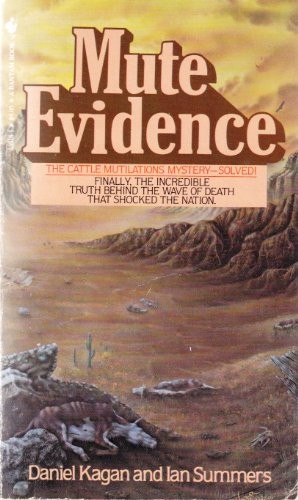
As an Amazon Associate, OverClassified may earn from qualifying purchases made through this link, at no extra cost to you.
Why This Is Essential Reading
Mute Evidence earns its place on this list not because its skeptical conclusions are beyond dispute — Gabe Valdez's documented objection to Kenneth Rommel's own methodology, and the genre-community critique of the authors' own selectivity that this article has stated plainly above, are real, specific complications this site treats as part of the record rather than noise to filter out — but because this book is the single most complete primary-source document of the skeptical, conventional-explanation case for a phenomenon this site's own Mutilation of Snippy the Horse case file already treats as foundational to its archive, and because this exact book, by this exact ISBN, is already cited on that case file alongside Howe's opposite-conclusion An Alien Harvest. Daniel Kagan and Ian Summers's year of firsthand 1980 fieldwork, conducted the same year Rommel's own federally funded report first appeared, gives this book an evidentiary vantage point neither a purely government document nor a purely proponent-side account can offer on its own. Read alongside An Alien Harvest and this site's own Snippy case file, this book is essential precisely because it is the strongest available version of the mutilation phenomenon's skeptical rebuttal, written by working journalists who went looking for a mystery and, in their own account, found there was none left to solve.
Related Cases & Theories
Sources Cited
- "Cattle mutilation." Wikipedia (identifies Daniel Kagan and Ian Summers as journalists and cites their 1984 book within the phenomenon's published literature; also sourced for the Kenneth Rommel LEAA investigation's objectives, 297-page report, and Gabe Valdez's documented dispute of it). en.wikipedia.org
- "Cattle Mutilations." Encyclopedia.com (independent characterization of Mute Evidence as "the definitive account of the phenomenon" and summary of its conclusion that reports stemmed from "inept observation and unfounded rumor"). encyclopedia.com
- Ayers, Kathleen. "Mute Evidence" (book review). Skeptical Inquirer, Vol. 9, No. 4 (Summer 1985). skepticalinquirer.org
- "Book Review: Mute Evidence by Daniel Kagan and Ian Summers." The PorPor Books Blog (2013 genre-specialist retrospective review; rated 2/5, biographical detail on Ian Summers's SF/fantasy book-packaging career and the book's 1980 field-research origin story). theporporbooksblog.blogspot.com
- "Mute Evidence." Open Library, edition record OL7821255M (publisher Bantam, publish date June 1, 1984, ISBN 0553233181 / 9780553233186, mass market paperback). openlibrary.org
- "Mute Evidence: Daniel Kagan, Ian Summers." Amazon.com product listing (ISBN 0553233181 / 9780553233186, Bantam Books, 1984). amazon.com
- "Mute Evidence – The Cattle Mutilations Mystery Solved." AbeBooks first-edition bibliographic listing (Bantam Books, 1984, 1st printing, mass market paperback, 504 pp.). abebooks.com
- "Mute Evidence – The Cattle Mutilations Mystery Solved" by Summers, Ian; Kagan, Daniel. Biblio.com bibliographic listing (Bantam Books, 1984). biblio.com
- "Mute Evidence" by Daniel Kagan. Goodreads (reader edition-tracking listing for this title). goodreads.com
- "Barlowe's Guide to Extraterrestrials." Wikipedia (1979 illustrated volume crediting Ian Summers alongside artist Wayne Douglas Barlowe and writer Beth Meacham, cited for Summers's separate career in SF/fantasy book packaging). en.wikipedia.org
- "Cattle Mutilation." The Skeptic's Dictionary, Robert Todd Carroll (skeptical analysis of the Rommel Report findings and the predator/scavenger/bloating explanation this book's own conclusion corroborates). skepdic.com
- "Animal Mutilation." FBI Vault (declassified FBI files on the cattle-mutilation reports, 1974–1978, including jurisdictional limitations). vault.fbi.gov
- This site's own case file: The Mutilation of Snippy the Horse (Case File #237), which already cites this exact book by ISBN in its own Further Reading section alongside An Alien Harvest.
- This site's own case file: Skinwalker Ranch (Case File #296), for the later, more instrumented chapter of the same reported cattle-mutilation phenomenon.
- This site's own essential-reading entry: An Alien Harvest (ER-125), for the proponent-side treatment of the same underlying reports this book reaches the opposite conclusion on.
- This site's own essential-reading entry: Hunt for the Skinwalker (ER-076), for the 2005 account of the NIDS investigation at Skinwalker Ranch.
- This site's own key-figures entry: Kenneth Rommel, for the full 1979–1980 LEAA investigation this book's own fieldwork corroborates.
- This site's own resources library: Full Reading List, where this exact edition (ISBN 0553233181) is already cited.
Have corrections, additional research, or peer-reviewed sources? Help improve this entry.
Suggest an Edit