
Stalking the Herd
Unraveling the Cattle Mutilation Mystery
Core Thesis
Stalking the Herd: Unraveling the Cattle Mutilation Mystery is Christopher O'Brien's 2014 attempt at the single most comprehensive one-volume survey of nearly fifty years of unsolved livestock mutilation reports, published by Adventures Unlimited Press with introduction and analysis by fellow San Luis Valley researcher David Perkins. Rather than advocating for one single explanation, the 560-page book systematically works through every major competing theory that has been proposed for the phenomenon -- ordinary predators and scavengers, covert military or government testing, ritual cult activity, extraterrestrial genetic sampling, and mystery-helicopter involvement -- while also situating the modern mutilation wave within humanity's much older historical relationship to cattle and animal sacrifice. This site's own research draws on it for two pages: The Mutilation of Snippy the Horse, the 1967 case this site's own research credits it with tracing "the genre's development from Snippy's own founding case through the following five decades," and the Cattle Mutilation / Biological Sampling Hypothesis theory page, which cites it as "widely regarded as one of the most comprehensive single-volume treatments available."
About the Author
Christopher O'Brien is, per his own author description, an investigator of paranormal events in Colorado and New Mexico's San Luis Valley who has spent decades examining UFO reports, cryptozoology, cattle mutilations, secret military activity, and regional folklore centered specifically on that particular high-altitude basin -- the same region this site's own Snippy the Horse case file identifies as having developed "one of the most concentrated reputations for sustained unexplained aerial and livestock-mutilation activity of any region in North America."
O'Brien built that regional reputation primarily through an earlier trilogy of San Luis Valley-focused books, beginning with The Mysterious Valley in 1996 and continuing through Enter the Valley, both of which this site's own case-file research already credits with documenting the valley's decades-spanning reputation in detail. Stalking the Herd represents a deliberate widening of scope beyond that single valley: rather than another regionally-focused investigation, it surveys the cattle mutilation phenomenon as a fully global, nearly half-century-old mystery, drawing on case reports from well beyond Colorado and New Mexico even as O'Brien's own firsthand field experience remains most directly grounded in that specific region.
The book's introduction and analysis section was contributed by David Perkins, a fellow San Luis Valley-based researcher and longtime collaborator within the same small community of investigators who have spent the most sustained field time examining Colorado's own mutilation reports directly -- a collaboration this site's own research treats as consistent with the tightly-knit, geographically concentrated character of serious cattle-mutilation research generally, where a small number of long-term field investigators, often working with limited institutional support or funding, account for a genuinely disproportionate share of the entire documented case record accumulated across nearly five decades.
Historical Context & Origins
The book's own framing device -- "an ongoing mystery that has endured for almost 50 years" -- dates the phenomenon's modern American wave to the late 1960s, placing this site's own Snippy the Horse case (September 1967) at or near the genre's actual founding moment rather than as one incident among many equally early reports.
O'Brien's own two-decade San Luis Valley research career, conducted well before this book's 2014 publication, gave him direct, sustained field access to the specific region this site's own case-file research identifies as having produced a disproportionate share of America's best-documented mutilation reports -- making him one of a small number of authors positioned to write a genuinely comprehensive survey grounded in firsthand regional investigation rather than secondhand case compilation alone.
The book's publication by Adventures Unlimited Press, a Illinois-based specialty publisher focused on fringe science, ancient mysteries, and unexplained phenomena, situates it within a specific niche-press ecosystem distinct from both academic presses and mainstream trade publishing -- a publishing context this site's own research treats as directly relevant to understanding the book's intended readership and market position relative to more skeptically-oriented or more academically-vetted treatments of the same subject.
By the time of its 2014 publication, the cattle mutilation phenomenon had already generated several full decades of prior book-length treatments, multiple separate congressional and law-enforcement inquiries in multiple U.S. states, and its own dedicated place within the broader UFO and paranormal literature -- meaning O'Brien's book arrived not as an introduction to a little-known subject but as a deliberate, comprehensive synthesis of an already extensive and often contradictory prior literature, a genuinely different and considerably more demanding project than a first-of-its-kind treatment would have been.
Core Arguments & Key Concepts
The book's central organizing method, rather than a single thesis, is a systematic, chapter-by-chapter evaluation of every major competing explanation that has been seriously proposed for cattle mutilations: ordinary predators and scavengers exploiting a carcass after natural death, covert military or government testing or environmental monitoring, ritual cult activity (the specific explanation the author notes law enforcement in several jurisdictions has favored), extraterrestrial genetic or biological sampling, and mystery-helicopter sightings reported in close proximity to mutilation sites.
A second theme situates the modern phenomenon within a much older historical frame, examining humanity's "venerated relationship with cattle, among the first domesticated livestock," and asking whether a meaningful connection exists between contemporary mutilation reports and humankind's ancient practice of ritual animal sacrifice -- a comparative-anthropological angle this site's own research treats as a genuinely distinctive contribution relative to more narrowly case-focused treatments of the subject.
A third theme raises a specific, testable comparative question the book treats as significant: why India, home to the Brahman cattle breed and a culture in which cattle are still widely revered, has produced essentially no reported cattle mutilations comparable to the American, and to a lesser extent, wider Western pattern -- an absence the book treats as a potentially important data point for evaluating theories that depend on cattle simply being a large, common, unguarded warm-blooded mammal rather than a religiously or culturally specific target.
A fourth theme concerns the sheer physical scale of the documented evidentiary record: the book discusses what it describes as thousands of pounds of accumulated scientific forensic material generated across decades of veterinary necropsies and law-enforcement investigations, while noting this evidentiary volume has still not produced a single broadly accepted, conclusively proven explanation -- a specific tension between abundant physical evidence and persistent explanatory failure that the book treats as itself one of the phenomenon's most notable and genuinely puzzling features, since a genuine hoax or ordinary predation pattern would ordinarily be expected to yield a conclusive resolution once subjected to this much sustained forensic scrutiny across so many separate, independently investigated cases spanning multiple states and jurisdictions.
A fifth theme, offered more speculatively toward the book's conclusion, considers whether covert government or military programs might be using mutilation-pattern livestock deaths to monitor the spread of "mad cow" disease or comparable livestock pathogens without publicly disclosing an active surveillance program -- one of what the book's own marketing describes as several "new theories that have chilling implications" beyond the four most commonly cited explanations.
A sixth theme concerns motive itself, a question the book treats as more fundamental than the identity of the responsible party: regardless of whether the ultimate cause proves to be predation, covert testing, ritual activity, or something stranger, the book frames the underlying pattern as, in its own words, potentially "the greatest unsolved serial crime spree of all time" -- a framing that deliberately borrows the language and investigative posture of criminal profiling rather than either pure cryptozoology or pure ufology, positioning the book's own methodology somewhere between true-crime investigative journalism and paranormal case compilation.
A seventh theme addresses the specific forensic signatures repeatedly reported across the decades of cases the book surveys -- precise, seemingly bloodless incisions; selective removal of soft tissue, reproductive organs, and eyes; and an apparent absence of predator tracks or struggle marks at many sites -- treating the consistency of these specific reported details across widely separated cases and decades as itself a data point worth taking seriously, whatever the ultimate explanation, rather than dismissing the pattern's consistency as simple confirmation bias among investigators already primed to look for it.
Key Cases & Evidence Discussed
The Mutilation of Snippy the Horse (September 1967), the case this site's own research credits the book with treating as the phenomenon's effective founding case, tracing how the specific combination of claims made about Snippy's death -- surgical-precision cuts, absent blood, elevated radiation readings -- established the interpretive template nearly every subsequent American mutilation report would be measured against, even though this site's own separate case-file research concludes each of those specific founding claims proved considerably less solid than their initial 1967 press treatment suggested.
The book's own survey extends across the following five decades of reports from the San Luis Valley and beyond, drawing directly on O'Brien's own two decades of prior firsthand field investigation in that specific region to connect Snippy's founding case to the much larger, geographically dispersed body of mutilation reports that followed it through the 1970s, 1980s, and beyond.
Beyond the American case record, the book's comparative discussion of the Brahman-cattle absence in India functions as an implicit international case study in its own right -- a documented regional non-occurrence the author treats as analytically significant precisely because it is a genuine negative case, directly testing whether theories built entirely on American and European reports can actually account for the phenomenon's observed global distribution and its apparent, still-unexplained absence from otherwise comparable cattle-herding cultures elsewhere in the world.
The book also surveys reports from outside North America more broadly, treating the mutilation phenomenon's documented spread across multiple continents and agricultural traditions as itself a significant methodological challenge for any single-cause explanation -- a genuinely global case record that, per the book's own framing, no theory confined to one country's specific military, cult, or predator ecology can plausibly account for entirely on its own without additional explanation.
Critical Reception & Controversies
This book carries a genuinely solid Goodreads record: 3.77 out of 5 stars averaged across 56 ratings and 13 written reviews, checked August 2026 -- a meaningfully larger review base than most of the niche-press titles this site's research has checked this session, consistent with the book's own status as one of the more widely circulated single-volume treatments of the cattle mutilation subject specifically, rather than a narrowly regional or self-published title with only a handful of readers.
This site's research also attempted to verify an Amazon rating for this title, but Amazon's bot-detection system blocked automated requests to the listing during this session, the same persistent pattern encountered across every title checked this session; per this site's own Amazon Rating Display Protocol, this gap is disclosed honestly here rather than fabricated or silently omitted.
The book's own even-handed structural approach -- working systematically through predator, government, cult, extraterrestrial, and helicopter explanations rather than advocating a single preferred theory from the outset -- is the specific quality this site's own theory-page citation credits it for, describing it as "widely regarded as one of the most comprehensive single-volume treatments available" precisely because it surveys the full competing literature rather than arguing a single position.
David Perkins's contributed introduction and analysis section gives the book a second, independent research voice beyond O'Brien's own -- a structural choice this site's own research treats as a meaningful point of difference from many single-author treatments of the same subject, since it allows a second, similarly experienced San Luis Valley field investigator to weigh in directly on the material rather than leaving every interpretive judgment to one author alone.
Influence & Legacy
Within this site's own essential-reading library, this book stands as the primary single-volume reference specifically for the cattle mutilation phenomenon, complementing more narrowly case-focused or theory-focused treatments elsewhere on this site with a genuinely comprehensive, decades-spanning survey that both this site's own Snippy the Horse case file and its Cattle Mutilation / Biological Sampling Hypothesis theory page independently draw on.
O'Brien's direct progression from three San Luis Valley-specific books to this considerably broader, phenomenon-wide survey mirrors a pattern this site's own research has observed among several other long-term regional investigators: sustained, geographically concentrated field research eventually maturing into a wider synthesis work intended for a broader readership than the original regional case record alone could support.
The book's continued strong Goodreads engagement more than a decade after publication suggests it has achieved a lasting reference status among readers specifically interested in the cattle mutilation subject, a comparatively narrow niche within the broader UFO and paranormal literature that nonetheless supports a genuinely dedicated, continuing readership rather than a single initial burst of publication-year interest that then faded.
Because the book works systematically through every major competing explanation rather than defending one position, this site's own research treats it as a uniquely useful cross-reference point for readers who arrive at either the Snippy case file or the Biological Sampling theory page already favoring one specific explanation, since the book's own structure actively encourages direct comparison against the full range of alternatives rather than reinforcing a single existing assumption.
The book's willingness to entertain a genuinely wide spread of explanations -- from mundane predation through covert government disease surveillance to extraterrestrial sampling -- without fully resolving the underlying mystery also means it has aged well as a reference work specifically: because it catalogs the competing theoretical landscape as it stood in 2014 rather than committing to conclusions that later evidence might undermine, this site's own research treats it as likely to remain a useful map of the phenomenon's explanatory possibilities even as individual case reports continue to accumulate in the years since its publication.
The Book
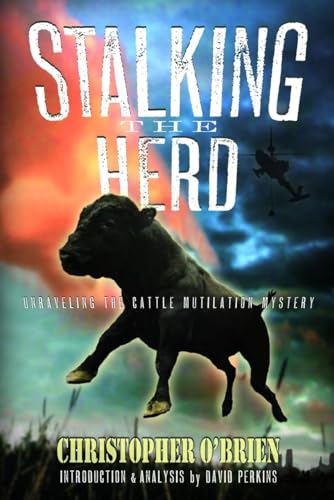
As an Amazon Associate, OverClassified may earn from qualifying purchases made through this link, at no extra cost to you.
Why This Is Essential Reading
Stalking the Herd earns its place on this list as the single most comprehensive one-volume survey this site's own library documents of the cattle mutilation phenomenon specifically, written by an author whose two decades of direct San Luis Valley field investigation give the book's own historical claims genuine firsthand grounding rather than secondhand case-compilation alone -- a distinction this site's own research treats as meaningfully separating it from the many shorter, more anecdotal treatments of the same subject scattered across the broader UFO and paranormal literature. Its systematic, even-handed treatment of every major competing explanation -- rather than advocacy for a single theory -- gives this site's own Snippy the Horse case file and Cattle Mutilation / Biological Sampling Hypothesis theory page a genuinely useful, comprehensive cross-reference that readers can consult regardless of which specific explanation they already find most persuasive. Its solid, sustained Goodreads reception more than a decade after publication further supports this site's own judgment that the book has earned lasting status as the definitive modern single-volume treatment of a persistently unresolved, nearly fifty-year-old mystery.
Related Cases & Theories
Essential Viewing
![Cattle Mutilations: Interview with author Christopher O'Brien [Stalking the Herd]](/images/thumbs/-sdscW6Lr7s.jpg)
Sources Cited
- O'Brien, Christopher. Stalking the Herd: Unraveling the Cattle Mutilation Mystery. Adventures Unlimited Press, 2014 (ISBN 978-1-939149-06-0, cited here).
- "Stalking the Herd." Goodreads (3.77 average rating, 56 ratings, 13 reviews, checked August 2026). goodreads.com
- "Stalking the Herd: Unraveling the Cattle Mutilation Mystery." AbeBooks (ISBN 9781939149060, marketplace listing photograph used for this article's cover image). abebooks.com
- "(Not Media Podcast) Cattle Mutilations: Interview with author Christopher O'Brien [Stalking the Herd]." Not Media, YouTube (direct author interview about this specific book, video verified via oEmbed). youtube.com
- Christopher O'Brien, Goodreads author profile (biography: "Investigator on paranormal events in the San Luis Valley... has investigated UFO reports, cryptozoology, cattle mutilations, secret military activity and folklore"). goodreads.com
- This site's own resources library: Full Reading List, where this exact 2014 edition is cited across 2 separate pages.
- This site's own key-figures entry: Christopher O'Brien, for his full biography and site-wide connections.
- This site's own case file: The Mutilation of Snippy the Horse, Case File #237.
- This site's own theory page: Cattle Mutilation / Biological Sampling Hypothesis, Theory File CMB-001.
- This site's own location entry: San Luis Valley, Colorado, the region O'Brien's earlier field research centered on.
- O'Brien, Christopher. The Mysterious Valley. St. Martin's Press, 1996 (ISBN 0-312-95883-8), the first volume of O'Brien's earlier San Luis Valley trilogy this book's own broader survey builds on.
- "Stalking the Herd: Unraveling the Cattle Mutilation Mystery." Adventures Unlimited Press, official publisher listing. adventuresunlimitedpress.com
Have corrections, additional research, or peer-reviewed sources? Help improve this entry.
Suggest an Edit