
The Montana Cattle Mutilation Wave
Beginning with a single report to the Cascade County Sheriff's Office on August 14, 1974, and escalating sharply through the fall of 1975, a wave of cattle mutilations swept five north-central Montana counties — Cascade, Judith Basin, Chouteau, Teton, and Pondera. By December 1977, sheriff's deputies had logged 67 cases marked by surgically precise organ removal, missing blood, and an absence of predator tracks, running in close parallel with more than a hundred reports of unidentified helicopters and, on at least one radar-confirmed night, an anomalous aerial object that Malmstrom Air Force Base and NORAD both agreed was not a conventional aircraft. Cascade County Sheriff's Captain Keith Wolverton led the five-county investigation and, with journalist Roberta Donovan, co-authored Mystery Stalks the Prairie (1976), the first book-length examination of the American cattle mutilation phenomenon. No federal agency ever opened a dedicated investigation into the Montana cases themselves.
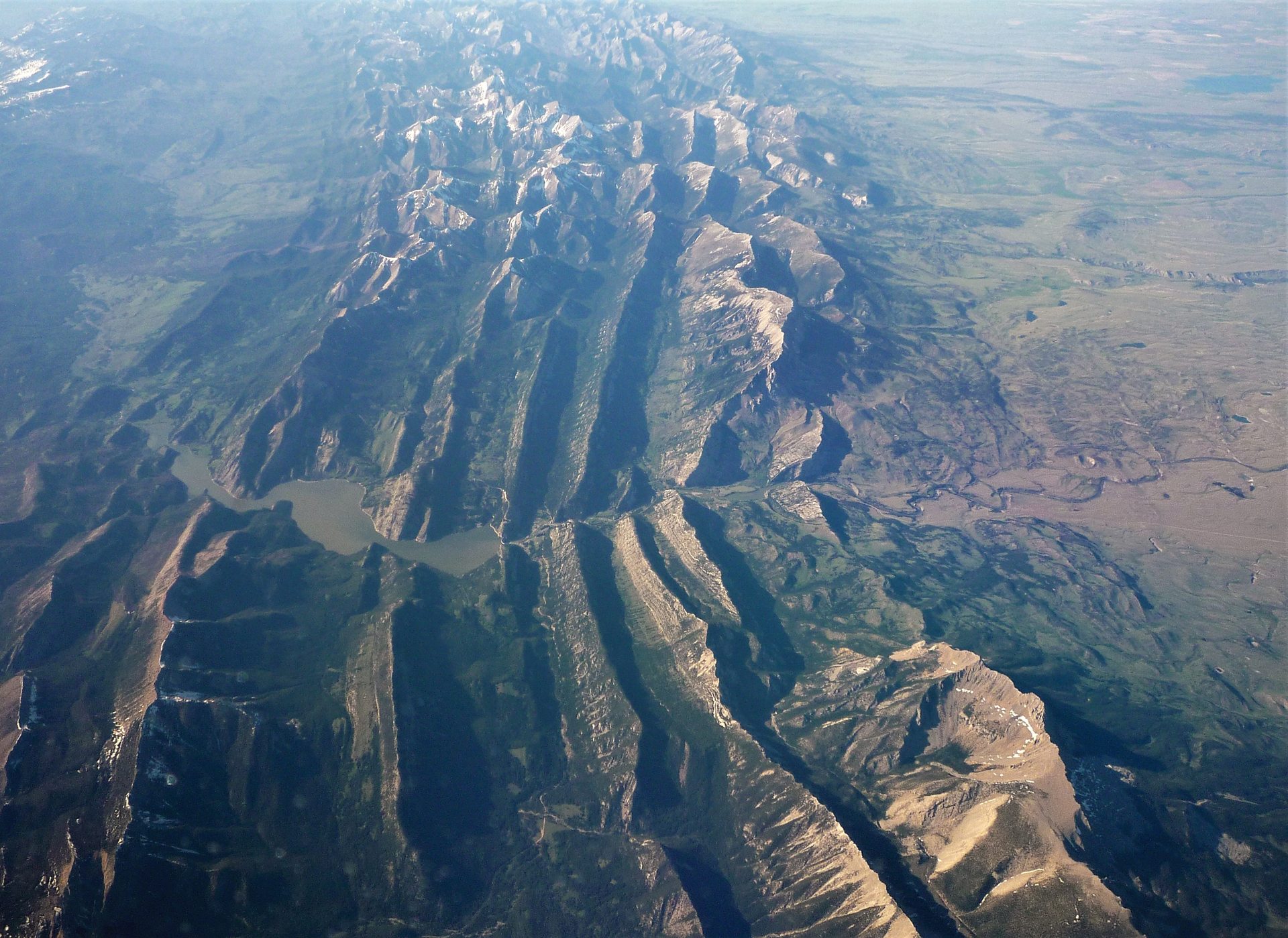
Pictured: the Rocky Mountain Front where it meets the mixed-grass prairie of Teton and Pondera Counties — the same north-central Montana ranchland where the 1975–1977 wave unfolded — not a photograph of any specific mutilation site or the reported aerial objects. No public-domain or rights-clear period photograph of an actual Montana mutilation carcass, the reported "hotel-size" object, or the unidentified helicopters is known to survive; the Cascade County Sheriff's Office photographs referenced throughout Mystery Stalks the Prairie remain that department's own case-file material rather than freely licensed images.
Theoretical Alignment
The Montana wave does not align cleanly with any single explanatory framework. The extraterrestrial hypothesis draws its support almost entirely from the temporal and geographic correlation between mutilations and independently reported UFOs and unidentified helicopters — a correlation investigators themselves admitted they could never definitively prove, only document. The psycho-social hypothesis (contagious rumor, misidentification of ordinary predation once "mutilation" entered the local vocabulary, and copycat human activity) accounts for a meaningful share of the reports, particularly once national media coverage of Colorado's parallel wave began shaping how Montana ranchers and even some investigating officers interpreted ordinary carcass decomposition. A residual core of cases, however — carcasses with genuinely bloodless body cavities, laboratory-confirmed serrated-edge incisions inconsistent with any scavenger's dentition, and organ removal through openings scavengers do not create — resist both frameworks equally.
Background
By the time the Montana wave began, "cattle mutilation" was already a recognized, if unexplained, category of American rural phenomena. The modern era of the mystery is generally dated to the September 1967 case of a horse named Lady, later nicknamed "Snippy," found dead and stripped of flesh from the neck up near Alamosa, Colorado — a case this site documents in full at The Mutilation of Snippy the Horse. Over the following decade, similar reports accumulated across the American West and Midwest, with Colorado, Nebraska, Kansas, Oklahoma, Texas, and New Mexico all reporting clusters by the mid-1970s. Colorado's own wave, peaking in 1975, was severe enough that Governor Richard D. Lamm flew to Pueblo on or about September 1, 1975, to meet with the Colorado Cattlemen's Association and pledge state resources against what he called "one of the greatest outrages in the history of the western cattle industry," explicitly rejecting predator explanations and blaming "human predators."
Montana's own wave had a quieter beginning. The Cascade County Sheriff's Office received its first cattle mutilation report on August 14, 1974. Isolated incidents continued through the following year, but the case count "began to markedly increase during the late summer and early fall" of 1975, in the department's own later account. What set the Montana cases apart from the outset, once deputies began comparing notes, was the near-total absence of the two things ranchers and lawmen most expected to find at a predator kill: footprints or vehicle tracks approaching the carcass, and any blood at all in the surrounding soil.
The investigation that followed was unusual in its scope for a rural, five-county area: it was led at the departmental level (not by a single officer working alone), it was sustained for more than two years, it generated its own internal experiments and photographic evidence log, and it produced a published book while the wave was still active. Captain Keith Wolverton, the Cascade County deputy placed in charge of the case, coordinated directly with Sheriff Pete Howard of Teton County, Undersheriff Jerry Skelton of Judith Basin County, Deputy Bob Blades of Chouteau County, and Sheriff Walter Hammermeister of Pondera County, sharing case files across jurisdictional lines and, at points, with law enforcement in Colorado, South Dakota, and Idaho investigating their own concurrent waves.
Complete Timeline
| Date | Event |
|---|---|
| Aug. 14, 1974 | The Cascade County Sheriff's Office receives its first reported cattle mutilation. Isolated reports continue through the following year without alarming officers. |
| Late summer–fall 1975 | The number of reported mutilations in Cascade County "began to markedly increase," in the department's own account, coinciding with a parallel escalation across Colorado, Nebraska, and the Dakotas. |
| Sept. 15, 1975 | Deputy Arne Sand, driving home near Fort Shaw, hears an aircraft-like "quiet whirr" pass directly overhead on a clear night; he cannot locate it visually. A ranch couple near Choteau reports a helicopter that killed its lights and flew south the same evening. |
| Sept. 22, 1975 | Cascade County deputies investigate two mutilated cows near Belt. Lifting the remaining hide, an officer discovers a cut with a distinct, regular serrated edge — photographed by Deputy Ken Anderson — the case that convinces investigators the mutilations cannot all be predator damage. |
| Oct. 9, 1975 | Undersheriff Jerry Skelton investigates a bull calf near Stanford with its testicles and spermatic cords surgically removed. Ten days later the carcass is found shrouded in a filmy, web-like substance a laboratory identifies as petroleum distillate. |
| Oct. 16, 1975 | A cow is found in a locked pasture with its jaw skinned, tongue excised, and right eye removed through the bone rather than the socket — a removal method investigators cannot attribute to any known predator. |
| Oct.–Nov. 1975 | Roughly ten days after a "several stones" disturbance is noted near one mutilation site, Sheriff Howard's office in Teton County examines a Shetland pony stud found with all male organs surgically removed and its body cavity found almost entirely void of blood by the attending veterinarian. |
| Nov. 8, 1975 | Multiple witnesses report a helicopter hovering over a Minuteman missile site near Lewistown. Malmstrom Air Force Base confirms no agency had helicopters operating in the area that night. |
| Fall 1975 (undated) | Law enforcement, working with a veterinarian and a donated crippled steer calf from a cooperating Teton County rancher, conducts a controlled experiment demonstrating the anesthetic Ketaset can render a 250-pound calf helpless within roughly four minutes and dramatically speed blood extraction via jugular puncture. |
| Dec. 2–3, 1975 | The Missile-Site Flap. An unidentified low-flying craft is tracked by successive law-enforcement radio reports moving between Malmstrom's Juliet missile complex, Dutton, and Brady over roughly 90 minutes; officers on patrol report it hovering as low as 500 feet. Hours later, a second anomalous object — a strobe-lit craft with no running lights that a missile-site airman says "did not sound like a conventional helicopter" — is jointly tracked on radar by both Malmstrom and Great Falls' Gore Hill airport until it vanishes from both scopes simultaneously near the air base. |
| Dec. 22, 1975 | Regional Radar Approach Control (RAPCON) reports an unidentified helicopter between Ulm and Cascade; Chouteau County deputies separately report two helicopters with a large red light and a white strobe that NORAD confirms it cannot locate on radar. |
| Jan. 21, 1976 | The Fairfield "Hotel-Size" UFO. A rancher and his two teenage sons near Fairfield watch, through field glasses, a stationary rectangular object roughly 300–400 feet long and 60 feet high with two rows of lighted windows, accompanied by smaller lights that land, brighten "like an acetylene torch," and dart away, before the whole formation departs toward the Sun River Valley. |
| Undated, ~Feb.–March 1976 | Law enforcement between Conrad and Shelby (Pondera/Toole Counties) tracks a color-shifting aerial object across roughly 90 minutes; Malmstrom and NORAD jointly confirm it is not a conventional aircraft. |
| March 1976 | Deputy Bob Blades and Deputy Tom Lee investigate a heifer found dead at the bottom of a coulee in Chouteau County near the Missouri River, with no human or vehicle tracks in the surrounding mud. |
| 1976 | Mystery Stalks the Prairie, co-authored by Keith Wolverton and Roberta Donovan, is published by the T.H.A.R. Institute of Raynesford, Montana, documenting the case files to date. |
| 1979–1980 | Former FBI agent Kenneth Rommel leads "Operation Animal Mutilation," a Law Enforcement Assistance Administration-funded investigation focused on New Mexico, ultimately attributing the great majority of examined cases nationally to predator and scavenger activity. The study did not conduct fieldwork in Montana. |
| Dec. 1977 | Sheriff's departments across the five affected counties have logged a cumulative total of 67 investigated mutilation cases since 1974. |
| 2005 | A further cattle mutilation is reported in Pondera County, documented by investigative journalist Linda Moulton Howe, indicating the phenomenon recurred in the same five-county region decades after the original wave. |
| 2016 | Wolverton and a retired Sheriff Pete Howard sit for a recorded interview with the Jesse A. Marcel Library, revisiting the case and describing additional UFO incidents from the period, including Howard's account of unidentified personnel confiscating radar evidence. |
| 2019 | Keith Wolverton dies, having maintained to the end that at least some of the Montana cases had no ordinary explanation. |
| 2021 | An expanded edition of Mystery Stalks the Prairie is published by Riverbend Publishing with a new epilogue and the transcribed 2016 interview. |
The First Breakthrough: The Serrated Edge
For the first year of reports, Cascade County investigators had no way to counter the standing assumption — voiced by skeptical neighbors and, at times, by their own colleagues — that every mutilated carcass was simply the work of coyotes, magpies, and other ordinary scavengers finishing off an animal that had died of natural causes. That assumption broke down on the afternoon of September 22, 1975, when deputies responded to a ranch near Belt, southeast of Great Falls, to examine two dead cows a veterinarian had already flagged as unusual. The first cow's udder, teats, rectal area, and reproductive organs had been removed so cleanly that an officer could see straight through the body cavity from the bag to the rectal opening. Lifting the remaining hide at the wound's edge, a deputy found something no one had documented before: a cut with a precise, regular, serrated edge — not the ragged tearing a coyote's teeth or a bird's beak produces. Deputy Ken Anderson photographed the wound in color, producing the department's first hard documentary evidence that at least some cases involved an instrument, not an animal.
Investigators were blunt about what this ruled out. As the case file's own account put it, coyotes might well feast on an already-dead carcass, "but they do not leave a neatly serrated edge where they gnaw away the hide." The observation reframed the entire investigation: officers now had a specific, repeatable physical signature to test every subsequent case against, rather than a subjective impression that something "looked wrong."
The Anniversary Case and the Missing Calf
On August 14, 1975 — the exact first anniversary of Cascade County's original 1974 report — a rancher near Belt found a mutilated Hereford cow in a locked pasture. The case, which investigators privately nicknamed "the mystery of the missing calf," took an unusual turn: the cow's own calf, born two days earlier with a distinctive white face, had vanished from the pasture entirely. An exhaustive search turned up nothing until, four days later, the calf reappeared in the same field lying on a snowbank — barely alive, weak, but entirely unmutilated. In the same period, the rancher reported that four other calves were stillborn for the first time in his herd's history; he placed the stillborn calves in a ravine, where predators consumed them within hours. The mutilated cow and her own calf, left in the open pasture, were never touched by a scavenger. Investigators also noted tracks resembling a horse's in one section of the fenced pasture, despite the rancher's confirmation that no horse had grazed there in twenty years.
The Idaho Connection: A Wound to the Heart
The same week as the anniversary case, deputies investigating a mutilated cow found in a plowed field near Belt — a location that made the total absence of tracks even more conspicuous, since any approach on foot or by vehicle should have visibly disturbed the loose, furrowed soil — noted an unusual incision beneath the animal's front leg. A deputy cleaned and opened the wound but attached no particular significance to it until months later, when visiting Idaho sheriff's deputies reviewing the department's mutilation photographs recognized the same wound pattern from a case in their own jurisdiction. Their department's veterinarian, performing an autopsy on that Idaho animal, had inserted a probe into an identical incision and found that it extended internally all the way to the heart — suggesting, to the investigators comparing notes, either a genuinely cross-jurisdictional method or an extraordinary coincidence in ordinary predator damage.
The Investigation Widens Across Five Counties
By the fall of 1975, Cascade County's caseload had grown large enough that Captain Wolverton, with the backing of Sheriff John C. Krsul, began coordinating formally with the four adjoining counties also reporting cases: Teton under Sheriff Pete Howard, Judith Basin under Undersheriff Jerry Skelton, Chouteau under Deputies Bob Blades and Tom Lee, and Pondera under Sheriff Walter Hammermeister. Sheriff Howard set what may be an informal record for a single night's caseload when he investigated three separate reported mutilations within a matter of hours, including a twelve-day-old heifer calf found on a grassy hillside roughly fifty yards from a stock pond — one of the rare cases in which visible tire tracks were found, though none led directly to or from the carcass itself. Howard noted a pattern he considered significant across his own county's cases: nearly every mutilation site had standing water nearby, whether a stock tank, pond, or irrigation ditch.
In Judith Basin County, Skelton's October 9, 1975 case involving a bull calf with its testicles and spermatic cords removed produced one of the investigation's stranger unexplained details: at the scene, several stones weighing six or seven pounds each had been moved from a nearby rock pile and turned over, with no apparent purpose officers could identify. Ten days later, at the rancher's request, Skelton returned to find the carcass covered in a filmy, cobweb-like substance stretching from the body to the surrounding ground; laboratory analysis identified it as petroleum distillate, though no explanation for its presence was ever established.
In Chouteau County, along the Missouri River bottomlands, Bob Blades and Tom Lee worked cases that were frequently harder to reach than to investigate: one March 1976 case required a four-wheel-drive vehicle to cross muddy ground to a heifer found at the bottom of a coulee, with deputies again finding no human footprints and no vehicle tracks beyond those the rancher himself had made retrieving the carcass. Pondera County's cases, led by Sheriff Hammermeister from Conrad, were shared with the other four departments as part of the same information-pooling effort, even as Pondera's airspace simultaneously became the site of one of the wave's most sustained radar-tracked aerial encounters.
The Ketaset Experiment
Struck by how many mutilated animals showed no evidence of having struggled — no disturbed ground, no defensive wounds, no signs the animal had tried to rise or flee — a veterinarian working with the investigation proposed that whoever or whatever was responsible for the mutilations might be chemically immobilizing cattle before cutting them, rather than killing them outright. A cooperating rancher in Teton County, who wanted the mystery solved as badly as the officers investigating it, donated a 250-pound crippled steer calf for a controlled field test of the anesthetic Ketaset (ketamine hydrochloride), then in veterinary use as a large-animal tranquilizer.
With lawmen from both Teton and Cascade Counties observing, the veterinarian administered an initial 5cc dose; after seven and a half minutes with no visible effect, a second 10cc dose was given. Within three and a half minutes the calf collapsed. As its heartbeat rose from 60 to 120 beats per minute under the drug's effect, the veterinarian inserted a 12-gauge needle into the calf's jugular vein; blood pumped out rapidly and regularly while the animal remained immobile and unable to resist. The calf's heartbeat slowed to 90 within twelve and a half minutes, and it was back on its feet within twenty-eight and a half minutes of the initial injection, apparently unharmed, and was returned to its owner. The experiment established, as a matter of directly observed fact rather than theory, that a widely available veterinary tranquilizer could render an animal completely helpless within minutes and that the resulting elevated heart rate would measurably speed blood loss through a single puncture — a finding that cuts two ways: it demonstrates the mutilations' most anomalous-seeming features (no struggle, no blood at the scene) are mechanically achievable by an ordinary human actor with access to a common drug, while doing nothing to identify who, if anyone, was actually using it in the field.
The Nighttime Air War: Helicopters, Missile Sites, and the FCC List
As mutilation reports accelerated through the fall of 1975, so did an entirely separate but temporally overlapping category of reports: unidentified helicopters, operating without visible markings, frequently near Malmstrom Air Force Base's dispersed Minuteman missile silo fields north and east of Great Falls. The pattern began drawing serious departmental attention after Deputy Arne Sand, arriving home near Fort Shaw on the night of September 15, 1975, heard what he initially took for a helicopter passing directly overhead on a clear, moonlit night — a sound he later described as an unusually quiet "whirr," unlike any rotorcraft he had heard before — without ever being able to visually locate the source. A ranch couple living north of Fort Shaw, near Choteau, independently reported a helicopter that extinguished its lights and flew south the same evening.
The Cascade County Sheriff's Department responded by compiling a reference list, obtained from the Air Force, other federal and state agencies, and area businesses, cataloguing every legitimately operating helicopter's markings and typical flight patterns in the region — an attempt to separate genuine unknowns from misidentified conventional traffic. The list proved useful in isolated cases (one navy-blue helicopter with yellow lettering, initially reported as unidentified, was traced to a nearby construction company's aircraft), but it consistently failed to account for a recurring subset of reports: helicopters described as unmarked, flying without navigation lights, or operating at altitudes and speeds that witnesses on the ground, including trained law enforcement officers, found difficult to reconcile with civilian rotorcraft.
The night of December 2–3, 1975, produced the investigation's most extensively cross-corroborated aerial event. An airman at Malmstrom's Juliet missile complex reported a low-flying aircraft passing so close to the ground it appeared nearly to touch it; checks with Malmstrom, Great Falls' Gore Hill airport, and the Montana Air National Guard found no helicopters operating in the area. Eighteen minutes later the same object, tracked by successive radio reports relayed between county sheriff's offices, was spotted east of Dutton; thirty-eight minutes after that, over Minuteman missile sites fifteen miles north of Malmstrom; thirteen minutes later, approaching Great Falls itself. A patrol officer independently reported passing directly beneath a hovering craft he estimated at 500 feet before it accelerated away faster than he could follow by road. Air Force radar coverage did not extend far enough to track the object at that stage, but Malmstrom soon reported receiving simultaneous sighting calls from two different missile areas, suggesting more than one craft was airborne. A public appeal broadcast on local radio and television that night drew a wave of independent tips, including reports of an object landing briefly north of Fairfield.
Later the same night, a second unidentified craft — described by a missile-site sergeant as producing a sound unlike any conventional helicopter, showing only a single strobe light with no running lights — was tracked moving toward Malmstrom from the Vaughn area. Twelve minutes after a law officer first reported the strobe, Malmstrom logged it seven miles east of the base and closing; seven minutes after that, at five miles out, it vanished from view. Critically, this vanishing point was cross-confirmed instrumentally: radar units at both Malmstrom Air Force Base and Gore Hill airport tracked the object until it disappeared from both scopes simultaneously. Just over an hour later, Air Force personnel again reported a strobe-lit UFO near the same Juliet missile site twenty-five miles north of Malmstrom, and a resident of the Highwood Mountains reported an independent UFO sighting in the same general area minutes later — though that final report could not be confirmed on Malmstrom's radar.
A separate radar-tracked pursuit occurred between the towns of Conrad and Shelby, in Pondera and Toole Counties, when a Shelby police officer described an object showing "a white light, red flame aft, green light on top, red lights on both sides" that climbed and changed direction repeatedly over roughly ninety minutes while patrol officers relayed its position along the highway corridor. Malmstrom and NORAD both confirmed to investigators that the object was not a conventional aircraft and asked to be kept informed of any further sightings — a rare instance of a military command formally acknowledging, in real time, that a specific tracked object defied identification.
Not every report resolved so ambiguously. Chouteau County deputies who reported two low helicopters with a large red light and white strobe were told by NORAD that the objects could not be located on radar at all; a separate sighting of three helicopters near a missile site outside Ulm was initially traced to the Army National Guard by radio dispatch, only for a National Guard official to deny, in an unrelated later conversation with Captain Wolverton, that any Guard aircraft had been involved that night — leaving even a seemingly "solved" report unresolved on closer inspection.
The Fairfield "Hotel-Size" UFO
The wave's single most detailed and widely cited sighting occurred on the night of January 21, 1976. A rancher west of Fairfield, returning home around 9 p.m. with his wife and two teenage sons, watched his sons spot an object in a field near their house. Using two pairs of seven-power field glasses, the family observed four separate lights "cavorting" among a stand of trees roughly three-quarters of a mile away for approximately twenty minutes. Mistaking two of the lights on the nearby highway for a patrol car's response to their own report, the rancher and his sons drove down to investigate — only to watch the lights float off the roadway and into the field ahead of them.
Approaching the field, the family found what the rancher described to investigators as "a structure that looked like a hotel. Two story hotel sitting out there in the field," surrounded by roughly four clusters of smaller lights. Through the field glasses, he estimated the central object at 300 to 400 feet long and 60 feet high, rectangular, with two rows of windows five to six feet high, and an interior that appeared brilliantly lit without any visible movement inside. The smaller lights approached and receded from the larger object repeatedly, occasionally landing in the stubble field, where their brightness would fade and the objects would appear to shrink before flaring back up "like an acetylene torch" — bright enough, the rancher said, to hurt the eyes if watched too long. At their largest, the smaller lights appeared ten to fifteen feet in diameter. A separate object the family initially mistook for an approaching helicopter revealed, as it banked, a shape "flat on one side and round on the other, like a ball cut in half."
After roughly forty-five minutes, the large object moved off toward the Sun River Valley and disappeared over the horizon; the smaller lights lingered before following the same direction. Driving further down the highway, the family encountered a second, apparently unrelated group of six small lights in another field, distinguished from the first group because they departed toward the east and south rather than due south. At one point one of these objects moved directly toward the family's pickup truck along the highway before the encounter ended. The rancher's account, given directly to law officers and preserved in the investigation's own records, remains the most detailed single UFO description associated with the entire wave — and, notably, was reported independently of any specific cattle mutilation that same night, illustrating the investigators' broader and unresolved difficulty in establishing whether the aerial phenomena and the mutilations were mechanically connected at all, or simply concurrent.
The Absence of Federal Interest
Despite the scale of the Montana wave and direct appeals from ranchers, state officials, and at least one U.S. senator's office to federal law enforcement for assistance, no federal agency ever mounted a dedicated field investigation in Montana during the period the wave was active. At one point, Captain Wolverton received a phone call from a U.S. Department of Agriculture official in Washington, D.C., who expressed strong interest in the case files and told Wolverton he intended to fly to Great Falls the following week to review them in person with the Cascade County Sheriff's Department. Wolverton and Deputy Ken Anderson spent time assembling copies of every report and photograph in preparation. The official never arrived, and the department received no further communication from him or his agency. As the case file's own contemporaneous account put it, the total absence of any federal follow-through "has made law officers wonder whether or not someone in high circles knows what is behind the mutilations, UFOs, and other mysteries, but is not disclosing this information" — a conclusion the investigators themselves explicitly labeled a guess rather than an established fact.
This is a materially different situation from New Mexico's, where former FBI agent Kenneth Rommel led a federally funded, yearlong investigation ("Operation Animal Mutilation") beginning in May 1979, discussed further below. Montana's five-county wave predates that investigation by roughly four years and was never within its geographic scope; no comparable dedicated federal or state-funded forensic investigation was ever conducted specifically into the Montana cases, a gap the site's own Cattle Mutilation / Biological Sampling Hypothesis theory page also notes when surveying the broader national pattern.
Key Witnesses
Captain Keith Wolverton
The Cascade County deputy placed in charge of the mutilation, UFO, and unidentified-helicopter investigation from its earliest escalation in 1975, Wolverton personally worked dozens of Cascade County's roughly 100 documented cases, coordinated the five-county information-sharing effort, staged the department's Ketaset field experiment, and fielded (without any follow-up) the sole federal inquiry the case ever drew, from a Department of Agriculture official who never arrived for his promised visit. With journalist Roberta Donovan, he co-authored Mystery Stalks the Prairie (1976), which remains the primary published record of the wave. He maintained until his death in 2019 that at least some cases had no ordinary explanation, telling Donovan at the time: "Call it a gut feeling, but I have a notion somebody knows what is going on."
Roberta Donovan
A former newspaper reporter and editor, Donovan wrote Mystery Stalks the Prairie using the field reports, case files, and technical detail supplied directly by Captain Wolverton. Her deliberately restrained, unsensationalized approach — explicitly stated in the book's own introduction as a choice to "underplay the situation" rather than court panic — set the tone for how the case has been treated by serious researchers ever since, in contrast to some contemporaneous cattle mutilation writing the authors themselves criticized as dramatized.
Sheriff Pete Howard
Investigated dozens of Teton County's mutilation cases, including three in a single night, and the Shetland pony case in which the animal's body cavity was found almost entirely void of blood. Howard identified standing water near mutilation sites as a pattern he considered too consistent to be coincidental, and frequently called in Cascade County officers to assist on his county's cases. In a 2016 recorded interview alongside Wolverton, the retired sheriff also described witnessing unidentified personnel confiscate radar evidence of a UFO — an account preserved in the 2021 expanded edition of Mystery Stalks the Prairie.
Sheriff John C. Krsul
As Cascade County's elected sheriff, Krsul authorized and backed the full investigation from its earliest days, assigning Captain Wolverton to lead it and giving the case the institutional standing needed to coordinate formally across four neighboring counties. Mystery Stalks the Prairie is dedicated to Krsul in recognition of that support.
Undersheriff Jerry Skelton
Handled Judith Basin County's cases, including the October 1975 bull calf mutilation near Stanford whose carcass was later found shrouded in a laboratory-confirmed petroleum-distillate residue, and reported unidentified helicopter sightings coinciding with mutilations near Geyser the same season.
Sheriff Walter Hammermeister
Led Pondera County's investigation from Conrad, sharing case data with Cascade County and the other affected departments as officers across the region attempted to establish whether a common pattern connected their respective cases.
Deputy Bob Blades
With Deputy Tom Lee, investigated Chouteau County's mutilation cases along the Missouri River bottomlands, including a March 1976 heifer found at the bottom of a coulee with no tracks in the surrounding mud beyond the discovering rancher's own.
The Five Observables Assessment
The Five Observables framework, developed by former AATIP director Luis Elizondo to classify instrumented UAP performance characteristics, applies only loosely to a mid-1970s rural case with no dedicated sensor coverage of its own.
Assessment: Low observability is the one observable genuinely documented by contemporaneous instrumentation rather than testimony alone: both the December 2–3, 1975 missile-site object and the Conrad-Shelby object vanished from active military and civilian radar coverage in a way Malmstrom and NORAD themselves confirmed was not consistent with a conventional aircraft simply flying beyond range. Hypersonic performance and anti-gravity lift are speculative at best, inferred only from the December 2 object's reported rapid departure from a hovering position and from witness impressions of the Fairfield object's silent, apparently unpowered hover — neither instrumentally measured. No trans-medium transition (air-to-water or similar) was ever reported in any Montana case.
Evidence Assessment
Supporting an Anomalous Component
- 67+ mutilation cases logged by five separate, independently staffed sheriff's departments over more than two years, ruling out a single officer's misjudgment as the explanation for the pattern
- A laboratory- and photograph-documented serrated incision edge (Sept. 22, 1975) that investigating officers concluded was inconsistent with predator dentition
- Multiple carcasses found with body cavities almost entirely void of blood despite no blood found on the surrounding ground
- A near-total absence of human or vehicle tracks at the great majority of mutilation sites, including cases in freshly plowed soil or after fresh snowfall where tracks should have been unmissable
- Two separate nights (Dec. 2–3, 1975; the Conrad-Shelby pursuit) on which Malmstrom Air Force Base and NORAD jointly confirmed a tracked aerial object was not a conventional aircraft
- More than half of Montana's mutilation cases between 1975 and 1977 had an independently reported helicopter or UFO sighting within a 40-mile radius within three days, per the department's own later tally
- The Idaho cross-jurisdictional match on an identical heart-deep incision pattern, discovered independently rather than through shared theory
Supporting a Conventional Explanation
- Investigators themselves never established a mechanical link between the reported aerial phenomena and any specific mutilation — the correlation is temporal and geographic, not causal
- The department's own Ketaset field experiment demonstrated that an ordinary human actor with access to a common veterinary tranquilizer could produce the wave's most "anomalous" signature (no struggle, minimal blood at the scene) without any exotic technology
- Most reported unidentified helicopters were never confirmed as genuinely unidentifiable; several were eventually traced to construction companies, National Guard units, or other conventional civilian and military traffic
- The Rommel/LEAA investigation, though not conducted in Montana, found the great majority of mutilation cases examined nationally under rigorous forensic conditions were attributable to ordinary predator and scavenger activity
- A convicted felon's fabricated claim to have information about the mutilations, which spread through regional newspapers as fact before a polygraph and follow-up investigation exposed it as false, illustrates how readily unverified claims entered the public record during the wave
- No mutilated animal, unidentified substance, or piece of physical evidence from the Montana wave has ever been independently laboratory-confirmed as having a non-terrestrial or otherwise non-mundane origin
Why "Disputed"
The Montana cattle mutilation wave earns a DISPUTED classification because it sits, more than almost any case on this site, on a genuine and irreducible fault line between corroborated anomaly and demonstrated mundane capability. On one side, the case is unusually well-documented for a rural 1970s phenomenon: five independent sheriff's departments, sustained institutional investigation over more than two years, contemporaneous photographic evidence of a serrated wound pattern, and — unusually for any UFO-adjacent case — two separate nights on which a major Air Force installation and NORAD both confirmed, in real time, that a tracked aerial object was not a conventional aircraft. That combination of multiply-corroborated law enforcement testimony and genuine instrumented radar confirmation is rare.
On the other side, the investigation's own internal experiment demonstrated that the wave's most striking physical signature — a helpless animal, minimal external blood, no struggle — is fully achievable by conventional human means using an ordinary veterinary drug, and the investigators themselves, working the case in real time with every incentive to find a connection, explicitly stated they could never definitively prove that the reported UFOs and helicopters caused, or were even mechanically related to, the mutilations rather than merely coinciding with them in a period of heightened regional attention to both phenomena. No physical sample from any Montana case has ever been forensically confirmed as anomalous by an independent laboratory. The honest assessment is that the Montana wave documents a real, well-corroborated pattern of unexplained livestock deaths occurring during a period of genuinely radar-confirmed anomalous aerial activity in the same airspace — without ever closing the gap between those two facts into a proven causal link.
Sensor & Instrumentation Detection Profile
Malmstrom Air Force Base radar and Great Falls' Gore Hill civilian airport radar jointly tracked an unidentified object to the point of simultaneous disappearance from both scopes on the night of December 2–3, 1975. A separate object near Conrad and Shelby was tracked across roughly ninety minutes by relayed law-enforcement radio reports, with Malmstrom and NORAD confirming by direct communication that it was not a conventional aircraft. RAPCON (civilian Radar Approach Control) and NORAD were both consulted on multiple other nights and, on at least two occasions, confirmed they could not locate a visually reported object on radar at all. No dedicated scientific instrumentation (spectrometry, magnetometry, or similar) was ever deployed to any Montana mutilation site.
Environmental & Geospatial Context
North-central Montana's mixed-grass prairie and Rocky Mountain Front foothills, spanning roughly 8,000 square miles across the five affected counties, are sparsely populated open ranchland used predominantly for cattle grazing and dryland grain farming — terrain where a carcass could plausibly go unnoticed by any witness for days, complicating time-of-death estimates in nearly every case. Several key incidents (the Sept. 22, 1975 Belt case; the plowed-field case the same week) occurred in freshly disturbed or snow-softened soil specifically noted by investigators as conditions that should have made any human or animal tracks unmissable, yet none were found. The region sits directly atop and around Malmstrom Air Force Base's dispersed 150th Strategic Missile Wing Minuteman silo field, placing the entire wave within the same airspace as one of the era's most sensitive nuclear weapons complexes — a juxtaposition this site's broader coverage of UAP activity near nuclear installations, including the March 1967 Malmstrom missile-shutdown case at the same base, treats as a recurring and unresolved pattern.
Observer Credibility & Occupational Profile
The Montana wave's central witnesses are overwhelmingly professional law enforcement officers rather than uncorroborated civilian bystanders: five county sheriffs and their deputies, several of whom (Wolverton, Howard) had years of prior investigative experience and no evident financial or reputational incentive to sensationalize the reports — if anything, the case's own co-authors explicitly state they chose restraint over dramatization wherever a choice existed. Ranchers, the other primary witness category, were generally reporting direct financial losses (a mutilated animal represented real economic damage) with no motive to fabricate, and in several cases actively assisted the investigation, including donating an animal for the department's own Ketaset experiment. Air Force and NORAD personnel, whose radar confirmations carry independent institutional weight, had every professional incentive toward a mundane explanation and volunteered "not a conventional aircraft" findings without prompting from civilian investigators. The one clearly discredited source in the case record — a convicted felon's fabricated tip, exposed by a Deputy Sand-administered polygraph and follow-up investigation — was identified and corrected by the same investigating officers rather than left unaddressed.
Physical & Material Assays
The forensic record compiled during the wave rests on veterinary field examination and limited laboratory testing rather than modern crime-lab forensics, but it is more extensive than most cattle mutilation cases from the period:
- Serrated-edge incisions: The September 22, 1975 case produced a photographed, regular, serrated cut edge that investigating officers — and, per the case record, an independent veterinary pathologist consulted in Colorado on a similar wound — agreed matched neither the tooth marks of a known predator nor the tearing pattern of wire or fence-line lacerations.
- Precise circular and clean-through cuts: Multiple cases documented circular incisions carried cleanly through leg bone with no trace of bone dust found at the scene, and reproductive organs removed with the surrounding scrotal or vulval tissue left otherwise intact — a level of precision investigators repeatedly contrasted with the ragged tearing typical of scavenger feeding.
- Bloodless body cavities: Several carcasses, including the Teton County Shetland pony, were found with body cavities almost completely void of blood, including minimal blood remaining in the heart itself, without corresponding blood loss visible on the surrounding ground.
- Non-standard organ-access routes: At least one case documented an eye removed through a hole in the skull rather than through the socket — an access route with no natural predator analog investigators could identify.
- The petroleum-distillate residue: Laboratory testing on the Judith Basin County bull calf carcass identified a filmy substance covering it, discovered ten days after initial examination, as petroleum distillate — a genuinely anomalous finding in the sense that no source for its presence was ever established, though a mundane origin (accidental contamination, a later human visit to the site) was never ruled out either.
- The Ketaset demonstration: A controlled, officer-witnessed field experiment established that ketamine hydrochloride could immobilize a 250-pound calf within roughly four minutes and, via elevated heart rate, meaningfully accelerate blood loss through a single jugular puncture — direct physical proof of a plausible, entirely mundane mechanism for the wave's "helpless animal, minimal blood" signature.
No toxicology, isotopic, or trace-metal analysis beyond the era's standard veterinary and county-laboratory capabilities was ever performed on Montana case material, and no sample from the wave is known to survive in any archive today for modern re-testing.
Historical Precedents & Archive Matches
The Montana wave arrived roughly eight years after the case now generally credited with popularizing the term "cattle mutilation" in American media: the September 1967 death of the horse "Snippy" near Alamosa, Colorado, which established the basic template — precise wounds, missing organs, no visible cause of death, unresolved investigation — that virtually every subsequent regional wave, including Montana's, would echo. By the time Montana's own case count began accelerating in late 1975, Colorado's parallel and more widely publicized wave was already generating state-level political attention, with Governor Richard D. Lamm's August 1975 statement pledging state resources against what he called deliberate human violence rather than predation. Montana investigators were in direct contact with their Colorado counterparts throughout the period, along with law enforcement in South Dakota, Nebraska, Minnesota, Oklahoma, Texas, and Idaho — the last of which produced the independently discovered heart-deep incision match described above.
The phenomenon did not end with the 1970s wave in the same five-county region. A further cattle mutilation was documented in Pondera County in 2005, investigated and reported by cattle-mutilation researcher Linda Moulton Howe, indicating the same geographic area experienced at least one recurrence roughly three decades after the original cases. More broadly, this site's Cattle Mutilation / Biological Sampling Hypothesis theory page surveys the national pattern of similar reports and the various veterinary, forensic, and law-enforcement responses to it across New Mexico, Colorado, and other affected states, providing broader context for where the Montana case sits within the larger, still-unresolved American cattle mutilation phenomenon.
Material Analysis
Setting aside the aerial sightings, the mutilations themselves constitute the wave's primary physical evidence record, and the material analysis divides along the same fault line as the case overall: a documented minority of wounds show characteristics consistent with instrument use, while the great majority of individual case details — missing tracks, missing blood, precise-appearing cuts — are also individually reproducible through a combination of ordinary scavenger activity, decomposition gas bloating that can mimic "clean" organ loss as tissue separates along fascial planes, and the weather conditions (freezing, thawing, and re-freezing) common to Montana's autumn and winter, which can obscure both track evidence and the true sequence of predation versus original cause of death.
The Serration Question
The September 22, 1975 photographed serrated edge remains the single strongest physical data point in the Montana case file specifically because it was documented, photographed, and independently compared against a known predator's dentition by trained officers at the time, rather than reconstructed from memory afterward. Veterinary literature on scavenger and predator damage generally attributes irregular, torn, or gouged tissue margins to the combination of canine teeth and avian beaks tearing along the path of least resistance in already-weakened tissue — a pattern investigators repeatedly stated did not match what they photographed. No independent modern forensic re-examination of the original photographs, if they survive in the Cascade County Sheriff's Office archive, has been published.
The Ketaset Counter-Evidence
Working directly against an anomalous reading of the "no struggle, no blood" signature is the department's own Ketaset experiment, which is unusual among cattle mutilation investigations nationally for having actually been performed and documented, rather than merely proposed as a theory. It demonstrates conclusively that the single most cited "unexplainable" feature of a cattle mutilation — an animal that shows no sign of having resisted whatever killed or cut it — requires no technology beyond a syringe and a drug already stocked in any rural veterinary practice of the era.
Supporting a Non-Predator, Instrument-Based Origin (at least some cases)
- The photographed, regular serrated incision edge from Sept. 22, 1975, which investigators and a consulted veterinary pathologist agreed did not match known predator dentition
- Clean circular cuts through bone with no bone dust recovered at multiple scenes
- Multiple carcasses found nearly bloodless with no corresponding ground staining
- An eye removed through a skull perforation rather than the natural socket in at least one case
- The independently matched, heart-deep incision pattern shared with an unrelated Idaho case
Supporting Ordinary Predation, Decomposition & Human Activity
- Decomposition and bloat can separate soft, fascia-connected tissue (udders, genitalia, lips) along "clean"-appearing lines that resemble surgical removal without any cutting instrument at all
- Scavengers (coyotes, magpies, ravens) preferentially target soft tissue — eyes, tongue, udder, anus — for identical anatomical reasons any human "harvester" theory would also propose, since these are simply the body's softest, most accessible tissues
- Freeze-thaw cycles and rehydration after initial death can eliminate visible bleeding into surrounding soil even from genuinely mundane wounds inflicted before death
- The Ketaset experiment proves the "no struggle, minimal blood" signature is achievable by ordinary human means with commercially available veterinary drugs
- The Rommel/LEAA investigation's national findings (see below) attributed the overwhelming majority of forensically re-examined mutilation cases elsewhere in the country to predator and scavenger activity
The Conventional Explanation Candidate
No single conventional explanation accounts for the entire Montana wave; investigators, both at the time and in retrospective analysis since, have generally treated it as a composite of at least three distinct, overlapping mundane phenomena layered on top of a genuine residual anomaly.
Predator & Scavenger Activity
The dominant national explanation for cattle mutilation reports broadly — and the explicit conclusion of the era's most authoritative dedicated investigation — is that the overwhelming majority of cases represent ordinary predator and scavenger feeding on already-dead livestock, with the "surgical" appearance created by decomposition-driven tissue separation along soft anatomical planes (the same soft tissues — eyes, tongue, udder, genitalia, anus — that any predator, and any bloat-driven decomposition process, would preferentially affect first). Former FBI agent Kenneth Rommel's federally funded 1979–1980 investigation in New Mexico, working with agreement from sheriffs and veterinary pathologists in several other states, concluded that the great majority of cases it forensically re-examined showed no evidence beyond normal predator damage, while explicitly noting a residual minority of cases for which no reasonable explanation could be found.
A note on official findings: Rommel's report, and the broader predator-and-scavenger consensus it helped establish in mainstream press coverage of cattle mutilation nationally (including some contemporaneous news accounts that loosely and somewhat inaccurately described it as "an FBI report," when it was in fact a district attorney's office investigation funded through a Department of Justice Law Enforcement Assistance Administration grant), should be weighed as one serious input rather than a final, dispositive word. Government and law-enforcement-adjacent bodies investigating anomalous phenomena have a documented history of settling on the least institutionally troublesome available explanation, and Rommel's investigation never examined a single Montana case directly — its "predator" conclusion is a national generalization applied here by inference, not a specific finding about this five-county wave's own physical evidence. That gap does not make the predator explanation wrong, but it does mean it should not be treated as though it had actually been tested against Montana's own serrated-edge photograph, its bloodless carcasses, or its radar-confirmed nights.
Applied specifically to Montana, this explanation accounts comfortably for the substantial share of cases lacking the wave's more distinctive features (an eye removed through a skull perforation; a photographed serrated cut edge inconsistent with known dentition), but strains to explain those specific documented outliers without simply asserting that the officers and consulted veterinary pathologist who examined them firsthand were mistaken.
Mass Hysteria & Social Contagion
Once "cattle mutilation" entered the regional vocabulary via national press coverage of Colorado's parallel and more publicized wave, it is plausible that a meaningful share of Montana's reported cases represent ordinary carcasses — animals that died of disease, difficult births, lightning, or predation in the ordinary course of ranching — being reinterpreted through a new and highly publicized lens, with ambiguous decomposition features read as "surgical" once the concept was culturally available. The sheer volume of UFO and helicopter reports logged in the same period, many later resolved as conventional civilian or military aircraft once the department's own helicopter reference list was compiled, supports the idea that heightened regional attention generated a real increase in reporting independent of any increase in genuinely anomalous activity.
Human Activity (Cult, Copycat, or Otherwise Deliberate)
Governor Lamm's August 1975 statement blaming "human predators" reflects a theory taken seriously by contemporaneous investigators across several states: that some fraction of cases represented deliberate human mutilation, whether by an organized group, individual copycats inspired by media coverage, or (a theory some investigators privately entertained but never substantiated) organ or tissue harvesting for unknown purposes. Montana's own investigation found no direct evidence of a specific human group or individual responsible for any case, and the total absence of tracks at the great majority of sites argues against an unsophisticated human actor working on foot, though it does not rule out a more careful one.
Genuine Unexplained Phenomenon
A residual core of the Montana wave — the September 22, 1975 photographed serrated edge, the near-bloodless carcasses with no ground staining, the Idaho cross-jurisdictional match, and above all the two nights of joint military/civilian radar confirmation that a specific tracked object was not a conventional aircraft — resists full explanation under any of the three candidates above without requiring either an implausible coincidence or an unsubstantiated assumption that experienced investigating officers and consulted veterinary professionals were simply wrong about what they directly examined. This candidate does not require an extraterrestrial explanation specifically; it only holds that the case, taken as a whole, has not been fully accounted for by any explanation offered to date.
Secret Government Testing or Bio-Warfare Program
Contemporary Montana press coverage documents that this specific theory circulated locally and nationally during the wave itself, not merely as later internet-era speculation: "some believed that the U.S. government was responsible, and that the episode had all been part of a top-secret bio-warfare project." The theory was taken seriously enough at a national level that Rommel's 1979–1980 investigation explicitly addressed and rejected it by name, alongside a "strange witch cult" and "rival ranchers," in favor of the predator-and-scavenger finding discussed above.
This candidate is not baseless folklore invented after the fact. It rests on a real, documented pattern of the U.S. government concealing exactly this kind of covert animal-based testing elsewhere: the U.S. Army killed more than 6,000 sheep grazing near Dugway Proving Ground, Utah in March 1968 during a nerve-agent test, and did not publicly acknowledge responsibility for three decades, until 1998. Separately, and more directly analogous to the idea of livestock as a human-exposure proxy, the Atomic Energy Commission is documented to have conducted a genuine covert program collecting thyroid and tissue samples from grazing cattle near nuclear test sites specifically because cattle physiology offered a fast, low-cost way to monitor airborne radioactive fallout's biological uptake before it reached the human food chain — and at least one specific set of New Mexico-area cattle deaths, on the Jicarilla Apache Nation near Dulce, was alleged by longtime state police investigator Gabe Valdez (and later his son) to be exactly this — government field researchers sampling cattle after the 1967 Project Gasbuggy underground nuclear test — though this remains the Valdez family's own theory rather than an officially confirmed finding; a 1978 FBI file on the case states the investigation "developed no positive lead identifying those responsible," and the underlying cases remain formally unsolved.
A caveat on both the theory and its official rejection: that a covert government livestock-testing program has been real and proven at least once elsewhere is a genuine reason not to dismiss this candidate as pure conspiracy thinking outright. At the same time, no source located by this file's own research ties any confirmed government testing program specifically to the Montana wave's own carcasses, and Rommel's rejection of the theory nationally is itself an official finding that should be weighed as one input rather than a final word, for the same reason discussed above regarding the predator explanation: it was reached without directly examining Montana's own evidence, and government bodies investigating their own past conduct (as the Dugway case shows, three decades before an official acknowledgment) have a documented history of delayed or incomplete candor. On balance, this file treats the candidate as a real, non-frivolous possibility for the wave's most anomalous individual cases specifically, rather than as the wave's most likely general explanation.
Secret Government Testing / Bio-Warfare Program
InconclusiveNot baseless: a covert Army sheep-kill (Dugway, 1968, unacknowledged for 30 years) and a confirmed AEC cattle radiation-monitoring program elsewhere establish real precedent for exactly this kind of concealment. But no source ties a confirmed program specifically to Montana's own carcasses, and the theory's official 1979–1980 rejection never examined Montana's evidence directly.
Predator & Scavenger Activity
Highly Plausible (majority of cases)Accounts comfortably for the substantial share of cases lacking the wave's more distinctive documented features, and matches the national forensic consensus reached by the Rommel/LEAA investigation, though that investigation never examined Montana's own evidence directly.
Mass Hysteria & Social Contagion
Plausible (contributing factor)Well-supported as a partial driver of case volume and of ambiguous, borderline reports, particularly once national media attention on Colorado's wave began shaping local interpretation, but does not by itself explain the wave's more specific, professionally photographed physical anomalies.
Deliberate Human Activity (Cult/Copycat)
InconclusiveTaken seriously by contemporaneous officials including Colorado's governor, but never substantiated by any identified group or individual in Montana specifically, and complicated by the near-total absence of human tracks at most sites.
Genuine Unexplained Phenomenon
InconclusiveThe residual core of cases — the photographed serrated edge, the bloodless carcasses, and above all the radar-confirmed nights — has not been fully accounted for by any offered explanation, without itself constituting proof of an extraterrestrial or other specific anomalous cause.
Related Cases
Related Official Records & Reports
The era's central government-adjacent cattle mutilation investigation, funded by the Justice Department's Law Enforcement Assistance Administration. Concluded most examined New Mexico cases were predator-related but did not investigate Montana's own cases. See this site's Skepticism Disclaimer discussion above for why this finding is weighed as one input, not a final verdict, on the Montana wave specifically.
UNCLASSIFIEDNational Archives holdings of Project Blue Book investigation files, including Montana-area UAP reports predating and providing context for the mid-1970s wave, such as the 1967 Malmstrom AFB case.
UNCLASSIFIED (declassified)Search Government Archives Directly
Further Reading — Recommended Literature
Mystery Stalks the Prairie
The original, primary-source account of the Montana wave, written by the investigating deputy and a Lewistown journalist while the case was still active. The 2021 expanded edition adds a new epilogue and a transcribed 2016 interview with Wolverton and Sheriff Pete Howard.
Mute Evidence
A major journalistic investigation into the national cattle mutilation panic of the 1970s and 1980s, examining the origins of the phenomenon and the various forensic, cult, and misidentification theories advanced to explain it.
An Alien Harvest
The book-length expansion of Howe's Emmy Award-winning 1980 documentary A Strange Harvest, compiling animal mutilation cases, law enforcement documents, and the abduction-adjacent theories some investigators associated with the phenomenon.
Stalking the Herd
A 600-page, two-decade research effort surveying the full history and geography of unexplained livestock mutilations across the American West, weighing predator, cult, government, and anomalous explanations against each other.
UFOs & Nukes
A survey of documented UAP encounters at nuclear weapons sites, including Montana's Malmstrom Air Force Base Minuteman fields — the same missile complex tracked on radar during the Montana wave's December 1975 aerial flap.
DISCLOSURE: Some links above are affiliate links. If you purchase through them, OverClassified receives a small commission at no additional cost to you. This helps support independent research.
Essential Viewing
Sources
- Donovan, Roberta & Wolverton, Keith. Mystery Stalks the Prairie, T.H.A.R. Institute, 1976. Full text: archive.org
- Donovan, Roberta & Wolverton, Keith with Bird, Joan. Mystery Stalks the Prairie: Unexplained Cattle Killings and UFOs in Montana (expanded ed.), Riverbend Publishing, 2021
- Distinctly Montana. "Montana's Mutilation Mystery." distinctlymontana.com
- Bozeman Daily Chronicle. "Grim smiles: The enduring mystery of cattle mutilations in Montana." bozemandailychronicle.com
- Billings Gazette. "Grim smiles: The enduring mystery of cattle mutilations in Montana." billingsgazette.com
- Helena Independent Record. "Cattle mutilation stuns ranchers." helenair.com
- Treasure State Lifestyles. "The Unusual Suspects." treasurestatelifestyles.com
- C.M. Russell Museum. "Mystery Stalks the Prairie by Keith Wolverton" (author biography & book listing). cmrussell.org
- Gallatin History Museum. "Mystery Stalks the Prairie" (book listing & author note). gallatinhistorymuseum.org
- Riverbend Publishing. "Mystery Stalks the Prairie" (2021 edition listing). riverbendpublishing.com
- The Jesse A. Marcel Library. "Are UFOs Real? Listen to These Montana Sheriffs!" (2016 interview with Keith Wolverton & Pete Howard). youtube.com
- Earthfiles (Linda Moulton Howe). "Another Cattle Mutilation in Pondera County, Montana" (2005). earthfiles.com
- Rommel, Kenneth M. Jr. Operation Animal Mutilation: Report of the District Attorney, First Judicial District, State of New Mexico, June 1980. ojp.gov
- Isaac Koi Archive. "1980.0600 'Operation Animal Mutilation'" (Rommel report documentation). isaackoi.com
- Kagan, Daniel & Summers, Ian. Mute Evidence: The Cattle Mutilations Mystery Solved, Bantam Books, 1984
- Howe, Linda Moulton. An Alien Harvest: Further Evidence Linking Animal Mutilations and Human Abductions to Alien Life Forms, LMH Productions, 1989
- O'Brien, Christopher. Stalking the Herd: Unraveling the Cattle Mutilation Mystery, Chris O'Brien Books, 2014
- Hastings, Robert. UFOs and Nukes: Extraordinary Encounters at Nuclear Weapons Sites, 2nd ed.
- Sasquatch and Friends. "Strangeness on the ranges: A cattle mutilation timeline, part one." sasquatchandfriends.wordpress.com
- Blaine County Journal News-Opinion. "Cattle mutilations: Biggest animal cold case file in the nation?" blainecountyjournal.com
- "Cattle mutilation," Wikipedia (general background & national context). en.wikipedia.org
- Wikipedia. "Teton County, Montana." en.wikipedia.org
- Wikipedia. "Judith Basin County, Montana." en.wikipedia.org
- Wikipedia. "Chouteau County, Montana." en.wikipedia.org
- Wikipedia Commons. "Aerial of Rocky Mountain Front.jpg," photograph by Bobak Ha'Eri, CC BY 3.0. commons.wikimedia.org
- OverClassified. "Cattle Mutilation / Biological Sampling Hypothesis" (site theory page, national context & Rommel investigation detail). overclassified.org
See something inaccurate? Have additional information or sources?
Suggest an Edit →Last Updated: August 2026