
Flying Saucers and the Three Men
Albert Bender's Own Account of the Visit That Created the Men in Black — Told Nine Years Late, and Almost Nothing Like the Version That Made Him Famous
Core Thesis
Flying Saucers and the Three Men is the primary source for the single most influential piece of folklore this subject has produced, and it is a far stranger book than its reputation suggests. In 1952 Albert K. Bender, a factory timekeeper in Bridgeport, Connecticut, founded the International Flying Saucer Bureau and its newsletter Space Review; in late 1953 he abruptly shut both down, telling colleagues he had been visited and silenced. Gray Barker built a bestselling book around that silence — They Knew Too Much About Flying Saucers (1956) — and in doing so invented the Men in Black. Nine years after the events, and six after Barker's book, Bender published his own version. It is not the version anyone expected. Instead of a terse government hush, Bender describes telepathic contact, three non-terrestrial beings with glowing eyes, a subterranean Antarctic base, an alien mission to extract a chemical from seawater, and a home planet called Kazik. The book's importance is therefore not that it corroborates the Men in Black story but that it comprehensively fails to — and that both accounts trace to the same man. This site's own Albert Bender & the Three Men in Black case file classifies the underlying claim Personal, 15/100, and this book is the reason it can be assessed at all.
About the Author
Albert K. Bender (June 16, 1921 – March 29, 2016) was not a researcher, a scientist, or a professional writer. Born in Duryea, Pennsylvania, he served during the Second World War as a dental technician and clerk with the U.S. Army Air Forces at Fort George G. Meade and at Langley, Virginia. He worked as a timekeeper at a factory in Bridgeport, Connecticut, and ran the International Flying Saucer Bureau out of his own home at 784 Broad Street — an attic room he decorated in a self-consciously macabre style he called the "Chamber of Horrors." The IFSB was, by the standards of 1952, a genuine organization: it had members in several countries, it published a real newsletter in Space Review, and it corresponded with other early civilian groups at a moment when almost none existed.
The IFSB's abrupt closure in October 1953 is the fixed, documented point in the whole story. Space Review's final issue carried a statement that the mystery of the saucers was "no longer a mystery," that the source of the information was "of the highest order," and instructed readers to "be very cautious." Then it stopped. The IFSB has a fair claim to having been the first major civilian UFO club in the world, which is part of why its sudden closure registered as significant rather than as one hobbyist quitting. Everything contested about the case concerns what Bender said afterward and to whom, not whether the shutdown happened.
What makes Bender an unusual author within this library is that he was, in effect, written about before he wrote. Barker's 1956 book made Bender a figure of national curiosity while Bender himself said essentially nothing publicly for nearly a decade. When he finally produced his own book in 1962 it appeared under Barker's own imprint, Saucerian Books of Clarksburg, West Virginia, with Barker as editor and publisher — an arrangement that has understandably raised questions about how much of the finished text represents Bender's unmediated account and how much reflects his publisher's commercial instincts.
Bender withdrew from the subject almost entirely after 1962. He married Betty Rose on October 18, 1954, later managed a motel in California, gave few interviews, and died in Los Angeles on March 29, 2016 at the age of 94 without ever substantially revising or retracting either the exotic 1962 account or the sinister 1953 one. That silence is part of the record: the field's most consequential single witness told his story twice, incompatibly, and then declined to adjudicate between the two versions for more than fifty years.
Historical Context & Origins
1953 was the year American UFO research went from enthusiastic to nervous. The CIA-convened Robertson Panel met in January and recommended that civilian UFO groups be monitored "because of their potentially great influence on mass thinking if widespread sightings should occur"; the Air Force issued Regulation 200-2 in August, restricting public discussion of unexplained sightings by service members; and the atmosphere around amateur research groups shifted accordingly. Bender's shutdown in October of that year happened inside a real climate of official discouragement, which is precisely why the story was believable to his contemporaries and why it has never been possible to dismiss out of hand.
The commercial context is equally important. Gray Barker was a working publisher and promoter with a demonstrated instinct for what sold, and by 1962 the Men in Black story he had built from Bender's silence had proven itself as a franchise. Flying Saucers and the Three Men was published by Barker's own Saucerian Books; the incentive to deliver a book that expanded rather than deflated the legend was structural. That it instead delivered an account so exotic it undercut the legend's central premise — government silencers — is one of the odder facts in this history.
The contactee genre was at its commercial peak. George Adamski's Flying Saucers Have Landed (1953) and its sequels had established that a first-person alien-contact narrative could sell in large numbers, and Bender's 1962 account — telepathy, a named home planet, a benign-but-secretive mission — reads much more like a late entry in that tradition than like the noir government-intimidation story Barker had told. Whether that reflects what Bender actually experienced, what he had come to believe by 1962, or what the market rewarded is not recoverable.
Finally, the Antarctic setting is period-specific in a way modern readers can miss. Operation Deep Freeze and the International Geophysical Year of 1957–58 had put Antarctica in American newspapers as the last genuinely unexplored place on Earth, and a hidden base beneath its ice was, in 1962, roughly the most plausible location a writer could choose for something being concealed on this planet. The choice dates the book precisely.
Core Arguments & Key Concepts
The visitors were not human and not governmental. This is the book's central and most consequential departure. Barker's 1956 account left the three men's identity ambiguous in a way readers naturally filled in with intelligence agencies; Bender's own book removes the ambiguity in the opposite direction, describing beings with glowing eyes who communicated telepathically and who were emphatically not from any terrestrial agency. Every later Men in Black narrative that assumes a human, official silencer is therefore working against, not from, the primary source.
The contact was telepathic and internal, not confrontational. Bender's account is structured around experiences that occurred in his own room, in altered states, with sensory components — a sulphurous smell, headaches, cold — that later abduction literature would recognise immediately. Read seventy years on, the 1962 book has considerably more in common with the experiential/abduction tradition that begins with the Hill case than with the espionage register Barker established.
The reason for silence was operational secrecy of a non-human kind. Bender's explanation for why he was told to stop is that the visitors were conducting an extraction operation — drawing a chemical from Earth's seawater from a concealed Antarctic facility — and would leave when it was complete. This is a coherent internal logic, and it explains the shutdown without requiring any government involvement at all.
The book is an autobiography, not an investigation. Bender makes no attempt to corroborate anything, cites no witnesses, produces no documents, and offers no physical trace. He is not arguing a case; he is reporting an experience. That is a legitimate genre, and it is important to judge the book by it — but it also means the book supplies exactly zero independently checkable evidence, which is the finding this site's case file records.
What the book does not do, and this is the point: it does not confirm the story that made its author famous. A reader coming to it expecting the origin document of the Men in Black will find that the origin document of the Men in Black is Barker's book, not this one, and that the man both books are about told a materially different story when he finally told it himself.
Key Cases & Evidence Discussed
The IFSB shutdown (Bridgeport, Connecticut, October 1953). The documented event at the centre of everything. Bender closed the International Flying Saucer Bureau and ceased publishing Space Review immediately after the visit he describes. This site's case file treats the shutdown as established and the explanations for it as unverifiable, noting that Bender's own testimony was "told at least twice, inconsistently, nine years apart."
The three visitors. In Barker's 1956 telling, three men in dark clothing; in Bender's 1962 telling, three glowing-eyed non-human entities who appeared in his room and communicated without speech. The site's case file states the divergence plainly: Bender's own later account described them "as exotic, non-terrestrial beings." Any treatment of the Men in Black that does not account for this contradiction is not engaging with the primary record.
The Antarctic base and the planet Kazik. Bender's account of being transported to a concealed installation beneath Antarctic ice, and of the visitors' home world Kazik, is the material most often omitted from summaries of the Bender case — which is precisely why the book matters. Summaries that omit it produce a coherent government-intimidation story; the book itself does not.
Gray Barker's parallel account. They Knew Too Much About Flying Saucers (1956) is the necessary companion text, and this site's breakdown of it covers the invention of the Men in Black in full. The two books should always be read together; neither is intelligible alone.
The Men in Black literature that followed. Every subsequent treatment on this site — The Real Men in Black, The Truth Behind Men in Black, Men in Black: The Secret Terror Among Us, The Real Men in Black: Behind the Bender Mystery, and The Mothman Prophecies — descends from these two 1950s–60s books. The size of that downstream literature relative to the evidentiary base underneath it is, in itself, one of the more instructive facts in ufology.
Critical Reception & Controversies
The book was received in 1962 largely as a disappointment by the audience Barker had built, and the reason is straightforward: readers wanted the sinister government story confirmed and got a contactee narrative instead. Within organized ufology, the exotic content damaged rather than strengthened the case, since it moved Bender from "credible man frightened into silence" to "contactee with an unverifiable cosmology" — a category the serious research groups of the period were actively trying to distance themselves from.
The most substantive modern criticism concerns the publishing arrangement. The book appeared under Gray Barker's own imprint, with Barker as editor, six years after Barker had made his reputation and his money on the earlier version of the same story. That is not proof the text was shaped, but it is a conflict of interest severe enough that no responsible account of the book can omit it, and it bears directly on how much weight the 1962 version can carry as independent testimony.
The most consequential fact about the reception is the absence of corroboration, then and since. No independent witness has ever confirmed any element of either version; no document, photograph, or physical trace exists; and Bender himself, living until 2016, never resolved the contradiction. This site's case file states the resulting position directly: the underlying claim is treated "as unverifiable rather than actively disproven," scored 15/100 and stamped Personal.
Against that, the book's cultural reception has been extraordinary and entirely disproportionate to its evidentiary content. The Men in Black passed from Bender through Barker into John Keel's work, into The Mothman Prophecies, into a comic series, and thence into one of the highest-grossing film franchises of the 1990s. Very few books with this little verifiable content have had this much downstream effect, and the disparity is worth sitting with rather than explaining away.
A note on availability and editions: the 1962 Saucerian Books first edition is scarce and expensive; the widely available text is a 2014 New Saucerian facsimile of the 1968 paperback. Readers should be aware they are reading a reprint of a reprint, and that the Saucerian imprint under which both appeared has, at every stage, been the same commercial interest that profited from the story.
Influence & Legacy
The Men in Black are, measured by cultural footprint, the most successful export UFO research has ever produced, and this book plus Barker's are their entire documentary basis. Nothing else underlies them — no case file, no witness cluster, no document. That fact deserves to be stated plainly rather than assumed, because the folklore is now so pervasive that it is routinely treated as a phenomenon with an evidentiary literature behind it.
For the study of testimony specifically, this book is a rare and valuable object: the same witness's account of the same event, recorded twice, nine years apart, with a known commercial intermediary in between, and with the two versions differing not in detail but in kind. Researchers looking for a worked example of how a first-person claim can transform under retelling, publication pressure, and elapsed time will not find a cleaner one in this literature.
Its narrower influence runs through the experiential tradition rather than the conspiratorial one. The telepathic contact, the room-based onset, the physiological symptoms, the sense of an ongoing operation the experiencer has stumbled into — these recur throughout the abduction literature of the following three decades. Bender's 1962 book sits, unnoticed, near the head of that line as well as at the head of the Men in Black line, which is a genuinely odd position for one short memoir to occupy.
Within this site's library, the book has one specific job and does it well: it is the primary source that lets a reader see the case's internal contradictions in the original author's own words rather than through a summary. That is why the Bender case file cites it as essential reading despite — in fact because of — how thoroughly it fails to support the story it is famous for.
The Book
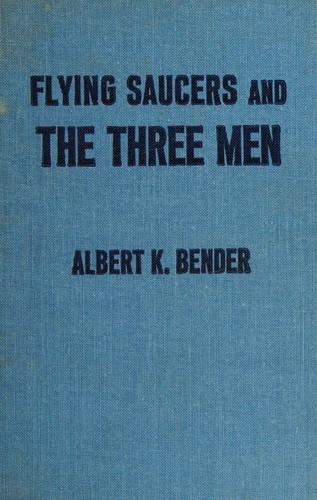
Flying Saucers and the Three Men
Albert Bender's Own Account of the Visit That Created the Men in Black — Told Nine Years Late, and Almost Nothing Like the Version That Made Him Famous
Find on Amazon →As an Amazon Associate, OverClassified may earn from qualifying purchases made through this link, at no extra cost to you.
Why This Is Essential Reading
Essential for exactly one reason, and it is not the obvious one. Flying Saucers and the Three Men is not the book that created the Men in Black — Gray Barker's 1956 bestseller did that — and anyone reading it expecting corroboration will be startled by telepathy, glowing-eyed entities, a subterranean Antarctic base and a planet called Kazik. That startlement is the point. This is the primary witness's own testimony, published nine years after the events by the same man who profited from the earlier version, and it does not match. Read it alongside Barker, and read this site's Bender case file for the assessment; taken together they are the clearest available demonstration of how a single unverifiable claim became a global piece of folklore without ever acquiring a single corroborating fact.
Related Cases & Theories
Sources Cited
- Bender, Albert K. Flying Saucers and the Three Men. Clarksburg, WV: Saucerian Books, 1962 (194 pp.), edited and published by Gray Barker. Facsimile reprint of the 1968 paperback, New Saucerian / CreateSpace, May 1, 2014 (160 pp.), ISBN-10 1499104200 / ISBN-13 9781499104202. amazon.com
- Wikipedia, "Albert K. Bender" — born June 16, 1921 in Duryea, Pennsylvania; died March 29, 2016 in Los Angeles; wartime service as a dental technician and clerk with the U.S. Army Air Forces at Fort George G. Meade and Langley; the IFSB as "the first major civilian UFO club in the world"; the telepathic communication and metal disk; the final Space Review warning "We advise those engaged in saucer work to please be very cautious"; and the standing speculation that the experience was a dream. en.wikipedia.org
- Wikipedia, "Men in Black (folklore)" — the transmission of the Bender/Barker material into wider folklore and popular culture. en.wikipedia.org
- Internet Archive, scanned copy of Flying saucers and the three men (Bender, Albert K.). archive.org
- Open Library edition record, Flying saucers and the three men (OL16521744M) — Saucerian Books, Clarksburg, WV, 1962, 194 pp. openlibrary.org
- Goodreads editions list for Flying Saucers and the Three Men — the 1962 Saucerian first edition, the 1968 paperback, and the 2014 New Saucerian facsimile. goodreads.com
- Google Books record, Flying Saucers and the Three Men by Albert Bender — bibliographic data. books.google.com
- Barker, Gray. They Knew Too Much About Flying Saucers. University Books, 1956 — the earlier, incompatible account of the same events, and the book that created the Men in Black. OverClassified breakdown
- Keel, John A. The Mothman Prophecies. Saturday Review Press, 1975 — the principal conduit by which the Bender/Barker material entered the wider high-strangeness literature. OverClassified breakdown
- Adamski, George, and Desmond Leslie. Flying Saucers Have Landed. Werner Laurie, 1953 — the contactee template Bender's 1962 account more closely resembles than it does Barker's 1956 one. OverClassified breakdown
- OverClassified case file, Albert Bender & the Three Men in Black — the IFSB's founding and October 1953 shutdown at 784 Broad Street, Bridgeport; the final Space Review statement; the divergence between Barker's and Bender's accounts; and this site's Personal / 15-out-of-100 assessment.
- OverClassified essential-reading breakdown, The Real Men in Black (Nick Redfern) — a later survey of the same folklore.
- OverClassified essential-reading breakdown, The Real Men in Black: Behind the Bender Mystery — a dedicated treatment of the Bender case's documentary problems.
- OverClassified essential-reading breakdown, The Truth Behind Men in Black.
- OverClassified essential-reading breakdown, Men in Black: The Secret Terror Among Us.
Have corrections, additional research, or peer-reviewed sources? Help improve this entry.
Suggest an Edit