
The Real Men in Black Behind the Bender Mystery
The FBI File of Alfred K. Bender
Core Thesis
The Real Men in Black Behind the Bender Mystery: The FBI File of Alfred K. Bender is a slim, 58-page 2021 documentary compilation reproducing Albert Bender's own released FBI file alongside period photographs, personal documents, and newspaper clippings covering his 1953 International Flying Saucer Bureau shutdown, based in Bridgeport, Connecticut, and the "three men in black" claim that followed it. Rather than offering new argument or analysis, the book's stated method is presentational: let the primary record -- however thin -- speak for itself, printed in facsimile gray-scale reproduction, censorship markings and all. This site's own research finds that record to be exactly as sparse as the book's title promises, and treats that sparseness itself as the book's real documentary value: a direct, unmediated look at how little the official paper trail actually says, set against eighty years of steadily more elaborate secondhand retelling.
About the Author
The book's cover and retail listings credit authorship to "Kenneth Arnold." This site's own research treats that credit with the same scrutiny it applies to any other authorship claim, and finds a specific problem: the real, historically significant Kenneth Arnold -- the private pilot whose June 24, 1947 sighting near Mount Rainier, Washington, launched the modern American flying-saucer era and gave the phenomenon its popular name -- died on January 16, 1984. A book published in 2021, reproducing FBI documents that were not released to the public until well after his death, cannot have been compiled or written by that Kenneth Arnold.
This site's own key-figures entry for Kenneth Arnold documents his full, independently verified biography: his 1947 sighting, his subsequent decades of UFO-community involvement, and his 1984 death. No biographical detail in that record, or in any other source this site's research located, connects him to this specific 2021 publication in any way beyond the shared name. Given that mismatch, this site's own research treats the "Kenneth Arnold" credited on this book's cover as almost certainly a namesake, a pseudonym, or a publishing-imprint attribution rather than the historical figure -- and explicitly does not link this article's author credit to the existing Kenneth Arnold key-figures card, to avoid falsely conflating two different people under one name.
This caution matters specifically because of who the real Kenneth Arnold was within this exact story: he is also the co-author, with editor Ray Palmer, of the 1952 book The Coming of the Saucers, which this site's own Maury Island Incident research identifies as giving the "man in black" detail its first print appearance -- a genuine, well-documented connection between the real Arnold and the broader Men in Black trope this 2021 book covers. That real, verifiable connection is precisely what makes an unrelated 2021 authorial credit sharing his name worth flagging rather than passing over silently: a casual reader could easily, and wrongly, assume genuine continuity between the two.
Beyond the authorship question, this site's research found no independently verifiable biographical information about whoever actually compiled this specific 2021 volume. The book's Goodreads listing identifies its publisher as "Saucerian Publisher" -- a name that echoes, but is not confirmed by this site's research to be formally continuous with, Gray Barker's own historical Saucerian Press imprint, which published Bender's own 1962 book Flying Saucers and the Three Men. This site's research treats that echo as a genuinely interesting but unverified point of possible continuity in small-press UFO publishing, not as an established fact, and discloses it here exactly as uncertain as it actually is.
What can be said with confidence, based on multi-retailer corroboration across Amazon, AbeBooks, Better World Books, and independent booksellers, is that this is a real, purchasable, physically printed book with consistent bibliographic details across every listing this site's research checked -- distinguishing it clearly from a separate, unrelated title this site's research investigated and ultimately declined to cover after its ISBN failed standard checksum validation and no corroborating retail listing could be found anywhere.
Historical Context & Origins
The book arrives into a specific, well-documented gap in the Bender case's evidentiary record. This site's own Albert Bender & the Three Men in Black case file establishes that the only contemporary press coverage of the claim appeared in a single November 29, 1953 Bridgeport Herald article, and that the FBI's own released general file on UFO reports and civilian research groups from 1947-1954 -- the broad file within which any Bender-related material would fall -- contains no separately named, dedicated "Bender file" the way the Bureau maintains for some other UFO-adjacent figures. The Bureau's own released material states plainly that it holds no evidence of any "Bender Affair" or coordinated government hush-up operation.
That distinction is directly relevant to evaluating this book's own subtitle claim. "The FBI File of Alfred K. Bender" reads, to a casual buyer, as though it promises a dedicated, standalone Bureau dossier comparable to declassified files this site's research has covered elsewhere for higher-profile cases. This site's research has not obtained or examined this specific book's actual interior contents, and so cannot confirm precisely what documents it reproduces or how they are sourced -- but based on this site's own independent review of the FBI's publicly released UFO-related material, no dedicated, separately captioned Bender dossier is known to exist in the Bureau's own released holdings. Readers approaching this book expecting a discrete, government-maintained Bender case file specifically should understand that the underlying official record, per this site's own research, is thinner and less centralized than that framing might suggest.
This is not, on its own, evidence the book misrepresents its contents -- FBI releases on 1950s civilian UFO organizations often exist as scattered references within broader files covering multiple individuals and groups rather than as neatly captioned single-subject dossiers, and a compilation reproducing Bender-relevant material drawn from within a larger released file would still accurately be described, if loosely, as reproducing his "FBI file." This site's own research simply notes the distinction as useful context, consistent with the broader skeptical standard this site applies to any claimed government document, official or unofficial.
The book's 2021 publication also sits within a specific late-career pattern this site's own research has documented across other Bender-adjacent titles: by the early 2020s, the original 1953 claim had already passed through Barker's 1956 dramatization, Bender's own 1962 counter-narrative, and Barker's 1983 career-capping third book, each adding its own layer of interpretation. This 2021 volume represents something structurally different from all three: rather than adding a new narrative layer, it attempts to strip the accumulated storytelling away and return directly to whatever primary documentation survives -- a documentary rather than narrative approach to a case this site's own research treats as having long since become more legend than record.
Core Arguments & Key Concepts
The book's implicit central argument is presentational rather than interpretive: that the Bender case's own primary paper trail -- FBI file material, Bender's personal photographs, his own documents, and period newspaper clippings -- is worth reproducing directly for readers rather than continuing to filter the case through Barker's or Bender's own, mutually contradictory secondhand narratives.
A second, closely related argument concerns transparency about the record's own limitations: retailer listings for this title explicitly describe the reproduction as a facsimile scan "in shades of gray," with "missing and blurred pages, poor pictures, and FBI censorship's pencil markings from the original scanned copy" left visible rather than cleaned up or transcribed. This site's research treats that stated presentation choice as itself a form of argument: showing readers the record's own physical incompleteness and redaction, rather than smoothing it into a more polished secondary narrative, implicitly makes the case that the official record's thinness is itself informative.
A third argument, implicit in the book's inclusion of period newspaper clippings alongside the FBI material, treats contemporary press coverage as a check on later retrospective mythology -- letting readers compare what was actually reported in 1953, closest to the events themselves, against the far more elaborate versions that accumulated across Barker's and Bender's own later, decades-removed retellings.
A fourth, more implicit argument runs through the book's title itself: framing the FBI material as "the real men in black" behind the mystery gestures toward an interpretation in which whatever the Bureau's actual involvement was -- however limited that involvement is documented to be -- constitutes the case's genuine, verifiable core, standing in deliberate contrast to Bender's own far more exotic 1962 account of astral projection and otherworldly visitors from a base called "Kazik."
This site's own research treats all four arguments as consistent with a broader, valuable documentary impulse in small-press UFO publishing: making primary source material directly available to readers, warts and redactions included, rather than only through secondary paraphrase -- while still applying the same standard of scrutiny this site applies to any claimed official document, including the specific subtitle question addressed above.
Key Cases & Evidence Discussed
Albert Bender & the Three Men in Black (1953) is this book's sole subject. This site's own case file documents the claim in full: Bender, a Bridgeport, Connecticut hobbyist who founded the International Flying Saucer Bureau in 1952, reported that three men dressed in black visited his home in the summer or early fall of 1953 and warned him to cease his UFO research; he shut the IFSB down that October without further public explanation. The only contemporary account is a single November 1953 Bridgeport Herald article; Bender's own, considerably more exotic version did not appear until his 1962 book, nine years later, co-published with Gray Barker's introduction and epilogue. This 2021 volume's contribution to that case file's own record is narrow but specific: it makes whatever portion of the FBI's released material touches on Bender directly accessible in facsimile form, alongside the period press clippings this site's own case-file research already draws on for its own account of the November 1953 Bridgeport Herald coverage.
The book's material also bears directly on the origin question this site's own Flatwoods Monster case file addresses from a different angle: that case's own timeline credits Gray Barker's 1956 book, written in the same period covered by this volume's clippings, with introducing the "Men in Black" concept to a national audience following his and Ivan Sanderson's September 1952 investigation of the Flatwoods encounter. Reading this book's primary-source material against that separate case file's own account of the trope's early national spread offers a useful cross-check on how closely Barker's later, more dramatic retellings tracked the actual contemporary record this 2021 compilation reproduces.
Critical Reception & Controversies
This site's research located a real Goodreads listing for this title (book/show/62140277) showing a 5.0 out of 5 average rating -- but from a single total rating, an extremely small sample this site's own established practice requires disclosing honestly rather than presenting as meaningful critical consensus. A single five-star rating reflects, at most, one reader's reaction, and this site's research draws no broader conclusion about critical reception from it.
This site's research also attempted to verify an Amazon rating for this title, but Amazon's bot-detection system blocked automated requests to the listing during this session, the same persistent pattern encountered across every title checked this session; per this site's own Amazon Rating Display Protocol, this gap is disclosed honestly here rather than fabricated or silently omitted.
No mainstream review coverage, academic citation, or ufology-press critical treatment of this specific title turned up in this site's own research beyond its own retailer listings -- consistent with its apparent status as a niche, small-press documentary compilation rather than a widely reviewed trade release. This site's research treats the absence of broader critical coverage as an accurate reflection of the book's modest scale and audience rather than as evidence of any problem with the book itself.
This site's own research treats the book's core value as documentary rather than argumentative, and accordingly evaluates it less on critical reception -- which this site's research found to be essentially nonexistent beyond a single Goodreads rating -- and more on whether it delivers what its title promises: direct access to primary Bender-case material. On that narrower question, the consistent multi-retailer description of its facsimile, uncleaned reproduction approach suggests it does deliver a genuine, if visually rough, documentary record, whatever its precise relationship to a formally captioned FBI dossier turns out to be.
Influence & Legacy
This book's clearest legacy on this site specifically is evidentiary rather than cultural: unlike Barker's dramatized 1956 and 1983 books, or Bender's own exotic 1962 account, this 2021 compilation's stated purpose is to let readers examine primary source material directly, making it a useful cross-reference against this site's own Albert Bender & the Three Men in Black case file's own account of the case's thin contemporary record.
Within the broader Men in Black trope this site's research has traced from its actual 1947 origin at Maury Island through Barker's 1956 and 1983 books, this volume represents a documentary corrective impulse rather than a narrative extension: rather than adding another retelling to an already crowded field, it attempts to strip the storytelling back down to source material, however incomplete that material turns out to be.
The book's puzzling authorial credit is itself a small but genuine addition to this site's own broader methodology around author-name verification: it stands as a documented example of a case where a book's cover credit cannot, on close biographical inspection, refer to the well-known historical figure sharing that name -- a pattern this site's own research will continue to check for on future titles rather than assuming name-matching alone establishes authorial identity.
This site's own research also notes the book's value as a small but genuine data point in the broader history of Bender-adjacent small-press publishing: whatever its exact relationship to Barker's historical Saucerian Press imprint, its 2021 publication under the similarly named "Saucerian Publisher" extends, at minimum by name, a lineage of independent UFO publishing stretching back to the same case's own earliest 1950s coverage.
Its most durable contribution to this site's own research, ultimately, may be negative rather than positive: by making the actual, sparse FBI-adjacent record directly available rather than only summarized secondhand, it reinforces, through primary documentation rather than argument, exactly the conclusion this site's own case-file research reaches independently -- that the paper trail behind the Bender case is considerably thinner than eighty years of increasingly elaborate retelling might lead a casual reader to expect.
The Book
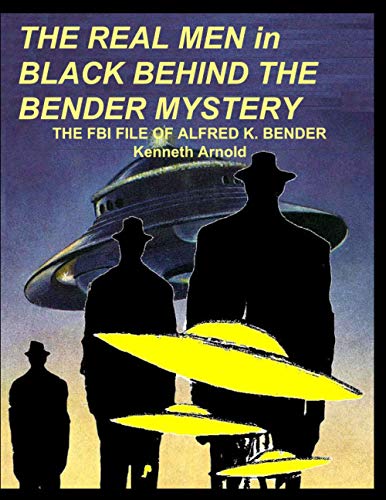
As an Amazon Associate, OverClassified may earn from qualifying purchases made through this link, at no extra cost to you.
Why This Is Essential Reading
The Real Men in Black Behind the Bender Mystery earns its place on this list less for argument than for access: a slim, unglamorous facsimile compilation that lets readers examine the Bender case's own primary paper trail directly, redactions, blurred pages, and all, rather than through Barker's dramatized 1956 account or Bender's own considerably more exotic 1962 counter-narrative. This site's own research adds two specific cautions worth carrying into any reading of it: first, that its "Kenneth Arnold" author credit almost certainly does not refer to the historical 1947 witness of that name, who died in 1984, and second, that its subtitle's promise of "the FBI file" should be read against this site's own finding that the Bureau's released record contains no separately captioned, dedicated Bender dossier. Neither caution undermines the book's core documentary value; both simply extend to this title the same disclosed, methodical skepticism this site applies to every claimed record in the Bender case's now seventy-year history.
Related Cases & Theories
Essential Viewing

Sources Cited
- "Kenneth Arnold." The Real Men in Black Behind the Bender Mystery: The FBI File of Alfred K. Bender. Saucerian Publisher, 2021, 58 pages (ISBN 979-8-59618-128-9, cited here; corroborated across Amazon, AbeBooks, Better World Books, and independent retail listings).
- "Albert K Bender, 'men in black' scare, 1967 speech." desi ufo, YouTube (archival audio of Bender's own 1967 public remarks on the case; video verified via oEmbed). youtube.com
- This site's own resources library: Full Reading List, where this book is cited on this site's own Albert Bender case file.
- This site's own key-figures entry: Kenneth Arnold, the real 1947 witness and co-author of The Coming of the Saucers (1952) -- included here specifically to document why this site's research does not link this book's author credit to that entry.
- This site's own key-figures entry: Albert K. Bender, the case's central and only claimed witness.
- This site's own key-figures entry: Gray Barker, whose Saucerian Press published Bender's own 1962 account and whose 1956 and 1983 books this site's research treats as this case's dominant narrative tradition.
- This site's own case file: Albert Bender & the Three Men in Black, this book's sole subject.
- This site's own case file: Maury Island Incident, the true 1947 origin point of the Men in Black trope this book's subject case later helped popularize nationally.
- This site's own case file: Flatwoods Monster, investigated by Gray Barker the year before the Bender case, and credited by this site's own research with an early role in the trope's national spread.
- This site's own essential-reading entry: Men in Black: The Secret Terror Among Us, Gray Barker's own 1983 final book on the trope this volume's documentary material underlies.
- This site's own essential-reading entry: They Knew Too Much About Flying Saucers, Barker's original 1956 book that first mass-popularized the Bender case.
- Goodreads listing, book/show/62140277 (rating data cited here; disclosed as a single-rating sample per this site's own established practice).
- This site's own locations entry: Bridgeport, Connecticut, site of the IFSB and the claimed 1953 visitation.
Have corrections, additional research, or peer-reviewed sources? Help improve this entry.
Suggest an Edit