
Flying Saucers and Science
A Scientist Investigates the Mysteries of UFOs — Stanton Friedman's Consolidated Case, Forty Years On
Core Thesis
Flying Saucers and Science: A Scientist Investigates the Mysteries of UFOs is Stanton T. Friedman's attempt to put forty years of argument into one volume, and its structure is the argument. Chapter one states the case for the extraterrestrial origin of flying saucers; chapter two answers the objection Friedman spent his career treating as the central one — 'You Can Get Here From There'; chapter three asks where they come from; chapter four names the cover-up 'The Cosmic Watergate'; chapter five attacks 'The Cult of SETI'; and the remaining chapters work through the why-questions, science fiction, public opinion, Roswell, press behaviour, and the Majestic 12 documents. Friedman's distinctive contribution to this subject was never a case or a document. It was a claim about the burden of proof: that the standard scientific dismissal of the extraterrestrial hypothesis rests on an engineering assertion — interstellar travel is impossible — which he, as a nuclear physicist who had actually worked on nuclear aircraft and space propulsion programmes, considered unexamined. Whether he was right about that is a genuinely open question. That he was uniquely qualified to raise it is not.
About the Author
Stanton T. Friedman (1934–2019) held bachelor's and master's degrees in physics from the University of Chicago and worked for fourteen years as a nuclear physicist for General Electric, Aerojet General Nucleonics, General Motors, Westinghouse and TRW — on fission and fusion rockets, nuclear aircraft, compact nuclear power plants and space nuclear propulsion. That employment history is the whole basis of his standing in this subject, and it is genuinely unusual: he had personally worked on advanced propulsion programmes classified at the time, and he knew from the inside how much of that work was invisible to the open literature.
He became the first civilian investigator of the Roswell incident, tracing and interviewing Major Jesse Marcel in 1978 — the single act that revived a case dormant for thirty years and generated the entire modern crash-retrieval literature. He subsequently became the principal defender of the Majestic 12 documents, and co-authored Captured! The Betty and Barney Hill UFO Experience (2007) with Kathleen Marden.
The book carries forewords by two people whose presence signals what Friedman was reaching for: Dr. Edgar Mitchell, the Apollo 14 lunar module pilot and sixth man to walk on the Moon, and Dr. Bruce Maccabee, an optical physicist who spent his career at the Naval Surface Warfare Center. Neither is a ufologist by training, and both are exactly the kind of credentialed endorsement Friedman's argument depends on.
His public persona — the combative lecture circuit, the standing challenge to debunkers, the trademark phrase 'Cosmic Watergate' — has coloured how the work is received, sometimes unhelpfully. Friedman gave more than seven hundred lectures and appeared in an enormous quantity of television programming, and the resulting familiarity has made it easy to treat him as a personality rather than as someone with a specific, technically-grounded argument. This book is the best place to encounter the argument without the performance.
Historical Context & Origins
By 2008 the American UFO subject had been in a long institutional trough. Project Blue Book had closed in 1969, the Condon Report had declared further study unwarranted, no federal programme publicly existed, and the 2004 Nimitz encounters were still nine years from public disclosure. A consolidating book by the field's most prominent scientifically-credentialed advocate arrived, in effect, at the low-water mark — which is part of why it reads as a summing-up rather than as an intervention.
The SETI chapter belongs to a specific and now largely forgotten quarrel. Through the 1990s and 2000s, SETI researchers were at pains to distinguish their federally-respectable search from ufology, and prominent SETI figures publicly dismissed UFO reports. Friedman regarded this as intellectually dishonest — a search for extraterrestrial intelligence that refuses on principle to examine reports of extraterrestrial intelligence — and 'The Cult of SETI' is his sustained attack on it. This site's library carries the other side in Seth Shostak's Confessions of an Alien Hunter and Carl Sagan's The Cosmic Connection.
The interstellar-travel chapter engages a real and live technical literature. Friedman's professional work included fusion-rocket and nuclear-propulsion design, and his argument — that relativistic time dilation, staged fusion propulsion and unmanned or long-duration approaches make interstellar transit an engineering problem rather than a physical impossibility — overlaps substantially with mainstream advanced-propulsion discussion. This site's library carries the technical end of that conversation in Frontiers of Propulsion Science (Millis and Davis, 2009).
The Zeta Reticuli material connects the book to the Betty and Barney Hill case through the star-map analysis Marjorie Fish conducted in the 1960s and 1970s, which Friedman championed. That analysis has been substantially challenged since — updated Hipparcos-era stellar distances weakened the pattern match — and readers should treat the chapter as a historically important argument rather than a current one.
One more piece of context explains why Friedman kept returning to the same argument for forty years. His professional experience was of a world in which genuinely advanced propulsion work — nuclear aircraft, fission and fusion rockets, compact reactors for space — was being done at industrial scale, funded at enormous cost, and simultaneously invisible to the open scientific literature and to the physicists who would have been most qualified to comment on it. Programmes he personally worked on were classified; papers were not published; the outside scientific consensus about what was and was not technically possible was formed without reference to a body of real engineering work. Friedman generalised from that experience, and whether or not the generalisation holds for UFOs, the underlying observation about the gap between classified engineering reality and open scientific opinion was drawn from direct professional knowledge rather than from speculation.
Core Arguments & Key Concepts
The extraterrestrial hypothesis is the least implausible explanation, and that is an evidence claim rather than a faith claim. Friedman's version rests on a specific reading of the case record: a subset of reports involve multiple independent observers, instrumented corroboration, and physical effects, and no conventional explanation covers them. He is arguing from a residue, not from all reports.
'You can't get here from there' is an engineering assertion, not a physical law. The book's most technically substantial chapter, and the one Friedman was best placed to write. His case rests on nuclear and fusion propulsion, relativistic time dilation for the travellers, and the observation that mainstream dismissals of interstellar travel routinely assume chemical rockets and constant-velocity transit — assumptions no propulsion engineer would make.
The 'Cosmic Watergate.' Friedman's term for what he argued is a sustained, deliberate withholding of UFO information by the U.S. government, evidenced through his own FOIA work and document collection. Readers should note that Friedman consistently framed this as bureaucratic secrecy about a genuine national-security-adjacent unknown rather than as a conspiracy in the popular sense.
SETI's exclusion of UFO data is unjustified. The 'Cult of SETI' chapter argues that a research programme searching for extraterrestrial intelligence, which refuses categorically to consider the possibility that evidence of it has already been reported, has adopted a methodological rule rather than a scientific one. This is the book's most rhetorically aggressive section and its most genuinely interesting philosophical point.
Roswell and MJ-12 are the strongest documentary claims available. Chapters nine and eleven give Friedman's updates on both. His MJ-12 advocacy is the most contested element of his legacy and is treated at length in this site's breakdown of Top Secret/MAJIC; readers should approach both chapters knowing that the documents' authenticity remains rejected by most researchers, including many who accept the Roswell crash claim.
A note on tone. Friedman's polemical register is a real feature of the book and readers have flagged it — one Goodreads reader's complaint about 'anti-science remarks and an undeserved dig at Carl Sagan' is representative. Friedman's quarrel with Sagan was long-running and genuine, and it does not always show him at his best.
Public opinion and press behaviour are part of the evidence. Chapters eight and ten take up something most technically-minded UFO writers ignore: how the subject is reported and how that reporting shapes what witnesses are willing to say. Friedman's argument is that the ridicule attached to the subject functions as a filter on the evidence itself — that credentialed observers systematically decline to report, which biases the surviving record toward exactly the low-quality accounts critics then cite as characteristic. It is a circular-causation argument, it is difficult to test, and it is almost certainly partly true.
Key Cases & Evidence Discussed
Roswell (New Mexico, July 1947). Chapter nine updates the case Friedman personally revived. His 1978 interview with Jesse Marcel is the origin point of the entire modern crash-retrieval literature. This site's Roswell Incident file carries the full evidentiary assessment, including the counter-case.
The Majestic 12 documents. Chapter eleven. Friedman's decades-long defence of their authenticity, against the majority research position, is covered in depth in this site's Top Secret/MAJIC breakdown.
The Betty and Barney Hill abduction (New Hampshire, September 1961) and the Zeta Reticuli star map. Friedman co-authored Captured! on this case with Kathleen Marden, Betty Hill's niece, the year before this book appeared. The Marjorie Fish star-map analysis he championed is discussed here; see this site's Betty & Barney Hill file for the case itself.
Bob Lazar and S-4. This site's Bob Lazar case file cites this book specifically for its analysis of propulsion theories, stellar travel and government secrecy as they bear on Lazar's claims about work at S-4, Papoose Lake. Friedman was notably not an uncritical Lazar supporter, and his propulsion chapter is useful precisely because it applies actual engineering standards to that class of claim.
The Condon Report and Blue Book. Friedman's standing critique — that the Condon Committee's own case studies left a substantial unexplained residue that its summary conclusions did not reflect — runs through the book. See this site's Condon Report breakdown for the document itself.
What is absent. Very little abduction material beyond the Hill case, and essentially no consciousness or high-strangeness content. Friedman was a nuts-and-bolts researcher throughout, and this book is an unusually pure statement of that position.
Critical Reception & Controversies
The book has been received largely as its author was: warmly inside the field, with reservations, and almost not at all outside it. Its Goodreads rating sits around 3.85 across roughly 160 ratings, and no substantive review in a scientific or mainstream literary venue has been identified — the standard fate of advocacy books in this genre regardless of their author's credentials.
The most frequently voiced reader criticism concerns tone rather than substance. Friedman's polemical treatment of scientific critics, and particularly of Carl Sagan, strikes many readers as counterproductive in a book whose whole argument is that ufology deserves scientific respect. There is a real tension there and Friedman never resolved it.
The strongest substantive objection is that the book's technical chapter and its documentary chapters operate at very different evidentiary standards. Friedman's propulsion argument is careful, quantitative and appropriately hedged; his MJ-12 chapter defends documents whose authenticity the majority of serious researchers — including researchers who accept Roswell — reject. A reader who finds chapter two persuasive is not thereby obliged to find chapter eleven persuasive, and the book's structure encourages exactly that transfer.
The Zeta Reticuli material has aged badly and honesty requires saying so. The Marjorie Fish star-map interpretation depended on stellar distance data that subsequent astrometry, particularly the Hipparcos catalogue, substantially revised; the pattern match that made the analysis compelling in the 1970s does not survive the updated figures in the form it was originally presented. Friedman continued to defend it.
Against all of that, the central methodological point stands and has arguably been vindicated by events. Friedman argued for decades that the scientific establishment's refusal to examine UFO data was a sociological posture rather than a reasoned position, and that credentialed people were privately more interested than they would say publicly. The 2017–2025 period — the AATIP disclosures, the Navy's confirmation of the Nimitz and Gimbal footage, congressional hearings, NASA's own UAP study — is not proof of his conclusion, but it is a substantial vindication of his complaint.
Influence & Legacy
Friedman's single largest contribution to this subject was made thirty years before this book: finding Jesse Marcel in 1978. Every crash-retrieval claim, every Roswell book, and a large fraction of the modern disclosure discourse descends from that one interview. Nothing in Flying Saucers and Science matches it, and the book does not pretend otherwise.
Its own legacy is as the consolidated statement of the nuts-and-bolts position — the clearest single place to find the argument that UFOs are physical craft, that interstellar transit is an engineering problem, and that the government has withheld information about both. Anyone assessing that position should read Friedman's own version of it rather than a summary.
The propulsion chapter has had a quieter and more durable influence than the documentary ones. Friedman's insistence that dismissals of interstellar travel routinely smuggle in chemical-rocket assumptions is now a standard point in serious discussion, and it connects directly to the technical literature this site covers in Frontiers of Propulsion Science and to the propulsion-theory pages built around it.
Within this site's library the book is used as it is cited: for its propulsion and secrecy analysis, by the Bob Lazar case file, and as the standing reference for Friedman's position generally. Its Roswell and MJ-12 chapters are treated as Friedman's argument rather than as findings, with this site's own Roswell file and Top Secret/MAJIC breakdown carrying the assessments.
A final assessment of the man rather than the book, since the two are hard to separate. Friedman spent his career insisting on a distinction the field has never been good at holding: between what the evidence supports, what the evidence permits, and what one personally believes. He was scrupulous about the first in his propulsion work, expansive about the second, and unusually forthright about the third — and the trouble is that he presented all three in the same confident register, which made it easy for readers to take the weakest parts of his case with the authority earned by the strongest. That is the central problem with reading him, and it is worth naming plainly rather than resolving by either dismissing or endorsing the whole.
The Book
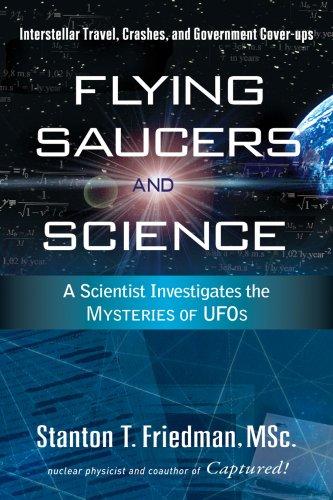
Flying Saucers and Science
A Scientist Investigates the Mysteries of UFOs — Stanton Friedman's Consolidated Case, Forty Years On
Find on Amazon →As an Amazon Associate, OverClassified may earn from qualifying purchases made through this link, at no extra cost to you.
Why This Is Essential Reading
The best single-volume statement of the nuts-and-bolts case, by the only person in this field with a genuine advanced-propulsion engineering background. Read chapter two — 'You Can Get Here From There' — even if you read nothing else: Friedman's point that the standard scientific dismissal of interstellar travel assumes chemical rockets and constant-velocity transit is a real objection made by someone who designed fusion rockets for a living, and it has never been properly answered. Read the SETI chapter for a genuinely interesting philosophical argument delivered with more heat than it needs. Treat the Zeta Reticuli star-map material as historically important and superseded, and treat the MJ-12 chapter as Friedman's most contested position rather than as a finding. His quarrel with Carl Sagan does him no favours; his 1978 discovery of Jesse Marcel outweighs everything else he ever wrote.
Related Cases & Theories
Sources Cited
- Friedman, Stanton T. Flying Saucers and Science: A Scientist Investigates the Mysteries of UFOs — Interstellar Travel, Crashes, and Government Cover-Ups. New Page Books, June 15, 2008, 320 pp., illustrated. ISBN-13 9781601630117; ReadHowYouWant large-print reissue ISBN-10 1442971126. amazon.com
- Red Wheel / Weiser (Career Press) publisher page for Flying Saucers and Science, ISBN 9781601630117 — publisher record for the first edition. redwheelweiser.com
- Google Books record, Flying Saucers and Science by Stanton T. Friedman — bibliographic data and contents. books.google.com
- AbeBooks bibliographic record, ISBN 9781601630117 — table of contents, including the forewords by Dr. Edgar Mitchell and Dr. Bruce Maccabee and the eleven chapter titles. abebooks.com
- Goodreads edition record, Flying Saucers & Science — reader ratings (approximately 3.85 across ~160 ratings) and reader commentary including the criticism of the book's treatment of Carl Sagan. goodreads.com
- Wikipedia, "Stanton T. Friedman" — his University of Chicago physics degrees, fourteen years of nuclear-physics industry work (General Electric, Aerojet General Nucleonics, General Motors, Westinghouse, TRW) on fission and fusion rockets, nuclear aircraft and space nuclear propulsion, his 1978 identification of Jesse Marcel, and his lecture and MJ-12 record. en.wikipedia.org
- ThriftBooks edition record, Flying Saucers and Science — format and printing data. thriftbooks.com
- Barnes & Noble listing, Flying Saucers and Science by Stanton T. Friedman — independent bibliographic confirmation. barnesandnoble.com
- Friedman, Stanton T. Top Secret/MAJIC. Marlowe & Company, 1996. OverClassified breakdown
- Marden, Kathleen, and Stanton T. Friedman. Captured! The Betty and Barney Hill UFO Experience. New Page Books, 2007. OverClassified breakdown
- Millis, Marc G., and Eric W. Davis, eds. Frontiers of Propulsion Science. AIAA, 2009 — the technical literature Friedman's propulsion chapter engages. OverClassified breakdown
- Shostak, Seth. Confessions of an Alien Hunter. National Geographic, 2009 — the SETI position Friedman attacks. OverClassified breakdown
- Condon, Edward U., ed. Scientific Study of Unidentified Flying Objects, 1968. OverClassified breakdown
- OverClassified case file, Bob Lazar / S-4 (Area 51) — cites this book for its analysis of propulsion theories, stellar travel and government secrecy as they bear on Lazar's claims.
- OverClassified case file, The Roswell Incident — the case Friedman revived with his 1978 Jesse Marcel interview.
- OverClassified case file, Betty & Barney Hill Abduction — the case behind the Zeta Reticuli star-map argument.
Have corrections, additional research, or peer-reviewed sources? Help improve this entry.
Suggest an Edit