
Confessions of an Alien Hunter
A Scientist's Search for Extraterrestrial Intelligence
Core Thesis
Confessions of an Alien Hunter makes a case that sits deliberately apart from most of the titles on this site's shelf: rather than arguing that aliens have already arrived, Seth Shostak — senior astronomer at the SETI Institute since 2001 — argues that the search for extraterrestrial intelligence is a legitimate, tractable scientific project precisely because it does not depend on eyewitness testimony, blurry photographs, or classified-document leaks. His method is narrow and falsifiable by design: point radio and optical telescopes at nearby stars, listen and watch for an artificial signal, and let statistics on stellar populations and the Drake Equation's variables set realistic expectations for how long the search might take. Framed as part memoir of his own quarter-century inside SETI and part plain-spoken explainer of the field's history, funding fights, and methodology, the book's second half turns that same evidentiary standard directly on UFO culture, walking through why Shostak finds crash-retrieval stories, abduction claims, and government-coverup narratives entertaining but scientifically unpersuasive — not because the underlying question of extraterrestrial life is unserious, but because, in his view, none of that testimony has ever produced the kind of physical, repeatable, laboratory-verifiable evidence that would settle it. That combination — genuine scientific commitment to the search for ET, paired with public skepticism toward the specific claim that ET is already visiting — is what makes this book a useful counterweight on a site otherwise dominated by sighting-based and coverup-based cases.
About the Author
Seth Shostak was born July 20, 1943, in Arlington County, Virginia, and traces his interest in astronomy to a book about the solar system he read as a ten-year-old. He earned a bachelor's degree in physics from Princeton University and a Ph.D. in astrophysics from the California Institute of Technology, then spent more than a decade using the Westerbork Radio Synthesis Telescope at the Kapteyn Astronomical Institute in Groningen, the Netherlands, publishing roughly sixty peer-reviewed papers on the structure and motion of galaxies before his career pivoted toward the search for extraterrestrial intelligence.
Since 2001, Shostak has held the title of Senior Astronomer at the SETI Institute, the Mountain View, California, not-for-profit research organization whose stated mission is to explore, understand, and explain the origin, nature, and prevalence of life in the universe. He chaired the International Academy of Astronautics' SETI Permanent Study Group from 2003 to 2012, and since 2002 has co-hosted the SETI Institute's weekly public-radio program (originally titled Are We Alone?, later renamed Big Picture Science, and independently produced since January 2025), which pairs interviews with working scientists on general science topics with recurring coverage of SETI's own methods and findings. He has written roughly 400 popular articles on astronomy and technology and, at the time of this book's 2009 publication, had already authored three previous books, including Sharing the Universe: Perspectives on Extraterrestrial Life (1998).
Shostak's credentials as a working scientist are not in serious dispute, and neither is his standing within the organized skeptical movement specifically: he was elected a Fellow of the Committee for Skeptical Inquiry in 2010 and received the American Astronomical Society's Committee on Astronomy and Public Policy's Klumpke-Roberts Award in 2004 for outstanding contributions to the public understanding of astronomy, followed by the Carl Sagan Prize for Science Popularization in 2015. He has also crossed into popular entertainment as a technical consultant — reviewing scripts and advising on scientific plausibility for Robert Zemeckis's 1997 film Contact, adapted from Carl Sagan's novel, and for the 2008 remake of The Day the Earth Stood Still, in which he also appears in a small on-screen role. That dual identity — credentialed radio astronomer and practiced popular communicator, equally comfortable testifying before Congress on SETI funding and bantering on a podcast about UFO reports — is the voice Confessions of an Alien Hunter is written in throughout.
It is worth stating plainly, in the interest of the same evidentiary honesty this site tries to apply across its Essential Reading list: Shostak's specific expertise is in radio and optical SETI methodology and galactic astrophysics, not in aviation, radar systems, or the forensic analysis of individual UFO reports. He has been candid on this point himself, for example telling a UFO Chronicles interviewer in 2014 that he was "not a chemist" and could not personally evaluate a submitted soil-analysis report on its own technical merits — a limitation this entry's Key Cases section discusses directly rather than glossing over.
Historical Context & Origins
Confessions of an Alien Hunter arrived in March 2009 at roughly the twenty-five-year mark of the modern SETI Institute's existence and squarely inside a long institutional struggle the book documents from the inside: NASA had funded a national SETI search program, the High Resolution Microwave Survey, only to see Congress cancel it within a year of its October 1992 launch via Senator Richard Bryan's 1993 budget amendment, a decision that pushed SETI research almost entirely into privately funded, nonprofit hands for the following three decades. Shostak writes as an employee of the institution — the SETI Institute — that had to rebuild a national search program on donor funding after that political defunding, and the book's recurring attention to fundraising, congressional testimony, and public communication reflects the practical reality of doing this specific science without guaranteed federal support.
The book's publication also landed in the same window as two genuinely significant developments for the search it describes: NASA's Kepler space telescope launched in March 2009, the same month Confessions of an Alien Hunter reached shelves, beginning the systematic exoplanet survey that would eventually confirm thousands of worlds and substantially firm up the previously speculative planet-count term in the Drake Equation Shostak discusses at length; and the SETI Institute's own Allen Telescope Array, a purpose-built array of forty-two six-meter radio dishes near Hat Creek, California, had begun science operations in 2007, giving Shostak's own institution a dedicated new instrument to describe rather than borrowed observing time on telescopes built for other astronomers.
The book also arrived at a specific moment in American public opinion on UFOs that Shostak addresses directly: national polling in the years around publication consistently found that roughly half of American adults believed intelligent life existed elsewhere in the universe, with a meaningful minority further convinced that some of it had already visited Earth — a gap between public belief and the working scientific consensus that Shostak frames as the book's second organizing question, distinct from but related to his first. Where most books on this site's Essential Reading list are written by investigators trying to close that gap in the direction of belief, this one is written by a scientist trying to explain, from the inside of an institution built to search for ET, why he thinks the gap persists and why he does not think the UFO evidence closes it.
Core Arguments & Key Concepts
The book's central methodological argument is that SETI and UFO research, though both aimed at the same underlying question of whether we are alone, are not the same kind of science, and that the distinction matters enormously for what counts as evidence. Radio and optical SETI is, in Shostak's own description, a passive listening and watching experiment: telescopes are pointed at chosen targets on a fixed schedule, any candidate signal is either reproducible on a second look or it is not, and a null result is still a scientifically meaningful, publishable data point about how much of the search space has been ruled out. UFO reports, by contrast, are typically unrepeatable, uncontrolled, single-occurrence events reconstructed after the fact from human memory, making them, in his framing, extremely difficult to subject to the same falsification standard — not proof that nothing anomalous occurred, but a structural reason the two research traditions produce very different kinds of confidence.
A second major argument concerns what contact would probably look like if it happened at all. Shostak devotes substantial attention to the case that any civilization advanced enough to be detectable across interstellar distances would very likely have long since transitioned from biological to artificial, machine-based intelligence — a claim he grounds in the comparatively brief span of human technological history between the invention of radio and the current trajectory of computing and argues should be applied symmetrically to any civilization old enough for us to plausibly detect. That argument does double duty in the book: it is offered as a reason optical and radio SETI should keep broadening its search strategies beyond narrowband radio signals, and it is offered separately as a reason the humanoid, biological "grays" of UFO-abduction lore strike him as evolutionarily unlikely messengers from another star system.
The book's excerpted chapter on hypothetical contact and invasion scenarios — publicly excerpted around publication on NPR's On Point — lays out a third argument aimed squarely at popular UFO-invasion anxiety: Shostak contends that any civilization capable of reaching Earth would hold such an overwhelming technological advantage that terrestrial military contingency planning against it would be roughly as effective as American Civil War-era armies planning to fight a modern military, and he singles out the 1996 film Independence Day's computer-virus-uploaded-to-an-alien-mothership plot as "absurd to the point of being quaint." The same chapter argues that any detectable civilization is much more likely to be a few hundred to a few thousand light-years away than parked in Earth orbit, making a detected radio signal — separated from us by a one-way light-travel delay of centuries — a categorically safer, more plausible first-contact scenario than a physical visitation would be.
Running under the science is the book's most direct engagement with UFO culture specifically: publisher's copy for the book describes it as working through, and generally rejecting on evidentiary grounds, the recurring urban-legend cluster of alien crash-retrieval stories, crop-circle claims, and similar staples of UFO lore, while Shostak simultaneously argues in interviews and his own public writing that the UFO-believing public deserves engagement rather than ridicule — the same "giggle factor" he has argued, in later congressional testimony, actively harms serious SETI funding by association. That combination of dismissing specific UFO claims on evidentiary grounds while defending the underlying question as worth taking seriously is the book's most distinctive and most contested argumentative posture.
Key Cases & Evidence Discussed
Confessions of an Alien Hunter is organized around SETI's own institutional history and general categories of UFO claims — crash-retrieval stories, abduction lore, government-coverup narratives — rather than a case-by-case review of specific named sightings, so it has fewer direct one-to-one links into this site's individual case files than a dedicated ufology title would. Its clearest points of contact run through Shostak's own documented public engagements with specific claims made after the book's 2009 publication, which this entry treats as continuations of the same evidentiary standard the book lays out.
The most concrete example is this site's own Delphos Ring Sighting (Case File #067, DISPUTED). In 2014, chemist Erol Faruk submitted his re-analysis of the persistent glowing soil ring from the 1971 case on the Johnson family farm near Delphos, Kansas directly to Shostak, responding to Shostak's own on-air invitation for listeners to send him "just one good example" of UFO evidence. Shostak's reply, reported by UFO Chronicles, was candid about the limits of his own expertise — "I'm not a chemist, so can't really speak to how unusual this ring was" — and noted that the SETI Institute "doesn't investigate UFO sightings" and lacks the staff to do so. Faruk and co-author Michael D. Swords went on to publish their own book-length analysis of the case, The Compelling Scientific Evidence for UFOs: The Analysis of the Delphos, Kansas UFO Landing Report, directly citing the exchange; the episode is a real-world test case of this book's own claim that SETI, as an institution, is neither staffed nor positioned to adjudicate individual physical-trace UFO evidence, whatever its scientists' personal opinions.
A second direct engagement predates the book but establishes the same recurring position: on July 21, 2004, Shostak debated Stanton Friedman on the Coast to Coast AM radio program, with Friedman arguing that the 1947 Roswell crash involved recovered extraterrestrial craft and bodies covered up by the U.S. government, and Shostak countering that convincing evidence of present-day alien visitation "should be irrefutable" and would, by now, be sitting in a science museum rather than remaining a matter of witness testimony and disputed documents. The same framing recurs in Shostak's later public writing on Roswell specifically, where he has argued the case endures less because of its evidentiary strength than because of its cultural momentum.
This site's own Zoo Hypothesis theory file and the Beatriz Villarroel & VASCO Project case file (Case #193) both already cite this book directly in their own reading lists, using it as institutional-context reading on SETI's culture and methodology rather than as a source for either page's central claims — a pattern this new entry extends with a reciprocal link back from Shostak's own key-figures card.
Critical Reception & Controversies
Trade and specialist review coverage at publication was substantially positive, with reviewers consistently praising the book's readability rather than treating it as a work of original science. Publishers Weekly described it as chronicling SETI's history, politics, and funding fights alongside interviews with believers and skeptics alike. Writing for The Space Review in November 2010, science writer and former Star Trek science consultant Andre Bormanis called it "a most enjoyable book, highly recommended," specifically praising Shostak's use of extremophile-biology findings and the then-accelerating pace of exoplanet discovery to argue that SETI's search space was only beginning to be explored, and reporting that the book had shifted his own prior pessimism about ever detecting a signal.
General-reader reviews were warm but noted a recurring stylistic tension: Shostak's "breezy writing style, peppered with puns and humor" won consistent praise for making technical material accessible, while several reviewers — including a 2014 assessment on the science blog Baldscientist and a later retrospective review on Creolened — observed that the wordplay occasionally competed with the substance, and that a book published in March 2009, the same month Kepler launched, inevitably reads as dated on any specific exoplanet statistics given how quickly that field has moved since.
The book's UFO-skeptical chapters have drawn a different, more pointed kind of pushback from within ufology itself, less about Shostak's prose than about his standing to adjudicate specific physical evidence. The 2014 Delphos Ring exchange discussed above is the clearest documented example: chemist Erol Faruk and co-author Michael D. Swords's subsequent book directly used Shostak's own self-described inability to evaluate the soil chemistry as evidence that dismissing individual UFO physical-trace cases from outside one's field of expertise is itself a methodological weakness, not a scientific rebuttal — a criticism that applies with particular force to a book whose own central argument is that evidentiary rigor should be the deciding standard.
A separate, longer-arc critique concerns Shostak's own optimism about SETI's timeline, a strand that runs through this book and hardened into a specific public wager afterward: at a 2012 TED talk, Shostak bet the audience a cup of coffee that a genuine extraterrestrial signal would be detected within twenty-four years, a bet grounded in projected growth in computing power and the number of stars scanned rather than in any claim already in hand. As of this writing, more than a decade into that bet and roughly seventeen years after this book's publication, no such signal has been confirmed, a gap between stated optimism and result that several of the book's own more skeptical readers — including Jeff Foust's November 2010 Space Review piece on a related SETI title — have flagged as a recurring pattern in popular SETI writing generally: enthusiasm for the search's plausibility outrunning what the null results, so far, actually support.
Influence & Legacy
The book's most durable legacy is less any single argument than the platform it helped cement for its author as the SETI Institute's public face during a period when that institute's funding remained genuinely precarious: just over two years after publication, in April 2011, budget cuts forced the Allen Telescope Array — the instrument this book describes as central to SETI's future — into a partial hibernation shutdown, restored only months later through a public crowdfunding campaign, SETIStars, that raised over $200,000 from donors directly. That episode gave the book's own recurring theme, that SETI survives on public goodwill and private funding rather than guaranteed government support, an almost immediate real-world test.
Shostak's own public role continued to expand well past the book's publication: he was elected a Fellow of the Committee for Skeptical Inquiry in 2010, received the Carl Sagan Prize for Science Popularization in 2015, and has remained a frequent on-camera and on-air commentator on UAP-related news specifically, including the Pentagon's 2020 confirmation of Navy encounter videos and the 2023 congressional UAP hearings — consistently reiterating the same evidentiary standard this book lays out: taking the underlying question seriously while remaining publicly unpersuaded that current sighting reports meet it. His weekly SETI Institute radio program, renamed Big Picture Science and now independently produced since January 2025, continues to extend the book's memoir-and-explainer format into an ongoing, still-running public record.
On this site specifically, the book already functioned as working infrastructure before this entry existed: it is cited in the reading lists of the Beatriz Villarroel & VASCO Project case file, the Delphos Ring Sighting case file, and the Zoo Hypothesis theory file as general context on SETI's institutional culture and methodology, with this new key-figures reciprocal link extending that same cross-referencing directly to Shostak's own entry.
The Book
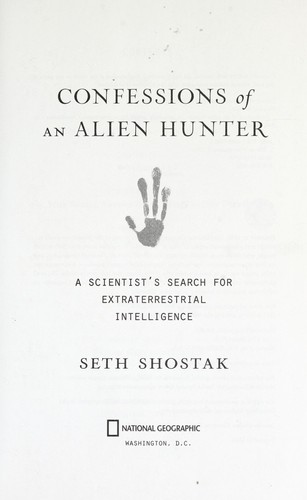
Confessions of an Alien Hunter
A Scientist's Search for Extraterrestrial Intelligence
Find on Amazon →As an Amazon Associate, OverClassified may earn from qualifying purchases made through this link, at no extra cost to you.
Why This Is Essential Reading
Confessions of an Alien Hunter earns its place on this list for a reason distinct from most of the books that precede it here: it is not a case for extraterrestrial visitation but a credentialed scientist's account of the alternative research program built specifically to test that question without relying on eyewitness testimony — and a candid record of why Seth Shostak does not think UFO sighting reports have yet met the evidentiary bar his own field sets for itself. Read against this site's own sighting-driven and coverup-driven case files, the book functions as a genuine methodological counterweight: where Stanton Friedman argued Roswell already proved visitation in their 2004 debate, and where Erol Faruk pressed Shostak directly with Delphos Ring soil chemistry a decade later, Shostak's own answer in both cases was not a rebuttal of the evidence so much as a request for a different, more rigorous kind of evidence — a standard this entry has tried to represent fairly rather than adjudicate. Whether or not his optimism about SETI's own timeline proves any better calibrated than the “any day now” predictions this site documents elsewhere, the book's core argument — that the search for intelligent life deserves real science, and that real science has a higher evidentiary floor than a compelling story — is exactly the kind of dissenting, well-credentialed perspective this list needs alongside its more UFO-sympathetic entries.
Related Cases & Theories
Essential Viewing
Seth Shostak: ET is (probably) out there — get ready
TED — Shostak's widely viewed TED talk laying out the same probabilistic case for SETI's near-term prospects this book argues at length, including his public wager that a signal will be found within roughly two decades.
Dr. Seth Shostak Interview: UFO Sightings Newly Released By The Pentagon
act.tv — A 2020 interview with Shostak responding to newly declassified Navy UAP videos, restating the same evidentiary standard for extraterrestrial visitation this book lays out over a decade earlier.
Sources Cited
- "Seth Shostak." Wikipedia (biography: education, career, SETI Institute, awards, bibliography, film consulting). en.wikipedia.org
- "Seth Shostak." SETI Institute official staff profile. seti.org
- "Confessions of an Alien Hunter: A Scientist's Search for Extraterrestrial Intelligence." Open Library / Internet Archive bibliographic record (ISBN 1426203926 / 9781426203923, National Geographic, 2009, 309 pp.). openlibrary.org
- "Confessions of an Alien Hunter: A Scientist's Search for Extraterrestrial Intelligence." Amazon.com product listing for ISBN 1426203926 (hardcover edition cited on this site). amazon.com
- "Confessions of an Alien Hunter: A Scientist's Search for Extraterrestrial Intelligence by Seth Shostak." Goodreads (reader ratings, edition record, publication date). goodreads.com
- Bormanis, Andre. "Review: Confessions of an Alien Hunter." The Space Review, November 22, 2010. thespacereview.com
- "'Just One Good Example' of UFO Evidence, asks SETI's Seth Shostak." UFO Chronicles, July 2014 (Shostak's exchange with chemist Erol Faruk over the Delphos, Kansas ring). theufochronicles.com
- "The Great UFO Debate: Friedman V. Shostak." UFO Chronicles, February 2005 (summary of the July 21, 2004 Coast to Coast AM debate between Stanton Friedman and Seth Shostak). theufochronicles.com
- "Confessions of an Alien Hunter by Seth Shostak (excerpt)." WBUR On Point, March 6, 2009 (book excerpt on invasion scenarios and SETI as a passive-listening experiment). wbur.org
- "In Search of Aliens: A Conversation with SETI Astronomer Seth Shostak." Skeptical Inquirer, 2026. skepticalinquirer.org
- "Confessions of an Alien Hunter." Internet Archive (full digital lending edition, item metadata). archive.org
- "Contact." SethShostak.com (author's own page on his consulting role for the 1997 film Contact). sethshostak.com
- Achenbach, Joel. "Big universe, eerie silence: Thoughts on the search for aliens in space." The Washington Post, September 13, 2016 (SETI funding history, Allen Telescope Array 2011 hibernation and SETIStars crowdfunding). washingtonpost.com
- "The Day the Earth Stood Still (2008 film)." Wikipedia (production notes referencing Shostak's consulting role and on-screen appearance). en.wikipedia.org
- This site's own key-figures entry: Seth Shostak, for his full biography and case connections.
- This site's own case file: The Delphos Ring Sighting, for the 2014 Faruk–Shostak evidence exchange this book's methodology anticipates.
- This site's own case file: Beatriz Villarroel & the VASCO Project, which already cites this book as SETI-culture context reading.
- This site's own theory file: The Zoo Hypothesis, which already cites this book in its own reading list.
- This site's own resources library: Full Reading List, where this 2009 hardcover edition (ISBN 1426203926) is cited across multiple pages.
Have corrections, additional research, or peer-reviewed sources? Help improve this entry.
Suggest an Edit