
The Roswell Slides Hoax
On May 5, 2015, Mexican broadcaster Jaime Maussan unveiled two 1947-dated Kodachrome slides before roughly 6,000–7,000 paying attendees at the Auditorio Nacional in Mexico City, promoted for months as photographic proof of a non-human body recovered from the 1947 Roswell crash. Within days of the reveal, independent researchers digitally deciphered a blurred museum placard visible in one of the slides, identifying the subject as the mummified remains of a Native American child, on loan from Arizona's Montezuma Castle to Colorado's Mesa Verde museum since 1938 — predating the Roswell incident by nearly a decade and having nothing to do with it.
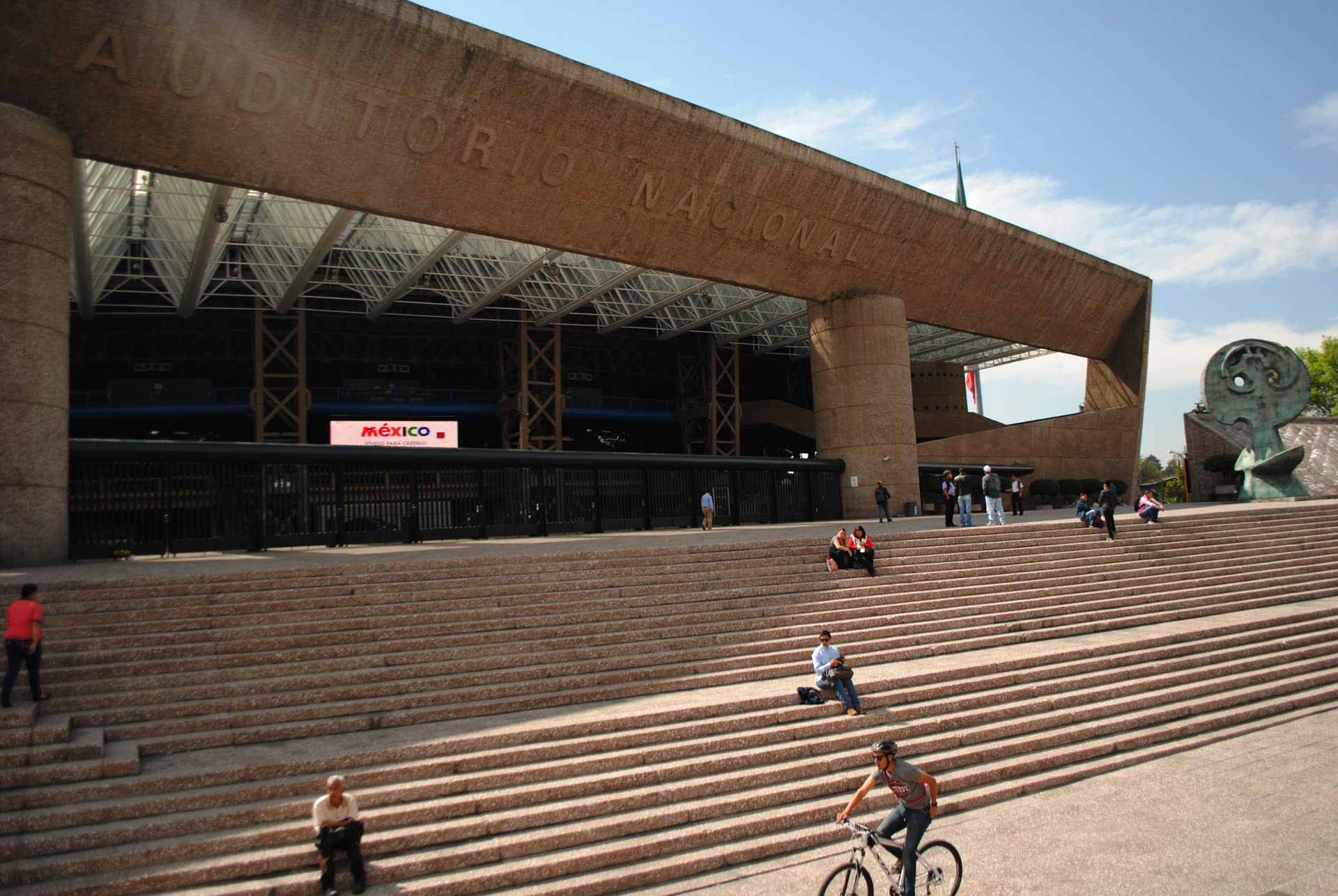
Pictured: the Auditorio Nacional in Mexico City, the actual venue of the May 5, 2015 "beWitness" reveal event. Not a photograph of the slides themselves or the event's audience.
Theoretical Alignment
This case is one of the most conclusively resolved files on this site. Unlike most Disputed cases, where competing explanations remain genuinely live, the Roswell Slides were identified through a direct, verifiable documentary paper trail — a National Park Service provenance record connecting a specific museum specimen to a specific display placard legible in the promoters' own photographs. The Psycho-Social Hypothesis dominates not because of ambiguous witness psychology but because the promotional apparatus itself — ticketed reveal events, embargoed high-resolution images, a countdown marketing campaign, and a refusal to retract even after independent verification — is better explained by the commercial and reputational incentives of UFO promotion than by any claim about the photographs' actual subject matter.
Background
The two Kodachrome slides at the center of this case were part of a larger personal photograph collection reportedly belonging to a Midland, Texas couple: Bernard Ray, a field geologist for an oil company, and his wife Hilda Ray (also referenced in some sources as Hilda Blair Ray), described as an attorney with a pilot's license and reported wartime intelligence connections. The childless, well-traveled couple died decades ago, and their photograph collection eventually passed into the hands of video producer and former journalist Adam Dew, reportedly around 2012, through an intermediary chain of custody that remains comparatively thin in the public record compared to the rest of this case's documentation.
Two of the slides appeared to show a small body laid out in a glass display case, and Dew came to believe they might depict a non-human being. He brought the slides to Roswell researchers Donald Schmitt and Thomas Carey, co-authors of Witness to Roswell (2007), who were assembling what became informally known as the "Roswell Dream Team," a group that also briefly included researchers Anthony Bragalia, Kevin Randle, and Chris Rutkowski. Randle withdrew, citing a prior credibility controversy involving Schmitt's fabricated academic credentials; Rutkowski's involvement ended after he expressed early skepticism about the slides' significance.
The Hype Campaign
At a public forum in November 2014, Carey publicly announced the slides' existence, describing Kodak's official company historian as having verified period-consistent 1947-era Kodachrome film stock and emulsion — a claim about the film's manufacture date, not about the subject photographed. This distinction is worth stating plainly because it was a central source of confusion throughout the case's public reception: verifying that a piece of film stock is genuinely from the correct manufacturing period says nothing whatsoever about when, where, or what was subsequently photographed on that film, nor does it rule out the film having been exposed years after its manufacture or repeatedly conflated with the separate, much larger question of the photographs' actual subject matter, a gap the promotional framing around the announcement did little to clarify for a general audience.
The November 2014 announcement itself functioned as a calculated media event in its own right, generating substantial anticipatory coverage across UFO-community outlets months before any image content was released. Carey's public framing at the time described the figure in the photographs as "three and a half to four feet tall" with an "almost insect-like" head, apparently mid-autopsy or dissection — a specific, evocative description that shaped public expectation considerably ahead of the eventual reveal and that, in hindsight, reads as an interpretive gloss placed on an ambiguous, low-resolution image rather than a neutral factual description.
Dew separately produced a professionally shot teaser trailer for an in-development documentary titled Kodachrome, released through his production outfit. For roughly two years the slides' existence circulated mainly within UFO-community blogs and forums, their actual content withheld and only rumored, a scarcity strategy that built anticipation ahead of a planned public reveal. Carey specifically claimed that a small, blurred placard visible next to the body in one slide "cannot be legibly read," citing failed attempts by outside experts including David Rudiak, a professional imaging studio, the Pentagon's Photo Interpretation Department, and even Adobe software engineers — a claim that, in retrospect, dramatically overstated the actual difficulty of the task.The reveal date was set for May 5, 2015 — Cinco de Mayo — and organized under the promotional banner "beWitness" by Jaime Maussan, the Mexican broadcaster whose career-making 1991 Mexico City eclipse UFO footage is documented in this site's own 1991 Mexico City Eclipse UFO Wave file. Maussan's involvement gave the American-originated slides an international promotional platform considerably larger than a purely U.S.-based UFO-conference release would likely have achieved, leveraging his decades-long reputation among Mexican and broader Latin American UFO audiences built since his 1991 eclipse broadcast.
The chain of custody linking the slides from the Ray estate to Adam Dew's possession is the single least independently verified element of this case's background, by this file's own assessment. Available accounts describe an intermediary — a woman sometimes referred to as Cat Beason and her brother Joseph — who reportedly discovered the collection during a house clearance and who provided it to Dew, but this file located no independent documentation of this specific transaction, its date, or its terms beyond promotional retellings originating with Dew himself. This gap does not affect the case's ultimate resolution, since the debunking rests entirely on the photographs' own visible content and independent government records rather than on any claim about how the slides changed hands, but it is worth flagging as a specific, unverified link in an otherwise well-documented chain.
Complete Timeline
| Date | Event |
|---|---|
| ~2012 | Adam Dew acquires the Bernard and Hilda Ray photograph collection, including the two disputed slides |
| Nov 2014 | Tom Carey publicly announces the slides' existence at a research forum, citing a Kodak historian's period-consistent film-stock verification |
| Early 2015 | Teaser trailer for the documentary Kodachrome released; slides' actual content remains embargoed |
| May 5, 2015 | "beWitness" reveal event at the Auditorio Nacional, Mexico City; ~6,000–7,000 paying attendees plus livestream audience |
| May 5–7, 2015 | A sufficiently high-resolution copy of the placard image reaches the independent Roswell Slides Research Group (RSRG) |
| Within hours | RSRG member "Nab Lator" uses commercial SmartDeblur software to read the first legible line: "MUMMIFIED BODY OF TWO YEAR OLD BOY" |
| ~May 8–10, 2015 | Anthony Bragalia matches the placard wording to a 1938 Mesa Verde Notes publication and issues a public apology |
| May 12, 2015 | Carey and Schmitt issue a joint statement calling the matter "still open to debate" rather than fully retracting |
| 2015 (later) | Researcher Shepherd Johnson's FOIA request to the National Park Service confirms the full provenance chain of the mummified remains |
The May 5, 2015 Reveal Event
The Auditorio Nacional event drew a reported 6,000 to 7,000 paying attendees, with ticket prices cited variously across sources as ranging from roughly $20 to $100 (some accounts report prices as high as $200-$350 for premium seating), plus a separate, technically troubled bilingual livestream priced around $15–$20 that drew heavy public mockery on social media under the hashtag #RoswellSlides. Speakers included Maussan as host, Adam Dew, Tom Carey, and Donald Schmitt, with some accounts placing researcher Richard Dolan and Canadian and Mexican forensic/anthropological consultants presenting a "forensic drawing" claimed to match the slide imagery on stage as well. Apollo 14 astronaut Edgar Mitchell's name circulated in pre-event promotional material as an associated supporter, though this file could not independently confirm his physical attendance at the event itself as opposed to a more general public association with the promotion.
Maussan presented the two Kodachrome images as "undeniable" proof of a non-human body dated to 1947, consistent with the Roswell narrative, and promised further high-resolution material would follow — a promise that was never meaningfully fulfilled in the way attendees were led to expect. One UFO-community critic, researcher Robert Salas, later publicly demanded a full financial accounting of the event's ticket and livestream revenue, with some unverified claims suggesting combined proceeds reaching into the tens of millions of dollars; this specific revenue figure is not corroborated by any mainstream financial reporting located in this file's research and should be treated as a disputed, unverified claim rather than an established fact.
Even taking only the most conservative confirmed figures — roughly 6,000 attendees at a low-end $20 ticket price — in-person gate revenue alone would have exceeded $120,000, before accounting for premium seating tiers reportedly priced considerably higher, merchandise, or the separate paid livestream audience. This file does not attempt to reconstruct a precise total revenue figure given the inconsistency across sources, but notes that even the most conservative reading of the confirmed ticket-pricing data establishes a genuine, substantial commercial incentive behind the event's promotion, a detail directly relevant to this file's later assessment of the promoters' post-debunking conduct.
The livestream's technical failures are documented across multiple contemporaneous sources as a significant part of the event's immediate public reception: viewers who paid for remote access reported buffering, dropped feeds, and delayed or garbled translation between the event's Spanish-language presentation and its English-speaking international audience, fueling public mockery well before the placard itself was deciphered. This file treats the livestream failures as a separate, independent embarrassment from the substantive debunking that followed within days — the event was already drawing significant public criticism on its own technical merits before the underlying photographic claim was shown to be false.
The hashtag #RoswellSlides itself became a minor case study in real-time public skepticism, with contemporaneous social media commentary mocking both the livestream's technical failures and the underlying presentation's evidentiary thinness well before any formal debunking had occurred, illustrating that a meaningful portion of the event's international audience approached the claims with active skepticism rather than the uncritical credulity sometimes assumed of large UFO-promotion event audiences generally.
Aftermath
No formal lawsuits between the various promoters were found in this file's own research, though public infighting continued for years afterward. Donald Schmitt later accused Adam Dew of never permitting him or Tom Carey to independently examine the original physical slides for material dating tests, a dispute Kevin Randle documented on his own research blog as late as February 2018, nearly three years after the reveal event. The planned Kodachrome documentary, teased since 2014, does not appear to have been released as a completed, widely distributed production in any source located by this file's research, suggesting the project was effectively abandoned once its central promotional claim collapsed. Mexican media coverage in the weeks following the event was notably more critical than the original promotional buildup, with commentary widely characterizing the "beWitness" event as a costly public embarrassment for its organizers. This shift in tone, from largely uncritical pre-event promotion to sharply critical post-event coverage, mirrors a pattern this file also documents in the later 2023 Mexican Congress affair, suggesting Mexican press institutions retained a working memory of this specific 2015 episode when evaluating Maussan's subsequent claims.
Key Witnesses
Jaime Maussan
Mexican broadcast journalist who organized and hosted the "beWitness" reveal event. Continued insisting the slides showed a genuine non-human body even after the debunking, issuing no retraction, and went on to promote further hoaxed "alien" specimens in subsequent years, most notably the September 2023 presentation of fabricated bodies to the Mexican Congress, documented in this site's own Mexican Congress UAP Hearing file.
Adam Dew
Video producer who acquired the Ray photograph collection, financed the slides' promotion and the in-production Kodachrome documentary, and became the most combative defender of the slides after the debunking, accusing independent researchers of fabricating the deciphered placard image through Photoshop — an accusation debunkers immediately disproved by deblurring Dew's own subsequently posted "authentic" copy in under two minutes using the same commercial software.
Thomas Carey & Donald Schmitt
Co-authors of Witness to Roswell, who publicly announced and championed the slides beginning in November 2014. Both offered only partial, hedging acknowledgments after the debunking rather than a clean retraction; Schmitt later disputed with Dew over access to the original physical slides for independent testing.
"Nab Lator" & the Roswell Slides Research Group
A pseudonymous French researcher and a loosely organized group of independent investigators — including Tim Printy, Lance Moody, Curt Collins, Gilles Fernandez, Paul Kimball, Isaac Koi, Chris Rutkowski, and José Antonio Caravaca — who had worked for months with only low-resolution images before deciphering the museum placard within hours of obtaining a usable high-resolution copy. The group had no formal organizational structure or funding, coordinating primarily through blogs and online forums, and included researchers who had previously held differing views on the slides' authenticity before the debunking resolved the question for all of them.
Anthony Bragalia
An early public defender of the slides who did the archival legwork matching the placard text to a 1938 Mesa Verde museum publication, then issued one of the most complete public apologies among the promoters, including a specific apology to Native American communities.
The Five Observables Assessment
Because this case involves static historical photographs rather than any claimed flight event, the Five Observables framework does not meaningfully apply in its usual sense; this file documents that absence explicitly rather than forcing an artificial fit.
Assessment: No craft, flight, or performance claim of any kind is made in this case; the entire claim concerns the identity of a photographed body, not any anomalous movement or capability. This file includes the standard Five Observables section for structural consistency with the rest of the site, but the correct assessment here is simply that the framework has no bearing on this case's central question.
Evidence Assessment
This case is unusual among this site's files in that the exculpatory evidence is not merely strong but functionally conclusive, resting on an independently verifiable documentary chain rather than competing witness interpretations. Most Disputed cases on this site turn on judgment calls about how much weight a single witness's memory, a blurry photograph, or an uncorroborated claim should be given; this case, by contrast, turns on a directly legible piece of text and a separately obtainable government record, neither of which requires any interpretive judgment about credibility or memory reliability. That structural difference is why this file departs from this site's usual Disputed classification and instead applies its Debunked stamp, reserved for cases where the underlying claim has been affirmatively and specifically shown false rather than merely left unproven.
Supporting Anomalous Origin
- The slides are apparently genuine period Kodachrome photographs from the correct general era, per Kodak's own historian's film-stock assessment
- The photographed body's unusual, atrophied appearance was visually striking enough to convince experienced Roswell researchers of its significance before the placard was read
Supporting Conventional Explanation
- A museum display placard, legible in the promoters' own high-resolution images the entire time, directly identifies the specimen: "MUMMIFIED BODY OF TWO YEAR OLD BOY"
- National Park Service records, obtained via a follow-up FOIA request, independently confirm the specimen's full provenance: discovered in 1894/1896 by Richard Wetherill and S.L. Palmer at Montezuma Castle, Arizona; on loan to the Chapin Mesa Archeological Museum at Mesa Verde National Park, Colorado, by 1938; transferred back to the Montezuma Castle museum by June 1947
- This provenance places the photographs' likely capture date before mid-1947, predating the Roswell incident itself and ruling out any connection between the two
- The promoters possessed a usable high-resolution scan for an extended period before the reveal and never disclosed this to the public
- Independent researchers deciphered the placard within hours to at most a few days of obtaining a comparable-resolution image, directly contradicting claims that the text was unreadable
- Neither Maussan nor Dew ever issued a retraction; Carey and Schmitt offered only partial, hedging statements
Why "Debunked"
This case receives this site's DEBUNKED classification — not "Disputed," because there is no genuinely live competing explanation left to weigh. The identification of the photographed subject rests on two independent, mutually corroborating lines of evidence: the display placard's own directly legible text, and a separate National Park Service documentary record obtained specifically to verify that text. Both point to the same conclusion by two different methods, which is a considerably stronger evidentiary convergence than this site typically has available even for its most confidently rated conventional-explanation cases.
What keeps this case worth documenting in detail, rather than dismissing in a single paragraph, is not any residual uncertainty about the photograph's subject but the behavior of its promoters after the debunking. A conclusively resolved misidentification became a genuine hoax in the fuller sense of that word specifically because the people best positioned to know the truth — Dew, who had held the high-resolution scan; Maussan, who had sold tickets promising "undeniable" proof — declined to correct the record once independent verification made the truth unambiguous. This file rates the underlying photographic claim as thoroughly debunked while separately documenting, in the Material Analysis section below, the promotional and financial incentives that allowed the claim to persist commercially well after it had been scientifically resolved.
This site's own rating framework generally reserves its lowest possible Data Integrity Scores for cases combining weak original evidence with strong post-hoc promotional incentive to avoid correction; this case exemplifies that specific combination about as clearly and completely as any file currently published on this site. It differs from a pure hoax in the narrowest sense — nothing indicates the underlying photographs were fabricated images rather than genuine period photographs of a real museum specimen — while differing from a pure innocent misidentification in that at least some participants continued promoting the claim commercially well past the point where continued promotion required either genuine ignorance of the debunking or a conscious decision to disregard it.
Readers of this file should come away with a specific, transferable lesson this site tries to draw out of its most conclusively resolved cases: an extraordinary claim's initial plausibility to experienced researchers, and even genuine period-consistent physical evidence supporting part of that claim (here, the film stock itself), does not substitute for actually examining the single most decisive piece of evidence available before publicly promoting a conclusion built on it. Every other development in this case — the ticketed event, the international media coverage, the years of promotional buildup — followed from a specific, avoidable failure to read a legible museum label before telling an audience of thousands that it proved something it did not.
Sensor & Instrumentation Detection Profile
No radar, aviation, or governmental instrumentation of any kind applies to this case, since it concerns the identity of a photographed historical specimen rather than any observed flight event. The relevant "instrumentation" here was, unusually for this site, entirely photographic and archival: commercially available image-deblurring software (SmartDeblur) applied to a high-resolution scan, cross-checked against a National Park Service paper record obtained through a formal FOIA request. This file treats that combination — independent digital image analysis plus an independently obtained government archival record — as functionally equivalent in evidentiary weight to instrumented sensor confirmation in other case types, and considerably stronger than the single-source promotional claims that preceded it.
It is worth stating explicitly what this case's "instrumentation" was not: no radiological, chemical, or physical-material testing of any kind was ever performed on the photographs, the film stock beyond its general period-consistency, or the historical remains themselves in connection with the 2015 promotional campaign. Every substantive claim in this case, on both the promotional and debunking sides, rests entirely on visual and documentary analysis rather than any laboratory or forensic-science method — a genuinely different evidentiary category than, for instance, the material analysis techniques (spectrometry, alloy testing) that appear in some of this site's other Roswell-adjacent case files.
Environmental & Geospatial Context
The photographs themselves were most likely taken at the Chapin Mesa Archeological Museum, Mesa Verde National Park, Colorado, sometime before the specimen's June 1947 transfer back to the Montezuma Castle museum near its original 1894/1896 discovery site in Arizona — both well-documented, publicly accessible U.S. National Park Service facilities with no connection whatsoever to Roswell, New Mexico, roughly 480 kilometers to the southeast. The reveal event itself took place at the Auditorio Nacional, a large, modern concert and event venue in Mexico City with no historical connection to the Roswell narrative beyond having been chosen as a large-capacity ticketed venue for the promotional event.
This geographic disconnect is itself a quiet but significant piece of evidence: a set of photographs taken in Colorado and Arizona, of a specimen with a fully documented, unrelated provenance, were marketed as direct physical evidence of an incident that occurred in a different U.S. state entirely, with the only connecting thread being the promoters' own unsupported interpretive claim.
Mesa Verde National Park and Montezuma Castle National Monument are both well-established, publicly documented U.S. National Park Service sites with long institutional records reaching back to the late nineteenth and early twentieth centuries, a level of institutional record-keeping that made the FOIA-based provenance verification in this case possible in a way it would not have been for a less formally documented private or municipal collection. This file notes that the same government-archival transparency that ultimately exposed this case also means any future attempt to revive a similar claim involving artifacts from a National Park Service facility would face a comparably high bar of independent verification.
Observer Credibility & Occupational Profile
The roughly 6,000–7,000 in-person attendees were, like the audience at many ticketed UFO-promotion events documented elsewhere on this site, a self-selected group who paid specifically to see promised "undeniable" evidence, a condition that predisposed many toward accepting the promoters' framing rather than independently scrutinizing it in real time. This file does not treat that audience credulity as a meaningful evidentiary factor either way, since the case was ultimately resolved through documentary and archival research entirely independent of audience reaction.
The promoters' own professional credibility varies considerably and is directly relevant to assessing their post-debunking behavior. Tom Carey and Donald Schmitt brought established, decades-long reputations as serious Roswell researchers into this case, reputations that suffered real damage from their premature public endorsement; Schmitt in particular already carried prior credibility damage from a fabricated-credentials controversy unrelated to this case. Jaime Maussan's own credibility, independently documented on this site via his key-figures entry, was already mixed before 2015, and his conduct in this case — combined with the 2023 Mexican Congress affair that followed the same essential pattern — forms part of a now well-documented, repeated professional pattern rather than an isolated lapse in judgment.
By contrast, the independent debunkers who resolved this case brought comparatively modest individual public profiles — several worked under pseudonyms or were known primarily within specialist UFO-skeptic communities rather than to a general audience — but collectively represented a working method this file weighs as considerably more credible than any individual promoter's reputation: open collaboration among researchers with differing prior views (some, like Anthony Bragalia, initially favorable to the slides), working from shared image data, cross-checking each other's results, and publishing their methodology openly rather than asserting a conclusion on personal authority alone. This file treats that methodological transparency, rather than any individual debunker's personal credentials, as the primary source of the debunking's credibility.
Kevin Randle's decision to decline joining the "Roswell Dream Team" promoting the slides, made before the debunking occurred and based on his own stated skepticism rather than hindsight, is itself a relevant credibility data point: a researcher with a comparable public reputation and level of access to the same promotional circle chose not to lend his name to the claim, a judgment later vindicated by events.
Physical & Material Assays
No physical material from the original 1947-era photographic subject was ever tested in connection with the 2015 promotional campaign; the entire case rests on photographic interpretation and archival documentation rather than any new physical examination of the mummified remains themselves. Sources differ on the ultimate final disposition of the actual physical remains depicted in the slides: some accounts describe them as having been held by the Smithsonian Institution at some point, while others suggest a 2015 repatriation to a local tribal authority occurred following the case's publicity, consistent with the broader climate of NAGPRA-related sensitivity around Native American remains in American museum collections. This file was unable to fully reconcile these accounts and flags the final-disposition question as an open, specific gap rather than asserting either version with confidence.
This file separately and explicitly notes the ethical dimension of this case that several of its own participants raised after the fact: the specimen photographed was not a prop or a fabricated hoax object but the actual remains of a Native American child, originally removed from a burial or archaeological context in the 1890s and displayed as a museum curiosity for decades before being further repurposed, without any consent from descendant communities, as supposed evidence of extraterrestrial visitation in a commercial ticketed spectacle. Anthony Bragalia's public apology "to the Native American people" specifically acknowledged this dimension of the case.
The broader museum practice of displaying Native American human remains without descendant consent, common throughout the late nineteenth and much of the twentieth century, has been substantially curtailed in the United States since the 1990 passage of the Native American Graves Protection and Repatriation Act (NAGPRA), which established formal processes for identifying, documenting, and returning such remains to culturally affiliated tribes. This case's own timeline — a mummified child displayed at Mesa Verde and Montezuma Castle museums decades before NAGPRA existed, then unexpectedly resurfacing in international UFO media in 2015 — illustrates how museum practices considered ordinary in the 1930s and 1940s can generate ethically fraught after-effects many decades later, entirely independent of and prior to any UFO-related controversy. This file treats the 2015 repatriation reports, where they exist, as a genuinely positive if incidental outcome of an otherwise disreputable promotional episode, without overstating this file's own confidence in the specific final-disposition details given the inconsistency across available sources noted above.
Historical Precedents & Archive Matches
This case fits within a well-documented broader pattern of UFO-promotion hoaxes involving misidentified or fabricated "alien" remains, several of which involve the same central promoter.
The 2023 Mexican Congress "Alien Mummies"
This site's own Mexican Congress UAP Hearing file documents Jaime Maussan's September 2023 presentation of fabricated "non-human" bodies to Mexican legislators, an event skeptical researchers have explicitly connected to this 2015 case as part of a repeated professional pattern — including the specific claim that the same self-described "expert," José de Jesús Zalce Benítez, was involved in authenticating both sets of remains. UNAM publicly declined to authenticate the 2023 specimens, and independent anatomical review concluded they were fabricated.
Maussan's Other Documented Hoaxes
Independent of both the 2015 and 2023 cases, Maussan has promoted several other claims later shown to be misidentifications or fabrications: a 2015 "Metepec creature," identified by UNAM as a shaved monkey; a 2016 "demon fairy," identified as a composite of bat remains, wood, and epoxy; and 2017–2018 promotion of doctored Peruvian remains with surgically altered skulls, which Peru's own prosecutor's office publicly described as recently manufactured. Taken together with this case, the pattern spans real, doctored, and fabricated human and animal remains repeatedly repackaged as extraterrestrial evidence and monetized through ticketed events, livestreams, books, and documentaries across at least a decade.
This file draws a specific structural comparison between this pattern and the general "programmed encounter" contactee format documented in this site's own Licancabur Volcano Contact Event file, covering Peruvian contactee Ricardo González's touring circuit: both involve a central promoter with a durable public following, a recurring commercial format capable of being repeated across multiple distinct events, and a demonstrated willingness to continue the format even after individual instances of it are publicly discredited. The specific mechanism differs — misidentified or fabricated physical specimens in Maussan's case, self-reported telepathic contact in González's — but the underlying commercial and reputational logic sustaining repetition after refutation is broadly comparable across both cases.
George Adamski's Desert Center Contact (1952)
This site's own George Adamski's Desert Center Contact file documents an earlier, structurally comparable case in which a charismatic promoter's claims, initially widely believed, did not withstand independent scrutiny — though the Roswell Slides case is evidentially far more conclusively resolved than the Adamski case, thanks to the direct documentary paper trail available here.
The "Alien Autopsy" Film (1995)
British film promoter Ray Santilli's 1995 "Alien Autopsy" footage, purportedly showing a genuine 1947 military examination of a non-human body, occupies a comparable position within Roswell-hoax history as a widely broadcast, commercially profitable claim later shown to be staged, with Santilli eventually admitting in 2006 that the footage was a reconstruction, though he continued to claim it was based on genuine, now-deteriorated original material he said he had once possessed. The structural parallel to this case is direct: both involve a claimed physical record of the 1947 Roswell event, monetized through ticketed screenings and broadcast licensing, promoted for years before being substantially or fully discredited, with the original promoter offering a partial rather than complete retraction even after independent analysis undermined the central claim.
The Ramey Memo and the Broader Roswell Documentary-Evidence Genre
This case belongs to a specific sub-genre within Roswell research generally: claims resting on the ability to extract hidden, legible text from a blurred or low-resolution photograph. David Rudiak's decades-long digital analysis of the Ramey Memo — a document photographed in Roswell Army Air Field commander Roger Ramey's hand in a 1947 press photo, which Rudiak has argued through image processing contains legible phrases including "the victims of the wreck" — represents a methodologically similar approach applied with a very different reception: this file's own review of the sourcing found Rudiak's Ramey Memo work has never achieved anything approaching the direct, independently corroborated resolution this present case reached with its museum placard, precisely because no equivalent independent government archival record exists to test Rudiak's specific readings against. The contrast between the two cases is instructive: the same general technique (digital deblurring of a period photograph) produced a conclusively verifiable result in this case and a persistently contested one in the Ramey Memo case, illustrating that the technique itself is sound but its evidentiary weight depends entirely on whether an independent corroborating record exists to check the result against.
Material Analysis
This case is exceptionally well-documented by the standards of this site, with the debunking itself constituting a small case study in rapid, methodologically transparent independent verification.
The Deblurring Itself
Once a sufficiently high-resolution copy of the placard image became available following the May 5 event, RSRG member "Nab Lator" processed it using SmartDeblur, a commercially available, non-specialized image-restoration program, and within hours produced a legible first line reading "MUMMIFIED BODY OF TWO YEAR OLD BOY." Satellite-tracking researcher Ted Molczan's contemporaneous remark captures the disproportion between the promoters' three-year claimed struggle and the actual difficulty of the task: independent researchers "solved in no more than 2-3 days what the promoters claimed not to have been able to solve in 3 years." The fuller placard text, once fully deciphered, read approximately: "At the time of burial the body was clothed in a cotton shirt. Burial wrappings consisted of these small cotton blankets. Loaned by Mr. S.L. Palmer, San Francisco, California."
SmartDeblur and comparable consumer-grade deconvolution software work by modeling and reversing a specific, mathematically describable blur pattern — typically simple motion blur or out-of-focus blur — rather than by any exotic or specialized process. This file emphasizes the ordinariness of the tool deliberately: the promoters' repeated claims that the placard "cannot be legibly read," attributed to a professional imaging studio, the Pentagon's Photo Interpretation Department, and Adobe engineers, describe a level of technical difficulty inconsistent with a problem an independent researcher resolved using free-trial consumer software within a single evening. This gap between the claimed and actual difficulty of the task is itself one of this case's more informative details: it suggests either that these outside experts were never actually given a comparable-quality image to work from, that their reported failures were mischaracterized or exaggerated in the promoters' retelling, or some combination of both, rather than that the placard text genuinely resisted analysis by qualified professionals using appropriate tools.
Multiple independent members of the Roswell Slides Research Group reportedly arrived at consistent or near-consistent readings of the placard's key phrase using different copies of the image and, in at least one case, different software entirely, which this file treats as a meaningful internal corroboration check within the debunking process itself — independent convergence on the same reading from separate starting points, rather than a single researcher's unverified claim. This convergence, achieved by researchers working largely independently and comparing notes only after arriving at their own initial readings, is methodologically closer to genuine scientific replication than to a single analyst's unverified assertion, and this file weighs it accordingly as a meaningfully stronger form of evidence than a lone researcher's claimed result would represent on its own.
The Full Provenance Chain, Traced Step by Step
Anthony Bragalia matched this placard wording to a September 1938 Mesa Verde Notes publication describing a mummy "received by the Park Museum," donated by S.L. Palmer Jr. of San Francisco, whose father had recovered it from ruins in the 1890s. Researcher Shepherd Johnson's subsequent FOIA request to the National Park Service produced a more complete documentary chain: the child mummy was discovered in 1894 or 1896 at Montezuma Castle, Arizona, by archaeologist Richard Wetherill and S.L. Palmer; loaned to the Chapin Mesa Archeological Museum at Mesa Verde National Park, Colorado (almost certainly the location where the Rays' photographs were taken, circa 1946–47); then transferred back to the Montezuma Castle museum near the original discovery site by June 1947. This dating detail is itself decisive: if the photographs were taken at Mesa Verde before the June 1947 transfer, they necessarily predate the Roswell incident (which occurred in July 1947), making any connection between the two chronologically impossible regardless of the specimen's identity.
Dew's Response and the Photoshop Accusation
When confronted with the deciphered placard, Adam Dew reacted by calling the RSRG researchers "a group of internet UFO trolls" and accused them of fabricating the placard text using Photoshop. He then posted his own version of the placard image, still deliberately blurred, as supposedly authentic proof the original was illegible — which independent researchers immediately deblurred themselves in under two minutes using a trial copy of the same commercial software, removing any remaining doubt about the placard's authenticity and directly contradicting Dew's fabrication accusation.
This specific sequence — a fabrication accusation immediately and publicly disproven by simply repeating the exact same publicly available process the accuser claimed was impossible to trust — is, in this file's own assessment, one of the more evidentially decisive individual moments in the entire case. It eliminated any remaining ambiguity about whether the RSRG's original reading might have been a coincidental misreading or an actual fabrication, since Dew's own subsequently released image, posted specifically to discredit the RSRG, produced the identical result when processed by the identical method, using software freely available to any interested reader wishing to verify the result personally rather than relying solely on any single party's word.
The Fallback "Deception Within Deception" Argument
Some slide defenders, confronted with the deciphered placard, argued that its "mummified body of two year old boy" text was itself a deliberate government or museum-level deception layered atop a genuine alien body — an unfalsifiable rationalization pattern common across UFO-promotion hoaxes generally, in which any disconfirming evidence is reframed as further proof of an ever-deeper cover-up rather than treated as grounds for revising the original claim. Not every early defender took this path: Dr. Richard O'Connor, an early defender of the slides, instead reviewed National Park Service documentation comparing the body to a mummified Native American child and publicly reversed his position, becoming known in the UFO-research press as a "defector" from the slides' defenders.
This file treats the "deception within deception" argument as structurally unfalsifiable and therefore outside the scope of ordinary evidentiary evaluation: any conceivable disconfirming evidence — a museum placard, a National Park Service archival record, even a hypothetical future physical examination of the remains themselves — can always be reframed under this argument as itself part of the alleged cover-up, which means no possible finding could ever satisfy it. This site generally declines to treat unfalsifiable rationalizations of this kind as live alternative explanations requiring separate evidentiary weighing, and does so here as well; it is documented in this file as a description of how some slide defenders responded to the debunking, not as a competing hypothesis this file considers genuinely open.
What Makes This Case Unusually Conclusive
- Two independent verification methods (direct placard text; separate NPS archival record) converge on the identical conclusion
- The debunking timeline (hours to days) directly contradicts the promoters' own three-year claimed failure to read the same text
- A specific, checkable chronological fact (the June 1947 museum transfer date) makes any Roswell connection impossible independent of the specimen's identity
- The lead promoter's own fabrication counter-accusation was itself disproven within minutes using the same publicly available software
The Conventional Explanation: Confirmed Museum Provenance, Predating Roswell
This section exists on this site's case files primarily to weigh genuinely open candidate explanations against each other; this case is unusual in that one candidate is not merely favored but directly confirmed by primary documentary evidence, a distinction worth stating clearly before working through the remaining candidates below for completeness and structural consistency with the rest of this site.
Unlike most files on this site, this case does not require this file to weigh competing candidate explanations against genuine uncertainty. The conventional explanation is not merely the most parsimonious available account — it is directly confirmed by the promoters' own photographic evidence, once its most legible portion (the placard) was actually read, and independently corroborated by an unrelated government archival record obtained specifically to test that reading.
Genuine Misidentification (Most Likely Candidate, For At Least Some Participants)
It remains plausible that Adam Dew's initial belief that the slides depicted something anomalous was a sincere, if poorly investigated, misreading of an unusual-looking historical photograph — consistent with how mummified remains, foreshortened by photographic angle and glass-case reflection, can appear genuinely strange to an untrained eye. This file extends that same possible sincerity, with much less confidence, to Carey and Schmitt's initial public endorsement in November 2014, given their extensive prior Roswell research credentials, which makes their apparent failure to obtain and examine a legible copy of their own central piece of evidence before publicly promoting it a genuine and specific investigative failure on their part, independent of any question of Dew's sincerity.
Knowing Commercial Exploitation (This File's Best Explanation for Post-Debunking Conduct)
Whatever the promoters' original state of mind, their conduct after independent verification made the true nature of the photographs unambiguous is much harder to explain as innocent error. Continuing to sell event access, refusing to release the high-resolution scan that would have resolved the question years earlier, and responding to correction with an unfounded fabrication accusation rather than verification of the counter-claim are all patterns more consistent with prioritizing ticket revenue and promotional momentum over accuracy once the commercial machinery around the reveal event was already in motion.
Deliberate Fabrication From the Very Outset
This file found no direct evidence that any promoter fabricated the slides themselves; the underlying Kodachrome photographs and their museum subject appear to be genuine period images of a real historical specimen, not manufactured props. The dishonesty in this case, to the extent it existed from the beginning, more likely concerned the promoters' claimed inability to read a placard that a functioning copy of readily available consumer software resolved within hours — an evidence-suppression pattern rather than an image-fabrication one.
This distinction matters for how this case should be categorized relative to other hoaxes covered on this site. Some case files here document claims resting on outright fabricated physical evidence — staged photographs, manufactured objects presented as recovered artifacts. This case instead documents a real, historically genuine photograph whose actual, fully documented and mundane subject was deliberately obscured, then marketed under a false interpretive claim to a paying audience. The evidentiary object was real; the claim made about it was not, and the gap between the two was maintained, at least by some participants, well past the point where maintaining it required either genuine ignorance or a conscious choice to disregard readily available correction.
Genuine Museum Misidentification
PlausiblePLAUSIBLE and directly confirmed by two independent documentary sources: the placard's own text and separate National Park Service provenance records.
Knowing Commercial Exploitation Post-Debunking
PlausiblePLAUSIBLE and consistent with the promoters' documented refusal to retract, release scans, or verify their own fabrication counter-accusation.
Genuine Extraterrestrial Body (Promoters' Claim)
ImplausibleIMPLAUSIBLE. Directly contradicted by legible placard text and independently obtained government archival records identifying the specimen and its pre-Roswell museum history.
Related Cases
Confirmed Documents & Official Records
A Freedom of Information Act request by researcher Shepherd Johnson to the U.S. National Park Service produced the documentary chain confirming the mummified child's discovery at Montezuma Castle, Arizona (1894/1896), loan to the Chapin Mesa Archeological Museum at Mesa Verde National Park, Colorado (by 1938), and transfer back to the Montezuma Castle museum (by June 1947) — the single most important government record in this case, directly corroborating the independently deciphered placard text.
Search Government & Official Archives Directly
Further Reading — Recommended Literature
This site's own essential-reading features on the Roswell literature offer deeper context on the researchers involved in this case; the five titles below broaden coverage across Roswell history, the psychology of the promoted-hoax genre, and Mexican ufology specifically.
Witness to Roswell
The authors' own major work, published years before the slides affair, useful for understanding the established Roswell-research reputations that made their premature endorsement of the slides so damaging.
UFO Crash at Roswell
An earlier foundational Roswell text, useful background on the broader research community and reputational stakes surrounding new "evidence" claims like the 2015 slides.
Why People Believe Weird Things
A foundational general framework for understanding how ticketed reveal events and scarcity-driven promotional hype can sustain belief in a claim well past the point of independent refutation.
A Colorful History of Popular Delusions
A broader survey of mass hoaxes and popular delusions, offering comparative context for the commercial and social dynamics that sustained the Roswell Slides promotion.
UFOs Over Mexico!: Encounters with Unidentified Aerial Phenomena
Context on the broader Mexican ufology scene and Jaime Maussan's career that produced both this case and the later 2023 Congress affair.
DISCLOSURE: Some links above are affiliate links. If you purchase through them, OverClassified receives a small commission at no additional cost to you. This helps support independent research.
Essential Viewing
Sources
- Sheaffer, Robert. "The 'Roswell Slides' Fiasco: UFOlogy's Biggest Black Eye." Skeptical Inquirer, Sept/Oct 2015. skepticalinquirer.org
- Roswell Slides Research Group, official findings. roswellslides.com
- Roswell Slides Research Group, "The Child Identified." roswellslides.com
- Hill, Sharon. "'Roswell Slides' BUSTED!" Bad UFOs. badufos.blogspot.com
- UAP Logbook. "Roswell Slides: the placard that changed the UFO body claim." uaplogbook.com
- Hanks, Micah. "The Roswell Slides: Case Closed, and Lessons Learned." micahhanks.com
- Collins, Curt. "ID Confirmed: the Roswell Slides Mummy of Mesa Verde." Blue Blurry Lines. blueblurrylines.com
- Randle, Kevin. "The Roswell Slides and the Mummy's Placard." kevinrandle.blogspot.com
- Randle, Kevin. "Don Schmitt, Adam Dew and the Roswell Slides." kevinrandle.blogspot.com
- The UFO Chronicles. "Roswell Slides Update: Mummy is Identified." theufochronicles.com
- The UFO Chronicles. "The Roswell Slides: Child From Montezuma Castle." theufochronicles.com
- Red Star Films. "The Roswell Slides Scandal: Who is Adam Dew?" redstarfilms.blogspot.com
- CBS News San Francisco / Seth Shostak. "Roswell Aliens Not So 'Alien' As We Thought." cbsnews.com
- Smithsonian Magazine. "Alleged Aliens' Corpses Displayed to Mexican Congress Did Not Convince Scientists." (2023, on the connected later incident) smithsonianmag.com
- Dunning, Brian. "The Alien Mummies Presented to Mexico's Congress." briandunning.substack.com
- This site's own Mexican Congress UAP Hearing case file.
- This site's own 1991 Mexico City Eclipse UFO Wave case file.
See something inaccurate? Have additional information or sources?
Suggest an Edit →Last Updated: August 2026