
The Licancabur Volcano Contact Event
On the clear desert night of September 28, 2019, roughly 340 people from more than twenty countries gathered on Atacameño indigenous land at the foot of Licancabur volcano, in Chile's Atacama Desert, for a publicly announced "programmed encounter" led by Peruvian contactee Ricardo González, who says he has received telepathic messages since 1993 from entities he calls Ivika and Antarel. After a two-hour collective meditation, attendees reported a pulsing light hovering overhead for several minutes; a friendly documentary crew filmed the phenomenon and called it inexplicable, while no independent scientific, governmental, or mainstream Chilean press body ever examined the footage.
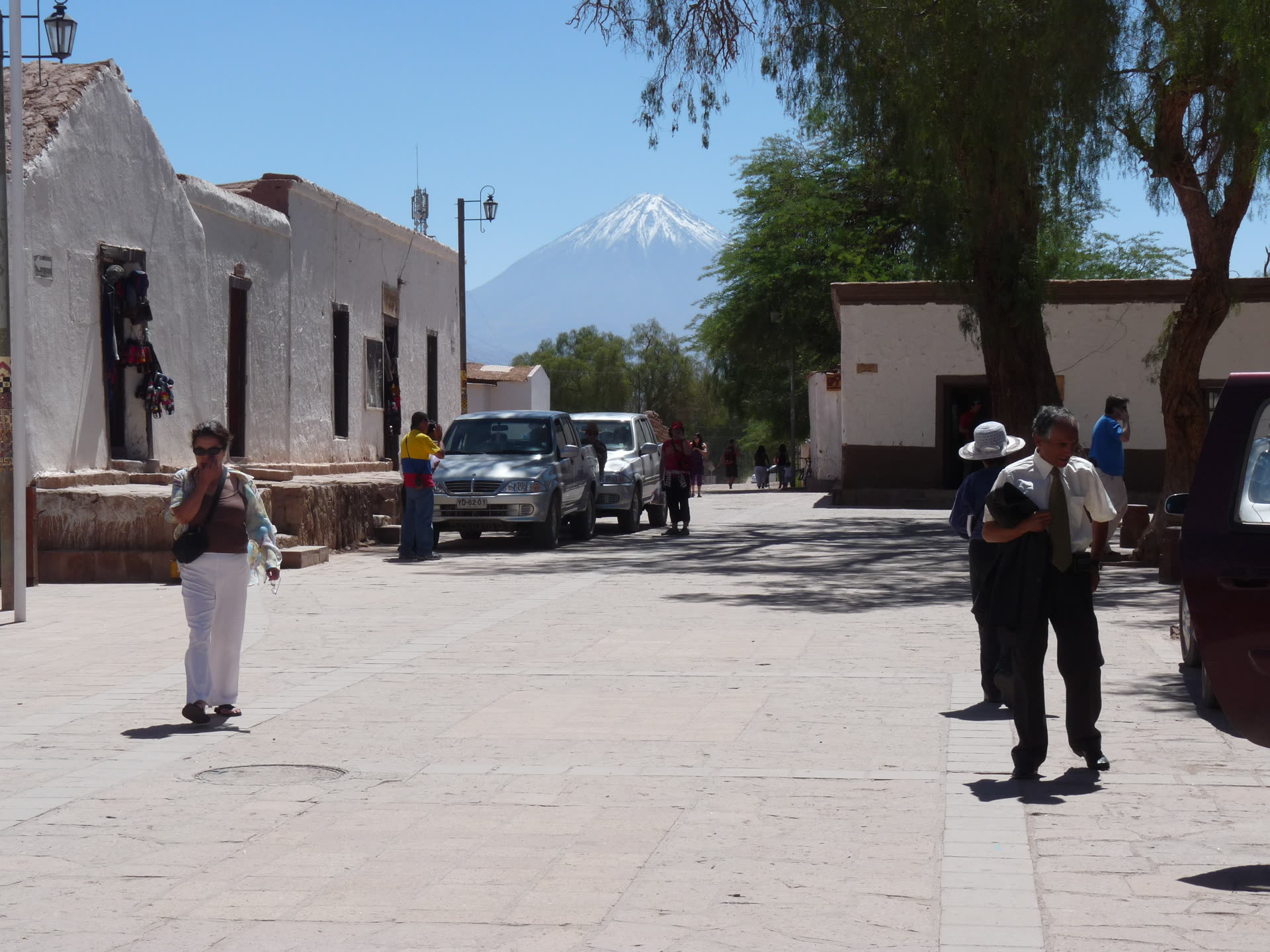
Pictured: Licancabur volcano as seen from San Pedro de Atacama, near the general area where the September 2019 gathering actually took place. Not a photograph of the event itself, its attendees, or the reported light phenomenon.
Theoretical Alignment
This case's alignment is dominated overwhelmingly by the Psycho-Social Hypothesis. Every structural element of the event — a leader who has claimed exclusive telepathic access to non-human entities since 1993, an advance announcement of the precise date and place a "contact" would occur, a large group primed by hours of collective meditation to interpret an ambiguous nighttime light as a confirmatory sign, and a documentary crew with a pre-existing sympathetic relationship to the organizer filming and endorsing the result — matches the well-documented anthropological and psychological pattern of belief-community expectation shaping perception, discussed at length in this site's own Essential Reading feature on Why People Believe Weird Things. The residual alignment given to the Extraterrestrial Hypothesis reflects only that a genuinely anomalous light was reported by multiple attendees and partially recorded on video; it does not reflect any independent confirmation that the light was craft of extraterrestrial origin rather than a conventional object misperceived under conditions of high expectation.
Background
This background section traces the full decades-long personal and organizational history behind the September 2019 gathering, since the event itself cannot be properly evaluated in isolation from the much longer contactee career and movement that produced it.
Ricardo González Corpancho was born in Lima, Peru, in 1974 and says he witnessed a UFO near his home in the San Miguel district of Lima in 1988, at around age fourteen. He emerged from Sixto Paz Wells's Misión Rahma, one of Latin America's longest-running organized UFO contactee movements, founded in Peru in 1974 by Paz Wells and his brother Carlos. Misión Rahma pioneered a distinctive format still used by González today: publicly announcing, in advance, a precise date, time, and location at which contact with non-human visitors would occur, then gathering witnesses, followers, and sympathetic press to observe the result. Paz Wells himself is documented as having convened press to more than ten such "scheduled sightings" over his career. Critical secondary sources, including the Ibero-American Network for the Study of Sects (RIES), have characterized Misión Rahma as a sect; a dedicated skeptic blog specifically alleges fraud and financial exploitation by both Paz Wells and González.
Among González's roughly twenty published books are titles including Los maestros del Paititi, his debut work describing an expedition into Peru's Manú jungle in search of the legendary lost city of Paititi; Lugares de contacto ("Places of Contact"), cataloguing the specific sites he identifies as significant to his contact program, including Licancabur; Protocolos de Contacto ("Contact Protocols"); El Arca ("The Ark"); and Los extraterrestres del planeta Apu ("The Extraterrestrials of Planet Apu"), which most directly elaborates the Apunian cosmology underlying the claims examined in this file. Taken together, this body of work functions as an internally consistent, decades-long mythology, developed and expanded across roughly three decades of publication, rather than a single isolated claim.
González says he received his first telepathic message from an entity he calls Antarel in October 1993, and reports his first claimed physical encounter with Antarel in Peru's Chilca desert on August 30, 1997. A second, more senior entity he calls Ivika, described as the program's current "operations commander," entered his narrative later, reactivated at a claimed event in Yungay, Peru, on April 12, 2015. González describes both entities as partially human beings — "descendants" of a future human space-colonization mission connected to the Alpha Centauri star system — and calls the broader contact program the "Apunianos," a name derived from Apu, the Quechua and broader Andean term for a sacred mountain spirit, tied to a distinct sub-tradition of Peruvian contacteeism centered on Peru's Huascarán massif in Áncash region. That sub-tradition traces to claimed 1960s contact by a Yugoslav-Peruvian technician, and its associated folklore claims the entities warned in advance of the real, catastrophic 1970 Ancash earthquake and Yungay avalanche — a detail González's own mythology draws on for legitimacy.
By 2019, González had authored roughly twenty books on contact-related themes, translated into English, Italian, French, Portuguese, and German, and had organized roughly a dozen internationally announced "programmed encounters" across Peru, Chile, Brazil, Paraguay, Argentina, and at Mount Shasta in California. The September 2019 Licancabur gathering was not his first at that specific volcano: he had held a structurally identical, smaller event at the same general site in September 2016, drawing a reported 328 participants from sixteen countries. Licancabur itself has been central to González's personal mythology since a claimed 2003 "physical contact" there. The 2019 gathering, titled "Recuerdos del futuro" ("Memories from the Future"), was explicitly framed by González as the larger, second iteration of the 2016 event and, by his own count, roughly the eighth "programmed sighting" of his career overall.
Peruvian ufology's most prominent skeptical voice, lawyer and radio host Anthony Choy — founder of the Asociación Peruana de Ufología and, separately, the researcher this site credits for compiling the standalone investigative report on the La Joya Air Base Incident — has interviewed González on his own radio program, "Viaje a otra dimensión," without offering pointed on-air rebuttal of the specific Ivika/Antarel claims. This file notes that omission without treating it as endorsement: Choy has separately and forcefully debunked other high-profile Peruvian and Latin American UFO claims, including the widely publicized 2023 "alien mummies" affair presented to the Mexican Congress by journalist Jaime Maussan, demonstrating that his general skeptical rigor is not in question, even where a specific interview with González did not include a direct challenge to the underlying contact claims.
Complete Timeline
| Date | Event |
|---|---|
| 1988 | Ricardo González reports his first UFO sighting, in Lima, Peru, age 14 |
| Oct 1993 | González says he receives his first telepathic message from an entity he calls Antarel |
| Aug 30, 1997 | Claimed first physical encounter with Antarel, Chilca desert, Peru |
| 2003 | Claimed first "physical contact" at Licancabur volcano |
| Apr 12, 2015 | Claimed reactivation event in Yungay, Peru, introducing the entity Ivika |
| Sep 2016 | First Licancabur "programmed encounter," ~328 participants from 16 countries |
| Sep 27–29, 2019 | Second, larger Licancabur gathering, "Recuerdos del futuro," ~340 participants from 20+ countries; documentary crew present throughout |
| Sep 28, 2019 (night) | Two-hour collective meditation followed by a reported pulsing light observed for roughly five minutes |
| 2020 | Diana Espírito Santo and Alejandra Vergara publish academic fieldwork on the event in Antipoda; "Making Contact: Messages from the Andes" documentary announced as forthcoming |
The September 2019 Gathering
González says Ivika and Antarel told him contact would occur "at a precise hour, on a precise day, and at a precise location," a message he then relayed to his international network of followers in advance through his own website and the international contactee and ufology conference circuit rather than through mainstream press. Roughly 340 people from more than twenty countries traveled to Chile and camped on land belonging to the Atacameño (Likan Antai) indigenous community of Estancia de Chalarquiche, near San Pedro de Atacama, at the foot of Licancabur. This attendance figure comes from González's own organization, but is independently corroborated in broad strokes by two Chilean anthropologists, Diana Espírito Santo and Alejandra Vergara, who personally attended the gathering as participant-observers and separately describe "over 20 countries" represented — a genuinely independent, non-promotional source, even though it still lacks any official or neutral headcount from police, municipal, or tourism authorities.
Notable attendees identified in available sources include UFO researcher and journalist Paola Harris; Italian researchers Filippo Sarpa of the Italian Ufological Network/Foundation (FUI) and colleagues; Giorgio Piacenza, described as a former informal UFO adviser to the Peruvian Air Force; Argentine journalists Silvia and Carlos Galliquio; and Chilean researchers Manuel Valdez and Pablo Zárate, a veterinarian and UFO investigator who had also attended the 2016 event. This mix of attendees — working journalists, veterinary and other professionals, and career ufologists from at least four countries traveling together specifically for this gathering — illustrates how thoroughly the event was embedded within González's existing international network rather than drawing a general or unaffiliated public audience; this file located no indication that any attendee arrived without prior familiarity with González's contact claims.
Publicity for the gathering ran through channels specific to this subculture: González's own website and mailing list, the international contactee and ufology conference circuit through which he had built his following over roughly three decades of touring, and the documentary production already filming his parallel May 2019 Peru expedition for the same planned series. This file found no evidence the event was advertised through general tourism channels, Chilean government tourism promotion, or any medium likely to reach an unaffiliated general public, consistent with an audience that arrived already primed by years of prior engagement with González's specific claims rather than one recruited fresh for this specific gathering.
The Meditation and the Light
Per Espírito Santo and Vergara's own account, participants "ommed and hummed, and chanted in unison for a couple of hours" under a clear desert sky. Afterward, attendees reported a pulsing, blinking light that remained roughly stationary overhead for about five minutes. Some attendees say they used astronomy apps in the moment to rule out satellites and known space debris. A documentary crew led by Canadian filmmaker Rob Freeman, working under the name "Centre for the Scientific Study of Atmospheric Anomalies," filmed the light and later reported capturing over 116 distinct pulses across five-plus minutes of footage. Freeman's team, by González's own account of their conclusion, stated the footage had "no conventional explanation" — a self-published, non-peer-reviewed claim from a documentary crew with an existing sympathetic relationship to González's project, not an independent scientific finding.
One of Freeman's cameramen, Dan Berg, reportedly experienced a period of "missing time" after following illuminated trees near the camp, returning with a fragmentary memory of being told to "be prepared." This claim is sourced only to González's own promotional account of the event and has not been independently corroborated by Berg himself in any source this file located.
Aftermath
No major press controversy, skeptical debunking campaign, or public scandal followed the September 2019 gathering in any source this file located; the event's low profile outside its own subculture appears to have insulated it from the kind of mockery cycle that has followed some other prominent contactee claims. No confirmed repeat gathering at Licancabur specifically has taken place since 2019: González's more recent publicly documented appearances, per his own website, shifted to other venues in his touring circuit, including Cerro Uritorco in Argentina (e.g., a February 2023 gathering), suggesting Licancabur functioned as a two-time venue (2016 and 2019) rather than an annual fixture, a pattern likely also affected by the COVID-19 pandemic's disruption of international travel throughout 2020 and into 2021. The planned "Making Contact: Messages from the Andes" documentary series, teased as forthcoming in 2020, does not appear to have been released as a completed, widely distributed production in any source this file located as of this file's writing.
A Note on the "Atacama Humanoid" Photograph
A widely circulated photograph, in which photographer Francisco Muñoz claimed to see a face or humanoid figure after examining a night image roughly two weeks after the fact, is sometimes associated with this case in secondary summaries. This file's own research found that photograph actually dates to the earlier 2016 Licancabur gathering, not the September 2019 event covered here, and this file avoids conflating the two. The 2016 photograph is a separate, classic example of pareidolia-prone claims — the tendency to perceive faces or figures in ambiguous visual noise — and is not treated here as evidence for the 2019 gathering specifically.
Key Witnesses
Ricardo González
The Peruvian author and contactee who announced the event's date and location in advance, based on messages he attributes to entities he calls Ivika and Antarel. The entire event's premise rests on his own uncorroborated claim of exclusive telepathic access to these entities, a claim first made in 1993 and elaborated across roughly twenty subsequent books and a decades-long international speaking and touring career built substantially around sustaining and monetizing that claim.
Diana Espírito Santo & Alejandra Vergara
Chilean anthropologists (Pontificia Universidad Católica de Chile) who personally attended the gathering as participant-observers and published a peer-reviewed academic treatment of the event, providing this case's only substantive non-promotional documentation. Their broader research program studies belief and evidentiary reasoning within Chilean ufology generally, rather than advocating for or against the specific reality of any individual claimed phenomenon.
Rob Freeman & Documentary Crew (Unregistered)
A Canadian filmmaker who led a crew filming González's 2019 Peru and Chile expeditions for a planned documentary series, and who filmed and endorsed the reported light phenomenon at Licancabur. His team's technical conclusions are self-published and were not independently peer-reviewed or verified. Crew member Dan Berg separately reported a personal "missing time" experience during the gathering, a claim sourced only to González's own promotional account.
Approximately 340 Attendees (Largely Unnamed)
The bulk of this case's testimony comes from an unnamed group of roughly 340 self-selected attendees from more than twenty countries, drawn from González's existing international follower network, who traveled specifically to witness a phenomenon they were told in advance to expect. Named individuals within this group identified in available sources include journalist Paola Harris, Italian researcher Filippo Sarpa, Giorgio Piacenza, Argentine journalists Silvia and Carlos Galliquio, and Chilean investigators Manuel Valdez and Pablo Zárate; the great majority of the roughly 340 attendees remain unnamed in any source this file located.
The Five Observables Assessment
Because this case's central phenomenon is a distant, ambiguous light observed by a primed audience rather than a close-range structured object, most of the traditional Five Observables categories do not meaningfully apply.
Assessment: The reported phenomenon — a stationary, pulsing light held roughly overhead for about five minutes — contains none of the high-performance flight characteristics (instant acceleration, hypersonic velocity, trans-medium travel) that anchor the AATIP Five Observables framework. Its only genuinely matching characteristic is low observability, in the narrow sense that its exact nature could not be determined by unaided eye at a distance, which is equally consistent with a conventional light source, aircraft, or astronomical object as with anything anomalous.
Evidence Assessment
Unlike many single-witness case files on this site, this case is not evidentially thin in the sense of having too little documentation; if anything, it has an unusually rich secondary record for a contactee event, spanning a peer-reviewed academic article, a professionally filmed documentary production, attendee social media, and the organizer's own extensive self-published writing. The difficulty here is not a lack of documentation but a lack of independence: nearly every source describing what happened either organized the event, attended it as a believer, or filmed it as part of a pre-existing collaborative relationship with the organizer. Weighing the two columns below means distinguishing, source by source, between genuine observation and promotional framing of that observation.
Supporting Anomalous Origin
- An independent, non-promotional academic source (Espírito Santo & Vergara) confirms that a group of attendees genuinely observed and discussed an unexplained light, rather than the story being invented wholesale after the fact
- Video footage exists showing a pulsing light, filmed by a documentary crew with recording equipment on hand
- Some attendees report attempting in-the-moment checks against astronomy apps to rule out satellites
Supporting Conventional Explanation
- The event's entire premise and timing rest on one man's uncorroborated claim of telepathic contact with named entities, a claim with no means of independent verification
- Attendees were a self-selected group who traveled specifically expecting a "confirmatory" phenomenon after a leader-organized, hours-long collective meditation — textbook conditions for expectation-driven perception
- The only technical assessment of the video footage comes from a documentary crew with an existing sympathetic, collaborative relationship with the event's organizer, not an independent analyst
- No Chilean mainstream press outlet, and no official body such as Chile's CEFAA/SEFAA, is known to have examined the footage or the event
- The organizer's own broader movement (Misión Rahma) has been characterized as a sect by a dedicated academic network studying such groups, and González individually has been accused of fraud by dedicated skeptic sources
- A widely circulated "humanoid" photograph associated with this case in some secondary sources actually dates to a separate, earlier 2016 event at the same site
Why "Disputed"
This case receives a DISPUTED classification, toward the lower end of this site's rating range. It is not rated as an outright hoax: a genuine, independently observed light phenomenon appears to have occurred and been filmed, and this file does not dismiss that observation. What keeps the rating low is the near-total absence of any evidence pointing toward the phenomenon's cause being connected to the specific claims made about it — that it represents confirmed contact with named entities from a future human colonization mission, announced telepathically in advance. No independent technical body examined the footage; no neutral attendance or observation record exists outside González's own organization and one sympathetic documentary crew; and the entire premise depends on trusting a single individual's decades-long, unverifiable claim of exclusive telepathic access.
This case sits in a structurally similar position to the site's other contactee-tradition case files: like George Adamski's Desert Center Contact, it combines a genuinely reported, witnessed phenomenon with an unverifiable claimed cause promoted by a figure with clear personal and financial incentive to sustain belief in that cause. It differs in one respect worth noting explicitly: unlike many single-witness contactee narratives, this event was independently documented, in real time, by professional academic anthropologists with no stake in promoting the outcome — a genuinely unusual level of scholarly attention for a contactee gathering, even though that scholarship examines the event as a case study in belief rather than as evidence for the claimed contact itself.
This file's rating also weighs the specific, dated, repeated nature of González's predictions. A contact program that has, by its own account, produced roughly a dozen "programmed encounters" across nearly three decades offers an unusually large sample against which the underlying predictive claim could in principle be evaluated: if telepathic contact with Ivika and Antarel were genuinely occurring and genuinely capable of producing confirmatory phenomena on a predicted schedule, a consistent, independently verifiable pattern of confirmed contact across a dozen announced events would constitute much stronger evidence than any single gathering considered in isolation. This file located no source presenting such a cross-event analysis, whether by González's own organization or by any outside researcher, and treats each event — including this one — as evidentially independent rather than mutually reinforcing.
Sensor & Instrumentation Detection Profile
No radar, satellite, or official aviation-authority data connected to this event has been located. The gathering took place in a remote section of the Atacama Desert, near but not within any major monitored airspace, and this file found no indication that anyone involved sought or obtained instrumented confirmation from Chile's CEFAA/SEFAA (the Air Force's civil aviation anomalous-phenomena unit) or any equivalent Bolivian authority, despite Licancabur's location on the two countries' shared border.
The only technical documentation is the documentary crew's own video footage, described by González's account of the crew's findings as showing over 116 distinct light pulses across roughly five minutes. No frame-by-frame technical analysis, camera specifications, exposure settings, or independent review of this footage by a photographic or astronomical expert outside the documentary team has been published in any source this file located.
This file also notes a specific technical distinction worth flagging for future researchers: a genuinely irregular pulsing pattern across dozens of discrete flashes is, in general terms, more consistent with a strobing or blinking man-made light source (aircraft anti-collision lighting, a drone, or a ground-based signal) than with the steady or slowly variable brightness typically reported for planets, most satellites, or natural atmospheric phenomena, which tend to present as continuous or gradually changing light rather than a rapid, discrete pulse count. This general observation does not resolve the case — it is equally consistent with a conventional aircraft as with any more exotic explanation, and this file has no independent access to the raw footage needed to evaluate the claimed pulse pattern directly — but it is offered as a specific, testable detail that any future analyst reviewing the actual footage should weigh alongside satellite and aircraft traffic data for the exact night.
Environmental & Geospatial Context
Licancabur is a near-symmetrical, 5,916-meter stratovolcano straddling the Chile–Bolivia border in the Atacama Desert, one of the driest and clearest-sky regions on Earth — a location prized internationally by professional astronomers for exactly the atmospheric clarity that also makes faint or distant lights, including aircraft, satellites, and astronomical objects, unusually visible and salient to observers on the ground at night. The mountain is sacred to the local Atacameño (Likan Antai) people, on whose community land at Estancia de Chalarquiche the gathering was held; this file located no comment from Atacameño community leaders themselves on the event, whether supportive, neutral, or critical.
The Atacama Desert's exceptional sky clarity is relevant context for evaluating the reported light: a region this favorable for astronomical observation also produces frequent, genuinely visible instances of satellites, aircraft contrails, planets, and other conventional lights that can appear unusual to observers unfamiliar with the local night sky, particularly at altitude and in a region with minimal light pollution. This file located no source that specifically cross-checked the September 28, 2019 sky against satellite pass predictions, known aircraft routes, or planetary positions for that exact night and location; this remains a specific, identifiable gap that any future skeptical investigation of this case would need to close.
The broader San Pedro de Atacama area is itself internationally significant precisely because of this atmospheric clarity: the region hosts major professional astronomical facilities, including the Atacama Large Millimeter/submillimeter Array (ALMA) and the European Southern Observatory's Paranal site, drawn to the area by the same combination of high altitude, minimal humidity, and dark skies that made Licancabur an appealing venue for González's gathering. This file notes the proximity of serious professional astronomical infrastructure only as regional context establishing how exceptionally clear and observation-friendly this particular sky is — not as any indication that these facilities were involved in, consulted about, or aware of the September 2019 event, for which no such connection was found in any source.
San Pedro de Atacama is additionally one of Chile's most visited tourist destinations, with an established astro-tourism industry offering commercial stargazing tours nightly to visitors specifically because of the region's sky quality — a detail relevant to assessing baseline local familiarity (or unfamiliarity) with ordinary satellite passes, aircraft, and bright planets among a visiting international crowd unaccustomed to the exceptional visibility such dark, high-altitude skies provide compared to their home cities.
Observer Credibility & Occupational Profile
The attendee population was not a neutral cross-section of the public but a self-selected group of roughly 340 people who traveled internationally, at their own expense, specifically because they already followed González's contact claims and expected to witness a confirmatory phenomenon. This is a materially different credibility profile than an unprepared bystander witness: prior belief and strong expectation are well-documented factors that can shape both the interpretation and the collective narrative-formation of an ambiguous visual stimulus, a dynamic this site's own Essential Reading feature on Why People Believe Weird Things discusses in general terms.
Independent academic observers Diana Espírito Santo and Alejandra Vergara represent a genuinely different, higher-credibility category within the same event: professional anthropologists attending specifically to study the belief community rather than to seek personal confirmation of the claimed contact, whose account is the closest thing this case has to a neutral record of what was collectively observed and how attendees interpreted it.
The general dynamics of large, ritually synchronized group gatherings are well studied outside the specific context of ufology. Sociologists have long described a phenomenon sometimes called "collective effervescence" — a term originating with Émile Durkheim's early twentieth-century sociology of religion — in which sustained group ritual activity (chanting, synchronized movement, shared physical hardship such as a long desert night) heightens emotional arousal and a felt sense of shared, meaningful experience among participants, making an ambiguous subsequent stimulus more likely to be collectively interpreted as significant and confirmatory rather than mundane. This file applies that general, well-established sociological concept to the September 2019 gathering's own structure — roughly two hours of synchronized collective meditation and chanting immediately preceding the observed light — without claiming any specific study examined this event itself; it is offered as relevant general background for understanding how a genuinely observed but ordinary light could plausibly be experienced by a primed group as more significant than an unprepared, unaffiliated observer would judge it.
A related, narrower psychological concept, confirmation bias, describes the well-documented general tendency to notice, recall, and weight evidence that supports a pre-existing belief more heavily than evidence that would disconfirm it. Applied here: attendees who traveled internationally specifically because they already believed in González's contact claims had a strong prior expectation that a phenomenon would appear at the announced time, a condition under which an ambiguous nighttime light is considerably more likely to be interpreted as confirmatory than the same light would be for a neutral, unprimed observer encountering it without context.
A third relevant concept is apophenia, the general tendency to perceive meaningful patterns, connections, or significance in random or ambiguous stimuli. Applied to a genuinely irregular pulsing light observed at night by a large, expectant crowd, apophenia offers a plausible general mechanism by which an ordinary but visually striking stimulus — consistent with, for instance, a distant aircraft's anti-collision lighting or a satellite catching sunlight at a particular angle — could be collectively perceived and retrospectively described as more structured, deliberate, or "communicative" in character than an unprimed technical analysis would independently support.
Physical & Material Assays
No physical trace evidence of any kind — ground marks, recovered material, radiation readings, or documented physiological effects on any attendee — is associated with this event. The only tangible artifact is the documentary crew's video footage of the light itself, which this file treats as a recording of an observed phenomenon rather than as physical trace evidence in the sense used elsewhere on this site (burns, punctures, or material samples). No named medical or forensic examination of any kind was performed in connection with this case.
The one claimed physiological effect associated with the event — cameraman Dan Berg's reported "missing time" experience — is documented only secondhand, through González's own promotional account, with no independent statement from Berg himself, no documented timeline of how long the "missing time" actually lasted, and no medical or psychological examination of any kind. This file treats the claim as unverified rather than as evidence of any genuine physiological or temporal anomaly, consistent with how this site treats similarly unverified secondhand physiological claims elsewhere.
This file also notes, for completeness, what was not reported: no attendee is documented as having experienced any injury, burn, unusual sound-related effect, or lasting physical symptom of any kind, in sharp contrast to the physiologically consequential case files elsewhere on this site (for example, this site's Attack on Moises or Colares files, both involving reported physical injury). The complete absence of any physical aftereffect here is consistent with a case whose central phenomenon is a purely visual, distant observation rather than any claimed close-range physical encounter.
Historical Precedents & Archive Matches
This case sits within a decades-old, cross-border Latin American contactee tradition with recurring venues and a circulating cast of participants, and comparison to that broader tradition is more useful here than comparison to any single prior UFO sighting.
Misión Rahma and the "Programmed Encounter" Format
Sixto Paz Wells's Misión Rahma, founded in Peru in 1974, originated the exact format this event replicates: announce a specific future date, time, and place for contact, gather a large group of believers and sympathetic press, and interpret whatever ambiguous phenomenon appears as confirmation. Paz Wells himself convened more than ten such events over his career. González, an early collaborator within Misión Rahma before developing his own parallel "Apunian" narrative, has simply continued and internationally scaled up this same format.
This file treats the "programmed encounter" format itself as the single most important piece of historical context for evaluating this case, more important than any specific detail of the Licancabur gathering alone. A prediction announced by the same trusted authority figure to an already-believing audience, followed by a genuinely ambiguous nighttime phenomenon that the format is specifically designed to produce a confirmatory interpretation of, is a structure that will tend to "succeed" from the organizer's and audience's perspective almost regardless of what specific light or object happens to be visible on the appointed night — a structural observation about the genre as a whole, not a claim about the sincerity of any individual participant, including González himself.
Cerro Uritorco / Erks (Argentina)
Cerro Uritorco, near Capilla del Monte in Córdoba province, Argentina, is an older, independent Argentine contactee and New Age pilgrimage site with its own "underground city" (Erks) mythology, drawing large annual gatherings since the 1980s and 1990s. González has explicitly folded Uritorco into his own international touring circuit and reportedly now lives near it, making it a useful comparison case showing that "mass-gathering contact events" of this kind constitute a recurring genre with established venues rather than isolated, one-off phenomena.
Mount Shasta (California, USA)
Mount Shasta functions as this same circuit's principal North American venue. González claims a 2014 physical group contact event there, documented by journalist Paola Harris, who was also present at the 2019 Licancabur gathering — reinforcing that Licancabur 2019 was one stop within an international touring pattern of similarly structured "programmed encounters," not a unique or standalone event.
The Broader Category of "UFO Religions"
Scholars of new religious movements have long treated organized UFO-contact groups as a distinct, internationally recurring category, sometimes labeled "UFO religions" in the academic literature on new religious movements. Better-known examples elsewhere in the world include Raëlism, founded in France in 1974 around claimed contact with an extraterrestrial being called Elohim, and the Aetherius Society, founded in Britain in 1955 around claimed telepathic communications from beings on Venus and elsewhere. This file situates Misión Rahma and González's own Apunian movement within this same general academic category — organized groups built around a founder's claimed exclusive channel of communication with non-human beings, structured teachings, and periodic collective gatherings — without asserting that any scholar has specifically classified González's movement this way in print; this file located no dedicated academic monograph treating the Apunian movement specifically, in contrast to the more extensive scholarly literature on Raëlism and the Aetherius Society.
Both Raëlism and the Aetherius Society, notably, founded in 1974 and 1955 respectively, share with Misión Rahma (also founded in 1974) a striking chronological clustering in the mid-twentieth century, a period general historians of the UFO phenomenon connect to the broader post-1947 "flying saucer" cultural wave following Kenneth Arnold's widely publicized sighting and the subsequent Roswell incident. This file notes that clustering as further comparative context for situating González's own later movement, which explicitly continues and internationally scales up a template established during that earlier wave, within a much longer twentieth-century pattern of organized contactee religious movements rather than treating it as a novel or isolated development, one now well into its second full generation of leadership as González continues the format his own predecessor originated five decades earlier.
George Adamski's Desert Center Contact (1952)
This site's own George Adamski's Desert Center Contact file documents the most famous single contactee case of the 1950s and offers a useful genre comparison: both cases combine a charismatic individual claiming exclusive, personally privileged contact with non-human beings, a devoted following willing to travel and organize around that individual's claims, and an evidentiary record that, on independent examination, has not withstood the specific factual claims made about it.
The 1970 Yungay Disaster and Andean Precognition Folklore
The "Apunian" sub-tradition González draws on traces to claimed 1960s contact by a Yugoslav-Peruvian technician near Peru's Huascarán massif, with associated folklore holding that the entities had warned in advance of the real, catastrophic May 31, 1970 Ancash earthquake and the resulting Yungay avalanche, one of the deadliest natural disasters in Peruvian history. This claimed precognitive warning, impossible to verify or falsify at this historical distance, functions within González's broader narrative in the same way many contactee traditions incorporate a genuine historical tragedy as retroactive proof of a contact program's benevolence and reality — a rhetorical pattern this file notes without independent means of assessing the specific 1960s claim itself.
Material Analysis
This case's evidentiary record is unusually well-documented for a contactee gathering by the standards of this genre, while remaining almost entirely uncorroborated as to the specific claims made about the phenomenon's cause.
The Strongest Available Source
Diana Espírito Santo and Alejandra Vergara's 2020 academic article, "The Possible and the Impossible: Reflections on Evidence in Chilean Ufology," published in Antipoda. Revista de Antropología y Arqueología (Universidad de los Andes / Pontificia Universidad Católica de Chile), is the single strongest, most independent source available on this event. The authors personally attended as participant-observers and frame the gathering through a theoretical lens examining "evidence-as-possibility" within belief communities, rather than attempting to adjudicate whether the observed light was genuinely anomalous. This is genuinely valuable scholarly documentation of what happened and how attendees experienced and interpreted it, but it is explicitly not designed to function as, and should not be read as, independent verification of the specific contact claims González makes.
The Absence of Mainstream and Official Coverage
This file's own research found no coverage of the September 2019 gathering in any major Chilean press outlet (El Mercurio, La Tercera, BioBioChile, Emol, Cooperativa) or in regional Antofagasta-area papers, despite the event's substantial size and international attendance. This absence is notable: an event this large, in a well-known tourist destination, involving hundreds of international travelers, would ordinarily be expected to attract at least local press curiosity, and its total absence from that record suggests the gathering's publicity ran almost entirely through González's own contactee and New Age networks rather than reaching a general audience. No evidence was found that Chile's official anomalous-phenomena body, CEFAA/SEFAA, ever investigated or commented on the event.
The Documentary Crew's Limitations
Rob Freeman's documentary team, filming under the name "Centre for the Scientific Study of Atmospheric Anomalies," is the only source offering any technical characterization of the video footage (the claimed 116-plus light pulses across five-plus minutes). This file treats that characterization as a documentary production's own internal account rather than as independent scientific analysis: Freeman's crew had an existing, ongoing collaborative relationship with González's project (having already filmed his earlier 2019 Peru expedition for the same planned series), was not blind to the expected outcome, and published no peer-reviewed or independently replicable technical methodology alongside its conclusion.
The organization name itself — "Centre for the Scientific Study of Atmospheric Anomalies" — is worth specifically noting here: this file located no independent institutional registration, academic affiliation, peer-reviewed publication record, or third-party recognition of this body beyond its use in connection with Freeman's own documentary and UFO-research projects. Its name carries the general register of a scientific research institution, but this file found no evidence it functions as one in the sense of independent, credentialed, peer-reviewed atmospheric science — a distinction relevant to how much evidentiary weight its stated conclusion about the footage should be given.
Coverage in the International Ufology Press
Beyond the academic Espírito Santo/Vergara treatment and the documentary production itself, coverage of this specific gathering within the broader UFO-research community appears to have circulated primarily through attendee social media, personal blogs, and secondhand summaries on general ufology news aggregators, rather than through investigation by any established, independent UFO research organization with its own methodology for evaluating the claims. This file located no treatment of the September 2019 event by any of the larger, longer-established international UFO research bodies typically cited elsewhere on this site (e.g., MUFON or an equivalent national body), consistent with the event's overall profile as a phenomenon documented almost entirely by parties either organizing it or personally attending it.
What Would Resolve This Case Further
Moving this case's rating would most plausibly require: the raw, unedited video footage becoming available for independent frame-by-frame analysis by an astronomer or photographic analyst with no connection to González's project; a check of the specific night's sky against satellite pass predictions, aircraft traffic, and planetary positions for that exact date and location; or on-the-record comment from the Atacameño community whose land hosted the gathering. None of this material is known to have surfaced since 2019.
This file also notes what such further research would need to distinguish, echoing a distinction this site draws in other single-source testimonial cases: independent confirmation that attendees genuinely observed and were moved by an unusual light is a different and much lower evidentiary bar than independent confirmation that the light's cause was connected to González's specific claimed contact program. Espírito Santo and Vergara's academic fieldwork already substantially clears the first bar; nothing located by this file's research comes close to clearing the second, and this file will revise its own assessment if any such independent material is ever located or brought forward by future researchers.
Sourcing Limitations Specific to This Case
- Entire premise rests on one individual's unverifiable, decades-long claim of exclusive telepathic contact
- Attendee population was self-selected specifically to expect and interpret a confirmatory phenomenon
- Only technical video assessment comes from a documentary crew with an existing collaborative relationship to the event's organizer
- No mainstream Chilean press or official government/military body examined the event
- No independent astronomical or aviation cross-check of the specific night has been published
The Conventional Explanation Candidate: Expectation-Primed Misperception of a Conventional Light Source
The most parsimonious explanation for this case, in this file's own assessment, treats the "programmed encounter" format itself as the primary causal mechanism: a large, self-selected group is told in advance, by a trusted charismatic figure, that a specific and dramatic phenomenon will occur at a specific time and place; the group then engages in hours of collective ritual (meditation, chanting) known to heighten suggestibility and group cohesion; and when an ordinary nighttime light — a satellite, high-altitude aircraft, or astronomical object, all common and often striking in the Atacama's exceptionally clear skies — appears roughly on schedule, it is collectively interpreted as confirmation rather than independently and skeptically assessed.
Genuine Anomalous Phenomenon (At Face Value)
This candidate holds that the pulsing light itself, entirely independent of González's specific interpretive claims about its ultimate cause, was a genuinely unidentified phenomenon that conventional explanations (satellites, aircraft, planets) do not adequately account for. This file cannot fully rule this out given the continuing absence of any specific, published satellite-pass or aircraft-traffic cross-check for the exact night in question, and treats it as a live but unconfirmed possibility rather than a demonstrated fact.
Deliberate Fabrication or Staged Phenomenon
No direct evidence of a staged or artificially produced light (a drone, flare, or ground-based light source) was found in any source this file's own research located, though the documentary crew's pre-existing collaborative relationship with González, combined with the total absence of any independent technical review of the footage, means this file cannot fully exclude the possibility either. Skeptical critiques of González and Misión Rahma more generally focus on financial exploitation and inconsistency in his broader claims rather than presenting event-specific evidence of staging at Licancabur itself.
Genuine Anomalous Contact (González's Own Claim, At Face Value)
The claim that the light represented confirmed communication from entities named Ivika and Antarel, arriving at a precisely predicted time as evidence of González's telepathic contact, is the least evidentially supported of the three candidates examined in this file. It depends entirely on trusting one individual's uncorroborated, decades-long personal claim, for which no independent verification method exists even in principle, now or in the foreseeable future.
Expectation-Primed Misperception
PlausiblePLAUSIBLE. Matches the well-documented general pattern of belief-community expectation shaping group perception of an ambiguous nighttime light.
Genuine Anomalous Phenomenon
InconclusiveINCONCLUSIVE. No published satellite, aircraft, or astronomical cross-check for the exact night exists to confirm or rule this out.
Confirmed Telepathic Contact (González's Claim)
ImplausibleIMPLAUSIBLE as stated. Rests entirely on one individual's unverifiable personal claim, with no independent means of confirmation.
Related Cases
Confirmed Documents & Official Records
No Chilean, Bolivian, or other government, military, or aviation-authority record specifically addressing this event is known to exist. This file located no indication that Chile's official anomalous-phenomena body, CEFAA/SEFAA, ever investigated or commented on the September 2019 gathering.
Search Government & Official Archives Directly
Further Reading — Recommended Literature
This site's own Essential Reading feature on UFOs, the Absurd covers Diana Espírito Santo's broader ethnographic research into Chilean ufology, of which this event's academic documentation forms one part; the five titles below broaden that coverage across the Latin American contactee tradition and the general psychology of belief.
UFOs, the Absurd, and the Limit of Anthropological Knowledge
Embedded ethnographic fieldwork among Chilean ufologists, sky watchers, and contactees, by one of this event's own independent academic documentarians.
Why People Believe Weird Things
A foundational general framework for understanding how belief communities form and sustain extraordinary claims under conditions of high expectation and social reinforcement.
Flying Saucers Have Landed
The foundational text of the 1950s Western contactee genre, offering a direct structural comparison to González's own claimed personal contact narrative.
UFOs in Chile
A broader chronicle of Chilean UFO encounters, offering national context for evaluating this event's place within the country's wider UFO reporting history.
UFOs In Central and South American AirSpace
A broader survey of Central and South American UFO reports, situating this event within the wider regional pattern of Latin American ufology and contacteeism.
DISCLOSURE: Some links above are affiliate links. If you purchase through them, OverClassified receives a small commission at no additional cost to you. This helps support independent research.
Essential Viewing
Sources
- Espírito Santo, Diana & Vergara, Alejandra. "The Possible and the Impossible: Reflections on Evidence in Chilean Ufology." Antipoda. Revista de Antropología y Arqueología, No. 41 (2020). redalyc.org
- González Corpancho, Ricardo. "Contacto en Atacama 2019." ricardogonzalezoficial.com
- González Corpancho, Ricardo. "Cronología del contacto Apuniano." ricardogonzalezoficial.com
- González Corpancho, Ricardo. Official biography. ricardogonzalezoficial.com
- "Ricardo González: 'Si los extraterrestres quisieran conquistarnos, lo habrían hecho hace mucho tiempo.'" Infobae, August 2, 2020. infobae.com
- "Perú: Investigador asegura contacto extraterrestre." El Popular. elpopular.pe
- "Ricardo González es otro peruano..." (critical commentary on González and Misión Rahma). sixtopaz.blogspot.com
- "OVNI: El Fraude de Sixto Paz Wells y Ricardo González" (skeptic blog). xyz010909.wordpress.com
- "Making Contact: Messages from the Andes" (2020 Teaser), Skylight Films. youtube.com
- "Making Contact: Messages from the Andes Preview with Ricardo González | 2019 Peru Interview," Rob Freeman. youtube.com
- Harris, Paola. "Messages from the Andes." paolaharris.com
- "El contacto con los Apunianos se activó." Misión Rahma New York (background on the Apunian mythology). misionrahmanewyork.blogspot.com
- "Sixto Paz Wells." Wikipedia. en.wikipedia.org
- "Licancabur." Wikipedia. en.wikipedia.org
- "File: San Pedro de Atacama view of Licancabur volcano.jpg." Wikimedia Commons. commons.wikimedia.org
- This site's own George Adamski's Desert Center Contact case file.
- This site's own Essential Reading feature on UFOs, the Absurd.
- This site's own Essential Reading feature on Why People Believe Weird Things.
See something inaccurate? Have additional information or sources?
Suggest an Edit →Last Updated: August 2026