
Collahuasi Mine UFO Sighting
In mid-April 2013, approximately 35 workers at the Collahuasi copper mine — one of the world's largest, sitting at roughly 4,200–4,300 meters in the Chilean Andes — watched a brilliant, flattened silvery disc hover, rise, descend, and drift in short horizontal segments roughly 600 meters above the mine site for about two hours before departing. Four technicians photographed it twice on a basic compact camera. Nearly a year later, after the photos finally reached Chile's CEFAA — the Comité de Estudios de Fenómenos Aéreos Anómalos, one of the only standing national government agencies on Earth dedicated to investigating anomalous aerial phenomena — a year-long multi-disciplinary review by CEFAA's meteorologist and photo analysts ruled out lenticular cloud, drones, weather balloons, and known or experimental aircraft. The agency's own, sole formal conclusion: “an extremely interesting object or phenomenon” that “would be classified as a UFO in the proper sense.”
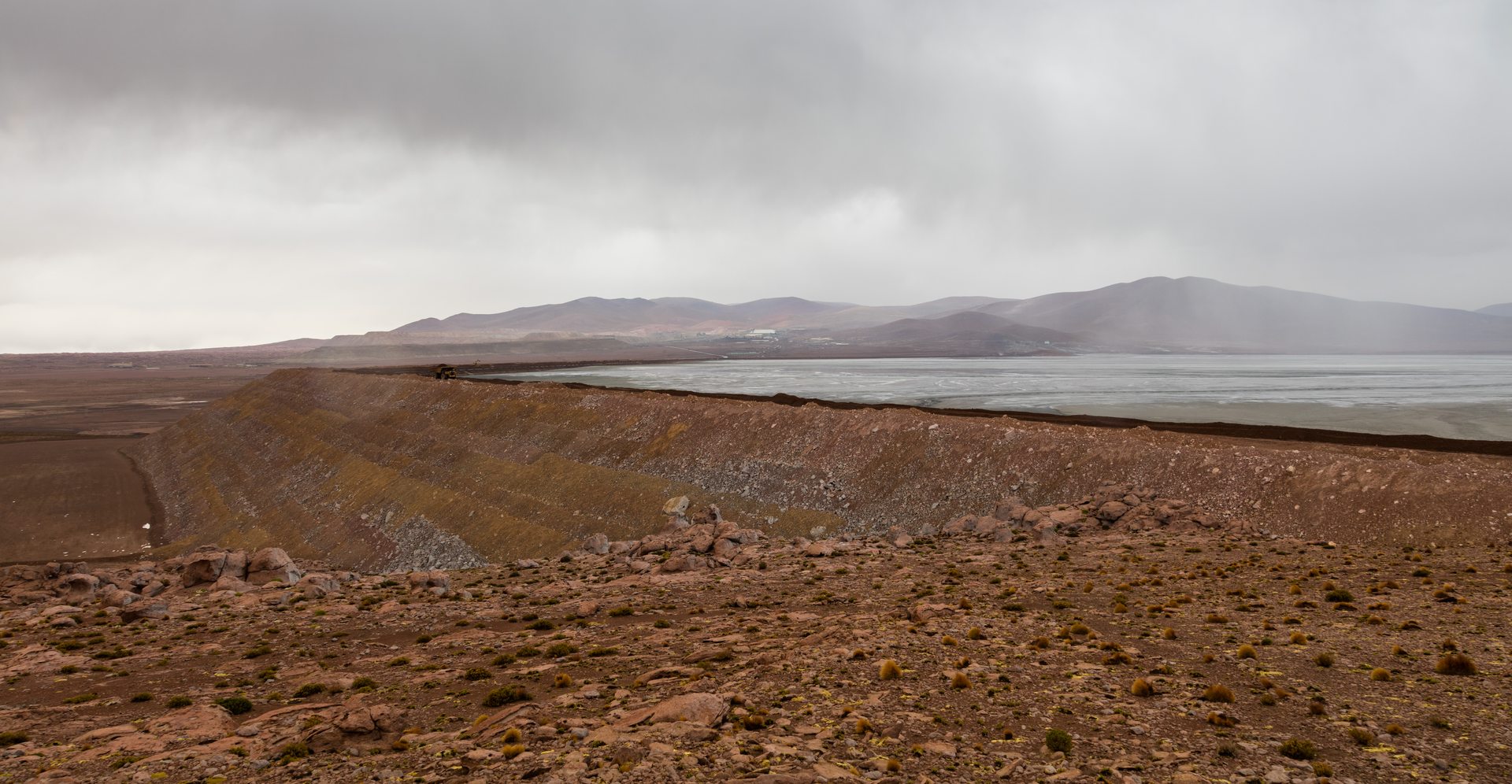
Pictured: the Collahuasi mine's open-pit operations in the high Andes of Chile's Tarapacá Region, photographed by Diego Delso in February 2016 — the real mine site at the center of this case, not the disputed object itself. No public-domain or rights-clear photograph of the original two 2013 witness images (still held privately and by CEFAA) is known to be freely licensed for reproduction here. (CC BY-SA 4.0, Diego Delso, delso.photo.)
Theoretical Alignment
This case sits closer to genuine ambiguity than most files in this catalog. The Extraterrestrial Hypothesis (ETH) draws real, if partial, support: a structured, apparently solid disc, independently photographed twice, displaying controlled-looking vertical and horizontal repositioning over two hours in front of dozens of technically literate industrial workers, with a formal government investigation unable to find any conventional match — a genuinely unusual evidentiary profile. It falls well short of full alignment, though, because nothing in the record establishes intelligent non-human origin specifically; CEFAA's own conclusion is a narrower and more modest one — “unidentified,” not “alien.” The Interdimensional Hypothesis (IDH) finds almost nothing to work with: no claim of dimensional transition, missing time, consciousness interaction, or any of the phenomenology that IDH cases typically involve. Psycho-Social Hypothesis (PSH) alignment is rated speculative rather than absent for a specific, honest reason distinct from most PSH ratings on this site: it is not that the sighting looks like a misperceived mundane object, but that the case's real evidentiary chain — a single photographer, a roughly ten-month delay before the photos reached investigators, and witnesses who declined all further cooperation — leaves open, if unproven, questions about how the story was assembled and transmitted before CEFAA ever saw it.
Background
Chile's Comité de Estudios de Fenómenos Aéreos Anómalos (CEFAA) is one of a small handful of standing national government bodies anywhere in the world formally chartered to investigate unidentified aerial phenomena, and the Collahuasi case sits squarely within its most institutionally unusual feature: unlike the U.S. Department of Defense's AARO or France's GEIPAN, which sit inside a defense ministry or a national space agency respectively, CEFAA was established by resolution of Chile's Dirección General de Aeronáutica Civil (DGAC) — the country's civil aviation authority, roughly Chile's equivalent of the U.S. FAA — on October 3, 1997, explicitly framed around aviation safety rather than defense or scientific curiosity. Enzo Di Nocera led the committee in its first year; retired Air Force brigadier general Ricardo Bermúdez Sanhueza then directed it across two separate terms (1998–2002 and 2009–2016, with a 2002–2008 dormancy period under an intervening director in between), building it into what DGAC's own published history calls a model other countries' agencies have looked to. CEFAA combines DGAC technical staff with volunteer scientists drawn from Chilean universities and observers from every branch of the armed forces and national police, evaluating citizen- and pilot-submitted reports — descriptions, photographs, video — against meteorological, astronomical, and aviation data before issuing a formal conclusion. The agency is genuinely selective: across the reports it has logged since 1998, CEFAA's own director has stated that only about 3% are ever formally classified as instances the committee cannot explain by conventional means: no known aircraft, no balloon, no astronomical object, no atmospheric phenomenon. The Collahuasi case is one of that small minority. In 2010 CEFAA became an independent unit reporting directly to DGAC's own general secretariat rather than remaining housed inside the Air Force Technical School, and by September 2021 — under its newer name, SEFAA (Sección de Estudios de Fenómenos Aéreos Anómalos) — the agency had logged 1,675 total case reports since its founding, publishing investigated and resolved cases on its own website on a quarterly basis since 2020, a practice that began after the Collahuasi case was already several years old and therefore does not include it in that online archive.
The mine itself is real and enormous. Compañía Minera Doña Inés de Collahuasi SCM operates one of the largest copper deposits on Earth — an estimated 3.93 billion tonnes of ore grading 0.66% copper — from open-pit workings (principally the Rosario and Ujina pits) in the high Andean plateau of the Pica commune, Tarapacá Region, roughly 180 km southeast of the port city of Iquique, at an elevation the mine's own operator and CEFAA's witnesses place at approximately 4,200 to 4,300 meters. It is jointly owned by Anglo American plc (44%), Glencore plc (44%), and a Mitsui & Co.-led consortium, Japan Collahuasi Resources (12%), and produced roughly 560,000 tonnes of copper in 2018 alone, placing it consistently among the handful of largest copper mines on the planet. Small-scale mining activity in the area dates back to at least 1905–1930, but the modern industrial-scale operation that exists today, with its large resident workforce rotating through remote high-altitude shifts, is a product of the 1990s expansion that made Collahuasi one of Chile's flagship mining assets — and, by extension, the kind of large, technically staffed, security-conscious industrial site where an anomalous daylight sighting is unusually likely to be witnessed by dozens of people at once, yet also unusually likely to go unreported for a long time given the operational and reputational sensitivities of a major multinational mining concession.
Complete Timeline
| Date | Event |
|---|---|
| October 3, 1997 | CEFAA is formally established by DGAC resolution; from 1998 it is led by retired Air Force Brig. Gen. Ricardo Bermúdez. |
| Mid-April 2013 | Around midday (per later shadow-angle analysis), a bright, flattened disc is sighted hovering and maneuvering roughly 600 meters above the Collahuasi mine site for about two hours; approximately 35 mine personnel observe it across the facility. |
| Same day | Four technicians specializing in electricity, electronics, and fluid control track the object directly and photograph it twice on a Samsung Kenox S860 compact digital camera before it departs. |
| April 2013–early 2014 | The witnesses keep the sighting and photographs private; the images are eventually shown informally to colleagues and supervisory staff at the mine rather than reported externally. |
| February 22, 2014 | A formal report and the two surviving photographs reach CEFAA — roughly ten months after the sighting itself. |
| 2014 | CEFAA distributes the material internally for review by a consulting meteorologist and its photo-analysis team, part of a process the agency's director later describes as spanning about one year. |
| July 1, 2014 | El Mostrador is among the first Chilean outlets to publish the leaked photograph and initial case details publicly. |
| July 7, 2014 | BioBioChile and other Chilean outlets report DGAC/CEFAA's formal acknowledgment that it has no conventional explanation for the object. |
| Mid-to-late 2014 | International wire and outlet pickup (HuffPost, Fox News, Inquisitr, and others) carries the case to a global audience, including on-record comment from independent U.S. physicist Bruce Maccabee. |
| May 14, 2015 | International outlets including Yibada report Chile's DGAC has formally concluded the object “qualifies as a UFO,” closing out roughly two years of intermittent press coverage following the original sighting. |
| Since 2015 | No further public follow-up investigation of the Collahuasi case has been reported by CEFAA/SEFAA; the case remains formally closed as unidentified, with no revision to its original classification. |
The Sighting: Two Hours Above the Atacama Plateau
The Collahuasi mine sits in one of the most extreme working environments in industrial Chile: a high Andean plateau at roughly 4,200 to 4,300 meters elevation, thin dry air, intense unfiltered sunlight, and some of the clearest, most cloudless skies anywhere on the planet — the same optical clarity that makes the wider Atacama region a magnet for the world's most sensitive ground-based astronomical observatories. It was against that backdrop, sometime in mid-April 2013, that workers at the mine first noticed an object in the sky that did not match anything routinely seen at the site. Witnesses described a flattened, brilliantly colored, silvery disc approximately 5 to 10 meters in diameter, hovering at an estimated 600 meters above the ground and holding position for extended stretches before making slow, incremental vertical and horizontal repositioning — rising, descending, and drifting sideways in short segments rather than any single continuous flight path. At points during the roughly two-hour observation, several witnesses reported the object's appearance shifting: what read most consistently as a static, silvery disc briefly took on the look of a glowing, balloon-like sphere before reverting to its more clearly defined disc shape. According to the most detailed independent account of the case's chronology, the object eventually departed toward the east, ending the sighting.
Reports differ, in a way this file treats honestly rather than glossing over, on exactly how many people saw it. Widely circulated Chilean press coverage (El Mostrador, La Tercera, coverage syndicated through Univision) places the number at approximately 35 workers and professionals across the mine site who observed the phenomenon during the two-hour window. Separately, English-language coverage drawing on CEFAA's own released case summary describes a core group of four technicians — specialists in electricity, electronics, and fluid control, professions CEFAA's own report characterized as bringing unusually pragmatic, technically literate mindsets to the encounter — who tracked the object most directly and were the ones who actually photographed it. The most coherent reading of both figures together, consistent with how a sighting would unfold across a sprawling, multi-pit industrial site with workers spread across different elevations and vantage points, is that the four technicians formed the closest, most sustained, and best-documented group of observers, while the wider total of roughly 35 reflects the larger number of personnel elsewhere on site who also glimpsed the object at some point during its two hours overhead without necessarily tracking it as continuously or photographing it themselves.
The two surviving photographs, taken on an ordinary Samsung Kenox S860 — a modest, consumer-grade compact digital camera, not any kind of specialized or military-grade optical equipment — became the entire physical evidentiary record of the case. Later shadow-angle analysis by CEFAA's own investigators placed the time of the photographs at approximately midday. No video was ever recorded, no second independent camera or vantage point exists in the public record, and no radar or other instrumented data corroborates the sighting in any way — the case, from beginning to end, rests entirely on witness testimony and those two still images.
From Silence to Disclosure: How the Photos Reached CEFAA
What happened between the sighting and its becoming public is, on its own, one of the case's more genuinely unusual features. Rather than reporting the object immediately — the pattern CEFAA's process is generally built around, since most of its case intake comes from pilots and aviation personnel filing contemporaneous reports — the Collahuasi witnesses said nothing for months. The photographs were eventually shown informally within the mine, reaching colleagues and supervisory staff before any formal report was made. It was not until February 22, 2014 — roughly ten months after the actual sighting — that a formal account and the two photographs finally reached CEFAA. By the time Chilean and international press picked up the story in July 2014, the case was already more than a year old, and CEFAA's own multi-disciplinary review, once underway, took roughly a further year to complete.
This delay carries real evidentiary weight and this file does not minimize it: a lengthy gap between an event and its first formal report is, across UAP investigation generally, one of the classic risk factors for embellishment, confused recollection, or fabrication, and it is compounded here by a second limitation — according to the most detailed account of CEFAA's own process, the witnesses subsequently declined to cooperate further with investigators, and CEFAA received no response when it attempted to make direct contact for follow-up interviews. No witness in this case has ever been named publicly, and none has given an on-record, first-person account beyond what was relayed secondhand through the mine's own internal chain before reaching CEFAA. That combination — genuine photographic evidence and a formal multi-year government review, set against a materially compromised chain of custody and zero direct investigator access to any primary witness — is precisely why this file's credibility assessment lands in the middle of this site's range rather than at either extreme.
CEFAA's Multi-Disciplinary Analysis
Once the material reached CEFAA, the agency followed its standard multi-disciplinary review process, distributing the two photographs to a consulting meteorologist and to its photo-analysis specialists working in parallel. CEFAA director Ricardo Bermúdez later described the process as pulling in “several analysts working with us,” describing the scientists involved as generally skeptical by disposition rather than predisposed to an exotic conclusion.
Ruling Out the Mundane
The meteorological review specifically examined whether the object could be explained as a lenticular cloud — a lens-shaped atmospheric formation common in mountainous terrain and one of the most frequent mundane explanations for disc-shaped sighting reports worldwide — and ruled it out on the strength of documented weather conditions: the day of the sighting was clear and cloudless at the mine's location, conditions inconsistent with the lenticular cloud formations that require specific atmospheric moisture and wind-shear conditions CEFAA's meteorologist found were not present. Separately, CEFAA's own director and its international affairs director, José Lay, addressed the era's obvious alternative explanation directly: consumer and survey drones. Lay was explicit that personnel in that part of northern Chile were themselves familiar with drone operations — the region hosts significant mining, surveying, and now-common recreational drone use — and stated flatly that this was “definitely not a drone.” CEFAA's broader review additionally ruled out any known experimental aircraft, conventional civil or military aviation, and weather balloons as explanations, finding no flight, exercise, or launch record consistent with the object's reported position, appearance, or two-hour duration overhead.
What the Photo Analysis Found
CEFAA's image analysts applied digital filtering to the two surviving photographs to bring out additional structural and luminosity detail beyond what was visible to the naked eye. In the second and more detailed of the two images, the filtered analysis distinguished two separate visual elements: a circular ring forming the object's outer perimeter, and a raised, roughly hemispherical structure at its center — a description broadly consistent with witnesses' own account of a disc that at times appeared to bulge or brighten toward its middle. The luminosity analysis produced the report's most striking technical finding: CEFAA's analysts concluded the object's brightness pattern was inconsistent with simple reflected sunlight, describing instead an intensely bright central point together with four faint luminous rays radiating outward, a pattern the report characterized as suggestive of the object emitting its own light from an internal, comparatively powerful source rather than merely catching and reflecting the sun. Compounding that finding, the analysts also noted that the brightest light in the image appeared to originate from the object's underside — the side that, under a midday overhead sun and simple solar reflection, would ordinarily be expected to sit in shadow rather than glow. Taken together, CEFAA's own report characterized the object as “an extremely interesting object or phenomenon” that “would be classified as a UFO in the proper sense” — a formal, published, and to date unrevised conclusion from the government body specifically chartered to make that determination.
Official Findings and Public Reaction
Ricardo Bermúdez, CEFAA's director for nearly two decades by the time the Collahuasi case became public, characterized the object in blunt, specific terms once the analysis concluded: “Era un disco plateado, de unos diez metros de diámetro, que hizo desplazamientos verticales y horizontales que ningún avión puede realizar” — “It was a silver disc, about ten meters in diameter, that made vertical and horizontal movements no airplane can perform” — and, more simply, that the object “no calza con nada conocido” (“doesn't match anything known”). Bermúdez placed the case within Chile's own broader UFO-reporting statistics, noting it fell among the roughly 3% of reports CEFAA has received since 1998 that the agency has formally been unable to explain, and framed Chile's approach as unusually open by international standards, describing the country as maintaining what he called “total transparency” in its UFO investigations — a claim grounded in CEFAA's genuinely unusual institutional position as a civilian, non-military aviation-safety body rather than a classified defense program.
José Lay, CEFAA's international affairs director, offered a more measured framing when the case drew international attention: “We do not know its origin or its nature,” he told reporters, explicitly declining to characterize the object as extraterrestrial or as necessarily beyond human manufacturing capability — only as unidentified. That distinction matters for how this file assesses the case: CEFAA's own institutional position, both in the Collahuasi report and consistently across its public statements on other cases, has never been that its unexplained cases prove non-human visitation, only that a specific, rigorous process of elimination failed to produce a conventional match.
Independent commentary from outside CEFAA reinforced the sense that the photographic evidence itself was not obviously flawed or fabricated. Retired U.S. Navy optical physicist Bruce Maccabee, a longtime independent UFO photo analyst with decades of experience examining disputed imagery, reviewed the Collahuasi photographs and offered a characteristically cautious but pointed assessment reported in the case's international coverage: “This is clearly not a normal thing seen in the sky…either the real thing—UFO—or a hoax, and it doesn't appear to be a hoax.” Maccabee's comment is notable less for endorsing an exotic explanation than for what it rules out: in his independent technical judgment, nothing in the two images themselves showed the digital or optical artifacts typically associated with staged or manipulated UFO photographs.
Context: CEFAA and Chile's Unique Government UAP Program
The Collahuasi case is best understood not as an isolated sighting but as one data point inside a much larger, genuinely unusual institutional experiment. Chile is one of a very small number of countries — alongside France's CNES-run GEIPAN and, more recently and narrowly, the U.S. Department of Defense's AARO — to maintain an ongoing, named, government-staffed body specifically tasked with investigating UAP reports as a standing function rather than an occasional ad hoc inquiry. CEFAA's placement inside DGAC, Chile's civil aviation regulator, rather than inside the Chilean Air Force's intelligence apparatus or a classified defense program, is itself part of why the agency has been able to publish findings, brand names, and even internal disagreements relatively openly compared to most other countries' UAP-adjacent efforts.
The comparison is worth drawing out in more detail, because it directly bears on why a private industrial site like Collahuasi ended up inside CEFAA's jurisdiction at all rather than a military one. France's GEIPAN (Groupe d'Études et d'Information sur les Phénomènes Aérospatiaux Non identifiés) has operated continuously since 1977 as a unit of CNES, the French national space agency, publishing its own case catalog with a four-tier classification system open to public search — a scientific, civilian-agency posture broadly similar to CEFAA's own. The U.S. Department of Defense's All-domain Anomaly Resolution Office (AARO), by contrast, is a much newer creation, established following the 2022 National Defense Authorization Act and operating under the Office of the Under Secretary of Defense for Intelligence and Security in coordination with the Office of the Director of National Intelligence — a defense- and intelligence-community structure fundamentally different from CEFAA's civil-aviation-safety framing. CEFAA's nearly three-decade continuous operation inside a civilian regulator, publishing named-director statements and, since 2020, quarterly case releases, sits closer in spirit to GEIPAN's open scientific posture than to AARO's classified, national-security-driven one — and it is that civilian, safety-first framing, not any military or intelligence mandate, that explains why a case involving a private multinational mining concession rather than any defense installation fell naturally within CEFAA's jurisdiction in the first place. This site's own catalog already documents two other CEFAA-investigated Chilean cases that follow a broadly similar pattern — a real, photographed or filmed anomaly at an industrial or military site, a multi-year internal CEFAA review, and a final classification of unresolved rather than solved — in the El Bosque Air Base UFO Video (November 2010) and the Chilean Navy Helicopter Video (November 2014). Collahuasi predates both by one to eighteen months and shares their structural signature: a credentialed institutional witness base, a documented CEFAA review process explicitly designed to rule out the mundane before ever entertaining the exotic, and a formal conclusion that stops short of endorsing any specific origin for the object while declining to offer one that fits known aircraft, weather, or human technology either.
The Five Observables Assessment
The Five Observables framework, developed from U.S. military and intelligence-community characterizations of genuinely anomalous flight performance, is applied here to the object's reported behavior as described by witnesses and by CEFAA's own report:
Assessment: This case rates as a comparatively modest, non-dramatic entry against the Five Observables framework, and this file treats that honestly rather than inflating the rating to match the case's overall credibility score. Anti-Gravity Lift is rated speculative rather than present because the object reportedly held stationary or near-stationary positions for extended stretches with no visible means of propulsion or support — genuinely consistent with a hovering craft, but never instrumented or measured, and equally consistent with a slow-drifting object of an entirely different, undetermined nature. Every other observable rates absent on the object's own reported behavior: the described vertical and horizontal repositioning happened in slow, incremental “short segments” rather than any instant, high-g acceleration; no velocity data of any kind exists to support a hypersonic rating; the object was, by every account, extremely visible — bright, colorful, and watched continuously by dozens of people in broad daylight for two hours, the functional opposite of a low-observable signature; and nothing in the case involves any transition between air, water, or ground. Collahuasi's evidentiary interest lies almost entirely in its witness count, its documented government investigation, and its two photographs — not in any exotic flight-performance claim.
Evidence Assessment
Supporting Anomalous Origin
- Approximately 35 workers across a large industrial site independently observed the object over a sustained two-hour period, with a core group of four technically trained technicians tracking and photographing it directly.
- CEFAA's own consulting meteorologist and photo analysts, working independently through a documented, roughly year-long process, were unable to identify the object as a lenticular cloud, drone, known or experimental aircraft, or weather balloon.
- Digital filtering of the surviving photograph revealed luminosity characteristics — an intensely bright center, four faint radiating rays, and light appearing to originate from the object's shadowed underside — that CEFAA's analysts concluded were inconsistent with simple solar reflection.
- Independent physicist Bruce Maccabee, reviewing the same photographs from outside CEFAA, found nothing indicating fabrication or manipulation.
- The sighting occurred under confirmed clear, cloudless skies at extreme altitude — among the best atmospheric visibility conditions anywhere on Earth — reducing the likelihood of common optical-distortion explanations.
Supporting Conventional Explanation or Caution
- Nearly ten months passed between the sighting and CEFAA first receiving any formal report or the photographs, a substantial gap during which memory, retelling, and image handling all could have introduced errors before any government investigator ever saw the material.
- No witness has ever been publicly named, and according to the most detailed account of the case, the witnesses declined further cooperation and did not respond to CEFAA's attempts at direct follow-up contact — meaning no primary account was ever taken directly by an investigator.
- Only one photographer and one camera (a basic consumer compact) produced the entire physical evidentiary record; no second independent camera, no video, and no radar or instrumented corroboration exists anywhere in the public record.
- CEFAA's report itself never claims to identify the object's true nature or origin — only that no conventional match was found, a materially narrower and more modest finding than “confirmed anomalous craft.”
- No detailed, published, independent skeptical technical rebuttal of the Collahuasi case specifically has been identified in this file's research, despite a genuine search effort — a gap that cuts both ways: it means the case's photographic evidence has never been directly, technically challenged in public, but also that it has not withstood the kind of adversarial scrutiny some other well-known cases have.
Why "Credible"
This case earns a Credible stamp, rather than Disputed or Debunked, because CEFAA's own investigation — not this site's independent judgment, but the formal conclusion of the specific government body chartered to make exactly this determination — genuinely and methodically ruled out the standard mundane explanations before declining to offer a conventional one. A consulting meteorologist checked and rejected lenticular cloud formation against real, documented weather data rather than assumption; CEFAA's leadership publicly and specifically addressed and rejected drones, a live and obvious candidate explanation for any 2013-era disc-shaped sighting, on the basis of local familiarity with drone operations in the area; and the agency's broader review found no experimental, conventional, or unmanned aircraft record consistent with the sighting. The photographic evidence, while limited to two images from a single ordinary camera, was subjected to genuine digital-filtering analysis that surfaced structural and luminosity findings — not simply witness impression — and an independent outside physicist reviewing the same images found nothing suggesting fabrication.
It does not earn a higher rating — Verified — because several real, specific evidentiary gaps remain open rather than resolved. The roughly ten-month delay between the sighting and CEFAA's first receipt of any report is a genuine, unaddressed weak point in the chain of custody. No witness has ever spoken on the record, been named, or been directly interviewed by an investigator; the entire human testimony in this case reaches the public only secondhand, through CEFAA's own report and subsequent press coverage, never through a primary account. Only one photographer and one basic camera produced the case's entire physical record, with no video, no second vantage point, and no instrumented data of any kind to cross-check it. And CEFAA's own conclusion, read carefully, is narrower than headlines describing an “officially recognized UFO” sometimes suggest: the agency found no conventional explanation, but explicitly declined to characterize the object's true nature, origin, or manufacture — a genuinely unresolved “unidentified” finding, not a confirmed anomaly. Those gaps, weighed against a real multi-witness sighting, genuine photographic evidence, and an honest, methodical, and unrevised government investigation, place this case solidly in credible, still-open territory rather than at either the fully verified or the debunked end of this site's scale.
Sensor & Instrumentation Detection Profile
Detection in this case was limited entirely to unaided human vision and a single consumer-grade compact digital camera, the Samsung Kenox S860, which produced the two surviving still photographs. No radar of any kind — military, civil aviation, or the mine's own private security or vehicle-tracking systems — recorded the object; Collahuasi, as a private industrial site rather than an airport or military installation, has no dedicated air-surveillance radar coverage of its own, and no external radar facility's data has ever been cited in connection with this case. No infrared, multispectral, or video recording exists. This is a significant limitation shared with many civilian UFO sightings of this era: the entire evidentiary record depends on the optical output of one ordinary camera, reviewed after the fact by CEFAA's photo analysts using digital filtering rather than any specialized imaging instrument deployed at the time of the sighting itself. CEFAA's own review process compensated for this limitation as best it could by cross-referencing the images against independently verifiable weather data and known aviation and drone activity records, rather than relying on the photographs in isolation — but no amount of after-the-fact analysis substitutes for the radar, video, or multi-instrument corroboration this site's higher-scoring cases typically possess.
Environmental & Geospatial Context
The Collahuasi mine sits at approximately 4,200 to 4,300 meters elevation on the high Andean plateau of northern Chile's Tarapacá Region, in one of the driest, clearest-skied environments on Earth — the same broader Atacama desert corridor that hosts major international astronomical observatories precisely because of its exceptional atmospheric transparency and minimal light pollution. CEFAA's own consulting meteorologist confirmed clear, cloudless conditions at the time of the sighting, a finding that both ruled out lenticular cloud formation as an explanation and, more generally, means the object was observed under close to ideal visual conditions rather than through haze, cloud cover, or atmospheric distortion that might otherwise explain an ambiguous shape as a misperceived mundane object. Shadow-angle analysis of the surviving photographs placed the sighting at approximately midday, meaning the object was observed under strong, direct, high-altitude equatorial-adjacent sunlight — conditions that make CEFAA's own finding of anomalous, non-reflective luminosity from the object's underside particularly notable, since simple solar reflection is generally easiest to demonstrate or rule out under exactly this kind of strong, unambiguous overhead lighting. The mine's extreme altitude and remoteness also mean the sighting occurred far from any civilian airport, military airfield, or populated town, reducing (though not eliminating) the likelihood of routine aviation traffic being mistaken for the object, while simultaneously reducing the odds that a second, independent camera or witness group beyond the mine's own workforce was ever in a position to corroborate it.
Observer Credibility & Occupational Profile
The witnesses in this case are, in aggregate, a genuinely credible professional population, even though none can be individually assessed by name. The core group of four technicians who tracked and photographed the object were, per CEFAA's own case summary, specialists in electricity, electronics, and fluid control — trades that require exactly the kind of practical, hands-on technical literacy least likely to mistake ordinary industrial equipment, aircraft lighting, or atmospheric phenomena for something genuinely anomalous, and CEFAA's own report specifically characterized them as bringing pragmatic, skeptical mindsets to the encounter rather than any predisposition toward an exotic interpretation. The wider group of roughly 35 additional personnel who reportedly observed the object elsewhere across the mine site situates this as a substantial multi-witness event at a single large, tightly managed industrial facility — the kind of setting where a two-hour aerial anomaly is difficult for a large workforce to collectively misperceive or fabricate in coordination, given the mine's normal security, shift-reporting, and operational discipline.
Set against that strength is a real, specific weakness this file does not minimize: none of the witnesses, including the four core technicians, has ever been named publicly, given an on-record interview, or spoken directly to a CEFAA investigator. Every account of what was seen reaches the public only through CEFAA's own secondhand case summary and subsequent press coverage, filtered through an internal chain that took roughly ten months to reach the agency in the first place. That combination — a technically credible occupational profile at scale, but zero primary, first-person, on-record testimony — is unusual even among this site's more thinly documented cases and is a central reason this file's credibility score sits in the middle of this site's range rather than near either extreme.
There is also an occupational-incentive argument worth making explicit rather than leaving implicit. Large-scale industrial mining operations like Collahuasi run under strict safety, security, and shift-accountability protocols, precisely because a joint venture of this size — jointly owned by two of the world's largest mining and commodities companies — carries substantial commercial and regulatory incentive to avoid operational disruption, false alarms, or reputational embarrassment. A coordinated fabrication convincing enough to be independently corroborated by dozens of technically trained personnel across a securely managed worksite, without any of them ever contradicting one another or recanting once questioned informally within the company, would represent an unusually elaborate and professionally risky hoax for workers with no obvious motive to manufacture one. That reasoning does not rule out honest collective misperception of a genuinely mundane stimulus, which remains possible regardless of witness sincerity, but it meaningfully raises the bar for any explanation resting on deliberate fabrication by the witnesses themselves, as distinct from the separate and more narrowly bounded question of whether the two photographs specifically were altered after the fact.
Physical & Material Assays
No physical evidence of any kind exists in this case, and none was ever claimed. The object was never approached, no debris or trace material was recovered from the mine site, and nothing beyond the two photographs and witness recollection was ever submitted to CEFAA for analysis. This is consistent with the great majority of visual and photographic UFO sightings generally, and it is a structural limitation of the case rather than a gap in this file's own research: there was simply nothing physical to test.
Historical Precedents & Archive Matches
Collahuasi fits into a well-documented broader pattern of Chilean UFO reporting that both predates and postdates it. Chilean journalist Patricio Abusleme's book-length survey of the country's UFO history documents thirteen especially prominent Chilean cases spanning 1956 to 1998 alone, witnessed across the country's full geographic range from its far northern deserts to the Antarctic research stations of its southernmost territory — a reporting density Chilean researchers and CEFAA officials themselves have repeatedly pointed to as part of why the country eventually institutionalized a standing investigative body rather than treating each report as an isolated curiosity. Within this site's own catalog specifically, Collahuasi is the earliest of three CEFAA-investigated cases sharing a common structural pattern — a photographed or filmed anomaly at an industrial or military installation, credentialed institutional witnesses, and a multi-year CEFAA review ending in an unresolved classification rather than either confirmation or debunking — alongside the November 2010 El Bosque Air Base UFO Video and the November 2014 Chilean Navy Helicopter Video. All three cases were investigated by the same agency under the same director for at least part of their review, and all three ultimately reached the same formal outcome: a documented, methodical process of elimination against known explanations, followed by an honest declination to identify what was actually observed.
Material Analysis
There is no recovered physical or trace material evidence in this case to analyze, and there could not be: the object was observed only from a distance of roughly 600 meters and was never approached, landed, or in any way physically accessible to witnesses. The only material available for analysis of any kind is the documentary record itself — the two surviving photographs, CEFAA's own written case findings, and the independently verifiable meteorological data for the date and location of the sighting. All of CEFAA's own analytical findings on the images point toward genuine ambiguity rather than a clear resolution in either direction: real, structured visual detail (a defined ring perimeter, a raised central element) and a luminosity signature the agency's analysts concluded was inconsistent with simple sunlight reflection, but nothing rising to confirmed physical or forensic proof of any origin, terrestrial or otherwise.
Supporting Non-Terrestrial or Genuinely Anomalous Origin
- CEFAA's digital-filter photo analysis concluded the object's luminosity pattern — an intense central point, four faint radiating rays, and apparent light from its shadowed underside — was inconsistent with simple solar reflection off a conventional surface.
- No terrestrial aircraft, drone, balloon, or cloud formation consistent with the object's reported appearance, duration, and movement was ever identified despite a year-long, multi-disciplinary institutional review.
Supporting Terrestrial or Conventional Origin
- The entire physical record consists of two photographs from a single basic consumer camera, with no physical sample, debris, or trace material of any kind ever recovered or even claimed to exist.
- CEFAA's own analysts worked exclusively from two static images taken well after the fact; no controlled, contemporaneous instrument measured the object's true luminosity, distance, or composition, leaving open the possibility that a conventional light source or reflective object, imaged under unusual conditions, could produce a similar signature.
The Conventional Explanation Candidate: What CEFAA Ruled Out, and What Remains
Unusually for a case in this catalog, the leading conventional-explanation work here was not performed by an outside skeptic or independent researcher after the fact — it was performed directly by the government agency investigating the case itself, as part of CEFAA's own standard process of elimination. That process addressed each of the obvious mundane candidates directly and specifically rather than in vague general terms, which is precisely why this file can rate each candidate individually rather than resorting to a single blanket dismissal.
A caveat on treating CEFAA's ruling-out as evidence of genuineness: CEFAA (Chile's official Committee for the Study of Anomalous Aerial Phenomena) is widely regarded as one of the more methodical state UAP bodies internationally, and this file gives its process-of-elimination work real credit for that reason — but ruling out the obvious mundane candidates is not the same as confirming an anomaly, and a government committee whose institutional purpose is studying unexplained aerial phenomena has an ordinary interest in cases that remain genuinely unexplained rather than in closing its own files. This site treats CEFAA's specific, checkable eliminations (the meteorologist's clear-sky finding, the international-affairs director's drone assessment) as strong evidence on their own technical merits, not because a government office's non-explanation should be read as pointing toward the exotic.
Atmospheric and Meteorological Candidates
CEFAA's own consulting meteorologist reviewed documented weather conditions for the date and location and specifically ruled out lenticular cloud formation — the single most common conventional explanation for disc-shaped sightings in mountainous terrain worldwide — on the strength of confirmed clear, cloudless sky conditions inconsistent with the moisture and wind-shear profile lenticular clouds require. No published account of the case raises sun dogs, ice-halo phenomena, or other atmospheric-optical effects as an alternative, and this file's own independent research found no detailed skeptical treatment proposing one; given the object's reported two-hour duration and controlled-looking vertical and horizontal repositioning, a static atmospheric-optical phenomenon would in any case be difficult to reconcile with the described behavior.
Drones and Known Aircraft
CEFAA's international affairs director addressed the drone hypothesis directly and specifically, noting that personnel in the mine's region were themselves familiar with drone operations and stating unambiguously that the object was “definitely not a drone.” Independently, this file notes a further technical point reinforcing that conclusion: no consumer, survey, or industrial drone commercially or militarily available in 2013 approached a 5–10 meter reported diameter, a scale that would place any drone explanation well outside anything realistically flown at a private mine site at that time. CEFAA's broader review additionally found no known experimental or conventional aircraft, and no military exercise, consistent with the object's reported position and behavior.
Weather Balloon
DGAC/CEFAA's review also ruled out weather balloons as an explanation. Independently, this file notes the reported behavior itself argues against a balloon explanation on its own terms: a free-flying balloon drifts largely in one direction under prevailing wind, and does not readily produce the repeated ascending, descending, and short-segment horizontal repositioning multiple witnesses described over a sustained two-hour period.
Photographic Hoax or Fabrication
This is the candidate this file treats with the most genuine caution, because the case's real evidentiary weaknesses — a single photographer, a roughly ten-month reporting delay, and witnesses who declined all direct cooperation with investigators — are exactly the conditions under which a hoax becomes easiest to construct and hardest to disprove. Weighed against that, CEFAA's own image analysts and the independent outside reviewer Bruce Maccabee both examined the same photographs and found nothing consistent with digital manipulation or staging. Neither of those assessments amounts to definitive proof against a hoax — no forensic file-metadata analysis or original camera-file chain of custody has ever been published for this case — but it is the most honest, currently available answer to a serious and fair question.
Lenticular Cloud / Atmospheric-Optical Phenomenon
ImplausibleDirectly and specifically ruled out by CEFAA's own consulting meteorologist against documented clear, cloudless weather conditions for the date and location; the object's sustained two-hour duration and controlled-looking repositioning are also difficult to reconcile with a static optical or cloud phenomenon.
Consumer or Survey Drone
ImplausibleExplicitly and directly ruled out by CEFAA's international affairs director, given local familiarity with drone operations; independently, no 2013-era drone approached the reported 5–10 meter scale of the object.
High-Altitude Weather Balloon
ImplausibleRuled out by DGAC/CEFAA's own review; a free-drifting balloon does not readily explain the reported repeated ascending, descending, and short-segment horizontal repositioning over two sustained hours.
Known or Experimental Aircraft
ImplausibleRuled out by CEFAA's review; no flight, exercise, or test consistent with the object's reported position and two-hour duration is documented, and multiple witnesses described the object as completely silent, unlike any known aircraft at that altitude.
Photographic Hoax or Fabrication
InconclusiveA genuinely fair concern given the single uncorroborated photographer, a roughly ten-month reporting delay, and witnesses who declined direct investigator contact; weighed against CEFAA's own and an independent physicist's review of the images finding no sign of manipulation, though no forensic file-metadata analysis has ever been published.
Genuine Unidentified Phenomenon
InconclusiveCEFAA's own, sole formal conclusion after a year of multi-disciplinary review, and the only characterization the investigating agency itself found consistent with all the available photographic and meteorological evidence — without the agency ever claiming to know the object's true origin or nature.
Related Cases
Confirmed Documents & Official Records
Chile's civil aviation authority's own published institutional history of CEFAA, covering its 1997 founding, its directors, its case-intake process, and its published transparency practices — the direct government source for how the agency that investigated Collahuasi actually operates.
DGAC's own official published booklet on Chile's institutional approach to anomalous aerial phenomena investigation, providing primary-source background on CEFAA's methodology and mandate.
CEFAA's successor unit's current official web presence, publishing newly investigated and resolved cases quarterly since 2020 — a practice that began after the Collahuasi case, whose original 2013–2015 report predates this online archive and is documented instead through the agency's public statements and contemporaneous Chilean press coverage cited below.
Further Reading — Recommended Literature
UFOs in Chile: Chronicles of Real Encounters with Unidentified Flying Objects and Their Alleged Occupants
A Chilean journalist's exhaustive documentary survey of thirteen major Chilean UFO cases from 1956–1998, providing essential national context for how a case like Collahuasi fits into Chile's much longer sighting history.
UFOs, the Absurd, and the Limit of Anthropological Knowledge: Imagining the Impossible in Chile
An anthropological analysis of contemporary Chilean ufology by a Santiago-based scholar, offering scholarly context for the cultural and institutional environment CEFAA and its case files, including Collahuasi, sit within.
UFOs In Central and South American AirSpace
A researcher's survey of Central and South American UFO sightings drawing on declassified military and civilian case files, situating Chile's reporting history within the wider regional pattern.
UFOs: Generals, Pilots, and Government Officials Go on the Record
Investigative journalist Leslie Kean's documentation of government and aviation officials worldwide going on record about unexplained cases, directly relevant to evaluating a government-agency-investigated case like Collahuasi on its own terms.
Confrontations: A Scientist's Search for Alien Contact
Physicist and longtime UFO investigator Jacques Vallée's field investigations of forty international cases, including multiple Latin American sightings, offering methodological grounding for evaluating a photographed, multi-witness case like this one.
DISCLOSURE: Some links above are affiliate links. If you purchase through them, OverClassified receives a small commission at no additional cost to you. This helps support independent research.
Essential Viewing
Dirección de Aeronáutica reconoció oficialmente un OVNI en Chile
Chilevisión's CHV Noticias national television report on DGAC/CEFAA's official acknowledgment of the Collahuasi case, covering the agency's findings directly.

Impactante avistamiento de ovni en Collahuasi
A dedicated Spanish-language report on the Collahuasi sighting itself, covering the witness photographs and the case's public emergence.
Sources
- The UFO Chronicles, "The Chilean Collahuasi UFO Case – Official Photographic Analysis/Report (English)," July 2014. theufochronicles.com →
- HuffPost, "Did A UFO 'Not Made By Man' Hover Over Chile?" huffpost.com →
- HuffPost, "Chile Releases Official Study on UFO Photos." huffpost.com →
- Fox News, "Chile Investigates UFO Sighting In The Atacama Desert – 'Definitely Not A Drone.'" foxnews.com →
- El Mostrador, "Difunden imagen de Ovni avistado en mina Collahuasi," July 1, 2014. elmostrador.cl →
- La Tercera, "El extraño ovni de Collahuasi." latercera.com →
- Univision Noticias, "Dirección de Aeronáutica reconoció oficialmente un ovni en Chile." univision.com →
- BioBioChile, "Dirección de Aeronáutica Civil oficializa avistamiento de OVNI en el norte de Chile," July 7, 2014. biobiochile.cl →
- La Voz del Norte, "Dirección General del Aeronáutica no tiene explicación para OVNI captado sobre mina Collahuasi," July 1, 2014. lavozdelnorte.cl →
- Yibada, "Chile Concludes Flying Saucer Shaped Object Seen in 2013 Qualifies as a UFO," May 14, 2015. en.yibada.com →
- RPP Noticias, "¿Un ovni en Chile? Científicos aseguran que sí y difunden imagen." rpp.pe →
- "Informe ufológico del caso Collahuasi," presentation/report compilation. es.slideshare.net →
- DGAC (Chile), "CEFAA: Un Modelo Investigativo de Fenómenos Aéreos Anómalos." dgac.gob.cl →
- DGAC (Chile), "Fenómenos Aéreos Anómalos y la Investigación Oficial en Chile," official publication, September 2019. dgac.gob.cl →
- SEFAA (Chile), official CEFAA successor case portal. sefaa.dgac.gob.cl →
- Wikipedia, "Collahuasi mine," used for cross-checking ownership, coordinates, elevation, and production data against primary sources. en.wikipedia.org →
- Wikimedia Commons, File:Mina de Collahuasi, Chile, 2016-02-10, DD 30.JPG, by Diego Delso (CC BY-SA 4.0) — source of this case file's hero image. commons.wikimedia.org →
- YouTube, CHV Noticias, "Dirección de Aeronáutica reconoció oficialmente un OVNI en Chile." youtube.com →
- YouTube, "Impactante avistamiento de ovni en Collahuasi." youtube.com →
- Patricio Abusleme, UFOs in Chile: Chronicles of Real Encounters with Unidentified Flying Objects and Their Alleged Occupants — national context for Chile's broader UFO-reporting history.
- Diana Espírito Santo, UFOs, the Absurd, and the Limit of Anthropological Knowledge: Imagining the Impossible in Chile (Routledge) — scholarly context on Chilean ufology.
- John Scott Chace, UFOs In Central and South American AirSpace — regional context for South American UFO reporting.
- Leslie Kean, UFOs: Generals, Pilots, and Government Officials Go on the Record (Harmony Books) — methodological context for government-official UFO testimony.
- Jacques Vallée, Confrontations: A Scientist's Search for Alien Contact (Ballantine Books) — methodological context for field investigation of international, including Latin American, UFO cases.
See something inaccurate? Have additional information or sources?
Suggest an Edit →Last Updated: August 2026