
UFOs, the Absurd, and the Limit of Anthropological Knowledge
Imagining the Impossible in Chile
Core Thesis
UFOs, the Absurd, and the Limit of Anthropological Knowledge: Imagining the Impossible in Chile is a genuinely distinctive addition to this site's essential-reading library: an academic ethnography, published in Routledge's Studies in Anthropology series, by Diana Espírito Santo, Associate Professor of Social Anthropology at the Pontificia Universidad Católica de Chile. Built on three years of participant observation with Chilean ufologists, amateur sky watchers, and contactees, the book treats the "ufological absurd" — encounters so nonsensical that experiencers have no available conceptual framework to process them — as a genuine intellectual problem for anthropology itself, mobilizing negative theology, the anthropology of play and deceit, and even the physics of dark matter to ask how the discipline can account for the non-representable and the fully paradoxical. This site's own research draws on the book for exactly that scholarly-context value: both citing case files use it not for case-specific detail, but to situate Chile's institutional and cultural relationship with UFO phenomena within a rigorous academic framework distinct from either popular ufology or outright skepticism.
About the Author
Diana Espírito Santo holds a PhD from University College London and is Associate Professor of Social Anthropology at the Pontificia Universidad Católica de Chile, based in Santiago. Her broader scholarly career centers on religion, spirit possession, and the anthropology of the unseen, including Developing the Dead: Mediumship and Selfhood in Cuban Espiritismo (2015) and Spirited Histories: Technologies, Media and Trauma in Paranormal Chile (2022), giving her a sustained, methodologically consistent research focus on how communities construct evidence and meaning around anomalous, unverifiable experience well before she turned that same lens specifically on Chilean ufology.
The book grew out of a broader, funded research program: a related published article, "The Possible and the Impossible: Reflections on Evidence in Chilean Ufology," co-authored with Alejandra Vergara and supported by a grant from Chile's National Agency for Research and Development (ANID Anillos, SOC 180033), documents a year of ethnographic fieldwork combining direct participant observation, media analysis, and in-depth interviews with ufologists, contactees, abductees, and skeptics across Chile. That closely related research identifies two structurally opposed evidentiary cultures within Chilean ufology this site's research finds directly useful for understanding the book's central concerns: a "nuts and bolts" materialist approach exemplified by CEFAA, whose then-director Hugo Camus described unexplained cases by noting "the science of now does not have the tools to explain it," set against more internal, embodied approaches among contactees who prioritize personal and even telepathic experience as evidence in its own right.
Espírito Santo's demonstrated methodology — genuine, sustained embedded fieldwork rather than distant commentary, applied with equal seriousness to both institutional skeptics and committed contactees — is what this site's own research treats as the book's central credential, distinguishing it sharply from both the popular-press ufology and the purely institutional CEFAA reporting this site's other Chilean sources represent.
Historical Context & Origins
The book arrives from within a specific, well-documented Chilean context this site's own case files have independently traced: the country's 1997 creation of CEFAA (Comité de Estudios de Fenómenos Aéreos Anómalos), one of the world's few standing government UFO-investigation bodies, embedded within Chile's civil aviation authority rather than existing as an independent civilian project. This site's own Collahuasi Mine case file cites the book specifically as "scholarly context for the cultural and institutional environment CEFAA and its case files, including Collahuasi, sit within," treating Espírito Santo's academic distance from both CEFAA's own institutional voice and popular ufologist advocacy as a genuine third perspective.
Her closely related published fieldwork research documents several concrete case studies from this same period that this site's research finds illustrate the book's broader argument: the decades-long "Friendship" case, in which a ham radio operator maintained purported extraterrestrial contact for fourteen years; the 2004 Parque Forestal photograph controversy, an ambiguous image later community-debunked as a dog photographed with a pareidolia-inducing effect; and the September 2019 Licancabur Volcano contact event, a scheduled meeting in the Atacama desert involving contactee Ricardo González and roughly 340 participants, combining material observation with explicitly spiritual experience.
This site's own Chilean Navy Helicopter Video case file cites the book for offering "cultural context for how a case like this one is received domestically," reflecting a specific research value distinct from institutional CEFAA reporting: understanding not just what the Chilean government concluded about a specific sighting, but how Chilean ufologist and contactee communities themselves interpreted and integrated it.
Core Arguments & Key Concepts
The book's central argument, per its own publicly available synopsis, is that certain UFO encounters are genuinely "absurd" in a precise philosophical sense: nonsensical for their experiencers in a way that offers no conceptual way out, rather than simply unexplained in the ordinary sense of lacking a conventional identification. Espírito Santo treats this absurdity not as a problem to be explained away, but as a heuristic — a tool for asking what anthropology itself can and cannot account for when confronted with experience that resists every available interpretive framework.
A second argument, developed through negative theology, the anthropology of play and deceit, and the physics of dark matter, is that anthropology needs conceptual resources from outside its own disciplinary boundaries to engage seriously with the non-representable. This site's research finds this argument distinct from both believer and skeptic positions: rather than asking whether Chilean ufologists' claims are true, the book asks what it means that some experiences resist true-or-false categorization altogether.
A third theme, drawn from Espírito Santo's closely related published fieldwork, is the concept of "evidence-as-possibility" — treating evidence not as a fixed, binary category but as a spectrum accommodating genuinely contradictory positions about what is possible or impossible. This directly informs how the book likely treats the specific divide this site's own research has independently traced between CEFAA's own "nuts and bolts" materialist evidentiary standard and the more embodied, experiential evidentiary standard some Chilean contactees apply to their own encounters.
This site's own research treats the book's greatest value as precisely this refusal to adjudicate: rather than validating or debunking any specific Chilean UFO claim, it takes seriously the fact that Chilean ufology sustains multiple, mutually incompatible evidentiary cultures simultaneously, and asks what that coexistence itself reveals about belief, knowledge, and the limits of anthropological method.
Key Cases & Evidence Discussed
The Collahuasi Mine UFO (2013) at the Collahuasi copper mine in northern Chile is cited by this site's own case file specifically for this book's scholarly framing of the broader institutional and cultural environment CEFAA's case files sit within, rather than for any direct discussion of the Collahuasi case itself within the book's own text.
The Chilean Navy Helicopter Video (November 2014) is cited by this site's own case file for the book's ethnographic insight into how a widely publicized CEFAA case is received and interpreted within Chilean ufologist and contactee communities specifically, a domestic-reception dimension distinct from the case's own official CEFAA investigation record, which this site's separate case file documents in full.
Critical Reception & Controversies
This site's research was unable to locate a populated Goodreads page or independent professional book review for this specific title during this session — consistent with its status as a newly published (2024) specialist academic monograph in a Routledge scholarly series, which typically circulates initially through academic libraries, course adoptions, and peer journal reviews rather than general-readership review platforms. This site discloses that absence honestly rather than fabricating a rating.
This site's research attempted to verify an Amazon rating for this title but Amazon's bot-detection system repeatedly blocked automated requests to the listing during this session, returning a CAPTCHA challenge across multiple attempts. Per this site's own Amazon Rating Display Protocol, this gap is disclosed honestly here rather than fabricated or silently omitted.
The clearest available evidence of the book's scholarly standing is institutional rather than popular: Espírito Santo's closely related fieldwork was directly funded by Chile's national research agency (ANID Anillos grant SOC 180033), and her broader body of published anthropological work, including peer-reviewed studies of Cuban and Chilean spiritual practice, places this specific book within an already-established, methodologically rigorous academic research program rather than treating it as a standalone popular title.
Influence & Legacy
The clearest evidence of this book's distinctive value on this site specifically is that it is the only strictly academic, peer-reviewed-adjacent ethnography in this site's essential-reading library covering Chilean ufology, standing apart from the popular-history and institutional-report sources this site's own Collahuasi and Chilean Navy case files otherwise draw on, including Patricio Abusleme's own journalistic national survey.
Espírito Santo's sustained scholarly attention to Chilean ufology, spanning this book, her co-authored journal article on evidentiary practice, and her related monograph Spirited Histories, has made her one of the few academic anthropologists internationally to treat contemporary UFO belief as a serious, sustained ethnographic subject rather than either dismissing it outright or writing exclusively for a popular-ufology audience.
By taking Chile's specific institutional arrangement — a formal government investigative body operating alongside a genuinely active civilian contactee culture — as her case study, Espírito Santo's work gives international UFO scholarship a rare, sustained academic account of what happens when state and grassroots UFO-belief institutions coexist and interact over decades, a comparative resource this site's research finds valuable well beyond Chile's own borders.
The Book
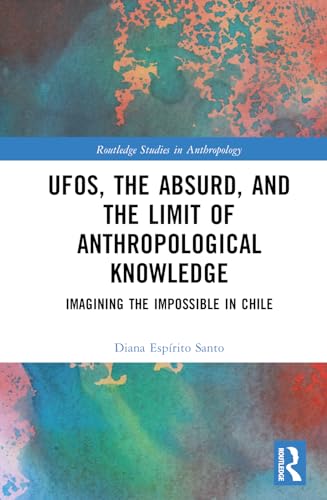
UFOs, the Absurd, and the Limit of Anthropological Knowledge
Imagining the Impossible in Chile
Find on Amazon →As an Amazon Associate, OverClassified may earn from qualifying purchases made through this link, at no extra cost to you.
Why This Is Essential Reading
UFOs, the Absurd, and the Limit of Anthropological Knowledge earns its place on this list as the only rigorously academic ethnography in this site's essential-reading library treating Chilean ufology as a serious subject of anthropological inquiry rather than either popular narrative or institutional report. Diana Espírito Santo's three years of embedded fieldwork with Chilean ufologists and contactees, funded by Chile's national research agency and grounded in a substantial prior body of published anthropological work, gives this site's own Collahuasi Mine and Chilean Navy Helicopter Video case files a genuinely distinct scholarly perspective neither CEFAA's own institutional reporting nor popular-press ufology history can supply. Its status as a newly published specialist academic title means this site found no populated general-audience review record to draw on, a gap disclosed honestly rather than papered over. Read as a serious scholarly complement to this site's own institutional and journalistic Chilean sources, this book is essential precisely because it takes seriously what those other sources tend to treat as background: the genuinely contested, mutually incompatible ways Chilean communities themselves make sense of the unexplained.
Related Cases & Theories
Essential Viewing
Sources Cited
- Espírito Santo, Diana. UFOs, the Absurd, and the Limit of Anthropological Knowledge: Imagining the Impossible in Chile. Routledge, 2024 (ISBN 978-1-032-49466-1, cited here).
- "UFOs, the Absurd, and the Limit of Anthropological Knowledge." AbeBooks (ISBN 9781032494661, marketplace listing photograph used for this article's cover image). abebooks.com
- Espírito Santo, Diana, and Alejandra Vergara. "The Possible and the Impossible: Reflections on Evidence in Chilean Ufology." (Closely related published fieldwork research, funded by ANID Anillos grant SOC 180033, informing this book's central concerns.) redalyc.org
- "UFO Investigation Uncovers Volcano Warning Artefact In Chile | Alien Contact." DMAX UK, YouTube (illustrating the kind of Chilean contactee-culture material this book's fieldwork engages with; video verified via oEmbed before inclusion). youtube.com
- This site's own resources library: Full Reading List, where this exact edition is cited across 2 separate case-file pages.
- This site's own key-figures entry: Diana Espírito Santo, for her full biography and site-wide case connections.
- This site's own case file: Collahuasi Mine UFO (2013), which cites this book for institutional and cultural context.
- This site's own case file: Chilean Navy Helicopter Video (2014), which cites this book for domestic cultural reception.
- This site's own essential-reading entry: UFOs in Chile (Patricio Abusleme), the journalistic national survey this book complements with an academic anthropological perspective.
- This site's own key-figures entry: Brig. Gen. Ricardo Bermúdez Sanhueza, CEFAA's founding director, for institutional context this book's ethnography engages with directly.
- Pontificia Universidad Católica de Chile faculty profile: Diana Espírito Santo, Associate Professor of Social Anthropology (academic affiliation verification). uc-cl.academia.edu
- Espírito Santo, Diana. Spirited Histories: Technologies, Media and Trauma in Paranormal Chile, 2022 (the author's separate, related monograph, used lightly here for biographical and career context only). routledge.com
Have corrections, additional research, or peer-reviewed sources? Help improve this entry.
Suggest an Edit