
A Colorful History of Popular Delusions
Core Thesis
A Colorful History of Popular Delusions is medical sociologist Robert E. Bartholomew and researcher Peter Hassall's 2015 attempt to update a genre effectively founded by Charles Mackay's 1841 classic Extraordinary Popular Delusions and the Madness of Crowds: a wide-ranging, 320-page survey of fads, crazes, moral panics, and mass hysteria episodes spanning the medieval period through the early 21st century, published by mainstream nonfiction house Prometheus Books rather than a narrowly specialist academic press aimed only at other sociologists. Rather than arguing for any single explanatory theory of collective irrationality, the book builds a working typology of mass behavior -- moral panics, mass psychogenic illness, urban legends, riots, and stampedes -- and demonstrates, case after case, how ordinary, otherwise rational people can be swept into extraordinary group reactions to fear or excitement. This site's own research draws on it for two of the phenomenon's founding phantom-airship episodes it situates within that broader sociological frame: The New Zealand Airship Wave of 1909, and The Great Airship Wave of 1896-1897, both of which the book treats as case studies in the same collective-delusion framework Bartholomew's own earlier, more narrowly focused academic papers on each wave first developed.
About the Author
Robert E. Bartholomew is an American-born medical sociologist and Honorary Senior Lecturer in the Department of Psychological Medicine at the University of Auckland, specializing in mass psychogenic illness, collective delusions, and moral panics. This site's own key-figures library already documents his 1998 book UFOs & Alien Contact: Two Centuries of Mystery, co-authored with George S. Howard and cited on this site's own Knowles Family Mundrabilla Encounter case file, as well as his earlier, more narrowly focused 1990 Skeptical Inquirer paper on the 1896-97 American airship wave and his 1998 New Zealand Skeptic paper specifically on the 1909 New Zealand wave -- both of which fed directly into this later, broader survey's own treatment of the same two cases.
Co-author Peter Hassall brings a genuinely different, complementary background to the collaboration: a New Zealand-based UFO researcher and author of The NZ Files: UFOs in New Zealand (1998), Hassall has also worked professionally in the film industry as a stunt coordinator, stunt double, and fight choreographer, including work on major productions filmed in New Zealand, and has conducted stage-combat workshops in both Wellington and Auckland alongside his research and writing career. This site's own research treats that dual background as a genuinely useful, well-balanced complement to Bartholomew's own academic sociology credential: a co-author with direct, on-the-ground New Zealand ufological research experience, rather than simply a second professional sociologist duplicating Bartholomew's own disciplinary lens on the material.
The book's own explicit intellectual lineage traces to Charles Mackay's 1841 Extraordinary Popular Delusions and the Madness of Crowds, widely regarded as the founding text of the popular-delusions genre; per a 2021 review republished by the NZ Skeptics newsletter, this book functions as a genuine update to that nearly two-century-old survey, incorporating contemporary cases -- social-media-driven hysteria, 21st-century moral panics -- Mackay's own era could not have anticipated, while retaining the same basic comparative-case-study structure.
Both authors bring direct, hands-on skeptical-organization experience to the collaboration rather than purely academic distance from their subject. Bartholomew's decades-long association with the NZ Skeptics organization -- the same body whose own newsletter first carried his 1998 paper on the New Zealand airship wave, and which would later commission a dedicated review of this very book six years afterward in 2021 -- gave him sustained, ongoing exposure to contemporary, unfolding cases of collective delusion as they were being actively investigated and debunked in real time, rather than only studied retrospectively through archival research. This site's own research treats that ongoing institutional involvement, alongside his own frequent role as a media commentator on developing panics, as a meaningful part of what distinguishes this book's treatment of its subject from a purely historical survey.
Historical Context & Origins
The book's 2015 publication came seventeen years after Bartholomew's co-authored 1998 book UFOs & Alien Contact, and twenty-five years after his original 1990 Skeptical Inquirer paper on the 1896-97 airship wave -- a considerable span of continued research this book's own broader synthesis draws on directly, per this site's own case-file citations of it, which credit it with placing both airship waves "within the broader sociological framework of mass delusions and social panics" his own earlier, narrower papers first developed for each wave individually.
This site's own Great Airship Wave of 1896-1897 case file (Case File #228) documents the earlier and larger of the two American waves this book addresses, spanning California's opening November 1896 phase through the much larger February-April 1897 Midwestern wave; the book's own citation on that case file specifically credits Bartholomew's original 1990 Skeptical Inquirer analysis of this specific wave as the direct academic precursor this broader 2015 book incorporates and updates.
The book arrived amid a genuinely active period for social-panic scholarship generally, with Bartholomew himself an frequently quoted media commentator on contemporary panics throughout the mid-2010s -- most visibly the October 2016 "creepy clown" scare that swept the United States, United Kingdom, and New Zealand simultaneously, which Bartholomew described to international media as a textbook social panic reflecting "a greater moral panic about the fear of strangers and terrorists in an increasingly urban, impersonal, and unpredictable world." This site's own research treats that near-simultaneous real-world case as a genuine, independently verifiable demonstration of the book's own analytical framework being applied to a live, unfolding panic rather than only to historical case studies.
Bartholomew's own long institutional relationship with New Zealand's skeptical community gave him direct access to genuinely local material this book draws on alongside its international cases. Per the 2021 NZ Skeptics review, the book documents a 1973 case of anxiety hysteria in Auckland triggered by a smell from leaking drums at the Parnell wharf, in which numerous people reported becoming physically ill before the substance in the drums was confirmed non-toxic -- a case with direct structural parallels, this site's research notes, to the same collective-perception dynamics documented in this catalogue's own New Zealand Airship Wave case file six decades earlier, in which a population primed by international press coverage of aerial mystery craft interpreted ambiguous nighttime stimuli through that specific cultural frame.
Core Arguments & Key Concepts
The book's central organizing move, per a detailed 2021 review republished by the NZ Skeptics newsletter (originally written for the organization's own newsletter by reviewer Jonathon Harper), is building a working typology of collective irrational behavior -- moral panics, mass psychogenic illness, urban legends, fads, riots, and stampedes -- rather than treating each case as a standalone curiosity, letting readers recognize the same underlying sociological mechanisms recurring across historically and geographically unrelated episodes.
A second theme, illustrated by several specific cases that review highlights, is that expert training does not confer immunity to collective delusion: the book documents a 2004 Canadian case in which medical staff themselves fell victim to anxiety hysteria, a finding the reviewer specifically noted as counterintuitive given medical professionals' own clinical training. This site's own research treats that specific case as a genuinely important corrective to any assumption that mass hysteria only afflicts the uneducated or credulous.
A third theme concerns the specific conditions under which authority figures make collective delusions worse rather than better. Per that same review, the book's treatment of exorcism and religious intervention in cases of hysteria found that such interventions can actively worsen episodes by reinforcing believers' fear of malevolent supernatural causation -- a specific, well-disclosed mechanism by which well-intentioned authority figures can amplify rather than defuse a developing panic, precisely because reinforcing a population's existing framework of belief -- religious, ufological, or otherwise -- tends to validate rather than challenge the underlying misperception actually driving the episode forward.
A fourth theme, again per the same review, is the book's attention to how collective symptoms can serve a genuine, if unconscious, protective function: in some documented institutional cases, a hysterical symptom or claimed "spirit" possession allowed workers legitimate absence from otherwise inescapable harsh conditions, with the review specifically noting that in some such cases conditions subsequently improved as a direct result -- an outcome the review suggests the same workers might not have achieved through ordinary protest alone.
A fifth theme addresses the book's treatment of self-mutilation and false confession within moral panics: the review notes the book documents cases in which self-harm functioned as an extreme attention-seeking mechanism that could also generate false accusations against others, and separately that false confessions are a well-documented recurring feature of public moral panics generally -- both patterns the book situates within its broader typology rather than treating as isolated psychological curiosities.
A sixth theme is the book's deliberate range across severity, from genuinely harmless commercial fads through to lethal collective violence, illustrating that the underlying sociological mechanism of mass conformity and contagious belief operates across a continuum rather than being confined to its most dramatic or dangerous expressions. The book's own case selection spans the 1970s American "pet rock" craze -- a harmless novelty-product fad, essentially a painted stone sold with a mock instruction pamphlet, often cited as a case study in how quickly and pervasively a manufactured consumer trend can spread through a population primed to want to belong to it -- through to the far graver 1902 stampede at the Shiloh Negro Baptist Church, in which a false cry of "fire" in a crowded building triggered a genuinely lethal crush, and the 1943 Zoot Suit Riots in Los Angeles, in which rumor and racialized moral panic escalated into sustained street violence against Mexican-American youth. This site's own research treats that deliberate range as the book's clearest structural argument: the same underlying mechanisms of rumor, conformity, and fear-driven misperception that produce a harmless fad can, given the right conditions of pre-existing social tension, escalate into genuinely lethal collective action.
A seventh theme, per the same 2021 review, concerns cases in which psychiatric conditions were misidentified by contemporaries as paranormal phenomena -- the review specifically cites the "Peron family" case as an example the book documents of this pattern. This site's own research treats that specific theme as directly relevant to its own broader editorial mission: distinguishing genuine anomalous reports from misattributed mundane explanations is precisely the kind of disciplined skepticism this book models, and precisely the standard this site's own case files aim to apply when weighing the credibility of any individual sighting report.
An eighth theme is media mechanics: the book's own treatment of the 19th-century "Great Moon Hoax" -- a series of 1835 New York Sun newspaper articles fabricating discoveries of bat-winged lunar humanoids, unicorns, and other creatures, falsely attributed to a real astronomer and citing a defunct scientific journal for apparent credibility -- documents a case in which the hoax's own circulation-boosting commercial success for the newspaper that ran it created a direct financial incentive independent of the story's truth. This site's own research treats that specific mechanism -- publishers benefiting commercially from sensational, unverified claims entirely independent of their underlying accuracy, a dynamic that long predates any modern social-media platform -- as directly relevant to how this site's own editorial policy insists on disclosing genuine research gaps (an unavailable Amazon rating, an unverifiable claim, an ambiguous single data point) rather than allowing commercial or narrative incentives to override honest uncertainty.
A ninth and final theme concerns skepticism's own demonstrated capacity to intervene productively in an active panic rather than merely documenting one after the fact. The 2021 review specifically notes the book's conclusion that skeptics have, in some documented cases, successfully helped defuse ongoing panics by effectively debunking the false beliefs driving them -- a genuinely constructive, forward-looking closing note this site's research treats as consistent with the book's overall approach: not merely cataloging human credulity for its own sake, but demonstrating that disciplined, evidence-based counter-argument has a real, historically documented track record of working.
Key Cases & Evidence Discussed
The Great Airship Wave of 1896-1897 (Case File #228) began the evening of November 17, 1896, when residents of Sacramento and the wider San Francisco Bay Area watched a searchlight-equipped object drift across the night sky; four months later, a vastly larger wave of cigar-shaped "airship" reports swept Nebraska, Kansas, Iowa, Illinois, Missouri, and Texas, drawing an estimated tens of thousands of witnesses across well over a thousand individual newspaper accounts. This site's own case-file citation of this book credits it with placing the wave "within the broader sociological framework of mass delusions and social panics that Bartholomew's own 1990 Skeptical Inquirer analysis of this specific wave first developed" -- the direct academic lineage from that narrower original paper into this book's own wider comparative survey.
The New Zealand Airship Wave (Case File #273) began July 11, 1909, with a light reported over Kaitangata's Wangaloa Hills, and peaked with the July 23 daylight sighting at Kelso School, where a small group of schoolchildren, individually interrogated by an Otago Daily Times reporter, produced six independently drawn, closely matching sketches. This site's own case-file citation of this book credits it with placing the wave "within the broader sociological framework of mass delusions and social panics that Bartholomew's own 1998 New Zealand Skeptic analysis of this specific wave first developed" -- again, a direct line from an earlier, narrower Bartholomew paper into this book's own comparative synthesis.
Both wave case files independently document the same specific analytical concept this book's own broader synthesis relies on throughout, one Bartholomew has applied consistently across his career: the "autokinetic effect," psychologist Muzafer Sherif's 1936 finding that a genuinely stationary point of light, viewed against a dark and otherwise featureless night sky, will reliably appear to move to an observer with no fixed reference point. This site's own New Zealand Airship Wave case file applies that specific mechanism directly to explain the majority of that wave's ambiguous nighttime reports, while treating the Kelso daylight sighting as a genuine residue the autokinetic effect alone cannot explain -- exactly the kind of case-by-case, not-everything-explained-the-same-way discipline this book's own broader typology models across dozens of otherwise unrelated episodes.
Critical Reception & Controversies
This book carries a real, substantial Goodreads reader record: 3.45 out of 5 stars averaged across 104 ratings and 15 written reviews, checked August 2026 -- a considerably larger sample than most titles this site's research has checked this session, reflecting the book's genuinely wider commercial reach through mainstream nonfiction publisher Prometheus Books rather than a small specialist press.
A detailed 2021 review published in the NZ Skeptics newsletter and reviewed by Jonathon Harper -- itself a notable piece of reception given Bartholomew's own long association with that organization -- assessed the book, six years after its original publication, as "a classic reference book that will endure," specifically praising it as a worthy companion to Charles Mackay's 1841 founding text of the genre and to Lynley Hood's A City Possessed, a separate study of the Christchurch Civic Creche moral panic surrounding the Peter Ellis case -- a comparison this site's research treats as a genuine, locally specific endorsement of the book's continued relevance to New Zealand skeptical scholarship specifically, not just its general historical interest.
This site's research also attempted to verify an Amazon rating for this title, but Amazon's bot-detection system repeatedly blocked automated requests to the listing during this session, the same persistent pattern encountered across every title checked this session. Per this site's own Amazon Rating Display Protocol, this gap is disclosed honestly here rather than fabricated or silently omitted -- readers are directed instead to the real, independently verified Goodreads figure listed above.
The book's own broad, near-encyclopedic scope -- ranging from the medieval "meowing nuns" of France and Italian tarantism dancing mania through to the 2012 social-media-amplified twitching-hysteria cluster among teenage girls in Leroy, New York, and the 1902 Shiloh Baptist Church stampede -- inevitably means individual cases receive comparatively brief treatment, a genuine tradeoff this site's research treats as the fair cost of the book's own breadth rather than a hidden flaw: readers wanting exhaustive depth on any single case are better served by a dedicated monograph, while readers wanting to recognize the recurring sociological pattern across dozens of superficially unrelated episodes are well served by exactly this book's format.
Bartholomew's own academic specialization in mass psychogenic illness -- a genuinely narrow, clinically grounded sociological subfield -- gives the book's central chapters a level of disciplinary rigor a purely journalistic popular-history treatment of the same broad subject matter would likely lack, while Hassall's complementary UFO-research background supplies direct familiarity with exactly the kind of ambiguous, hard-to-verify witness testimony this site's own case files also have to weigh. This site's research treats that specific author pairing -- one credentialed clinical sociologist, one experienced field researcher of ambiguous sighting reports -- as a genuinely well-matched division of expertise for a book that has to move credibly, often within the very same chapter, between clinical psychiatric case histories and folkloric sighting reports gathered through direct fieldwork rather than archival research alone.
Influence & Legacy
Within this site's own key-figures and essential-reading library, this book extends Bartholomew's documented body of work beyond the narrower 1998 UFOs & Alien Contact collaboration with George S. Howard, giving this site's own research a second, more recent Bartholomew title and directly connecting his two independent academic papers on the American and New Zealand airship waves -- previously cited on this site only individually, within their own respective case files, separated by eight years of Bartholomew's own continued research between the 1990 and 1998 originals -- into a single later synthesis that explicitly places both within the same comparative sociological frame.
The book's continued relevance seventeen years after Bartholomew's original UFO-focused work, and six years after this book's own 2015 publication, is reflected in the NZ Skeptics organization's own 2021 decision to commission and publish a fresh review of it -- itself a form of ongoing institutional endorsement from the exact skeptical organization whose own earlier newsletter first carried Bartholomew's 1998 paper on the New Zealand wave this book later incorporated.
Bartholomew's own subsequent, highly visible role as a global media commentator on real-time social panics -- most prominently the 2016 international "creepy clown" scare and, in the early 2020s, the "Havana Syndrome" controversy affecting U.S. diplomatic personnel -- demonstrates the book's own explanatory framework being actively applied by its lead author to unfolding contemporary events well beyond the book's original historical case studies, a form of continued real-world application this site's research treats as a meaningful, ongoing indicator of the underlying scholarship's durability rather than a one-time academic exercise.
The book's own multi-format availability -- hardcover, standard paperback, and a Kindle ebook edition carrying its own distinct ASIN, plus a subsequent second Kindle release issued years after the original 2015 publication -- alongside its presence in public library systems including Auckland's, per the NZ Skeptics reviewer's own note that it was "available in some local libraries," reflects a genuinely wider institutional and public reach than a narrowly academic sociology monograph would typically achieve, consistent with Prometheus Books' own positioning as a mainstream publisher of skeptical and science-adjacent nonfiction for a general audience rather than a specialist academic press.
The Book
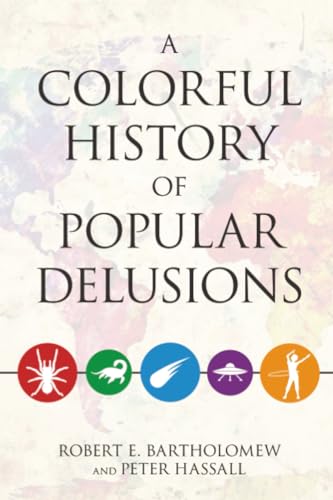
A Colorful History of Popular Delusions
Find on Amazon →As an Amazon Associate, OverClassified may earn from qualifying purchases made through this link, at no extra cost to you.
Why This Is Essential Reading
A Colorful History of Popular Delusions earns its place on this list as the broadest single synthesis this site's own library documents of the sociological framework underlying two of its most historically significant phantom-airship case files. Bartholomew and Hassall's comparative typology -- built from decades of Bartholomew's own prior academic research, including the original papers this site's own Great Airship Wave of 1896-1897 and New Zealand Airship Wave case files each cite individually -- gives readers a single volume in which to see both waves situated among dozens of other historically and geographically unrelated mass-delusion episodes, from medieval dancing manias and religious convent hysteria through to 21st-century social-media-amplified adolescent hysteria clusters. Its substantial, real Goodreads reader base and its endorsement, six years on, as "a classic reference book that will endure" by the same New Zealand skeptical community Bartholomew has spent decades contributing to, together support this site's own judgment that the book has earned durable reference status within the sociology-of-collective-delusion genre it explicitly updates -- and its closing insistence that skeptical debunking has a genuine, demonstrated track record of defusing real panics gives the book's overall project a constructive, forward-looking purpose well beyond simple cataloging of past human folly.
Related Cases & Theories
Essential Viewing
Sources Cited
- Bartholomew, Robert E. & Hassall, Peter. A Colorful History of Popular Delusions. Prometheus Books, 2015 (ISBN 978-1-63388-122-8, cited here).
- "A Colorful History of Popular Delusions." Goodreads (3.45 average rating, 104 ratings, 15 reviews, checked August 2026). goodreads.com
- "A Colorful History of Popular Delusions." AbeBooks (ISBN 9781633881228, marketplace listing photograph used for this article's cover image). abebooks.com
- Harper, Jonathon. "A Colourful History of Popular Delusions." NZ Skeptics newsletter (June 2021 review, republished via Aotearoa Workers Solidarity Movement). anarchistfederation.net
- "Why Mass Hysteria is Thriving in the 21st Century - Robert Bartholomew." Center for Inquiry, YouTube (author lecture, video verified via oEmbed). youtube.com
- This site's own resources library: Full Reading List, where this exact 2015 edition is cited across 2 separate case-file pages.
- This site's own key-figures entry: Robert E. Bartholomew, for his full biography and site-wide case connections.
- This site's own case file: The Great Airship Wave of 1896-1897, cited for this book's framing of Bartholomew's original 1990 paper.
- This site's own case file: New Zealand Airship Wave, cited for this book's framing of Bartholomew's original 1998 paper.
- This site's own essential-reading entry: UFOs & Alien Contact: Two Centuries of Mystery, Bartholomew's earlier 1998 book with George S. Howard.
- This site's own locations entry: Sacramento, California, opening site of the 1896-97 wave.
- "Creepy clown 'madness' is classic social panic, say experts." The National (media coverage of Bartholomew's 2016 real-time application of the book's framework). thenational.ae
- Bartholomew, Robert E. "The Airship Hysteria of 1896-97." Skeptical Inquirer, 1990 (the original academic paper this book's Great Airship Wave chapter draws on and updates).
- Bartholomew, Robert E. "The Great Zeppelin Scare of 1909." New Zealand Skeptic (NZ Skeptics), 1998 (the original academic paper this book's New Zealand Airship Wave chapter draws on and updates). articles.skeptics.nz
Have corrections, additional research, or peer-reviewed sources? Help improve this entry.
Suggest an Edit