
The Egryn Lights
Beginning in December 1904, hundreds of witnesses across the Welsh county of Merionethshire (now Gwynedd) reported unexplained lights — stars, balls of fire, arches, and darting orbs of color — clustering around the hamlet of Egryn and coinciding precisely with a religious revival led by local preacher Mary Jones, who became known as "the Lady of the Lights." Decades later, earth-mysteries researcher Paul Devereux plotted every documented sighting location on a map and found the cluster ran almost directly along the Mochras Fault, a major geological fracture running beneath the region — a correlation even skeptical reviewers have called striking, even as they question whether it can explain the phenomenon on its own.
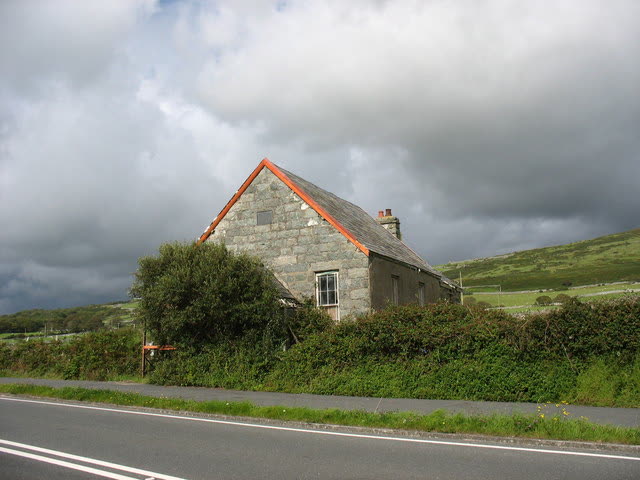
Pictured: Capel Egryn, the small Calvinistic Methodist chapel (built 1836) in Dyffryn Ardudwy, Gwynedd, where Mary Jones preached during the 1904-05 revival and around which many of the earliest light reports clustered. Photographed in 2007 by Eric Jones; not a photograph of the lights themselves or of any witness. Licensed CC BY-SA 2.0 via Wikimedia Commons / Geograph.
Theoretical Alignment
No contemporary investigator and no later researcher surveyed for this file has proposed that the Egryn lights represented a piloted, intelligently controlled craft of any kind; this case sits almost entirely outside the Extraterrestrial and Interdimensional hypotheses as this site normally frames them. The real debate, then and now, runs between two naturalistic poles: a geophysical explanation centered on this site's own Earth Lights Hypothesis theory page, and a psycho-social explanation centered on the extraordinary emotional conditions of a region-wide religious revival unfolding at the exact same time and in the exact same places. This file assigns Psycho-Social the largest single share of alignment, not because the geological correlation Devereux identified is weak — reviewers who are otherwise skeptical of his broader "earth lights" program still call it a genuinely striking finding — but because the revival's mass emotional intensity, national press attention, and documented copy-cat reporting pattern offer the more complete account of the wave's actual behavior, including its rapid geographic spread far beyond any single fault line.
Background
Egryn is a small farming hamlet on the Cardigan Bay coast of Gwynedd, historically part of Merionethshire, set back from the coast road between the towns of Barmouth and Harlech, roughly two miles from the village of Dyffryn Ardudwy. In late 1904 it was, by any ordinary measure, an unremarkable rural community — until it became, for a few months spanning the winter of 1904 into the spring of 1905, one of the most closely watched places in Britain, at the intersection of two extraordinary phenomena unfolding simultaneously: a sweeping national religious revival, and a wave of reported lights in the sky that Fleet Street correspondents traveled hundreds of miles to see for themselves.
The broader context was the 1904–05 Welsh Revival, a mass evangelical awakening that began in South Wales under the preacher Evan Roberts and, within months, had drawn an estimated 100,000 new converts across the country, filling chapels to capacity and becoming a subject of national and even international press coverage in its own right. The revival reached North Wales more slowly, and it was a farmer's wife from Egryn, Mary Jones, who became its leading regional figure — and, uniquely among the revival's many preachers, the one whose ministry became inseparably associated with a genuinely anomalous, independently witnessed physical phenomenon.
Roberts's own South Wales campaign was itself already a phenomenon of extraordinary scale by the time it reached its peak in early 1905: contemporary newspaper estimates described chapels turning away hundreds of would-be attendees at a single sitting, all-night prayer meetings continuing until dawn, and a marked, independently noted drop in reported crime and public drunkenness across several Welsh mining valleys during the revival's height. This file treats that broader context as directly relevant background rather than incidental color: it establishes that the North Wales public and press were already primed, well before the first Egryn light report, to expect and to actively look for extraordinary, providentially charged events unfolding around the revival's leading preachers, a documented psychological backdrop this file returns to under Material Analysis below.
What makes this case structurally distinctive within this site's broader catalog is the sheer density of independent, named, contemporaneously published testimony behind it. Unlike many single-night sightings elsewhere in this archive, the Egryn wave generated a running, dated stream of newspaper dispatches over several months, filed by reporters who arrived as skeptics and, in a number of well-documented instances, left describing genuinely puzzling personal observations. This file treats that volume and immediacy of contemporary documentation as one of this case's most valuable features, even as it also treats the conditions under which that documentation was produced — a national media frenzy layered onto a mass religious awakening — as a serious complicating factor in evaluating what it actually shows.
Complete Timeline
| Date | Event |
|---|---|
| Late 1904 (early) | Residents around Egryn, Bryncrug, and Tywyn report an "enormous luminous star of intensely brilliant white light" emitting sparks from its circumference |
| December 5, 1904 | Mary Jones begins revival meetings at Capel Egryn; witnesses describe a luminous arch spanning from a hilltop to the sea, one end bathing the chapel in soft light |
| December 22, 1904 | Three observers report "a large light" containing what appears to be a dark shape within it |
| January 2, 1905 | A witness reports three lights moving in formation "like Prince of Wales feathers" over a farmhouse |
| January 13, 1905 | The Cambrian News runs the first newspaper report of the sightings, initially in a straightforward tone |
| January 15, 1905 | The Barmouth Advertiser reports nearly 40 converts enrolled at Mary Jones's revival meetings |
| January 16, 1905 | Mary Jones writes to the Society for Psychical Research describing having "seen a mysterious star" several times over the preceding six weeks |
| January 31, 1905 | Journalist Beriah G. Evans documents five separate lights in a single account, including "an enormous luminous star flashing forth an enormously brilliant white light" |
| February 9, 1905 | Evans's dramatic dispatch appears in major national papers, triggering a wave of journalists traveling to Egryn |
| February 10, 1905 | A reported event at Bryncrug Chapel, roughly 25 miles from Egryn, describes "a gigantic figure rising over a hedgerow" and "a ball of fire" |
| February 10–11, 1905 | Multiple sightings, including a "ball of fire" hovering above a chapel roof for roughly ninety seconds, and a light reportedly bathing Mary Jones's room at Bontddu |
| February 13–14, 1905 | Investigators bring telescopes and instruments to observation sites; the notable "bar of light" sighting (Feb. 14) describes a brilliant blue bar roughly four feet wide, visible to some nearby observers but not others |
| February 24, 1905 | The Cambrian News, which had covered events straightforwardly, adopts a markedly more skeptical editorial line |
| March 13, 1905 | A light reportedly "played and danced" around Mary Jones's horse-drawn carriage near Llanbedr |
| April 1905 | Ground-level lights are reported at Llangollen, well to the east of the original area |
| March–May 1905 | Sightings are reported more widely across Wales, including Llanfair, Froncysyllte, Wrexham, and the Rhondda valley |
| July 26, 1905 | Witnesses at Ynysybwl, near Pontypridd — roughly 127 miles from Egryn — report a white, then yellow, then "brilliantly red triangle" of light |
| 1906 | Scattered reports continue before the phenomenon, alongside the broader Welsh Revival itself, tapers off; a minor earthquake is recorded near Swansea, later cited by Devereux as circumstantial support for a tectonic connection |
The Sightings at Egryn
The core wave of reports, concentrated between December 1904 and March 1905, describes lights of striking variety in color, shape, and behavior. Witnesses reported white, blue, red, and yellow lights, and iridescent, "rainbow" variants; one account specifically describes three balls of deep red light together. Reported shapes included stars, balls of fire, bars, arches, ovals ("half open, disclosing... a kernel of white light," in one Daily Mirror correspondent's words), and objects some witnesses likened to the acetylene lamps then coming into use on early motor cars. Estimated sizes ranged from roughly six inches across up to bars described as four feet wide. Movement was similarly varied — hovering, darting, sharp changes of direction, and, in a recurring and specifically noted pattern, lights that appeared to follow or circle Mary Jones's carriage as she traveled between preaching engagements after dark.
Several accounts describe effects extending to the ground itself: a "soft shimmering radiance" was said to flood a road so thoroughly that "every stick and stone within twenty yards" became visible; "columns of light" were reported rising from the ground near ancient megalithic sites in the area, a detail later earth-mysteries writers would find suggestive given the region's genuinely deep prehistoric ritual landscape, including the Neolithic burial chamber at nearby Dyffryn Ardudwy; and a blood-red light was reported no more than a foot above the ground in a village street. Duration varied enormously across individual reports, from momentary flashes to sustained appearances that allowed some witnesses to study the phenomenon through borrowed telescopes.
The association between the lights and Mary Jones specifically hardened quickly into the public narrative that gave this case its lasting name and its central figure. Lights were reported hovering over or bathing the chapel roof while she preached inside; dancing around her carriage as she rode to and from meetings; and, on at least one occasion, filling her bedroom with light while she was staying at Bontddu. Because the phenomenon so often coincided with her specific movements, many contemporaries — including Mary Jones herself, in her own correspondence with the Society for Psychical Research — came to regard the lights as a divine sign endorsing her ministry. This file treats that interpretation as a genuine, historically important belief held by participants rather than as this file's own conclusion; the specific instances in which the lights were reported while Mary Jones was independently confirmed to be many miles away (detailed under Evidence Assessment below) directly undercut the strongest version of the personal-endorsement reading.
The Media Storm
Local coverage began cautiously: the Cambrian News ran the first dedicated report on January 13, 1905, in a straightforward, largely uncritical register, and the Barmouth Advertiser tracked the growing revival congregation in parallel. The story's transformation into a national sensation is traceable to a specific figure and a specific date: journalist Beriah G. Evans, writing initially for the Daily News and the Manchester Guardian, filed a vivid dispatch on January 31, 1905, describing five separate lights observed in a single outing, including "an enormous luminous star flashing forth an enormously brilliant white light, and emitting from its whole circumference dazzling sparklets like flashing rays from a diamond." When that dispatch reached national papers on February 9, 1905, it triggered an immediate wave of correspondents traveling to Egryn from London and beyond, including the Daily Mail's Bernard Redwood and an unnamed Daily Mirror correspondent, with The Times, the British Weekly, and the more sympathetically inclined Occult Review also carrying coverage.
The pattern documented across these sources is genuinely notable: several skeptical London journalists arrived openly expecting to expose a rural superstition and instead filed reports describing personally puzzling observations, which further fueled national interest. Others pushed back hard, and by February 24, 1905, even the originally straightforward Cambrian News had adopted a markedly more critical editorial stance — a shift this file reads as reflecting genuine editorial reconsideration rather than any single debunking event, since no specific triggering incident for the tonal change has been documented in available sources. Later in July 1905, Beriah G. Evans returned to the subject in a more considered, sympathetic profile of Mary Jones published in the Aberdare Leader, describing her as "well steeped in Scriptural knowledge" and specifically noting she made "no effort whatever to trade on sensationalism" — a first-hand journalistic assessment this file weighs as a meaningful, if not conclusive, data point regarding her personal sincerity, addressed further under Observer Credibility below.
Key Witnesses
Mary Jones
A Merionethshire farmer's wife who began leading Welsh Revival meetings at Capel Egryn in December 1904 following years of personal grief, and around whose ministry and travels the great majority of the reported lights clustered. Her own January 1905 letter to the Society for Psychical Research is the earliest first-person documentary source for the phenomenon. She is addressed at length in the dedicated witness profile below.
Beriah G. Evans (Unregistered)
The single most consequential journalist in this case's history: his vivid January 31, 1905 dispatch, describing five separate lights in one outing, and its national republication on February 9, 1905, directly triggered the wave of correspondents that turned a regional curiosity into a national sensation. His later, more considered July 1905 profile of Mary Jones remains one of the most-quoted contemporary character assessments of her.
Bernard Redwood (Unregistered)
Conducted an on-the-ground, semi-scientific investigation for the Daily Mail during the February 1905 media wave. His report of seeing only a distant flash on an occasion when Mary Jones was independently confirmed to be fifteen miles away is this case's single clearest documented instance of the lights being observed independent of her physical presence — a detail directly relevant to evaluating the strongest "personal sign" reading of the phenomenon.
Rev. A. T. Fryer (Unregistered)
Authored "The Psychological Aspects of the Welsh Revival, 1904–1905," published in the Proceedings of the Society for Psychical Research, Vol. 19 (1905–07) — the only known formal, contemporaneous scholarly investigation of the wider Revival phenomena within which the Egryn lights occurred, situating the case within the SPR's broader turn-of-the-century interest in psychical and psychological research.
Paul Devereux
British researcher who, decades after the events, plotted every documented Egryn sighting location on a map and identified a close correlation with the region's Mochras Fault system, publishing the analysis in Earth Lights (1982) and, in fuller form, Earth Lights Revelation (1989). His full background and methodology are addressed in detail under Material Analysis below.
The Five Observables Assessment
The standard Five Observables framework, developed around instrumented modern military encounters, applies only loosely to a pre-instrumental 1904–05 light wave with no defined craft; this file nonetheless runs the comparison for consistency with its treatment of every other case in this archive.
Assessment: No source reviewed for this file describes the lights performing sustained directional flight, formation maneuvering of a structured craft, or any of the classic performance-envelope claims common elsewhere in this archive; the "three lights in formation" report is the closest analogue, and even that is more consistent with independent luminous phenomena moving similarly than with a single controlled object. The one Observable with genuine documentary support is low observability, in the specific sense that instruments brought to observation sites reportedly failed to register the lights at all — addressed further under Sensor & Instrumentation Detection Profile below.
Evidence Assessment
This case's evidentiary profile is unusual within this site's broader catalog for its combination of genuine documentary depth — dozens of dated, named, independently published newspaper accounts across a period of months — and its complete absence of any physical trace, photograph, or instrumented reading corroborating a single one of those accounts.
Supporting Anomalous Origin
- Dozens of independent, named witnesses across a period of months, including skeptical professional journalists who arrived expecting to debunk the story
- Devereux's later geological plotting shows a genuinely close correlation between reported sighting locations and the trace of the Mochras Fault, a finding even skeptical reviewers of his broader thesis treat as noteworthy on its own terms
- Documented historical precedent for anomalous lights in the same general area predating this wave by more than two centuries (the 1693–94 "Harlech Meteor")
- Some reports describe lights observed independent of Mary Jones's presence, weakening a pure suggestion-around-one-figure explanation
Supporting Conventional Explanation
- The wave coincided precisely with an intense, mass religious revival characterized by heightened expectation and emotional excitement, examined directly by the Society for Psychical Research's own contemporary investigator
- Daily Mail correspondent Bernard Redwood reported seeing only a distant flash on an occasion when Mary Jones was confirmed to be fifteen miles away, directly undercutting the strongest "personal sign" version of the story
- Investigators who brought scientific instruments to observation sites reported they "did not respond in the slightest degree" to the lights on the occasions tested
- At least one specific sighting was attributed at the time to a defective, flickering arc-lamp — an ordinary electrical artifact rather than anything anomalous
- Reports spread rapidly, after national press coverage began, to locations up to 127 miles from Egryn (Ynysybwl, July 1905), a pattern more consistent with social contagion and copy-cat reporting than with a single localized physical phenomenon
- No photograph, film, or physical trace of any kind survives from the entire multi-month wave
Why "Disputed"
This file assigns the Egryn Lights a DISPUTED classification. It is not rated as Debunked, because a specific, non-trivial finding — Devereux's demonstrated correlation between sighting locations and the Mochras Fault trace — has never been directly refuted, only contextualized and questioned as a complete explanation; nor has any single source been identified that accounts for the full range of reported light behavior, colors, and durations across the entire wave. It is not rated higher than Disputed because the wave's own internal evidence — its precise coincidence with an intense regional religious revival, its documented instances of lights reported independent of Mary Jones's presence yet still treated as confirmatory, its instrumental non-response, and its geographic spread that tracks press coverage more closely than any single geological feature — collectively point toward a phenomenon substantially shaped by social and psychological conditions layered on top of whatever specific naturalistic light-generating mechanism, if any, was genuinely active in the area.
This file treats the tension between these two findings — a real, geologically interesting spatial correlation, and a social/psychological context that plainly amplified and spread the story well beyond whatever that correlation could account for — as this case's single most important analytical feature, and declines to resolve that tension in either direction given the evidence available more than a century after the fact. Readers looking for a single tidy verdict on the Egryn lights will not find one in this file, and this file considers that an honest reflection of the underlying evidence rather than a failure of analysis: a case this old, this well-documented in one respect (contemporary press testimony) and this poorly documented in another (physical and instrumental data), genuinely does resist confident resolution in either direction more than a century on.
Sensor & Instrumentation Detection Profile
This case predates radar, spectrographic field equipment, and essentially all modern detection instrumentation by decades; "instrumentation" here means the ordinary optical aids — telescopes, and in at least one account a theodolite-style sighting instrument — that investigators brought to observation sites during the February 1905 peak of press interest. Multiple secondary accounts describe these instruments as failing to register the reported lights "in the slightest degree" on the specific occasions they were used, even as onlookers standing nearby continued to report visual observations. This file treats this instrumental non-response as a genuinely significant data point cutting against a straightforward, purely physical explanation for at least the specific instances tested, while noting that a null instrumental reading during a handful of tested occasions cannot rule out a genuine, if inconsistent or narrow-band, physical phenomenon across the wave's full multi-month run.
Environmental & Geospatial Context
Egryn sits at the foot of the Rhinog hills on the Cardigan Bay coast, roughly two miles from Dyffryn Ardudwy and three miles from Barmouth, on the coastal strip between Barmouth and Harlech. The immediate geology is dominated by the Mochras Fault, a major north–south normal fault that, together with the related Bala and Tonfanau faults, bounds the eastern margin of the Cardigan Bay sedimentary basin, down-faulting it against the older Palaeozoic "Welsh Massif" rock of the interior. The fault has preserved an exceptionally thick sedimentary sequence offshore — roughly 2,500 meters of Lias Group deposits alone — later sampled directly by the Mochras Borehole, drilled onshore at nearby Llanbedr by the British Geological Survey and Aberystwyth University between 1967 and 1969, which became an internationally important reference section for Jurassic stratigraphy.
North Wales has recorded a number of seismic events since systematic record-keeping began in the 1600s, the most significant modern instance being the July 19, 1984 North Wales earthquake centered near the Llŷn Peninsula and Bala area, a lower-crustal event that academic seismologists have linked tentatively, but not definitively, to the Bala Fault system specifically, noting "numerous north–south and east–west lineaments" in the area that could equally be responsible. Two further offshore events in Cardigan Bay have been proposed as evidence the western extension of the Bala Fault system remains active, and the region's general northwest–southeast compressional stress field favors seismicity along northeast–southwest structures like Bala specifically, consistent with, though not proof of, ongoing low-level activity along the broader Cardigan Bay fault system that includes Mochras, even though no single confirmed instrumental reading directly ties any specific recorded tremor to this particular case's own December 1904 through March 1905 timeframe.
This file's own research did not locate any documented seismograph reading or felt-earthquake report specifically dated to the December 1904–March 1905 window itself, a gap Devereux's own retrospective analysis (discussed more fully below) does not entirely close; the specific tremor he cites as corroborating evidence dates to 1906, near Swansea — itself well over a hundred miles from Egryn, in South rather than North Wales, and connected to this case only by rough chronological proximity rather than by any documented shared fault system.
The wider Cardigan Bay sedimentary basin bounded by the Mochras, Bala, and Tonfanau fault system has a long and complex geological history: the Bala Fault itself originated as a strike-slip structure in the late Precambrian, more than 500 million years ago, and has undergone at least two later distinct phases of renewed movement, including a middle-to-late Jurassic phase involving as much as 24 degrees of localized rotation. This file notes that a fault system with this degree of demonstrated long-term reactivation is, at minimum, geologically consistent with continued low-level modern activity of the kind Devereux's and Persinger's models require, even though the specific 1904–05 window itself remains, as noted above, undocumented by any surviving instrumental record.
Observer Credibility & Occupational Profile
Mary Jones was, prior to late 1904, an ordinary farmer's wife with no public profile of any kind, which this file weighs as a point of some significance against a straightforward attention-seeking or fabrication-for-profit explanation of her own testimony: she did not seek out a public role and, by multiple contemporary accounts, appeared uncomfortable with the scale of press attention her ministry eventually attracted. Beriah G. Evans's own July 1905 assessment — that she was "well steeped in Scriptural knowledge" and made "no effort whatever to trade on sensationalism" — is a first-hand journalistic character judgment from someone with direct, extended personal contact, and this file weighs it as genuine, if inherently limited, evidence of her personal sincerity rather than as conclusive proof of anything about the lights themselves.
The professional journalists who investigated the case in person present a more mixed credibility picture specifically useful for evaluating the phenomenon rather than Mary Jones's own character. Several, including figures at papers with no evident sympathy toward revivalist or paranormal claims, filed reports describing personally puzzling observations after arriving as stated skeptics — a pattern this file treats as meaningfully strengthening the case that at least some genuine, unexplained luminous activity was occurring, independent of any judgment about the revival itself. Bernard Redwood's account of seeing only a distant flash while Mary Jones was independently confirmed fifteen miles away is, by contrast, this case's clearest single piece of evidence against the specific "personal sign" narrative that made the story famous, without necessarily undermining the possibility of a genuine, impersonal light phenomenon in the same general area.
Rev. A. T. Fryer's Society for Psychical Research investigation adds a further, distinct layer of credibility assessment: the SPR by 1905 had an established, if imperfect, reputation for applying comparatively rigorous contemporary standards to psychical and paranormal claims, and Fryer's specific focus on the "psychological aspects" of the Revival suggests an investigator oriented toward explaining the phenomenon through mass psychology rather than validating it as supernatural — a framing this file's own Psycho-Social alignment above is broadly consistent with, though this file's own research could not locate Fryer's full original paper to confirm his specific conclusions regarding the lights themselves as distinct from the Revival's other reported phenomena.
This file also weighs the credibility of the wave's more anonymous witnesses — the many unnamed farmers, chapel-goers, and travelers cited throughout the contemporary press accounts — separately from its named principal figures, since anonymous testimony inherently carries less individually assessable weight than testimony attached to a specific, checkable identity and occupation. Where this file's own research could establish a general pattern across the surviving press record, the majority of these anonymous witnesses appear to have been ordinary rural residents with no evident financial or reputational stake in the story's veracity, consistent with a genuine, if imperfectly documented, wave of shared local observation rather than a phenomenon sustained primarily by a small number of self-interested repeat witnesses.
Physical & Material Assays
No physical trace evidence of any kind survives from this case: no photograph, no film, no burn mark, no recovered material, and no scientific instrument reading positively confirming the phenomenon on any of the specific occasions tested. This absence is itself a significant structural feature of the case, distinguishing it sharply from cases elsewhere in this archive that retain photographic, filmed, or instrumented evidence from their original event, however contested. Every account of the Egryn lights that survives is testimonial — written contemporaneously by named witnesses and journalists, in some cases within days of the events described, but testimonial nonetheless.
This file specifically notes what the instrumental non-response documented under Sensor & Instrumentation above can and cannot establish: it demonstrates that whatever was observed did not register on the specific optical instruments brought to specific observation sites on specific occasions, which is meaningful negative evidence against certain classes of explanation (a bright conventional light source of the kind period telescopes could easily have confirmed or measured) without establishing what, if anything, actually produced the visual sensation reported by onlookers standing at the same location and moment.
The single documented instance of a specific, identified mundane cause — a flickering, defective arc-lamp attributed to at least one particular sighting — is itself a genuinely useful data point precisely because of its narrowness. This file treats it as demonstrating that at least a portion of the wave's reported sightings are traceable to ordinary contemporary technology being misperceived under conditions of heightened attention and low ambient light, without extending that specific finding to the entire multi-month wave; a single confirmed mundane misidentification establishes that the underlying population of reports was not uniformly anomalous, not that every report shared the same mundane origin.
Historical Precedents & Archive Matches
This case sits within two overlapping traditions this site has documented elsewhere: a specific, older regional folklore of anomalous coastal lights in this exact part of North Wales, and the much broader modern research tradition of "earth lights" and tectonic-strain luminosity claims.
The Harlech Meteor (1693–94)
Welsh sources describe a phenomenon known as the "Harlech Meteor," reported roughly two centuries before the Egryn wave in the same general coastal area: a "livid vapour, or fiery exhalation" that reportedly persisted for about eight months, crossed an eight-mile stretch of channel, and was blamed for destroying hay ricks and causing cattle deaths, said to be dispersible by loud noise such as horns or gunfire. Smaller, similarly described events were later noted near Pwllheli in 1875 and along the Dysynni estuary in 1877, both within the same broader region. This file treats this precedent as genuinely double-edged: it is consistent with the possibility of a real, recurring local luminous phenomenon tied to this specific stretch of Welsh coastline (lending some circumstantial support to a geological or geophysical explanation with genuine longevity), while also being equally consistent with a persistent regional folklore motif that would have primed 1904–05 observers, consciously or not, to interpret ordinary lights through an already-established local narrative frame.
The Broader 1904–05 Welsh Revival
Beyond its role as background context, the Welsh Revival itself is a well-documented historical precedent for exactly the kind of visionary and extraordinary-experience reports that accompanied the Egryn lights specifically. Contemporary accounts from other revival centers across Wales, entirely independent of Egryn, describe congregants reporting visions, prophetic utterances, and, in a smaller number of cases, their own claims of unusual lights or figures during highly charged meetings — a pattern Rev. A. T. Fryer's Society for Psychical Research paper addressed at the level of the Revival as a whole rather than as a phenomenon unique to Mary Jones's ministry. This file treats the existence of scattered, less-documented light and vision reports at other unrelated revival centers as meaningful corroborating context for a psycho-social reading of the Egryn wave specifically: it suggests the underlying conditions capable of generating extraordinary perceptual reports were present across the Revival broadly, and Egryn's own wave, however striking, was the most extensively documented and most geographically persistent instance of a wider pattern rather than a wholly isolated event.
Marfa Lights and Brown Mountain Lights
This site's own Marfa Lights and Brown Mountain Lights files document two of the best-known modern American "earth lights" or "spooklight" cases, both featuring recurring, unexplained luminous phenomena in geologically or topographically distinctive terrain, and both subject to similarly unresolved debate between geophysical and purely conventional (distant vehicle headlights, atmospheric refraction) explanations. Neither American case involves anything resembling the Egryn wave's specific, dense coincidence with an organized religious movement, making Egryn a genuinely distinctive entry within the broader "earth lights" literature specifically for that social dimension, even as its underlying geophysical debate runs in parallel to these better-instrumented modern cases.
Project Hessdalen
This site's own Hessdalen Lights file documents Norway's decades-long, formally instrumented scientific field study of a recurring light phenomenon in a remote valley — the closest modern analogue to what a sustained, rigorous scientific investigation of the Egryn wave might have looked like, had 1905 investigators possessed anything resembling Project Hessdalen's radar, spectroscopic, and magnetometer instrumentation. This file notes the contrast directly: Hessdalen's phenomenon has been radar- and spectrum-confirmed on numerous specific occasions since formal instrumentation began in 1984, a category of evidence entirely unavailable for any 1904–05 event no matter how many contemporary witnesses described it.
Material Analysis
This case's central analytical puzzle is the relationship between two genuinely separate bodies of evidence, produced roughly eighty years apart by entirely different methods: the dense, testimonial newspaper record assembled in real time during the wave itself, and the retrospective geological correlation Paul Devereux constructed from that same record decades later.
Devereux's Earth Lights Analysis
Paul Devereux, born 1945, trained originally as a painter at Ravensbourne College of Art and Design before developing a research focus on the geometry and geography of ancient sites. He became editor of The Ley Hunter magazine in 1976, where, notably, his own research pushed back against purely mystical readings of "ley lines," arguing many of Alfred Watkins's original alignments amounted to little more than chance alignments of points on a map, and tracing the more mystical ley-line interpretation to Dion Fortune's 1936 novel and later 1960s counterculture. He went on to direct the Dragon Project Trust, which combined scientific instrumentation and dowsing to investigate claimed "energies" at British prehistoric sites across roughly two decades of active research.
Devereux coined the term "earth lights" and introduced it to a wide public audience in his 1982 book of that name, expanding the analysis considerably in Earth Lights Revelation: UFOs and Mystery Lightform Phenomena (Blandford, 1989), which contains his fullest treatment of Egryn specifically. His method for this case was straightforward and, in this file's own assessment, genuinely rigorous as far as it goes: working with professional geologists, he plotted the precise location of every documented December 1904–March 1905 sighting on a large-scale map and compared the resulting distribution against local fault geology, finding the reported locations "strung out like beads on a thread" along the trace of the Mochras Fault, running almost directly beneath Egryn itself between Harlech and Barmouth. He additionally noted tremor activity reported around and after the light events, culminating in the 1906 minor earthquake near Swansea discussed above.
Devereux's proposed physical mechanism favored triboluminescence — light generated by the mechanical stress and fracturing of rock under tectonic pressure — distinguishing his model from physicist Michael Persinger's related and roughly contemporaneous Tectonic Strain Theory, which instead emphasizes a piezoelectric mechanism: stressed rock generating localized electrical charge, with associated geomagnetic effects proposed to influence witness perception and cognition directly. Persinger and collaborator G. Lafrenière independently identified broadly similar correlations between UFO report clusters and tectonically active zones across North America, offering convergent, though methodologically entirely separate, support for a general geophysical light-generation hypothesis of this kind.
Persinger's Tectonic Strain Theory, as later formalized in the peer-reviewed literature, makes several specific, in-principle testable predictions relevant to evaluating Egryn: that reported light events should cluster temporally around periods of measurably elevated regional seismic strain, that they should be more frequent along or near mapped active fault traces than in tectonically quiet terrain at comparable population density, and that percipients closest to the strain source may in some cases report associated physiological effects (headache, anxiety, disorientation) consistent with localized geomagnetic field perturbation. Applied to Egryn specifically, this file finds the theory only partially testable given the available record: the spatial correlation with the Mochras Fault broadly fits the theory's second prediction, but no contemporaneous seismographic data exists for the December 1904–March 1905 window itself to test the first prediction directly, and no source reviewed for this file documents percipients reporting the kind of physiological effects the theory's third prediction would anticipate, beyond the general emotional intensity already well explained by the revival context alone.
The Rimmer Critique
Reviewer John Rimmer's assessment of Devereux's broader "earth lights" program, in a retrospective piece discussed in later Magonia commentary, acknowledged directly that "the arguments hold up remarkably well" as pure geological plotting for a correlation this file and other observers find genuinely striking — a notable concession from an otherwise skeptical reviewer. Rimmer's substantive objections were aimed elsewhere: he argued Devereux's claim that earth lights could explain the full worldwide range of anomalous-light and UFO reports overreaches considerably, pointing to inconsistencies such as American "spooklight" reports frequently clustering near disused railway lines, a pattern with no obvious British earth-lights equivalent and no clear tectonic explanation of its own. Rimmer further argued that the 1904–05 Welsh events specifically cannot be cleanly separated from "the extraordinary social conditions of the time" — an intensely emotional mass revival with an unusually motivated, actively watching set of observers — which a purely geological framing tends to set aside rather than genuinely account for. This file's own reading agrees with Rimmer's specific critique as applied to this case: the fault correlation, while real and worth taking seriously on its own narrow terms, does not by itself explain the wave's rapid spread to locations far from Mochras, its precise synchronization with revival meeting schedules, or its documented instances of instrumental non-response.
Mass Psychology and the Welsh Revival
The Society for Psychical Research's own contemporary investigation, Rev. A. T. Fryer's paper on the "Psychological Aspects of the Welsh Revival," situates this case within a well-established general phenomenon: intense, sustained religious revivals reliably produce elevated rates of visionary experience, altered perceptual states, and (per multiple sociological studies of comparable 19th- and 20th-century revival movements generally, not specific to Wales) socially reinforced misperception and exaggeration under conditions of high collective emotional arousal and expectant attention. Applied to Egryn, this framework does not require concluding that every witness fabricated or hallucinated their account; it instead predicts exactly the pattern actually documented here — an initial, possibly genuine anomalous phenomenon (whether geophysical, astronomical, or otherwise conventional) becoming rapidly elaborated, multiplied, and reinterpreted through an intensely primed social and religious lens, with press coverage itself then acting as a further, independent amplifying mechanism once national attention arrived in February 1905.
Sourcing Limitations Specific to This Case
- All testimony is more than 120 years old, filtered entirely through period newspaper conventions and no surviving primary manuscript sources for most individual sightings
- No photograph, film, or physical trace evidence survives from any point in the wave
- Devereux's geological correlation is retrospective, constructed roughly eighty years after the events, from secondary press compilations rather than original field measurement of witness positions
- Rev. A. T. Fryer's full original SPR paper could not be directly located and reviewed by this file's own research; its specific conclusions regarding the lights are known only through later secondary citation
- Several of the richest-looking specialist compilations of primary newspaper quotations proved intermittently unreachable during this file's research and could not be directly verified against original press archives
The Conventional Explanation Candidate: A Genuine Regional Light Phenomenon, Amplified by Revival Fervor and National Press Attention
As with several other candidate-explanation sections on this site, the analysis below weighs multiple broad possibilities against one another rather than declaring any single account definitively settled, since the surviving evidence for a wave this old does not permit that degree of certainty in any direction.
Genuine Geophysical Phenomenon (Earth Lights), Socially Amplified
This candidate treats Devereux's Mochras Fault correlation as reflecting a real, if narrow and inconsistent, underlying geophysical light-generation process specific to this stretch of Cardigan Bay coastline — consistent with the older Harlech Meteor precedent and the two smaller 19th-century regional events at Pwllheli and the Dysynni estuary — which then became dramatically amplified, multiplied, and reinterpreted once it intersected with an intensely primed religious revival and, from February 1905 onward, national press attention. This file finds this the best-supported single reading of the case as a whole: it is the only candidate that takes the geological correlation seriously as a genuine finding while still fully accounting for the wave's documented instrumental non-response, its rapid spread to locations the fault-line correlation cannot explain, and its precise synchronization with Mary Jones's own revival schedule.
Purely Psycho-Social Phenomenon (No Underlying Geophysical Component)
This narrower candidate treats the entire wave as a product of mass religious excitement, social contagion, and ordinary misidentified conventional phenomena (astronomical objects, atmospheric effects, at least one documented defective arc-lamp), with Devereux's fault-line correlation dismissed as a statistical artifact of where an unusually large number of excited, actively watching observers happened to be concentrated — namely, wherever Mary Jones's revival meetings were held. This file finds this candidate plausible but somewhat less well-supported than the combined geophysical-and-social reading above, given Rimmer's own concession that the geological plotting "holds up remarkably well" even under otherwise skeptical scrutiny, though it cannot be ruled out given how thoroughly revival fervor and press amplification demonstrably shaped the wave's reported behavior regardless of any underlying physical trigger. A pure observer-concentration artifact would also need to explain why Devereux's plotted locations track the specific geometry of a mapped geological fault rather than simply tracking population density or road access around Egryn itself, a distinction this candidate's proponents have not, in this file's own research, addressed directly.
Deliberate Fabrication or Sustained Hoax
This file's own research located no evidence of any coordinated fabrication across the dozens of independent witnesses and journalists involved, several of whom had every professional incentive to expose rather than participate in a hoax, and at least one of whom (Redwood) filed testimony directly undercutting rather than supporting the story's most dramatic personal-sign claims. A sustained, coordinated fabrication spanning months, dozens of independent named witnesses, and skeptical outside journalists is considered by this file the least plausible of the candidates weighed here, though isolated instances of individual exaggeration or misreporting within the broader wave cannot be entirely excluded and are, in this file's own assessment, likely given the documented social-contagion pattern of the wave's later spread. This file's assessment also weighs the financial incentive structure of the period specifically: unlike some later 20th-century contactee cases elsewhere in this archive, no source reviewed here documents Mary Jones or any other central figure profiting materially from the wave's notoriety, charging admission to observation sites, or otherwise monetizing the phenomenon in any way distinguishable from her ordinary revival ministry, a structural absence this file treats as further evidence against a profit-motivated hoax explanation specifically.
Genuine Earth Lights, Socially Amplified
PlausiblePLAUSIBLE. Best accounts for both the geological correlation and the wave's documented social amplification and geographic spread.
Purely Psycho-Social, No Geophysical Component
InconclusiveINCONCLUSIVE. Cannot be ruled out, but sits uneasily against the specific strength of Devereux's fault-line correlation.
Deliberate Fabrication
ImplausibleIMPLAUSIBLE. No coordinated motive across dozens of independent, in some cases skeptical, witnesses and journalists.
Related Cases
Confirmed Documents & Official Records
No government, military, or law-enforcement record of any kind is known to exist for this case; in December 1904 no such investigative apparatus for aerial phenomena existed anywhere in the world. The only contemporary formal investigation was conducted by a private scientific body, the Society for Psychical Research, via Rev. A. T. Fryer's study of the wider Revival's psychological aspects. Paul Devereux's geological analysis, conducted independently decades later, was likewise a private research undertaking with no government sponsorship or involvement.
Search Government & Official Archives Directly
Further Reading — Recommended Literature
This site's own Essential Reading feature on Earth Lights Revelation covers Paul Devereux's full geophysical treatment of this case; the four titles below broaden that coverage across scientific field investigation, the psychology of mass religious phenomena, and mundane atmospheric-light identification.
Earth Lights Revelation
The primary published source for this case's central geological analysis, including the Mochras Fault correlation discussed at length above.
Project Identification
The kind of sustained, instrumented field study 1905's investigators lacked, useful for contrast with Egryn's purely testimonial evidence base.
Fatima Revisited
A close analogue: another mass religious event with independently reported anomalous light phenomena, examined from multiple disciplinary angles.
Ball Lightning
A comprehensive survey of one candidate mundane physical mechanism sometimes invoked for anomalous atmospheric light reports of this general kind.
Lights in the Sky
A practical identification guide to astronomical and meteorological light phenomena, directly relevant to evaluating this case's conventional explanation candidates.
DISCLOSURE: Some links above are affiliate links. If you purchase through them, OverClassified receives a small commission at no additional cost to you. This helps support this site's continued independent research work.
Essential Viewing

Sources
- "The Egryn Lights." Cambria Stories. cambriastories.net
- "The Egryn Lights." South Ceredigion UFO Network (SUFON). sufon.co.uk
- "1905: The Mysterious Lights Of Ergyn, Wales." BEAMS Investigations. beamsinvestigations.org
- "The North Wales X-Files: The 'Egryn Lights' mystery." North Wales Live / Daily Post. dailypost.co.uk
- "Mary Jones and the Egryn Lights." Babylon Wales. babylonwales.blogspot.com
- McClure, Kevin. "Stars and Rumours of Stars: The Egryn Lights, Part 1." MAGONIA. magonia.haaan.com
- "The Egryn Lights." inamidst.com. inamidst.com
- "Mary Jones the Welsh Prophetess of 1905." welldigger. daibach-welldigger.blogspot.com
- "Egryn Lights 1905." Julie Broadbent, YouTube. youtube.com
- Devereux, Paul. Earth Lights Revelation: UFOs and Mystery Lightform Phenomena — The Earth's Secret Energy Force. Blandford Press, 1989.
- "Paul Devereux." Wikipedia. en.wikipedia.org
- "Earthlights Revisited" (John Rimmer review discussion). mrobsr.blogspot.com
- "Michael Persinger's Tectonic Strain Theory – Replies to Critics." god-helmet.com
- "Bala Fault." Wikipedia. en.wikipedia.org
- "Borehole at Mochras, West of Llanbedr, Merionethshire." Nature, 1967. nature.com
- Musson, R.M.W. "The Seismicity of Wales." British Geological Survey. nora.nerc.ac.uk
- "The 1984 July 19 North Wales earthquake – a lower crustal event." Geophysical Journal International. academic.oup.com
- "Evan Roberts (minister)." Wikipedia. en.wikipedia.org
- "'Lord, bend us.'" Christian History Magazine. christianhistoryinstitute.org
- "Tal-y-bont, Dyffryn Ardudwy." Wikipedia. en.wikipedia.org
- "File: Capel Egryn - the scene of strange apparitions - geograph.org.uk - 529241.jpg." Wikimedia Commons (photograph by Eric Jones, 2007, CC BY-SA 2.0). commons.wikimedia.org
- This site's own Marfa Lights file.
- This site's own Brown Mountain Lights file.
- This site's own Hessdalen Lights file.
See something inaccurate? Have additional information or sources?
Suggest an Edit →Last Updated: August 2026