
Ball Lightning
An Unsolved Problem in Atmospheric Physics
Core Thesis
Ball Lightning: An Unsolved Problem in Atmospheric Physics is a deliberately exhaustive scientific-literature survey, not a popular-science narrative and not a debunking pamphlet. Mark Stenhoff, formerly scientific director of the Ball Lightning Division of the UK's Tornado and Storm Research Organisation (TORRO), spent more than two decades collecting witness accounts — over 200 firsthand reports gathered after his own 1976 report in Nature drew worldwide attention — and reviewing a body of scientific literature that by the book's 1999 publication ran to roughly 2,400 references. The book's central, carefully hedged conclusion is that ball lightning is very likely a genuine, if rare, atmospheric-electrical phenomenon distinct from ordinary lightning, meteors, and the dozen or more mundane light sources with which it is routinely confused, but that no single physical model proposed as of 1999 — whether built on an internal energy source (self-confining plasma vortices, radial charge separation, chemical combustion) or an external one (microwave cavity resonance, focused cosmic rays, or more speculative candidates such as antimatter micrometeorites and microscopic black holes) — could yet account for the full, remarkably consistent range of reported behavior: luminous spheres roughly grapefruit- to beach-ball-sized, typically lasting a few seconds and ending in either a small explosion or a silent fade, occasionally reported passing through closed windows or aircraft fuselage without breaking them. Stenhoff's book is essential context for this site specifically because it is the rigorous scientific reference this site's own case files reach for whenever “ball lightning” is invoked as a proposed conventional explanation for an anomalous light — from the U.S. Air Force's 1957 Levelland finding to the Ball Lightning & Atmospheric Plasma Hypothesis theory file this site maintains for the Hessdalen light clusters — and it treats that explanation with exactly the same evidentiary rigor Stenhoff demanded of every ball-lightning report he personally assessed, neither dismissing the phenomenon as fantasy nor overselling it as settled science.
About the Author
Mark Stenhoff's documented public career centers on a single, sustained institutional role: scientific director of the Ball Lightning Division of the Tornado and Storm Research Organisation (TORRO), the UK volunteer-scientist body founded in 1974 to study severe and unusual weather phenomena. His entry into the field traces to a specific, checkable event — a short report, simply titled “Ball lightning,” that he published in Nature (vol. 260, pp. 596–597) in 1976. That paper received wide press attention at the time, and the publicity it generated brought Stenhoff a flood of correspondence from other witnesses; he went on to accumulate more than 200 firsthand accounts of personal ball-lightning experiences over the following two decades, a collection that forms much of the raw case material this book eventually drew on.
Stenhoff's involvement with organized ball-lightning research did not end with the 1999 book. In 1993 he co-authored, with Adrian C. James, a report on TORRO's own Fourth TORRO Conference (Oxford, 11 July 1992), published in the Journal of Meteorology — direct evidence of his continued standing within TORRO's internal scientific programme well before this book appeared. Nearly two decades after the book's publication, Stenhoff and James co-authored a retrospective chapter, “Ball Lightning Research in the United Kingdom,” in Extreme Weather: Forty Years of the Tornado and Storm Research Organisation (TORRO) (ed. Robert K. Doe, 2016) — confirming decades of sustained, credentialed involvement in mainstream British atmospheric-science research rather than a single one-off publication.
Beyond that institutional and publication record, detailed public biographical information about Stenhoff is genuinely thin: this entry's own research found no independent academic CV, no dedicated encyclopedia or Wikipedia biography, and no confirmed record of a specific university physics degree or prior employer beyond his TORRO role and his own book's author description as a physicist with a long-standing personal research interest in the phenomenon. That gap is worth disclosing honestly rather than papering over with invented detail: it is consistent with Stenhoff's position as a working field researcher inside a specialist, largely volunteer-run scientific organization rather than a media-facing public scientist, and it means this entry, like the book itself, is built on what is actually documented — the TORRO role, the 1976 Nature paper, the 200-plus case archive, and the two decades of subsequent publication record — rather than on biographical color this research could not verify.
Historical Context & Origins
Ball lightning entered the English literary imagination long before any scientist studied it directly. The book's own epigraph is drawn from James Thomson's 1727 poem “Summer,” part of his larger work The Seasons, which describes a storm in which “the unconquerable lightning struggles through, / Ragged and fierce, or in red whirling balls” — a description of glowing spherical lightning printed nearly a century before any scientist attempted to catalogue the phenomenon systematically. Isolated historical reports run further back still: the 1638 Great Thunderstorm at Widecombe-in-the-Moor, Devon, killed four parishioners inside a church and left surviving witnesses describing an approximately eight-foot ball of fire that tore through the building, one of the earliest well-documented events retrospectively read as ball lightning.
Systematic scientific attention began with French physicist and astronomer François Arago, whose 1837 essay “Sur le tonnerre” (“On Thunder”) was the first readily available scientific-literature source to collect and discuss ball lightning specifically, gathering roughly thirty documented accounts and concluding that the phenomenon represented one of the most inexplicable problems in physics. English physician William Snow Harris continued cataloguing reports in the 1840s. One of the era's most frequently cited individual cases is the 1753 death of Professor Georg Wilhelm Richmann in Saint Petersburg: while reproducing Benjamin Franklin's lightning-rod experiments with an insulated rod on his own roof, Richmann was killed by what his assistant's contemporaneous account described as a glowing ball of fire that leapt from the apparatus to his forehead — one of the earliest fatalities directly and contemporaneously attributed to a ball-lightning-like discharge, rather than a modern reinterpretation applied after the fact. Despite this documented history, mainstream physics remained broadly skeptical of ball lightning reports well into the twentieth century, with many scientists treating witness accounts as optical illusion, afterimage, or simple misremembering.
A genuine turning point in scientific credibility came from a single, unusually well-credentialed witness: Roger C. Jennison, a radio astronomer at Jodrell Bank Observatory who later became professor of physical electronics at the University of Kent, reported in Nature (vol. 224, p. 895, 1969) a glowing sphere roughly 22 cm across that emerged from the cockpit of an Eastern Air Lines flight from New York to Washington on the night of 19 March 1963, travelled slowly down the aisle past his seat, and then vanished. Because Jennison was a working physicist describing his own direct, sustained observation rather than relaying a secondhand account, his report is still cited by historians of atmospheric science specifically because it reads, as later reviewers have put it, like a careful scientific observation rather than a tall tale. It was into this specific research tradition — TORRO's founding in 1974, its dedicated Ball Lightning Division, and a slowly growing body of credentialed eyewitness reports like Jennison's — that Stenhoff's own two-decade case-collecting effort, and eventually this book, emerged.
The book appeared five years before the single most significant empirical advance in the phenomenon's modern scientific history. In July 2012, a team from Northwest Normal University led by Ping Yuan, with Jianyong Cen and Simin Xue, had set up spectrometers on the remote Qinghai Plateau in northwest China to study ordinary lightning, and fortuitously recorded both high-speed video and, for the first time, an optical emission spectrum of a naturally occurring ball lightning event that appeared roughly 900 meters from their apparatus immediately after a normal lightning strike. Published in Physical Review Letters in 2014, the spectrum showed emission lines of silicon, calcium, iron, nitrogen, and oxygen consistent with vaporized soil, lending real observational support to one specific model family among the many Stenhoff's book had surveyed fifteen years earlier without being able to adjudicate between them.
Core Arguments & Key Concepts
The book is organized as a methodical, chapter-by-chapter survey rather than a single sustained argument. Its structure runs from “The Study of Ball Lightning” and “Thunderstorms and Lightning” through a dedicated chapter on “Phenomena that May Be Mistaken for Ball Lightning,” practical risk-assessment chapters on buildings and aircraft, a general chapter on lightning itself, and then two long theoretical chapters — “Models Based on an Internal Energy Source” and “Models Based on an External Energy Source” — before closing with “Conclusions and Recommendations,” a glossary, and a bibliography of roughly 2,400 references spanning pages 265 to 343 of the book's 349 total pages.
The chapter on “Phenomena that May Be Mistaken for Ball Lightning” is directly relevant to this site's own work: it catalogues the specific alternative explanations a careful investigator must rule out before accepting a ball-lightning identification — St. Elmo's fire, will-o'-the-wisp and marsh-gas ignition, meteor and bolide fragments, misidentified aircraft or vehicle lighting, ordinary electrical faults, and deliberate hoax — the same rule-out discipline this site's own case files apply in reverse whenever they weigh ball lightning itself as the proposed mundane explanation for an anomalous light.
The two model chapters lay out, in careful detail, how genuinely unsettled the theoretical physics was at the time of writing. Internal-energy-source models proposed self-confining plasma vortices or spheroids, radial charge-separation (soliton-type) structures, and sustained chemical combustion of atmospheric gases as the mechanism keeping a ball lightning event luminous and stable for several seconds. External-energy-source models included microwave cavity resonance — building on a 1955 proposal by Nobel laureate Pyotr Kapitsa that a standing microwave field generated by the parent thunderstorm's return stroke could sustain a small trapped plasma — along with focused cosmic rays and, at the theoretical field's speculative edge, antimatter micrometeorites and microscopic black holes, included by Stenhoff largely to illustrate how wide open, and how thinly supported, the available theoretical space genuinely was.
Running underneath the whole survey is a single methodological argument: the remarkable internal consistency of witness testimony — in reported size, duration, silent or explosive termination, and occasional accompanying odor of ozone or sulfur — across independent, geographically and temporally scattered reports is itself real evidence of a genuine common physical phenomenon rather than pure imagination or folklore. But Stenhoff consistently declines to over-claim on that basis, explicitly recommending in his closing chapter that future research prioritize better-instrumented observation of active thunderstorms over further anecdote-collection — a recommendation the 2012 Qinghai Plateau observation would fulfill, by chance rather than design, fifteen years later.
Key Cases & Evidence Discussed
This book's most direct connection to this site's own catalogue is not a case it discusses itself, but a case this site has already invoked it to help evaluate: the Hessdalen Lights case file recommends this exact Stenhoff monograph by name in its own further-reading section, describing it as essential context “for evaluating the plasma-ball and dusty-plasma models proposed for Hessdalen's light clusters,” and links onward to this site's own Ball Lightning & Atmospheric Plasma Hypothesis theory file, which itself weighs the U.S. Air Force's repeated invocation of ball lightning against the first spectroscopically confirmed natural recording of the real phenomenon.
The book's central real-world subject, in a sense this site's own research independently arrived at, is the U.S. Air Force's most consequential use of a “ball lightning” finding: the November 1957 Levelland case, where Project Blue Book chief Capt. George T. Gregory closed roughly fifteen independent vehicle-interference reports from Hockley County, Texas as “ball lightning or St. Elmo's fire.” J. Allen Hynek initially concurred with that finding and later, in his 1972 book The UFO Experience, publicly retracted it, and physicist James E. McDonald independently rebutted it before Congress in 1968 by establishing that no thunderstorm was active over the area that night — precisely the storm-activity precondition Stenhoff's own book treats as a baseline physical requirement for any genuine ball-lightning event, since virtually every model it surveys ties the phenomenon's formation to an active parent lightning strike or thunderstorm electric field.
In several of this site's more recent case files, credentialed scientists have proposed ball lightning independently and in apparent good faith, only for the hypothesis to fall short on grounds Stenhoff's own survey identifies as basic physical requirements. UNAM physicists proposed “centellas” (ball lightning) within roughly 48 hours of the 2004 Campeche Military FLIR Incident, a hypothesis this site's own file rates Inconclusive rather than confirmed, offered without case-specific geolocation and less well fitted to the encounter's extended, intermittent timeline than the oil-platform-flare explanation that later analysis converged on. At Kapustin Yar (1989), the closest witnesses' position on an antenna tower raised the possibility of induced ball lightning, though this site's file treats it as a weak, largely unfalsifiable candidate given the absence of any accepted mechanism for a multi-kilometer, multi-object, two-hour event. In the 1948 Green Fireballs wave, a rare atmospheric-electrical phenomenon akin to ball lightning was floated specifically to explain the total absence of sonic boom, but foundered against the clear-sky, multi-mile sustained horizontal transits witnesses reported — inconsistent with the brief, localized, thunderstorm-associated lifespan the accepted literature (Stenhoff's book chief among it) assigns to genuine ball lightning. In the Hawker Sea Fury Sighting, this site's own plausibility assessment rules ball lightning out directly on the same grounds: no storm was reported that night, and no established, non-speculative mechanism gives ball lightning a way to produce the strong, discrete radar return recorded.
At the 1970 Imjärvi Incident in Finland, ball lightning and related atmospheric-electrical phenomena were the specific hypothesis Uppsala University's own Institute for High Voltage Research was consulted to test — a genuinely rare instance of formal laboratory science being brought to bear on a UFO report close to real time — and its conclusion, for a clear, windless January evening with no thunderstorm activity, was that the case showed no connection to known atmospheric-electrical behavior at all.
Two further cases treat ball lightning as a genuine, if only partial, contributor rather than a confirmed or dismissed explanation. At Brown Mountain, researchers Joe Nickell and Daniel Caton's team have raised ball lightning as a plausible contributor to a small residue of otherwise-unexplained events, including tentatively the unresolved July 2016 Appalachian State University camera capture; this site's own file frames that explicitly as “a genuinely double-edged explanation,” since invoking a real but still poorly understood natural phenomenon substitutes one open scientific question for another rather than closing the case outright — the same caution Stenhoff's own book repeatedly counsels against overconfident identification. David Clarke's 2011 analysis of the Vietnam-War-era Chu Lai Egg-Shaped Object Incident raised ball lightning, or the related folk category of “spook lights,” as a reasonably close match for a glowing, silently drifting object with a negative radar return, though this site's own file also notes the reported egg shape sits awkwardly against the predominantly spherical morphology Stenhoff's book documents as characteristic of the wider ball-lightning case literature.
Critical Reception & Controversies
Because this is a working physics monograph rather than a UFO book, its critical reception sits almost entirely within mainstream atmospheric and plasma physics rather than the UFO skepticism-versus-belief debate this site otherwise tracks. A 2021 history-of-science paper in the journal History of Geo- and Space Sciences, surveying two centuries of ball lightning observations by scientists and trained professionals, describes Stenhoff's 1999 monograph as representing “a watershed moment,” crediting it with compiling extensive case literature and establishing methodological standards for evaluating observations by trained professionals rather than simply dismissing anecdotal reports.
Descriptive praise recurs consistently across bookseller and publisher listings for the title, characterizing its summary of sightings and review of competing theories as very valuable, particularly given the absence of any comparable recent publication on the subject at the time. This entry's own research could trace that specific phrasing only to recurring publisher/bookseller description text rather than to a named, independently bylined review in a specific physics journal, and it is flagged here honestly as promotional-adjacent rather than confirmed independent peer commentary — though the underlying claim, that no comparable recent survey of the ball-lightning literature existed in 1999, is well supported by the book's continued citation record in the decades since.
That continued citation record is itself a form of critical reception. Wikipedia's own article on ball lightning cites Stenhoff's book directly as a documentary source for historical case material, and TORRO — the organization whose Ball Lightning Division Stenhoff directed — continued building on his and Adrian James's work for years afterward, culminating in a dedicated retrospective chapter on UK ball lightning research in the organization's own 2016 fortieth-anniversary volume.
The book's most honest limitation is one of timing rather than rigor: because it predates the 2014 Cen, Yuan, and Xue spectroscopic observation by a decade and a half, its survey of internal- and external-energy-source models is necessarily inconclusive on the single question a modern reader most wants answered — which model, if any, is actually correct. Stenhoff's own “Conclusions and Recommendations” chapter reads, by evident design, as a call for better field instrumentation rather than as a verdict, which is a genuine and disclosed limitation of the book as a snapshot of a science that was, quite literally, still waiting for its first confirmed spectrum.
Its status as a specialist Kluwer Academic/Plenum monograph, priced and distributed at a scholarly-library level rather than for a general trade readership, also means it never reached the wide popular-skeptic audience that a book like Philip J. Klass's UFOs Explained did. It remains a standard citation within specialist atmospheric- and plasma-physics bibliographies while staying comparatively obscure outside them, including within general UFO-skeptic literature, which more often cites its findings secondhand than engages with the book directly.
Influence & Legacy
The book became, and remains, the standard reference citation for later scientific work on ball lightning's documented history: the 2021 History of Geo- and Space Sciences survey of historical observations and Wikipedia's own ball lightning article both cite it directly for case material and historical framing, a durable citation footprint unusual for a specialist 1999 monograph in a field this narrow.
TORRO's own institutional ball lightning research continued under Stenhoff and Adrian James well beyond the book's publication, culminating in their co-authored 2016 retrospective chapter, “Ball Lightning Research in the United Kingdom,” in the organization's own fortieth-anniversary volume — a direct, credentialed institutional throughline from the 1976 Nature paper that started Stenhoff's case archive to a formal scientific retrospective nearly forty years later.
On this specific site, the book already functioned as the go-to scientific anchor for “ball lightning” as a proposed explanation well before this entry existed: it is recommended directly by name in the Hessdalen Lights case file's own further-reading section, and its underlying findings inform the reasoning across at least eight other case files in this catalogue — Levelland, Campeche, Brown Mountain, Chu Lai, Green Fireballs, Imjärvi, Kapustin Yar, and the Hawker Sea Fury Sighting — plus this site's own dedicated theory file tracking the hypothesis across the wider catalogue.
More broadly, the book's continued relevance is really a story about the phenomenon outliving any single account of it. The 2014 Chinese spectroscopic confirmation, a specific empirical result Stenhoff's 1999 survey could not have anticipated, validated the book's central methodological instinct — that the genuine way forward was better instrumentation of an active thunderstorm, not further anecdote-collection — even as it left most of the individual theoretical models Stenhoff had catalogued still formally untested against real data.
The Book
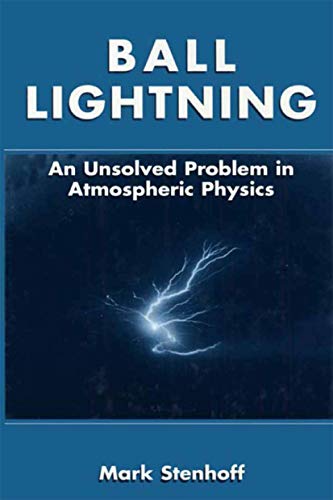
As an Amazon Associate, OverClassified may earn from qualifying purchases made through this link, at no extra cost to you.
Why This Is Essential Reading
Ball Lightning: An Unsolved Problem in Atmospheric Physics earns its place on this list for a reason distinct from almost every other title on this site's Skeptical Works shelf: it is not a UFO book weighing in on ball lightning from outside the field, but the genuine, mainstream physics-literature survey of ball lightning itself, written by someone who spent decades directing a dedicated research division and personally collecting the case reports rather than adjudicating other people's UFO sightings. That distinction matters directly for this site's own work, because ball lightning is one of the single most frequently invoked mundane explanations across this catalogue — reached for by the U.S. Air Force at Levelland in 1957, by credentialed UNAM physicists at Campeche in 2004, and by this site's own researchers weighing Brown Mountain, Chu Lai, and half a dozen other files — and Stenhoff's book is the honest, checkable standard against which every one of those invocations can actually be tested: does the case show the storm activity, the size, the duration, and the termination behavior a genuine ball-lightning event requires, or is “ball lightning” being used as a vague placeholder for “something electrical and unexplained”? Read against Stenhoff's own careful refusal to declare victory for any single physical model, this book is essential less as a source of answers than as a working demonstration of what rigorous, honestly inconclusive science looks like — a genuinely rare thing to find cited, by name, inside a UFO research catalogue at all.
Related Cases & Theories
Sources Cited
- Stenhoff, Mark. Ball Lightning: An Unsolved Problem in Atmospheric Physics. Kluwer Academic/Plenum Publishers, 1999 (ISBN 0306461501 / 9780306461507, xvi + 349 pp.). Borrowable digitized copy. archive.org
- "Ball Lightning: An Unsolved Problem in Atmospheric Physics." Google Books listing (edition record id snI8SW81K-MC; description, subject classification, and partial table of contents). books.google.com
- "Ball Lightning: An Unsolved Problem in Atmospheric Physics." Amazon.com product listing for ISBN 0306461501 / 9780306461507, the same edition cited directly by this site's own Hessdalen Lights case file. amazon.com
- Stenhoff, M. "Ball lightning." Nature, vol. 260, pp. 596–597 (1976) (Stenhoff's original report, the publicity from which generated his 200-plus case archive).
- Jennison, R. C. "Ball Lightning." Nature, vol. 224, p. 895 (1969) (the 1963 Eastern Air Lines cabin observation). Abstract via NASA Astrophysics Data System. ui.adsabs.harvard.edu
- Cen, Jianyong, Ping Yuan, and Simin Xue. "Observation of the Optical and Spectral Characteristics of Ball Lightning." Physical Review Letters, vol. 112, 035001 (2014) (first spectroscopically confirmed natural ball lightning event, Qinghai Plateau, July 2012). Summary via APS Physics. physics.aps.org
- "A brief history of ball lightning observations by scientists and trained professionals." History of Geo- and Space Sciences, vol. 12, pp. 43–58 (2021) (historical survey citing Stenhoff's book as a watershed methodological reference). hgss.copernicus.org
- "Ball lightning." Wikipedia (phenomenon history, historical case reports, 2014 spectroscopic observation, leading theoretical models, citing Stenhoff's book for historical case documentation). en.wikipedia.org
- Tornado and Storm Research Organisation (TORRO). "Research — Lightning — Incidents" (publication record for James & Stenhoff, 1993, Journal of Meteorology, and Stenhoff & James, 2016, in Extreme Weather: Forty Years of TORRO). torro.org.uk
- "Ball lightning." The Skeptic's Dictionary, skepdic.com (summary of mainstream physicists' consensus that ball lightning is very likely real, with ongoing disagreement over mechanism). skepdic.com
- Thomson, James. "Summer," in The Seasons (1730 edition; "Summer" first published 1727) (source of the book's own epigraph, "in red whirling balls"). en.wikisource.org
- This site's own case file: The Levelland UFO Case, for the U.S. Air Force's own 1957 "ball lightning" finding and its later scientific rebuttal by J. Allen Hynek and James E. McDonald.
- This site's own case file: Hessdalen Lights, which already recommends this exact Stenhoff book by name in its own further-reading section.
- This site's own case file: Campeche Military FLIR Incident, for UNAM physicists' 2004 "centellas" (ball lightning) hypothesis.
- This site's own case file: Brown Mountain Lights, for ball lightning as a marginal contributor to a residue of unexplained events.
- This site's own case file: Chu Lai Egg-Shaped Object Incident, for David Clarke's 2011 ball-lightning/spook-light analysis.
- This site's own case file: Green Fireballs (1948), for the rare-atmospheric-electrical-phenomenon candidate weighed and found wanting against the Los Alamos wave.
- This site's own case file: Imjärvi Incident, for Uppsala University's Institute for High Voltage Research consultation and negative finding.
- This site's own case file: Kapustin Yar UAP Sighting, for the antenna-tower ball-lightning candidate.
- This site's own case file: Hawker Sea Fury Sighting, for the plausibility rating ruling ball lightning out directly.
- This site's own theory file: Ball Lightning & Atmospheric Plasma Hypothesis, for this site's own dedicated tracking of the hypothesis across its wider case catalogue.
Have corrections, additional research, or peer-reviewed sources? Help improve this entry.
Suggest an Edit