
The Dr. X Encounter
In the predawn hours of November 1–2, 1968, an anonymous French physician known to ufology only as "Dr. X" was woken by his infant son's cries and, opening his shutters, watched two luminous, disc-shaped objects hover, pulse in unison, and merge into one before departing. In the following weeks he reported the rapid, medically unexplained healing of a fresh leg wound and an old war injury, and the appearance of a lasting triangular mark around his navel — documented within days by French researcher Aimé Michel and later carried to an international audience by Jacques Vallée, who called it one of ufology's most significant "physiological effects" cases.
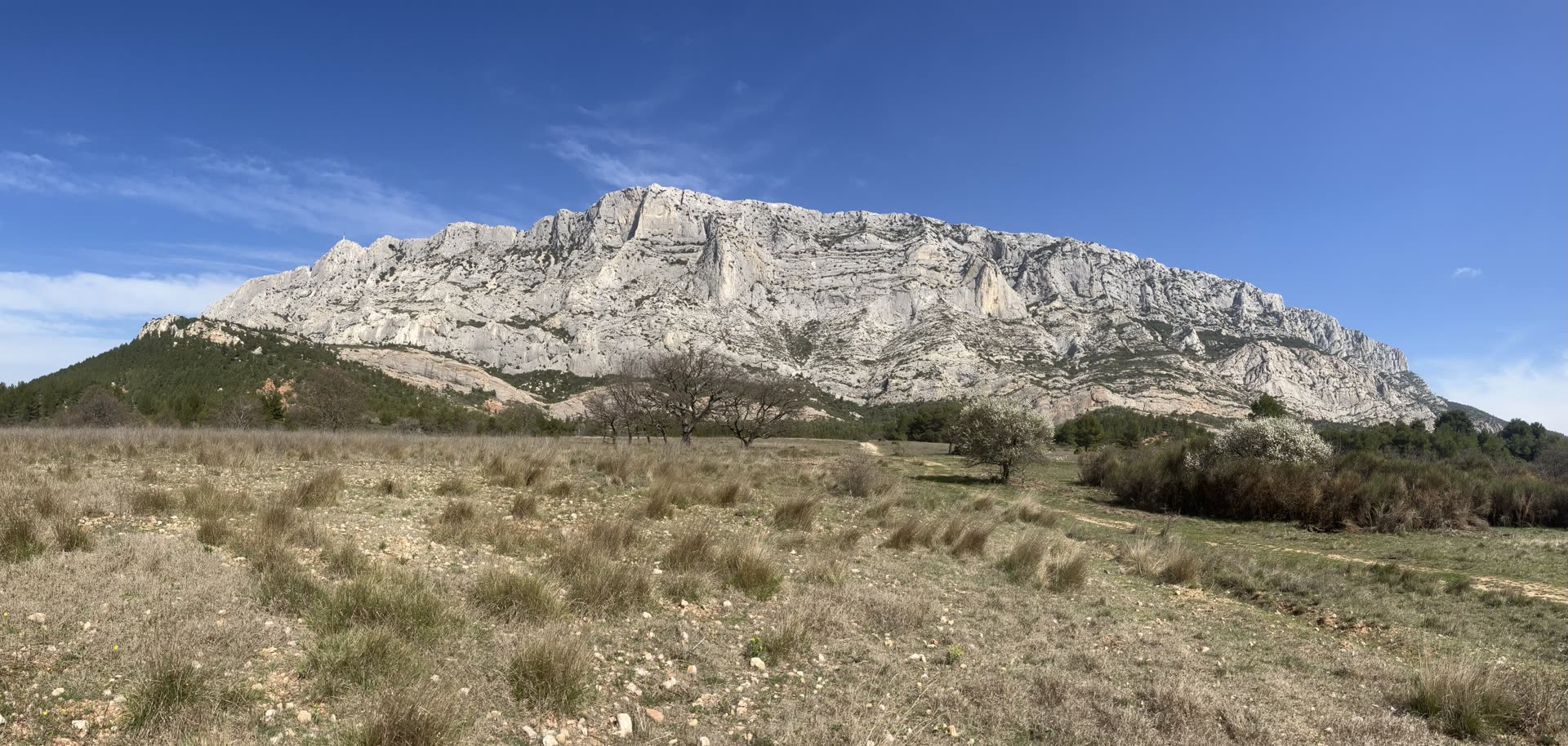
Pictured: Montagne Sainte-Victoire, the hillside landscape overlooking the Aix-en-Provence countryside commonly associated with this case's deliberately undisclosed location. Photographed in 2024 by Wikimedia contributor Imac.vincent; not a photograph of the witness's actual home, which has never been identified. Licensed CC BY-SA 4.0 via Wikimedia Commons.
Theoretical Alignment
This case's central appeal within ufology — and its central evidentiary weakness — are the same fact: a case this rich in claimed physical and physiological detail, investigated this promptly, would ordinarily anchor a strong alignment with either the Extraterrestrial or Interdimensional hypotheses. Jacques Vallée himself has long argued that cases combining a genuine close-range sighting with unexplained physiological aftereffects sit awkwardly within a purely nuts-and-bolts extraterrestrial framework, and are more naturally read alongside his own broader Interdimensional-leaning body of work on UFO "physical effects" — the basis for this file's above-baseline IDH alignment. This file assigns the largest single share to Psycho-Social specifically because of the case's one truly disqualifying structural feature relative to nearly every other case in this archive: the witness's real identity was never disclosed, meaning no part of this case — the injury, the healing, the marks, the dermatologist's findings — can be independently verified by anyone outside the small circle of people Dr. X personally chose to trust.
Background
By 1968, the "physiological effects" sub-genre of UFO close encounters — cases combining a sighting with claimed injuries, burns, healing, or lasting bodily marks — was still a relatively young category within Western ufology, though it would grow considerably over the following decades through cases like the American Cash-Landrum incident. Dr. X's case, emerging from provincial southern France and investigated within days by one of French ufology's most respected figures, became one of the category's foundational examples, cited repeatedly across the following half-century of ufological literature specifically because of the unusually short delay between event and investigation — a rare structural strength this file weighs carefully against the case's equally unusual and much more significant weakness, discussed throughout this file: total, permanent witness anonymity.
The witness, per the consistent secondary literature, was a stomatologist (a physician specializing in oral and dental medicine, a recognized medical specialty within the French system) described as "well known in the South of France" and holding "an important official position" — the reason universally given, though never directly quoted from the man himself, for his insistence on absolute anonymity. He was 38 years old at the time, married, with a 14-month-old son. He had served roughly a decade earlier in the Algerian War, where he sustained a serious head injury; secondary accounts vary in specifics but converge on a subdural hematoma affecting the left hemisphere of his brain, a coma reported as lasting around 21 days, and lasting right-side physical weakness (hemiparesis) as its legacy.
This file weighs Dr. X's professional background as a significant, if inherently unverifiable, credibility factor throughout its treatment of this case: a trained physician is, in principle, a more medically literate observer of his own body's condition than an untrained witness would be, better positioned to recognize genuine change in a chronic old wound versus ordinary day-to-day variation in pain and mobility. This file treats that medical literacy as cutting toward taking the reported healing claims seriously as the witness's own genuine, informed assessment, while noting it does nothing to solve the case's deeper problem: a medically literate witness's own self-assessment, however informed, still cannot substitute for independent documentation by someone else.
Complete Timeline
| Date | Event |
|---|---|
| ~1958 | Dr. X sustains a serious head injury during the Algerian War, reportedly including a subdural hematoma, a coma of roughly three weeks, and lasting right-side weakness |
| ~October 29–30, 1968 | Dr. X injures his leg splitting wood with an axe, producing a large, painful hematoma/laceration |
| Night of November 1–2, 1968, ~3:45–4:00 a.m. | Woken by his infant son's cries, Dr. X opens his shutters and watches two luminous discs hover, pulse, merge into one, approach, and depart over roughly 10 minutes |
| Following morning | His wife reportedly notices he is no longer limping; the leg wound appears largely healed |
| ~November 5, 1968 | Dr. X writes a letter describing the sighting to a local ufology contact |
| November 8, 1968 | Aimé Michel visits Dr. X in person, six days after the sighting, and examines the healed leg, finding only faint, old-looking scarring |
| November 8–13, 1968 | Dr. X begins experiencing abdominal cramps and pain around the navel |
| November 17, 1968 | A reddish, roughly triangular pigmentation is fully formed around his navel; a dermatologist examines it and reports negative findings |
| ~November 18, 1968 | The same triangular mark reportedly appears on the infant son, roughly 12 hours after the father's, without the child having been told anything about the case |
| 1969, 1971 | Aimé Michel publishes "The Strange Case of Dr. X" in two parts in Flying Saucer Review |
| 1975 / 1981 | Jacques Vallée documents the case in The Invisible College (French edition Le Collège Invisible, 1981) |
| 1990 | Vallée revisits the case in Confrontations: A Scientist's Search for Alien Contact |
| April 26, 1993 | French skeptic Éric Maillot publishes a critical analysis, "Le cas du Dr X: deux ovnis pour un stigmate," for the Cercle Zététique |
| December 11, 1993 | The case is featured on the French television program Mystères (TF1), with researcher Jean-Yves Casgha's team reportedly filming a recurrence of the triangular mark |
The Sighting
Dr. X was woken in the early hours by his young son crying and, on going to check on him, noticed irregular flashes through the closed window shutters that he first took for distant lightning. Opening a large window onto the terrace for a clearer view, he saw two horizontal, disc- or oval-shaped objects at a distance he estimated at somewhere between 200 meters and roughly 2 kilometers, each displaying a silvery-white upper section — dimmer than the full moon — and a deep, sunset-red lower section. Each object carried rod-like protrusions he described as antennae, arranged both horizontally and vertically, and each projected a cylindrical beam of white light downward, illuminating low-lying fog beneath them.
The two objects pulsed in near-perfect synchronization, roughly once every half-second to one second, and Dr. X described what he took to be electrical discharges arcing between them — in one frequently quoted characterization, describing the objects as appearing to draw in atmospheric electricity through their antennae before it "exploded" in the gap between the two craft. The objects then drifted together, their antennae appearing to make contact, and merged into a single object, which rotated to a more vertical orientation and approached noticeably closer — some accounts specify to within roughly 200 meters — before directing its light beam directly at Dr. X's face. It then reportedly "dematerialized" or departed vertically with a loud detonation, in some accounts leaving behind a visible white cloud. Dr. X's own later time-check placed the full observation, from first noticing the flashes to the object's departure, at approximately ten minutes.
Several secondary sources describe a further, more unusual claim: that Dr. X experienced a period of amnesia covering parts of the event itself and covering notes or sketches he apparently made at the time, with fuller recall returning only after a fall down a staircase later the same day. This file was unable to corroborate this specific detail against more than one source and flags it as unverified rather than established, consistent with this file's general practice of distinguishing well-corroborated case elements from those resting on a single, uncross-checked secondary account.
Later developments, documented primarily by Jacques Vallée rather than by Aimé Michel's original, more narrowly focused investigation, describe a broader pattern of anomalous phenomena reportedly continuing in the household in the months and years that followed: electrical disturbances that a French electrical utility technician allegedly could not resolve and reportedly attributed, in frustration, to "witchcraft"; a mechanical clock reported to have lost roughly three hours overnight with no identified mechanical cause; and an object of flypaper reported to have adhered, under circumstances the family found inexplicable, to a ceiling roughly six meters high. This file treats these later claims with particular caution relative to the original sighting and physiological effects: they are documented considerably more thinly across the available literature, rest on the same permanently anonymous family as every other element of the case, and describe the kind of diffuse, hard-to-pin-down household phenomena that are, across the broader UFO and paranormal literature generally, disproportionately susceptible to ordinary misattribution, confirmation bias, and the retrospective reinterpretation of mundane household occurrences once a family has already come to believe something extraordinary happened to them.
The Physiological Effects
The Healed Injuries
Two separate healing claims run through the secondary literature on this case, not always clearly distinguished from one another. The first concerns a fresh injury: three days before the sighting, Dr. X had cut his leg badly while splitting wood with an axe, producing a large, painful hematoma that was reportedly still causing him significant discomfort on the night of the encounter. By the following morning, his wife noticed he had stopped limping, and the wound appeared substantially healed. The second concerns his older, chronic Algerian War injury — the right-side weakness and rapid fatigue on exertion that had persisted for roughly a decade — which was also reported to have resolved following the encounter, a claim secondary sources attribute to subsequent medical examination rather than to the family's own unverified observation alone.
When Aimé Michel visited in person six days later, on November 8, he personally examined the leg and reportedly found only the faintest trace of scarring, "as if the wound had been healed for years" rather than days — a first-hand observation from an experienced investigator this file weighs as the single strongest piece of corroborating detail in the entire case, precisely because it was made by someone other than the witness or his immediate family, even though Michel himself was, of course, not a medical professional qualified to formally assess healing timelines.
The Triangular Marks
Beginning roughly a week after the sighting, Dr. X developed abdominal cramping and pain centered around his navel. By November 17, a reddish, roughly isosceles-triangular pigmented mark had fully formed in that location. A dermatologist who examined the mark reportedly found no identifiable dermatological or toxicological cause, but was sufficiently intrigued to consider — and, per some accounts, actually submit — a report to the French Academy of Medicine (Académie de médecine); this file's own research could not confirm whether such a report was ever formally filed or published, and could not identify the examining dermatologist by name.
The mark recurred periodically over an extraordinarily long span, described variously across sources as appearing roughly every three weeks during the period of closest monitoring (secondary sources suggest roughly its first two years), then more sporadically — annually, or at irregular intervals — for a total span some sources place at 25 to 30 years. Dr. X reportedly still displayed a visible recurrence of the triangle during the December 1993 Mystères television appearance, roughly a quarter-century after it first appeared.
This file notes that a recurring, roughly triangular dermatological presentation over a multi-decade span is not, on its own, medically inexplicable in a way that requires an anomalous origin; the human body is capable of producing recurring idiopathic (cause-unknown) skin presentations for a wide range of ordinary reasons, including stress-related dermatological reactions, and a pattern the sufferer has come to consciously or unconsciously associate with a specific triggering memory or anniversary can plausibly recur on a roughly periodic basis without requiring any external cause at all. This file raises this general possibility not to assert it as the confirmed explanation, but because the recurring nature of the mark specifically — as opposed to a single, one-time event — is sometimes presented in popularized retellings of this case as itself constituting additional independent evidence of anomaly, when in fact a recurring, psychologically-linked dermatological presentation is arguably more consistent with a psychosomatic mechanism than a single, one-time occurrence would be.
The single most extraordinary and most frequently repeated specific claim in this case's entire literature is that the identical triangular mark also appeared on the infant son — roughly twelve hours after it appeared on the father, and, per every source describing this detail, without the child having been told anything about the case at all, given his age at the time. This file treats this specific claim as the case's most evidentially significant single detail if true, since a toddler's genuinely independent development of a matching, unusual dermatological pattern is considerably harder to explain through ordinary suggestion or parental expectation than an adult witness's own report of a mark on his own body — while also noting that "if true" is doing real work in that sentence, since this detail, like virtually everything else in this case, rests entirely on the anonymous family's own reporting, with no independent medical documentation located by this file's research.
Key Witnesses
Dr. X (Unregistered)
A 38-year-old stomatologist described as holding "an important official position" in southern France, who insisted on total, permanent anonymity and whose real identity has never been disclosed by any investigator across more than five decades of the case's public discussion. A veteran of the Algerian War with a documented (per secondary sources) history of a serious head injury roughly a decade before this encounter.
Dr. X's Wife (Unregistered)
Present in the home at the time of the sighting, though her own direct observation of the objects themselves is less consistently detailed across sources than her husband's; credited as the first to notice his leg wound had healed the morning after the encounter.
Dr. X's Son (Unregistered)
His crying reportedly first drew his father to the window that night. Later reported to have developed the same triangular abdominal mark roughly twelve hours after his father, and, according to secondary accounts, to have experienced two years of subsequent insomnia and to have later described, unprompted, "a big red machine" and a "fou-fou noise" with flashes to a schoolteacher, without apparent knowledge of his father's account. This file notes that a young child's later, seemingly spontaneous description of imagery matching a parent's own much earlier account is a detail that could, in principle, reflect either genuine independent recall of the same real event, or the far more mundane possibility of a child absorbing fragments of family conversation about the encounter over the intervening years without any adult realizing he had done so — a distinction this file cannot resolve given the available sourcing, but one it considers important to state explicitly rather than let the more dramatic reading stand unchallenged.
Aimé Michel
The leading figure in French ufology at the time, who received Dr. X's own letter within days of the event and personally traveled to interview the family and examine the healed leg wound just six days after the sighting — an unusually short investigative delay this file treats as one of the case's genuine methodological strengths, addressed at length under Material Analysis below.
Jacques Vallée
Documented the case at length in The Invisible College (1975) and again in Confrontations (1990), presenting it internationally as one of ufology's most significant physiological-effects cases and situating it within his own broader interdimensional-leaning framework for UFO close encounters.
The Five Observables Assessment
This case's central claims sit outside the standard Five Observables framework, developed for describing instrumented flight-performance characteristics rather than close-range luminous phenomena and physiological aftereffects; this file nonetheless runs the comparison for consistency with every other case in this archive.
Assessment: The reported merging of two separate objects into one is this case's single most distinctive morphological claim, without a close analogue in most other cases in this archive; the reported departure — a loud detonation and possible "dematerialization" — is the closest this case comes to a sudden-acceleration claim, though it is described in terms of abrupt disappearance rather than observed rapid flight.
Evidence Assessment
This case's evidentiary profile is defined by a genuine tension between unusually prompt, in-person investigation and total, permanent source anonymity — a combination this file has not encountered in quite this specific form elsewhere in its catalog.
Supporting Anomalous Origin
- Investigation began within six days of the event — unusually prompt by the standards of this archive, and specifically by Aimé Michel, one of French ufology's most respected contemporary figures
- Michel's own first-hand examination of the healed leg found scarring consistent with a wound "healed for years," a specific, checkable clinical-adjacent observation made by someone other than the witness himself
- A dermatologist's contemporaneous examination of the triangular marks found no identifiable conventional dermatological cause
- The reported appearance of the same mark on a 14-month-old child, too young to have been coached or to have understood any suggestion, is difficult to explain through ordinary psychosomatic mechanisms if the underlying reporting is accurate
- Dr. X maintained the same core account consistently across more than two decades of periodic recurrence and public discussion, including a 1993 television appearance, with no reported financial motive at any point
Supporting Conventional Explanation
- Dr. X's real identity, exact address, and the identity of the examining dermatologist have never been disclosed, making every specific claim in this case fundamentally unverifiable by any outside researcher
- No photograph, film, or instrumented reading of the objects themselves exists from the night of the sighting
- The dermatologist's "negative" finding establishes only that no conventional dermatological cause was identified at the time, not that no conventional cause existed; unexplained dermatological presentations occur for reasons unrelated to anomalous phenomena
- Éric Maillot's 1993 skeptical analysis specifically ties the sighting itself to Dr. X's own prior occipital-lobe head injury as a plausible contributing factor in visual misperception
- An unconfirmed claim, sourced only to a since-removed internet forum thread, alleges the case was denounced as fabricated by Dr. X's own wife; this file could not verify this claim's origin or substance and flags it explicitly as unconfirmed rumor rather than established fact
- Aimé Michel himself, the case's original and most sympathetic investigator, reportedly leaned initially toward a psychosomatic explanation for the triangular marks specifically
Why "Disputed"
This file assigns the Dr. X Encounter a DISPUTED classification. It is not rated as Debunked, because no source located by this file's research offers a specific, confirmed conventional explanation for the full combination of claims — the merging-object sighting, the rapid healing, and the persistent triangular marks — and because the unconfirmed "denounced by his wife" hoax claim rests on a single dead forum thread this file was unable to substantiate. It cannot be rated any higher than Disputed, however, because this case's core structural feature — complete, permanent witness anonymity, extending even to the examining dermatologist — makes independent verification of any specific claim in the case impossible in principle, not merely difficult in practice.
This file treats that specific structural feature, rather than any single disputed detail, as this case's defining analytical fact. A case this rich in claimed physical and physiological corroboration would, if fully verifiable, represent one of the strongest physiological-effects cases in the entire UFO literature; because it is not verifiable, and by the family's own explicit choice can never become verifiable, it instead occupies a permanent middle ground — taken seriously for decades by serious researchers precisely because of its investigative promptness and internal richness, while remaining, by its own design, immune to the kind of independent confirmation this site's own Data Integrity scoring is built to reward.
Readers should understand this file's low Data Integrity score, discussed in full under the Forensic Data Profile below, as a direct mathematical consequence of that permanent unverifiability rather than as a judgment that the case is more likely fabricated than genuinely experienced. A witness can be entirely honest, entirely sincere, and entirely mistaken or subject to a genuine but conventionally explicable physiological event, all at once; this file's scoring framework is built to reward independently checkable evidence, not to adjudicate a witness's personal sincerity, and this case scores low specifically because so little of it can be independently checked by anyone, not because this file has concluded Dr. X was lying.
Sensor & Instrumentation Detection Profile
No scientific instrumentation of any kind was used on the night of the sighting itself. Aimé Michel's subsequent investigation, six days later, appears to have relied on direct interview and personal physical examination of the healed leg rather than on any calibrated instrument; the dermatologist's later examination of the triangular marks likely involved standard period dermatological assessment, though this file located no description of specific tests performed (biopsy, blood work, or otherwise) beyond the general characterization of the findings as "negative." No radiation, electromagnetic, or dosimetric testing of any kind is documented in connection with this case, distinguishing it from some other physiological-effects UFO cases (such as Cash-Landrum) in which such testing was specifically conducted.
Environmental & Geospatial Context
Every primary and near-primary source reviewed for this file deliberately withholds Dr. X's precise location, describing it only as a hillside home in "the South of France" overlooking a valley. "Aix-en-Provence" is the location consistently used in later popular and secondary retellings of the case, including this site's own prior queue placeholder, but this file's research found no primary investigative source stating that specific city as established fact rather than as a general regional shorthand; this file preserves the commonly used regional identifier for continuity with the existing literature while stating plainly here that the exact location remains, by design, undisclosed.
The broader Aix-en-Provence area sits within the Bouches-du-Rhône department of Provence-Alpes-Côte d'Azur, a hilly, valley-cut landscape dominated regionally by the Montagne Sainte-Victoire and the Arc river valley — terrain generally consistent with the "hillside home overlooking a valley" description found across the secondary literature, though this file cannot confirm any specific correspondence between that description and any particular real location within the broader region.
Observer Credibility & Occupational Profile
Dr. X's professional standing as a physician, and the stated reason for his anonymity — protecting "an important official position" from association with a UFO and paranormal-adjacent claim — is, in this file's own assessment, a genuinely double-edged credibility factor. A medical professional with an established local reputation and evidently something meaningful to lose professionally has, on one hand, less obvious incentive to fabricate an elaborate hoax purely for attention, particularly one involving claims (unexplained bodily marks, a UFO encounter) that could plausibly have damaged rather than enhanced his professional standing if it had become widely known within his own community. On the other hand, that same total anonymity is precisely what makes it impossible for this file, or any other outside researcher, to independently verify a single fact about him — his actual medical credentials, his actual war record, or even that the described injuries genuinely existed prior to November 1968 in the specific form reported.
Aimé Michel's own investigative credibility is considerably easier to assess, since his identity, career, and body of published work are all a matter of public record. His willingness, per secondary accounts, to initially entertain a psychosomatic explanation for the triangular marks specifically — rather than immediately embracing the most dramatic possible reading — is a point this file weighs as meaningfully favoring his overall investigative caution, even though his broader career (particularly his development of the later-refuted orthoteny theory) shows he was not a reflexive skeptic either.
This file finds Michel's specific combination of traits genuinely useful for calibrating how seriously to take his own reported observations in this case: a researcher capable of both proposing an ambitious, ultimately unsupported statistical theory about global sighting patterns and independently entertaining a mundane psychosomatic explanation for a specific case's most dramatic physical claim is not someone whose testimony can be dismissed as uniformly credulous, nor trusted as uniformly rigorous. His personal, in-the-room examination of the healed leg wound six days after the event remains, in this file's own weighting, the single most credible individual data point in the entire case specifically because it came from an investigator with this demonstrated willingness to consider mundane explanations even for cases he ultimately found compelling.
The unverified claim that Dr. X's own wife later denounced the story cuts, if true, sharply against the family's collective credibility; but this file's inability to locate the claim's original source, date, or any corroborating detail beyond a single dead forum thread means it cannot be weighed as established fact here. This file's own position is that the claim should be flagged for readers' awareness precisely because it circulates in some corners of the UFO-skeptic internet, while making clear it does not meet this file's own sourcing standard for inclusion as anything more than an unconfirmed rumor.
Physical & Material Assays
No photograph, film, or recovered physical material connects to the sighting itself. The case's only genuinely physical evidentiary category is the witness's own body: the healed leg wound Aimé Michel personally examined six days after the fact, and the triangular abdominal marks a dermatologist examined roughly two weeks after the sighting and periodically thereafter for decades. Neither examination, as documented in available secondary sources, involved photography, biopsy, or any form of physical sample retained for independent later analysis — a significant gap given how central the marks specifically became to the case's later fame. The 1993 Mystères television appearance and the reported filming of a mark recurrence by researcher Jean-Yves Casgha's team represent the closest thing to visual physical documentation this file located, though this file's own research could not confirm whether that footage remains accessible today or has ever been independently reviewed by researchers outside the original production team.
This file specifically notes the significance of what was never done rather than only what was done: no blood sample was drawn and preserved for later re-analysis, no biopsy of the triangular tissue was taken and archived, and no dosimetric or radiation testing of any kind was performed on the witness despite the broader physiological-effects UFO literature already, by 1968, containing occasional discussion of possible radiation exposure as a mechanism in comparable cases. Whether this absence reflects the genuine medical limitations of late-1960s provincial French practice, a deliberate choice by the family to limit the scope of any examination, or simply the fact that no one present that week thought to preserve physical samples for a purpose that would only become scientifically interesting decades later, this file cannot determine from available sources — but the absence itself is a permanent, unrecoverable gap in this case's evidentiary record regardless of its cause.
Historical Precedents & Archive Matches
This case sits within two overlapping traditions: the broader physiological-effects sub-genre of UFO close encounters, and the specific French tradition of privately investigated, later internationally popularized sightings from the late 1960s.
Cash-Landrum and the Physiological-Effects Genre
This site's own Cash-Landrum file documents the best-known American physiological-effects case, involving reported burn-like injuries and radiation-consistent symptoms following a close-range diamond-shaped object sighting in 1980. The comparison is instructive specifically for its contrast in evidentiary structure: Cash-Landrum involved named, identifiable witnesses who sought and received extensive documented medical treatment, producing a genuine (if disputed) paper trail of hospital records, while Dr. X's case, despite its considerably richer claimed physiological detail, produced no comparable independently verifiable medical record precisely because of the family's insistence on total anonymity.
This file finds the contrast genuinely instructive for readers weighing which of the two cases deserves more evidentiary confidence: Cash-Landrum's identifiability cuts both ways, exposing its witnesses to sustained public scrutiny, cross-examination, and a formal (if ultimately dismissed) federal lawsuit that tested aspects of their account in an adversarial setting no part of Dr. X's case has ever been subjected to. Dr. X's case, protected by anonymity from that same scrutiny, has never had to withstand comparable adversarial testing of any single specific claim, a structural asymmetry this file considers directly relevant to why Cash-Landrum, despite its own significant unresolved questions, generally receives somewhat more cautious credence in the broader skeptical literature than the substantially less checkable Dr. X case.
Aimé Michel and French Ufology's Golden Age
Aimé Michel (1919–1992) was the central figure of French ufology following the country's major 1954 sighting wave, developing the influential (and later, in 1976, statistically refuted) orthoteny theory proposing that UFO sightings cluster along great-circle alignments. His involvement with GEPA (Groupe d'Étude des Phénomènes Aériens) and its journal Phénomènes Spatiaux situates this case within an organized, if non-governmental, French investigative tradition distinct from the later official GEPAN apparatus documented elsewhere on this site (see this site's own Bize-Minervois Sighting and Cussac Close Encounter files) — Michel's investigation of Dr. X predates GEPAN's own 1977 founding by nearly a decade, and was conducted entirely as private, unofficial ufological research rather than under any government mandate.
This file notes the broader historical irony in this chronology: Dr. X's case emerged from precisely the kind of privately organized, non-governmental French ufological research tradition that GEPA and figures like Michel represented in the 1960s, nearly a decade before the French state itself, through GEPAN, began formally investing its own scientific resources in equivalent questions. That later official apparatus, whatever its own documented limitations in cases like Bize-Minervois, at minimum offered a standardized investigative methodology and calibrated instrumentation unavailable to Michel in 1968 — a methodological gap this file considers directly relevant to explaining why this case's evidentiary record consists of personal interview and physical examination rather than the theodolite measurements, psychosociological assessment, and known-phenomena test matrices later GEPAN investigators would routinely apply to comparable French sightings roughly a decade afterward.
Material Analysis
This case's evidentiary record rests almost entirely on two bodies of secondary testimony — Aimé's Michel's original investigation and Jacques Vallée's later documentation — both filtered through an anonymous, unverifiable primary witness.
The Éric Maillot Skeptical Analysis
French skeptic Éric Maillot, whose later critical work on GEPAN's own "PAN D" case files this site documents in its Bize-Minervois Sighting file, published a dedicated critical analysis of this case for the Cercle Zététique in April 1993, titled "Le cas du Dr X: deux ovnis pour un stigmate" ("The Case of Dr. X: two UFOs for one stigma"). His analysis offers several converging rationalizing hypotheses: diplopia (double vision), potentially connected to Dr. X's own prior head injury or a lens abnormality, as a candidate explanation for perceiving two objects rather than one; a noted alignment between the Moon's actual position that night and the reported direction of the sighting, raising the possibility of celestial misidentification; and, most specifically, a direct connection between Dr. X's documented prior occipital-lobe brain injury and the general reliability of his own visual perception and interpretation of ambiguous nighttime stimuli.
This file weighs Maillot's analysis as a genuinely serious, specifically targeted piece of skeptical scholarship rather than a dismissive one-line debunking, and notes that his argument does not require assuming deliberate fabrication on Dr. X's part — it is fully compatible with a witness who genuinely, honestly misperceived an ambiguous nighttime stimulus (celestial objects, a genuine but far more mundane light source, or some combination) through the lens of pre-existing neurological vulnerability, and then, independently, experienced a set of genuine but coincidentally timed and psychosomatically influenced physiological events in the emotionally charged weeks that followed.
The diplopia hypothesis specifically deserves closer examination given how central it is to Maillot's broader argument. Double vision arising from an ocular-muscle imbalance or nerve-signaling defect can, under the right conditions, cause a single genuine light source to be perceived as two separate, spatially offset images — and critically, such double images can appear to move in apparent synchrony with one another as the underlying single source moves, since both perceived images derive from the same physical stimulus. This file finds this mechanism a plausible, though unproven, candidate specifically for the reported synchronized pulsing and the eventual "merging" of the two objects into one: a diplopic perception would naturally resolve into a single image as viewing conditions changed, which is functionally indistinguishable, from the witness's own subjective perspective, from watching two genuinely separate objects merge into one.
The Anonymity Problem, Considered Directly
This file treats the case's defining anonymity not merely as an inconvenience but as a structural feature that changes what kind of evidentiary claim the case can actually support. A case with a named, identifiable witness and documented medical records can, in principle, be independently re-examined, its claims checked against contemporaneous records, its witnesses cross-interviewed by other researchers. This case, by contrast, can only ever be re-examined through the same small set of secondary sources — Michel's original notes and published articles, Vallée's later books, and the small number of French-language retrospectives that have engaged with the underlying file. No new primary research is possible on this case today, and none will become possible in the future unless Dr. X's own family, at some point, chooses to lift the anonymity his family has now maintained for more than half a century.
This file also considers the specific consequences of that permanent anonymity for one detail in particular: the identity of the examining dermatologist. Unlike Dr. X himself, whose anonymity is explicitly and consistently justified across the literature by his own stated wish to protect his professional standing, no source located by this file's research offers any explanation for why the examining dermatologist's identity was also never disclosed, nor whether that dermatologist ever published anything under their own name about the case, nor whether the reported consideration of a report to the French Academy of Medicine was ever pursued to completion. This second, seemingly incidental layer of anonymity compounds the case's core verification problem: even a reader willing to fully trust Dr. X's own account of events has no path to independently confirming that a qualified specialist ever actually examined the marks and reached the "negative" conclusion attributed to them, since that specialist, too, remains entirely unnamed across more than five decades of the case's circulation in the literature.
Vallée's Broader Framing
Jacques Vallée's own treatment of this case, across both The Invisible College (1977) and Confrontations (1990), situates it within his broader, long-standing argument that the most evidentially interesting UFO cases are often precisely those combining an ambiguous physical sighting with genuinely strange psychological and physiological aftereffects — a pattern he has argued fits poorly with a simple "alien spacecraft" reading and better with a more genuinely unknown, higher-strangeness phenomenon. This file notes that Vallée's own framing, whatever its ultimate merit, does not resolve this case's core anonymity problem; it instead explicitly builds a broader theoretical argument on top of a case whose foundational facts cannot themselves be independently checked, a structural feature this file considers worth stating plainly for readers evaluating Vallée's wider body of work through this specific case.
Vallée's own career-long methodological pattern is itself worth noting here: across decades of published work, he has consistently argued that ufology's most analytically productive path lies not in seeking a single unifying physical mechanism for every reported case, but in carefully cataloging the specific, granular details of the strangest individual cases and looking for structural patterns across them — an approach this case exemplifies almost perfectly, given how central its very specific, granular details (the antenna arrangement, the merging behavior, the precise triangular geometry of the marks) have been to its decades of continued citation. This file's own assessment is that this cataloging approach has genuine scholarly value as a way of organizing a large, messy body of testimonial evidence, while noting that cataloging detailed anomalies is a different intellectual exercise from establishing that any specific catalogued case actually occurred as described — a distinction this file considers particularly important for a case built entirely on a single, permanently unverifiable source family, however genuine and however sincerely and consistently reported that family's own testimony has plainly remained across the more than five decades since the original November 1968 sighting itself first occurred.
The Conventional Explanation Candidate: A Genuine but Misperceived Sighting, Compounded by Psychosomatic Aftereffects
As with several other candidate-explanation sections on this site, the analysis below weighs multiple broad possibilities against one another rather than declaring any single account definitively settled, since this case's defining anonymity makes definitive resolution structurally impossible regardless of which candidate a reader ultimately favors.
Genuine Misperception, Amplified by Prior Neurological Vulnerability
This candidate, closely following Éric Maillot's own published analysis, treats the sighting as a genuine but significantly misperceived observation of ambiguous nighttime phenomena — plausibly involving celestial objects, atmospheric effects, or some combination — interpreted through the specific lens of a witness with a documented prior head injury affecting visual processing, and subsequently elaborated, consciously or not, into the richly detailed account that reached Aimé Michel. This file finds this the best-supported single reading available, precisely because it is the only candidate that directly engages with Dr. X's own documented neurological history rather than treating his professional credibility as a general-purpose stand-in for reliability on this specific, neurologically relevant point.
Genuine Anomalous Encounter with Genuine Physiological Effects
This candidate takes the full account at face value: a genuinely anomalous craft, a genuine close-range encounter, and genuine, medically real physiological consequences including the child's independently developed mark. This file finds this candidate impossible to rule out given the available evidence, and notes that Aimé Michel's own first-hand examination of the healed leg is a genuinely meaningful data point in its favor — while weighing it as less well-supported than the misperception-plus-psychosomatic candidate above, given this case's total reliance on unverifiable anonymous testimony for every single specific claim beyond Michel's own limited direct observations, made only once, roughly six days after the fact, and never since independently repeated, confirmed, or reproduced by any other outside investigator in the more than five decades that have now passed.
A reader inclined toward this candidate would reasonably point out that this file's own preferred alternative requires several separate coincidences to align: a genuinely ambiguous nighttime stimulus, occurring specifically to a witness with a pre-existing neurological vulnerability affecting visual processing, followed independently by a genuine but medically unrelated rapid natural healing of a recent wound, followed independently again by a psychosomatically triggered dermatological presentation that happened to recur for decades and happened to also, independently, appear on a toddler too young to have been consciously influenced. This file acknowledges that stacking several independent coincidences is itself a real cost to the conventional-explanation candidate, and that a single unifying anomalous cause is, in this narrow sense, a more economical explanation for the full cluster of reported effects — a genuine point in this candidate's favor that this file weighs directly even while ultimately finding the balance of considerations, on net, still favors the conventional reading overall, given the case's total, structural dependence on a single family's own testimony, testimony that by its own permanent design cannot itself ever be independently checked, cross-examined, or corroborated by any outside party, however credible, remarkably consistent, or genuinely sincere that same original testimony has, by literally every single account located across this file's own dedicated research, plainly and repeatedly appeared to remain across all of the many intervening decades since 1968.
Deliberate Fabrication
This file's own research located no confirmed evidence of deliberate fabrication, and notes that Dr. X had, if anything, more to lose professionally than to gain from associating himself with an anonymous but still personally identifiable-to-his-immediate-circle UFO story, particularly one involving claims of paranormal-adjacent bodily marks. The unconfirmed "denounced by his wife" rumor, discussed above, is the only source pointing toward deliberate fabrication located by this file's research, and its single, now-inaccessible source prevents this file from weighing it as more than a data point worth flagging rather than a conclusion worth adopting. This file considers deliberate fabrication less plausible than genuine misperception, though, unusually for cases in this archive, the case's fundamental unverifiability means this candidate cannot be as confidently downweighted here as it can in better-documented cases elsewhere in this site's catalog.
Misperception, Neurologically Amplified
PlausiblePLAUSIBLE. The only candidate directly engaging Dr. X's own documented head injury and its relevance to his visual perception that night.
Genuine Anomalous Encounter
InconclusiveINCONCLUSIVE. Cannot be ruled out, and Michel's own direct leg examination is a genuine data point, but rests entirely on unverifiable testimony.
Deliberate Fabrication
ImplausibleIMPLAUSIBLE, though less confidently ruled out than usual, given the case's fundamental unverifiability and one unconfirmed hoax rumor.
Related Cases
Confirmed Documents & Official Records
No government, military, or official scientific body ever formally investigated this case. It predates GEPAN's 1977 founding by nearly a decade and was, from its origin, a privately conducted piece of civilian ufological research by Aimé Michel, later documented internationally by Jacques Vallée. No record of this case is known to exist in any French governmental archive, GEIPAN's own case catalog, or any equivalent official body in any other country.
Search Government & Official Archives Directly
Further Reading — Recommended Literature
This site's own Essential Reading feature on Confrontations and The Invisible College cover Jacques Vallée's own direct documentation of this case; the three titles below broaden that coverage across his wider catalog and general skeptical evaluation of anecdotal claims.
Confrontations
Vallée's later, fuller treatment of this case as one of ufology's most significant physiological-effects encounters.
The Invisible College
Vallée's earlier, original documentation of the case, including the healed leg wound and old war injury.
Passport to Magonia
Vallée's foundational catalog of high-strangeness cases, situating this encounter within his broader career-long framework.
Forbidden Science 2
Vallée's own contemporaneous journals from this era, offering direct insight into his working methods and evolving thinking.
Why People Believe Weird Things
General framework for evaluating anecdotal healing and physiological claims, directly relevant to this case's central evidentiary question.
DISCLOSURE: Some links above are affiliate links. If you purchase through them, OverClassified receives a small commission at no additional cost to you. This helps support this site's continued independent research work.
Essential Viewing
Sources
- "Le cas du docteur X." RR0.org — the most detailed available synthesis, citing Inforespace n°26 (1976), Michel Figuet's Premier dossier des rencontres rapprochées en France, Aimé Michel's investigation files, Jacques Vallée's Le Collège Invisible (1981), Le Monde Inconnu n°58 (1985), Contraintes (1992), and Éric Maillot's 1993 analysis. rr0.org
- "Cas du docteur X." Encyclopédie Wikimonde. wikimonde.com
- "The Strange Case of Dr. X: UFOs and 'Miracle' Healings." Think Anomalous. thinkanomalous.com
- "The 'Dr. X' Encounter And The 1960s French UFO Invasion." UFO Insight. ufoinsight.com
- "The Amazing Case of Dr. X." Contact Underground. contactunderground.org
- Michel, Aimé. "The Strange Case of Dr. X." Flying Saucer Review, 1969, with a follow-up in 1971.
- Vallée, Jacques. The Invisible College: What a Group of Scientists Has Discovered About UFO Influence on the Human Race. 1975.
- Vallée, Jacques. Confrontations: A Scientist's Search for Alien Contact. Ballantine, 1990.
- Maillot, Éric. "Le cas du Dr X: deux ovnis pour un stigmate." Cercle Zététique, April 26, 1993 (summarized via Wikimonde).
- "Aimé Michel." Wikipedia. en.wikipedia.org
- "Orthoténie." Wikipédia (French). fr.wikipedia.org
- "LES GUÉRISONS EXTRATERRESTRES." Les Repas Ufologiques (Elisabeth de Caligny talk, Oct. 12, 2019, citing Preston Dennett). lesrepasufologiques.org
- "File: Montagne Sainte-Victoire (versant sud).jpg." Wikimedia Commons (photograph by Imac.vincent, 2024, CC BY-SA 4.0). commons.wikimedia.org
- This site's own Cash-Landrum file.
- This site's own Cussac Close Encounter file.
- This site's own Bize-Minervois Sighting file.
See something inaccurate? Have additional information or sources?
Suggest an Edit →Last Updated: August 2026