
The Cussac Close Encounter
At about 10:30 AM on August 29, 1967, thirteen-and-a-half-year-old François Delpeuch and his nine-year-old sister Anne-Marie Delpeuch were minding the family's cattle in a meadow called Les Tuiles, about 800 meters west of the village of Cussac, on a high plateau in France's Cantal department, when their dog began barking at something behind a hedge. What the children said they saw next — four small, entirely black figures beside a dazzling silver sphere, which the figures entered headfirst before the sphere rose in circles and sped off to the northwest — reached Radio Luxembourg the next day and the regional daily La Montagne on September 1, and became one of the most re-investigated close encounters in French ufology. Its afterlife is what makes it unusual: gendarmes from two brigades visited the meadow that afternoon (they wrote no official report); a private group, GEPA, investigated on site in April 1968; and in April 1978 Claude Poher, who had just founded France's government UFO-study unit GEPAN within the space agency CNES, took a four-person team back to the plateau, including a retired investigating judge. GEPAN's confidential 1978 report concluded the children had witnessed "the hurried departure of an inhabited vehicle" of unknown type, and the judge found nothing that permitted doubting their sincerity. Skeptical researchers have argued since the 1990s that the children saw a light helicopter, perhaps an Alouette II, and that later investigators enlarged their account. No flight record settling the question has ever been found.
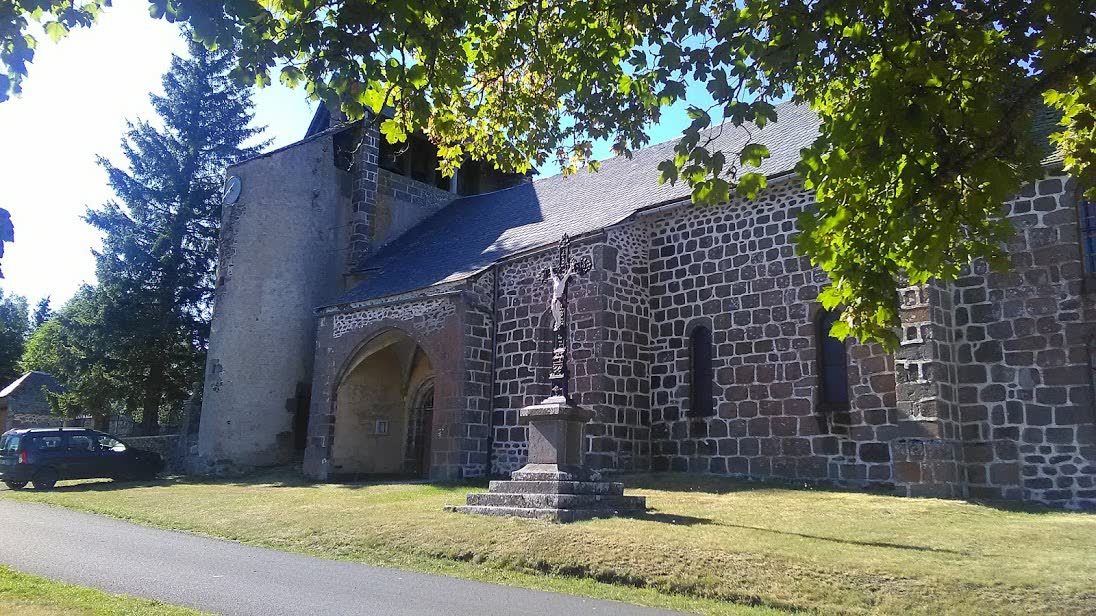
Pictured: Église Saint-Amand, the parish church of Cussac, Cantal — the commune where the Delpeuch family lived, not the isolated Les Tuiles pasture roughly 800 meters outside the village where the sighting itself occurred. No public-domain or rights-clear photograph of the actual pasture, the 1967 ground trace, or the witnesses is known to exist; GEPAN's own 1978 site photography remains held within CNES/GEIPAN's archival case file rather than freely licensed. Photograph by Sancta floris, licensed CC BY-SA 4.0 via Wikimedia Commons.
Theoretical Alignment
Cussac sits in a well-documented but evidentially modest position among humanoid-occupant cases. Its Extraterrestrial Hypothesis alignment is capped at a middling 25% because, unlike physical-trace landmark cases such as Trans-en-Provence, no laboratory ever tested anything from Cussac, and the only reported ground trace surfaced eleven years later from a single gendarme. The case's weight rests on two children's testimony, which stayed broadly consistent from 1967 through the 1980s, and on a handful of adults' secondhand sensory reports (an odor, a whistling sound, the cattle's agitation). What keeps the ETH alignment from falling lower still is that consistency, and the fact that the retired judge on Claude Poher's 1978 GEPAN team found no basis to suspect invention, hoax, or hallucination. The Interdimensional Hypothesis offers little here — a landed object and physically embodied occupants fit poorly with a framework built around trans-dimensional phenomena. The Psycho-Social Hypothesis scores comparatively higher, not because the children were lying, but because skeptical researchers have documented a credible contamination pathway: a summer of saucer stories in the regional press, the July 17, 1967 Arc-sous-Cicon report of small black figures in the Doubs, and successive investigators whose questions, they argue, enlarged a brief sighting into the classic account.
Background
In the late summer of 1967, Cussac was, and remains, one of the smallest and most remote communes in the Cantal department: a scattering of stone farmhouses on a high volcanic plateau in France's Massif Central, its economy built entirely around dairy and beef cattle grazed on the thin mountain pasture that surrounds it on every side. François Delpeuch, thirteen and a half years old, and his younger sister Anne-Marie, nine, were the children of the commune's mayor, a local lawyer who would go on decades later to serve as mayor of the larger nearby town of Saint-Flour. Watching the family's cattle on the plateau was an entirely ordinary chore for children in a farming commune this size, one they had almost certainly performed dozens of times before without incident; nothing in either child's background, or their father's, suggested any prior interest in UFOs, unusual religious belief, or any motive to fabricate an elaborate hoax that would draw unwanted national press attention to a mayor's own household. France in 1967 had no government body dedicated to investigating UFO reports — GEPAN would not be founded within the national space agency CNES for another decade — but the country already possessed an active, organized private ufology community, anchored by groups like GEPA (Groupe d'Étude des Phénomènes Aériens) and the long-running bulletin Lumières Dans La Nuit (LDLN), whose members would descend on Cussac within months of the sighting to conduct the kind of methodical, comparative witness interviews that gave the case its unusually well-documented early record. It was into this pre-GEPAN landscape — serious volunteer investigators, an engaged regional and national press, but no standing government scientific unit — that the Delpeuch children's morning on the plateau abruptly, and permanently, dropped.
Complete Timeline
| Date | Event |
|---|---|
| August 29, 1967, ~10:30 AM | François Delpeuch (13½) and his sister Anne-Marie Delpeuch (9), who had taken about a dozen cows to the Les Tuiles meadow beside departmental road 57 outside Cussac, Cantal at 8 a.m., see their dog Médor barking toward a hedge; François climbs onto a wall or stone and sees four small black figures and a dazzling sphere beyond it (about 40–50 m away per the 1968 GEPA report, 60 m per La Montagne, 70–82 m in GEPAN's 1978 reconstruction). |
| Same morning | Three of the figures dive headfirst into the sphere; the fourth follows as it rises. The sphere climbs in small circles, then spirals up, growing brighter, and leaves rapidly toward the northwest (the Plomb du Cantal). The children report a soft whistling and a brief sulfur-like smell; the cows bellow and bunch together. |
| Same morning | The children head home early, in tears, telling a farmer they pass on the way. Their father, the mayor of Cussac, visits the meadow with his son and then alerts the gendarmerie, citing a prefectoral circular from two or three years earlier that had asked mayors to report anything unusual during military maneuvers. |
| August 29, 1967, about 4 p.m. | Gendarmes from the Saint-Flour and Neuvéglise brigades visit the meadow and question the children. They write no official report (procès-verbal); one of them, gendarme S., later tells GEPAN he noticed a strong odor and a circle of yellowed grass. |
| August 30, 1967 | Radio Luxembourg broadcasts an early report on the sighting. |
| September 1, 1967 | Regional newspaper La Montagne publishes "Les martiens ont-ils atterri?" ("Have the Martians landed?"), the case's first major press coverage. |
| September 2–3, 1967 | The tabloid Paris Jour runs the story nationally; Lumières dans la nuit (no. 90) and the APRO Bulletin follow in September–October. |
| Following days | François's eyes water for about fifteen minutes after the sighting and again on waking for several days; Anne-Marie reports no physical effect. Both sleep badly for a night or two. No doctor is mentioned in the early reports. |
| Late 1967 – April 1968 | LDLN members Ch. Caudy and Couzinié make the first inquiries; GEPA investigators Joël Mesnard and Claude Pavy then investigate on site in April 1968, questioning the children and taking them back to the meadow. |
| June 1968 | Mesnard and Pavy publish their findings in Phénomènes Spatiaux no. 16, pp. 27–31 — the case's first detailed formal writeup. |
| October 12, 1968 | A parallel investigation by Claude de Saint-Étienne for LDLN is published in the Toulouse edition of Hebdo. |
| September 1968 | An English translation of the GEPA findings appears in Flying Saucer Review, Vol. 14, No. 5, introducing the case to English-language researchers. |
| 1969–1977 | The case is discussed in a lengthening series of French UFO books and journals, including works by Jacques Vallée (1972), Fernand Lagarde (1973), Jean-Claude Bourret (1974), and Coral and Jim Lorenzen's English-language Encounters with UFO Occupants (1976), cementing its status as a landmark French humanoid case even as no further fieldwork occurs. |
| 1977 | LDLN investigator Luc Bourdin re-interviews François, by then a law student at Clermont-Ferrand. He learns that the "do you want to come and play with us?" line in the first press report was a journalistic invention, and François again says he never saw the support legs his sister described. Bourdin publishes nothing. |
| 1977 | CNES engineer Claude Poher founds GEPAN (Groupe d'Études des Phénomènes Aérospatiaux Non-identifiés) within France's national space agency in Toulouse, the world's first standing government UFO-study unit. |
| April 1978 | Claude Poher leads a two-day GEPAN re-investigation with a retired investigating judge (juge d'instruction), a CNES optical engineer and his secretary, eleven years after the sighting. The team re-measures the site with a theodolite, interviews the children, the garde champêtre and gendarme S., and runs an odor-recognition test. |
| June 1978 | GEPAN's report to its Scientific Council (vol. 4) concludes that the witnesses saw "the hurried departure of an inhabited vehicle" of unknown type exceeding known technology; the judge finds no flaw that would permit doubting the witnesses' sincerity. At the Scientific Council's request the report stays confidential, and the witnesses are never told its conclusions. |
| 1983–1985 | Thierry Pinvidic, Bertrand Méheust and Jean-Pierre Grangeon re-interview François, Anne-Marie, their parents, the garde champêtre and the farmer; their account, published by Pinvidic in 1993, leaves the case unidentified. In 1985 the garde champêtre says he had taken the whistling for a passing helicopter. |
| 1993–1999 | Jean-Jacques Velasco's book Ovnis, la science avance makes parts of the GEPAN dossier public; in 1996 Éric Maillot of the Cercle Zététique publishes "Les ufologues et l'ovni de Cussac – 30 ans dans un cul-de-sac!", proposing a helicopter. The unofficial 1999 COMETA report lists Cussac among its French close encounters and cites the GEPAN reassessment; Velasco, a COMETA member, delivers the report to Prime Minister Lionel Jospin. |
| 2003 | Researcher Alain Delmon publishes an analysis of Cussac as a "solid case" disputing the helicopter hypothesis. |
| June 2004 | Claude Poher publishes "Retour sur le cas de Cussac," arguing the reported spiral ascent, odor, and brightness are difficult to reconcile with an ordinary helicopter. |
| August 29, 2004 | Éric Maillot revisits the site on the sighting's 37th anniversary for a photographic sightline reconstruction; researcher Grégory Gutierez separately publishes a helicopter-hypothesis visualization. |
| March 2, 2005 | Gutierez reports that GEPAN's internal 1978 dossier on Cussac has become available to outside researchers. |
| March 2007 | CNES opens its GEPAN/SEPRA/GEIPAN case archive to the public online; the site is overwhelmed on its first day. |
| 2007 | David Rossoni, Éric Maillot, and Éric Déguillaume publish a dedicated Cussac chapter in Les OVNI du CNES: 30 ans d'études officielles (1977–2007), the fullest published statement of the helicopter hypothesis. |
| January/February 2009 | Rossoni, Maillot, and Déguillaume summarize the case and the broader helicopter debate for an English-language audience in Skeptical Inquirer, Vol. 33, No. 1. |
Ten-Thirty on the Plateau: The Sighting at Les Tuiles
By the Delpeuch children's own account, the morning of August 29, 1967 began like any other. François and Anne-Marie had taken about a dozen cows out at 8 a.m. to the meadow at Les Tuiles, beside departmental road 57 about 800 meters west of the village. What broke the routine was their dog, Médor, barking at a hedge across the road. François, worried about the cows, had his back to the scene; when he turned and climbed onto a low wall or stone to see better, he saw small figures he first took for children he did not know — an assumption that lasted only until a closer look. Beyond them was an intensely bright, smooth sphere, silver in color and about two meters across by the children's 1968 estimate, near the ground. The distance has never been settled: the 1968 GEPA report put the figures about forty meters away (a sketch says fifty), La Montagne said sixty meters, and GEPAN's 1978 theodolite reconstruction gave between 71.5 meters (Anne-Marie) and 82 meters (François).
The four figures stood about one to 1.2 meters tall. Both children described them as completely black with a faintly shiny look François compared to silk, and could not tell whether this was skin or a close-fitting suit. Their arms were too long and thin and their legs short and thin; their heads were bare, with a pointed skull and a marked chin, and Anne-Marie saw a nose that was too sharp. The GEPA report also records a "beard" on each side of the head and a small tuft under the chin, echoing La Montagne's "hair on the face"; neither child could make out eyes or ears. One figure held an object that reflected the sun, which François compared to a mirror. Anne-Marie, but not François, described three or four thin, straight legs beneath the sphere ending in round pads about ten centimeters across. Three of the figures then dove headfirst into the sphere, apparently straight through its wall; the fourth ran or flew back and joined it as it began to rise.
What happened next was, by both children's account, the most physically striking part of the encounter. In the 1968 GEPA report the sphere rose in small circles and then spiraled upward, growing so bright that detail was lost, before heading off rapidly to the northwest; the report calls the climb helical, that is, of roughly constant radius. In 1978 François told GEPAN the object made a few turns about a vertical axis before spiraling upward, and Claude Poher later described the trajectory as a spiral of radius widening from ten to fifty or even a hundred meters at about one turn per second. Skeptics argue that this last version is Poher's own reconstruction rather than the children's testimony. The departure was accompanied by a soft, high-pitched whistle mixed with something like a rush of air, and by a brief smell the children likened to sulfur. The cattle bellowed and bunched together, and Médor gave chase. GEPAN estimated the whole observation at 21 to 35 seconds — long enough to frighten both children badly, but far too brief for a complete inventory of what they saw.
Sulfur in the Grass: The Gendarmerie's First Response
The children's fear was, by every account, obvious to the adults around them. They left the meadow early with the cattle, in tears, and told a farmer, M. V., whom they passed on the road; he sensed their emotion but had noticed nothing himself. Their father — the mayor of Cussac — went to the meadow with his son and then alerted the gendarmerie, because a prefectoral circular two or three years earlier, issued before military maneuvers in the area, had asked mayors to report anything abnormal (GEPAN's 1978 report notes there were no maneuvers at the time of the sighting). Gendarmes from the Saint-Flour and Neuvéglise brigades came to the meadow at about 4 p.m. and made brief inquiries, but they wrote no official report. According to GEPAN's 1978 file they nonetheless concluded the children had seen something real, probably a foreign military aircraft.
That afternoon visit is the root of the case's best-known physical claims, and their history is weaker than often presented. The 1968 GEPA report says the investigators who came that day at 4 p.m. noted a sulfur odor. The yellowed grass, however, first appears in 1978, when GEPAN found one of the gendarmes, gendarme S.: he described a roughly circular patch four to five meters across "where the grass seemed yellowed," visible for two or three days. Of the other gendarmes, one was retired and was not heard, and one had died. No earlier source mentions the patch. La Montagne's correspondent wrote in 1967 that "nowhere were any traces found"; the children's father and the garde champêtre did not notice it; and in 1983 François himself seemed unaware of it. GEPAN's own report noted that the low color contrast the gendarme picked in a Pantone test did not allow the trace to be taken into account. No soil sample, photograph, or measurement was ever made. François's watering eyes, the one physiological effect reported, were described by the family and never attested by a doctor.
The Press Descends, and a Quote Is Invented
News of the sighting escaped Cussac almost immediately. The children's father spoke to Radio Luxembourg on August 30; a La Montagne correspondent interviewed the children and published "Les "Martiens" ont-ils atterri?" ("Have the "Martians" landed?") on September 1; and the Paris tabloid Paris Jour carried the story on September 2–3. That first article differs from later versions in several ways: it puts the object sixty meters away and four meters wide by two high, gives the figures hair on their faces, has the figures run behind a hedge, and has François, taking them for children, call out "Vous voulez bien venir jouer avec nous?" ("Would you like to come and play with us?"). In LDLN's first note on the case the object does not take off at all: one of the dwarfs came back out, took a few steps, dove in again, "then everything disappeared."
When LDLN investigator Luc Bourdin re-interviewed François in 1977, by then a law student at Clermont-Ferrand, he learned that the invitation to play was a journalistic invention: the children had quickly realized the figures were not other children. The episode shows how fast press coverage can add a vivid detail that then circulates for years as though it were testimony. Skeptics Rossoni, Maillot and Déguillaume draw a broader lesson from the same record: comparing the successive accounts, they argue, shows the story gaining new elements within a few months, through investigators' leading questions and the witnesses' later reading (François said in 1983 that he had read about a hundred UFO books, and Anne-Marie had read the illustrated GEPA report).
GEPA's 1968 Field Investigation
The first published field investigation came from GEPA (Groupe d'Étude des Phénomènes Aériens), a private French research group with no connection to the later government GEPAN. LDLN members Ch. Caudy and Couzinié had made the first inquiries; GEPA investigators Joël Mesnard and Claude Pavy then went to Cussac in April 1968. They questioned both children at length, returned to the same points more than once, compared their accounts with what the parents and local people reported, and took the children back to the meadow. Their report favored an extraterrestrial explanation, and skeptics later criticized it for insistent questioning of young witnesses.
Mesnard and Pavy's report, "Rencontre «diabolique» sur le plateau de Cussac," appeared in Phénomènes Spatiaux no. 16 (June 1968, pp. 27–31) and in English as "Encounters with ‘devils’" in Flying Saucer Review (vol. 14, no. 5, September–October 1968). It found the children's testimony coherent. François was candid about the limits of what he saw: "From day one, Anne-Marie said she saw crutches [legs] on the object, but I did not see them" — the kind of small, honestly reported discrepancy that a jointly rehearsed account would be more likely to remove. For many years this report was the main source on the case.
A Decade of Silence, and Luc Bourdin's 1977 Re-Interview
For nearly a decade after the 1968 report, little new fieldwork was published, though the case's reputation grew. Claude de Saint-Étienne's LDLN investigation appeared in the Toulouse Hebdo on October 12, 1968 and was soon forgotten; two Clermont-Ferrand LDLN members, B. Pulvin and J.-C. Ameil, made further inquiries in the early 1970s without publishing; and the case was summarized by Jacques Vallée (1972), Fernand Lagarde's LDLN volume (1973), Jean-Claude Bourret (1974) and others. In 1977 LDLN investigator Luc Bourdin met François, then a law student at Clermont-Ferrand, and carried out a full counter-investigation, which was not published.
François's core narrative — the black figures, the bright sphere, the rising departure, the smell — was essentially the one he had given in 1968, and he again said he had never seen the legs his sister described. Bourdin also traced the "come and play with us" line to the press. François, who as an adult became a lawyer and later mayor of Saint-Flour, went on giving the same basic account to later investigators.
Claude Poher and GEPAN's 1978 Reconstruction
The case's most consequential investigation came from a new direction. In 1977 Claude Poher set up GEPAN (Groupe d'Études des Phénomènes Aérospatiaux Non-identifiés) within France's national space agency, CNES, in Toulouse, to study reports referred mainly by the gendarmerie. In 1978 Poher re-examined ten older cases, and Cussac was one of eight he retained as caused, a priori, by a genuine unidentified object. In April 1978 he led a two-day site investigation: a four-person team made up of a retired investigating judge (juge d'instruction), a CNES optical engineer, Poher himself and his secretary. By Poher's own account the first two had no prior knowledge of the subject; the judge was given responsibility for the psychological analysis of the testimony.
The team re-measured the site with a theodolite with each witness, re-interviewed the children separately, and found two adults no earlier investigator had published: the village garde champêtre (rural policeman), who said he had heard "a whistling mixed with a humming" from his attic several hundred meters away, and gendarme S., who reported the odor and the yellowed-grass patch. It also asked the children, the gendarme and the garde champêtre to identify the smell among sulfur dioxide, nitrogen dioxide, kerosene and acetone; the answers varied and none matched well. The judge's assessment was that "there is in these various elements no flaw, no discordance" permitting doubt about the witnesses' sincerity or reasonable suspicion of invention, hoax or hallucination, and that despite their age they had really observed what they described. GEPAN went further, concluding in its June 1978 report to the Scientific Council (vol. 4) that the observers had seen "the hurried departure of an inhabited vehicle" of a wholly unknown type, with characteristics beyond known technology. At the Council's request the report stayed confidential, and the witnesses were never told its conclusions. Because GEPAN did not exist in 1967, this was a retrospective assessment of eleven-year-old memories, not a fresh scene investigation like Trans-en-Provence. Parts of the dossier became public in Jean-Jacques Velasco's 1993 book Ovnis, la science avance, and researchers outside the agency reported obtaining the internal dossier in 2005.
The Helicopter Hypothesis: Éric Maillot and the Cercle Zététique
The case's longest-running skeptical challenge began in the mid-1990s, when Éric Maillot, a schoolteacher linked to the Cercle Zététique, reopened the file. Working from the early press, GEPA's report and the GEPAN material, he published "Les ufologues et l'ovni de Cussac – 30 ans dans un cul-de-sac!" (1996). Maillot did not accuse the children of lying: he treated the case as a good-faith sighting and argued that the object was most likely a light helicopter, an Alouette II or a Bell 47, seen against the sun at a distance and enlarged by investigators' questions and the witnesses' later reading. One scenario he offered was a gendarmerie helicopter landing briefly to recover a fallen radiosonde, its aluminized radar reflector serving as the "mirror." He also noted that Alouettes were based mainly at Bordeaux, that he had been unable to obtain flight records, and that SEPRA, which publicly promised in 1995 to query the gendarmerie archives, never reported a result.
Maillot and his later co-authors engage directly with the details that make a helicopter hard to accept, treating each as a problem to address: the absence of reported rotor noise (they note a tractor at work a few hundred meters away, the nearby road, and the possibility of a quiet autorotation landing), the smell (a farmer had spent the morning spreading manure nearby, and the GEPAN odor test included no farm smells), and the reflective, roughly spherical shape (they point to the glazed cabins of the Alouette II and Bell 47). They also note that the regional press had run saucer stories all summer and that the Arc-sous-Cicon report of small black figures, though not carried in the Cantal papers, was published elsewhere in France. What the helicopter hypothesis has never produced is a dated flight record placing any helicopter over Cussac that morning — a gap its proponents acknowledge.
Rebuttal and Counter-Rebuttal: Delmon, Poher, and the Unresolved Geometry
The helicopter hypothesis did not go unanswered. In 2003 researcher Alain Delmon published a detailed defense of Cussac as one of the "solid" close-encounter cases, disputing Maillot's reading. Claude Poher entered the debate directly in 2004 with "Retour sur le cas de Cussac," arguing that the sphere had been too close to the hedge for a helicopter to land (eight to ten meters by GEPAN's measurements), that exhaust smell would not carry eighty meters through rotor downwash, and that the ascent he reconstructed (a spiral widening to fifty or a hundred meters) and the object's extreme brightness did not fit a helicopter. The skeptics replied that the earliest accounts describe a slow vertical take-off and a tight helical climb, not a wide spiral, and that GEPAN's site measurements contain inconsistencies, including a turn in the road that the plan omits. The nearest gendarmerie helicopter group, at Limoges-Feytiat, lay roughly 160 kilometers away along the object's departure line; Civil Defense Alouette IIs were based at Clermont-Ferrand, about 85 kilometers away.
The debate continued to sharpen rather than resolve. Éric Maillot revisited the site on August 29, 2004, the 37th anniversary, to reconstruct the witnesses' sightlines photographically, and researcher Grégory Gutierez produced a visualization of how a helicopter would have looked from the children's position. Patrick Gross has since published detailed replies defending GEPAN's measurements against the skeptics' charge of incoherence. The argument has never been a simple two-sided contest between believers and skeptics so much as a granular, decades-long dispute over specific meters, minutes and wording that no one has settled.
The 2007 Declassification and Cussac's Place in COMETA
Two later developments widened access to the case's official paper trail. In 1999 the unofficial COMETA report — a study by a private association of retired senior officers, defense specialists and scientists, several linked to the Institut des Hautes Études de Défense Nationale, delivered informally to Prime Minister Lionel Jospin's office — listed Cussac among its French close encounters and cited the GEPAN reassessment, including a gendarme's report of a strong sulfur smell. One of COMETA's members was Jean-Jacques Velasco, then head of SEPRA, GEPAN's successor, who personally carried the report to Jospin's office.
Then, in March 2007, CNES opened its GEPAN/SEPRA/GEIPAN case archive to the public online, a release so heavily visited that the agency's website was overwhelmed on the first day, as The Washington Post's Molly Moore reported. GEIPAN's modern online catalogue does not appear to give Cussac a formal A-to-D classification; for this October 2026 check, searches of the GEIPAN website returned errors (HTTP 404), and no archived catalogue entry for Cussac was found. Contrary to what is sometimes said, there is no original gendarmerie report to release: the gendarmes who visited on August 29, 1967 wrote none.
Circumstantial Evidence
- Gendarmes visited the meadow that afternoon and reportedly concluded the children had seen something real; one gendarme later told GEPAN he had noticed a strong odor there.
- François's eyes watered for days after the sighting, an effect reported by the family in 1968 (no doctor was involved).
- The village garde champêtre told GEPAN in 1978 that he heard an unfamiliar whistling that morning (though in 1985 he said he had taken it at the time for a passing helicopter).
- François Delpeuch's core account stayed broadly the same across interviews by different investigators from 1968 to the 1980s, though skeptics document details added in later retellings.
- François consistently and voluntarily reported a discrepancy with his sister's account (the landing legs), the kind of detail a rehearsed or coordinated false story would more likely have eliminated than preserved.
- The retired investigating judge on Claude Poher's 1978 GEPAN team found no flaw that would permit doubting the witnesses' sincerity or suspecting invention, hoax, or hallucination.
- The "come play with us" quote once widely attributed to the beings was traced by LDLN's 1977 re-investigation to journalistic invention, demonstrating the case's record has been actively and successfully corrected of embellishment rather than allowed to accumulate it unchecked.
- No dated military flight log placing a helicopter over Cussac that morning has ever surfaced, despite nearly three decades of dedicated skeptical research specifically seeking one.
Key Witnesses
François Delpeuch
The son of Cussac's mayor, François, who wore glasses, was watching the family's cattle at Les Tuiles when he saw four small black figures near a dazzling sphere, first taking them for unfamiliar children. He was questioned by LDLN and GEPA investigators in 1967–68, by LDLN's Luc Bourdin in 1977 as a law student, by Claude Poher's GEPAN team in 1978, and by Pinvidic, Méheust and Grangeon in 1983, and his basic account held. He consistently said that, unlike his sister, he never saw support legs beneath the sphere. As an adult he became a lawyer and later mayor of Saint-Flour.
Anne-Marie Delpeuch
François's younger sister, watching the cattle alongside him, Anne-Marie corroborated the core sighting — the sphere, the four black figures, the departure, the smell — while also describing details her brother did not, most notably three or four thin support legs beneath the sphere ending in small round pads. When Pinvidic's group interviewed her as an adult in 1985, they concluded that she had indeed seen, and not merely imagined, the scene her brother described.
Claude Poher
The CNES engineer who founded GEPAN in 1977, Poher led the four-person team that returned to Les Tuiles in April 1978 to re-measure the site with a theodolite and reassess the witnesses, eleven years after the sighting. GEPAN's confidential report concluded the children had seen the hurried departure of an unknown inhabited vehicle. He remained engaged with the case for decades, publishing "Retour sur le cas de Cussac" in 2004 against the helicopter hypothesis.
The Five Observables Assessment
The Five Observables framework, developed by former AATIP director Luis Elizondo, is designed to classify witnessed UAP flight performance against the limits of known technology. Cussac, like other brief, close-range humanoid-occupant cases in this catalogue, is a difficult structural fit for that framework: it is a thirty-second visual sighting by two children at a distance of roughly 80 meters, not an instrumented flight-dynamics event with tracked speed, altitude, or maneuvering data. The assessment below reflects what the witnesses impressionistically described rather than anything independently measured, and says so plainly.
Assessment: Anti-Gravity Lift is rated speculative because the children described the sphere hovering just above the grass with no reported downwash, wheels, skids, or (per François's own account) any visible support structure at all — consistent with an unconventional lift mechanism, but resting entirely on two children's brief visual impression rather than any measurement. Instant Acceleration is similarly speculative: the object's departure was rapid, but neither witness offered anything like a timed estimate of its actual speed. Hypersonic Velocity is rated absent, since neither child described anything approaching extreme velocity, only a fast climb-away after the spiral ascent. Low Observability is rated present on a narrower basis than in most cases in this catalogue: the object produced no reported engine roar and left the scene without being independently seen departing by anyone beyond the two witnesses, though this is arguably as consistent with the encounter's brief duration and remote location as with any genuinely unusual acoustic signature — a distinction the helicopter hypothesis's proponents would frame very differently than this catalogue's default reading. Trans-Medium travel does not meaningfully apply to a hovering, near-ground encounter with no medium transition of any kind. As with several other humanoid-occupant cases in this catalogue, Cussac's evidentiary weight rests almost entirely on witness testimony and its surrounding corroboration, not on any instrumented flight-performance characteristic.
Evidence Assessment
Supporting Anomalous Origin
- Gendarmes who visited that afternoon reportedly concluded the sighting was real, and one later reported a strong odor at the site.
- François's eyes watered for several days afterward, reported by the family in 1968 (not attested by a doctor).
- François Delpeuch's account remained substantively consistent across three separate formal interviews given to different, uncoordinated investigators over more than a decade.
- The retired investigating judge on Claude Poher's 1978 GEPAN team, with no prior ufology background, found no basis to suspect invention, hoax, or hallucination.
- The village garde champêtre reported hearing a whistling that morning (though he later said he had taken it for a helicopter).
- The case's record demonstrably self-corrected a journalistic fabrication (the "come play with us" quote) rather than allowing embellishment to accumulate unchecked.
Supporting Conventional Explanation
- The only direct witnesses to the object and its occupants were two children, ages 9 and 13½, an unavoidable limitation on the account's evidentiary weight.
- No sample was ever collected; the only reported ground trace was first described eleven years later by a single gendarme, and GEPAN's own report said it could not be taken into account.
- A prefectoral circular about military maneuvers in the area two or three years earlier shows military aviation was not foreign to the plateau, although GEPAN found no maneuvers under way at the time.
- A summer of saucer stories in the regional press, and the July 17, 1967 Arc-sous-Cicon report of small black figures, offer a plausible source for the children's and investigators' vocabulary.
- Eleven years elapsed before any government-level investigation occurred, long after contemporaneous physical evidence could have been more rigorously documented.
Why "Disputed"
The Cussac Close Encounter earns a DISPUTED classification because it combines unusual investigative depth and decades of broadly consistent testimony with the limitation that constrains every case resting on child witnesses: at its core, it is the memory of two children describing well under a minute at something like forty to eighty meters. On the strength side: the children were plainly frightened; gendarmes came the same afternoon and, by GEPAN's account, believed them; the 1968 GEPA investigation recorded the account early; a decade-later re-interview caught and corrected a fabricated press quote; and the founder of France's government UFO-study unit revisited the case with a retired judge who found no reason to doubt the children's sincerity. On the other side: there was no gendarmerie report; the only ground trace was first described eleven years later by one gendarme and set aside by GEPAN's own report; nothing was ever tested; the government reassessment came eleven years late and ended in a conclusion (an unknown inhabited vehicle) that went beyond its evidence; skeptics have documented how the account grew between the first press report and later versions; and a light-helicopter explanation, though never confirmed by a flight record, fits much of the earliest description. The witnesses' sincerity is not seriously in doubt. What they saw is.
Sensor & Instrumentation Detection Profile
No radar station, aircraft, or automated sensor recorded the Cussac object. The only instrumentation ever applied was retrospective and geometric: in April 1978 Claude Poher's GEPAN team used a theodolite to re-measure the sightlines each witness indicated, giving witness-to-object distances of 71.5 meters (Anne-Marie) and 82 meters (François) and placing the object eight to ten meters from the hedge. That tested the geometry of eleven-year-old memories, not the object itself, and skeptics have disputed parts of the resulting plan. No photograph, film, or recording exists; the gendarmes arrived about five and a half hours after the sighting. Cussac is accordingly a pure testimony-and-aftermath case.
Environmental & Geospatial Context
Cussac is a small commune in France's Cantal department, in the volcanic Massif Central, at about 1,040 meters on the plateau southwest of the market town of Saint-Flour. In 1967 it had 282 inhabitants in about 70 houses, a cattle-farming community. The weather that morning, as GEPAN reconstructed it, was fine: a clear sky, perhaps some high cirrus, a light westerly breeze and 12–16°C, with morning fog only in two valleys about ten kilometers away. At 10:30 local time (09:30 UT) the Sun stood about 44° high in the southeast (azimuth ~129°; NASA JPL Horizons), so a polished or glazed object on the meadow would readily have flashed in the sunlight, a point Maillot stresses. The Les Tuiles meadow lies beside departmental road 57, with a low wall, the road and a hedge of trees and bushes between the children and the reported landing place. A farmer was spreading manure a few hundred meters away, and the garde champêtre was in his attic several hundred meters off. A prefectoral circular two or three years earlier had warned mayors of military maneuvers in the area, which took place weeks after it; GEPAN found none under way in August 1967.
Observer Credibility & Occupational Profile
Cussac's central credibility problem, honestly stated, is that its only direct witnesses were two children — François Delpeuch, thirteen and a half and a wearer of glasses, and his sister Anne-Marie Delpeuch, nine — doing the ordinary chore of watching the family's cattle. Both said in 1983 they had not read or heard anything about UFOs before the sighting, though the family took a regional daily that had carried saucer stories all summer. Their father, the mayor of Cussac, alerted the gendarmerie and later spoke to Radio Luxembourg. The adult corroboration gathered around the sighting is thinner than often claimed: a farmer who met the children saw their panic but nothing else; the garde champêtre heard a whistling (in 1978 he said it was neither helicopter nor plane; in 1985 that he had taken it for a helicopter overhead); and one gendarme, interviewed eleven years later, recalled a strong odor and a yellowed patch of grass. When Claude Poher's GEPAN team re-examined the case in 1978, the retired judge on that team concluded that nothing permitted doubting the witnesses' sincerity or reasonably suspecting invention, hoax, or hallucination. Pinvidic, Méheust and Grangeon, who interviewed François in 1983, at first leaned toward a purely personal, "numinous" experience; after interviewing Anne-Marie in 1985 they judged that she had genuinely seen the scene, and left the case unidentified. The two children's accounts were not identical: Anne-Marie described support legs that François said he never saw.
Physical & Material Assays
Unlike Trans-en-Provence or the Delphos ring, no soil sample, plant sample, or trace material from Cussac was ever submitted to a laboratory. What exists is sensory testimony, and its history matters. The odor is reported by the children (a fleeting smell as the object rose), by the investigators who visited at 4 p.m. that day (per the 1968 GEPA report), and, eleven years later, by gendarme S. and by the garde champêtre, who told GEPAN he was nearly suffocated by a smell near his home at about 8 p.m., more than 500 meters from the site. GEPAN's odor test (sulfur dioxide, nitrogen dioxide, kerosene, acetone) matched none of them well. The yellowed-grass circle rests on gendarme S. alone, first reported in 1978, unmentioned by the 1967 press, the father, the garde champêtre or the early investigators, and set aside by GEPAN's own report because of the low contrast in his Pantone color test. The only physiological effect, François's watering eyes, was reported by the family and never examined by a doctor. No metallurgical, isotopic, or radiological assay was ever performed, because nothing was ever collected.
Historical Precedents & Archive Matches
Cussac belongs to a small, internationally recognized group of close encounters of the third kind — J. Allen Hynek's category for sightings in which occupants are seen — that includes France's own Valensole incident of July 1965, in which farmer Maurice Masse reported a landed egg-shaped craft and two small occupants. More directly relevant to the skeptical reading is the Arc-sous-Cicon report in the Doubs, about 340 kilometers to the northeast: on July 17, 1967, six weeks before Cussac, children aged ten to fifteen said they had seen "black dwarfs dressed in tight, shiny suits" running near them in a pasture; they saw no craft. The story ran in newspapers in many regions, though Maillot found it in neither La Montagne nor La Voix du Cantal. Maillot and his co-authors treat it, together with a summer of saucer stories in the regional press, as a possible source of vocabulary rather than proof of contamination. Within the history of French government UFO research, Cussac is one of the few pre-1977 cases GEPAN revisited, and it is listed in the unofficial 1999 COMETA report alongside Trans-en-Provence, whose members included Jean-Jacques Velasco, later head of SEPRA.
Material Analysis
Cussac's material record is modest, and this catalogue states that plainly. There is no sample, photograph, or measurement of any kind. The physical claims are a smell reported by several people at different times and places, and a yellowed patch of grass described by one gendarme eleven years after the event and discounted by GEPAN's own report. Neither was ever sampled or recorded at the time.
Supporting a Genuine Anomaly
- A gendarme who visited that afternoon later reported a strong odor at the site, and the 1968 GEPA report says the 4 p.m. visitors noted a sulfur smell.
- The garde champêtre reported a strong smell near his home that evening, independently of the children.
- GEPAN's odor test did not match the smell to kerosene, which Poher and Velasco took as evidence against a helicopter.
Supporting a Natural or Mundane Origin
- Neither the odor nor the trace was ever laboratory-tested, sampled, or photographed under controlled conditions, leaving no way to rule out a mundane chemical or agricultural cause after the fact.
- Eye irritation is a common, non-specific physiological response to a wide range of ordinary chemical odors, not a signature unique to an exotic origin.
- The reported grass patch is attested only by one gendarme's recollection eleven years later, and GEPAN's report itself declined to take it into account; skeptics note that mundane causes (a watering spot, hay, a fairy ring) were never examined.
Conventional Explanation Candidate: Military Helicopter Misidentification
Three distinct terrestrial explanations have been proposed for Cussac across more than five decades of investigation and critique, and each deserves individual evaluation.
Military Helicopter Misidentification
InconclusiveÉric Maillot's Cercle Zététique hypothesis, developed with David Rossoni and Éric Déguillaume in Les OVNI du CNES (2007), holds that the object was a light helicopter (an Alouette II or Bell 47, perhaps from the gendarmerie, a training flight, a private tour toward the Plomb du Cantal, or the electricity utility EDF), seen against the sun across a hedge, its passengers' dark clothing or suits read as black figures, and the story enlarged by later questioning. It falls short of confirmation because no flight record has ever placed a helicopter over Cussac that morning, the children did not report the noise of an arrival, and GEPAN's measurements put the object too close to the hedge for a landing, though the skeptics dispute those measurements.
Media-Contaminated Genuine Misperception
InconclusiveA variant holds that the children saw something genuinely unfamiliar and startling and described it, or had it described for them, in the saucer vocabulary of a summer full of press stories, including the Arc-sous-Cicon report six weeks earlier. This deserves serious consideration because the first press account is plainer than later versions and the children's later reading is documented. It falls short of confirmation because no specific stimulus has been identified.
Hoax or Deliberate Fabrication
ImplausibleThe least-favored explanation holds that the Delpeuch children invented the story. It falls short: the children were visibly frightened when they came home; the retired judge on GEPAN's 1978 team found no basis to suspect invention; Pinvidic's group, after interviewing both as adults, judged that Anne-Marie had really seen the scene; and even the leading skeptics treat the case as a good-faith sighting of a real object.
The helicopter-misidentification hypothesis and its media-contamination variant both offer genuinely plausible mechanisms grounded in real, verifiable circumstances (the plateau's military use, the Arc-sous-Cicon precedent), but neither has ever been confirmed with a specific dated flight record or identified stimulus, while the hoax hypothesis has been directly and repeatedly undermined by independent adult corroboration and three decades of consistent, separately-tested witness testimony.
Related Cases
Confirmed Documents & Official Records
France's national space agency's public case-search database, opened in March 2007. No published A–D classification for Cussac was found; searches of the GEIPAN site returned HTTP 404 errors during this October 2026 check.
UNCLASSIFIED / PUBLIC ARCHIVEGEIPAN's own published institutional history, covering Claude Poher's 1977 founding of GEPAN, the agency's early investigations including its 1978 Cussac reconstruction, and the 2005–2007 transparency reforms that led to public archive release.
UNCLASSIFIED / PUBLIC ARCHIVEThe unofficial 1999 report by retired French senior officers and defense specialists, which lists Cussac among its French close encounters and cites GEPAN's 1978 reassessment.
UNOFFICIAL / NON-GOVERNMENTALSearch Government Archives Directly
Further Reading — Recommended Literature
Chronique des apparitions extra-terrestres
One of the earliest book-length treatments to discuss Cussac directly, from the French-American astronomer and computer scientist whose broader work situates the case among ufology's classic humanoid-occupant reports.
Encounters with UFO Occupants
The APRO founders' English-language survey of humanoid-occupant reports, including an early detailed summary of Cussac for readers outside France's own ufological press.
Les OVNI du CNES : 30 ans d'études officielles (1977–2007)
The fullest published statement of the helicopter-misidentification hypothesis, with a dedicated chapter reconstructing the case's geometry and critiquing GEPAN's institutional handling of it.
The UFO Experience: A Scientific Inquiry
The astronomer's foundational work defining the Close Encounter classification system, including the CE3 "occupant" category Cussac is universally cited under.
DISCLOSURE: Some links above are affiliate links. If you purchase through them, OverClassified receives a small commission at no additional cost to you. This helps support independent research.
Essential Viewing

Cas OVNI 04 – Le Cas de Cussac (1967)
A French-language dedicated case rundown covering the Delpeuch children's sighting, the gendarmerie and GEPA investigations, and the case's place in French ufology.
OVNI : Militaires ou Autre Chose ? Cussac, le Mystère Français Jamais Résolu
A French-language analysis weighing the military-helicopter hypothesis against the case's unresolved status, examining why the debate has never been definitively settled.
Sources
- "Rencontre de Cussac," Wikipédia (French). fr.wikipedia.org
- "Close encounter of Cussac," Wikipedia. en.wikipedia.org
- "Cussac, Cantal," Wikipedia (commune). en.wikipedia.org
- Patrick Gross. "UFOs at Close Sight: Cussac, France, 1967." ufologie.patrickgross.org
- Patrick Gross. "Cussac: Question de mesures" (distance-reconstruction analysis). ufologie.patrickgross.org
- Mesnard, Joël, and Claude Pavy. "Cussac, France, 1967 – the GEPA Report" (English summary of Phénomènes Spatiaux no. 16, June 1968). ufologie.patrickgross.org
- Gutierez, Grégory. "L'observation de Cussac en 1967 : historique des débats." gregorygutierez.com
- Maillot, Éric. "Les ufologues et l'ovni de Cussac – 30 ans dans un cul-de-sac!" Cercle Zététique, 1996. zetetique.ldh.org
- Rossoni, David, Éric Maillot & Éric Déguillaume. "Chapitre 10 – Cussac (1967)," from Les OVNI du CNES. Observatoire Zététique. zetetique.fr
- Observatoire Zététique. "Les OVNI du CNES, trente ans d'études officielles (1977–2007)." zetetique.fr
- Rossoni, David, Éric Maillot, and Éric Déguillaume. "UFOs: An Assessment of Thirty Years of Official Studies in France," Skeptical Inquirer, Vol. 33, No. 1 (Jan/Feb 2009). skepticalinquirer.org
- COMETA. Les OVNI et la Défense: À quoi doit-on se préparer? (1999), English translation "UFOs and Defense: What Should We Prepare For?" — Cussac case summary. archive.org
- "COMETA report," Wikipedia. en.wikipedia.org
- GEIPAN / CNES. "Its history" (GEPAN/SEPRA/GEIPAN institutional history since 1977). cnes-geipan.fr
- GEIPAN / CNES. Official Case Search database. cnes-geipan.fr
- CNES. "GEIPAN" project overview. cnes.fr
- Moore, Molly. "French Get a Look at Nation's UFO Files," The Washington Post, March 23, 2007. washingtonpost.com
- "GEIPAN," Wikipedia. en.wikipedia.org
- Vallée, Jacques. Chronique des apparitions extra-terrestres, Denoël, 1972 (Cussac discussion, p. 420).
- Amazon.com. "Chronique des apparitions extra-terrestres," Jacques Vallée. amazon.com
- Amazon.com. "Encounters with UFO Occupants," Coral E. & Jim Lorenzen. amazon.com
- Amazon.com. "Les OVNI du CNES," David Rossoni, Éric Maillot & Éric Déguillaume. amazon.com
- Wikimedia Commons. "File: Église de Cussac (Cantal).jpg" (CC BY-SA 4.0, hero image source). commons.wikimedia.org
- Clark, Jerome. The UFO Encyclopedia, 4th ed., 2 vols., Relevant Information LLC (general reference; publisher corrected October 2026; the Cussac entry was not checked for this review).
- Hynek, J. Allen. The UFO Experience: A Scientific Inquiry, Henry Regnery Company, 1972 (CE3/occupant classification framework).
- Mesnard, Joël & Claude Pavy. "Rencontre «diabolique» sur le plateau de Cussac." Phénomènes Spatiaux no. 16, June 1968, pp. 27–31; English translation "Encounters with ‘devils’," Flying Saucer Review vol. 14 no. 5, 1968 (read via Patrick Gross's English text).
- "Les «Martiens» ont-ils atterri ?" La Montagne (Cantal edition), September 1, 1967, p. 3 (quoted in the French Wikipedia article and archived on rr3.fr).
- Pinvidic, Thierry. "Un grand classique qui a la vie dure," in T. Pinvidic (ed.), OVNI : vers une anthropologie d'un mythe contemporain, Heimdal, 1993, pp. 199–209 (1983–85 interviews, as cited by Rossoni et al.).
- NASA JPL Horizons, observer ephemerides for the Sun (10) and Moon (301) from Cussac (44.981°N, 2.920°E), August 29, 1967, 09:30 UT (QUANTITIES 4 and 10). ssd.jpl.nasa.gov
Corrections (October 2026)
A fact-check against the 1968 GEPA report, the first press report in La Montagne, Éric Maillot's 1996 study, the Rossoni, Maillot and Déguillaume chapter (which quotes the confidential 1978 GEPAN report and Pinvidic's 1983–85 interviews) and NASA JPL Horizons found that the earlier page overstated the physical corroboration. There was no gendarmerie report: the gendarmes who came at about 4 p.m. wrote none. The yellowed-grass patch was first described by a single gendarme to GEPAN in 1978, and GEPAN's own report set it aside. No physician examined the children; only François had watering eyes. The "field hand" was the village garde champêtre, who in 1985 said he had taken the whistling for a helicopter. GEPAN did not "reach no conclusion": it concluded the children saw the hurried departure of an unknown inhabited vehicle. Its 1978 team was a retired judge, a CNES optical engineer, Poher and his secretary, not an engineer "who would go on to work on SPOT." The "come play with us" line was attributed to François, not to the beings. Arc-sous-Cicon involved no craft and no ground trace, and was not carried in the Cantal press. The future mayor of Saint-Flour was François, not his father. Smaller fixes: the distances (40–82 m depending on the source, not a fixed 80 m), the dates of the GEPA investigation (April 1968), the military-maneuvers context, the spiral-ascent description (now attributed to Poher), and a computed "light drizzle" weather line that contradicted the record. Unsourced specifics (the children playing cards, theodolite distances of 30 and 33 m, a 2008 Rossoni–Maillot dispute) were removed. GEIPAN's website returned HTTP 404 errors during this check, and no archived catalogue entry was found.
Following this review, the rating was changed from Disputed 53 to Disputed 45 (October 27, 2026), because the higher rating had rested partly on claims corrected or removed above.
See something inaccurate? Have additional information or sources?
Suggest an Edit →Last Updated: August 2026