
The Bize-Minervois Sighting
On the morning of January 14, 1974, a 65-year-old winegrower and, separately, a 12-year-old boy pruning vines nearby, each reported a gray-green, rounded object with a bulging glazed canopy hovering low over the vineyards near Bize-Minervois, in the Aude department of southern France. Four years later, in March 1978, investigators from GEPAN, the French national space agency's newly formed UFO study group, classified the case "PAN D" — unexplained despite investigation — even as its own field report documented the two witnesses' testimony becoming cross-contaminated in the years before the visit. Decades later, skeptical researchers Éric Maillot and his co-authors argued the described object matches a crop-spraying helicopter in remarkable physical detail — a mundane explanation this file finds GEPAN's own investigation never adequately tested.
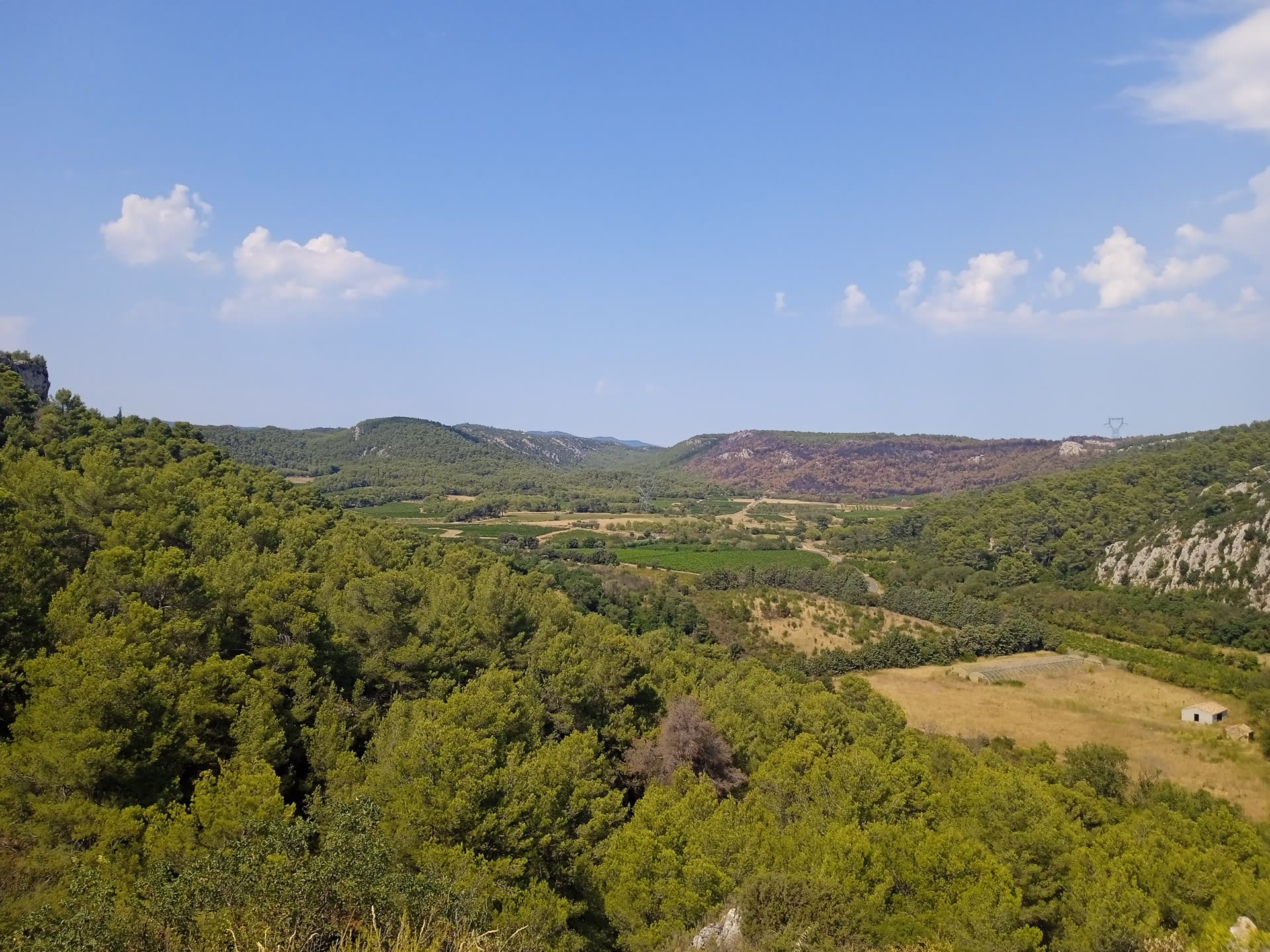
Pictured: the vineyard and valley landscape around Bize-Minervois, Aude, viewed from the Tour de Boussecos. Photographed in 2025 by Wikimedia contributor Enrevseluj; not a photograph of the object or of either witness. Licensed CC BY-SA 4.0 via Wikimedia Commons.
Theoretical Alignment
This case's evidentiary profile is dominated by two structural weaknesses this file weighs heavily: a four-year gap between the sighting and any formal investigation, and documented cross-contamination between its only two witnesses before that investigation ever began. The Psycho-Social Hypothesis receives the largest share of alignment on the strength of a specific, physically detailed conventional candidate — a crop-spraying helicopter — that matches the witnesses' own described object with a precision this file finds difficult to dismiss as coincidence. The Extraterrestrial Hypothesis retains modest alignment specifically because GEPAN's own trained investigators, working directly from the same testimony, concluded the sighting could not be attributed to any known phenomenon; a formal government classification of "unexplained" carries real evidentiary weight on this site even when this file's own independent analysis, detailed under Material Analysis below, reaches a different practical conclusion.
Background
Bize-Minervois is a small wine-growing commune in the Aude department of southern France, on the Cesse river a short distance from Narbonne, within the Minervois wine appellation. The sighting this file documents actually occurred a few kilometers away, on the D20 road near the neighboring commune of Agel, technically across the departmental line in Hérault — but the case has always been known by the name of the larger, more recognizable village nearest the site, a naming convention this file follows for consistency with the existing UFO literature while noting the geographic distinction plainly here.
The case belongs to a broader body of French sightings investigated years after the fact by GEPAN (Groupe d'Étude des Phénomènes Aérospatiaux Non-identifiés), the unusual French government body created within CNES, the national space agency, specifically to apply scientific method to reported UFO sightings — a mandate essentially without parallel anywhere else in the world at the time. This site's own Cussac Close Encounter file documents a structurally similar case from the same GEPAN case-selection process, also later subjected to the same helicopter-based skeptical reanalysis discussed at length below.
Unlike many cases in this archive, this one benefits from an unusually well-documented paper trail specifically because it was formally investigated by a government scientific body using a standardized methodology, and because that same investigation file was later obtained, quoted extensively, and critically reassessed by independent skeptical researchers. This combination — official government "unexplained" classification on one hand, detailed retrospective skeptical reconstruction on the other — makes this case an unusually clear test of how much weight a formal classification like "PAN D" should actually carry, a question this file returns to throughout.
GEPAN's classification system itself, still used in essentially its original form by its present-day successor GEIPAN, assesses each case along two separate axes: the internal consistency of the collected data, and the degree of residual strangeness remaining once every known-phenomena explanation has been tested against that data. The system's own stated logic is that the greater a case's apparent strangeness, the greater the data consistency required before it can be validated as genuinely unexplained — a demanding internal standard this file returns to directly when assessing whether this specific case's own data actually met that bar, given the documented witness contamination and investigative gaps discussed at length below.
Complete Timeline
| Date | Event |
|---|---|
| January 14, 1974, ~10–11 a.m. | 12½-year-old "G.B." reports a hovering, rounded, glassy object about 50m above a nearby hill while pruning vines with his older brother, who reportedly saw nothing |
| January 14, 1974, shortly before noon | 65-year-old winegrower "H.G." reports a gray-green object with a glazed canopy near the D20 road at Agel, watching it for roughly four minutes before it departed north toward Saint-Chinian |
| ~January 21, 1974 | H.G. learns of G.B.'s sighting via the boy's grandfather, roughly a week after the event; the two accounts begin to be discussed and compared |
| March 1974 | Ufologist M. Grazzioli publishes the first account of the case in the amateur bulletin Lumières dans la nuit, no. 136 |
| March 17, 1974 | H.G. sends a corrective letter to Grazzioli regarding details of his account |
| June–July 1974 | Lumières dans la nuit, no. 138, reprints diagrams of the sighting |
| May 1, 1977 | GEPAN is formally created within CNES under founding director Claude Poher |
| May 5, 1978 | Poher publicly describes the case, among GEPAN's "best" investigated sightings, in Paris-Match no. 1570 |
| March 6–7, 1978 | Four GEPAN investigators, including a young Jean-Jacques Velasco, conduct the only formal field investigation, four years after the event; the two witnesses had spoken again just two days prior |
| June 1978 | GEPAN presents its findings and "PAN D" classification to its Scientific Council as CNES/CT/GEPAN n°0140, tome 2, annexe 2 |
| 2004 | Researchers David Rossoni, Éric Maillot, and Éric Déguillaume visit the site and interview locals for their forthcoming critical study; both original witnesses had since died |
| 2007 | Rossoni, Maillot & Déguillaume publish Les OVNI du CNES, devoting Chapter 11 to a detailed critical reconstruction proposing a crop-spraying helicopter explanation |
| 2008–2009 | The authors publish an English-language condensation in Skeptical Inquirer; GEIPAN director Jacques Patenet agrees to review dozens of similarly disputed "D" classifications |
The Two Sightings
Because this case rests on exactly two accounts, and because those accounts differ from each other in several material respects even before any contamination is considered, this file presents each witness's own reported observation separately before addressing how and where they came to influence one another.
G.B.'s Account
The younger witness, twelve and a half years old at the time, was cutting vine shoots ("taille des vignes") with his older brother when he noticed a silent, hovering object roughly 50 meters above a nearby hill, some 200–300 meters away. He estimated it larger than a car — roughly 7–9 meters — rounded, with a prominent glassy surface, a color he recalled as green (GEPAN's own report records gray) and a bluish glow around it. After tilting slightly, the object moved and disappeared behind another hill within about eight seconds. As it departed, he reported seeing two V-shaped rods tipped with small balls, which he likened to a television antenna, and heard a whistling sound he compared to the buzz of an electrical transformer. His older brother, standing beside him, reported seeing nothing unusual despite G.B. drawing his attention to it. G.B. mentioned the sighting at lunch and was not believed by his family until, roughly a week later, his grandfather learned of H.G.'s separate report and the two accounts were connected.
H.G.'s Account
The older witness, a 65-year-old winegrower, was driving on the D20 road near Agel shortly before noon the same day when his attention was caught by a light he described as resembling "a reflection off a windowpane" (reflet lumineux « comme sur une verrière »), coming from a gray-green object he initially judged to be roughly 650 meters away, motionless despite a south wind. After about a minute of driving observation, he stopped his car and got out to watch on foot. The object's front carried a rounded, glazed bulge roughly 2.5 meters high; from a certain angle he could make out what appeared to be a rectangular platform beneath it, which he estimated at roughly 6 meters long, 4.5 meters wide, and 0.6 meters thick. It "vibrated" slightly, then moved silently roughly 500 meters (GEPAN's own recalculation put the figure closer to 350 meters) at low altitude over the vineyards, at approximately the speed of a small touring aircraft, along a roughly straight path. It hovered again for one to two minutes above the vines, executed a 90-degree turn, and departed north toward Saint-Chinian, shrinking to the apparent size of a ping-pong ball before vanishing after ten to fifteen seconds at an elevation of roughly 17 degrees. H.G.'s total observation lasted approximately four minutes — considerably longer, and from considerably farther away, than G.B.'s.
This file notes directly that no primary source reviewed here describes the object emitting a directed beam of light, a detail present in some later secondhand retellings of this case but not supported by either witness's own recorded testimony as quoted in GEPAN's file; both accounts instead describe a reflective glint or glow off a glazed surface. This file corrects that discrepancy here rather than repeating it uncritically, consistent with this site's general practice of fixing rather than perpetuating errors found in secondary UFO literature. The "beam of light" version of the story appears to be a later embellishment introduced somewhere in the case's decades-long journey through secondary ufological retellings, a drift this file notes as a useful cautionary example in its own right: even a case with an unusually well-documented primary investigation file is not immune to accumulating inaccurate detail once it circulates widely enough through summaries of summaries, each one slightly compressing or reshaping the original testimony.
The Contamination Problem
The two witnesses were not strangers who separately, independently came forward to authorities or ufologists. H.G. learned of G.B.'s sighting through the boy's grandfather roughly a week after the event, and the two subsequently met and discussed their respective observations — first around the time of the original 1974 ufologist inquiry, and again, critically, just two days before GEPAN's own March 1978 field investigation. GEPAN's own assigned psychosociologist documented this cross-contamination directly and explicitly in the investigation file: G.B. was recorded repeating H.G.'s claimed sighting location rather than his own original position, and specific disputed details — including who had reported seeing the antenna-like rods versus who had reported a colored flame or glow — had become interchangeable between the two accounts by the time investigators arrived.
This file treats this documented contamination as a central, load-bearing weakness of the case rather than a minor procedural footnote. The basic evidentiary principle GEPAN's own methodology is supposed to rest on — that independent, mutually uninfluenced testimony from separate witnesses corroborating one another meaningfully strengthens a case — simply does not apply here in its strongest form, since the witnesses had years of unsupervised contact, including contact immediately preceding the formal investigation itself, well after the case had already become locally known and discussed. In the framing used by the case's own later skeptical reviewers, testimony of this kind can, in strict evidentiary rigor, only really be counted as a single account corroborated by itself rather than as two independently confirming reports.
This file also weighs a further, more subtle version of the same problem: even setting aside the direct contact between H.G. and G.B., both men lived in a small rural community where the story had already circulated locally, through family members, neighbors, and the March 1974 Lumières dans la nuit article, for four full years before GEPAN's investigators ever arrived to take formal statements. Ordinary social reinforcement of a story over that length of time — retellings at family gatherings, casual conversations with neighbors who had heard some version of events, the natural tendency for a story to sharpen and simplify with each repetition — can shape a witness's own eventual "final" account in ways that have nothing to do with deliberate collusion and everything to do with the well-documented general unreliability of long-delayed memory, a concern this file notes applies independently of, and in addition to, the specific direct contact between the two witnesses that GEPAN's own psychosociologist documented.
Key Witnesses
H.G. (Unregistered)
Anonymized to initials throughout GEPAN's own official file and never publicly named in any source this file located. Reported the more detailed, longer-duration, and more distant of the two sightings, from the D20 road near Agel. Locals interviewed by later researchers in 2004 (after his death) described him as a well-liked local character with "a tendency to exaggerate and invent bar-room stories," while also noting that, oddly, none of them recalled ever having heard this specific story from him despite UFOs being a common topic of local conversation at the time.
G.B. (Unregistered)
Also anonymized to initials in GEPAN's file. Reported a shorter, closer-range sighting while pruning vines with his older brother, who saw nothing. Separately known locally for having reported an unrelated "red streaking light" sighting to his schoolteacher, a detail this file notes as potentially relevant context for assessing his general disposition toward reporting anomalous sky phenomena, without treating it as disqualifying on its own.
Claude Poher
Founded GEPAN within CNES in May 1977 and personally selected this case, alongside the Cussac and Sauvigny-le-Bois cases, as one of the group's three best-investigated sightings from its first eighteen months of operation. Publicly described the object in Paris-Match in May 1978 as having exhibited "aeronautical behavior" that could not be explained by the "flying-saucer myth."
Jean-Jacques Velasco
One of four GEPAN investigators who conducted the March 1978 field visit to Agel and Bize-Minervois, at a point in his career predating his later, better-known tenure as director of GEPAN's successor body, SEPRA, from 1983 to 2004.
Éric Maillot
With co-authors David Rossoni and Éric Déguillaume, conducted the 2004 site visit and archival research underlying the detailed critical reconstruction and proposed crop-spraying helicopter explanation discussed at length under Material Analysis below, published in Les OVNI du CNES (2007) and condensed for English-language readers in Skeptical Inquirer the following year.
The Five Observables Assessment
Applying the standard Five Observables framework to a single low-altitude, low-speed hovering-and-departing object reported by two non-independent witnesses is necessarily limited, but this file runs the comparison for consistency with every other case in this archive.
Assessment: Neither witness described sudden or extreme acceleration directly; both described a gradual hover, a slow horizontal transit over the vineyards, and a gradual, shrinking departure. GEPAN's own reconstructed departure speed calculations (600–1,800 km/h, discussed in full below) are a computed inference from angular measurements, not something either witness directly reported experiencing, and this file flags that distinction as significant: the case's only "instant acceleration" data point is an artifact of GEPAN's own analysis rather than of the underlying testimony.
Evidence Assessment
This case's evidentiary profile combines a formally documented government field investigation, using genuine measurement instruments and a trained psychosociologist, with exactly two witnesses whose testimony was demonstrably cross-contaminated well before that investigation occurred.
Supporting Anomalous Origin
- GEPAN's four trained investigators, working directly from the primary testimony and site measurements, formally concluded the sighting "cannot be attributed... to any known phenomenon"
- The two original accounts, before contact, described broadly similar object characteristics (rounded shape, glazed/glassy surface, gray-green coloring, silence) from two different vantage points
- Neither witness had any documented history of hoaxing, and H.G.'s reputation as a raconteur was, per later local interviews, not specifically associated with this particular story by neighbors who otherwise knew him well
Supporting Conventional Explanation
- The two witnesses' testimony was demonstrably cross-contaminated on at least two separate occasions before GEPAN's investigation, including two days immediately prior to the formal 1978 visit
- GEPAN's own report contains an internal date inconsistency (January 14 versus January 18) never resolved in the file itself
- The described object's dimensions, glazed bulging canopy, rear pods, V-shaped antenna-like rods, and rectangular "platform" underneath closely match the profile of a period agricultural spray helicopter (such as an Alouette II) performing a routine vineyard treatment
- GEPAN's weather data was drawn from a station 47 kilometers away rather than the sighting site itself, and its own report separately notes local valley winds inconsistent with that distant reading
- GEPAN's own internal date inconsistency — January 14 in the report's opening summary versus January 18 in other numerical data elsewhere in the report and in H.G.'s own transcribed testimony — was never identified or resolved within the file itself, a basic internal quality-control failure independent of any question about the object's actual identity
- GEPAN's investigators never contacted the vineyard's owner to check for a scheduled spraying operation on the date in question — a basic verification step this file, like the case's later skeptical reviewers, considers a significant omission
- The assigned psychosociologist's own documented concerns about witness reliability were not reflected in the investigation's final published conclusions
Why "Disputed"
This file assigns the Bize-Minervois Sighting a DISPUTED classification, deliberately declining to simply adopt GEPAN's own official "PAN D" (unexplained) rating at face value. It is not rated as Debunked, because no source located by this file's research definitively confirms a specific helicopter was operating at the specific reported time and location — the crop-duster explanation, however well it matches the physical description, remains a compelling proposed reconstruction rather than a confirmed identification with, for instance, a named pilot, flight log, or spraying-company record. It is not rated as Unexplained in the same sense GEPAN's own file uses that term, because this file finds GEPAN's investigation itself methodologically incomplete in specific, documented ways: distant weather data, no verification of scheduled agricultural operations, and a published conclusion that did not fully reflect its own psychosociologist's contemporaneous concerns about witness contamination.
This file treats the gap between GEPAN's formal classification and what its own underlying investigation file actually documents as this case's single most important analytical feature — a demonstration that an official government "unexplained" rating, however genuinely earned through real scientific procedure, is not the same thing as a rating that has actually eliminated every plausible conventional explanation, and should be read by researchers accordingly rather than treated as a final word. Readers should not take this file's own disagreement with GEPAN's specific 1978 conclusion as a broader dismissal of GEPAN's institutional legitimacy or of the general value of government-sponsored UFO investigation; the same organization's later, more thoroughly instrumented cases, including Trans-en-Provence, demonstrate real methodological improvement over time, and this case's own documented shortcomings are best read as evidence of an early-career institution still refining its own investigative standards rather than as evidence the underlying project was misconceived.
Sensor & Instrumentation Detection Profile
No contemporaneous instrumentation of any kind was used at the time of the January 1974 sighting itself; the only instrumented data in this case comes from GEPAN's March 1978 field reconstruction, four years later, using a theodolite, compass, chronometer, and inclinometer to recalculate the object's likely distance, size, and speed from the witnesses' angular descriptions and the physical geography of the site. This file weighs this retrospective instrumentation as methodologically valuable in principle — it is a genuine attempt to convert subjective testimony into checkable geometric figures — while noting that its outputs are only as reliable as the four-year-old angular estimates and recollections it was built from, and that its own resulting departure-speed calculations (600 to as much as 1,800 km/h) sit in some tension with the witnesses' own description of a gradual, non-explosive departure.
Environmental & Geospatial Context
The sighting site sits in vineyard terrain along the D20 road near Agel, Hérault, in the Cesse river valley a short distance from Bize-Minervois, Aude, within the broader Minervois wine appellation between the Narbonne coastal plain and the limestone plateaus of the Montagne Noire foothills. The area was, and remains, active viticultural land, with vine rows running in the long, straight lines characteristic of commercial wine-growing — terrain this file notes is also exactly the kind of geometry that produces the straight-line, row-following flight paths and near-right-angle turns typical of low-altitude agricultural spraying operations, a pattern the case's later skeptical reviewers argue matches H.G.'s described flight path closely.
GEPAN's own weather data for the case was drawn from a meteorological station in Carcassonne, roughly 47 kilometers from the sighting site — a significant distance for micro-local wind and visibility conditions in hilly vineyard terrain. The same GEPAN report separately notes locally observed south valley winds inconsistent with the distant station reading, a discrepancy this file treats as a genuine data-quality weakness in the investigation rather than a resolved detail. Immediately south of the site, the Cesse river's resurgences are known to produce audible rushing-water noise; since the object was reported departing to the north, this file notes such ambient noise could plausibly have masked rotor or engine sound reaching the witnesses, an acoustic factor GEPAN's own report does not appear to have directly addressed.
Observer Credibility & Occupational Profile
H.G.'s occupation as a longtime local winegrower gave him direct, practical, decades-long familiarity with exactly the kind of agricultural aircraft operations this file's own preferred conventional explanation involves — a background this file weighs as cutting in two directions at once. On one hand, a witness intimately familiar with ordinary crop-spraying helicopters operating over local vineyards would seem, at first glance, less likely to misidentify one; on the other, GEPAN's own record of local interviews found that helicopter spraying was reportedly less common specifically in the hillier northern part of the Minervois vineyard area (versus the flatter south), meaning an unfamiliar sight in his own usual territory could plausibly have startled even an experienced local observer into an unconventional interpretation, particularly given the unusual viewing angle and the sun's reflection off the aircraft's canopy.
G.B.'s status as a twelve-year-old witnessing an unfamiliar object from a genuine distance, in the company of an older brother who reported seeing nothing at all despite being directed to look, is a specific and significant credibility factor this file weighs carefully. The brother's null observation does not, on its own, disprove G.B.'s account — attention, field of view, and momentary distraction can easily explain one person noticing something a companion misses — but it does mean G.B.'s report has no genuinely independent corroboration from the one person best positioned to provide it, a gap distinct from, though related to, the separate contamination problem involving H.G. discussed above.
GEPAN's own assigned psychosociologist — identified in the case's later skeptical reconstruction only by her initials, "F.A.," and affiliated with the Université René Descartes (Paris V) — represents this case's most direct professional credibility assessment, and her documented inability to interview G.B. alone, as the group's own standard methodology required, is itself a specific, named procedural failure this file weighs directly against the full rigor GEPAN's investigation is often credited with elsewhere. When later asked why the investigation's published conclusions did not more fully reflect her own contemporaneous concerns about witness reliability, she reportedly declined to answer — a detail this file notes without further speculation as to her reasons.
This file also weighs the specific institutional position GEPAN's four-person investigating team occupied in March 1978, less than a year after the group's own founding. A newly created scientific body, working under close public and internal scrutiny to demonstrate the seriousness and legitimacy of its own novel mandate, may reasonably have felt pressure to reach conclusions that justified its continued existence and funding within CNES — a structural incentive this file notes as a plausible contributing factor to the gap between the psychosociologist's own documented reservations and the investigation's ultimately published "unexplained" conclusion, without asserting this dynamic as proven in this specific instance. Claude Poher's own public description of the case in Paris-Match, occurring the same month GEPAN's findings were presented to its Scientific Council, situates this case directly within the group's broader effort to establish its own public credibility during its critical early period.
Physical & Material Assays
No photograph, film, or physical trace evidence of any kind exists for this case. No ground marks, burn traces, or recovered material were reported by either witness or documented by GEPAN's 1978 investigators, four years after the fact, by which point any such transient traces would in any case have long since disappeared under ordinary agricultural use of the land. This file treats the total absence of physical evidence as consistent with, though not proof of, either candidate explanation weighed in this case: a genuine anomalous craft leaving no trace is unfalsifiable in the same way a routine helicopter overflight leaving no trace is entirely unremarkable, and this specific category of evidence therefore cannot meaningfully discriminate between the two explanations here.
This file also notes what a genuine crop-spraying operation would and would not be expected to leave behind by the time of any investigation, whether four years or four days later: residual pesticide traces on vine foliage are rapidly diluted by weather and further agricultural treatment, spray-pattern marks on soil are erased by the very cultivation and irrigation cycles a working vineyard undergoes continuously, and no aviation authority in 1970s rural France routinely retained detailed flight logs for short local agricultural charter flights of the kind this file's preferred explanation involves. The absence of physical evidence corroborating a helicopter overflight is therefore no more surprising, or no more suggestive of anomaly, than the absence of physical evidence corroborating an unconventional craft — both explanations predict essentially the same evidentiary outcome, a genuinely null physical record, which is precisely what this case in fact has, and this file weighs that shared prediction as one further reason the physical-evidence category cannot, on its own, settle the question either way in this specific case.
Historical Precedents & Archive Matches
This case sits within a specific, well-documented tradition on this site: GEPAN's own formative case-selection process in its first years of operation, and the later systematic skeptical re-examination of that same body of "best" cases decades afterward.
GEPAN's Founding and the 1978 "Best Cases" Selection
Claude Poher founded GEPAN within CNES on May 1, 1977, after years of lobbying within the agency following a 1969 meeting with American astronomer J. Allen Hynek, who showed him old U.S. Air Force case files during preparation of a Skylab experiment. Poher subsequently studied the Condon Report and conducted private statistical UFO analyses before persuading CNES director-general Yves Sillard to authorize the group's creation — making GEPAN, and its later successors SEPRA (from 1988) and GEIPAN (from 2005), a genuinely unusual institution: a national space agency's own standing scientific body for investigating civilian UFO reports, with no direct equivalent anywhere else in the world at the time. This case was one of three Poher personally selected, alongside Cussac and Sauvigny-le-Bois, as GEPAN's best-investigated sightings from its first eighteen months, a selection this file notes was made by the group's own founding director specifically to showcase its methodology's strengths — making its later, documented procedural gaps all the more significant as a test case.
The Cussac Parallel
This site's own Cussac Close Encounter file documents a strikingly similar pattern: another of GEPAN's own selected "best" cases, later subjected to the same helicopter-based conventional reanalysis by the same team of skeptical researchers, using the same core method of cross-referencing physical details recorded in GEPAN's own file against known aircraft profiles. This file treats the recurrence of essentially the same critique — a physically plausible aircraft explanation GEPAN's own investigators considered and rejected using reasoning the later reviewers found methodologically weak — across two of GEPAN's three flagship early cases as a meaningful pattern in its own right, independent of the specific merits of either individual case. That two of Poher's own three hand-selected "best" cases would later attract essentially the same category of skeptical reanalysis is, in this file's own assessment, more consistent with a systemic methodological blind spot in GEPAN's early investigative approach to aircraft-shaped objects specifically than with mere coincidence, though this file stops short of asserting the same critique would necessarily apply to GEPAN's later, more mature case files from the 1980s onward, several of which (including Trans-en-Provence) involved considerably more rigorous physical sample analysis unavailable to the group's earliest investigators in 1978.
The GEIPAN Classification Revision
GEIPAN's own published statistics at the time of its 2007 public relaunch put "D" (unexplained) cases at roughly 28% of its full catalog; following the 2007–2008 publication of Les OVNI du CNES and subsequent direct engagement between its authors and then-GEIPAN director Jacques Patenet, that proportion was revised sharply downward in later published statistics, to a figure closer to 3%, as dozens of previously "D"-classified cases were re-examined and reclassified. This file treats that documented, large-scale downward revision as directly relevant background for evaluating this specific case's own "D" classification: it demonstrates that GEIPAN's own institutional confidence in a meaningful share of its historical "unexplained" ratings did not survive sustained, detail-level external scrutiny of the kind this specific case has also now received.
This file's own research was unable to confirm whether this specific case was among the dozens formally reclassified during that later review process, since GEIPAN's public case catalog did not surface a confirmed entry for this event under any search terms this file's research attempted. That gap is itself worth stating plainly: it means this case's official status, as far as this file's own research could establish, may still formally stand as "PAN D" within GEIPAN's records even though the specific reasoning behind that original 1978 classification has since been directly and, in this file's own assessment, persuasively challenged in published form. A reader seeking the current, authoritative official status of this specific case is directed to contact GEIPAN directly, using the search link provided under Declassified Government Records below.
The Broader Pattern of "D"-Class Cases Involving Aircraft
Beyond Cussac specifically, the case's own later reviewers argue that a meaningful share of GEPAN and SEPRA's historical "unexplained" classifications, examined collectively across their full published body of work, involve objects whose described dimensions, flight behavior, and visual characteristics plausibly match ordinary aircraft — helicopters, light planes, and, in some cases, military aircraft operating under conditions or altitudes unfamiliar to civilian witnesses. This file treats that broader pattern claim as a reasonable, if necessarily generalized, observation rather than a proven statistical finding for the full catalog, since a comprehensive independent re-audit of every GEPAN/SEPRA "D" case against aircraft flight-log data was well beyond what this file's own research was able to undertake. Applied specifically to this case, however, the pattern claim gains considerable force precisely because the described object's dimensions, canopy, rear pods, antenna-like booms, and flight geometry match a light agricultural helicopter in a level of specific, itemized detail this file has not found matched this closely in comparably scrutinized cases elsewhere in this archive.
Material Analysis
This case's central analytical question is whether the physical object both witnesses described can be reasonably accounted for by an ordinary aircraft performing a routine agricultural task — and, separately, whether GEPAN's own stated reasons for rejecting that explanation actually hold up under scrutiny.
The Crop-Spraying Helicopter Hypothesis
Researchers David Rossoni, Éric Maillot, and Éric Déguillaume, working directly from GEPAN's own 1978 file, argue the described object matches a light agricultural helicopter — such as an Alouette II, the same aircraft type these researchers separately implicate in the parallel Cussac case — with a precision this file finds genuinely striking once laid out point by point: the craft's overall proportions (roughly 6–7 meters long, 4.5 meters wide, 2.5 meters high) match a light helicopter airframe; the described "bulging, ribbed glazed cabin reflecting the sun" matches a helicopter's canopy; the "two volumes behind the cabin" match chemical-tank pods; the "V-shaped antennas tipped with balls" match agricultural spray booms; and the "rectangular plate" H.G. described beneath the object matches the fine rectangular curtain of mist produced during pesticide dispersal. The reported flight behavior — hovering nose-level, then tilting nose-down before moving, flying very low over vine rows in straight-line runs, and executing near-right-angle turns at row ends — matches routine crop-dusting flight patterns closely. Winter vineyard treatments against diseases such as excoriose and flavescence dorée, both common in humid zones near watercourses like the nearby Cesse, historically did occur around mid-January using arsenate-based sprays since banned.
Why GEPAN Did Not Accept the Helicopter Explanation
GEPAN's own "known phenomena test matrix" assigned the helicopter hypothesis a stated "probability of mistake" of zero, reasoning in part from an angular size described as spanning "several degrees" — but this file notes, following the case's later reviewers, that H.G. himself estimated the object's length at roughly 7 meters, notably smaller than GEPAN's own separately calculated figure of 15.5 meters derived from the same angular data, a discrepancy that undermines confidence in the angular-size reasoning GEPAN used to rule out a helicopter. GEPAN's investigators separately judged a helicopter "impossible" citing the object's apparent speed, absence of engine noise, and "strong accelerations" — yet, as this file notes above, GEPAN's own reconstructed departure speeds of 600 to as much as 1,800 km/h directly contradict the witnesses' own description of a gradual, non-explosive departure, meaning this specific objection appears to rest on GEPAN's own extrapolated calculation rather than on anything either witness actually reported experiencing.
This file also weighs two further, more basic investigative gaps: GEPAN's report never contacted the vineyard's owner to check for a scheduled spraying operation on the day in question, a verification step this file considers elementary given how directly it bears on the case's central question; and the weather data GEPAN did use came from a station 47 kilometers away, at Carcassonne, despite the same report separately noting local wind conditions inconsistent with that distant reading. Taken together, this file's own assessment is that GEPAN's stated grounds for rejecting the helicopter explanation do not, on close examination, actually rule it out — a conclusion consistent with the case's later skeptical reviewers' own published verdict that "none of GEPAN's stated arguments actually rules out the helicopter hypothesis." This file's own independent review of the same underlying file reaches the identical conclusion through its own separate reasoning above, which this file considers a meaningful point in its favor: two independent analyses of the same primary evidence, conducted decades apart and for somewhat different purposes, converging on the same specific structural criticism of GEPAN's own original stated reasoning in this particular case, independently and quite separately arrived at by each of these two distinct parties, working years apart.
The Date Discrepancy
GEPAN's own report states the sighting date as January 14, 1974 on its first page, yet elsewhere in the same document — including in other numerical data (p. 28) and in the transcript of H.G.'s own recorded testimony — the date January 18 appears instead, even though the report's meteorological conditions are themselves recorded for January 14. The case's later reviewers treat January 14 as the correct date, corroborated independently by the March 1974 Lumières dans la nuit article written only weeks after the event, and treat the 18th as a clerical or transcription error introduced somewhere in GEPAN's own four-years-later reconstruction process. This file adopts the same reading, while noting that an internal date inconsistency of this kind, however minor in itself, is a further small but genuine indicator of the broader evidentiary degradation a four-year investigative delay can introduce even into an otherwise carefully conducted formal inquiry. A discrepancy of this specific kind — small, internally inconsistent, and never flagged or resolved by the investigators who produced the document containing it — is exactly the sort of quality-control failure that becomes more likely, not less, the longer an investigation is delayed after the underlying event, since transcription and cross-referencing errors accumulate more easily when investigators are working from secondhand recollections and years-old correspondence rather than fresh, directly comparable notes taken close to the event itself.
The Conventional Explanation Candidate: A Crop-Spraying Helicopter, Misjudged in Size and Distance
As with several other candidate-explanation sections on this site, the analysis below weighs multiple broad possibilities against each other rather than treating GEPAN's own "PAN D" classification as automatically final, given the specific, documented weaknesses in that classification's own supporting reasoning detailed above.
Agricultural Helicopter, Misperceived Under Unusual Viewing Conditions
This candidate treats the object as a genuine, ordinary light helicopter performing routine winter vineyard spraying, observed from an unfamiliar angle, at an unfamiliar distance, with sunlight reflecting unusually off its canopy, by a witness (H.G.) who, per his own estimate, badly underjudged its true size and by a second witness (G.B.) whose account had, by the time of formal investigation, already become entangled with the first. This file finds this the best-supported single explanation for the case as a whole: it accounts for the object's described proportions, canopy, rear pods, antenna-like booms, underside "platform," and characteristic flight behavior in close, specific detail, and it is not defeated by GEPAN's own stated objections, which this file's own review, detailed above, finds do not actually withstand scrutiny. This candidate also has the specific virtue of requiring no single implausible coincidence stacked on top of another: a routine winter vineyard treatment, an unfamiliar viewing angle, a startling glint of sunlight off a canopy, and two witnesses independently, honestly misjudging the size and nature of what they saw is, taken together, a considerably less demanding account than one requiring an unidentified craft of unknown origin to have coincidentally chosen this specific ordinary vineyard, on this specific ordinary morning, for an otherwise undocumented appearance.
Genuine Unexplained Craft (Taking GEPAN's Classification at Face Value)
This candidate treats GEPAN's own "PAN D" classification as the appropriate final word: a formally trained team of government investigators, using calibrated instruments and a structured methodology, concluded after direct site work that the object could not be attributed to any known phenomenon. This file finds this candidate plausible only in the narrow sense that GEPAN's classification is a real, earned data point deserving genuine weight — but weighs it as less well-supported than the helicopter candidate above, given the specific, documented gaps in GEPAN's own investigation (distant weather data, no verification of scheduled agricultural operations, a psychosociologist's contemporaneous concerns not fully reflected in the published conclusions) that this file's own independent review was able to identify directly within GEPAN's own file.
Deliberate Fabrication or Hoax
This file's own research located no evidence of any coordinated fabrication by either witness, no financial or attention-seeking motive documented for either, and specifically notes that local residents interviewed decades later, in 2004, did not recall H.G. telling this particular story despite knowing him as a raconteur prone to embellishment generally — a detail this file weighs as mildly favoring genuine, if potentially mistaken, testimony over deliberate invention. This file considers deliberate fabrication the least plausible of the candidates weighed here, while noting that a genuine misidentification, honestly reported and then unintentionally reinforced through repeated later contact between the two witnesses, remains fully compatible with both witnesses acting in complete good faith throughout.
This file also weighs a specific detail sometimes cited elsewhere in this archive as a hoax indicator — a child witness's later corroboration of an adult's account — and finds it does not meaningfully strengthen a fabrication reading here. G.B. reported his own sighting independently, hours before he had any knowledge of H.G.'s separate report, to his own family, who did not believe him; it was only afterward, once his grandfather connected the two stories, that any contact between the accounts began. A coordinated hoax constructed from the outset would ordinarily be expected to produce two accounts that already matched cleanly on first contact, rather than a pattern — documented directly in GEPAN's own file — of specific details continuing to shift and align only after repeated later conversation between the witnesses, a pattern this file finds considerably more consistent with two honestly, if imperfectly, remembered independent observations gradually converging through ordinary social contact than with any form of prearranged fabrication.
Agricultural Helicopter, Misperceived
PlausiblePLAUSIBLE. Matches the described object's physical details and flight behavior closely; GEPAN's own stated objections do not hold up under this file's own review.
Genuine Unexplained Craft
InconclusiveINCONCLUSIVE. A real, formally earned government classification, but one this file finds rests on an incomplete underlying investigation.
Deliberate Fabrication
ImplausibleIMPLAUSIBLE. No documented motive for either witness, and no local corroboration of H.G. ever previously telling this specific story.
Related Cases
Confirmed Documents & Official Records
Unlike many cases in this archive, this one has a confirmed official government file: Claude Poher et al., "Enquête sur l'observation du 14.01.74 à Bize en Minervois (Aude)," presented to GEPAN's Scientific Council as part of Présentation au Conseil scientifique du G.E.P.A.N. des études menées pendant le premier semestre 1978, CNES/CT/GEPAN n°0140, Toulouse, June 1978, tome 2, annexe 2. This file's own research was unable to locate a freely accessible digitized copy of the original annex; direct quotations relied upon throughout this file are drawn from the extensive excerpts published by researchers Rossoni, Maillot, and Déguillaume in their 2007 critical study. GEIPAN's present-day public online case catalog was searched but did not surface a confirmed public case-ID entry for this specific event under its current classification system.
Search Government & Official Archives Directly
Further Reading — Recommended Literature
This site's own Essential Reading feature on Les OVNI du CNES covers Rossoni, Maillot & Déguillaume's full critical treatment of this case and GEPAN's broader thirty-year history; the four titles below broaden that coverage across the French government's official UFO investigation program and general skeptical investigative methodology.
Les OVNI du CNES
The primary published source for this case's critical reconstruction, including the crop-spraying helicopter analysis discussed at length above.
Les OVNI et la défense: À quoi doit-on se préparer?
Another major French government-adjacent UFO study, useful context for the broader institutional tradition GEPAN belongs to.
UFO Investigations Manual
A practical guide to field investigation methodology, directly relevant to evaluating GEPAN's own procedural choices in this case.
UFO Sightings: The Evidence
A general skeptical framework for evaluating mundane explanations against UFO testimony, applicable to this case's central evidentiary question.
The French UFO Wave of 1954
Broader historical context for France's distinctively long and organized tradition of civilian and official UFO investigation.
DISCLOSURE: Some links above are affiliate links. If you purchase through them, OverClassified receives a small commission at no additional cost to you. This helps support this site's continued independent research work.
Essential Viewing
Sources
- Rossoni, David; Maillot, Éric; Déguillaume, Éric. Les OVNI du CNES: 30 ans d'études officielles (1977–2007), Chapter 11. Book-e-Book, 2007. zetetique.fr
- Rossoni, Maillot, Déguillaume. Les OVNI du CNES, Chapter 9 (GEPAN 1978 methodology). zetetique.fr
- Rossoni, Maillot, Déguillaume. Les OVNI du CNES, Chapter 2 (GEPAN organizational history, 1977–1988). zetetique.fr
- "Les OVNI du CNES: trente ans d'études officielles (1977–2007)." Observatoire Zététique. zetetique.fr
- Rossoni, Maillot, Déguillaume. "UFOs: An Assessment of Thirty Years of Official Studies in France." Skeptical Inquirer, Jan/Feb 2009, pp. 47–51. skepticalinquirer.org
- "Remember BIZE-MINERVOIS" forum thread. ufo-scepticisme.forumactif.com
- AFIS. "Trente ans d'études du CNES, OVNI et extra-terrestres." afis.org
- "Aux origines du Geipan, l'organisme français dédié à l'étude des ovnis." Slate.fr. slate.fr
- "GEIPAN." French Wikipedia. fr.wikipedia.org
- "GEIPAN." English Wikipedia. en.wikipedia.org
- "Missions, Methods and Results." GEIPAN official site. cnes-geipan.fr
- "Bize-Minervois." English Wikipedia. en.wikipedia.org
- "Agel." English Wikipedia. en.wikipedia.org
- Claude Poher biography. rr0.org. rr0.org
- "Claude Poher." French Wikipedia. fr.wikipedia.org
- GEIPAN case search interface. geipan.fr
- "File: Paysage du haut de la tour de Boussecos.jpg." Wikimedia Commons (photograph by Enrevseluj, 2025, CC BY-SA 4.0). commons.wikimedia.org
- This site's own Cussac Close Encounter file.
- This site's own Amarante Incident file.
- This site's own Trans-en-Provence Sighting file.
See something inaccurate? Have additional information or sources?
Suggest an Edit →Last Updated: August 2026