
The Amarante Incident
Shortly after noon on October 21, 1982, an anonymous cellular-biology researcher in his thirties reported an oval, metallic-and-translucent object descending silently into his small backyard garden in Laxou, a residential suburb of Nancy in northeastern France, where it hovered roughly a meter above the lawn for about twenty minutes before departing vertically at high speed. Days later, a border of amaranth flowers planted less than a meter from the site was found severely dehydrated, and GEPAN — the French national space agency's official UAP-investigation unit — conducted a formal scientific inquiry that gave the case its name: Note Technique n°17, “L’Amarante.” Nearly forty-four years later, the case remains one of GEPAN's small number of officially unresolved “PAN D” files, and one this site's own research found still carries an unresolved discrepancy at its very center — no two secondary sources agree on the witness's own name.

Pictured: Place Stanislas, the historic central square of Nancy, France, a few kilometers from the Laxou garden where the sighting occurred. Not a photograph of the object, the witness, or the garden itself. The witness's camera reportedly jammed during the encounter, and no photograph of any kind associated with this case is known to exist; GEPAN's own Note Technique n°17 report remains the closest surviving period documentation.
Theoretical Alignment
This case's evidentiary profile is unusual on this site in a specific way: it is one of a small handful of files where a national government space agency's own scientists directly conducted the physical and biochemical trace analysis, yet it still rests, at its evidentiary core, on the testimony of a single, never-publicly-identified witness. The Extraterrestrial Hypothesis draws meaningful support from GEPAN's own formal “PAN D” classification — a rating reserved for cases with genuinely good-quality data that a rigorous scientific investigation was nonetheless unable to explain conventionally. The Psycho-Social Hypothesis receives comparable or slightly greater weight on the strength of French skeptical researcher Éric Maillot's specific, published “grande illusion” (great illusion) argument, discussed in detail in this file's own Material Analysis section below, which proposes a perceptual rather than a physically-real explanation for the encounter. The Interdimensional Hypothesis finds little specific support in the case's own reported details, which describe a solid, physically consistent, singly-located object rather than any transitional or dimensionally ambiguous phenomenon.
Background
By October 1982, GEPAN (Groupe d'Etude des Phénomènes Aérospatiaux Non-identifiés) had been operating for five years as a formal technical unit inside CNES, France's national space agency, headquartered in Toulouse. Founded in 1977 by engineer Claude Poher with the direct approval of then-CNES director general Yves Sillard, GEPAN's mandate was to scientifically investigate UAP reports referred to it through the national gendarmerie — France's rural and provincial police force, which by the early 1980s had a standing procedure for collecting and forwarding witness statements on unexplained aerial phenomena. This structural arrangement is directly relevant to how this specific case entered the official record: gendarmes, not a private ufological organization, took the witness's statement on the evening of the sighting itself, which is what ultimately routed the report into GEPAN's own investigative pipeline within days rather than months or years later.
GEPAN's most famous and most thoroughly documented prior case, the Trans-en-Provence landing of January 8, 1981, had established less than two years earlier what a rigorous GEPAN physical-trace investigation could look like in practice: a landed object leaving a compacted, thermally altered ground ring, followed by multi-laboratory biochemical analysis of the affected alfalfa plants, all managed by GEPAN engineer Jean-Jacques Velasco. The Amarante case, arriving roughly twenty months later, gave GEPAN a second, structurally similar opportunity — a private garden, a specific plant species showing anomalous physiological effects, and a single credible-seeming witness — to apply that same scientific methodology a second time. This file's own Historical Precedents section below examines how directly the two cases have actually been compared in the published literature, and finds the comparison is real but looser than the surface similarity might suggest.
Nancy itself, the nearest city to the sighting location, had no particular prior reputation within French ufology as a hotspot for UAP reports, unlike some other French regions with denser reporting histories. This file's research found no documented pattern of comparable sightings in the immediate Lorraine region either before or after October 1982, meaning the Amarante case entered the record as an isolated report from a part of France with no established local reporting culture to either corroborate or contextualize it — a genuinely different starting position than a case arising in a region already primed, at both the institutional and popular level, to notice and report this category of event.
The witness's own professional background is a genuinely relevant piece of case context that this file treats carefully. Described consistently across every source this file's research located as a cellular-biology researcher in his early thirties, he would have brought a working scientist's baseline familiarity with careful observation and precise physical description to his own account — a credential this file's own Observer Credibility section below weighs explicitly, while also noting the specific limits of what that professional background can and cannot establish about a single, uncorroborated encounter.
Complete Timeline
This case's early chronology is unusually well anchored for a single-witness sighting, thanks to the same-day gendarme report and GEPAN's own dated field deployment; its later citation history, by contrast, is thin and intermittent, with years-long gaps between documented published references.
| Date | Event |
|---|---|
| Oct 21, 1982, ~12:33–12:56 PM | The witness observes an oval object descend into and hover above his garden in Laxou for approximately twenty minutes before departing vertically at high speed |
| Oct 21, 1982, evening | Gendarmes take the witness's statement the same day as the sighting |
| Oct 27, 1982 | Gendarmes return to collect amaranth flower and grass samples from the garden, roughly a week after the sighting |
| Oct 28–30, 1982 | GEPAN investigators deployed from Toulouse conduct the on-site field investigation, working with the local gendarmerie and using structured radial vegetation sampling |
| Mar 21, 1983 | GEPAN publishes its formal Note Technique n°17, “L'Amarante,” classifying the case PAN D (good-quality data, unexplained) |
| Jan–Feb 1985 | The French ufological review Lumières dans la nuit covers the case |
| 1994 | Robert Roussel's book OVNI: Les vérités cachées de l'enquête officielle discusses the case |
| Nov 14, 1990 | The national daily Le Monde references the case |
| 2007 | David Rossoni, Éric Maillot, and Éric Déguillaume publish Les OVNI du CNES, devoting a full chapter to the case |
| After 2007 | Maillot publishes a standalone follow-up paper, “Le PAN D du 21 octobre 1982 dit ‘L'Amarante’: une grande illusion?”, arguing for a perceptual-illusion explanation |
The October 21, 1982 Sighting
Around midday — the most consistently reported window across sources places the observation between roughly 12:33 and 12:56 PM local time — the witness was in the small garden behind his home in Laxou when he noticed a circular, metallic object descending from a clear sky. The garden itself was modest, reported at roughly ten square meters and reached via a path only about eighty centimeters wide, meaning the witness had a close, unobstructed, and geographically confined vantage point rather than an open-field or long-distance sighting.
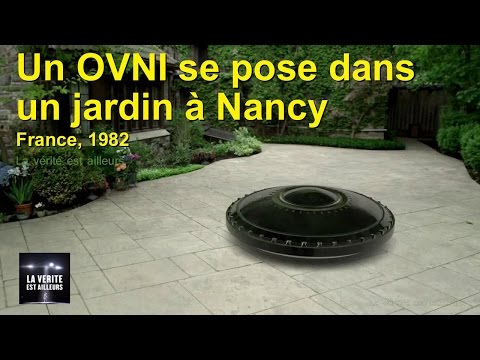
The object came to rest hovering approximately one meter above the lawn and remained essentially stationary for about twenty minutes, giving the witness an unusually extended observation window compared to most single-witness UAP reports on this site, the great majority of which describe encounters lasting well under a minute. Descriptions of the object's physical structure are detailed and specific: an oval or ovoid disc roughly 1.5 meters in diameter and 0.8 meters thick, which the witness reportedly compared to two washing-machine lids pressed together rim to rim. Its lower hemisphere was described as solid, metallic, and polished, with a gray-blue coloration compared to beryllium, and with no visible rivets, seams, or other surface features suggesting mechanical assembly. Its upper hemisphere, by contrast, was described as translucent, with a distinctive blue-green “lagoon” coloration and an apparent sense of interior depth, as though looking into rather than merely at the material.
The witness reported the object was completely silent throughout the encounter, producing no detectable sound, heat, cold, wind, or any sensation of electromagnetic effect on his own body even as he progressively approached it — at points reportedly closing to within fifty centimeters, circling partway around it for a closer look. At this distance he attempted to photograph the object, but his camera reportedly jammed or otherwise malfunctioned, leaving no photographic record of an encounter that otherwise produced an unusually detailed verbal and written description. The object's departure was reported as abrupt: a vertical ascent at very high speed, with no gradual acceleration phase, which the witness later described as though the object had been “aspirated” upward.
The Report to the Gendarmerie
The witness reported the sighting to the local gendarmerie the same day, a detail this file treats as a genuine strength of the case's evidentiary chain: unlike many UAP reports that reach an official investigative body only weeks or months after the fact, filtered through the witness's own decision to seek out a ufological organization, this report entered an official government channel within hours, before any of the extended secondary retelling that affects so many other case files on this site had any opportunity to occur. The gendarmes' involvement also created the institutional pathway that brought GEPAN into the case at all, since GEPAN's mandate specifically covered reports referred through this exact channel.
The Physical Trace Evidence
Roughly a week after the sighting, on October 27, 1982, gendarmes returned to the property and collected samples from a border of amaranth flowers — ornamental plants of the genus Amaranthus, prized for their vivid red foliage — planted less than a meter from where the object had reportedly hovered, with the closest individual specimens as little as twenty centimeters from the site. The delay between the sighting and the sample collection, roughly a week, is a specific point this file's own Material Analysis section below returns to as a genuine limitation on how confidently any later biochemical finding can be tied to the object's presence rather than to a week of ordinary environmental exposure in the interim.
The amaranth plants nearest the site showed a measurable water-content deficit when analyzed: roughly 40% water content in the affected specimens, compared to approximately 80% in control specimens taken from elsewhere in the garden, alongside a visible color shift from the plant's normal bright red toward a dull brown. Some secondary accounts additionally describe nearby fruit in the garden as appearing “cooked,” though this file's research was unable to confirm this specific detail against GEPAN's own primary technical note, which exists only as an unreadable scanned document (discussed further below) rather than a text this file's research was able to directly quote from.
A second, separately reported effect concerned the lawn itself: the grass directly beneath the object was reported to have stood erect and rigid at the moment of the object's departure, before relaxing back to its normal, flexible state shortly afterward — a transient mechanical effect distinct from the amaranth's slower biochemical dehydration, and one that later scientific analysis, discussed below, treated as a separately measurable phenomenon in its own right.
GEPAN's Scientific Analysis
GEPAN's investigation, conducted by a team deployed from Toulouse between October 28 and 30, 1982, used a structured radial vegetation-sampling protocol — taking specimens at measured distances and directions outward from the reported hover point — alongside a formal discourse analysis of the witness's own statement, a methodology GEPAN had by this point already developed and applied to the Trans-en-Provence case the previous year. This file's research identified a specific named scientific finding attributed to a researcher referred to in secondary sources only as “Chauzy”: that an electric field of at least approximately 30 kilovolts per meter could, in principle, reproduce both the grass's transient upright behavior and, potentially, contribute to the amaranth's observed dehydration, offering a specific, physically-grounded candidate mechanism rather than a vague appeal to unspecified “energy.”
This finding, while genuinely significant as a specific, testable physical hypothesis, leaves real gaps this file does not gloss over. An electric field strong enough to measurably affect nearby plant tissue and grass rigidity would, on ordinary physical grounds, be expected to produce some detectable effect on a human body positioned as close as fifty centimeters away, yet the witness reported no sensation of any kind. No source this file's research located offers a specific resolution to that apparent tension, and this file treats it as a genuine, unresolved technical question rather than one GEPAN's own investigation is documented as having fully answered.
The GEPAN Investigation and Note Technique n°17
GEPAN's formal report on the case, Note Technique n°17, titled simply “L'Amarante,” was published March 21, 1983, roughly five months after the sighting itself — a comparatively fast turnaround for a government technical publication of this kind. The document survives today as a scanned PDF hosted directly on GEIPAN's own successor website, though as an image-based scan rather than a text-searchable document, meaning this file's research was able to confirm its existence, length, and general structure but could not directly extract or quote its original French-language text; every specific technical claim in this file therefore traces to secondary sources describing the report's contents rather than to a direct reading of the primary document itself, a distinction this file states explicitly rather than implying a level of primary-source access its research did not actually achieve.
The report's official classification, PAN D, follows GEIPAN's own long-standing four-tier scale for evaluating UAP reports: PAN A denotes a case identified with high confidence as a known phenomenon; PAN B, probably identified; PAN C, a case that cannot be usefully classified due to insufficient data; and PAN D, a case investigated with genuinely good-quality data and testimony that nonetheless remains unexplained after the full investigative process. This file treats the PAN D classification as a meaningful, specific signal — it is not GEIPAN's default outcome for an ordinary, weakly-documented report, which would more typically receive a PAN C rating for insufficient information, but a rating reserved for cases the agency's own scientists judged worth taking seriously on the merits of the available evidence.
No source this file located identifies a specific named GEPAN director as having personally led the Amarante field investigation, and this file was correspondingly careful not to assert a specific individual's direct role beyond what its research could actually confirm. What is documented is the institutional fact that GEPAN, operating from its Toulouse base under CNES, deployed a field team within a week of the gendarmes' sample collection and produced a formal technical note within five months — a genuinely faster and more resourced response than most UAP reports anywhere in the world receive from any government body.
Key Witnesses
The Laxou Witness (Identity Never Officially Published)
A cellular-biology researcher in his early thirties, resident in Laxou at the time of the sighting. GEPAN's own practice, consistent with French official policy for civilian witnesses, appears to have anonymized his identity in its published technical note, and this file's own research found at least four different, mutually inconsistent names or pseudonyms circulating across secondary sources — “M. Henri,” “Marc V.,” “M.T.,” and, in what this file's research judged almost certainly a dramatization invention from a later French television reconstruction series, “Henri Laurent.” No single name among these is traceable to an official document this file's research was able to verify, and this file presents his identity as genuinely unresolved rather than adopting any one of the competing secondary-source names as fact.
The Five Observables Assessment
As with most single-witness cases resting on unaided visual testimony, the assessment below describes what the witness reported rather than any independently confirmed technical data.
The Five Observables framework is applied to the performance characteristics reported in this case:
Assessment: The object's twenty-minute stationary hover roughly a meter above the lawn, with no visible means of support and no downward disturbance of the grass beneath it during the hover itself, constitutes a genuine claimed anti-gravity lift profile. Its abrupt, non-gradual vertical departure “as if aspirated” upward is marked present for instant acceleration, though no specific speed estimate survives in available sources precise enough to also register as hypersonic. Low observability is marked present on the strength of the object's camera-jamming effect — a specific, if unusual, claimed interference with a conventional recording device, distinct from the more common claim of literal optical invisibility. Trans-medium travel is marked absent, since every account describes a purely atmospheric encounter with no claimed transition into water, ground, or any other medium.
Evidence Assessment
This case occupies a genuinely unusual position among files on this site: a single, never-publicly-named witness, on one hand, set against a same-day official police report and a formal, resourced government scientific investigation, on the other — two facts that would, in most other cases, point toward opposite evidentiary conclusions, but that coexist directly here.
Supporting Anomalous Origin
- The sighting was reported to gendarmes the same day, entering an official channel before any extended secondary retelling could occur
- GEPAN, a national space agency's own scientific unit, judged the case worth a dedicated field deployment and formal technical publication
- The case received GEPAN's own PAN D classification — reserved for good-quality, genuinely unexplained data, not GEPAN's default outcome for a weak report
- A measurable, specific biochemical finding (the amaranth's water-content deficit) and a named physical hypothesis (Chauzy's ~30 kV/m electric-field estimate) both exist in the record, rather than only vague secondhand description
- The twenty-minute observation duration and fifty-centimeter close approach gave the witness an unusually extended and detailed vantage point compared to most brief sighting reports
Supporting Conventional Explanation or Unresolved Uncertainty
- Every specific claim in the case traces to a single, uncorroborated witness whose real identity has never been officially published and is reported inconsistently across secondary sources
- No photograph exists; the witness's own camera reportedly malfunctioned at the critical moment
- Sample collection occurred roughly a week after the sighting, leaving open whether the amaranth's condition reflects the object's presence specifically or a week of subsequent ordinary environmental exposure
- GEPAN's primary technical note exists only as an unreadable image scan, meaning no source in this file's research chain has been able to directly quote the agency's own original findings and caveats
- A specifically credentialed skeptical researcher, Éric Maillot, has published a named, reasoned argument that the case is best explained as a perceptual illusion rather than a physical craft, discussed in Material Analysis below
- The electric-field hypothesis that would explain the plant and grass effects does not, on its own terms, explain why the witness reported no physical sensation despite approaching to within fifty centimeters
Why "Disputed"
This case receives a DISPUTED classification reflecting a genuine, specific tension this file does not attempt to resolve in either direction: real institutional and scientific weight on one side, and a single, never-identified witness on the other. The institutional weight is not nominal. GEPAN did not merely receive a report and file it; it deployed a field team within days, applied the same structured sampling methodology it had used on Trans-en-Provence, identified a specific measurable biochemical effect, and ultimately classified the case PAN D — a rating this file's own reading of GEIPAN's classification scale treats as a meaningful, non-default outcome. A case a national space agency's own scientists were unable to explain after a genuine field investigation is not, on its own, evidence of an extraordinary origin, but it is evidence that the report was not obviously dismissible on its face either.
Working against that weight is the case's total dependence on one uncorroborated observer whose actual identity remains unresolved even in this file's own research, nearly forty-four years later — a level of anonymity this file was unable to fully penetrate despite consulting the same range of French-language ufological, skeptical, and journalistic sources any future researcher would also encounter. No second witness, no photograph, and no primary-document quotation (as opposed to secondary description) of GEPAN's own findings exist anywhere in this file's assembled source base. The specific, named skeptical treatment by Éric Maillot — not a generic dismissal, but a reasoned, published argument for a perceptual-illusion mechanism — further tempers how much weight the PAN D classification alone can carry, since it demonstrates that at least one researcher with direct access to the case's full documentation reached a substantially more skeptical conclusion than GEPAN's own formal, unresolved rating implies on its face.
This rating sits close to, but modestly below, this site's rating for Trans-en-Provence, GEPAN's other major physical-trace investigation. Trans-en-Provence benefited from a witness (Renato Nicolaï) whose real identity was always publicly known and independently checkable, and from a physical ground trace (compaction, thermal alteration) that did not depend on a week-old biochemical sample for its central evidentiary claim. The Amarante case's genuine strengths — the same-day police report, the resourced GEPAN investigation, the specific electric-field hypothesis — are real, but they sit atop an anonymous, uncorroborated witness in a way Trans-en-Provence's own strongest evidence does not.
Sensor & Instrumentation Detection Profile
No radar, military, or civilian aviation instrumentation of any specific kind is documented anywhere in the currently available record for this case. The sighting occurred over a private residential garden rather than any location where such instrumentation would ordinarily be present, and no source indicates any request was ever made for contemporaneous air-traffic radar data covering the Nancy area at the reported time.
The closest approach to instrumented data in this case is the witness's own camera, which reportedly malfunctioned or jammed at the moment he attempted to photograph the object from close range. No source describes the specific nature of the malfunction (mechanical failure, film advance failure, or some other cause), and this file's research was unable to independently examine the camera or any resulting exposed-but-blank film, meaning this detail is treated as a reported, unverified claim rather than a documented technical finding.
Environmental & Geospatial Context
Laxou itself sits immediately west of central Nancy, in the Meurthe-et-Moselle department of the Lorraine region in northeastern France, an area of rolling terrain along the Meurthe river valley with a mix of urban, suburban, and light-industrial land use. The witness's garden, described as a small residential plot reached by a narrow path, places the sighting firmly within an ordinary suburban setting rather than a remote or rural one — a genuinely different environmental profile than many other single-witness case files on this site set in isolated countryside or open highway settings, and one that this file notes as relevant to evaluating how plausible an undetected close-range hover would be: a twenty-minute hover a meter above a residential garden, in daylight, created a real opportunity for a second witness (a neighbor, a passerby) to have observed the same event, yet no source this file located documents any second observation from anyone else in the immediate area.
The reported time of day — shortly after noon, in clear daylight — is itself a notable feature of this case relative to the broader UAP literature, where a disproportionate share of reports occur at night or twilight, when ordinary aerial objects and atmospheric phenomena are both harder to identify and easier to misperceive. A midday, clear-sky sighting removes several of the most common conventional-explanation categories (misidentified stars or planets, aircraft running lights, atmospheric electrical phenomena more visible against a dark sky) from serious consideration, while correspondingly raising the bar for what kind of daylight object could plausibly have gone unidentified by a single close-range observer for a full twenty minutes.
No specific meteorological data for October 21, 1982 in the Nancy area was located in this file's research beyond the witness's own report of clear conditions, and this file was similarly unable to identify any documented civil or military aviation activity, agricultural equipment operation, or other conventional environmental candidate specific to the Laxou garden and its immediate surroundings on that date, a genuine gap this file states plainly rather than filling with speculation.
Observer Credibility & Occupational Profile
The witness's professional background as a cellular-biology researcher is a genuinely relevant credibility factor this file weighs carefully, while being explicit about what it can and cannot establish. A working laboratory scientist brings habituated skills in careful, precise observation and description as part of ordinary professional practice, and several secondary sources describe his account as demonstrating “exceptional precision” and internal consistency across the multiple retellings GEPAN's investigators would have solicited during their field interview process. This file treats that consistency as a real, if modest, positive signal, on the same general principle it applies to other professionally credentialed witnesses elsewhere on the site.
Working against a straightforward credibility assessment, however, is the single most unusual feature of this specific case: unlike virtually every other named witness on this site, this witness's actual identity has never been confirmed by any source this file's research located, including GEPAN's own published technical note as described in every secondary account this file reviewed. This file cannot, therefore, independently verify his stated profession, his actual institutional affiliation, his prior history (if any) with UAP reporting, or any other biographical detail beyond what secondary sources uniformly but unverifiably repeat. A credibility assessment normally grounded in a real, checkable professional and personal history is, in this specific case, grounded instead in GEPAN's own institutional judgment that the witness and his account were credible enough to warrant a formal field investigation — a meaningful but categorically different kind of evidence than this site is usually able to bring to bear on an individual witness's personal reliability.
This file also notes, as a specifically relevant point, several secondary sources' claim that the witness showed little interest in publicity and was not seeking media attention — a detail consistent with, though not proof of, an absence of an obvious motive for fabrication. No source documents any financial arrangement, book deal, or media appearance connected to the witness at any point in the more than four decades since the sighting, a genuinely different pattern than several more publicity-embracing witnesses discussed elsewhere on this site.
Physical & Material Assays
The amaranth flowers remain this case's single most substantive physical evidence: a measured water-content deficit (approximately 40% in affected specimens versus approximately 80% in controls) alongside a visible color shift from red to brown, in plants located within a meter of the reported hover site. This file treats this finding as genuinely more concrete than many other case files' physical-evidence claims on this site, since it involves an actual measured quantity (water content) rather than only a qualitative description, and since it was gathered and analyzed by a government scientific body rather than by an interested private party.
That said, this file identifies two specific, unresolved limitations that keep this evidence from being fully conclusive. First, the roughly week-long delay between the sighting (October 21) and sample collection (October 27) leaves genuine room for the amaranth's condition to reflect some combination of the reported event and a week of subsequent ordinary environmental stress, disease, or seasonal decline — late October is already within amaranth's natural senescence period in the Northern Hemisphere, a horticultural consideration this file's research did not find explicitly addressed in any available secondary source describing GEPAN's own analysis. Second, no source this file located describes any parallel soil chemistry, radioactivity, or mineral-content analysis of the ground itself, unlike the Trans-en-Provence case's own more extensive soil and multi-laboratory biochemical workup — meaning this case's physical evidence, while real and measured, is narrower in scope than GEPAN's own strongest prior physical-trace investigation.
The grass's transient upright behavior, while separately reported and separately analyzed via Chauzy's electric-field hypothesis, was never physically sampled or laboratory-tested in the way the amaranth was; it exists in the record as an observed and later theoretically modeled phenomenon rather than as a directly assayed physical specimen.
Historical Precedents & Archive Matches
These comparisons situate the case within its broader historical genre; none imply that this file's conclusions about any comparison case automatically transfer to the Amarante witness's own account, which this site evaluates independently on its own specific evidence.
The case is most directly and frequently compared, across the secondary sources this file's research reviewed, to GEPAN's own earlier Trans-en-Provence Sighting of January 8, 1981 — both are physical-trace cases investigated by the same government agency using broadly similar field methodologies, arriving less than two years apart. This file's research found, however, that the pairing in most sources is journalistic and thematic (retrospective articles and video summaries grouping GEPAN's “greatest hits” together) rather than the product of any dedicated, rigorous academic comparison of the two cases' evidentiary structures side by side. The two cases differ in several evidentiarily important ways this file treats as more significant than their surface similarity: Trans-en-Provence's witness was always publicly identified, while the Amarante witness was not; Trans-en-Provence's central physical evidence was a ground trace not dependent on a delayed sample collection, while the Amarante case's central evidence is a plant sample collected roughly a week after the event.
Within the broader genre of physical-trace UAP cases involving affected vegetation, the American Delphos Ring Sighting of 1971 offers a useful international comparison: like the Amarante case, it involves a landed or hovering object leaving a measurable biochemical signature in nearby plant life, investigated by a credentialed researcher (soil scientist Ted Phillips) rather than by ufological enthusiasts alone, though Delphos benefited from multiple family-member witnesses rather than the Amarante case's single observer.
Within France's own broader UAP institutional history, the Amarante case sits chronologically between GEPAN's founding-era Trans-en-Provence investigation and the agency's later transformation into SEPRA in 1988 under the same Jean-Jacques Velasco who had managed Trans-en-Provence — part of a continuous, roughly decade-long period in which French UAP investigation operated with a genuinely resourced government scientific mandate that few other countries' equivalent agencies have matched before or since. This file's own essential-reading feature on Les OVNI du CNES covers this broader institutional history in more depth than is appropriate to duplicate here.
Material Analysis
This case's evidentiary record combines a genuine, government-conducted physical-evidence investigation with an unusually thin secondary citation trail outside French-language ufological and skeptical literature — this file's research found essentially no substantive English-language academic or journalistic coverage of the case at all, a genuinely different sourcing situation than most files on this site.
Éric Maillot's “Grande Illusion” Argument
The most direct and specifically credentialed skeptical treatment of this case comes from French researcher Éric Maillot, co-author with David Rossoni and Éric Déguillaume of Les OVNI du CNES: 30 ans d'études officielles, 1977–2007, whose fifteenth chapter is devoted specifically to this case. Maillot subsequently published a standalone follow-up paper titled “Le PAN D du 21 octobre 1982 dit ‘L'Amarante’: une grande illusion?” — “The PAN D of October 21, 1982, called ‘The Amarante’: a great illusion?” — arguing, per its title and circulated summary, that the case is best explained as an elaborate perceptual or optical illusion rather than a physically real craft. This file's research was unable to obtain the full text of either Maillot's book chapter or his standalone paper in a form allowing direct quotation of his specific proposed illusion mechanism (both exist only as scanned, non-text-searchable PDFs), and this file states that limitation plainly rather than characterizing Maillot's argument in more mechanistic detail than its own research actually confirmed.
What this file can state with confidence is the structural significance of Maillot's argument existing at all: it demonstrates that at least one researcher with direct, dedicated access to the case's full documentary record — someone who had specifically reviewed GEPAN's own technical note in a way this file's own research, working only from secondary description of a scanned document, was not able to replicate — reached a substantially more skeptical conclusion than GEPAN's own formal, unresolved PAN D rating implies at face value. This file treats Maillot's argument as a serious, credentialed skeptical position genuinely worth citing, while being explicit that it cannot itself verify or reproduce his specific reasoning beyond what his paper's title and secondary summaries convey.
The Anonymity Problem
A second, distinct analytical issue this file's own research surfaced independently is the case's persistent, unresolved witness-identity confusion. Across the range of French-language sources this file's research consulted — ufological blogs, skeptical forum threads, and podcast summaries — at least four different names or partial names for the witness appear, with no clear indication that any one of them derives from an actual official disclosure rather than from a later writer's own invented or half-remembered pseudonym. This file treats this inconsistency as directly relevant to how confidently any reader should weight later, more specific claims about the witness (his exact address, his specific institutional affiliation) that appear in some secondary sources but not in the earliest identified citations: a citation chain this unable to agree on the witness's own name is not a chain this file is prepared to trust on finer biographical details it cannot independently verify.
The Delayed Sample Collection
As discussed in Physical & Material Assays above, the roughly week-long gap between the sighting and the amaranth sample collection is, in this file's own assessment, the single most significant methodological limitation on the case's physical evidence. Gendarmes, not GEPAN's own scientists, made the initial visit and collected the samples; GEPAN's dedicated field team arrived only the following day, October 28, already a full week after the original event. This file finds no indication in any available source that this delay reflects any lack of diligence — a rural gendarmerie responding to an unusual civilian report and coordinating with a Toulouse-based scientific agency several hundred kilometers away plausibly could not have moved faster through entirely ordinary institutional channels — but the delay's evidentiary consequence remains the same regardless of its cause: a full week of uncontrolled environmental exposure sits between the reported event and the sample this case's central physical claim depends on.
Sourcing and Methodological Limitations
- GEPAN's own primary technical note exists only as an unreadable image scan; no source in this file's research chain has directly quoted its original text
- The witness's real identity has never been confirmed, with at least four inconsistent names circulating across secondary sources
- Physical samples were collected roughly a week after the sighting, an interval this file was unable to find addressed in any available account of GEPAN's own analysis
- A specifically credentialed skeptical researcher (Éric Maillot) has published a named argument for a perceptual-illusion explanation, based on direct access to documentation this file's own research could not fully replicate
- No second witness has ever come forward despite the daylight, twenty-minute duration, and residential suburban setting of the encounter
What the Physical Record Still Supports
- A measured, quantitative water-content deficit in the affected amaranth specimens, gathered and analyzed by a government scientific body rather than an interested private party
- A specific, named, physically grounded hypothesis (Chauzy's ~30 kV/m electric-field estimate) rather than only vague appeal to unspecified energy or force
- A same-day official police report, removing the extended pre-investigation retelling window present in many other case files
- GEPAN's own PAN D classification, a rating this file's reading of the agency's own four-tier scale treats as reserved for genuinely unexplained, good-quality cases rather than routinely assigned
The Conventional Explanation Candidate: Perceptual Illusion Atop a Real Electromagnetic Environmental Effect
Because Éric Maillot's own specific proposed illusion mechanism was not directly accessible to this file's research (his paper exists only as a scanned, non-text-searchable document), the candidates below combine what this file can confirm about his named position with this file's own original analysis applying general categories of misidentification and misperception to this case's specific reported details.
The most frequently invoked conventional-explanation category for this case, following Maillot's own published framing, holds that the witness experienced a genuine but misperceived event — some combination of an unusual, momentarily disorienting visual stimulus (light refraction, an afterimage effect, or a similar optical phenomenon specific to the garden's own physical layout) that his mind then organized into the coherent, detailed object description he later reported. This candidate has the specific advantage of being a named, credentialed researcher's own conclusion after direct access to the case's full documentation, though this file cannot independently verify or reconstruct the specific mechanism Maillot proposes without access to his full paper's text.
Genuine Electromagnetic Environmental Anomaly
A second, distinct candidate treats the amaranth dehydration and grass effects as evidence of a real, if conventionally sourced, localized electromagnetic event — potentially connected to atmospheric electrical activity, a transient ground-level static discharge, or some other natural or human-caused source unrelated to any structured craft — that the witness then separately, and mistakenly, associated with a simultaneously misperceived visual object. This candidate has the advantage of taking the physical trace evidence at face value without requiring an anomalous craft explanation, while requiring two separate coincidental events (an electromagnetic anomaly and an unrelated visual misperception) to have occurred in the same garden within the same twenty-minute window.
Deliberate Fabrication
No specific evidence of deliberate fabrication has surfaced in any source this file located: no financial motive, no documented history of prior extraordinary claims from the witness, no publicity-seeking behavior in the more than four decades since the event, and a same-day report to gendarmes that would have exposed any immediate fabrication to prompt official scrutiny. This file finds no specific basis to treat fabrication as the best-supported explanation, while formally acknowledging it as a candidate any thorough accounting must consider, consistent with how this site treats the same candidate in every comparable case file.
A Genuinely Anomalous Encounter
The candidate this file's own rating treats as a live possibility, though not the single best-supported explanation, holds the witness's account largely at face value: that a genuinely unidentified, technologically capable object hovered in the garden and produced a real, physically measurable environmental effect on the surrounding vegetation. Proponents of this reading can point to GEPAN's own PAN D classification and the specific, quantitative amaranth finding as exceeding what casual misperception alone would typically produce. This file's own assessment gives this candidate real but limited weight, constrained specifically by the case's total dependence on one uncorroborated, never-identified witness and by the existence of a specific, credentialed skeptical alternative this file could not fully evaluate on its own merits.
What Would Resolve This Case Further
Moving this case's rating beyond Disputed in either direction would most plausibly require obtaining a text-searchable, OCR-processed version of GEPAN's own Note Technique n°17, allowing this file's research to quote its original findings and caveats directly rather than relying on secondary description of a scanned document; obtaining the full text of Éric Maillot's standalone “grande illusion” paper, to state his specific proposed mechanism with the same precision this file applies to every other candidate explanation; or, most significantly, identifying the witness's actual confirmed identity through a French governmental or archival records request, which could in turn open the possibility of a direct interview more than four decades after the event. None of this material is known to have surfaced since the case's last substantive published treatment (Maillot's own follow-up paper), and given the case's genuinely low public profile relative to Trans-en-Provence, further primary material seems unlikely to emerge without a dedicated archival research effort specifically targeting GEIPAN's own internal case files and any surviving gendarmerie records from the Meurthe-et-Moselle department.
A specific, narrower piece of unfinished analytical work this file identifies concerns the amaranth's own biology: no source located in this file's research directly addresses whether the plant's late-October position within its natural annual senescence cycle was ever formally distinguished from the reported anomalous dehydration in GEPAN's own laboratory comparison, despite this being, in this file's own assessment, one of the single most testable and important open questions bearing on how much evidentiary weight the amaranth finding can actually carry.
Perceptual / Optical Illusion
InconclusiveINCONCLUSIVE. A credentialed skeptical researcher's own published conclusion, but this file could not independently verify the specific proposed mechanism from available sources.
Genuine Electromagnetic Environmental Anomaly
InconclusiveINCONCLUSIVE. Directly accounts for the amaranth and grass effects without requiring a craft, but requires a coincidental, separately-timed visual misperception to fully explain the sighting.
Deliberate Fabrication
ImplausibleIMPLAUSIBLE as the primary explanation. No financial motive, prior comparable claims, or documented inconsistency has ever surfaced; the same-day gendarme report left little room for undetected fabrication.
Genuinely Anomalous Encounter (At Face Value)
InconclusiveINCONCLUSIVE. Supported by GEPAN's own PAN D classification and a specific quantitative finding, but weakened by total dependence on one never-identified witness.
Related Cases
The three cases below each share this case's core physical-trace evidentiary structure, its French GEPAN/GEIPAN institutional context, or both — while differing in ways that usefully illustrate the range within this case category.
Confirmed Documents & Official Records
GEPAN's Note Technique n°17, “L'Amarante” (March 21, 1983), is published directly by GEIPAN, GEPAN's successor agency within CNES, France's national space agency. It survives only as a scanned document without an embedded text layer, meaning this file's research could confirm its existence and general structure but could not directly extract quotable text from it.
Search Government & Official Archives Directly
Further Reading — Recommended Literature
This site's own Essential Reading feature on Les OVNI du CNES covers this case's own dedicated chapter in more depth than is appropriate to duplicate here; the five titles below broaden that coverage to the wider physical-trace UAP literature and general skeptical methodology.
Les OVNI du CNES
Dedicates its fifteenth chapter specifically to this case, the single most detailed published critical treatment of the Amarante investigation available in any language.
Physical Traces Associated with UFO Sightings
A foundational reference on vegetation and ground-trace UFO evidence by the researcher most associated with cases like Delphos, useful for the general physical-trace evaluation framework this file applies.
Confrontations: A Scientist's Search for Alien Contact
Vallée's personal investigation of forty international UFO cases, including several European physical-trace reports, offering methodological context for evaluating a case this thinly covered in English-language literature.
UFOs Explained
A foundational skeptical treatment of UFO testimony broadly, useful for the general misidentification-category framework this file applies in evaluating perceptual and environmental conventional explanations.
The Emergence of a Phenomenon
A comprehensive reference covering the broader history of official and institutional UFO investigation, situating GEPAN's own work within the wider international pattern of government UAP study.
DISCLOSURE: Some links above are affiliate links. If you purchase through them, OverClassified receives a small commission at no additional cost to you. This helps support independent research.
Essential Viewing
Sources
- GEPAN. Note Technique n°17: L'Amarante. Centre National d'Etudes Spatiales, March 21, 1983. cnes-geipan.fr
- “Documentation.” GEIPAN, Centre National d'Etudes Spatiales. geipan.fr
- Maillot, Éric; Rossoni, David; Déguillaume, Éric. Les OVNI du CNES: 30 ans d'études officielles, 1977–2007. Chapter 15. Observatoire Zététique. zetetique.fr
- Maillot, Éric. “Le PAN D du 21 octobre 1982 dit ‘L'Amarante’: une grande illusion?” Circulated via CNEGU and Academia.edu.
- “The Amarante UFO Incident: A Case Study.” UFO Insight. ufoinsight.com
- “Ovni à Nancy Laxou: l'affaire des Amarantes (1982).” ovni-extraterrestre.com. ovni-extraterrestre.com
- “GEPAN.” RR0 (Réseau Reyskrupt). rr0.org
- “L'affaire de l'Amarante.” UFO Scepticisme forum. ufo-scepticisme.forumactif.com
- “Je souhaiterais avoir des articles sur une observation d'OVNI à Nancy en 1982.” Guichet du Savoir, Bibliothèque municipale de Lyon. guichetdusavoir.org
- “GEIPAN.” Wikipedia. en.wikipedia.org
- “Laxou.” Wikipedia. en.wikipedia.org
- “Groupe d'études et d'informations sur les phénomènes aérospatiaux non identifiés.” Wikipédia (French). fr.wikipedia.org
- “File: Place-Stanislas-Nancy.JPG.” Wikimedia Commons. commons.wikimedia.org
- Vallée, Jacques. Confrontations: A Scientist's Search for Alien Contact. Ballantine Books, 1990.
- Klass, Philip J. UFOs Explained. Random House, 1974.
- Roussel, Robert. OVNI: Les vérités cachées de l'enquête officielle. 1994.
- Lumières dans la nuit, January–February 1985 issue.
- “Un ovni observé à Nancy.” Le Républicain Lorrain, regional newspaper coverage.
See something inaccurate? Have additional information or sources?
Suggest an Edit →Last Updated: August 2026