
The Oskar Linke East German Landing Case
Oskar Linke, the village mayor of Gleimershausen in the Soviet-occupied zone of Germany, later gave a notarized statement describing a landed, disc-shaped object and two suited figures in a forest clearing near Hasselbach, East Germany, in the early hours of June 17, 1950 — an account his 10-year-old stepdaughter Gabriele first prompted and independently corroborated. Linke said nothing publicly for two years, until he and his family fled to West Berlin in 1952 and he swore out his account before a notary. The story then crossed four countries' press in a matter of days, reached a CIA foreign-documents desk as an "unevaluated" foreign-press clipping, and was eventually logged by J. Allen Hynek's Project Blue Book — under the wrong year, in a filing error that outlived the Cold War itself.
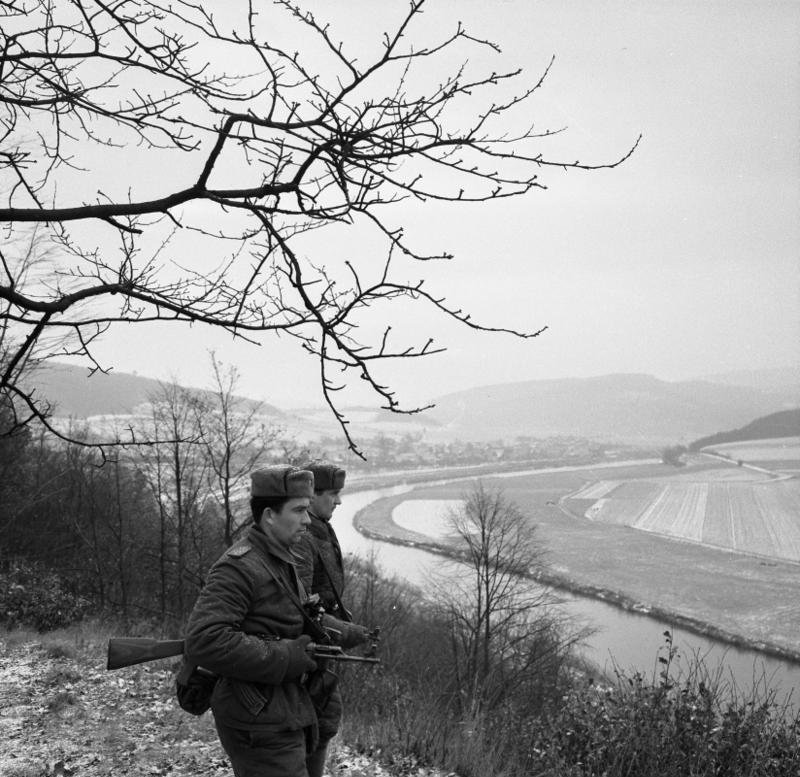
Pictured: East German border guards on patrol above the Werra river valley, photographed in February 1965 — not the actual clearing near Hasselbach, and not contemporaneous with the 1950 sighting, but a real, rights-clear (Bundesarchiv, CC BY-SA 3.0 DE) illustration of the fortified Cold War frontier that separated Linke's Thuringian village from the West Germany he fled to in 1952. No photograph of the actual clearing, the alleged object, or the ground impression Linke described is known to exist; only Linke's own three sketches, published in the British press in July 1952, were ever produced, and this site could not verify a rights-clear reproduction of them.
Theoretical Alignment
If taken at face value, the description of a landed craft and two suited occupants aligns loosely with a conventional Extraterrestrial Hypothesis reading, but the case's two-year public silence, single-family witness base, and its emergence at the exact moment its witnesses had strong personal incentive to attract Western press attention make a Psycho-Social explanation — embellishment, suggestion, or a refugee narrative shaped for its audience — at least equally plausible. There is no meaningful basis for an Interdimensional reading; nothing in the account describes phasing, disappearance-in-place, or other IDH-associated phenomenology.
Background
Oskar Linke was born in 1901 in Breslau (now Wrocław, Poland), then part of the German Empire's Silesia province. By 1950 he worked as a painter and served as the village mayor (Bürgermeister) of Gleimershausen, a small farming community in southern Thuringia that had become part of the Soviet occupation zone after Germany's 1945 division and, following the German Democratic Republic's founding in October 1949, part of the new East German state. Gleimershausen sat only a few kilometers from the emerging inner-German border — the line that within two years would harden into a fortified, patrolled frontier separating the GDR from the Federal Republic of West Germany.
The timing placed Linke's later account squarely inside the first great international "flying saucer" era. Kenneth Arnold's 1947 sighting near Mount Rainier had already coined the term and triggered years of American press coverage; by 1950 the phenomenon had become genuinely international, with Cold War anxieties about Soviet aeronautical secrecy feeding speculation on both sides of the Iron Curtain. Linke himself later insisted, in interviews given after he reached the West, that he had not even heard the phrase "flying saucer" until after he crossed into West Germany — meaning that whatever vocabulary his eventual account used to describe the object arrived only after the event itself, layered on by the press machinery that would carry his story from a Thuringian forest road to a CIA reading file in barely six weeks.
East Germany's own state apparatus took essentially no interest in reports like Linke's. The Ministry for State Security (the Stasi) is not known to have opened any file connected to this specific case — unsurprising, since Linke's account only became public after he had already escaped the GDR. Later Stasi records reviewed by historians show the East German security services treated UFO reports with what one historical review called "stubborn disregard" for decades, only intermittently logging sightings (three in 1976, four in 1983, twenty-five in the GDR's final year of 1990) and rarely investigating them with any rigor. Linke's case is therefore not a Stasi file at all; it is a refugee's story that became visible entirely through Western intelligence and press channels, filtered through West Berlin, London, Paris, and Athens before it ever touched an American archive.
Within East German ufological folklore, Linke has sometimes been informally likened to "the GDR's Kenneth Arnold" — the point of origin, however contested, for a nation's most famous single UFO account, even though (unlike Arnold) Linke's story only reached the public because he had already left the country it happened in.
The Linke family's 1952 departure was itself one small part of a vastly larger historical pattern. Between the GDR's 1949 founding and the sealing of the inner-German border with the Berlin Wall in August 1961, an estimated 2.5 to 3.5 million East Germans left for the West through what East German authorities officially termed Republikflucht ("flight from the republic") — a westward exodus large enough to eventually force the East German government's most drastic countermeasure. A rural village mayor bringing his wife and six children across in 1952, two years into that outflow and nearly a decade before the border fully closed, was a genuinely ordinary event by the standards of the era, even though the UFO account he carried with him was not. This context matters directly to how Linke's case should be read: he was one of millions of East Germans with straightforward personal reasons to resettle in the West that had nothing to do with any UFO sighting, which weakens (without eliminating) any theory that treats the defection itself as evidence of a fabricated pretext.
Complete Timeline
| Date | Event |
|---|---|
| 1901 | Oskar Linke is born in Breslau, Silesia (German Empire; now Wrocław, Poland). |
| Oct 7, 1949 | The German Democratic Republic (East Germany) is founded in the former Soviet occupation zone, formalizing the division that placed Gleimershausen inside the GDR. |
| June 17, 1950, ~2:30 a.m. | The encounter. Linke and his 10-year-old stepdaughter Gabriele, traveling on foot after their motorcycle suffered a blown tire on a forest road between Hasselbach and Gleimershausen, report a landed disc-shaped object roughly 13–15 meters (43–49 ft) in diameter and two figures in shiny, one-piece metallic suits near it. |
| July 1, 1950 | Gleimershausen, the village Linke served as mayor, is formally incorporated into neighboring Haselbach/Hasselbach — a purely administrative boundary change two weeks after the reported sighting, coincidental to the case but a real, verifiable local-government record. |
| 1950–1952 | Linke tells no press, government, or foreign authority about the incident. He continues serving as village mayor under the East German administration. |
| 1952 (date uncertain) | Linke, his wife, and their six children leave the German Democratic Republic for West Berlin — part of the large westward refugee movement that preceded the GDR's later border fortifications. |
| July 1, 1952 | Linke gives a sworn, notarized statement describing the June 1950 encounter before a notary in West Berlin, providing sketches of the object. |
| July 6, 1952 | London's Sunday Graphic runs Linke's account across its front and second pages, reproducing three of his sketches and quoting Vickers aeronautical chief designer George Edwards, who speculated the description might resemble contemporary circular-wing ("flying wing") aircraft research. |
| July 7, 1952 | Paris's Le Figaro reprints the London story (dateline July 6) on its own page 7, describing Linke's sketches of the disc, its central cylinder, and the two suited figures. |
| July 9, 1952 | Athens newspaper I Kathimerini publishes a Greek-language version of the story — the specific clipping that would shortly reach the CIA. |
| Aug 15, 1952 | Berlin tabloid Nacht-Depesche runs its own account; Gabriele Linke would keep a copy of this clipping for the rest of her life. |
| Aug 23, 1952 | The CIA's Foreign Documents Division distributes report 00-W-23682, "Flying Saucers in East Germany," summarizing the I Kathimerini article and explicitly filing it as unevaluated foreign-press information, not a verified intelligence finding. |
| 1952 | Linke and Gabriele appear as themselves in The Flying Saucer Mystery, a short American documentary that also features Donald Keyhoe and other early UFO figures. |
| 1-31 March 1952 (Blue Book's own index date) | The filing error. The U.S. Air Force's Project Blue Book indexes the case as entry #1087 under "Additional Reported Sightings (Not Cases)" for the period 1–31 March 1952 — two years off the actual June 1950 event, and, per researcher Kevin Randle's review of the underlying file, apparently sourced from a retyped, unattributed news clipping rather than any CIA transmittal. |
| 1977 | J. Allen Hynek's book The UFO Report discusses the case, dating it July 9, 1952 (the Kathimerini publication date, not the June 1950 event date) and describing it as CIA-sourced — a characterization Randle's later research found the actual Blue Book file did not support. |
| Oct 5, 1978 | CIA document DOC_0000015464 (the digitized version of report 00-W-23682) is released as part of the CIA's "UFOs: Fact or Fiction?" release tranche, later republished via the agency's online FOIA reading room. |
| 1980s | Gabriele Linke corresponds with CENAP, a West German UFO research organization, which reaches no conclusive findings on the case. |
| Oct 21, 2014 | German researcher Ralf Bülow interviews Gabriele Linke, then 75, for what would become a 2016 published account revisiting the case. |
| Jan 26, 2016 | Bülow's interview and case review is published (German UFO-news outlet grewi.de), the most recent substantive primary-witness material gathered on the case. |
| Dec 2016 | Kevin Randle publishes an updated blog analysis after obtaining a direct link to the underlying Blue Book archive scan, confirming the "Not Cases" filing and the 1952 misdate. |
The Night of June 17, 1950
According to Linke's later notarized account, he and Gabriele were traveling home after a blown tire forced them off their motorcycle on a forest road connecting Hasselbach and Gleimershausen, in the small hours of the morning — roughly 2:30 a.m. It was Gabriele, not her father, who first noticed something unusual in a clearing off the road: a large, low, disc-shaped object that witnesses in later press coverage repeatedly compared to "a huge frying pan" or an old-fashioned hot-water bottle lying on its side. Linke's own sketches, reproduced later in the British and French press, showed a shape roughly 13–15 meters (43–49 ft) in diameter and about 2.5 meters (8 ft) high, ringed around its outer edge by two rows of holes approximately 30 centimeters (1 ft) across, with a conical central tower rising some 3 meters (10 ft) from its middle.
Approaching to what he estimated as roughly 30 feet, Linke said he saw two figures near the base of the object, described as wearing shiny, form-fitting, one-piece metallic suits, apparently examining or working on the craft in a stooped posture. When Gabriele called out, the two figures reacted with what Linke described as alarm, moved quickly to the central tower, and climbed or stepped inside it as it retracted or closed behind them. A support column beneath the object reportedly shifted position, and the object then began to hum, its exterior color shifting — in Linke's account — from green to red, before it lifted off the ground, rotating as it climbed, the hum rising to a whistle as it accelerated away. NICAP's own catalog summary of the case, drawing on Hynek's and other secondary compilations, records the object's departure heading only as "toward Stockholm" — a striking, oddly specific detail that appears nowhere else in this file's other independently reviewed sources and that could not be corroborated beyond that single catalog entry; it is reported here as an unverified claim from a single secondary source, not an established fact of the case.
Afterward, Linke said he examined the clearing and found a round, dug impression in the ground that appeared to match the shape and position of the object's support column — the case's only claimed physical trace evidence, and one that was never examined, measured, cast, or photographed by any investigator, East German or Western, because Linke told no one what he had seen for the next two years.
Secondary, much weaker corroboration exists in later summaries of the case: an unnamed shepherd and an unnamed night watchman in the area are said to have separately reported unusual lights or activity in the sky that same night. Neither individual was ever named, interviewed on the record, or connected to Linke's account through any surviving primary document this file could locate; their mention functions as folkloric reinforcement of the story rather than independent, checkable testimony, and this file treats it accordingly — as an unconfirmed detail rather than genuine multi-witness corroboration.
The Long Silence and Flight West
The two-year gap between the reported event and its first public telling is the single most consequential fact in this case's evidentiary record, and it cuts in more than one direction. As a village mayor under a one-party Communist state whose security services (even if only informally, in this early pre-consolidation period of the GDR) took a dim view of any report of the sort a Western reader would call a "flying saucer," Linke had straightforward practical reasons to stay silent: an East German local official volunteering a story about an unidentified craft and mysterious occupants risked ridicule at best and suspicion of subversive fantasy or foreign contact at worst. His own later statements — that he had not even heard the term "flying saucer" until reaching the West — are consistent with a genuine, if extraordinary, experience he had no safe outlet to discuss inside the GDR.
But the same two-year gap is also the central weakness skeptics have raised ever since: it left the story entirely reliant on Linke and Gabriele's unaided memory, with no contemporaneous notes, no East German report of any kind, and no opportunity for independent investigators to visit the site, examine the ground impression, or interview any secondary witnesses while the trail was fresh. By the time Linke went public, he and his family had also just completed a defection from a Communist state to the West — a context in which a dramatic, internationally marketable personal story carried real, if unstated, value to a family rebuilding a life and reputation in West Berlin. Neither explanation can be proven from the surviving record; both remain live possibilities addressed in the Conventional Explanation Candidate analysis below.
Public Disclosure and the Press Cascade
On July 1, 1952, Linke gave his account under oath before a notary in West Berlin, along with the sketches that would illustrate every subsequent press account of the case. The story moved with striking speed. Within five days, London's Sunday Graphic ran it across its front and second pages, reproducing three of Linke's sketches and soliciting comment from Vickers-Armstrongs aeronautical chief designer George Edwards, who reportedly speculated that the described shape recalled contemporary circular-wing or "flying wing" aircraft research then rumored in British aviation circles — commentary that should be read as a period aviation professional's speculative aside to a tabloid reporter, not a verified technical assessment, and this file could not independently confirm any specific Vickers circular-wing program matching Linke's description.
The following day, Paris's Le Figaro carried its own version of the London story on page 7, describing the same sketches: a roughly 13-meter disc in a clearing ringed by fir trees, a 3-meter central cylinder from which two suited figures had been observed, and semi-conical exhaust-like fittings around the object's rim. Two days after that, Athens's I Kathimerini published a Greek-language account — and it was specifically this Greek clipping, not the original German notarized statement or the English or French coverage, that a CIA Foreign Documents Division officer translated and filed on August 23, 1952, as report 00-W-23682, "Flying Saucers in East Germany." In Berlin itself, the tabloid Nacht-Depesche ran its own account on August 15 — a clipping Gabriele Linke kept for the rest of her life and showed to researcher Ralf Bülow more than sixty years later.
In under seven weeks, in other words, a single family's account of a single night in a Thuringian forest had been notarized in West Berlin, splashed across a London tabloid, picked up in Paris, translated into Greek in Athens, and filed inside the United States Central Intelligence Agency — a genuinely international documentary trail for a case whose only two named witnesses never spoke to a single professional investigator from any of the countries whose press or intelligence services eventually handled their story.
The CIA Foreign-Documents Report
CIA report 00-W-23682, later digitized and released under the designation DOC_0000015464 as part of the agency's 1978 "UFOs: Fact or Fiction?" release tranche, is an entirely ordinary example of Cold War-era foreign press monitoring — the sort of routine clipping-and-translation work the Agency's Foreign Documents Division performed constantly on East Bloc-adjacent press coverage of every kind, UFO-related or otherwise. Its own internal classification marks it as unevaluated information sourced from a named foreign newspaper, explicitly not a verified intelligence product, a distinction that has been lost in some later popular retellings that describe the case as having "reached CIA files" in a way implying agency investigation or endorsement. What the document actually demonstrates is more mundane and, in its own way, more historically interesting: it is direct physical evidence of exactly how a single refugee's account, filtered through four countries' press over six weeks, became visible to American intelligence purely as a foreign-media curiosity — not because any U.S. agency investigated Linke's claim, corroborated it, or found it credible, but because a Greek newspaper article about it happened to cross a CIA analyst's desk during routine monitoring.
This document is one of a large tranche of similarly unevaluated foreign UFO press clippings released by the CIA over the decades and frequently cited, out of context, as evidence of high-level American interest in a given case. In Linke's case, no surviving record indicates the CIA took any further action on report 00-W-23682 beyond filing it — no follow-up cable, no request for additional information, no cross-reference to any other program. The document's real evidentiary value to this case is narrow but genuine: it independently confirms the press cascade's timeline and content, and it is the direct paper-trail link between the European newspaper coverage and the case's eventual, badly garbled appearance in Project Blue Book.
Project Blue Book's Two-Year Filing Error
The case's most bureaucratically interesting feature is not the sighting itself but what happened to it inside the U.S. Air Force's own UFO investigation program. J. Allen Hynek, Blue Book's longtime scientific consultant, discussed the case in his 1977 book The UFO Report, dating it July 9, 1952 (the date of the Kathimerini article, not the June 1950 event) and describing it as a case that had "come from the CIA" and been classified among the program's "unidentifieds."
Decades later, researcher Kevin Randle went looking for the underlying Blue Book file using Hynek's own stated date and found nothing under it. Searching further, Randle located the case filed not under any 1950 date but under the index period "1–31 March 1952," as entry number 1087 — and not among Blue Book's "Unidentified" cases at all, but under a separate administrative heading, "Additional Reported Sightings (Not Cases)," a lower-tier bucket the program used for reports it never formally investigated as its own numbered cases. The file itself, per Randle's review, consists of a retyped news clipping with no attributed newspaper source — differing from Hynek's own citation of the Greek I Kathimerini article, and offering no indication the file ever contained, or was cross-referenced to, the CIA's own foreign-documents report. Randle also found the case grouped in the same Blue Book index batch as an unrelated Iranian sighting and a Massachusetts newspaper account, consistent with the file having been assembled from a wire-service digest of miscellaneous foreign and domestic clippings rather than compiled as a discrete, individually investigated case.
The net effect is a case whose most frequently cited secondary account (Hynek's) misstates both its filing date and its classification status, whose real Blue Book record was for decades harder to locate than the wrong date implied, and whose underlying government paper trail was never actually cross-referenced between the CIA and Air Force systems that separately touched it. None of this bears on whether Linke's account was accurate — but it is a genuine, independently documented illustration of how thinly "Project Blue Book has a file on this" and "the U.S. government investigated and vouched for this" can differ in practice, one specific case at a time.
The 2016 Interview with Gabriele Linke
Gabriele Linke, ten years old on the night of the reported sighting, remained the case's only other named witness for the rest of her life. On October 21, 2014, then 75 years old, she was interviewed at length by German researcher Ralf Bülow, whose account was published in January 2016. Described by Bülow as mentally sharp and notably youthful for her age, Gabriele confirmed the core of her father's account — the object's startup and departure, which she described simply as "round, bright, and loud" — while striking a tone that itself became one of the interview's more revealing details. She characterized the experience at the time as almost unremarkable, "not a particular sensation, but almost something normal, what modern times and the Cold War simply bring with them," and drew a comparison to having seen a crashed wartime aircraft as a child, another jarring but oddly ordinary sight amid the disruption of the era.
Gabriele told Bülow she still possessed a copy of the August 1952 Nacht-Depesche clipping, along with correspondence she had exchanged with CENAP, a West German UFO research organization, in the 1980s — an inquiry that, by her own account, reached no conclusive findings. When asked directly about a conventional helicopter explanation for what she and her father saw, she rejected it decisively. Bülow's own assessment, after the interview, described the case as remaining genuinely "unsolved and mysterious," while candidly noting its real evidentiary weaknesses: only two witnesses, a nighttime observation under difficult conditions for detail or distance estimation, and an object whose described construction (visible rivet-like holes, a mechanically simple retracting tower) reads as comparatively "low-tech" next to later, more elaborate accounts of advanced craft — a combination that, in Bülow's words, raises real questions about the account's reliability without resolving them either way.
Key Witnesses
Oskar Linke
Born 1901 in Breslau, a professional painter and the mayor of the small Thuringian village of Gleimershausen at the time of the reported sighting. Linke told no one about the June 1950 encounter for two years, continuing to serve as a local East German official, until he fled to West Berlin with his wife and six children in 1952 and gave a notarized account of the incident, along with three sketches of the object, on July 1 of that year. His story was picked up by the London Sunday Graphic within days and subsequently reprinted across the French, Greek, and West German press. Linke and his stepdaughter later appeared as themselves in the 1952 American documentary short The Flying Saucer Mystery. As a local government official whose account only became checkable after he had personally escaped the state he served, and whose story broke at the exact moment his own resettlement and public reputation in the West were most in play, Linke's own credibility sits at the center of the case's evidentiary dispute — a genuine account of an extraordinary night, or a compelling story that served its teller's circumstances unusually well; the surviving record supports either reading.
Gabriele Linke
Gabriele was the first of the two witnesses to notice the object, drawing her father's attention to the clearing off the forest road, and her call toward the two figures is, in her father's account, what prompted their retreat into the craft. She remained connected to the case for the rest of her life, corresponding with the West German UFO research organization CENAP in the 1980s and giving a substantial on-record interview to researcher Ralf Bülow in 2014 (published 2016) at age 75, in which she confirmed her father's core account, described the object's departure in her own words, explicitly rejected a conventional helicopter explanation when asked, and preserved a 1952 press clipping about the case for over six decades. As the only other named witness, her independent, decades-later confirmation is the strongest piece of corroboration the case has — though it remains testimony from a single family, not from an unrelated second party.
The Five Observables Assessment
The Five Observables framework, developed by former AATIP director Luis Elizondo, is used to classify UAP encounters based on performance characteristics that exceed known technology:
Assessment: This 1950 account predates any instrumented UAP data by decades and involves no radar, no aircraft intercept, and no sensor record of any kind — only unaided visual testimony from two witnesses at close range. If accepted at face value, Linke's description of a craft lifting straight off the ground under its own power, with no visible conventional propulsion, would imply anti-gravity-style lift, but this rests entirely on witness description rather than any instrumented observation, and is classified here as speculative rather than present. None of the other four observables are meaningfully assessable from an account of this kind; the object was reported stationary and then departing at a described but unmeasured speed, with no data supporting hypersonic performance, demonstrated low observability, or trans-medium transition.
Evidence Assessment
Supporting an Anomalous Encounter
- Two named witnesses (stepfather and young stepdaughter) gave consistent, mutually corroborating descriptions of the object and its departure, maintained without significant variation across a public record spanning more than six decades
- Gabriele Linke's independent 2014 interview, given as an adult more than sixty years after the event and with no evident motive to sustain a family story, confirmed the core account and explicitly rejected a conventional helicopter explanation when directly asked
- Linke gave his account under oath before a West Berlin notary, a real legal act carrying personal accountability, rather than merely telling the story informally to reporters
- The account produced a genuine, verifiable international documentary trail — London, Paris, Athens, and CIA filings — within weeks, evidence the story was taken seriously enough by contemporary editors and at least one aviation professional to warrant coverage and comment
- Neither Linke nor his stepdaughter is known to have sought or received any payment for the story, nor to have published a book or built any ongoing public career around the case, reducing (without eliminating) one common motive for sustained fabrication
Supporting a Conventional Explanation
- A two-year gap between the alleged event and its first telling means no contemporaneous investigation, ground examination, or independent interview was ever possible while the physical trace evidence (the claimed ground impression) still existed
- The story surfaced at the precise moment Linke's family had just completed a defection from East Germany to the West, a period in which a dramatic, internationally marketable account carried plausible, if unprovable, personal value
- The only physical evidence claimed — a "round dug impression" matching a support column — was never measured, cast, photographed, or examined by anyone with relevant expertise
- The shepherd and night watchman said to have corroborated unusual sky activity that night are unnamed and untraceable in any primary document this file could locate
- The case's most influential secondary account (Hynek's) misdated the event by two years and mischaracterized its actual Blue Book classification, indicating even sympathetic professional researchers handled the case's basic facts carelessly
- Descriptions of visible rivet-like holes and a simple mechanically retracting tower read, to some researchers reviewing the case decades later, as comparatively unsophisticated construction details more consistent with an imagined or embellished object than a genuinely advanced craft
Why "Disputed"
The Oskar Linke case earns a DISPUTED classification because its evidentiary record supports two starkly different, equally unprovable readings, and because the case's real documentary strength — an unusually well-preserved international paper trail through the British, French, Greek, and West German press, plus genuine CIA and Project Blue Book files — is a strength of the paper trail, not of the underlying claim itself. What the record actually, verifiably establishes is narrower than popular retellings often suggest: that Oskar and Gabriele Linke told a consistent story about a June 1950 encounter; that they first told it under oath in West Berlin in July 1952, two years after it allegedly happened and immediately after their own defection from East Germany; that the story then moved rapidly and accurately through four countries' press and into a CIA filing that itself explicitly labeled the information unevaluated; and that the U.S. Air Force's own Project Blue Book handled the case sloppily, misfiling it under the wrong year and a lower-tier administrative category that its own most prominent consultant misrepresented in print.
None of that documentary trail proves or disproves what happened in the Thuringian forest before dawn on June 17, 1950. Two witnesses, one of them a child prompted by the other's growing public fame and, six decades later, independently confirmed by that same witness as an adult with nothing obvious to gain, is real evidence — but it is also precisely the evidentiary profile a compelling, unfalsifiable refugee narrative would produce. The case is disputed, not debunked and not verified, because both the sincere-witness reading and the shaped-narrative reading remain fully consistent with everything that can actually be checked in the surviving record.
Sensor & Instrumentation Detection Profile
No radar, aircraft intercept, or instrumented sensor of any kind was involved in or has ever been connected to this case. The entire evidentiary record consists of unaided visual witness testimony (two named witnesses), Linke's own hand-drawn sketches of the object, and the secondary documentary trail (press clippings, a notarized statement, and government filings) generated after the fact. No contemporaneous Soviet, East German, or Western military detection system is known to have logged anything corresponding to the reported object on the night in question, though this file could not locate any surviving East German civil or military records from mid-1950 that would have been capable of confirming or ruling out such an event either way.
This absence of any instrumented data is itself partly a function of the era and region rather than a specific gap in this case's own record-keeping. In June 1950, five years after the war's end, civilian and military radar coverage over rural, sparsely populated stretches of interior Germany — on either side of the emerging Iron Curtain — remained thin by later Cold War standards; dense, overlapping NATO and Warsaw Pact air-defense radar networks over precisely this kind of border terrain would not mature for at least another decade. A low-altitude event over a forest clearing near a minor Thuringian village in 1950 sat well outside the practical detection envelope of any air-defense system operating at the time, East or West, independent of whatever actually occurred there.
Environmental & Geospatial Context
The reported encounter occurred in rural, forested terrain in the foothills of the Rhön region of southern Thuringia, near the villages of Hasselbach and Gleimershausen, at approximately 2:30 a.m. local time in mid-June — a period of short, mild summer nights at that latitude (roughly 50.5°N). No surviving contemporaneous meteorological record for this specific rural site from June 1950 could be located; East German civil weather-station coverage for small Thuringian villages in this period was sparse, and no East German or Allied military weather log referencing this location and date has surfaced in any source reviewed for this file.
Observer Credibility & Occupational Profile
Oskar Linke held a position of genuine local public trust as an elected village mayor, a role that in a small rural community typically reflects a degree of standing and perceived reliability among neighbors, and he maintained that position under the East German administration for some time after the reported sighting without any indication of the story affecting his standing (since he told no one). He was not a trained aviation, military, or scientific observer, and nothing in his background suggests specialized technical expertise that would make his distance, size, or performance estimates especially reliable or unreliable relative to an average adult civilian witness. Gabriele Linke was ten years old at the time, a factor that reduces the evidentiary weight normally assigned to eyewitness testimony on questions of scale, distance, and technical detail, but her later, independently given adult testimony (2014) carries somewhat more weight as corroboration of the encounter's basic occurrence, if not necessarily every specific detail. Neither witness is known to have had any prior interest in, or connection to, UFO reporting, ufological organizations, or the broader "flying saucer" subculture before 1952 — a point favoring sincerity, though it does not rule out honest misperception, suggestion, or later embellishment shaped by the press attention their story received.
Physical & Material Assays
No physical material of any kind connected to this case was ever recovered, tested, or preserved. The single claimed piece of physical evidence — a round, dug impression in the clearing's soil, said by Linke to match the shape and position of the object's support column — was never measured, photographed, cast, or examined by any investigator, because Linke did not report the sighting to anyone until two years after the fact, by which point any such ground disturbance would long since have weathered away or been reclaimed by vegetation. No soil samples, metallic fragments, burn marks, or other trace material were ever collected or described in any account of the case reviewed for this file.
Historical Precedents & Archive Matches
Linke's account sits at the very beginning of a specific sub-category of early Cold War UFO reports: close-range landing and occupant cases emerging from Europe in the years immediately following Kenneth Arnold's 1947 American sighting wave, at a time when the phenomenon's vocabulary and iconography (the disc shape, the "flying saucer" label itself) were still actively spreading internationally through newsreels, wire services, and translated press coverage — the same channels that carried Linke's own story from a Thuringian forest to an Athens newsroom in a matter of weeks. This site's file on the UK "Flying Saucer Working Party", formed later the same year Linke's sighting allegedly occurred, documents how seriously even a skeptical Western government apparatus was, by 1950, already taking the broader phenomenon — a useful contrast to East Germany's own contemporaneous official indifference.
The specific press mechanism that carried Linke's story — a personal account crossing multiple national presses and eventually reaching an American intelligence or military archive as an unevaluated foreign clipping — recurs on this site's file on the Greek UFO wave of 1954, which involves some of the same regional press ecosystem (including, coincidentally, Greek-language coverage) just two years after Linke's own story ran in Athens. Later Stasi-era records reviewed by historians (see Background, above) show East German UFO reporting remained a marginal, rarely investigated phenomenon for the entire remaining life of the East German state, with logged sightings never exceeding a few dozen in any single year even at their late-1980s peak — consistent with a state apparatus that, unlike its Western Cold War counterparts, never built any dedicated UFO investigation function comparable to Project Blue Book, the UK's Flying Saucer Working Party, or France's later GEPAN.
Material Analysis
Because no physical material was ever recovered from this case, "material analysis" here necessarily concerns the case's documentary and testimonial materials rather than any physical trace evidence — the sketches, the notarized statement, and the multinational press and government paper trail that together constitute the entire surviving evidentiary record.
The Linke Sketches
Linke's three original sketches, first published in the July 6, 1952 Sunday Graphic and subsequently reprinted across the French and other European press, are the closest thing this case has to primary visual documentation — drawn, however, from memory two years after the fact, by a witness with no professional draftsmanship training beyond his work as a house/decorative painter. The sketches depict the disc rotating horizontally around a fixed central cylinder, flames or exhaust visible from the semi-conical rim fittings during the object's ascent, and a stepped vertical takeoff — a coherent, internally consistent visual account, but one that cannot be independently checked against any photograph, film frame, or other contemporaneous image, because none exists.
The Documentary Paper Trail as Evidence
Considered purely as documents, the notarized July 1952 statement, the CIA's report 00-W-23682/DOC_0000015464, and the Project Blue Book file entry are all genuine, verifiable historical artifacts — this file confirmed each independently. What they establish, however, is the existence and rapid spread of Linke's account, not the truth of its content. A notary certifies that a named individual swore to a statement, not that the statement is factually accurate; a CIA foreign-documents report explicitly labeled "unevaluated" certifies that a foreign newspaper published a story, not that any American analyst verified it; and a Project Blue Book "Not Cases" entry, per Kevin Randle's research, indicates the Air Force logged a clipping without ever opening a numbered investigation into it at all.
Supporting the Account's Sincerity
- The sketches are internally consistent across all published versions traced to the same July 1952 originals, with no evidence of the description changing to fit later press embellishment
- Linke swore his account under oath before a notary, a real legal and personal accountability act rather than an anonymous or purely informal telling
- Gabriele Linke's independently given 2014 account, more than sixty years later, matches her father's original description without evident elaboration or added anomalous detail, a pattern more consistent with genuine memory than with an actively embellishing storyteller
Supporting a Constructed or Embellished Account
- No physical, photographic, or independent contemporaneous documentary evidence exists from 1950 itself — every surviving document dates from 1952 or later, after the described event's technical vocabulary ("flying saucer") had already saturated international media
- The claimed ground impression, the case's only physical evidence, was never examined and cannot now be verified to have existed in the form described
- The story's public debut coincided precisely with the family's defection and resettlement, a period when a compelling personal narrative carried plausible reputational and attention value independent of its truth
The Conventional Explanation Candidate
No single conventional explanation for this case has documented, verifiable evidence tying it specifically to the Hasselbach clearing on the night of June 17, 1950 — a direct consequence of the two-year reporting delay that make any candidate explanation, conventional or anomalous, effectively unfalsifiable this far after the fact. What follows are the three most substantively arguable conventional readings, each evaluated on its own merits against what can actually be checked in the surviving record.
Cold War Refugee Narrative Embellishment
Under this reading, Linke and his stepdaughter experienced something genuinely startling or ambiguous — unusual lights, an unfamiliar piece of equipment, a misperceived mundane object — that was progressively elaborated, consciously or not, into the detailed encounter narrative that emerged fully formed only after the family's 1952 defection to the West. The timing is the strongest evidence for this reading: the account's first telling, under oath, coincided exactly with the period in which a dramatic, internationally marketable personal story carried real (if unstated and unprovable) value for a family establishing itself in West Berlin after fleeing a Communist state. Against this reading stands Gabriele Linke's own 2014 testimony, given as an independent adult more than sixty years later with no comparable incentive, which confirmed rather than walked back her father's account.
Contemporary Secret Aircraft / Circular-Wing Speculation
The Sunday Graphic's own 1952 coverage floated this explanation contemporaneously, quoting Vickers-Armstrongs chief designer George Edwards's speculation that Linke's description might match then-rumored circular-wing "flying wing" aircraft research. This file could not independently verify any specific, documented British, American, or Soviet circular-wing aircraft program operating in the relevant region and period that matches Linke's description in scale, behavior, or location; broader postwar rumors of German wartime "round-wing" aircraft projects (a recurring thread in later "Nazi saucer" popular mythology) are themselves poorly documented and postdate the war by years with no working prototype ever confirmed. Absent a specific, named, documented aircraft or test program placed at this location on this date, this candidate remains speculative rather than established.
Nighttime Misperception of Mundane Technology or Equipment
A landed disc with a central retracting tower, viewed briefly at night by two witnesses under stress after a mechanical breakdown, could plausibly describe a misperceived piece of stationary agricultural, road, or surveying equipment, or a Soviet/East German field exercise apparatus, especially given the region's proximity to the emerging, actively-patrolled inner-German border. No specific piece of equipment matching the description has been identified in any source reviewed for this file, and the reported color change, rotation, and powered vertical departure are not well explained by any purely stationary object.
The Assessment
Refugee Narrative Embellishment
InconclusiveThe timing correlation with the family's defection is genuinely suggestive, but Gabriele Linke's independent 2014 confirmation, given decades later with no comparable incentive, keeps this from rising to more than an inconclusive, unresolved candidate.
Secret Circular-Wing Aircraft
ImplausibleRaised contemporaneously by a real aviation professional, but no specific documented aircraft program has ever been identified matching the description, location, and date; this remains 1952 tabloid speculation rather than a verified candidate.
Misperceived Mundane Object
InconclusivePlausible in general terms given nighttime conditions and witness stress, but no specific matching object or equipment has ever been identified, and the reported color change, rotation, and powered departure are not well explained by a stationary misidentified object.
Related Cases
Confirmed Documents & Official Records
Foreign Documents Division translation and summary of the July 9, 1952 I Kathimerini (Athens) article on Linke's account, explicitly filed as unevaluated foreign-press information.
UNCLASSIFIED (released via FOIA, 1978)National Archives holdings of Project Blue Book's administrative case index, within which this account was filed under a two-years-off date and a non-investigated "Not Cases" heading rather than as a numbered unidentified case.
UNCLASSIFIED (declassified)Search Government Archives Directly
Further Reading — Recommended Literature
The UFO Encyclopedia, 4th Edition
The standard reference work covering global UFO cases, organizations, and figures, including early Cold War-era European sightings and the press/intelligence pipelines that carried them into American archives.
Watch the Skies! A Chronicle of the Flying Saucer Myth
A rigorously researched, skeptically framed history of the flying saucer phenomenon from Kenneth Arnold onward, useful context for how quickly saucer vocabulary and iconography spread internationally by the early 1950s.
UFOs and Government: A Historical Inquiry
A scholarly, multi-author history of government engagement with UFO reports across several nations — directly relevant background for how a case like Linke's could pass through CIA foreign-documents monitoring without ever becoming an investigated intelligence matter.
Project Blue Book: Exposed
A twenty-year study of Blue Book's declassified files by the researcher who personally re-traced this case's misfiled index entry, correcting decades of secondary sources (including Hynek's own) that had the date and classification wrong.
Above Top Secret: The Worldwide U.F.O. Cover-Up
A wide-ranging survey of international UFO cases and government responses, including Cold War-era European sightings, useful for situating Linke's account within the broader pattern of 1950s East-West saucer reporting.
DISCLOSURE: Some links above are affiliate links. If you purchase through them, OverClassified receives a small commission at no additional cost to you. This helps support independent research.
Essential Viewing

Sources
- NICAP. "UFO Report: Oscar Linke Case, June 17, 1950, Hasselbach, East Germany." nicap.org
- Central Intelligence Agency. "'Flying Saucers' in East Germany," Report 00-W-23682, August 23, 1952 (released as DOC_0000015464). cia.gov/readingroom
- Randle, Kevin D. "A Different Perspective: Oskar Linke - Update," December 2016. kevinrandle.blogspot.com
- Bülow, Ralf. "Das Haselbach-UFO von 1950 – die Augenzeugin spricht" (interview with Gabriele Linke, Oct. 21, 2014), grewi.de, Jan. 26, 2016. grewi.de
- Gross, Patrick. "UFOs at Close Sight: The Newspapers, the Oskar Linke CE3, 1952" (Le Figaro, July 7, 1952, reproduction and translation). ufologie.patrickgross.org
- UAP Logbook. "Oskar Linke, East Germany, and the CIA Flying Saucer Clipping." uaplogbook.com
- Hive/@koenau. "UFO Sightings in Eastern Germany: The Secret X-Files of the Stasi." hive.blog
- UFO Evidence. "UFO with Occupants Encountered by Former Mayor in Hasselbach, Germany." ufoevidence.org
- Hynek, J. Allen. The UFO Report, Dell Publishing Co., 1977 (Hasselbach case discussion, subsequently corrected by Randle's Blue Book file review)
- Wikipedia (German). "Haselbach (Rhönblick)" (municipal history, coordinates, and the July 1, 1950 Gleimershausen incorporation record). de.wikipedia.org
- Landkreis Schmalkalden-Meiningen municipal records, Thüringen, Germany (administrative jurisdiction for Haselbach/Gleimershausen)
- "The Flying Saucer Mystery" (1952), short documentary film, credited cast including Oscar Linke, Gabriella Linke, and Donald E. Keyhoe. imdb.com
- National Archives and Records Administration. Project Blue Book Records. archives.gov
- Randle, Kevin D. Project Blue Book: Exposed, Visible Ink Press, revised edition
- Clark, Jerome. The UFO Encyclopedia, 4th Edition, Visible Ink Press
- Swords, Michael; Powell, Robert; et al. UFOs and Government: A Historical Inquiry, Anomalist Books, 2012
- Peebles, Curtis. Watch the Skies! A Chronicle of the Flying Saucer Myth, Smithsonian Institution Press, 1994
- Good, Timothy. Above Top Secret: The Worldwide U.F.O. Cover-Up, William Morrow, 1988
- Sunday Graphic (London), July 6, 1952 (original English-language press account with Linke's sketches, cited via secondary sources)
- Le Figaro (Paris), page 7, July 7, 1952 (French press reproduction of the Sunday Graphic account)
- I Kathimerini (Athens), July 9, 1952 (Greek-language account, source of CIA report 00-W-23682)
- "Haselbach, Bavaria" and related German municipal disambiguation records, consulted to confirm the correct Thuringian Haselbach against similarly named villages elsewhere in Germany
- NICAP UFOCat rating and preliminary case classification notes (Category 7 / Entity, Preliminary Rating 5), nicap.org
See something inaccurate? Have additional information or sources?
Suggest an Edit →Last Updated: August 2026