
The UK "Flying Saucer Working Party"
In October 1950, Sir Henry Tizard, the Ministry of Defence's Chief Scientific Adviser, authorized a small technical-intelligence committee to review Britain's own flying saucer reports — the first, and for decades the only publicly acknowledged, official British study of the phenomenon. Chaired by Admiralty scientific-intelligence officer G. L. Turney and drawing on representatives from the Air Ministry, Admiralty and War Office, the Flying Saucer Working Party spent eight months weighing a handful of credible cases — among them a radar-corroborated sighting over Portsmouth and two encounters reported by decorated test pilot Stan Hubbard at Farnborough — before delivering a six-page report in June 1951 that attributed every case to misidentification, optical illusion, delusion or hoax, and recommended no further investigation take place. Classified "Secret/Discreet" and given, at the chairman's own urging, as little publicity as possible, the report and the committee that produced it vanished from public knowledge for half a century, its very existence "known to very few," until researchers David Clarke and Andy Roberts tracked down the surviving copy at the National Archives in 2001. Often described as Britain's own answer to the American Robertson Panel, the working party's conclusions became the template the Ministry of Defence would follow, largely unchanged, for the rest of the Cold War.
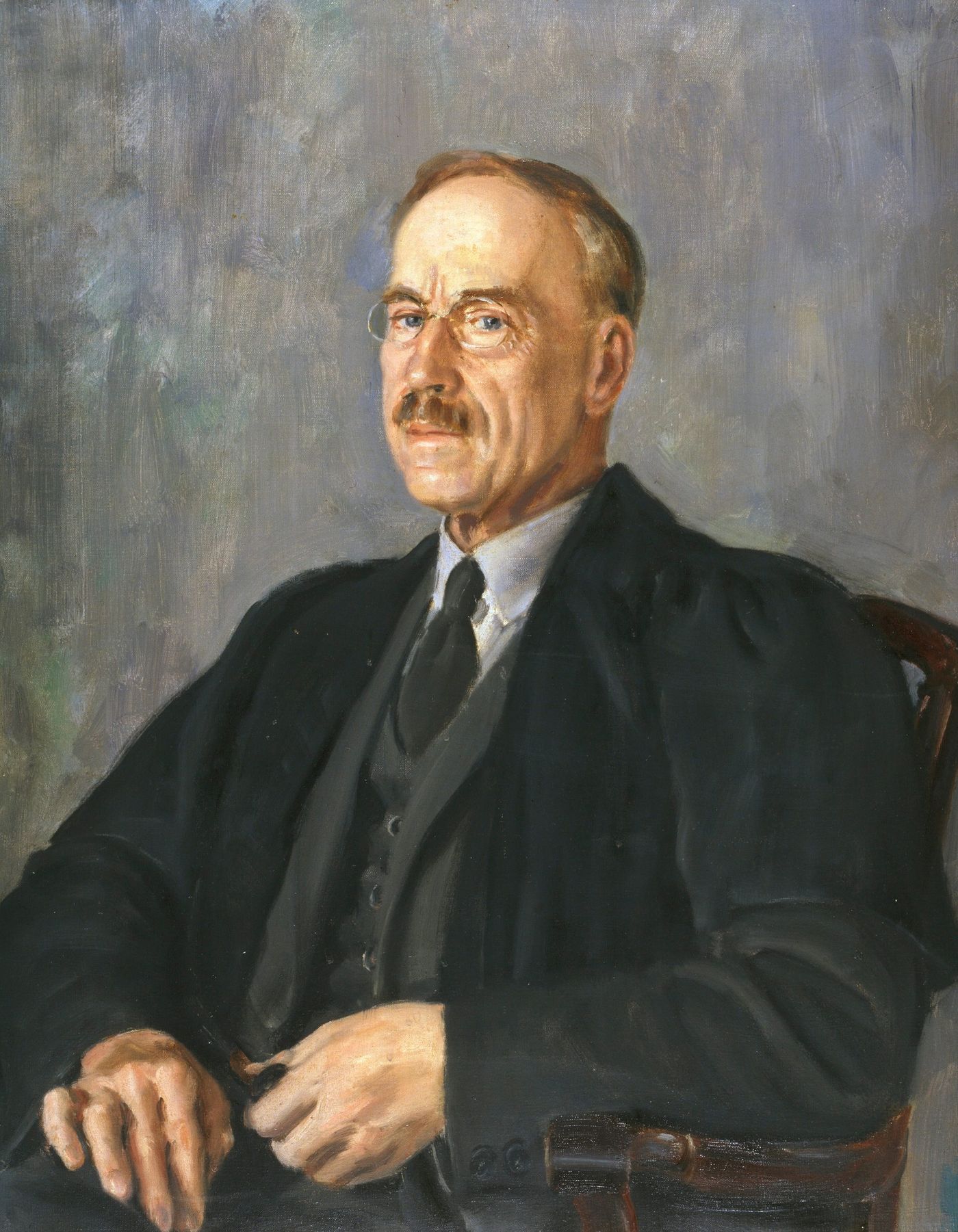
Pictured: Sir Henry Tizard, painted by war artist Bernard Hailstone in 1945 (Imperial War Museum, ART LD 5581; UK Crown Copyright expired, public domain) — the scientist who, as Chief Scientific Adviser to the Ministry of Defence, personally authorized the Flying Saucer Working Party five years later. No photograph of the working party's actual five members in session, nor of the original DSI/JTIC Report No. 7 document itself, is known to be freely licensed for reproduction; the report can be viewed in person or via paid copying order at the National Archives, Kew (DEFE 44/119).
Theoretical Alignment
This case is a government policy review, not a sighting, so alignment with any single origin hypothesis for an observed craft is not directly meaningful. The working party's own conclusions — misidentification, optical illusion, delusion, hoax — sit closest to the Psycho-Social Hypothesis's emphasis on perceptual and social explanations for anomalous reports, though the committee itself never framed its work in those terms; PSH's 40% reflects that the report's chosen language anticipates the PSH framework more than any other, not that OverClassified endorses it as the correct reading of the underlying Portsmouth and Farnborough cases. ETH and IDH scores are low because nothing in the surviving record — the committee's own minutes, its final report, or the cases it reviewed — makes any claim of non-human origin; the working party's silence on that question is a product of its own dismissive methodology rather than genuine evidence against it.
Background
The Ministry of Defence's interest in "flying saucers" did not begin in a vacuum. British air intelligence had been collecting reports of unexplained aerial phenomena since at least 1942, when RAF Bomber Command aircrew began reporting the mysterious balls of fire and moving lights American airmen nicknamed "foo-fighters." Dr. R. V. Jones, Assistant Director of Intelligence (Science) at the Air Ministry, found through interrogation of captured Luftwaffe pilots that German aircrew had reported the same unexplained phenomena — evidence, at the time, against either side's secret-weapon theories. In 1946 and 1947, intelligence officers at the Air Ministry turned their attention to reports of mysterious "ghost rockets" over Scandinavia, at first suspecting modified V-2 rockets launched by the Soviet Union to intimidate the Scandinavian powers — an episode this site covers in full at The Swedish Ghost Rockets.
The American flying saucer wave that began with Kenneth Arnold's June 24, 1947 sighting near Mount Rainier — and the alleged crash near Roswell, New Mexico two weeks later — crossed the Atlantic quickly. By the spring and summer of 1950, British Sunday newspapers were running serialized excerpts of American flying saucer books, most prominently retired U.S. Marine Corps Major Donald Keyhoe's The Flying Saucers Are Real (a copy of which the Ministry of Defence itself retained, filed at DEFE 41/117). The Sunday Dispatch was actively encouraged to run flying saucer coverage by Admiral of the Fleet Louis Mountbatten — later Chief of the Defence Staff (1959–65) — who was privately convinced UFOs were real craft of interplanetary origin, one of a small circle of senior British establishment figures who took the subject seriously well before any formal government study existed.
Sir Henry Tizard was cut from very different cloth than Mountbatten's circle of true believers. A chemist by training, Tizard had chaired the Aeronautical Research Committee through most of the Second World War and is widely credited — alongside Robert Watson-Watt — with pushing the Chain Home radar chain into operational service in time to give Fighter Command the warning margin it needed during the Battle of Britain. In 1940 he led the "Tizard Mission" to the United States, sharing British radar and jet-engine research with American counterparts at a moment when Britain desperately needed America's industrial capacity in return. Appointed Chief Scientific Adviser to the newly unified Ministry of Defence in 1948, Tizard was, by any measure, one of the most credentialed and least credulous scientific minds in British government — which is precisely what gives his 1950 decision its documentary weight. Rather than dismissing the flying saucer reports reaching the Ministry out of hand, Tizard concluded, in the words later recovered from the committee's own minutes, that "reports of flying saucers should not be dismissed without some investigation" (DEFE 41/74). As a direct result of Tizard's own influence, the Ministry of Defence was asked to establish a small technical-intelligence team under the Directorate of Scientific Intelligence/Joint Technical Intelligence Committee (DSI/JTIC) to review the evidence.
Two specific incidents in mid-1950 gave the new committee its first serious test cases before its formal Terms of Reference were even finalized: a radar-corroborated sighting over the naval city of Portsmouth on June 1, and a set of encounters reported that August by an experienced Royal Aircraft Establishment test pilot at Farnborough. Both are examined in detail below.
Complete Timeline
| Date | Event |
|---|---|
| 1942–1945 | RAF Bomber Command aircrew begin reporting "foo-fighters" over occupied Europe; R. V. Jones's interrogations of captured Luftwaffe pilots find German aircrew reporting the same unexplained phenomena independently. |
| 1946–1947 | Air Ministry and Foreign Office intelligence track mysterious "ghost rocket" sightings over Scandinavia, initially suspected as Soviet-launched modified V-2s (see The Swedish Ghost Rockets). |
| June 24, 1947 | Kenneth Arnold's sighting near Mount Rainier, Washington, coins the term "flying saucer" and triggers a wave of American sightings, followed within weeks by the alleged Roswell crash. |
| Spring–Summer 1950 | British Sunday newspapers, including the Sunday Dispatch, serialize American flying saucer books, encouraged in part by Admiral Louis Mountbatten. Public and establishment interest in the subject rises sharply in Britain. |
| June 1, 1950 | A Gloster Meteor pilot flying over Portsmouth at 20,000 feet reports a bright, circular metallic object on a reciprocal course roughly 1,000–2,000 feet above him; four independent radar operators at RAF Wartling track an unidentified fast-moving contact at an estimated 1,350–1,650 knots within minutes of the visual report. |
| August 1950 | RAE test pilot Stan Hubbard reports a pearl-grey, discus-shaped object performing high-speed S-turns over Farnborough airfield. |
| ~Two weeks later, August 1950 | Hubbard and five other senior RAF officers watch a second disc-shaped object over Farnborough execute a "falling leaf" descent before diving away at speed. |
| October 1950 | Sir Henry Tizard authorizes the Ministry of Defence to convene a small DSI/JTIC study team — the Flying Saucer Working Party — with a four-point Terms of Reference; committee minutes (DEFE 41/74–75) show initial internal discussion of the study beginning as early as August 1950, with the formal committee taking shape that autumn. |
| Oct 1950 – Jun 1951 | The five-member committee, chaired by G. L. Turney of the Admiralty, reviews British sighting reports (including the Portsmouth and Farnborough cases) alongside American studies (Project Sign and Project Grudge) over roughly eight months. |
| June 1951 | The working party delivers DSI/JTIC Report No. 7, "Unidentified Flying Objects" — a six-page document classified "Secret/Discreet" — concluding every reviewed case was misidentification, optical illusion, delusion or hoax, and recommending no further investigation absent material evidence. |
| 1951 (after report) | Chairman Turney recommends the report receive "as little publicity as possible." The working party is dissolved; distribution is confined to senior MoD leadership. |
| September 19, 1952 | Shackleton aircrew at RAF Topcliffe, Yorkshire, report a circular silver object during Operation Mainbrace — the first post-report sighting serious enough to prompt renewed Air Ministry attention (see RAF Topcliffe Sighting). |
| July 28, 1952 | Prime Minister Winston Churchill sends a personal minute to the Secretary of State for Air: "What's does all this stuff about flying saucers amount to? What can it mean? What is the truth? Let me have a report at your convenience" (PREM 11/855). |
| August 9, 1952 | The Air Ministry replies to Churchill that "the various reports about unidentified flying objects... were the subject of a full intelligence study in 1951," and that "nothing has happened since 1951 to make the Air Staff change their opinion." |
| 1953 | Responsibility for UFO investigation passes from the Chief of Air Staff to a branch within the Deputy Directorate of Intelligence (Technical), designated AI3, formalizing ongoing monitoring. |
| March 1955 | An Air Ministry Secret Intelligence Summary analyzes 80 UFO reports from 1952–1954; in a May 1955 Parliamentary Question, Air Minister George Ward states "about 90 percent of the reports have been found to relate to meteors, balloons, flares and many other objects." |
| 1999 | The DSI/JTIC committee's minutes surface during unrelated archival research, confirming the working party existed — but the report itself cannot initially be located and is feared destroyed. |
| 2001 | Researchers David Clarke and Andy Roberts, researching their book Out of the Shadows, formally request the report under the Code of Practice on Access to Government Information; the Ministry of Defence locates the surviving copy and releases it to them. |
| January 1, 2002 | DSI/JTIC Report No. 7 is formally made available to the public at the National Archives, Kew, under reference DEFE 44/119. |
The Terms of Reference
The working party's own surviving minutes (DEFE 41/74–75) record a four-point Terms of Reference, remarkably narrow in scope for a Cold War intelligence body:
- To review the available evidence in reports of "Flying Saucers."
- To examine, from that point forward, the evidence on which reports of British origin of phenomena attributed to "Flying Saucers" are based.
- To report to DSI/JTIC as necessary.
- To keep in touch with American occurrences and their evaluation.
The minutes further record that the committee considered — and explicitly declined — consulting two other bodies that might have brought genuinely independent technical expertise to the review: the Meteorological Office and the Operational Research Section of RAF Fighter Command. It was agreed these two bodies would "probably" need to be consulted eventually, but that they should not, for the time being, be asked to nominate representatives. In practice, this meant the working party conducted its entire eight-month review using only the in-house technical-intelligence judgment of officers already institutionally inclined to treat unexplained aerial reports as a security triage problem rather than a genuine scientific puzzle — a methodological choice that later researchers, including Clarke and Roberts, have identified as central to understanding why the committee's conclusions arrived so quickly and so uniformly negative.
Membership and Method
The Flying Saucer Working Party had five members, drawn from the elite technical-intelligence branches of the three armed services and the Ministry of Defence itself. Its chairman was G. L. Turney, head of scientific intelligence at the Admiralty. The committee's membership is recorded in its own minutes as comprising representatives of DSI1 (the Directorate of Scientific Intelligence's own branch), ADNI(Tech) (Admiralty Naval Intelligence, Technical), MI10 (the War Office's technical-intelligence branch), and ADI(Tech) (the Air Ministry's Assistant Directorate of Intelligence, Technical) — the Air Ministry's seat on the committee was filled by Wing Commander M. Formby, who simultaneously chaired the Air Ministry's contemporary Guided Missiles Working Party. Historians Steven Twigge, Edward Hampshire and Graham Macklin, writing the National Archives' own official history British Intelligence: Secrets, Spies and Sources (2008), confirm Turney's chairmanship as the authoritative record; the individual names of the War Office (MI10) and Admiralty naval-intelligence (ADNI(Tech)) representatives beyond Turney himself do not appear to have been published in any source consulted for this case file, and are noted here as unconfirmed rather than guessed at.
The committee's chosen method reflected its members' shared professional background: all had specialized in assessing foreign military hardware against known and prospective weapons technology, and they applied that same threat-assessment lens to flying saucer reports rather than a scientific or meteorological one. Reports were gathered from RAF and Royal Navy personnel and cross-referenced against newspaper accounts and the parallel American investigations then underway — Project Sign and Project Grudge, the U.S. Air Force's own early, similarly dismissive UFO studies. Of the substantial volume of British reports reviewed over the review period, the committee identified a small handful it judged serious enough to warrant individual scrutiny — accounts from credentialed military observers rather than the general public — the most significant of which were the Portsmouth radar-visual case and the two Farnborough sightings by test pilot Stan Hubbard.
Case Study: The Portsmouth Radar-Visual Sighting
On June 1, 1950, a Royal Air Force Gloster Meteor pilot flying eastward at 20,000 feet over Portsmouth — home to one of Britain's principal naval dockyards — reported an object on a reciprocal course roughly 1,000 to 2,000 feet above his own altitude. He described it as circular and of bright metallic appearance, travelling at very high speed, estimated at around 1,000 miles per hour. What elevated the report beyond a routine visual misidentification was independent corroboration: four separate radar operators at the RAF Wartling Ground Controlled Interception station, roughly 100 kilometers to the east along the south coast, tracked an unidentified contact moving toward and then away from the station at an estimated 1,350 to 1,650 knots — speeds far beyond any aircraft in RAF or Fleet Air Arm service at the time.
The working party's eventual handling of the case became one of its most criticized decisions in later analysis. Rather than treating the near-simultaneous visual and radar reports as mutually reinforcing, the committee's investigators focused on a claimed time discrepancy of a few minutes between the pilot's sighting and the radar contact, arguing the two events did not actually corroborate one another. The committee's working explanation — reached without, so far as the surviving record shows, ever locating a specific weather balloon launch, meteorological log entry, or documented equipment fault to support it — was that the pilot had probably seen a weather balloon while the radar operators had probably experienced interference or anomalous propagation, two entirely unrelated phenomena that happened to coincide in the same patch of sky at the same time. Researchers examining the case since 2001 have noted that this "double coincidence" explanation requires two independent, low-probability mundane events to have occurred together purely by chance — an explanation the committee itself never subjected to the same evidentiary standard it demanded of the anomalous alternative.
Case Study: The Farnborough Test Pilot Sightings
In August 1950, Wing Commander Stan Hubbard, a decorated Royal Aircraft Establishment test and research pilot, was walking across the airfield at Farnborough when he heard a humming, hissing sound and turned to see a flat, disc-shaped object — he compared its edge-on profile to a sports discus, pearl-grey and roughly the size of a shirt button at the distance he judged it to be — performing a series of tight S-turns at speeds he estimated up to 1,000 miles per hour. Roughly two weeks later, Hubbard and five other senior RAF officers watched a second disc-shaped object appear low over the airfield, execute a bizarre "falling leaf" descent — the same fluttering, side-to-side motion test pilots use to describe a stalled aircraft losing lift — and then dive away toward the horizon at speed.
Hubbard's professional credentials made his report difficult for the committee to dismiss casually: as an RAF test pilot holding the Distinguished Flying Cross and Air Force Cross, his entire career depended on the ability to distinguish real aircraft behavior from illusion or misperception, and the second sighting carried the independent corroboration of five further senior officers. The working party's conclusion, nonetheless, was that Hubbard had experienced an optical illusion — a finding that offered no specific mechanism for how a trained test pilot and five colleagues could collectively misperceive a discrete object performing multi-second aerobatic maneuvers, and that later chroniclers of the case, including Clarke and Roberts, have singled out as emblematic of the committee's broader pattern: reaching for the least specific available conventional label rather than doing the harder work of identifying an actual balloon launch, aircraft movement, or atmospheric event that could account for what was seen.
The June 1951 Report and Its Conclusions
The working party delivered its final report in June 1951: a six-page document formally designated DSI/JTIC Report No. 7, "Unidentified Flying Objects," and classified "Secret/Discreet" — a relatively low classification tier by Cold War standards, but one that nonetheless kept the document entirely outside public or even most internal Ministry of Defence circulation. The report concluded that every case the committee had reviewed could be explained by one or more of four categories: astronomical or meteorological phenomena; misidentification of aircraft, balloons, birds and similar objects; optical illusions and psychological delusions; or deliberate hoaxes. Its closing recommendation, quoted directly from the surviving document, set British government UFO policy for the following half-century:
"We accordingly recommend very strongly that no further investigation of reported mysterious aerial phenomena be undertaken, unless and until some material evidence becomes available."
No specific, individually documented conventional explanation was offered for the Portsmouth radar-visual case or Hubbard's two Farnborough sightings beyond the general categories above — the report reasoned by category rather than by case-specific reconstruction for at least these three incidents, according to the surviving text and the researchers who have examined it. Once delivered, the committee was formally dissolved, and per chairman Turney's own recorded recommendation that the findings receive "as little publicity as possible," the report's distribution was confined to senior figures within the Ministry of Defence rather than published, summarized publicly, or even acknowledged to exist.
Suppression and Rediscovery
The Flying Saucer Working Party's existence remained essentially unknown outside a small circle of Ministry of Defence officials for nearly fifty years. The committee's own minutes surfaced during unrelated archival research in 1999, confirming that such a body had once existed, but the report itself — the actual substance of what the committee had found and concluded — could not initially be located and was feared lost or destroyed, a routine fate for many British government files of that era before the modern preservation rules took hold. It was researcher David Clarke, working with Andy Roberts on what would become their 2002 book Out of the Shadows: UFOs, the Establishment and the Official Cover-Up, who formally pursued the matter through the Code of Practice on Access to Government Information — the pre-Freedom-of-Information-Act mechanism then available for requesting government records. In 2001 the Ministry of Defence located a surviving copy of DSI/JTIC Report No. 7 and released it to Clarke and Roberts. The document was formally made available to the public at the National Archives, Kew, on January 1, 2002, under reference DEFE 44/119, with a further copy catalogued at DEFE 24/2050/1.
Churchill's Question
The working party's report might have remained a purely internal footnote had it not resurfaced, indirectly, in one of the most quoted documents in the entire British UFO file series. In July 1952, a fresh wave of flying saucer sightings swept the United States, culminating in radar and visual reports over Washington, D.C. that prompted the U.S. Air Force to scramble jet interceptors twice within a single week — an episode that made international headlines. On July 28, 1952, Prime Minister Winston Churchill — himself no stranger to the subject, having ordered an inquiry into an unidentified aircraft reported over the Sheerness naval torpedo school as First Lord of the Admiralty back in 1912 — sent a brief, characteristically blunt personal minute to the Secretary of State for Air: "What's does all this stuff about flying saucers amount to? What can it mean? What is the truth? Let me have a report at your convenience" (National Archives, PREM 11/855).
The Air Ministry's response, dated August 9, 1952, drew directly on the working party's year-old conclusions rather than commissioning any fresh investigation: "The various reports about unidentified flying objects, described by the Press as 'flying saucers,' were the subject of a full intelligence study in 1951," the reply stated, adding that "nothing has happened since 1951 to make the Air Staff change their opinion, and, to judge from recent Press statements, the same is true in America." Churchill's own file on the exchange remained closed until it was transferred to the Public Record Office in 1986 under the thirty-year rule — meaning the Prime Minister's personal question about flying saucers was itself withheld from public view for thirty-four years, entirely independent of the working party report it was answered from, which stayed secret for a further fifteen years beyond that.
Legacy: From the Working Party to DI55
The working party's conclusions set the template for every subsequent phase of British government UFO policy through the end of the Cold War and beyond. Barely a month after Churchill's exchange with the Air Ministry, a new wave of sightings during the September 1952 NATO exercise Operation Mainbrace forced a partial reconsideration: Shackleton aircrew at RAF Topcliffe in North Yorkshire, led by Flight Lieutenant John Kilburn of 269 Squadron, reported a circular silver object descending to follow a Meteor jet, rotating on its own axis, and then accelerating away — a sighting this site covers in full at RAF Topcliffe Sighting. American UFO investigator Edward Ruppelt later credited the Topcliffe incident with causing "the RAF to officially recognise the UFO," and the Air Ministry responded by formalizing ongoing responsibility for UFO reports within its Deputy Directorate of Intelligence (Technical), a branch designated AI3, in 1953.
That administrative arrangement evolved over the following decades — through S6 (Air) from 1958, S4 (Air) after the 1964 creation of the unified Ministry of Defence, and eventually the Defence Intelligence Staff branch DI55 from 1967 — but its underlying posture never meaningfully departed from the working party's own 1951 conclusions. A March 1955 Air Ministry Secret Intelligence Summary analyzing 80 reports from 1952–1954 found, in Air Minister George Ward's own words to Parliament, that "about 90 percent of the reports have been found to relate to meteors, balloons, flares and many other objects" — almost the identical ratio the American Condon Report would reach independently fourteen years later. DI55's own final UFO study, the classified 1996–2000 project this site covers at Project Condign Summary, likewise concluded that reported phenomena posed no defence threat and showed no evidence of extraterrestrial or foreign origin — closing out, more than fifty years after Tizard first authorized the working party, essentially the same institutional conclusion it had opened with.
Key Witnesses
This case is unusual among OverClassified's case files: its central "witnesses" are not sighting eyewitnesses recounting a single anomalous encounter but the government scientists and intelligence officers who conducted an institutional review, alongside the credentialed military witnesses whose original reports that review assessed. Both groups are profiled below.
The Committee
Sir Henry Tizard
The scientist whose personal conviction that flying saucer reports "should not be dismissed without some investigation" (DEFE 41/74) directly created the Flying Saucer Working Party. Tizard's own credentials — chairman of the wartime Aeronautical Research Committee, the man widely credited with pushing Chain Home radar into service before the Battle of Britain, and leader of the 1940 Tizard Mission that shared Britain's radar and jet-engine secrets with the United States — made him one of the least dismissible advocates the subject could have had within the British scientific establishment. He did not sit on the committee himself, but authorized its creation and its chairman answered, ultimately, to him. Tizard retired from the Chief Scientific Adviser post in 1952, the same year his working party's conclusions were relayed to Churchill, and died in 1959.
G. L. Turney
The Admiralty's own scientific-intelligence chief, identified by National Archives historians Twigge, Hampshire and Macklin as the working party's chairman. Turney's own recorded advice — that the finished report should receive "as little publicity as possible" — did more than any single document to determine the working party's fifty-year obscurity; it was Turney's institutional instinct for containment, as much as the report's actual classification level, that kept DSI/JTIC Report No. 7 out of public view until David Clarke's 2001 request forced its rediscovery.
Wing Commander M. Formby
The Air Ministry's seat on the five-member committee, drawn from the Assistant Directorate of Intelligence (Technical) branch. Formby's day job — chairing the Air Ministry's own contemporary Guided Missiles Working Party — meant he brought the same threat-assessment mindset used to evaluate captured or reported foreign weapons hardware directly to bear on flying saucer reports, a professional lens that shaped the working party's methodology as much as any of its four written Terms of Reference.
The Original Witnesses
Wing Commander Stan Hubbard
A Distinguished Flying Cross and Air Force Cross recipient whose two August 1950 sightings at Farnborough — the second independently witnessed by five other senior RAF officers — became among the working party's most closely examined cases and were ultimately dismissed as an optical illusion. As a professional test pilot, Hubbard's entire livelihood depended on his ability to distinguish genuine aircraft performance from misperception, a credential that made his case unusually difficult to wave away with the committee's general explanatory categories, and one that later researchers have cited as among the working party's weakest dismissals.
Unnamed Gloster Meteor Pilot
The RAF pilot whose visual report over Portsmouth was independently corroborated within minutes by four radar operators at RAF Wartling. No source consulted for this case file records his name, a gap consistent with how the RAF's own contemporary reporting and later declassified files habitually anonymized ordinary serving personnel's identities in surviving UFO records — this is noted here as an honest limitation of the public record rather than an editorial choice to withhold it.
The Researchers Who Rediscovered It
Dr. David Clarke
The academic and journalist whose Code of Practice request, made while researching Out of the Shadows with Andy Roberts, prompted the Ministry of Defence to locate and release DSI/JTIC Report No. 7 in 2001. Clarke went on to author The National Archives' own official UFO research guide (2019), the standard published reference for the surviving DEFE and AIR series UFO files at Kew, and has separately researched numerous other British UFO cases this site covers, including the 1974 Berwyn Mountains Incident, the 1957 West Freugh radar incident, and the March 1993 Cosford Incident.
Andy Roberts
Clarke's co-author on Out of the Shadows (2002), the book whose research directly led to the working party's rediscovery. Roberts has separately investigated numerous other British UFO cases documented on this site, including the West Freugh UFO Sighting, the 1974 Berwyn Mountains Incident, and — with Clarke, Martin Shough and Jenny Randles — the 2000s re-investigation of the Lakenheath–Bentwaters incident.
The Five Observables Assessment
The Five Observables framework, developed by former AATIP director Luis Elizondo, classifies UAP encounters by performance characteristics that exceed known technology. It is not meaningfully applicable to this case file: the working party was a government policy review of pre-existing reports, not itself a sighting, and it produced no instrumented flight-performance data of its own for any single craft. Where the underlying Portsmouth and Farnborough cases described object behavior, the descriptions are entirely lay/professional visual accounts — an estimated 1,000 mph pass, a "falling leaf" maneuver — with no radar velocity/acceleration trace, no altitude telemetry, and no trans-medium observation reported in any surviving account. All five observables are therefore marked N/A below, consistent with how this site treats other institutional and whistleblower-report case files rather than single-incident sightings.
Assessment: Neither the Portsmouth radar contact's estimated 1,350–1,650 knots nor Hubbard's estimated 1,000 mph pass at Farnborough was ever instrumented in the modern sense — both are pilot and radar-operator estimates, recorded contemporaneously but never independently cross-checked against a second instrument or flight-recorder trace. The working party itself never applied anything resembling a performance-envelope framework to the cases it reviewed; its own analytical categories were entirely explanatory (what mundane thing might this have been) rather than descriptive of craft capability. Applying the Five Observables retroactively to a 1950-51 institutional review would manufacture a precision the surviving record simply does not support.
Evidence Assessment
Supporting a Genuinely Unresolved Underlying Phenomenon
- The Portsmouth sighting combined an experienced RAF pilot's visual report with independent, near-simultaneous corroboration from four separate radar operators at RAF Wartling
- The working party's own explanation for Portsmouth required two independent, low-probability coincidences (a weather balloon and unrelated radar interference) occurring in the same location at the same time, without ever identifying a specific balloon launch or fault to support either half of that explanation
- Stan Hubbard's Farnborough sightings were reported by a decorated professional test pilot whose career depended on distinguishing real aircraft behavior from illusion, and the second sighting was independently corroborated by five further senior RAF officers
- The working party's report offered no case-specific reconstruction for either the Portsmouth or Farnborough incidents, reasoning by general category rather than by documented mundane cause
- The committee explicitly declined to consult the Meteorological Office or RAF Fighter Command's own Operational Research Section — the two bodies best positioned to supply genuinely independent technical verification — before reaching its conclusions
- Chairman Turney's own recorded instruction to minimize the report's publicity, rather than simple bureaucratic classification practice alone, is difficult to read as consistent with full confidence in the report's own conclusions
Supporting the Working Party's Dismissive Conclusions
- Sir Henry Tizard — one of the least credulous, most scientifically credentialed officials in the British government of the era — personally authorized and oversaw the study, and its conclusions carried his implicit endorsement
- The committee's own explanatory categories (misidentification, optical illusion, delusion, hoax) match almost exactly the American Robertson Panel's contemporaneous conclusions, reached by an entirely separate group of scientists working from a largely separate dataset
- No physical evidence, recovered material, or verifiable instrument recording from either the Portsmouth or Farnborough cases has ever surfaced in the seventy-five years since, including during the 2001–2013 mass declassification of British UFO files
- Radar anomalous propagation, producing spurious high-speed contacts from atmospheric ducting or temperature inversions, was and remains a documented, if intermittent, source of false GCI radar returns along the English Channel coast
- Subsequent, far larger and more heavily resourced British and American UFO studies — including the 1969 U.S. Air Force-sponsored Condon Report and the Ministry of Defence's own 1996–2000 Project Condign — reached broadly similar conclusions using more systematic methodologies, suggesting the working party's 1951 verdict was not an outlier
- A six-page report compiled in eight months by five officers, working alongside their existing full-time intelligence duties, was never intended or resourced as an exhaustive scientific investigation, and its own limited scope should be weighed accordingly
Why "Disputed"
OverClassified classifies the Flying Saucer Working Party as DISPUTED because two entirely separate questions are easily conflated here, and the honest answer to each is different. As a historical fact — that Sir Henry Tizard convened this committee, that it reviewed these specific cases, that it produced this report, and that the report was kept from public view for roughly fifty years — none of that is in any real doubt; it is confirmed by the committee's own surviving minutes, the report itself, and independent academic and archival sourcing. What is genuinely disputed is whether the working party's own explanations for its two strongest reviewed cases — the radar-corroborated Portsmouth sighting and test pilot Stan Hubbard's twice-witnessed Farnborough encounters — actually hold up as satisfying conventional accounts, or whether they represent a bureaucratic answer reached under an explicit institutional preference (Turney's own recorded advice to minimize publicity) for closing the file quickly rather than resolving it thoroughly.
The working party never located a documented weather balloon launch to anchor its Portsmouth explanation, never identified a specific atmospheric or optical mechanism for Hubbard's multi-witness Farnborough sightings, and never consulted the two outside technical bodies best positioned to supply real verification. Those are genuine, substantive gaps in the record, not manufactured ones. At the same time, nothing in the surviving documentation supports an exotic or non-terrestrial reading of either case, and the working party's broad conclusions have been echoed by every subsequent, better-resourced British and American study of the same general phenomenon. That combination — real institutional shortcuts in the specific 1950-51 investigation, sitting alongside no positive evidence for anything beyond conventional explanation — is exactly what this site's Disputed classification is designed to capture.
Sensor & Instrumentation Detection Profile
The only instrumented data associated with any case the working party reviewed comes from the Portsmouth sighting: four independent Ground Controlled Interception radar operators at RAF Wartling tracked an unidentified fast-moving contact, estimated at 1,350–1,650 knots, on early-1950s GCI radar equipment. No recording, photograph, or plotted track from this contact is known to survive in any released file; the estimate comes from the operators' contemporaneous verbal/written reports rather than a preserved radar trace. The Farnborough sightings were visual-only, with no radar, photographic, or other instrumented corroboration on record for either of Stan Hubbard's two 1950 encounters. The working party itself, as a review body, deployed no sensors or instruments of its own; its "detection profile" consists entirely of secondhand analysis of these pre-existing reports.
Environmental & Geospatial Context
The working party's own review was conducted from the Ministry of Defence's Main Building on Whitehall in central London, but the underlying cases it assessed span England's southern coast: the Portsmouth sighting occurred in the airspace over Hampshire's naval dockyard city, corroborated by radar roughly 100 kilometers east along the coast at RAF Wartling in East Sussex, while the Farnborough sightings occurred inland at the Royal Aircraft Establishment's Hampshire airfield, some 30 kilometers northwest of Portsmouth. No meteorological log entries specific to either the Portsmouth or Farnborough incidents are cited in any source consulted for this case file; the working party's own "weather balloon" and "radar interference" explanations for Portsmouth are not tied to any specific documented atmospheric condition on June 1, 1950 in the surviving record.
Observer Credibility & Occupational Profile
The underlying witnesses in this case carry unusually strong professional credentials for a 1950-era British UFO report: an RAF Gloster Meteor pilot and four independent Ground Controlled Interception radar operators (Portsmouth), and a Distinguished Flying Cross/Air Force Cross-decorated Royal Aircraft Establishment test pilot corroborated by five further senior RAF officers (Farnborough). The reviewing committee itself was staffed entirely by career technical-intelligence officers — G. L. Turney (Admiralty), Wing Commander M. Formby (Air Ministry), and unnamed representatives of the War Office's MI10 and the Admiralty's ADNI(Tech) branches — operating under the direct authority of Sir Henry Tizard, whose own scientific credentials (wartime radar development, the Tizard Mission) were among the strongest in the British government of the era. No civilian or amateur witnesses feature in the working party's own core cases as documented in the surviving report.
Physical & Material Assays
No physical evidence, recovered material, or debris of any kind is associated with any case the working party reviewed, and none has ever surfaced in the seventy-five years since — a point the committee's own final recommendation implicitly acknowledged by conditioning any future investigation on "some material evidence" becoming available, evidence that, as of this case file's publication, has never materialized for either the Portsmouth or Farnborough incidents specifically.
Historical Precedents & Archive Matches
The Flying Saucer Working Party sits at the head of a documented chain of British institutional UFO reviews that this site covers individually: the September 1952 RAF Topcliffe Sighting that prompted the Air Ministry's first formal ongoing UFO-monitoring branch; the April 1957 West Freugh UFO Sighting, whose official report came closer than almost any other British government document to acknowledging a genuinely unexplained radar contact; and the classified 1996–2000 Project Condign Summary, DI55's own final UFO study before the Ministry of Defence's public-facing "UFO desk" closed in 2009. Internationally, the working party is most frequently compared to the United States' Robertson Panel of January 1953 — a scientific advisory panel convened by the CIA that likewise reviewed a small set of credible cases and recommended against further official investigation absent new evidence, reaching remarkably similar conclusions to Tizard's committee less than two years earlier and working almost entirely independently of it. The working party's own background context traces further back still to the 1946–47 Scandinavian "ghost rocket" wave this site documents at The Swedish Ghost Rockets, and to the American sighting wave opened by Kenneth Arnold's 1947 report and the alleged Roswell crash that followed it.
Material Analysis
Because no physical trace evidence exists for any case the working party reviewed, "material analysis" in this case file necessarily means analysis of the documentary material itself — the committee's minutes, its final report, and the archival record of how both were suppressed and later recovered — rather than metallurgical or isotopic testing of any recovered object. That documentary record is, unusually for a 1950-51 British government file, substantially intact: the Terms of Reference, the chairman's identity, the report's exact conclusions and closing recommendation, and the correspondence chain connecting the report to Churchill's 1952 inquiry are all independently verifiable through National Archives holdings.
What the Surviving Documents Establish
DEFE 41/74 and DEFE 41/75 (the working party's own minutes) establish the committee's Terms of Reference, its decision not to consult the Meteorological Office or RAF Fighter Command's Operational Research Section, and Tizard's originating role. DEFE 44/119 (with a duplicate at DEFE 24/2050/1) preserves the actual text of DSI/JTIC Report No. 7, including its closing recommendation quoted above. PREM 11/855 preserves both Churchill's July 1952 minute and the Air Ministry's August 1952 reply, independently confirming the working party's 1951 conclusions were still the Ministry's official position a year after the report was delivered. Each of these documents can be independently cross-checked against the others — Churchill's file references "a full intelligence study in 1951," which matches the working party's own report date exactly, and the report's conclusions match the four explanatory categories the Air Ministry cited to Churchill nearly word for word.
What Remains Undocumented
The gaps are equally real. No case-specific technical workings survive — no identified balloon serial number, launch log, or radar-fault diagnosis — for either the Portsmouth or Farnborough cases specifically; the surviving report states its conclusions by general category rather than showing its work case by case. The individual names of two of the five committee members (the War Office's MI10 representative and the Admiralty's ADNI(Tech) representative, beyond chairman Turney) do not appear in any source consulted for this case file. And the fate of any underlying working papers, witness interview notes, or draft versions of the report beyond the final six-page document itself is unknown; if such material ever existed, no source consulted here indicates it has survived or been located.
Supporting a Genuine, If Incomplete, Documentary Record
- Multiple independently catalogued National Archives files (DEFE 41/74–75, DEFE 44/119, DEFE 24/2050/1, PREM 11/855) corroborate one another's account of the same events, dates, and conclusions
- The chain from Tizard's authorization through Turney's chairmanship to the final report and Churchill's 1952 inquiry is continuous and internally consistent across every source consulted
- The report's release to Clarke and Roberts in 2001 followed a formal, documented government records-access process rather than an unverified leak
Supporting Real Limits on What Can Be Verified
- No case-specific technical reconstruction survives for either the Portsmouth or Farnborough incidents individually
- Two of five committee members' individual identities remain unpublished in any source located for this case file
- No underlying working papers or interview notes beyond the final report itself are known to survive
The Conventional Explanation Candidate
Because this case file concerns an institutional review rather than a single sighting, its Conventional Explanation Candidate section evaluates the working party's own stated explanations against the specific cases they were meant to resolve, rather than proposing a single alternative explanation of our own.
The Working Party's Own Categories: Misidentification, Illusion, Delusion, Hoax
The committee's four explanatory categories are each individually well-established, common causes of UFO reports generally, and there is no reason to doubt they genuinely account for the majority of the broader pool of British sightings the working party would have reviewed beyond its two headline cases. The problem is specificity: for the Portsmouth and Farnborough incidents particularly, the report never identifies which category applies to which specific detail of either case, nor does it name a documented balloon launch, aircraft movement, or optical phenomenon responsible. A general category is not the same as a resolved case, and the working party's own report does not bridge that gap for its two strongest examples.
Radar Anomalous Propagation (Portsmouth Radar Contact)
Anomalous propagation — atmospheric ducting or temperature-inversion effects that cause radar to detect spurious returns from ground clutter, weather, or distant objects at implausible apparent ranges and speeds — is a real, documented phenomenon along the English Channel coast, and remains a standard skeptical explanation offered for many historical UK radar-visual cases. It is a genuinely plausible partial explanation for the Wartling radar contact considered in isolation. It does not, however, explain why the contact's timing and general bearing matched a Meteor pilot's simultaneous visual report of a fast-moving metallic object on a reciprocal course — the working party's own explanation required this to be pure coincidence, without identifying the specific inversion layer, ducting condition, or clutter source responsible on June 1, 1950.
Optical Illusion / Misperception (Farnborough Sightings)
Optical illusions affecting experienced pilots are a documented phenomenon — atmospheric refraction, autokinetic effect, and misjudged distance/size of a genuinely mundane object (a balloon, a bird, another aircraft at an unusual angle) can all produce convincing but ultimately explicable sightings even from trained observers. This remains a real possibility for Stan Hubbard's August 1950 encounters. It is weakened, though not disproven, by the second sighting's independent corroboration by five further senior RAF officers, a scale of simultaneous multi-witness misperception that the working party's report does not attempt to explain mechanistically.
Institutional Threat-Management Motive
A distinct question from what the underlying objects actually were is why the working party reached its conclusions as quickly and uniformly as it did. The committee's own decision not to consult the Meteorological Office or RAF Fighter Command's Operational Research Section, combined with chairman Turney's recorded advice to minimize the report's publicity, is consistent with an institution more interested in closing a potentially distracting file quickly than in exhaustively resolving it — a Cold War-era intelligence body triaging finite resources against a perceived low-priority, low-threat subject, rather than a body pursuing genuine scientific closure. This does not require, or even suggest, an exotic explanation for the underlying sightings; it simply means the working party's own stated reasoning should be read as institutionally motivated as well as evidentiary.
Misidentification / Illusion / Delusion / Hoax (General Categories)
Plausible (as a general population explanation)Highly plausible as an account of the broader pool of British sighting reports the working party would have screened, consistent with every larger, better-resourced study before or since. Its application to the two headline Portsmouth and Farnborough cases specifically is weaker, since the report never names a documented cause for either.
Radar Anomalous Propagation (Portsmouth)
InconclusiveA real, documented phenomenon in the right general location, but never tied to a specific atmospheric condition on June 1, 1950, and does not by itself explain the near-simultaneous, corroborating visual sighting.
Optical Illusion / Misperception (Farnborough)
InconclusivePlausible for a single witness, but the working party's report offers no mechanism for how the second sighting's six independent RAF observers could have shared the same misperception simultaneously.
Institutional Threat-Management Motive
PlausibleWell supported by the committee's own documented choices — declining outside technical consultation and minimizing the report's publicity — though this explains the working party's conduct, not the underlying objects themselves.
Related Cases
Confirmed Documents & Official Records
The Flying Saucer Working Party's six-page final report, classified "Secret/Discreet," released to researchers David Clarke and Andy Roberts in 2001 and made publicly available at Kew on January 1, 2002. A duplicate copy is catalogued at DEFE 24/2050/1.
Formerly SECRET/DISCREET (declassified)The committee's own surviving minutes, recording its Terms of Reference, Tizard's originating role, and chairman G. L. Turney's advice on limiting the final report's publicity.
UNCLASSIFIED (declassified)Winston Churchill's July 28, 1952 personal minute asking the Secretary of State for Air "what does all this stuff about flying saucers amount to," with the Air Ministry's August 9, 1952 reply citing the working party's 1951 conclusions.
UNCLASSIFIED (declassified 1986)David Clarke's official National Archives research guide to the full surviving series of UK government UFO files, including the Flying Saucer Working Party's own file references and the wider DEFE/AIR document series.
UNCLASSIFIEDSearch Government Archives Directly
Further Reading — Recommended Literature
Out of the Shadows: UFOs, the Establishment and the Official Cover-Up
The book whose research directly led to the Flying Saucer Working Party's rediscovery, and remains the single fullest published treatment of the case and the wider British government UFO cover-up.
The UFO Files: The Inside Story of Real-Life Sightings
The National Archives' own official history of British UFO investigation, published to accompany the mass declassification program Clarke consulted on, covering the working party alongside Topcliffe, West Freugh and dozens of other cases.
Britain's X-traordinary Files
Clarke's wider survey of the National Archives' own official paranormal and anomalous-phenomena records, situating the working party within the broader British government tradition of quiet institutional inquiry into unexplained reports.
Open Skies, Closed Minds
A firsthand account from the former head of the Ministry of Defence's own public UFO desk, describing the institutional culture the working party's 1951 conclusions helped establish and that persisted for decades afterward.
A Covert Agenda: The British Government's UFO Top Secrets Exposed
An early, independent investigation into decades of British government UFO secrecy, tracing the same institutional pattern of quiet review and minimal disclosure the working party's own history exemplifies.
DISCLOSURE: Some links above are affiliate links. If you purchase through them, OverClassified receives a small commission at no additional cost to you. This helps support independent research.
Essential Viewing
No Videos Available
Sources
- Clarke, David. "The National Archives Research Guide — Unidentified Flying Objects (UFOs)." Sheffield Hallam University Research Archive (SHURA), 2019. shura.shu.ac.uk
- The National Archives (Kew). "UFOs" research guide. nationalarchives.gov.uk
- The National Archives (Kew). DSI/JTIC Report No. 7, "Unidentified Flying Objects," June 1951 (DEFE 44/119; duplicate DEFE 24/2050/1)
- The National Archives (Kew). Flying Saucer Working Party committee minutes (DEFE 41/74–75)
- The National Archives (Kew). Winston Churchill personal minute and Air Ministry reply on flying saucers (PREM 11/855)
- Clarke, David, and Roberts, Andy. Out of the Shadows: UFOs, the Establishment and the Official Cover-Up. London: Piatkus, 2002
- Clarke, David. The UFO Files: The Inside Story of Real-Life Sightings. London: The National Archives, 2009 (2nd ed. 2012)
- Clarke, David. Britain's X-traordinary Files. London: Bloomsbury, 2014
- Twigge, Steven, with Hampshire, Edward, and Macklin, Graham. British Intelligence: Secrets, Spies and Sources. Kew: The National Archives, 2008
- Ridpath, Ian. "UK Government Flying Saucer Working Party." ianridpath.com
- Clarke, David. "Flying Saucer Working Party." drdavidclarke.co.uk
- "The Flying Saucer Working Party." UFO Sightings, Facts and Myths. ufoencounters.co.uk
- Enigma Labs. "The UK's Flying Saucer Working Party." enigmalabs.io
- UFO Casebook. "Commentary on DSI/JTIC Report No. 7 (Working Party)." ufocasebook.com
- Magonia Magazine. "UFOs at the National Archives." magoniamagazine.blogspot.com
- "Flying Saucer Working Party." Wikipedia. en.wikipedia.org
- "Henry Tizard." Wikipedia. en.wikipedia.org
- "RAF Wartling." Wikipedia. en.wikipedia.org
- "Royal Aircraft Establishment." Wikipedia. en.wikipedia.org
- Thetartanterror. "Test & Research Pilots, Flight Test Engineers: W/Cdr Stan Hubbard DFC AFC* 1921–2014." thetartanterror.blogspot.com
- Pippaettore.com. "Wing Commander Stan Hubbard — obituary." pippaettore.com
- International Churchill Society. "How UFOs KBO." winstonchurchill.org
- The London Economic. "What Churchill knew about flying saucers and aliens." thelondoneconomic.com
- UFO Evidence. "Secret UFO Report To Churchill Revealed After 50 Years." ufoevidence.org
- Wikimedia Commons. "Sir Henry Tizard, KCB, AFC, FRS – IWM ART LD 5581." Imperial War Museum, portrait by Bernard Hailstone, 1945. commons.wikimedia.org
- Podcast UFO. "The Flying Saucer Working Party." podcastufo.com
- Kiddle. "Flying Saucer Working Party facts for kids" (summary derived from Wikipedia). kids.kiddle.co
See something inaccurate? Have additional information or sources?
Suggest an Edit →Last Updated: August 2026