
A Covert Agenda
The British Government's UFO Top Secrets Exposed
Core Thesis
A Covert Agenda: The British Government's UFO Top Secrets Exposed is Nick Redfern's 1997 reconstruction of nearly fifty years of Ministry of Defence engagement with UFO reports, built almost entirely from documents Redfern obtained by exploiting Britain's Public Record Acts — the same declassification mechanism that, four years later, would surface the exact case study this site covers in full at The UK "Flying Saucer Working Party". Redfern's central argument is that the MoD has quietly tracked, documented, and investigated hundreds of Royal Air Force, police, and civilian UFO encounters since 1947 while publicly maintaining that it takes no interest in the subject beyond any conventional defense implication — and that the pattern of minimal, reluctant disclosure this book traces through Cold War-era files is a genuine institutional policy, not a series of isolated bureaucratic accidents. The book carries a foreword by Nick Pope, who ran the MoD's own UFO desk from 1991 to 1994 and later authored Open Skies, Closed Minds; Pope's own assessment, that the book's real strength lies in constructing its case almost entirely from official documentation rather than testimony or speculation, is a fair description this article's own research confirms.
About the Author
Nick Redfern, born in England in 1964 and later based in Texas, is the author of more than thirty books on UFOs, cryptozoology, and government secrecy, and a longtime researcher of declassified Royal Air Force, Air Ministry, and Ministry of Defence files. A Covert Agenda, published in January 1997, was among his earliest major books and established the FOI-document-driven method that has defined his career since — a marked contrast to the witness-testimony-heavy approach of contemporaries like Timothy Good, whose own Above Top Secret and Alien Base this site has also reviewed.
Redfern's subsequent career built directly on this book's documentary foundation: his later work, including Top Secret Alien Abduction Files (2018) and multiple books specifically on the "Men in Black" phenomenon (The Real Men in Black; Men in Black: Personal Stories & Eerie Adventures), continues the same pattern of grounding extraordinary claims in specific, named declassified documents and Freedom of Information requests rather than secondhand contactee testimony.
The book's foreword author, Nick Pope, brings a directly relevant institutional perspective: as the Ministry of Defence's own UFO desk officer from 1991 to 1994, Pope was, for those three years, the actual civil servant responsible for exactly the kind of public-facing UFO correspondence and internal review process Redfern's book investigates historically — giving his foreword's assessment of the book's documentary rigor unusual first-hand institutional weight compared to a foreword from an outside commentator.
Historical Context & Origins
The book arrived at a specific inflection point in British UFO-secrecy disclosure: the mid-to-late 1990s saw a gradual loosening of MoD file classification under the Code of Practice on Access to Government Information, the same administrative mechanism that would later release the actual DSI/JTIC Report No. 7 this site's own Flying Saucer Working Party case file is built on — though that specific report was not itself released until 2001, four years after this book's publication, when researchers David Clarke and Andy Roberts tracked down the surviving copy at the National Archives.
This site's own case file documents exactly the institutional pattern Redfern's book argues for at book length: in October 1950, Sir Henry Tizard, the Ministry of Defence's Chief Scientific Adviser, authorized a small technical-intelligence committee — the Flying Saucer Working Party, chaired by Admiralty scientific-intelligence officer G. L. Turney — to review British flying saucer reports. After eight months examining cases including a radar-corroborated sighting over Portsmouth and test pilot Stan Hubbard's encounters at Farnborough, the committee's June 1951 report attributed every case to misidentification, optical illusion, delusion, or hoax, and was then classified "Secret/Discreet" and given, at the chairman's own urging, as little publicity as possible — vanishing from public knowledge for exactly the kind of half-century-long institutional silence Redfern's book, written in the middle of that fifty-year gap, argued was standard MoD practice rather than a one-off.
The book's central institutional claim is also independently corroborated by the British government's own later admission: the 2000 Condign Report, the MoD's internal review of UAP phenomena (commissioned 1997, the same year this book was published, and not itself declassified until 2006), concluded that a genuine, unexplained atmospheric-plasma phenomenon existed in a small percentage of reports — a finding that, whatever its own scientific merits, confirmed the MoD had continued taking the subject seriously enough to commission a dedicated internal study during the exact period Redfern's book argued it was doing so quietly rather than not at all.
Core Arguments & Key Concepts
The book's central argument is that the Ministry of Defence has systematically documented and investigated UFO reports since 1947 through Royal Air Force, police, and civilian channels, while maintaining a public posture that no such systematic activity exists beyond routine airspace-security screening — a specific institutional-hypocrisy claim Redfern supports primarily through documents obtained under the Public Record Acts rather than through witness testimony or speculation.
A second argument concerns the specific mechanics of British UFO secrecy: Redfern traces how individual case files were classified, how internal MoD correspondence characterized public inquiries, and how the department's stated policy (no operational interest in UFOs as a defense matter) coexisted with an evident, ongoing internal review process — the same tension this site's own Flying Saucer Working Party case file independently documents through Tizard's own 1950 minutes, in which he stated "reports of flying saucers should not be dismissed without some investigation" even as the committee's eventual public-facing posture minimized the study's existence entirely.
A third argument, reflected in the book's closing chapters per available summaries, is that by the mid-1990s an official shift in policy was underway, with the MoD gradually more willing to release historical UFO files under Freedom of Information-adjacent mechanisms — a prediction later borne out concretely by the 2001 release of the Flying Saucer Working Party's own report and by the MoD's 2008–2009 decision to release its entire UFO files archive to the National Archives in stages, disbanding its UFO desk (the same desk Pope had staffed) in 2009.
Key Cases & Evidence Discussed
This site's own The UK "Flying Saucer Working Party" (Case File #343, October 1950, Disputed) is the single clearest documented case study of exactly the institutional pattern this book describes: a real, MoD-authorized technical committee, chaired by G. L. Turney under Sir Henry Tizard's authorization, that investigated credible cases (the Portsmouth radar-visual sighting and Stan Hubbard's Farnborough encounters) and then had its own existence classified and minimized for fifty years — a real-world instance of the secrecy pattern this book, written while that specific report was still unreleased, argued was MoD standard practice.
The case file's own description of the working party as "Britain's own answer to the American Robertson Panel" connects this book's British-focused argument to this site's parallel American case-file coverage of the CIA-sponsored 1953 Robertson Panel, a comparable institutional pattern (a credentialed scientific committee reviewing UFO evidence, concluding non-threat, and then minimizing its own study's public visibility) documented independently on both sides of the Atlantic.
This site's resources library separately cites Nick Pope's own Open Skies, Closed Minds, this book's foreword author's later first-person account of running the exact MoD UFO desk this book examines historically — a useful direct comparison between an outside investigator's document-based reconstruction (Redfern) and an insider's own first-hand account of the same institutional machinery (Pope).
Critical Reception & Controversies
The book received a positive trade-press reception on release: UFO Magazine (UK) called it "an accomplished and thoroughly fascinating expose of official government and military interest in the UFO phenomenon," and its foreword author Nick Pope specifically praised its evidentiary method — noting the book's strength lies in constructing its case for taking UFO reports seriously largely from official documentation obtained through the Public Record Acts, rather than from witness testimony or speculation. This site's own research confirms that characterization is accurate relative to the wider ufology genre: a document-first method is comparatively rare, and Redfern's approach here anticipates the more rigorously archival method later followed by David Clarke and Andy Roberts in actually recovering the Flying Saucer Working Party's own report four years later.
Reader response on Amazon is solidly positive (4.0 out of 5 stars across 23 ratings at time of research), consistent with a book whose reputation rests on its documentary sourcing rather than sensational claims.
The book's central rhetorical framing — that the pattern of MoD secrecy it documents implies "rationally-controlled machines from outside Earth" are genuinely penetrating British airspace, per some publisher summaries of its argument — runs ahead of what the documentary record on its own actually establishes. This site's own independent case-file research into the Flying Saucer Working Party reaches a more measured position on the same underlying documents: that the working party's own conclusions (misidentification, optical illusion, delusion, hoax) sit closest to a Psycho-Social Hypothesis framing, and that the committee's evident secrecy is better explained by institutional caution and image management than by a confirmed non-human threat the government was actively concealing — a distinction this article notes explicitly, since demonstrating that a government kept UFO files secret is a substantially different and more easily supportable claim than demonstrating what those files actually prove about the underlying phenomenon.
Set against Redfern's own later, more specialized books (on Men in Black intimidation claims specifically, for instance), A Covert Agenda represents his broader, foundational documentary project before his later work narrowed into more individually contestable sub-genres of the field — a useful early-career reference point for readers of his more recent, more speculative titles.
Influence & Legacy
This book's most concrete legacy is documentary continuity: it was written using the same Public Record Acts access mechanism that, within a few years of its publication, surfaced the actual Flying Saucer Working Party report this site's own case file is built from, and its central argument — that quiet, sustained MoD review coexisted with a public posture of disinterest — was borne out concretely by that report's own fifty-year classification history.
On this site specifically, this book is cited directly on the Flying Saucer Working Party case file's own Further Reading list as "an early, independent investigation into decades of British government UFO secrecy, tracing the same institutional pattern of quiet review and minimal disclosure the working party's own history exemplifies" — a description this article's own research confirms holds up well against the specific documented case the site has independently investigated.
Within British ufology specifically, this book represents an important documentary bridge between the earlier, more anecdotal British UFO literature and the more rigorously archival research method Clarke and Roberts would apply four years later to recover the working party's own report — part of a broader shift, evident across this site's own British-focused essential-reading coverage (Clarke and Roberts's Out of the Shadows among them), toward treating declassified government documents as the primary evidentiary basis for UFO-secrecy claims rather than witness testimony alone.
The Book
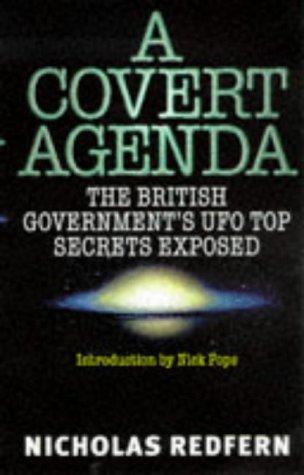
As an Amazon Associate, OverClassified may earn from qualifying purchases made through this link, at no extra cost to you.
Why This Is Essential Reading
A Covert Agenda earns its place on this list as an early, genuinely document-driven investigation into British government UFO secrecy, written using the same Public Record Acts mechanism that would, within a few years, surface the actual Flying Saucer Working Party report this site's own case file investigates directly. Read alongside that case file for the specific 1950–51 documentary record this book anticipated, and alongside foreword author Nick Pope's own Open Skies, Closed Minds for an insider's first-hand account of the same institutional machinery from the other side of the desk. Its rhetorical leap from "the government kept UFO files secret" to "non-human craft are confirmed to be penetrating British airspace" outruns what the documentary record alone supports — a distinction this site's own more measured reading of the same underlying Flying Saucer Working Party documents is worth keeping in mind while reading Redfern's own framing.
Related Cases & Theories
Sources Cited
- Redfern, Nicholas. A Covert Agenda: The British Government's UFO Top Secrets Exposed. Foreword by Nick Pope. Simon & Schuster / Pocket Books, 1997 (ISBN-13 9780671005320). amazon.com
- "A Covert Agenda." Open Library (bibliographic record: publisher, publish date, cover art). openlibrary.org
- "A Covert Agenda: The British Government's UFO Top Secrets Exposed." Goodreads (reader ratings and reviews). goodreads.com
- "Flying Saucer Working Party." Wikipedia (1950–51 DSI/JTIC study, 2001 National Archives release). en.wikipedia.org
- "Guest blog: Do you believe in UFOs? Part 1 of 2." The National Archives blog (blog.nationalarchives.gov.uk), on the MoD UFO files release program. blog.nationalarchives.gov.uk
- "Condign Report." Wikipedia (MoD's 2000 internal UAP study, commissioned 1997, declassified 2006). en.wikipedia.org
- This site's own resources library: Full Reading List, where this book is cited on the Flying Saucer Working Party case file's own Further Reading list.
- This site's own case file: The UK "Flying Saucer Working Party", for the full 1950–51 documentary record this book anticipated.
- This site's own case file: The Robertson Panel, for the comparable American institutional pattern.
- This site's own key-figures entry: Nick Redfern, for his full bibliography and further case connections.
- This site's own key-figures entry: Nick Pope, for his own MoD UFO desk career and this book's foreword.
- This site's own essential reading entry: Open Skies, Closed Minds, for Nick Pope's own first-hand account of the same institutional machinery.
Have corrections, additional research, or peer-reviewed sources? Help improve this entry.
Suggest an Edit