
The Gemini IV / McDivitt Cylindrical Object Sighting
On June 4, 1965, twenty-two orbits into the second crewed flight of Project Gemini, command pilot James McDivitt spotted a white, cylindrical object with a rod or "arm" protruding from its side drifting outside his window as the spacecraft passed over the Pacific near Hawaii. He grabbed two cameras and photographed it, radioed Houston, and briefly fired the Gemini's thrusters out of concern for a collision — while co-pilot Ed White slept through the entire event. The object was never conclusively identified. In 1969 the government-commissioned Condon Report singled it out, alongside a second McDivitt sighting later the same mission and a separate Gemini VII observation, as one of three astronaut sightings that had "not been adequately explained." No official body has ever formally reversed that verdict; the closest thing to a resolution is McDivitt's own, decades-later, admittedly uncertain guess that he may have seen sunlight glinting off a bolt in his window.
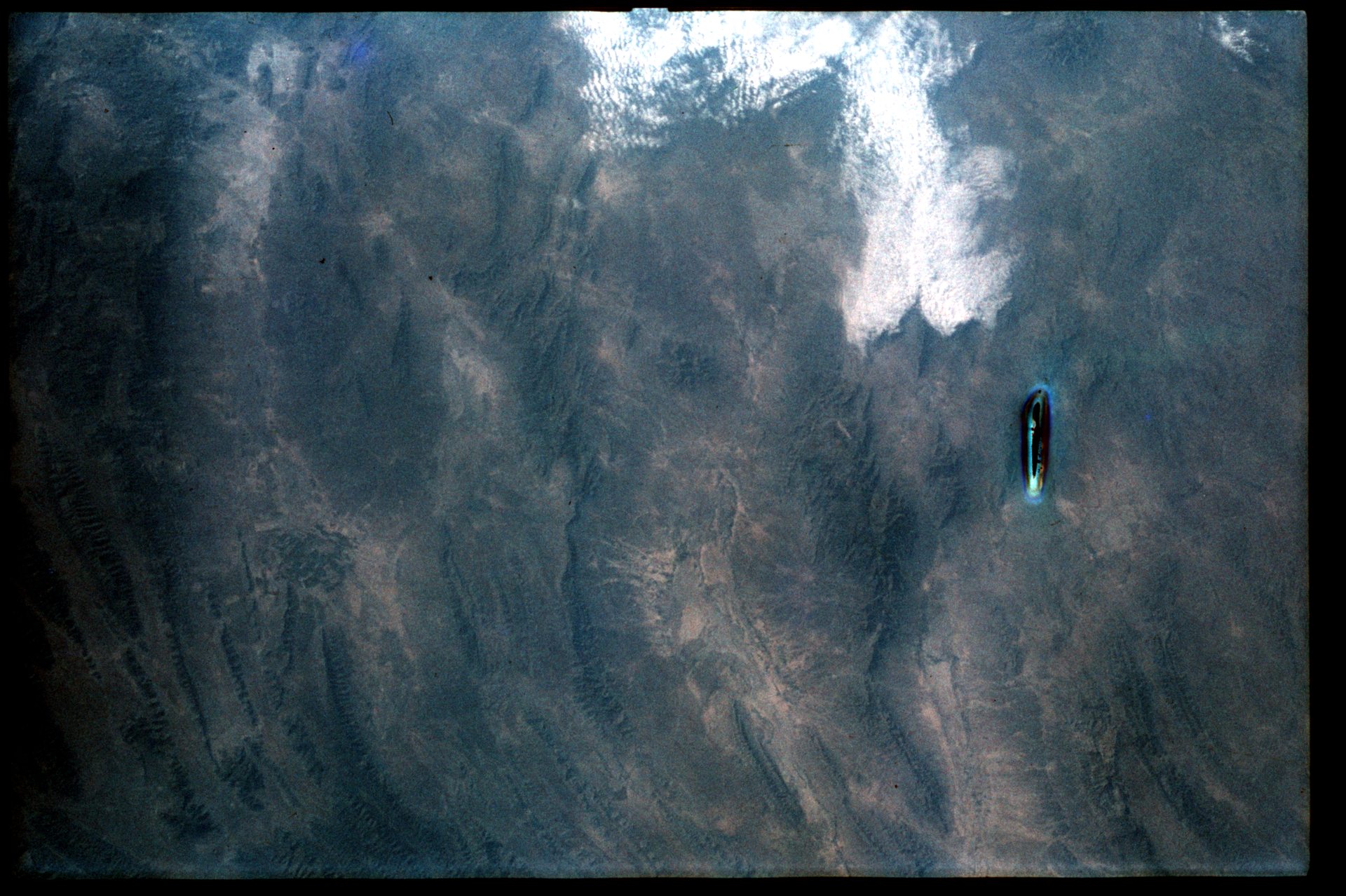
Pictured: NASA/JSC frame GT4-37149-039, digitized from the original Gemini IV flight film and filed under "Unidentified" in the Johnson Space Center & Arizona State University "March to the Moon" archive — the frame some UFO publications have captioned as McDivitt's photograph of the object. It is not a confirmed photograph of the sighting: it shows a dark, chromatically fringed streak of light superimposed over ordinary Earth-observation terrain photography (mountainous desert, most consistent with the Middle East, taken during a daylight pass), and McDivitt himself explicitly rejected NASA's captioning of a released frame as his object, stating "this is not a photograph of the object which I described." Most analysts, including skeptic Philip J. Klass, regard frames like this one as a lens flare or film-emulsion artifact rather than genuine photographic evidence of the sighting — no photograph clearly and uncontestedly showing the object McDivitt described is known to exist.
Theoretical Alignment
This is fundamentally an unresolved-identification case rather than a strong candidate for any particular explanatory framework. Extraterrestrial Hypothesis alignment is rated speculative rather than negligible only because the case's central, distinguishing fact — a formal U.S. government scientific report explicitly declining to explain it — keeps it technically open in a way most single-witness sightings never achieve; nothing about the object's reported behavior (no maneuvering, no acceleration, no trans-medium travel, a single 30-second look) supplies independent support beyond that bare non-explanation. Psycho-Social alignment is low but not zero: McDivitt was an experienced, unexcitable test pilot reporting a discrete, describable object rather than a vague light or a psychological event, but the case does sit inside the broader, well-documented pattern of early Space Age astronauts misidentifying genuinely novel visual stimuli — sunlit debris, ice crystals, distant catalogued satellites — that had no analog in their prior flying experience. Interdimensional Hypothesis alignment is negligible; nothing in the record suggests anything beyond a physical, opaque object in normal three-dimensional space.
Background
Gemini IV was the second crewed mission of NASA's Gemini program, the two-man bridge between the single-seat Mercury flights of the early 1960s and the three-man Apollo missions that would attempt the Moon by decade's end. Where Mercury had proven that Americans could survive spaceflight, Gemini existed to prove NASA could actually operate in space — rendezvous, dock, maneuver, and keep a crew functioning and productive for the roughly eight days a lunar round trip would eventually require. The program's stakes were sharpened by the Cold War: the Soviet Union had already flown the first spacewalk, by cosmonaut Alexei Leonov, on March 18, 1965, just eleven weeks before Gemini IV's launch, and closing that gap was an explicit NASA priority.
Command pilot James A. McDivitt and pilot Edward H. White II were both members of NASA's second astronaut class, selected in September 1962, and both Air Force officers with backgrounds as fighter pilots and engineering-credentialed test pilots — the standard astronaut profile of the era, built specifically around men NASA judged capable of calm, technically precise reporting under novel and stressful conditions. Gemini IV lifted off from Launch Complex 19 at Cape Kennedy (present-day Cape Canaveral), Florida, at 10:15:59 a.m. EST on June 3, 1965, roughly 74 minutes late due to a wiring fault in the launch pad's erector mechanism. It was the first crewed Gemini mission controlled from the newly opened Mission Control Center in Houston rather than Cape Canaveral, and, at a planned four days, was intended to nearly double the longest prior American spaceflight.
The flight plan called for two headline objectives on its very first day: a close-range rendezvous with the spent Titan II second stage that had just placed the spacecraft in orbit, and America's first-ever spacewalk. The rendezvous attempt was abandoned after roughly 74 minutes and 74 maneuvers when McDivitt found the exercise burning far more maneuvering propellant than planned without achieving a stable station-keeping position — a real engineering lesson about orbital rendezvous dynamics that later, more successful Gemini missions absorbed directly. The spent booster was released to drift on its own orbital path, a detail that would return to the case a day later as one of the leading candidate explanations for what McDivitt saw. White's spacewalk went forward instead, delayed by one revolution to accommodate the aborted rendezvous. At approximately 04:23 Ground Elapsed Time (GET) on June 3, White opened the hatch and became the first American to walk in space, spending roughly 21 to 23 minutes outside the spacecraft (accounts vary slightly) maneuvering on an 8-meter tether with a hand-held gas-powered maneuvering gun, radioing back "this is the greatest experience, it's just tremendous" as McDivitt photographed him against the Earth below — images that remain among the most reproduced photographs of the entire Space Race. Hatch closure and cabin repressurization were not completed until 05:06 GET, roughly ten minutes behind schedule because of difficulty resealing the hatch mechanism, a delay serious enough that the crew decided not to reopen it later to jettison EVA equipment as originally planned.
It was against this backdrop — a crew already exhausted from an aborted rendezvous and a physically demanding, slightly-behind-schedule spacewalk, settling into an extended period of fuel-conserving drifting flight for the remainder of the mission — that McDivitt's sighting occurred roughly a day later, on the mission's second day.
Complete Timeline
| Date | Event |
|---|---|
| Mar 18, 1965 | Soviet cosmonaut Alexei Leonov performs the world's first spacewalk during Voskhod 2, sharpening the pressure on NASA to fly White's EVA on Gemini IV as planned. |
| May 25, 1965 | NASA launches the Pegasus 2 micrometeoroid-detection satellite aboard a Saturn I rocket — a large, winged spacecraft that would later be proposed as a candidate identification for McDivitt's object. |
| Jun 3, 1965, 10:15:59 a.m. EST | Launch. Gemini IV lifts off from Launch Complex 19, Cape Kennedy, roughly 74 minutes late due to a ground-erector wiring fault. Command pilot James McDivitt and pilot Ed White aboard; backup crew Frank Borman and James Lovell, who would themselves later report an unexplained sighting on Gemini VII that December. |
| Jun 3, 1965 (first revolution) | McDivitt attempts a close-range rendezvous with the spent Titan II GLV second stage. After 74 maneuvers and roughly 115 pounds of maneuvering propellant, the attempt is abandoned; the booster is left to drift on its own orbital path. |
| Jun 3, 1965, ~04:23 GET | First American spacewalk. Ed White egresses the spacecraft and spends roughly 21–23 minutes maneuvering outside on an 8-meter tether with a hand-held gas gun, photographed by McDivitt. |
| Jun 3, 1965, 05:06 GET | Hatch closure and cabin repressurization complete, roughly ten minutes late due to a difficult reseal. The crew is subsequently instructed to fly in a fuel-conserving drifting attitude for an extended period. |
| Jun 4, 1965, ~3:00 CST | The sighting. McDivitt spots a white, cylindrical object with a protruding rod outside the spacecraft while passing over the Pacific near Hawaii. He photographs it with two cameras, radios Houston, and briefly activates the reaction control system out of collision concern. White is asleep throughout and does not witness the object. |
| Jun 4, 1965 (same pass) | Capcom advises McDivitt that the nearest catalogued object NORAD's tracking network can identify near the spacecraft is the Pegasus 2 satellite, reported as roughly 1,200 miles away — a distance McDivitt immediately questions as inconsistent with what he saw. |
| Jun 5–6, 1965 (mission's second/third day) | Second sighting. At approximately 50 hours 58 minutes GET, McDivitt reports a second, separate object — a moving, star-like point of light "very high," in an apparent polar orbit above the spacecraft's own altitude. |
| Jun 7, 1965, 12:12:11 p.m. EST | Splashdown. Gemini IV lands in the western Atlantic (27.73°N, 74.18°W) after 62 orbits and 97 hours, 56 minutes, 12 seconds, recovered by the USS Wasp. |
| 1965–1966 | NASA's official Gemini IV Mission Report is compiled; the flight-plan chart in its Pilots' Report section logs "Command pilot sighted satellite with arms" as a discrete mission event, without further narrative elaboration or explanation. |
| 1966–1968 | The University of Colorado UFO Project, directed by physicist Edward U. Condon and funded by the U.S. Air Force, reviews the McDivitt sightings as part of its broader study of astronaut visual observations, authored in this section by solar physicist Franklin E. Roach. |
| 1969 | The Condon Report is published, explicitly naming McDivitt's two Gemini IV sightings and Frank Borman's separate Gemini VII "bogey" observation as "three visual sightings made by the astronauts while in orbit which, in the judgment of the writer, have not been adequately explained." |
| 1970s–1980s | Skeptic Philip J. Klass is given a print of the discarded Titan II second stage by a NORAD officer who proposes it as the object's identity; McDivitt rejects the comparison as not matching what he described. |
| 1999 | McDivitt offers his own tentative, non-definitive explanation in later interviews: that the object may have been a reflection of sunlight off a bolt in the spacecraft's window. |
| 2013 & 2019 | Digitized frames from the Gemini IV flight film, including one catalogued as "Unidentified" and associated by some publications with the sighting, become newly accessible through the NASA/JSC & Arizona State University "March to the Moon" online archive. |
| 2022 | James McDivitt dies on October 13 in Tucson, Arizona, at age 93, having never filed a formal UFO report and having consistently described the sighting, to the end of his life, as unidentified rather than extraordinary. |
The Sighting
By the sighting's own timing, the crew was roughly a full day into Gemini IV's extended drifting-flight phase, conserving the maneuvering propellant they had used up in the aborted first-day rendezvous attempt. McDivitt's own account, given consistently across decades of interviews, describes an unremarkable moment interrupted without warning: he was alone at the controls, White asleep beside him, the spacecraft windows already somewhat fouled with residue from earlier thruster firings and the EVA. "All of a sudden there was this white object out there," McDivitt recalled. "It looked like a beer can with a pencil sticking out of it at an angle." In fuller descriptions he elaborated: "It had a very definite shape — a cylindrical object — it was white — it had a long arm that stuck out on the side," with a "definite cylinder shape, about three times as long as its diameter." He estimated the total observation lasted about 30 seconds.
McDivitt's immediate, practical concern was collision, not identification. "I grabbed one and took a picture of [the object] and grabbed the other and took a picture," he later said. "Then I turned on the rocket control systems because I was afraid we might hit it." He was candid, then and later, about the fundamental ambiguity that made the object impossible to size or range with confidence: with no reference points in the vacuum of space and the object seen against either the black sky or Earth's daylit limb, "I don't know whether it was a very small object up close or a very large object a long ways away." That admission — volunteered by the witness himself, not extracted under skeptical pressure — is one of the case's defining honest features, and it is precisely the ambiguity that made every subsequent proposed identification, from a nearby piece of debris to a distant satellite, physically possible from the description alone.
White's absence from the sighting is not a minor detail; it is the single largest corroboration gap in the case. Had he been awake and independently described the same object, this would be a substantially stronger multi-witness sighting in the tradition of cases like the Coyne helicopter incident. Instead, every element of the sighting — the object's appearance, its apparent proximity, the decision to photograph it, the decision to fire the RCS thrusters — rests on one observer's unaided, thirty-second look through a partially fouled window.
Ground Control and the Search for an Identification
McDivitt reported the object to Houston in real time, before landing and well before any public UFO framing could have shaped his account — a meaningful point in the case's favor, since it rules out the sighting being a retrospective embellishment invented after the fact. Ground control's own capacity to help was limited to what its tracking network, the North American Air Defense Command's Space Detection and Tracking System (SPADATS), could offer: a running catalog of known orbiting objects and their positions. Capcom's best real-time answer pointed to the Pegasus 2 micrometeoroid-detection satellite, launched barely ten days earlier, on May 25, 1965 — a genuinely large, winged spacecraft (its deployed meteoroid-detection panels spanned roughly 29.3 by 4.3 meters) that NORAD's own tracking data placed as the nearest catalogued object near Gemini IV at the time.
McDivitt pushed back immediately, and his objection was a straightforwardly physical one: Capcom's own figure put Pegasus roughly 1,200 miles away — other secondary accounts of the exchange give figures on the order of 2,000 kilometers — a range at which Pegasus's own maximum 29.3-meter dimension would be far too small to resolve the kind of structural detail ("arms sticking out") McDivitt was describing. If NORAD's own listing of tracked objects near the spacecraft was complete, as it was presumed to be, then Pegasus's distance made it a poor match for an object McDivitt perceived as close enough to threaten a collision. This exchange is the case's central, unresolved tension in miniature: the only concrete tracking data available at the time pointed toward an identification the witness himself, on the spot, judged physically inconsistent with what he was seeing.
The Photographs and Their Disputed Fate
McDivitt's attempt to document the object with the spacecraft's onboard cameras is, on paper, the strongest kind of evidence a 1960s sighting could produce — and, in practice, one of the case's most frustrating dead ends. The photographs that survive from the roll are poorly exposed and effectively unidentifiable; UFO researchers who examined early prints nicknamed the blurred results "tadpoles" for their indistinct, smeared shape. NASA subsequently released and captioned a separate frame as showing the object, which McDivitt explicitly and directly rejected: "this is not a photograph of the object which I described." NASA's own competing explanation for that specific frame was that it showed a sun reflection on the spacecraft window, not any external object at all — meaning NASA's official position and its own published caption were, at different points, in direct conflict with each other and with the witness's account of what he had actually photographed.
The underlying flight film survived, uncatalogued in any easily accessible way, for decades. In 2013 and again in 2019, digitized scans from the Gemini IV mission's original Hasselblad and 16mm camera film became newly viewable to the public through a NASA Johnson Space Center partnership with Arizona State University's School of Earth and Space Exploration, hosted at the "March to the Moon" archive. One specific frame, catalogued as GT4-37149-039 and filed under the archive's "Unidentified" heading, is the frame most commonly circulated online as "the McDivitt UFO photo" — the same frame used, with full disclosure of its disputed status, as this case file's hero image above. Examined directly, it shows a dark, chromatically fringed streak of light superimposed on ordinary Earth-observation photography of mountainous desert terrain, consistent with a lens-flare or film-emulsion artifact rather than a discrete object photographed against open sky or space — and, notably, inconsistent with McDivitt's own description of an object seen against the daylight sky during an in-cabin, out-the-window sighting. No photograph that unambiguously and uncontestedly matches McDivitt's verbal description is known to have surfaced from the archive's digitization, then or since.
The Second Sighting: A Bright Light at 50:58
The Condon Report treats McDivitt's cylindrical-object sighting as the first of two separate observations he made during Gemini IV, and both are named in its "not adequately explained" finding. The second occurred later in the mission, at approximately 50 hours 58 minutes GET, and was of a fundamentally different character: not a close, structured object but a distant, star-like point of light. McDivitt described it as "a satellite, very high…spotted away just like a star…when you see one go by…a long, long ways away," moving in a manner consistent with a polar orbit and positioned at a higher altitude than Gemini IV's own. Unlike the cylindrical object, this second sighting reads, on its own description, much more readily as a genuine distant satellite pass — the kind of naturally occurring event any attentive observer in orbit would eventually notice — and later analysis has treated it as a substantially weaker and less contested part of the case than the cylindrical-object sighting the day before. It is included here because the Condon Report itself treated the two as a linked pair from the same witness and the same mission, not because the two sightings carry equal evidential weight.
The Condon Report's Verdict
The University of Colorado UFO Project, popularly known as the Condon Report after its director, physicist Edward U. Condon, was commissioned by the U.S. Air Force in 1966 and published its final report in January 1969. The Report's overall conclusion — that further concentrated study of UFO reports was unlikely to yield significant scientific advances — became the U.S. government's public rationale for closing Project Blue Book later that same year, and it has been criticized ever since, including by some of the Report's own contributing scientists, as reaching a broader dismissive conclusion the underlying case-by-case chapters did not consistently support.
The astronaut-sightings chapter is a clear example of that internal tension. Its author, solar physicist Franklin E. Roach, reviewed the full run of Mercury, Gemini, and early Apollo-era crew observations and reached a conclusion sharply at odds with the Report's own public framing: "There are three visual sightings made by the astronauts while in orbit which, in the judgment of the writer, have not been adequately explained." Roach specifically named McDivitt's cylindrical-object sighting, writing that "Astronaut McDivitt described seeing at 3:00 CST, on 4 June 1965, a cylindrical object that appeared to have arms sticking out, a description suggesting a spacecraft with an antenna," alongside McDivitt's second, later sighting and a separate observation by Gemini VII astronaut Frank Borman of a "bogey" flying information with his spacecraft. On the specific Pegasus identification NORAD had proposed, Roach was explicitly unpersuaded, writing that "a preliminary identification of the object as Pegasus B is suspect," and closing the case's discussion with a rare admission of genuine scientific uncertainty rather than a forced resolution: "If the NORAD listing of objects near the GT-4 spacecraft at the time of the sighting is complete as it presumably is, we shall have to find a rational explanation or, alternatively, keep it on our list of unidentifieds."
That a federally-funded scientific review explicitly tasked with explaining away UFO reports — and which reached an overall public conclusion that UFOs did not merit further study — nonetheless left this specific case formally on its own list of unidentifieds is the single strongest evidentiary fact in the case's favor. It is not proof of anything anomalous; it is proof that the identification problem was real, not merely a matter of insufficient skeptical effort at the time.
McDivitt's Later Reflections
McDivitt himself never treated the sighting as evidence of anything extraordinary, and his own later comments are central to any honest accounting of the case. He never filed a formal UFO report with Project Blue Book or any other body, and by his own account saw no special importance in the object beyond the immediate, practical concern of a possible collision. In a widely quoted later reflection, he said flatly: "At the time I saw it, I said there was something out in front of me or outside the spacecraft that I couldn't identify and I never have been able to identify it, and I don't think anybody ever will." In 1999, pressed for his own best guess after more than three decades, he offered one, framed explicitly as speculation rather than a conclusion: that the object could have been a reflection of sunlight off a bolt in the spacecraft's window. He gave the comparably mundane explanation equal or greater credence to any exotic one throughout his life, generally describing the object as most likely some kind of man-made orbital debris he simply lacked the tracking data to identify — a position notably more cautious than either the "definitely anomalous" framing UFO literature has sometimes applied to his account, or the confident, settled "solved" framing some skeptical treatments have applied to the bolt-reflection guess.
Key Witnesses
Major James A. McDivitt
The sighting's sole witness. A veteran of 145 combat missions over Korea who graduated first in his engineering class at the University of Michigan before becoming an experimental test pilot at Edwards Air Force Base, McDivitt was selected as a NASA astronaut in 1962 and commanded Gemini IV at age 35. His account of the object was consistent across decades of interviews, and his own conduct during the sighting — photographing it, radioing ground control, and taking a defensive maneuvering precaution rather than reacting with alarm — reflects exactly the calm, procedural response NASA's astronaut selection process was designed to produce. He went on to command Apollo 9 in 1969, the first crewed test of the complete Apollo lunar hardware, and later served as NASA's Apollo Spacecraft Program Manager overseeing missions 12 through 16, retiring from the Air Force as a Major General. He died in 2022 at age 93, having never filed a formal report and having maintained, to the end of his life, that the object remained genuinely unidentified rather than extraordinary.
Major Edward H. White II
White is included here for context rather than testimony: he was asleep in the cabin at the time of McDivitt's sighting and is explicitly not a witness to the object, by both crewmen's own account. A West Point graduate and Air Force fighter pilot with a master's degree in aeronautical engineering, White became the first American to walk in space during Gemini IV's first day, a demanding EVA that likely contributed to his exhaustion the following day. His absence from the sighting is the case's single greatest limitation: a second, independent, similarly credentialed observer describing the same object at the same moment would have transformed this from a single-witness case into a corroborated one. White died on January 27, 1967, alongside Gus Grissom and Roger Chaffee in the Apollo 1 launch-pad fire, and was posthumously awarded the Congressional Space Medal of Honor in 1997.
The Five Observables Assessment
The Five Observables framework, developed by former AATIP director Luis Elizondo, classifies UAP encounters based on performance characteristics exceeding known technology. Applying a modern instrumented-sensor framework to a 30-second, unaided-eye sighting from 1965 requires real caution, but the exercise is still useful for calibrating what this case actually claims and does not claim.
Assessment: McDivitt never reported the object maneuvering, accelerating, or changing course during his 30-second observation — both spacecraft were already in independent orbital motion at roughly 17,500 mph, and no data exists to separate any powered movement by the object from ordinary relative orbital drift between two independently moving bodies, so Anti-Gravity Lift, Instant Acceleration, and Hypersonic Velocity are all rated N/A rather than present or absent. Trans-Medium Travel is not applicable at all; the entire sighting occurred in the vacuum of space. Low Observability is rated speculative rather than present: the object was difficult to size, range, or later relocate and photograph clearly, but this is at least as consistent with the inherent difficulty of judging distance against a reference-free black sky as with any deliberate low-observable design. In short, the case's genuine anomaly is entirely an identification problem, not a performance-envelope one; nothing about how the object reportedly moved (or failed to move) exceeds the physics of ordinary orbiting debris.
Evidence Assessment
Supporting an Unresolved / Anomalous Reading
- McDivitt was a highly credentialed, calm, technically trained observer with no history of exaggeration or hoaxing, selected specifically for reliable reporting under pressure
- The sighting was reported to Houston in real time, before landing, ruling out post-hoc embellishment or retrospective UFO-culture influence on the initial account
- NASA's own official Gemini IV Mission Report independently logs the event ("Command pilot sighted satellite with arms") on its flight-plan chart, corroborating that the sighting was taken seriously enough to record at the time
- The Condon Report — a government-commissioned study whose overall conclusion was skeptical of UFOs — explicitly and specifically declined to explain this sighting, describing the leading NORAD candidate identification (Pegasus) as "suspect"
- McDivitt's own real-time physical distance/size objection to the Pegasus identification was a substantive, specific technical objection, not a vague dismissal
- No photograph that unambiguously matches McDivitt's own verbal description of the object has ever been produced, despite a genuine, immediate attempt to document it
Supporting a Conventional Explanation
- The sighting rests on a single, uncorroborated witness; co-pilot Ed White was asleep and never saw the object
- McDivitt himself never treated the sighting as anomalous, never filed a formal report, and consistently framed it as an unidentified but presumably man-made object
- McDivitt offered his own tentative mundane explanation (a window-bolt reflection) decades later, indicating the witness's own confidence in an exotic origin was low or nonexistent
- Multiple plausible, real, catalogued or physically-present conventional candidates exist in the immediate vicinity — the Pegasus 2 satellite, the just-released Titan II second stage, and spacecraft hardware reflections — even though none has been conclusively matched to the description
- The photographs NASA did release are of poor enough quality that no independent visual analysis has ever been able to confirm or rule out any specific identification
- The sighting occurred after an exhausting first mission day (an aborted rendezvous and a physically demanding spacewalk), a context in which observer fatigue and unfamiliarity with a genuinely novel visual environment are documented contributors to misperception in other astronaut sightings
Why "Disputed"
This case earns a DISPUTED classification rather than either "Credible" or "Debunked" because its evidentiary profile genuinely pulls in both directions at once, and no single piece of evidence resolves the tension. On one hand, the witness's credentials, the real-time nature of the report, NASA's own independent documentation of the event, and — most significantly — a formal government scientific review's explicit refusal to explain it, are all unusually strong points for a single-witness sighting. Very few UFO cases can claim their central mystery was affirmatively left open by the same official body tasked with closing UFO cases down.
On the other hand, this remains fundamentally a single, uncorroborated 30-second look through a partially fouled spacecraft window, by a witness who himself never claimed anything exotic and who offered his own plausible mundane guess late in life. Multiple real, physically present conventional candidates existed in the immediate vicinity of the spacecraft at the time, even though none has ever been conclusively matched to McDivitt's specific description of a cylinder with a protruding rod. The absence of any photograph that clearly and uncontestedly corroborates that description, more than fifty years after the sighting and after a full digitization of the underlying flight film, is itself telling. The honest reading of the record is that the identification genuinely remains open — not because the evidence points toward anything anomalous, but because the available conventional candidates, while plausible, were never definitively confirmed either.
Sensor & Instrumentation Detection Profile
Detection was limited entirely to McDivitt's unaided vision through the spacecraft's window, followed by an attempt to document the object with two onboard cameras — a 70mm Hasselblad and a 16mm motion-picture camera, the same equipment used to photograph White's spacewalk the previous day. Gemini spacecraft carried no radar or other electronic sensor capable of independently detecting or ranging a nearby object; all situational awareness of nearby craft depended on ground-based tracking relayed by radio. NORAD's SPADATS network did maintain radar and optical tracking of known, catalogued orbital objects — including the Pegasus 2 satellite and the discarded Titan II second stage, both of which factor into the case's proposed explanations below — but that network never specifically detected or tracked the unidentified object itself; it could only report what catalogued objects happened to be nearby. The photographic attempt, McDivitt's only real evidentiary tool beyond his own testimony, produced images too poorly exposed to independently confirm the object's shape, size, or distance.
Environmental & Geospatial Context
The sighting occurred in low Earth orbit, at an altitude cited variously as roughly 162 to 282 kilometers depending on the mission phase, on a 32.5-degree inclination orbit that carried the spacecraft's ground track across the Pacific near the Hawaiian Islands at the reported time. There is no atmosphere, no weather, and no local terrestrial geography to assess at the spacecraft's own altitude; the object was seen against the vacuum of space and, per the Condon Report's own description, "against the day sky," meaning the pass occurred in direct, unfiltered sunlight rather than during an orbital night period — a lighting condition directly relevant to the window-reflection and sun-glint explanations discussed below, since bright, unfiltered sunlight striking spacecraft hardware or window imperfections at the right angle is exactly the condition under which such reflections are most visible. NASA's Manned Space Flight Network maintained a tracking and communications station on Hawaii (station code HAW) during this era, which relayed at least part of the crew's air-to-ground traffic during Pacific passes, giving Hawaii a genuine operational role in the mission quite apart from its coincidental position on this particular ground track.
Observer Credibility & Occupational Profile
James McDivitt is, by any reasonable standard, an unusually well-credentialed witness. A U.S. Air Force officer who flew 145 combat missions during the Korean War, he graduated first in his class from the University of Michigan's engineering program before becoming an experimental test pilot at Edwards Air Force Base — the same demanding, methodical flight-test culture that produced much of NASA's early astronaut corps. Selected as an astronaut in 1962, he was chosen in part specifically for the kind of calm, technically literate reporting under pressure that his handling of this sighting exemplifies: rather than panicking, he methodically retrieved cameras, documented what he could, radioed a factual report to ground control, and took a sensible defensive precaution against collision. His subsequent career — commanding Apollo 9, then managing five further Apollo missions as a senior NASA program manager, and retiring from the Air Force as a Major General — reflects an institution that continued to trust his judgment at the highest levels for the rest of his professional life. He never sought attention for the sighting, never professionalized as a UFO witness, and by his own account remained personally ambivalent about its significance for more than half a century.
NASA's astronaut-selection process of the early 1960s was itself an unusually stringent occupational filter, drawing exclusively from military test-pilot ranks and layering on extensive physiological, psychological, and technical screening on top of an already narrow pool of qualified candidates. That screening was explicitly designed to select for exactly the trait McDivitt displayed during the sighting — the ability to observe something genuinely unfamiliar, describe it precisely, and act on it procedurally rather than emotionally. Measured against comparable credentialed-witness cases already documented on this site, such as helicopter pilot Lawrence Coyne's multiply-corroborated 1973 sighting, McDivitt's occupational profile is, if anything, the more rigorously vetted of the two; what the case lacks by comparison is not witness quality but the second, independent observer that transforms a strong single account into a corroborated one.
Physical & Material Assays
No physical evidence exists in this case, and none was ever recoverable: the object was never approached, no debris was collected, and nothing physical returned to Earth beyond the spacecraft's own exposed camera film. The only material record is that film itself, and the assay it permits is photographic rather than physical or chemical — specifically, whether any surviving frame can be shown to depict the object McDivitt described. As detailed above, none conclusively does; the frame most commonly associated with the case (GT4-37149-039) appears, on direct examination, to be an unrelated lens or film-emulsion artifact rather than an image of any discrete external object.
Historical Precedents & Archive Matches
McDivitt's sighting sits inside a well-documented broader pattern of early Space Age astronauts reporting objects or lights they could not immediately identify, a pattern that has repeatedly turned out to have mundane explanations even when an initial identification proved elusive. John Glenn's February 1962 Friendship 7 flight produced the earliest and most famous example: Glenn reported his capsule surrounded by luminous, star-like particles he described as "fireflies," an observation later attributed to ice crystals shaken loose from the spacecraft's exterior by thruster firings and illuminated by direct sunlight — a genuinely novel visual phenomenon with no analog in atmospheric flying experience, exactly the kind of misidentification risk this case's own CEC analysis weighs below. Later the same year, Gordon Cooper's Mercury-Atlas 9 flight and subsequent Gemini 5 mission produced their own separate, never-fully-resolved visual reports. Most directly relevant, Gemini VII astronauts Frank Borman and James Lovell — Gemini IV's own backup crew, flying the very next Gemini mission that December — reported a "bogey" and a field of "hundreds of little particles" that the Condon Report grouped together with McDivitt's two sightings as the third of its three officially unexplained astronaut observations, though Borman's case is not the subject of this file and does not yet have its own dedicated case file on this site. This site's Apollo 11 UAP Sighting case file documents a structurally similar later episode — a crew observing an ambiguous object with no reliable size or distance reference, eventually concluding it was very likely their own mission's jettisoned hardware. The recurring thread across all of these cases is the same one at the center of McDivitt's sighting: trained, credible observers encountering a genuinely unfamiliar visual environment, in which ordinary spacecraft debris, ice particles, and distant satellites can present as far stranger than they are.
Material Analysis
Because no physical sample of any kind exists in this case, "material analysis" here means photographic and documentary analysis rather than metallurgical or isotopic testing — an important distinction from cases like Roswell where recovered debris is itself the primary evidence.
The Object's Reported Morphology
McDivitt's description is unusually precise and consistent for a 1965 sighting: a white, opaque, roughly cylindrical shape approximately three times as long as it was wide, with a thinner rod or "arm" projecting from one side at an angle. That specific morphology — a cylinder with a protruding element — is exactly what the Condon Report's own author read as "a description suggesting a spacecraft with an antenna," and it is the detail that makes the Titan II booster and Pegasus satellite candidates physically plausible in the first place: both are real, catalogued objects with elongated bodies and protruding structural elements (the Titan's engine bell and interstage hardware; Pegasus's deployed meteoroid-detection panels and boom).
What the Recovered Film Actually Shows
The digitized Gemini IV flight film, publicly available since the 2013/2019 archive releases, does not contain any frame that unambiguously matches this description. The specific frame most often circulated as "the McDivitt UFO photo," GT4-37149-039, shows what analysis here identifies as a chromatically fringed streak — consistent with lens flare, an internal reflection, or physical damage/contamination on the original film emulsion — superimposed on ordinary daylight Earth-observation photography of mountainous desert terrain, not a discrete object photographed against open sky. This is a materially different visual signature than McDivitt's own account of a solid, three-dimensional, cylindrical shape with a clearly resolved protruding rod, and is consistent with NASA's own alternative explanation for a released frame as a "sun reflection on the window" rather than a photograph of any external object.
Supporting a Genuine External Object
- McDivitt's verbal description is specific, consistent, and volunteered in real time, before any photograph existed to shape it
- He immediately treated the object as a physical collision hazard serious enough to activate the spacecraft's reaction control system, a response inconsistent with mistaking a window artifact for something outside the spacecraft
- The Condon Report's author explicitly rejected the leading conventional candidate (Pegasus) as "suspect" after independent review
Supporting a Reflection or Photographic Artifact
- No surviving photograph clearly and uncontestedly matches McDivitt's own verbal description of the object
- The one frame most associated with the case in public circulation shows a signature far more consistent with a lens-flare/emulsion artifact than a discrete external object
- NASA's own alternative caption for a released frame explicitly proposed a window reflection, not an external object
- McDivitt's own later, tentative explanation converged on the same reflection hypothesis, independent of NASA's captioning dispute
The Conventional Explanation Candidate
No single conventional explanation for McDivitt's sighting has ever been conclusively proven, but three distinct, physically real candidates have been proposed at different points by NORAD, by skeptical investigators, and by McDivitt himself. Each deserves individual evaluation rather than being treated as a single interchangeable "mundane explanation."
Candidate 1: The Pegasus 2 Meteoroid-Detection Satellite
NORAD's own real-time tracking data offered this identification during the mission itself: Pegasus 2, a large NASA meteoroid-detection satellite launched just ten days earlier on May 25, 1965, with deployed wing-like detection panels spanning roughly 29.3 by 4.3 meters — genuinely large enough, and structurally complex enough (a body with large flat projecting surfaces), to plausibly account for a "cylinder with an arm sticking out" impression at the right viewing angle and distance. Its weakness is the same one McDivitt raised on the radio in real time: NORAD's own distance estimate, roughly 1,200 miles (some secondary accounts cite approximately 2,000 kilometers), is far too great for Pegasus's own maximum dimension to resolve the kind of structural detail McDivitt described, and the Condon Report's own author, after independent review, explicitly called this identification "suspect."
Candidate 2: The Titan II GLV Second-Stage Booster
Gemini IV's own spent Titan II second stage, deliberately released into its own independent orbit after the first-day rendezvous attempt was abandoned, is a real, physically present object in the same general orbital environment — already known to the crew, already photographed at close range during the rendezvous attempt, and genuinely cylindrical with protruding engine and interstage hardware. A NORAD officer later gave skeptic Philip J. Klass a print of the booster specifically as a proposed identification. Its weakness is McDivitt's own direct rejection of the comparison: having personally maneuvered close to and photographed the same booster just a day earlier during the rendezvous attempt, he was arguably the single best-positioned person in the case to recognize it on sight, and he stated plainly that this was not what he saw.
Candidate 3: Window Bolt / Spacecraft Hardware Reflection
McDivitt's own later, tentative explanation — that sunlight reflecting off a bolt or other hardware in or near the spacecraft's window produced the impression of an external object — converges independently with NASA's own alternative caption for the released photograph as a "sun reflection on the window." This candidate has real strengths: it is offered by the primary witness himself, it is consistent with the daylight, direct-sunlight lighting conditions of the pass, and it would explain why no clear external photograph of the object exists despite a genuine attempt to capture one. Its weakness is that it explains the disputed photograph considerably better than it explains McDivitt's original, real-time verbal account and his real-time collision response — a witness who had already spent a day flying with a fouled window is a plausible candidate for a reflection misidentification, but McDivitt's own contemporaneous decision to fire the RCS thrusters suggests he judged the object, at the time, to be genuinely external and near rather than an obvious artifact of his own window.
Pegasus 2 Satellite
ImplausibleNORAD's own tracking data placed Pegasus roughly 1,200 miles away at the time — far too distant for its structure to be resolved as described, and the Condon Report's own reviewer explicitly rejected this identification as "suspect" after independent analysis.
Titan II Second Stage
InconclusiveA real, physically present, structurally plausible candidate the crew had directly encountered a day earlier — but McDivitt, arguably the best-positioned person alive to recognize it, explicitly stated it did not match what he saw.
Window/Hardware Reflection
InconclusiveIndependently proposed by both McDivitt himself and NASA's own photo caption, and consistent with the daylight lighting conditions and the absence of any clear external photograph — but harder to reconcile with McDivitt's real-time collision response to what he took to be a genuine external object.
Related Cases
Confirmed Documents & Official Records
The official NASA/MSC mission report (NASA-TM-X-60404). Its Pilots' Report flight-plan chart independently logs "Command pilot sighted satellite with arms" as a discrete mission event.
UNCLASSIFIEDThe full, USAF-funded Condon Report. Its astronaut-sightings chapter, authored by Franklin E. Roach, names this case among three astronaut sightings "not been adequately explained."
UNCLASSIFIEDNASA's current official mission summary page, with crew, launch/landing details, orbital parameters, and mission achievements.
UNCLASSIFIEDNASA/JSC partnership with ASU's School of Earth and Space Exploration, hosting digitized scans of original Gemini IV flight film, including frame GT4-37149-039.
UNCLASSIFIED (public domain, NASA origin)Search Government Archives Directly
Further Reading — Recommended Literature
Scientific Study of Unidentified Flying Objects
The Condon Report itself — the primary source for this case's central finding, including the astronaut-sightings chapter that lists McDivitt's sighting among three officially unexplained observations.
UFOs and Outer Space Mysteries: A Sympathetic Skeptic's Report
A former NASA Johnson Space Center flight controller's detailed skeptical review of dozens of astronaut sightings, including his own analysis of the Gemini IV case.
Gemini 4: An Astronaut Steps into the Void
A detailed mission history of Gemini IV itself, covering the rendezvous attempt, White's spacewalk, and the mission's full flight plan and engineering context.
The UFO Evidence
NICAP's landmark documentary compilation of UFO case evidence, assembled by one of the era's leading civilian investigators contemporaneous with the Gemini program.
High Strangeness: UFOs from 1960 Through 1979
Volume of Clark's exhaustive UFO Encyclopedia series covering exactly this case's era, situating the Gemini IV sighting within the broader 1960s UFO wave.
DISCLOSURE: Some links above are affiliate links. If you purchase through them, OverClassified receives a small commission at no additional cost to you. This helps support independent research.
Essential Viewing
Sources
- Condon, Edward U. (dir.). Scientific Study of Unidentified Flying Objects, University of Colorado / Bantam Books, 1969, Section III, Chapter 6 (Franklin E. Roach, "Astronaut Visual Observations"). project1947.com
- Condon Report, full digitized volume. archive.org
- NASA / Manned Spacecraft Center. Gemini Program Mission Report: Gemini IV, NASA-TM-X-60404 / MSC-G-R-65-3, 1965–1966. ntrs.nasa.gov
- NASA. "Gemini IV" official mission overview. nasa.gov
- NASA Kennedy Space Center. "Gemini IV: Learning to Walk in Space." nasa.gov
- NASA Johnson Space Center & Arizona State University School of Earth and Space Exploration. "March to the Moon" digitized Gemini/Apollo flight film archive, frame GT4-37149-039. tothemoon.im-ldi.com
- Gross, Patrick. "UFOs at close sight: NASA photographs of unidentified objects — Gemini IV, 1965." ufologie.patrickgross.org
- UFO Evidence. "Gemini 4 / Astronaut James McDivitt sighting of cylindrical object in space, June 1965." ufoevidence.org
- UFO Evidence. "The Gemini 4 UFO (Skeptical analysis by James Oberg)." ufoevidence.org
- Oberg, James. "Astronaut 'UFO' Sightings," case-by-case skeptical analysis including the Gemini IV sighting. debunker.com
- Oberg, James. "The Gemini 4 UFO," James Oberg's Pioneering Space. jamesoberg.com
- Oberg, James. UFOs and Outer Space Mysteries: A Sympathetic Skeptic's Report, Donning Company, 1982
- The Black Vault. "James McDivitt Gemini UFO Photograph — June 1965." theblackvault.com
- NASA Technical Reports Server. Pegasus Satellite Measurements of Meteoroid Penetration, February 16–July 20, 1965. ntrs.nasa.gov
- NASA. "This Week in NASA History: First Pegasus Satellite Launches — Feb. 16, 1965." nasa.gov
- NASA. "Former Astronaut Edward H. White, II" biography. nasa.gov
- CBS News. "Astronaut James McDivitt, commander of Apollo 9, dies at 93." cbsnews.com
- NPR. "Former NASA astronaut Jim McDivitt, who led Gemini and Apollo missions, dies at 93." npr.org
- Klass, Philip J. UFOs Explained, Random House, 1974
- Hall, Richard H. The UFO Evidence, National Investigations Committee on Aerial Phenomena (NICAP), 1964
- Clark, Jerome. The UFO Encyclopedia, Volume 2: High Strangeness — UFOs from 1960 Through 1979, Omnigraphics, 1996
- Shayler, David J. Gemini 4: An Astronaut Steps into the Void, Springer Praxis, 2018
- "Gemini 4," Wikipedia (orbital parameters, mission timeline cross-reference). en.wikipedia.org
- "James McDivitt," Wikipedia (biographical cross-reference). en.wikipedia.org
- "Ed White (astronaut)," Wikipedia (biographical cross-reference). en.wikipedia.org
- "Philip J. Klass," Wikipedia (biographical cross-reference). en.wikipedia.org
See something inaccurate? Have additional information or sources?
Suggest an Edit →Last Updated: August 2026