
The STS-48 Space Shuttle UFO Video
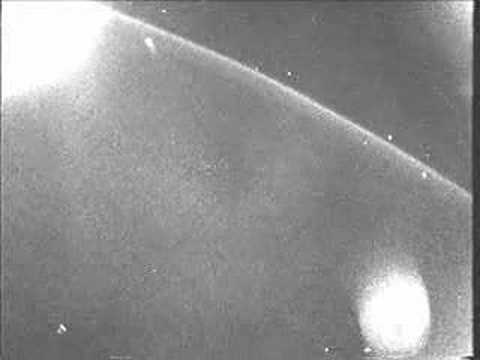
On September 15, 1991, a payload-bay camera aboard Space Shuttle Discovery, orbiting above the Indian Ocean, recorded several faint objects drifting past — until a sudden flash of light in the frame's corner sent the brightest one reversing direction and streaking away at speed. NASA says it was ice, jarred loose and blown off course by a routine thruster firing. A University of Nebraska physicist's frame-by-frame analysis says the physics doesn't add up.

Pictured: Space Shuttle Discovery en route to launch pad 39A ahead of the STS-48 mission, NASA photo S91-44810 (public domain) — the actual orbiter whose payload-bay camera captured the video analyzed in this case, though not a frame from the video itself.
Theoretical Alignment
This case file weights Psycho-Social/Mundane slightly higher than Extraterrestrial for a specific, disclosed reason: NASA's own ice-particle-and-thruster explanation is physically well-precedented, since "space dandruff" — ice, insulation fragments, and other shuttle debris — genuinely accumulates around every orbital vehicle and genuinely does respond visibly to thruster plumes. What keeps ETH weighted nearly as high is that this is one of the few UFO cases in this catalogue's holdings built entirely from public-domain, unedited government video rather than witness testimony, and independent physicists' frame-by-frame kinematic analysis has identified specific, quantified behaviors — a measurable pause before acceleration, a gradual rather than abrupt brightness change, backward-traced trajectories that fail to converge on a shared thruster location — that the ice-particle model does not straightforwardly predict. The Interdimensional Hypothesis is weighted lowest of the three because nothing about the footage's own content (a luminous object accelerating and changing brightness) offers any positive evidence distinguishing an interdimensional origin from a more conventional physical one; this case file finds IDH scored low across nearly its entire catalogue for the same structural reason, and STS-48 is no exception. This case file also notes that the PSH/ETH split here is unusually close relative to many of this catalogue's other holdings, a reflection of the fact that the debate is being conducted almost entirely in the register of quantified physics and kinematics rather than competing witness credibility assessments, which tends to narrow rather than widen the gap between the two live interpretations.
Background
STS-48 was the forty-third flight of NASA's Space Shuttle program and the thirteenth flight of the orbiter Discovery, launched September 12, 1991 at 23:11:04 UTC from Kennedy Space Center's Launch Complex 39A, with a crew of five: commander John O. Creighton, pilot Kenneth S. Reightler, and mission specialists Mark N. Brown, Charles D. "Sam" Gemar, and James F. Buchli. The mission's primary payload was the Upper Atmosphere Research Satellite (UARS), a roughly 13,000-pound NASA science satellite carrying ten instruments designed to operate as a single, integrated experiment measuring the winds, chemistry, and energy inputs of Earth's upper atmosphere and stratospheric ozone layer. Discovery deployed UARS from the payload bay using the shuttle's Remote Manipulator System arm early on September 16, 1991 — a detail this case file finds worth noting for context, since it means the mission's payload-bay cameras were, as a matter of routine operational necessity, actively monitoring cargo-bay activity and orbital debris around the vehicle throughout the flight, both before and after the satellite deployment.
STS-48 is also independently notable among shuttle missions for its orbital profile: NASA flew Discovery to an unusually high altitude, cited in various mission summaries as either a 307-nautical-mile (roughly 568 km) circular orbit or as reaching as high as 373 miles (600 km), at a 57-degree inclination — a combination spaceflight historians have described as the highest-altitude orbit ever flown by the Space Shuttle at that inclination. Commander Creighton later recalled the distinction in an interview with the spaceflight history site AmericaSpace, reportedly saying, "We set a world altitude record for a winged vehicle," and stating that he kept the mission's commemorative plaque as a memento; this case file flags that specific quote as sourced to secondary reporting on an interview, not a primary transcript this case file could independently verify, though the underlying altitude claim itself is corroborated across multiple independent mission summaries. The mission also carried the first Electronic Still Camera (ESC) flown on the Space Shuttle — a modified Nikon F-4 35mm camera fitted with a charge-coupled device for digital image capture and near-real-time downlink, distinct from the analog payload-bay video camera that recorded the September 15 sequence at the center of this case, but illustrative of the broader imaging capability NASA was actively testing and relying on throughout the flight.
NASA's own published orbital figures for the mission record a 57.00-degree inclination, a perigee of roughly 575 km and apogee of roughly 580 km, an orbital period of 96.20 minutes, and a total of 81 completed orbits over a cumulative distance of 3,530,369 km — figures this case file cites not because they bear directly on the anomaly itself, but because they establish, from NASA's own mission-tracking data rather than any UFO-research source, the precise physical environment (altitude, orbital velocity, day/night cycle length) in which the September 15 footage was recorded. UARS itself went on to considerably outlive its planned 18-month mission, ultimately operating for roughly 14 years and providing what NASA has described as the most complete dataset gathered up to that time on upper-atmospheric winds, chemistry, and energy inputs relevant to stratospheric ozone depletion; this case file notes that detail primarily to underscore that STS-48 was, by any measure, a genuine, successful science mission first, with the September 15 anomaly a secondary, unplanned event captured incidentally by a payload-bay camera performing its routine monitoring function. Discovery landed at Edwards Air Force Base, California on September 18, 1991 at 07:38:42 UTC (roughly 12:38 a.m. local time, in darkness), concluding a mission lasting 5 days, 8 hours, 27 minutes, and 38 seconds.
On September 15, 1991, during a period when the shuttle's payload-bay camera was recording standard downlink footage of the bay and surrounding space, the video captured several faint, glowing objects drifting through the frame. This case file treats the footage's public-domain status as directly relevant to its overall evidentiary character: unlike the great majority of this catalogue's holdings, which depend on witness recollection, private investigation, or classified government material never fully released, this footage was recorded on an official NASA downlink, broadcast in essentially real time, and has remained continuously, freely available for independent frame-by-frame analysis by any researcher for over three decades. Two days after the sequence, on September 17, mission control directed a seven-second Reaction Control System thruster burn to maintain a 10-mile separation from the derelict Soviet satellite Kosmos 955 — described in mission retrospectives as the shuttle program's first dedicated orbital-debris avoidance maneuver, and a useful independent reminder that RCS thruster firings, debris tracking, and orbital housekeeping were routine, recurring features of this particular flight rather than isolated events confined to September 15.
Complete Timeline
| Date | Event |
|---|---|
| September 12, 1991 | Space Shuttle Discovery launches on mission STS-48, deploying the Upper Atmosphere Research Satellite as its primary payload. |
| September 15, 1991, ~20:30–20:45 GMT | The payload-bay camera, orbiting over the Indian Ocean, records roughly 65 seconds of footage showing several faint objects drifting across the field of view. |
| September 15, 1991 (same sequence) | A bright flash of light appears in the lower-left of the frame; the brightest object abruptly reverses direction and accelerates away at markedly increased speed. |
| September 15, 1991 (following) | The camera pans down to reveal the shuttle's cargo bay, later cited by researchers as evidence the lens was focused at infinity rather than on nearby debris. |
| September 18, 1991 | STS-48 lands, concluding the mission; the downlink footage, already publicly broadcast, begins circulating among UFO researchers. |
| November 1, 1991 | NASA Kennedy Space Center engineers Scott A. Higginbotham and J. Bradley Davis complete Technical Memorandum NASA-TM-103826, a formal debris/ice/thermal-protection-system assessment for STS-48, documenting the mission's routine ice and debris inspection process. |
| 1990s | NASA engineer and aerospace journalist James Oberg publishes an ice-particle-and-thruster explanation for the footage, part of his broader "space dandruff" framework for shuttle-video anomalies. |
| Late 1990s–2000s | Dr. Jack Kasher, physics professor emeritus at the University of Nebraska, conducts a detailed frame-by-frame kinematic analysis, developing what he calls five distinct proofs against the ice-particle model. |
| 1995 & later | Independent researchers Mark Carlotto and Lan Fleming publish separate digital video analyses, identifying curvilinear trajectory changes they argue are inconsistent with debris propelled by thruster exhaust. |
| Ongoing | The footage remains one of the most widely circulated and independently analyzed pieces of UFO evidence in existence, still cited and re-examined decades later. |
What the Footage Shows
The roughly 65-second sequence begins with several faint, glowing objects visible against the black background of space, moving slowly across the payload-bay camera's field of view, generally interpreted even by skeptics as debris of some kind rather than stars, given their visible motion relative to the fixed star field. Approximately 33 seconds into the sequence, a distinct flash of light occurs in the lower-left portion of the frame. Jack Kasher's later frame-by-frame measurement of the flash itself found it was preceded by a fainter pre-flash lasting roughly 150 milliseconds, followed by a brighter main flash lasting roughly 400 milliseconds — a level of timing detail only possible because the underlying video, unlike almost any other case in this catalogue's holdings, could be paced through frame-by-frame by any researcher with access to a copy of the tape. Immediately following the flash, the brightest of the visible objects appears to change direction abruptly and accelerate away from the shuttle at a markedly higher rate of speed than its prior drifting motion, followed by what several researchers describe as rapid light streaks moving through the frame. The camera subsequently pans downward, revealing the edge of the shuttle's cargo bay — a detail multiple independent analysts have cited as evidence the camera's optics were set at, or near, infinity focus throughout the sequence, relevant to arguments about whether the objects were genuinely distant or merely small particles very close to the lens.
During the shuttle program's operational years, NASA routinely downlinked live mission video over NASA Select television, a public satellite and cable feed that allowed anyone with the right receiving equipment to watch shuttle missions, including payload-bay camera footage, essentially as it happened; this case file finds that general broadcast practice directly relevant to understanding how footage like the September 15 sequence reached UFO researchers and the public so quickly and in such an evidentially clean, unedited form, without requiring any subsequent government release, leak, or Freedom of Information Act request of the kind that characterizes most of this catalogue's other government-related holdings.
This case file also notes a separate, lower-profile technical detail from the mission's camera logs worth distinguishing from the anomaly itself: NASA's own operational records show that a different payload-bay camera, designated Camera D, developed a fault producing "full-frame horizontal multicolored lines" on September 14, 1991 — the day before the anomalous sequence — degrading that specific camera's picture quality. This case file has found no indication in any source it reviewed that the camera which recorded the September 15 sequence was the same unit, or that the fault is connected to the anomaly in any way; it is included here only because a mission's routine camera-maintenance log is the kind of granular technical detail that, when it does turn out to be relevant to a UFO case (as camera or sensor malfunctions sometimes are in this catalogue's other holdings), is usually decisive, and its absence of connection here is itself worth documenting rather than leaving unaddressed.
NASA's Explanation: Ice, Debris, and Thruster Plumes
NASA's official position, most extensively articulated by former NASA Johnson Space Center flight controller and aerospace journalist James Oberg in a detailed technical analysis dated June 28, 1992, holds that the objects are ordinary orbital debris — ice flakes, insulation fragments, and other material Oberg has termed "space dandruff" — that routinely sheds from the shuttle's exterior and water-management systems during every mission. Oberg's written analysis is unusually specific about the debris' possible origins: it catalogues more than fifty distinct identifiable sources of ice and debris aboard a shuttle orbiter, including the vehicle's air dump line, waste water dump line, supply water dump line, two fuel cell purge lines (the hydrogen purge line, Oberg notes, "always" leaks a small amount of water), two flash evaporators, a water spray boiler, and flaking insulation from the payload bay itself, on top of the orbiter's 38 primary and 6 vernier Reaction Control System jets. Oberg's account of the ice-formation mechanism is similarly specific: residual propellant and water "seeps out the feed lines into the nozzle, where it accumulates, freezes through evaporative cooling, and flakes off during the next firing" of the associated jet.
Under this model, the flash of light represents illumination from the shuttle's Reaction Control System (RCS) thrusters firing, whose exhaust plume both illuminates and physically accelerates the small, low-mass ice particles away from the vehicle. Oberg describes the RCS jets as normally firing in roughly 80-millisecond pulses under autopilot control, typically once every few minutes, to keep the shuttle pointed in its commanded attitude; when a drifting ice flake is caught directly in one of these pulses, Oberg's analysis states the particle is "violently accelerated away from the jet" to a velocity on the order of 1,000 feet per second. Oberg states this general phenomenon — small debris illuminated and set in motion by a thruster firing — has been observed and recorded on effectively every shuttle mission, and links it to a recurring, specific orbital lighting condition (shortly after the shuttle emerges from Earth's shadow into direct sunlight, with the camera pointed back toward the receding horizon) that produces similar-looking footage repeatedly across the shuttle program's history. This case file also notes that formal, routine debris-and-ice tracking was a documented, standing part of STS-48's own mission engineering: NASA Kennedy Space Center's own Technical Memorandum NASA-TM-103826, completed by engineers Scott A. Higginbotham and J. Bradley Davis on November 1, 1991, formally documents debris, ice, and thermal-protection-system inspection procedures and high-speed photographic analysis conducted for this specific mission, both before and after launch. That memorandum concerns ground-based launch and ascent debris tracking rather than the September 15 orbital video sequence itself, and this case file did not find it to reference the anomalous footage directly, but it is nonetheless genuine primary-source documentation that ice and debris monitoring were a routine, engineering-grade concern for STS-48 specifically, not a post hoc explanation invented only after the footage generated public attention. Some published overviews of the case also note that Mark N. Brown, one of the STS-48 mission specialists, is reported to have separately described comparable debris events aboard other missions in terms of ice breaking free from an engine bell and being carried off by a thruster plume; this case file was unable to independently verify the exact wording of any such comment against a primary transcript or interview, and flags it here as a paraphrase of a secondary account rather than a confirmed direct quotation from Brown.
Jack Kasher's Frame-by-Frame Counter-Analysis
Dr. Jack Kasher, Professor Emeritus of Physics at the University of Nebraska, conducted a detailed frame-by-frame kinematic analysis of the footage, developing what he described as five distinct proofs that the primary object's observed behavior was inconsistent with a passive ice particle responding to thruster exhaust. Kasher's work was privately funded through a grant from the Fund for UFO Research, a nonprofit UFO-research organization, rather than commissioned or funded by NASA itself; he has stated he hired two graduate students from the University of Wisconsin to help him track the objects' frame-by-frame positions using precision measuring equipment adapted from microbiology laboratory work. His full report, "A Scientific Analysis of the Videotape Taken by Space Shuttle Discovery on Shuttle Flight STS-48," was presented and published in the Proceedings of the 1994 MUFON International UFO Symposium (pages 108–136), giving his analysis a citable, dated, peer-reviewed-adjacent form beyond informal online commentary.
Kasher's central finding was that the main object appeared to pause for approximately half a second before accelerating away following the flash — a behavior he argued was physically inconsistent with a continuous external force (thruster exhaust) acting on a passive, unpowered object, which should produce smooth, continuous acceleration rather than a discrete stop-then-go pattern. In his own published words, Kasher wrote: "It is difficult to conceive of a mechanism by which a rocket exhaust could stop an ice particle and allow it to sit at its location for about half a second, then accelerate back to the right." His second proof extended this kinematic argument geometrically: tracing the pre-flash trajectories of two of the visible objects backward in time, Kasher found the lines diverged rather than converging on a single point — the location a shared originating thruster would be expected to occupy if both objects were debris scattered from the same firing.
Kasher's remaining proofs were built from his team's frame-by-frame position measurements, which used the mission's own recorded orbital altitude (approximately 355 miles) and the resulting geometric horizon distance (slightly more than 1,700 miles) to convert angular, on-screen motion into physical distances and speeds. From this geometry, Kasher calculated the primary object's implied terminal velocity at 5.5 ± 0.7 feet per second, compared with the roughly 8,300 feet per second he calculated would be required of a rocket exhaust plume traveling fast enough to explain the object's post-flash motion — a discrepancy of roughly three orders of magnitude that forms his third proof. His fourth proof approached the same problem from the timing side: the roughly half-second delay between the flash and the object's acceleration implied, in his calculation, an effective exhaust-front travel speed of only about 130 feet per second, again far short of the multiple-thousand-feet-per-second speed a thruster plume should exhibit at that range. His fifth proof was purely geometric: back-calculating from the object's measured angular position (roughly 53.6 ± 7.8 degrees from the camera's line of sight) and apparent motion, Kasher estimated the object would need to have been on the order of 22 miles from the shuttle for the ice-particle model to work, which would in turn require the originating thruster to have been positioned roughly fifteen miles below Discovery — a location Kasher noted was physically impossible for a shuttle-mounted RCS jet.
Kasher also examined the specific pulse characteristics of the shuttle's vernier RCS thrusters, the only jets he judged capable in principle of producing the very brief, discrete-looking flash observed in the footage; per NASA's own published specifications, verniers fire either in 80-millisecond pulses or continuously for durations of one to 125 seconds, and Kasher argued the flash durations he measured (a roughly 150-millisecond pre-flash followed by a roughly 400-millisecond main flash) did not cleanly match either firing mode. Kasher further argued that the object's brightness increased gradually over roughly a one-second period following the flash, rather than changing abruptly as would be expected if the object were a small ice particle suddenly transitioning from shadow into direct illumination from the thruster exhaust. He also directly addressed the "tiny particle near the lens" explanation, noting that the camera's later pan down to the cargo bay demonstrated the optics were focused at infinity throughout the relevant sequence, which he argued was inconsistent with the object being a small, out-of-focus particle very close to the camera. Kasher's own stated conclusion went considerably further than most of the footage's other independent analysts: he wrote that the evidence pointed to "spacecraft maneuvering out in space away from the Shuttle," and calculated that if the object had genuinely been at a distance of roughly ten miles, its implied acceleration would have been on the order of 100 g — a force he noted would "absolutely flatten a human pilot," a detail this case file reads as Kasher's own indication that he considered the object, whatever it was, very unlikely to be crewed. This case file finds Kasher's specific, quantified, frame-timed claims (the roughly half-second pause, the divergent backward trajectories, the multiple-order-of-magnitude velocity discrepancy, the roughly one-second brightness ramp) the most evidentially significant single element of his analysis, since they represent falsifiable, technical claims about the footage's own content rather than general skepticism toward the NASA explanation — while treating his own preferred "spacecraft" interpretation as a separate, considerably more speculative step beyond what the kinematic measurements themselves establish.
Carlotto and Fleming: Curvilinear Trajectories
Independent researchers Mark Carlotto, an aerospace engineer, and Lan Fleming, who has been described in published case summaries as a NASA-affiliated imaging analyst, separately extended the frame-by-frame analytical approach, examining the footage at roughly one-third-second intervals across a longer time span than Kasher's initial analysis. Carlotto's own published digital video analysis, dated to 1995, used a frame-overlay methodology to track object positions across successive frames; assuming the tracked objects were at or near the shuttle's own orbital altitude, his calculations implied velocities on the order of 35 kilometers per second — a speed he judged far too high for orbital debris of the kind NASA's explanation proposed. Carlotto noted the corresponding alternative: if the objects were instead assumed to be much closer to the camera, the implied velocity problem eases, but only by creating a different problem, since the objects would then need to be implausibly small to match their measured apparent size on screen — a trade-off this case file finds neither side of the debate has ever fully closed, since single-camera video cannot independently establish both an object's distance and its true size.
Fleming's specific conclusion, developed independently and published in the journal New Frontiers in Science (Vol. 3, No. 1, Fall 2003), was that the objects' motion exhibited curvilinear trajectories and changes from linear to curved paths that he argued were inconsistent with either debris propelled by a single thruster firing or with material undergoing sublimation (a physical process by which ice transitions directly to vapor, which can itself impart small, but generally more randomly distributed, accelerations to a particle). Fleming's analysis singled out one specific tracked object, which he labeled M11 in his figures, as changing course at the precise moment of the light flash and then resuming its original heading shortly afterward — a pattern this case file finds difficult to reconcile with either of the two more purely passive explanations (thruster-plume impact or sublimation), both of which would be expected to produce a single, one-way change in trajectory rather than a course change followed by a return to the original heading. Fleming's own preferred alternative interpretation — that the objects' flight paths were more consistent with large, self-propelled objects moving around the Earth's curvature than with passive debris — represents this case's most explicitly pro-anomalous technical conclusion, though this case file notes it remains a minority position even among the footage's other independent analysts, and has not been replicated through peer-reviewed publication in a mainstream physics or aerospace journal. Carlotto and Fleming later collaborated on a similar frame-by-frame methodology applied to a different mission's footage, published as "Anomalous Phenomena in Space Shuttle Mission STS-80 Video," which this case file finds relevant context: whatever the merits of their STS-48 conclusions, their general analytical approach was not a one-off exercise but one they subsequently applied, with the same techniques, to at least one other shuttle mission's payload-bay video.
This case file finds a genuine, unresolved technical limitation running through all three independent counter-analyses (Kasher, Carlotto, and Fleming): none had access to NASA's own complete Reaction Control System thruster-firing logs with precise timestamps for the STS-48 mission, information that would allow a direct, unambiguous correlation between any specific thruster firing and the flash observed in the video. In the absence of that specific documentary confirmation, both the NASA/Oberg explanation and its critics' counter-analyses remain, in this case file's own assessment, inferential rather than conclusively demonstrated.
Key Figures
James Oberg
Authored the primary skeptical explanation for the STS-48 footage, attributing the objects to ice and debris ("space dandruff") illuminated and accelerated by routine Reaction Control System thruster exhaust, a pattern he has documented recurring across numerous shuttle missions. His written analysis, dated June 28, 1992, catalogues more than fifty specific onboard sources of ice and debris and remains the most detailed single technical document underlying NASA's own public position on this case.
Dr. Jack Kasher
Conducted the most widely cited frame-by-frame kinematic analysis challenging the ice-particle model, identifying a roughly half-second pause before acceleration and a gradual, rather than abrupt, brightness change as specific quantified inconsistencies with NASA's explanation. His analysis, funded through the privately supported Fund for UFO Research rather than by NASA, was formally published in the Proceedings of the 1994 MUFON International UFO Symposium, giving it a dated, citable form distinct from informal online commentary.
The Five Observables Assessment
The Five Observables framework is applied here to the primary object's own documented behavior in the footage itself:
Assessment: The case's evidentiary core is not exotic performance in the usual sense but a narrow, specific kinematic dispute — whether the primary object's acceleration pattern following the flash is consistent with a passive particle under thruster-plume force, a question this catalogue finds remains genuinely unresolved on the publicly available evidence.
Evidence Assessment
Supporting Anomalous or Unresolved Origin
- The footage is unedited, public-domain government video, not witness testimony, private investigation material, or a private photograph of disputed provenance.
- Independent, credentialed analysts (a physics professor emeritus and two separate aerospace/imaging researchers) identified specific, quantified kinematic behaviors difficult to reconcile with a simple passive-particle model.
- Kasher's calculated terminal velocity of the primary object (5.5 ± 0.7 ft/sec) differed from his calculated required exhaust-plume velocity (roughly 8,300 ft/sec) by roughly three orders of magnitude, on his own published figures.
- Two independently traced object trajectories, projected backward from the flash, failed to converge on a single shared thruster location, per Kasher's second proof.
- Fleming's tracked object M11 reportedly changed course at the flash and then returned to close to its original heading, a pattern not obviously predicted by either the thruster-plume or sublimation models.
- The camera's later pan to the cargo bay is cited by multiple analysts as evidence the optics were focused at infinity, weakening the "tiny out-of-focus particle" explanation.
- NASA's own complete RCS thruster-firing logs with precise timestamps, which could definitively resolve the dispute, have never been published for public cross-reference against the video's timeline.
Supporting Conventional Explanation
- Ice and debris ("space dandruff") accelerated by thruster plumes is a well-documented, physically real phenomenon recorded on numerous other shuttle missions under similar lighting conditions.
- Multiple identifiable, mundane sources of ice existed aboard STS-48 specifically, including several water-system dump and purge lines, fuel-cell purge lines, and flash evaporators — more than fifty sources by Oberg's own count.
- The general phenomenon of thruster-illuminated debris has been independently endorsed by other mainstream science communicators, including astronomer Philip Plait, beyond Oberg's original analysis alone.
- No independent analyst has established the objects' absolute distance, size, or velocity from single-camera footage alone, a fundamental technical limitation affecting every proposed interpretation, anomalous or conventional.
- No radar, second-camera, or independent instrumented corroboration exists beyond the single payload-bay camera's video.
- The 1990s-era analog NTSC video's limited frame rate and resolution introduce genuine measurement uncertainty into any frame-by-frame timing analysis on either side of the dispute.
Why "Disputed"
This case earns a Disputed rating because it represents a genuine, still-unresolved technical disagreement between credentialed analysts working from identical, publicly available video evidence, rather than a case resolved by the weight of consensus or additional corroborating data on either side. NASA's ice-particle-and-thruster explanation is physically well-precedented and supported by identifiable onboard ice sources; Jack Kasher's counter-analysis identifies specific, quantified frame-timing behaviors the simple model does not obviously predict. Neither side has definitively prevailed in the more than three decades since the footage was recorded, and the single piece of documentary evidence that could most directly resolve the dispute — complete, precisely timestamped RCS thruster-firing logs for the relevant minutes of the mission — remains, as far as this case file's own research could establish, unpublished.
This case file also finds it relevant that the ice-particle explanation has, independent of Oberg himself, been separately endorsed by at least one other prominent mainstream science communicator: astronomer and science writer Philip Plait has discussed the STS-48 footage on his widely read "Bad Astronomy" science blog, siding with NASA's explanation and walking through the general trajectory and lighting reasoning that supports it. This case file was not able to locate or verify an exact, word-for-word quotation from Plait's specific STS-48 discussion to a standard it could confidently reproduce here, and so paraphrases his general position rather than quoting it directly; his broader endorsement is nonetheless a useful data point that NASA's explanation has support beyond Oberg's own original analysis, even as it does not, on its own, resolve Kasher's specific quantified objections.
This case file also finds it worth stating explicitly what would, and would not, resolve this dispute if it ever became available. A single, precisely timestamped RCS thruster-firing log for the relevant minutes of September 15, 1991, cross-referenced against the video's own internal timestamp, would allow a direct test of whether a real thruster firing coincided with the observed flash, and if so, whether its measured plume characteristics were consistent with the object's subsequent motion; this would not, on its own, resolve Kasher's separate distance and velocity calculations, but it would at minimum confirm or eliminate the specific triggering mechanism NASA's explanation depends on. Absent that document, this case file's own position is that both the NASA/Oberg explanation and the Kasher/Carlotto/Fleming counter-analyses represent good-faith, technically serious efforts to interpret the same limited dataset, and that the "Disputed" rating reflects a genuine evidentiary gap rather than a case where one side's methodology can be dismissed as obviously flawed.
This case file finds a useful point of comparison within its own holdings in the Petrozavodsk Phenomenon, another case in which James Oberg's own technical analysis (there, identifying a specific satellite launch as the likely stimulus) proved decisive in resolving an initially mysterious sighting. This case file finds it instructive that Oberg's STS-48 explanation, despite drawing on the same general skeptical methodology, has not achieved comparably broad acceptance, precisely because the specific, falsifiable technical claims Kasher and others have raised against it have never been directly answered with the kind of definitive, primary documentary evidence (confirmed thruster-firing timestamps) that resolved the Petrozavodsk case.
Observer Credibility & Occupational Profile
This case presents an unusual credibility profile within this catalogue's broader holdings: rather than weighing eyewitness testimony, this case file weighs the competing technical analyses of credentialed experts working from identical source material. James Oberg brings direct institutional experience as a former NASA Johnson Space Center flight controller with documented, specific expertise in space-debris and orbital-mechanics phenomena, a background this case file finds directly relevant to his explanation's baseline plausibility. Jack Kasher brings an independent physics background (Professor Emeritus, University of Nebraska) without any institutional stake in either confirming or denying NASA's own explanation; his research funding for the STS-48 analysis specifically came from the privately funded Fund for UFO Research rather than from NASA or any government agency, a funding relationship this case file credits as meaningful evidence against any claim that his conclusions were shaped by an institutional client relationship, in either direction. That independence is itself a genuine, if different, form of credibility from Oberg's own insider expertise, and this case file declines to rank one above the other.
Mark Carlotto's professional background as an aerospace engineer and Lan Fleming's reported background as a NASA-affiliated imaging analyst add a further wrinkle this case file finds worth stating plainly: at least one of the three named counter-analysts brings direct, professional image-analysis experience from within the NASA orbit itself, meaning the "independent outsiders versus NASA insider" framing sometimes applied to this case is, on closer inspection, less clean than it first appears. Neither Carlotto's nor Fleming's professional credentials, as documented in the sources this case file reviewed, include specific expertise in orbital debris photogrammetry as a dedicated sub-field, meaning both sides' technical claims ultimately rest on general physics, aerospace, and video-analysis competence applied to a genuinely difficult single-camera measurement problem.
This case file also finds the absence of first-hand crew testimony a distinct and separate credibility factor from the competing analysts' own qualifications. None of the five STS-48 crew members — Creighton, Reightler, Brown, Gemar, or Buchli — is documented in any source this case file reviewed as having offered a specific, on-the-record account of the September 15 footage's content, as opposed to general remarks about ice and debris phenomena aboard shuttle missions more broadly. This case file finds that gap worth naming plainly rather than glossing over: the case rests entirely on unmanned camera footage and its subsequent third-party analysis, with no eyewitness account, crew log entry, or contemporaneous flight-deck report from anyone physically present in orbit at the time to weigh alongside the competing technical interpretations.
Historical Precedents & Archive Matches
This case belongs to a broader, recurring category of shuttle- and space-station-era orbital video anomalies this catalogue's own holdings document across multiple decades, in which onboard cameras capture ambiguous luminous objects whose interpretation hinges on unresolved technical questions about distance, debris behavior, and lighting conditions specific to the orbital environment. James Oberg's own broader body of work, including his analysis of the Petrozavodsk Phenomenon, establishes a documented pattern in which specific, verifiable technical explanations (a satellite launch, a debris source) have successfully resolved cases that initially appeared far more anomalous, a pattern this case file finds relevant context for evaluating his STS-48 explanation's own baseline credibility, even where the specific supporting documentation (thruster logs) remains unpublished for this particular case.
The STS-48 case is also not an isolated instance of the same critics applying the same frame-by-frame methodology to shuttle-era footage: Carlotto and Fleming's later joint paper, "Anomalous Phenomena in Space Shuttle Mission STS-80 Video," applied comparable techniques to footage from a different mission, indicating this case sits within a small but sustained body of independent orbital-video analysis rather than a single, isolated dispute over one video. This case file has not independently reviewed the STS-80 footage or that paper's specific conclusions in detail, and notes it only as evidence of the analysts' continued engagement with this general category of evidence, not as independent corroboration of their STS-48 findings specifically.
The case's continued citation is itself part of its own evidentiary character within this catalogue. Kasher's formal presentation of his findings at the 1994 MUFON International UFO Symposium, and the subsequent publication and reproduction of that presentation's full text by multiple UFO-research archives over the following three decades, means this case has been continuously re-examinable in a level of technical detail (specific measured angles, velocities, and frame timings, rather than only a general narrative summary) that is unusual even among this catalogue's other government-video-based holdings. This case file finds that sustained, technically detailed re-examination — by both defenders and critics of the ice-particle explanation — itself a form of evidence about the case's seriousness: unlike many single-witness or single-photograph cases that generate a burst of initial attention and then fade from technical discussion, STS-48 has instead generated a small, ongoing body of dated, citable, quantitative analysis on both sides that any researcher can independently check against the original public-domain video.
This case also connects to a broader pattern this catalogue has separately documented of publicly available government video and photographic evidence generating more sustained, technically detailed independent analysis than privately-held or witness-testimony-based cases typically receive, precisely because public availability allows unlimited independent frame-by-frame scrutiny by any credentialed researcher rather than dependence on a single investigator's own access and interpretation.
Material Analysis
This case's entire evidentiary record is the video itself; no physical sample of any object depicted was, or could have been, recovered for laboratory analysis. This case file treats the footage's own optical and kinematic properties — brightness curves, apparent trajectories, timing relative to the flash — as the closest available substitute for physical material evidence, and finds that both the NASA/Oberg explanation and its critics' counter-analyses are, in the absence of a recoverable physical sample, ultimately arguments about how to correctly interpret the same optical data rather than disputes over independently verifiable physical facts. The precision with which Kasher's team was able to extract quantitative figures from that optical data — a measured object distance from screen center of roughly 77.7 ± 5.3 feet at one reference frame, three-axis velocity components he expressed as ratios to the object's distance, and an angular position accurate to roughly ± 7.8 degrees — illustrates both the genuine analytical rigor independent researchers brought to this "video as material evidence" approach, and its inherent limitation: every one of those figures still ultimately rests on assumptions about the objects' true distance from the camera that single-camera video, by itself, cannot independently confirm.
Supporting Non-Terrestrial or Unexplained Origin
- Kasher's, Carlotto's, and Fleming's independent frame-by-frame analyses each identified kinematic behaviors they argue are difficult to reconcile with the simple ice-particle-and-thruster model.
- Kasher's own published measurements — a 5.5 ± 0.7 ft/sec terminal velocity against a roughly 8,300 ft/sec required exhaust speed, and a geometric distance estimate implying an impossible sub-orbital thruster position — represent specific, checkable numbers rather than general impressions.
- Carlotto's independent frame-overlay analysis, using a different methodology from Kasher's, arrived at a separate objection (an implied ~35 km/sec velocity if the objects were at shuttle altitude) rather than simply repeating Kasher's own findings.
Supporting Terrestrial or Mundane Origin
- Multiple identifiable onboard sources of ice existed aboard STS-48, and comparable footage has been recorded and explained similarly across numerous other shuttle missions.
- NASA-TM-103826 documents that formal, engineering-grade debris and ice inspection was already a routine, standing part of STS-48's own mission profile, independent of the September 15 footage.
- No independent analyst has established the objects' absolute size or distance, a fundamental limitation of single-camera footage that affects the reliability of any velocity or acceleration calculation on either side.
The Conventional Explanation Candidate: Ice Debris Accelerated by Thruster Exhaust
NASA's own explanation, developed most extensively by James Oberg, holds that the objects are ice particles and other minor debris shed from the shuttle's exterior and water-management systems, illuminated and physically accelerated by the exhaust plume of a routine Reaction Control System thruster firing corresponding to the observed flash. This case file finds this candidate the single most physically well-precedented explanation available, given the well-documented, recurring nature of similar "space dandruff" footage across the shuttle program's broader history, the multiple identifiable ice sources aboard STS-48 specifically (more than fifty catalogued sources, by Oberg's own count, spanning water dump lines, fuel-cell purge lines, flash evaporators, and payload-bay insulation), and the well-documented, physically real evaporative-cooling mechanism by which residual water and propellant accumulate as ice on a shuttle's exterior fittings between thruster firings.
Sublimating Ice Undergoing Non-Thruster Acceleration
A second candidate, distinct from the thruster-plume model, holds that the objects could be ice particles undergoing sublimation — a phase transition directly from solid to vapor that can itself impart a small propulsive force to the remaining solid material, independent of any thruster activity. This case file finds this candidate only partially addresses Fleming's specific curvilinear-trajectory critique, since sublimation-driven acceleration would still be expected to behave differently, in both timing and directional consistency, from the sustained curved paths Fleming's analysis described, and would be especially hard-pressed to explain his specific finding that object M11 changed course at the flash and then returned to something close to its original heading, since a sublimation-driven course change would have no obvious physical mechanism for reversing itself a second time on a comparable timescale. This case file also finds this candidate structurally weaker than the primary thruster-plume model as a proposed trigger for the flash itself, since sublimation is generally a gradual, continuous process driven by solar heating rather than a discrete event that would coincide, as the video shows, with a sudden, momentary flash of light; it functions better as a supplementary explanation for the slower, earlier drift of the background objects than as a stand-alone account of the flash-and-acceleration event that is this case's central anomaly.
Optical/Photogrammetric Misinterpretation
A third candidate holds that some or all of the disputed kinematic findings — the half-second pause, the gradual brightness ramp, the divergent backward-traced trajectories — may themselves be artifacts of the specific frame-by-frame measurement methodology applied to standard-definition analog video of the era, rather than genuine physical behaviors of the objects themselves, given the well-documented technical difficulty of precisely timing rapid events in low-resolution 1991-era NTSC video, which records at only about thirty frames per second and was digitized from an analog broadcast signal for later frame-by-frame study rather than natively captured as discrete digital frames. This case file finds this candidate a genuine, underexplored possibility that neither side of the public debate has, to this case file's own research, fully and independently addressed through modern digital re-analysis of the original source footage using contemporary image-stabilization and sub-pixel tracking techniques unavailable to Kasher's team in the early 1990s. It is worth noting, however, that this candidate cuts in both directions rather than simply favoring one side of the dispute: if 1991-era measurement limitations are responsible for some of Kasher's, Carlotto's, and Fleming's specific quantitative findings, the same limitations would equally undermine any confidence in a precise, frame-timed correlation between a specific thruster pulse and the observed flash, meaning this candidate does not, on its own, strengthen the ice-particle explanation relative to its critics so much as it introduces additional uncertainty into every quantitative claim made about the footage by any party to the dispute.
Ice Debris Accelerated by Thruster Exhaust — Plausibility Rating: PLAUSIBLE (Contested by Specific, Unresolved Kinematic Claims)
Related Cases
Confirmed Documents & Official Records
NASA's own public mission records for STS-48, including crew, payload, and flight information; the raw downlink footage itself was broadcast publicly and remains part of the mission's official record.
A formal NASA engineering memorandum, authored by Scott A. Higginbotham and J. Bradley Davis, documenting standard pre- and post-launch debris and ice inspection procedures, high-speed photographic analysis, and thermal protection system conditions specific to STS-48. This case file finds it useful primary-source context for NASA's ice-and-debris explanation, though it should be noted this specific memorandum documents ground-based launch and ascent debris tracking rather than the September 15 orbital video sequence itself.
Further Reading — Recommended Literature
UFOs and Outer Space Mysteries: A Sympathetic Skeptic's Report
Oberg's own foundational skeptical framework for evaluating orbital and spaceflight-related UFO claims, essential for understanding the specific reasoning behind his STS-48 explanation.
UFOs and the National Security State: Chronology of a Coverup, 1941–1973
A detailed institutional history of American government engagement with the UFO question, offering broader context for evaluating NASA's own public communications about anomalous footage.
UFOs: Generals, Pilots, and Government Officials Go on the Record
A survey of credentialed military, aviation, and government witnesses, offering useful comparative context for weighing the credibility of the STS-48 case's own competing expert analysts.
UFOs and Government: A Historical Inquiry
A team of veteran UFO historians examine government responses to UFO reports across multiple decades and countries, providing essential comparative institutional context.
The UFO Encyclopedia
A comprehensive reference situating the STS-48 case within the broader history and typology of the global UFO phenomenon, including other space-based sighting cases.
DISCLOSURE: Some links above are affiliate links. If you purchase through them, OverClassified receives a small commission at no additional cost to you. This helps support independent research.
Essential Viewing
Sources
- "STS-48 UFO Footage: The 1991 Space Shuttle Mystery That Still Defies Explanation," Hangar1publishing. Case overview and technical analysis summary
- "STS-48 Space Shuttle Video," UFO Evidence. Case documentation archive
- "Unsolved Mystery Of NASA Footage Showing 'Intelligently Controlled' UFOs During 1991 STS-48 Mission Revisited," Inquisitr. Case overview
- Mark Carlotto, "Digital Video Analysis Of Anomalous Space Objects," ResearchGate. Technical frame analysis paper
- "STS-48 UFO with 'Abrupt Turn,'" The UFO Database. Case summary and crowd assessment
- "NASA STS-48 'UFO' Video," debunker.com. Skeptical case analysis
- "This Former NASA Engineer Has Debunked Pretty Much Every Online UFO Sighting," ScienceAlert. James Oberg profile and methodology
- "How One Man Has Explained Almost Every Internet UFO Theory," Atlas Obscura. James Oberg profile
- "STS-48," World Space Flight. Mission crew and technical details
- Scott A. Higginbotham & J. Bradley Davis, "Debris/Ice/TPS Assessment and Photographic Analysis of Shuttle Mission STS-48," NASA-TM-103826, NASA Kennedy Space Center. NASA Technical Reports Server →
- Jack Kasher, "A Scientific Analysis of the Videotape Taken by Space Shuttle Discovery on Shuttle Flight STS-48," Proceedings of the 1994 MUFON International UFO Symposium, pp. 108–136. Full analysis reproduced at NICAP.org →
- Ben Evans, "'To Make Sure We Didn't Make the News': The High-Altitude Mission of STS-48 (Part 2)," AmericaSpace. Mission altitude record and crew recollections
- "Gentlemen's Hours: Remembering STS-48, Thirty Years On," AmericaSpace. Mission retrospective
- James Oberg, UFOs and Outer Space Mysteries: A Sympathetic Skeptic's Report, Donning Company, 1982.
- Richard M. Dolan & Jacques F. Vallée, UFOs and the National Security State: Chronology of a Coverup, 1941–1973, Keyhole Publishing, 2002.
- Leslie Kean, UFOs: Generals, Pilots, and Government Officials Go on the Record, Harmony Books, 2010.
- Michael Swords & Robert Powell, eds., UFOs and Government: A Historical Inquiry, Anomalist Books, 2012.
- Jerome Clark, The UFO Encyclopedia, 3rd ed., Omnigraphics.
See something inaccurate? Have additional information or sources?
Suggest an Edit →Last Updated: August 2026