
GEIPAN: France's Official UAP Investigation Unit
On May 1, 1977, CNES, France's national space agency, announced the creation of GEPAN (Groupe d'Étude des Phénomènes Aérospatiaux Non-identifiés) under founding director Claude Poher — the first standing, government-funded scientific unit anywhere in the world tasked full-time with investigating UFO reports. Reorganized as SEPRA in 1988 and relaunched under its current name, GEIPAN, in 2005, the unit has now operated continuously inside CNES's Toulouse headquarters for 49 years, longer than any other government UAP body on Earth. Its public database, rebuilt and opened to the world on March 22, 2007, now classifies more than 3,380 individual French sighting cases under a formal A/B/C/D methodology built around two measurable axes — "strangeness" and "consistency" — that this file explains in full, alongside the unit's chronic underfunding, its real controversies from both skeptical and pro-anomaly critics, and what its own current statistics actually show.
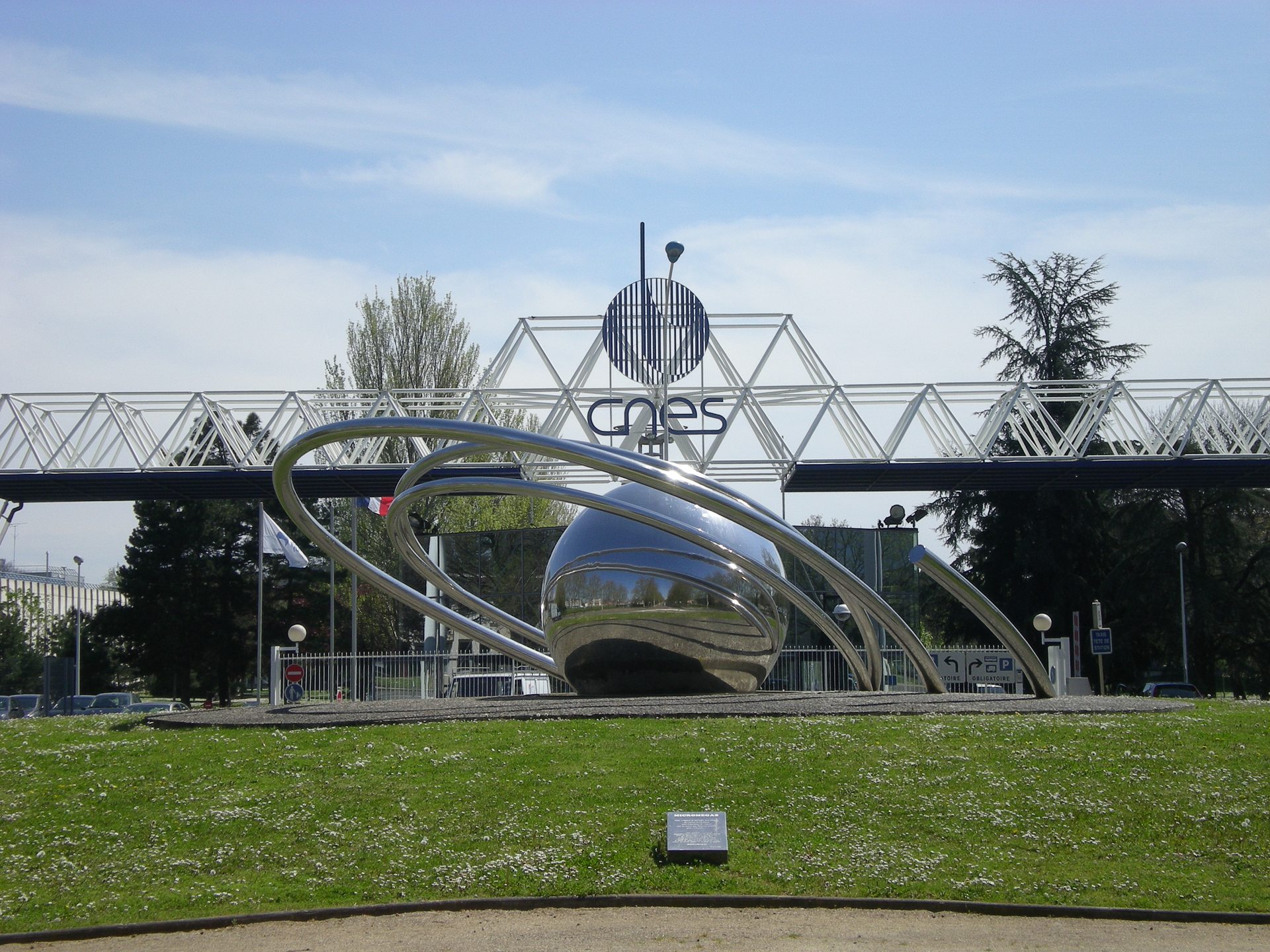
Pictured: the entrance to the CNES Toulouse Space Centre, the campus that has housed GEPAN, SEPRA, and GEIPAN continuously since 1977 — not a photograph of any specific UAP case or of GEIPAN's own offices specifically, since no rights-clear photograph of the unit's actual working space inside the larger CNES campus is publicly available. Photo by Wikimedia contributor Guyblade, licensed CC BY-SA 3.0.
Theoretical Alignment
This case file documents an institution, not a single observed craft or encounter, so the standard ETH/IDH/PSH alignment grid does not meaningfully apply and all three are marked N/A rather than forced into a rating. What is worth noting instead is GEIPAN's own institutional position on the question: the organization is explicit, in its own published mission statements, that it is "not a UFO research organization seeking extraterrestrial life" and takes no institutional position on the ultimate nature of its unexplained residue. Individual cases GEIPAN has investigated — Trans-en-Provence chief among them — carry their own Theoretical Alignment ratings on their own case files; this file's subject is the investigating body itself.
Background
France's decision to fund a standing scientific UAP investigation unit in 1977 did not emerge from nowhere. By the mid-1970s the country had experienced a sustained wave of rural sighting reports, many funneled through the national Gendarmerie, France's rural police force, which had no formal mechanism for evaluating them scientifically. According to the fullest published institutional histories of the unit, the specific push for an official body came in part from the French Ministry of Defense, whose own internal thinking held that the state needed "official representation" on the subject — a considered, deliberate position rather than an improvised reaction to any single incident, reinforced by a favorable working-group conclusion from the Institut des Hautes Études de Défense Nationale (IHEDN), the same state defense-studies institute that would, more than two decades later, produce most of the membership behind the 1999 COMETA report.
The engineer who translated that political appetite into an actual working scientific unit was Claude Poher, a CNES astrophysicist who had already been informally cataloguing sighting reports through contact with GEPA, a private French ufology association, before his proposal for a formal government unit was approved. Yves Sillard, then CNES's director general, personally authorized the new unit, and CNES announced GEPAN's creation on Sunday, May 1, 1977 — a date this site's own established case files (see The Bize-Minervois Sighting) already use as the organization's founding date, and the same date this case file's own index listing (case #374) was originally queued under. What made GEPAN genuinely unusual, by the standards of every other country's UFO-study effort before or since, was not merely that a government funded it, but that it was built from the outset as a small, technically rigorous scientific unit inside a real space agency, with an explicit mandate to apply ordinary investigative method — witness interviews, physical measurement, laboratory analysis, cross-referencing against known aviation and astronomical data — to reports referred to it through the Gendarmerie's own national reporting channel, rather than as a public-relations office or a one-off blue-ribbon panel.
Almost half a century later, that basic institutional shape has survived three name changes, several funding crises, and a complete generational turnover in leadership. GEIPAN remains, by a wide margin, the longest continuously operating government UAP investigation body in the world — predating the United States' All-domain Anomaly Resolution Office (AARO) by 45 years and Chile's CEFAA by 20 — and its 46-year output of investigation files, both the confirmed and the genuinely unexplained, forms one of the largest structured UAP datasets any government has ever made publicly browsable.
Complete Timeline
| Date | Event |
|---|---|
| May 1, 1977 | CNES announces the creation of GEPAN (Groupe d'Étude des Phénomènes Aérospatiaux Non-identifiés) under founding director Claude Poher, authorized by CNES director general Yves Sillard — the world's first standing government UFO-study unit inside a national space agency. |
| 1977–1978 | GEPAN establishes its investigative infrastructure: formal partnerships with the national Gendarmerie (the primary intake channel for reports), the civil aviation authority, the Air Force, and Météo-France, plus a scientific council that includes physicist and future government minister Hubert Curien. |
| March 6–7, 1978 | GEPAN investigators, including a young Jean-Jacques Velasco, conduct the formal field investigation behind The Bize-Minervois Sighting (1974), one of the unit's first showcase cases. |
| April 1978 | Poher personally leads a four-person team to Cussac, Cantal, to reconstruct the 1967 close encounter behind The Cussac Close Encounter, concluding the child witnesses' testimony showed no basis for suspecting hoax or hallucination. |
| July 1979 | Alain Esterle succeeds Poher as GEPAN's second director. |
| March 1983 | Jean-Jacques Velasco, previously a field investigator on cases including Bize-Minervois, becomes GEPAN's third director — a tenure that will run, across the unit's next name change, until 2004. |
| 1983–1988 | CNES substantially reduces GEPAN's funding and public profile. According to independent institutional histories of the unit, the scientific council's meetings grow infrequent and technical-note publication slows during this period, coinciding with reduced budget support from CNES leadership. GEPAN's public outreach narrows to occasional press and television appearances rather than the more visible posture of its first six years. |
| February 17, 1981 | GEPAN investigates the physical ground trace at Trans-en-Provence under Velasco, ultimately producing the multi-laboratory analysis that would become the unit's single most-cited case. |
| July 1988 | The French science magazine Science et Nature publicly questions whether GEPAN's continued existence is justified, citing what it characterizes as meager results over eleven years of operation — a sign of how far the unit's public standing had fallen from its 1977 launch. |
| November 1988 | CNES formally dissolves GEPAN and replaces it with SEPRA (Service d'Expertise des Phénomènes de Rentrée Atmosphérique — "Atmospheric Re-entry Phenomena Expertise Department"), retaining only Velasco and a single secretary from the previous structure and publicly reframing the unit's work around the more defensible-sounding mandate of tracking satellite and space-debris re-entries, alongside its continuing, lower-profile UAP casework. |
| 1994 | SEPRA investigates the January 28 Air France Flight 3532 sighting near Coulommiers, eventually classifying it D1 — a rating GEIPAN's current database still carries. |
| 2000 | SEPRA's internal name is expanded to "Service d'Expertise des Phénomènes Rares Aérospatiaux," broadening its described mandate while keeping the same acronym and, by this point, an extremely low public profile. |
| February 1999 | The private COMETA study group, whose members are consulted directly by Velasco at SEPRA, publishes the COMETA report, adopting GEPAN/SEPRA's own A/B/C/D case-classification framework wholesale and recommending the unit be better resourced. |
| 2001 | An internal CNES audit of SEPRA recommends restructuring the unit around a more transparent, public-information-oriented mandate — the direct origin of the "I" (Informations) that will be added to the unit's next name. |
| 2004 | Velasco's 21-year tenure as director ends; he later publishes Ovnis: L'Évidence (2004), drawing on his SEPRA-era casework. |
| 2005 | CNES reorganizes SEPRA into GEIPAN (Groupe d'Études et d'Informations sur les Phénomènes Aérospatiaux Non identifiés) under new director Jacques Patenet, formally adopting the broader "PAN" (Phénomènes Aérospatiaux Non identifiés) terminology COMETA had specifically urged in place of the narrower "OVNI"/UFO framing. |
| March 22, 2007 | GEIPAN launches its first fully public, browsable online case database — the single biggest transparency shift in the organization's history, opening decades of previously internal investigation files to direct public and researcher access. |
| May 11, 2007 | GEIPAN publishes an archival copy of the 1999 COMETA report on its own site, with an explicit accompanying statement that doing so "does not signify in any way an approval of the report by CNES." |
| 2008 | GEIPAN refines its classification methodology, splitting the unexplained "Category D" into two sub-tiers, D1 (strange) and D2 (very strange), based on a formalized strangeness-versus-consistency scoring model. |
| 2008–2009 | Researchers Éric Maillot, David Rossoni, and Éric Déguillaume publish a Skeptical Inquirer critique arguing several GEIPAN-inherited "Category D" classifications, including Bize-Minervois, do not hold up to closer scrutiny; Patenet agrees to have GEIPAN formally review dozens of the challenged cases. |
| 2009–2021 | Directorship passes from Patenet to Yves Blanc (2009), Xavier Passot (July 2011), Jean-Paul Aguttes (February 2016), and Roger Baldacchino (September 2019), each continuing the post-2007 public-database model with incremental methodology and tooling updates. |
| February 2022 | GEIPAN introduces IPACO, dedicated photo/video authentication and analysis software, and in November formally recognizes "entoptic vision" — visible artifacts generated within the eye itself, such as floaters — as a previously under-credited source of some UAP misidentification reports. |
| November 2021 | Vincent Costes becomes director, succeeding Baldacchino. |
| Feb.–July 2023 | GEIPAN publishes technical explanations attributing a cluster of pilot-reported "unidentified phenomena" to SpaceX Falcon 9 second-stage deorbit burns and Starlink satellite-train "flaring" reflections — work extended further in July 2024. |
| January 15, 2024 | Frédéric Courtade becomes GEIPAN's current director, succeeding Costes. |
| May 20, 2025 | GEIPAN relaunches an upgraded version of its IPACO authentication software, used, among other applications, to re-examine older photographic cases with modern digital forensic methods. |
| August 11, 2026 | GEIPAN's own public statistics page records 3,381 total published cases: 950 Category A (28.1%), 1,310 Category B (38.7%), 1,015 Category C (30.0%), and 106 Category D (3.1%) — the most current live figures available as of this file's research. |
From GEPAN to GEIPAN: Three Names, One Institution
It is easy to read GEPAN, SEPRA, and GEIPAN as three separate organizations; they are, in every functional sense that matters for this file, one continuous institution that has changed its public name twice while keeping the same parent agency, the same Toulouse campus, and in Velasco's case, the same director straddling two of the three names. The renamings each mark a real shift in institutional posture rather than a cosmetic rebrand. GEPAN's 1988 dissolution into SEPRA followed a period, well-documented in independent institutional histories, during which CNES's own scientific council for the unit stopped meeting regularly and its public technical-note publication slowed — a genuine retrenchment, not merely a renaming, that left the unit with a skeleton staff of essentially one director and one secretary heading into the 1990s. SEPRA's own name — "Atmospheric Re-entry Phenomena Expertise Department" — was itself a deliberate reframing, giving CNES a publicly defensible reason (tracking genuine satellite and space-debris re-entries, a real and growing aerospace-safety concern) to keep funding a unit whose actual majority workload remained ordinary UFO report investigation, conducted with a far lower public profile than GEPAN had maintained in its first years.
The 2005 shift to GEIPAN reversed that low-visibility posture deliberately, following a 2001 internal CNES audit that concluded the unit needed a mandate built explicitly around public transparency rather than quiet internal casework. The single letter added to the acronym — the "I" for "Informations" — is not decorative; it names the specific institutional change the audit prescribed, and the March 2007 launch of GEIPAN's first fully public case database, followed two months later by the explicit, non-endorsing publication of the COMETA report, are the two clearest concrete actions that followed directly from it. Every director since 2005 — Patenet, Blanc, Passot, Aguttes, Baldacchino, Costes, and Courtade — has operated within that same public-database model, adding incremental tooling (IPACO, entoptic-vision recognition, Starlink-flare documentation) rather than reversing the transparency commitment the 2005 relaunch established.
How a Sighting Becomes a GEIPAN Case File
GEIPAN's investigative process runs through seven formal stages, per the unit's own published methodology: a witness testimony is received (most commonly filed through a Gendarmerie or police station, or increasingly via GEIPAN's own online questionnaire); a case file is opened; an initial analysis screens for cases with enough substance to warrant deeper work; a full investigation and processing phase follows for cases that clear that screen, potentially including field visits, cognitive-interview techniques with witnesses, and cross-referencing against air-traffic, meteorological, and astronomical data held by partner agencies; the case is formally classified under the A/B/C/D system; witness-identifying details are anonymized; and the finished file is published to the public database, with the original witness notified of the outcome. Of the roughly 600–700 reports GEIPAN receives in an average year, only a minority — historically in the range of 150–200 — receive the full investigation-and-classification treatment; the remainder are typically resolved at the initial-analysis stage as clear-cut misidentifications (aircraft, satellites, astronomical objects, drones, lanterns) that do not require the fuller process.
This is not, by GEIPAN's own repeated public description, a search for extraterrestrial contact. Then-director Vincent Costes summarized the unit's actual self-conception plainly in a 2022 interview: "Part of our job is to explain to people that what they have seen is not what they expected" — a framing that treats the majority of GEIPAN's work as public education and rational-explanation delivery, with the residual unexplained category treated as a genuine but numerically small byproduct of that broader process, not the organization's central purpose.
The Classification System: Strangeness, Consistency, and the A/B/C/D Scale
GEIPAN's classification methodology, still used in essentially its original form by the unit's present-day iteration and inherited directly from GEPAN's founding-era framework, scores every case along two independent, formally defined axes rather than relying on an investigator's unstructured overall impression.
Consistency (French: consistance) measures how much reliable data a case actually has to work with. GEIPAN defines it as a product, C = I × F, where I represents the quantity of information collected (witness count, corroborating instrument data, physical trace evidence, and so on) and F represents the reliability of that information's sources. A single, uncorroborated account from an anonymous caller with no follow-up investigation scores low on this axis regardless of how strange its content is; a multiply-witnessed sighting with radar corroboration, a formal cognitive-interview transcript, and verified professional credentials for the witnesses scores high.
Strangeness (French: étrangeté) measures how far a case sits from any known, mundane phenomenon once every candidate explanation has actually been tested against the data — formally defined as the complement (1 minus) of the strongest surviving hypothesis's estimated probability. A report investigators can confidently attribute to a specific known aircraft or a specific meteor shower scores low on strangeness even if the witness's own subjective impression was of something bizarre; a report for which no known-phenomena explanation can be made to fit the data, after genuine testing, scores high.
The resulting five-tier scale (four categories, with D split into two sub-tiers since 2008) reads as follows, per GEIPAN's own published methodology:
- Category A ("perfectly identified"): low strangeness, validated by strong consistency — a case GEIPAN can confidently and specifically explain, with the data to back that explanation up. 950 of 3,381 published cases (28.1%) as of August 2026.
- Category B ("probably identified"): low strangeness, validated by adequate (but not maximal) consistency — GEIPAN's best working explanation is judged very probable even though the supporting data falls short of Category A's bar. 1,310 cases (38.7%).
- Category C ("unexploitable"): a case where the strangeness-versus-consistency test simply cannot be run to a conclusion, because the underlying data is too thin — not evidence the sighting was anomalous or mundane, just evidence GEIPAN could not gather enough to say either way. 1,015 cases (30.0%). GEIPAN's own methodology notes explicitly state that Category C cases "are not of the same order" as A, B, or D cases, since they represent an investigation GEIPAN was structurally unable to complete rather than one that reached any actual conclusion.
- Category D1 ("strange"): strangeness above the 0.5 threshold, validated by strong consistency — a case genuinely unexplained despite good underlying data.
- Category D2 ("very strange"): very high strangeness, validated by very strong consistency — GEIPAN's most rigorously documented, most confidently unexplained tier, reserved for cases like Trans-en-Provence that combine high strangeness with the strongest possible evidentiary backing GEIPAN's own process can produce.
Categories D1 and D2 combined (Category D overall) account for 106 of 3,381 published cases as of August 2026, or 3.1% — a figure this file examines in detail below, because it has changed substantially over the unit's own history and is itself a genuine point of dispute between the organization's critics.
A Declining D-Rate: Real Trend, Contested Interpretation
GEIPAN's own published statistics show a real, substantial decline in the proportion of cases classified D over time. From 1975 through 2004, the unit averaged roughly 6.8 Category D classifications per year, against a much smaller total annual case volume, for an overall D-rate GEIPAN's own retrospective analysis puts at roughly 10% across that period. From 2005 through 2014, the annual D count dropped to roughly 2.4–2.5 cases per year even as total case volume roughly tripled, producing an overall D-rate for that decade of approximately 2%. The current cumulative rate, 3.1% as of August 2026, sits between those two historical figures.
GEIPAN's own published explanation for the decline cites three specific, non-conspiratorial factors: first, a mechanical dilution effect — case throughput roughly tripled after the 2007 public-database launch made reporting easier, and most of that new volume consists of routine, easily explained reports (Chinese lanterns, photographic artifacts, misidentified aircraft) that add to the denominator without adding to the D-category numerator; second, the 2008 methodology refinement that formally split Category D into D1/D2 and tightened the strangeness/consistency scoring criteria; and third, genuinely improved investigative capability — digital case-management tools, standardized cognitive-interview questionnaires, and terrain investigation protocols that let modern GEIPAN investigators resolve ambiguous cases that an earlier, less-resourced GEPAN might have had to leave unclassified or default to D. GEIPAN's own retrospective figures put the "explained" share (A + B combined) at roughly 40% in the pre-2005 era, versus roughly 70% today — a shift its own analysis attributes to better tools and more available comparison data (denser radar coverage, satellite-tracking databases, ubiquitous smartphone cameras with metadata) rather than a change in institutional willingness to call a case unexplained.
Not every outside observer accepts that explanation at face value, and this file returns to that dispute directly in the Controversies and Conventional Explanation Candidate sections below, where GEIPAN's own account of its declining D-rate is weighed directly against critics who argue the decline reflects methodological drift rather than genuine improvement.
Funding, Staffing, and the Investigator Network
GEIPAN's core paid staff has never, at any point in its 49-year history, exceeded a handful of people. As of the most recent published accounts, the unit's salaried core consists of roughly two full-time CNES positions (a head and a deputy) plus approximately 1.5 further full-time-equivalent technical support roles — a total core staff on the order of 3.5 to 4 people, a figure independently corroborated across multiple journalistic accounts describing the unit as "a team of four experts" or "the equivalent of three full-time workers." That tiny core is deliberately supplemented, not replaced, by a wider volunteer and partner network: approximately 15 to 20 trained volunteer field investigators distributed across France, who conduct in-person witness interviews and site visits on the unit's behalf, and roughly 15 to 20 external scientific experts drawn from fields including plasma physics, meteorology, and astronomy, most of them affiliated with partner institutions rather than employed by GEIPAN directly.
Those partner institutions form the backbone of GEIPAN's actual investigative capacity, since the core staff alone could not plausibly process 600–700 annual reports without them: the national Gendarmerie and Police, which channel the large majority of initial witness reports; the Direction Générale de l'Aviation Civile (France's civil aviation authority), which supplies flight-plan and air-traffic data to rule aircraft in or out; the French Air Force, which can supply military radar and flight-log data unavailable to civilian channels; the Centre National de la Recherche Scientifique (CNRS), France's basic-research agency, for specialized scientific consultation; and Météo-France, the national weather service, for atmospheric and astronomical (including meteor and fireball) cross-checks. Oversight sits with a roughly 15-member steering committee, chaired for a period by Yves Sillard — the same CNES director general who personally authorized the unit's creation in 1977, returning to it decades later as its senior institutional overseer — until his death in April 2023.
Funding is, by design, minimal: independent journalistic reporting on the unit's budget describes its total operating cost as roughly one-thousandth of CNES's overall human-resources budget — an extraordinarily small line item for an agency the size of France's national space program — even as GEIPAN's public website reportedly generates a disproportionate share (cited in one 2022 account as roughly a quarter) of all traffic to CNES's own domain, a genuine mismatch between the unit's public visibility and its formal budget allocation that several of this file's cited critics, on both the skeptical and pro-anomaly sides, treat as evidence the unit remains under-resourced relative to the public interest and scientific value of its actual mandate.
Notable Cases in GEIPAN's Own Archive
GEIPAN's public database now holds 3,381 individually classified cases, the overwhelming majority mundane and resolved. A handful, however, have become landmark files in their own right, several of which this site covers as full standalone case files — each one worth reading in full for its own specific evidence, but summarized here for how each fits the institution's own history.
Trans-en-Provence (January 8, 1981) remains GEIPAN's single most-cited case: a ground trace investigated on-site by Jean-Jacques Velasco under GEPAN, subjected to real multi-laboratory soil and plant-sample analysis, and eventually classified in GEIPAN's highest unexplained tier. The Bize-Minervois Sighting (January 14, 1974, investigated by GEPAN in 1978) is, by contrast, this site's own primary example of GEIPAN's institutional lineage being fallible: this site's independent research into that case documents specific, real investigative shortcomings in GEPAN's own 1978 file — weather data pulled from a station 47 kilometers away, no verification of a candidate crop-spraying-helicopter explanation against actual agricultural records — that this file treats as directly relevant evidence when assessing GEIPAN's own institutional track record later in this file. The Cussac Close Encounter (August 29, 1967, formally reconstructed by GEPAN in 1978) was one of Poher's own personally selected showcase investigations from the unit's first eighteen months. Air France Flight 3532 (January 28, 1994) shows the unit's civil-aviation investigative track record, pairing cockpit-crew testimony with a partial, disputed radar correlation; it remains classified D1 in GEIPAN's current database. The Angoulême Daylight Ovoid (August 15, 2009) illustrates the more routine end of a modern GEIPAN Class D file: a single uncorroborated witness, several mundane objects tested and excluded, and an honest "we cannot identify this with the data available" conclusion rather than any claim of extraordinary evidence.
A note on reading any specific GEIPAN classification as evidence: Wherever this file or any other on this site cites GEIPAN's own "unexplained" (D1/D2) or "explained" (A/B) rating for a specific case as evidence bearing on that case's genuineness, that rating should be weighed as one serious input among several, not as a final or infallible verdict either way. GEIPAN is a genuinely more transparent and methodologically documented body than most government UAP programs, and its classifications are not casually assigned — but, like any institution, it operates under real budget constraints, a small core staff, and its own internal culture and incentives (discussed at length in the Controversies section below), any of which can shape a specific case's outcome in either direction, toward premature explanation or toward an unresolved "D" default. Treat a specific case's A/B/C/D rating as informative, not dispositive.
COMETA, SIGMA2, and GEIPAN's Place in French UAP Research
GEIPAN is not the only serious French institutional effort to engage with unexplained aerial phenomena, and understanding how it relates to the others clarifies what makes it distinct. The 1999 COMETA report, produced by a private nonprofit association of retired generals, engineers, and scientists (most drawn from IHEDN's own alumni network), explicitly adopted GEPAN/SEPRA's own four-tier A/B/C/D classification framework for its own case analysis rather than inventing a competing system, and consulted directly with then-SEPRA director Jean-Jacques Velasco for primary case data, most heavily on Trans-en-Provence. But COMETA was never part of GEIPAN institutionally, and GEIPAN's own 2007 decision to publish the report came with an explicit, unambiguous disclaimer that doing so "does not signify in any way an approval of the report by CNES" — the clearest documentary evidence available that COMETA, however seriously it drew on real GEPAN/SEPRA case data, was never itself an official government product.
A separate thread of institutional follow-through runs through the 3AF (Association Aéronautique et Astronautique de France), France's professional aeronautics and astronautics society, whose SIGMA and successor SIGMA2 commissions — standing bodies of roughly 25 working aerospace and physics specialists — have continued studying GEIPAN's own Category D residue using radar, infrared, and electromagnetic data since 2008, publishing further technical progress reports as recently as 2021. SIGMA2 is best understood as an independent professional-society effort that studies GEIPAN's own published output rather than a GEIPAN program itself, providing a form of outside technical peer review GEIPAN's own small internal staff could not easily perform on its own.
Tools of the Trade: Modern Investigative Methods
GEIPAN's investigative toolkit has visibly modernized over the past several years, driven by both new software and new categories of misidentification the unit has had to learn to recognize. IPACO, introduced in February 2022 and substantially relaunched in May 2025, is dedicated photo and video authentication software used to test the internal consistency of submitted imagery — including, per GEIPAN's own published account, revisiting older, previously unresolved photographic cases (among them the famous 1950 McMinnville photographs from the United States) with contemporary digital-forensic methods unavailable to earlier investigators. In November 2022, GEIPAN formally recognized "entoptic vision" — visual artifacts (floaters, afterimages, and similar phenomena) generated within the eye itself rather than by any external object — as a previously under-credited source behind a meaningful share of single-witness reports, a genuinely useful addition to the unit's standard toolkit of misidentification candidates. Most recently, GEIPAN's 2023–2024 published technical work on SpaceX Falcon 9 second-stage deorbit burns and Starlink satellite-train "flaring" reflections directly addressed a fast-growing modern category of pilot and public reports tied to the sharp recent increase in low-earth-orbit satellite launches — a good example of the unit adapting its methodology to a genuinely new phenomenon rather than simply reapplying decades-old explanatory categories.
Controversies and Criticism
GEIPAN and its predecessors have drawn sustained criticism from both directions of the UAP debate simultaneously — a pattern worth reading as a real signal about where the institution actually sits, rather than dismissing either side as noise, since genuinely biased institutions in either direction usually do not attract serious, sourced criticism from both flanks at once.
The 1980s Retrenchment
The clearest documented institutional low point in GEIPAN's history is not a specific scandal but a slow, budget-driven decline: starting around 1983, CNES leadership scaled back GEPAN's funding and public engagement, its scientific council's meetings grew infrequent, and by the time Science et Nature published its July 1988 piece questioning whether the unit's continued existence was justified — citing eleven years of what the magazine characterized as meager results — GEPAN's public standing had fallen far enough that its dissolution into the deliberately lower-profile SEPRA later that same year drew little public objection. This period demonstrates, at minimum, that French institutional support for UAP research has never been unconditional or immune to ordinary budget politics, whatever else one concludes about the underlying phenomenon.
The Skeptical-Community Critique: Not Rigorous Enough
From one direction, a body of pro-anomaly researchers and commentators — writing on sites including UAP-Anomalie and MUFON France — has argued GEIPAN's actual investigative rigor has declined even as its public transparency has improved, pointing to specific alleged errors: a claimed confusion between separate video sources in analyzing a "Tic Tac"-type case, a Lake Chauvet investigation one such critique calls a "complete failure," and a broader argument, advanced by MUFON France writer Manuel Wiroth, that GEIPAN has reclassified roughly 160 cases downward since 2010 using what he characterizes as speculative rather than rigorously tested mundane explanations. Wiroth's piece names the August 15, 1997 Réunion Island sighting (Saint-André) as a specific example, describing its reclassification from Category D to Category A (explained as a misidentification of the planet Jupiter) as illustrative of what he views as an institutional pattern; he cites former CNES scientific council member François de Brichambaut and former SIGMA commission president Alain Boudier as sympathetic to this broader critique. A separate critique from the skeptic-leaning site UAP-Anomalie argues, somewhat differently, that GEIPAN's own investigator corps has itself grown close to organized French zeteticism (skeptic) associations under recent leadership, naming internal critic Éric Maillot's own published debunking of a fellow GEIPAN-affiliated investigator's case analysis as evidence of real internal inconsistency in the unit's own methodological standards.
This Site's Own Documented Case: Bize-Minervois
This site's own independent research into The Bize-Minervois Sighting reaches a similar conclusion through original analysis rather than secondary reporting: GEPAN's own 1978 investigation of that case drew weather data from a station 47 kilometers from the actual sighting site, never contacted the local vineyard's owner to check for a scheduled crop-spraying operation on the date in question despite a plausible helicopter-misidentification candidate matching the witnesses' description in detail, and contained an internal date inconsistency (January 14 versus January 18) the file itself never resolved — while its own psychosociologist's documented concerns about witness cross-contamination did not fully make it into the final published "PAN D" classification. This file treats that finding as directly relevant, real evidence that even GEIPAN's own predecessor's "unexplained" classifications have not always reflected exhaustive investigation, a data point this file's own Conventional Explanation Candidate analysis below weighs alongside the aggregate declining-D-rate statistics.
The Opposite Critique: Too Quick to Explain
From the other direction, rationalist and scientific-establishment critics questioned GEPAN's very existence from early in its history — the 1988 Science et Nature piece is one documented example — and some ufologists have separately argued, across GEIPAN's whole institutional history, that the unit's practical function has always been closer to reducing the officially recognized number of "genuine" UFO cases than to deepening scientific understanding of the residual unexplained category, treating the declining D-rate discussed above as itself the strongest evidence for that view rather than as a legitimate product of better tools and more volume, as GEIPAN's own published statistics explanation holds.
Weighing these against each other honestly: both critiques cannot be simultaneously and fully correct, since one holds GEIPAN systematically too credulous and the other systematically too skeptical. The more defensible reading of the evidence, which this file's own Conventional Explanation Candidate section develops in full below, is that GEIPAN is a small, chronically underfunded institution whose specific case-by-case quality has genuinely varied over 49 years and across at least three organizational eras, rather than a monolithically biased body pursuing either agenda consistently.
Current Status
As of this file's research (August 2026), GEIPAN remains an active unit within CNES, led by Frédéric Courtade since January 15, 2024. Its public database stood at 3,381 published cases as of the most recent official statistics update (August 11, 2026), continuing to receive roughly 600–700 new witness reports annually through the Gendarmerie, Police, and its own online questionnaire. Its most recent visible institutional activity centers on continued tool development (the May 2025 IPACO relaunch) and ongoing public-facing explanatory work addressing the modern satellite-megaconstellation era's effect on sighting reports — a genuinely new category of casework that did not exist for most of the unit's history. GEIPAN continues to operate on a budget its own public description characterizes as roughly one-thousandth of CNES's total human-resources spending, a constraint that has shaped, and continues to shape, essentially everything else described in this file.
Key Figures
Claude Poher
CNES astrophysicist who, with the personal authorization of director general Yves Sillard, established GEPAN on May 1, 1977, building the investigative framework — witness interviews, physical measurement, laboratory referral, and cross-referencing against known aviation and astronomical data — that every successor unit has continued to use in essentially its original form. Personally led the 1978 field reconstruction of Cussac and selected Bize-Minervois as one of GEPAN's three best-investigated early cases.
Alain Esterle
Succeeded Poher and ran GEPAN through the final years before CNES began scaling back the unit's funding and public profile, handing leadership to Velasco in March 1983.
Jean-Jacques Velasco
The unit's longest-serving director, spanning the 1988 GEPAN-to-SEPRA transition and personally leading the on-site investigation of Trans-en-Provence, the organization's single most-cited case. Consulted directly with the COMETA committee in 1999 and later published Ovnis: L'Évidence (2004) drawing on his SEPRA-era casework — one of very few career government officials anywhere whose full-time job was the direct scientific investigation of UFO reports.
Jacques Patenet
Oversaw the 2005 relaunch and the March 2007 public-database opening that defines GEIPAN's modern institutional identity, and agreed to formally review dozens of disputed "Category D" classifications after Éric Maillot and co-authors' 2008–2009 Skeptical Inquirer critique — a real, documented instance of the unit responding to outside methodological criticism rather than dismissing it.
Yves Sillard
Personally authorized GEPAN's 1977 creation as CNES director general, and decades later returned to the organization as chairman of its roughly 15-member modern steering committee — the same individual bookending both the unit's founding and its later governance — until his death in April 2023.
Frédéric Courtade
Oversaw the May 2025 IPACO software relaunch and GEIPAN's continued explanatory work on satellite-megaconstellation sighting reports. His tenure has drawn direct criticism from advocacy-side commentators who argue GEIPAN's culture under his and predecessor Vincent Costes's leadership has grown too closely aligned with organized skeptical associations — a critique this file weighs in the Controversies section above alongside the opposite complaint that GEIPAN remains too quick to call a case unexplained.
Éric Maillot
Co-author, with David Rossoni and Éric Déguillaume, of a 2008–2009 Skeptical Inquirer critique arguing several of GEIPAN's inherited "Category D" classifications — including Bize-Minervois — did not hold up to closer scrutiny, prompting a formal GEIPAN review of dozens of challenged cases under director Jacques Patenet. Separately cited by other critics as having publicly debunked a fellow GEIPAN-affiliated investigator's own case analysis, illustrating real methodological variation within the unit's own investigator network.
The Five Observables Assessment
Assessment: The Five Observables framework rates the performance envelope of a single observed craft. This case file documents a government investigative institution across 49 years and thousands of individual cases, not one encounter, so all five observables are honestly marked N/A rather than forced into a rating. Readers interested in observable-based analysis of specific phenomena GEIPAN has itself classified as unexplained should consult the individual case files linked throughout this page, especially Trans-en-Provence.
Evidence Assessment
Supporting GEIPAN's Institutional Credibility
- Forty-nine years of continuous operation inside a real national space agency, longer than any other government UAP body in the world, surviving three name changes and a genuine 1980s funding crisis without ever being permanently dissolved
- A formally defined, published, mathematically structured classification methodology (strangeness × consistency) applied consistently since the 1970s and refined, not abandoned, in 2008
- A fully public, browsable case database covering 3,381 individual investigations, opened in 2007 and still actively maintained — a transparency standard almost no other national UAP program matches
- Documented responsiveness to outside methodological criticism: Jacques Patenet's formal review of disputed Category D cases following the 2008–2009 Skeptical Inquirer critique is a real, verifiable instance of the institution correcting itself rather than stonewalling
- A real, ongoing partnership network spanning the Gendarmerie, Air Force, civil aviation authority, CNRS, and Météo-France, giving its investigations access to corroborating data most private UFO research groups cannot obtain
- Genuine adaptation to new phenomena, evidenced by its 2022–2025 work on entoptic vision and Starlink/Falcon 9 satellite-related misidentifications rather than static reliance on decades-old explanatory categories
Supporting Skepticism of GEIPAN's Track Record
- A core paid staff of roughly 3.5–4 people, funded at approximately one-thousandth of CNES's human-resources budget, for a mandate covering the entire French national territory and 600–700 annual reports
- A documented 1983–1988 period of real institutional retrenchment, including a lapsed scientific council and a magazine (Science et Nature) publicly questioning the unit's continued justification in 1988
- This site's own independently researched Bize-Minervois case file documents specific, real investigative shortcomings (distant weather data, an unverified crop-spraying candidate, an unresolved internal date discrepancy) in a case GEPAN itself classified as one of its three best-investigated early files
- Sustained, sourced criticism from advocacy researchers (MUFON France, UAP-Anomalie) alleging methodological errors in specific recent cases and an institutional drift toward organized skeptical associations under recent leadership
- A Category D rate that has declined from roughly 10% (1975–2004) to roughly 2–3% (2005–present) — a trend GEIPAN attributes to better tools and case-volume dilution, but one critics on the pro-anomaly side read as evidence of a shifting institutional standard for what counts as genuinely unexplained
Why "Credible"
This case is stamped CREDIBLE — not because every individual case in GEIPAN's 3,381-case database is correctly classified, and not as an endorsement of any specific conclusion GEIPAN has reached about any specific sighting, but because the institution itself, evaluated on its own real, independently verifiable record, meets a genuinely high bar for a government scientific body: continuous 49-year operation, a formally defined and consistently applied methodology, an unusually transparent public database opened voluntarily in 2007 and still maintained, and at least one documented instance of correcting course under outside methodological pressure. Those are substantive, verifiable institutional strengths that distinguish GEIPAN from a purely symbolic government UFO office.
The score is not higher because this file's own research turned up real, specific, and independently corroborated weaknesses that a purely celebratory account would omit: a genuine multi-year funding and credibility crisis in the 1980s; a documented case (Bize-Minervois) where GEPAN's own investigation fell short of its own stated standards; and sustained, sourced criticism from both directions of the UAP debate simultaneously, which this file reads as evidence of real, uneven institutional performance across nearly five decades rather than either a uniformly rigorous or uniformly biased track record. A score in the high-credible range, rather than the top tier, reflects that honest balance.
Sensor & Instrumentation Detection Profile
Rather than a single case's sensor readings, this section documents GEIPAN's own institutional investigative toolkit — the closest equivalent for an organization rather than an incident. GEIPAN does not operate its own dedicated sensor network; instead, it draws on data already collected by partner institutions and, since 2022, on purpose-built software of its own. Its working "sensor suite" consists of: Gendarmerie and Police-collected witness testimony, gathered through standardized questionnaires and, for higher-priority cases, formal cognitive-interview protocols; civil and military radar and flight-log data, obtained through the Direction Générale de l'Aviation Civile and French Air Force; meteorological and astronomical cross-reference data from Météo-France, including cloud cover, precipitation, and known meteor-shower activity; and, since February 2022, IPACO, its own dedicated photo/video authentication and digital-forensic analysis software, relaunched in an upgraded form in May 2025 and used to re-examine both new submissions and historic photographic cases. This composite, partnership-dependent toolkit is both a genuine strength (real corroborating data most private researchers cannot access) and a real limitation (GEIPAN's small core staff has no independent instrumentation of its own and depends entirely on partner-agency cooperation and responsiveness for every case that requires it).
Environmental & Geospatial Context
GEIPAN's jurisdiction is the whole of metropolitan and overseas France, and its published case data shows a real, non-uniform geographic distribution rather than an even spread. Analysis of this site's own synchronized copy of GEIPAN's published case dataset shows the largest concentrations of published cases in Provence-Alpes-Côte d'Azur, Île-de-France (the Paris region), and the former R&hocirc;ne-Alpes and Midi-Pyrénées regions — a distribution that tracks France's own population density and regional Gendarmerie reporting-station coverage at least as closely as it tracks any specific geographic hot-spot theory, and is consistent with the general finding, replicated across most national UFO databases worldwide, that reporting volume correlates more strongly with population and reporting-channel accessibility than with any single environmental or geological variable. GEIPAN's own casework spans the full range of French climate zones, from Mediterranean Provence (Trans-en-Provence, Bize-Minervois) to the temperate north (Air France Flight 3532's Coulommiers sighting) to the volcanic Massif Central highlands (Cussac, Cantal) — geographic diversity this file notes as evidence against any simple regional-anomaly explanation for the unit's overall unexplained caseload.
Observer Credibility & Occupational Profile
Rather than rating a single incident's witnesses, this section assesses the credentials of GEIPAN's own investigative personnel — the closest institutional equivalent. GEIPAN's paid core staff are CNES civil servants with formal scientific or engineering backgrounds, consistent with the unit's origin as an astrophysicist-founded technical department rather than a public-relations office; Poher himself held a doctorate in astrophysics, and Velasco was a trained optical engineer. The unit's roughly 15–20 volunteer field investigators undergo GEIPAN's own training in cognitive-interview technique and standardized data collection before conducting witness interviews on the organization's behalf, and its roughly 15–20 external scientific consultants are drawn from established institutional affiliations (CNRS, universities, Météo-France, and the military and civil-aviation partner agencies) rather than informal or self-credentialed sources. This is a meaningfully more credentialed and formally trained investigative corps than most private ufology organizations can field, though its very small paid core (3.5–4 people) means the depth of any individual case's investigation depends heavily on which volunteer investigator happens to be available and how much time a chronically under-resourced staff can allocate to it — a real constraint this file's own Bize-Minervois research illustrates concretely.
Physical & Material Assays
GEIPAN's single strongest physical-evidence case remains Trans-en-Provence (1981), where GEPAN investigators under Jean-Jacques Velasco collected soil and plant samples from a physical ground trace and referred them to multiple independent laboratories for biochemical and mechanical analysis — a genuine instance of the unit exercising real laboratory-grade forensic capability rather than relying on testimony alone, and the direct evidentiary basis GEIPAN cites for that case's D2 ("very strange") classification. As with any GEIPAN classification cited as evidence of genuineness, that D2 rating should be weighed as one serious, well-documented input rather than a final verdict; GEIPAN's own case file, and this site's separate Trans-en-Provence case file, both note that the trace's terrestrial-versus-non-terrestrial origin remains genuinely disputed among independent reviewers of the same underlying laboratory data. Outside of Trans-en-Provence, the large majority of GEIPAN's published caseload involves no physical trace evidence at all — visual and, less commonly, radar-corroborated sightings dominate the database, consistent with the general pattern across UAP reporting worldwide that physical trace evidence is the rare exception rather than the norm.
Historical Precedents & Archive Matches
GEIPAN's closest institutional comparators are a small handful of other government UAP-study bodies, and the comparison is instructive on several axes. The United States' All-domain Anomaly Resolution Office (AARO), established in July 2022, commands a vastly larger budget and staff than GEIPAN ever has, but has operated for a fraction of GEIPAN's 49-year history and has not, as of this writing, matched GEIPAN's practice of publishing a fully browsable, case-by-case public database with individual classification ratings; AARO's own public output has instead centered on periodic aggregate historical-record reports (see this site's own AARO Historical Record Report, Volume I case file). Chile's CEFAA (Comité de Estudios de Fenómenos Aéreos Anómalos), established in 1997 under the country's Civil Aeronautics Board, is structurally closer to GEIPAN — a small, scientifically credentialed body pairing university researchers with military, police, and aviation personnel — but has operated for roughly half of GEIPAN's institutional lifespan. Both AARO and CEFAA, in different ways, illustrate that GEIPAN's specific combination of long institutional continuity, a small dedicated core staff, and full public case-level transparency remains genuinely unusual among the world's government UAP-study efforts, most of which have historically chosen either much shorter operating lifespans, much less granular public disclosure, or both.
Material Analysis
The clearest window into how GEIPAN's methodology actually functions on physical evidence remains the Trans-en-Provence case. On January 8, 1981 (per this site's own case file date; some secondary sources cite February 17), witness Renato Nicolaï reported a landed object on his property near Trans-en-Provence, Var; GEPAN investigators arrived promptly enough to collect soil and vegetation samples from the reported landing site while the physical trace was still fresh, and referred those samples to multiple French laboratories for independent biochemical, mechanical-compression, and chlorophyll-degradation analysis — a genuinely rigorous chain-of-custody and multi-laboratory verification process, rare among UFO physical-trace cases anywhere in the world. The published laboratory results documented real, measurable mechanical ground compression and biochemical changes in the plant material consistent with exposure to significant, briefly applied heat or pressure, findings GEPAN's own 1983 published report, and a later 1990 English-language paper in the Journal of Scientific Exploration, both treated as the strongest empirical basis for the case's D2 classification.
Independent reviewers, including some cited within GEIPAN's and SIGMA2's own later technical literature, have not reached full consensus on whether those laboratory results are best explained by an actual physical craft, a more mundane mechanical or agricultural cause the original investigation did not fully rule out, or some combination of contamination and coincidence across a genuinely unusual but non-anomalous natural event. This file does not resolve that underlying dispute — readers should consult this site's dedicated Trans-en-Provence case file for the full evidentiary detail — but treats the case's investigative process itself, independent of its ultimate interpretation, as a legitimate example of GEIPAN's institutional capability at its strongest.
Supporting Genuine Institutional Forensic Capability
- Trans-en-Provence's soil and plant samples were referred to multiple independent French laboratories, not analyzed in-house by a single, potentially biased source
- The resulting 1983 GEPAN report and 1990 peer-reviewed English-language paper represent a real, published, citable scientific record — not an internal memo or unpublished finding
- GEIPAN's ongoing IPACO software investment (2022, relaunched 2025) shows continued institutional commitment to genuine forensic capability rather than reliance on decades-old methods alone
Supporting Limits on That Capability
- GEIPAN's own database shows physical trace evidence is present in only a small minority of its 3,381 published cases; the large majority rest on testimony alone
- Independent reviewers have not reached consensus on Trans-en-Provence's own laboratory results, even among researchers broadly sympathetic to GEIPAN's institutional seriousness
- This site's own Bize-Minervois research shows that even a GEPAN-era case selected as one of the unit's own three best-investigated early files fell short of exhaustive forensic verification (an unverified crop-spraying candidate, distantly-sourced weather data)
The Conventional Explanation Candidate: Assessing GEIPAN's Own Track Record
This case has no single anomalous event to explain conventionally. Its equivalent analytical question, adapted for an institutional subject, is: how should GEIPAN's declining Category D rate, its funding history, and the specific criticisms leveled at it from both directions actually be interpreted? Four candidate explanations have been advanced by GEIPAN itself, by its critics, and by this file's own independent research. None is fabricated; each draws on named, sourced material described above.
Genuine Methodological Improvement
GEIPAN's own explanation, and the one this file's research finds the most direct primary-source support for: the declining D-rate reflects real gains in investigative capability (digital tools, standardized cognitive interviews, denser comparison data for satellites and aircraft) combined with a mechanical dilution effect from tripled post-2007 case volume, not a change in institutional willingness to call a case unexplained. GEIPAN's own published statistics and methodology explanations are internally consistent and specific rather than vague, and the 2008 D1/D2 split represents a genuine tightening of criteria rather than a loosening.
Institutional Drift Toward Reflexive Skepticism
The critique advanced by MUFON France and UAP-Anomalie: that GEIPAN's actual case-by-case rigor has declined even as its stated methodology has stayed formally consistent, with specific named cases (the 1997 Réunion Island sighting, a "Tic Tac"-type video case, Lake Chauvet) offered as concrete examples of speculative or under-verified reclassification. This file cannot independently verify or refute each specific case-level claim within the scope of an institutional overview, but treats the pattern — sourced, specific, named-case criticism from multiple independent researchers over more than a decade — as more than background noise.
Chronic Underfunding as the Root Cause of Uneven Quality
This file's own independent contribution, drawn directly from its Bize-Minervois research: a core paid staff of 3.5–4 people funded at roughly one-thousandth of CNES's HR budget cannot plausibly deliver uniformly exhaustive investigation across 600–700 annual reports, regardless of the sincerity or skill of the people doing the work. The specific, documented shortcomings in GEPAN's own Bize-Minervois file — distant weather data, an unverified crop-spraying candidate — are more parsimoniously explained by a chronically resource-starved institution making triage decisions under real constraints than by either deliberate bias or institutional incompetence.
Ordinary Institutional Politics, Not a Coordinated Agenda
The 1980s retrenchment, the 2001 audit-driven pivot to transparency, and the recent leadership-specific criticism of Courtade and Costes's ties to skeptical associations are each better explained, in this file's assessment, as the kind of ordinary bureaucratic drift, personnel-dependent culture shift, and budget politics that affect any small government scientific unit over five decades, rather than as evidence of a single, sustained, coordinated institutional agenda in either direction.
Genuine Methodological Improvement
Highly PlausibleDirectly supported by GEIPAN's own specific, internally consistent published statistics and methodology explanations, and consistent with genuinely improved digital tools and comparison data available to any investigator after 2007.
Institutional Drift Toward Reflexive Skepticism
Plausible but Unverified at the Case LevelA sourced, sustained, named-case critique from multiple independent researchers over more than a decade, worth taking seriously — but this file could not independently re-verify each specific disputed case (Réunion Island, the Tic Tac video, Lake Chauvet) within an institutional overview's scope.
Chronic Underfunding as Root Cause of Uneven Quality
Highly PlausibleDirectly corroborated by this file's own independent Bize-Minervois research, by GEIPAN's own published, unusually low budget figures, and by the basic arithmetic of a 3.5–4 person core staff against 600–700 annual reports.
Ordinary Institutional Politics, Not a Coordinated Agenda
PlausibleConsistent with the specific, well-documented timeline of the 1980s retrenchment and 2001 audit, both explicable through ordinary CNES budget and administrative decisions without requiring any deliberate agenda toward either credulity or debunking.
Related Cases
Confirmed Documents & Official Records
GEIPAN's own live, browsable database of 3,381+ classified cases, individually searchable by classification, department, year, and phenomenon type.
UNCLASSIFIED (declassified/anonymized)GEIPAN's own live-updated statistics breakdown by classification (A/B/C/D), the primary source for this file's total case count and classification percentages.
UNCLASSIFIEDGEIPAN's own published explanation of its A/B/C/D1/D2 classification system, the strangeness/consistency scoring model this file's Classification System section is drawn from.
UNCLASSIFIEDGEIPAN's own official statement of its mission, seven-stage investigative process, and relationship to CNES.
UNCLASSIFIEDSearch Government Archives Directly
Further Reading — Recommended Literature
Ovnis: L'Évidence
Written by GEPAN/SEPRA's own longest-serving director, drawing directly on his 21 years leading the unit's investigations, including Trans-en-Provence — the closest thing to an insider institutional memoir this case has.
UFOs and Government: A Historical Inquiry
A scholarly, multi-author history of official government UAP investigation programs worldwide, with detailed treatment of France's GEPAN/SEPRA/GEIPAN lineage in comparative institutional context.
UFOs: Generals, Pilots, and Government Officials Go on the Record
Situates GEIPAN's French counterpart tradition within a broader international pattern of credentialed government and military officials engaging seriously with unexplained aerial phenomena.
How UFOs Conquered the World: The History of a Modern Myth
By the UK National Archives' own UFO-files consultant, offering a skeptically-informed but methodologically serious historical lens directly relevant to weighing GEIPAN's own classification disputes.
In Plain Sight: An Investigation into UFOs and Impossible Science
An award-winning journalist's investigation into government UAP secrecy internationally, useful comparative context for how GEIPAN's transparency model differs from most other national programs.
DISCLOSURE: Some links above are affiliate links. If you purchase through them, OverClassified receives a small commission at no additional cost to you. This helps support independent research.
Essential Viewing
Ovnis: le Geipan, au CNES, enquête sur ces phénomènes
AFP news footage (2015) profiling GEIPAN's investigative work inside CNES's Toulouse headquarters.
Sciences: les enquêteurs du Geipan traquent les ovnis dans le ciel français
Ouest-France reporting (2022) on GEIPAN's investigators and how they process public UAP reports.
GEIPAN: Dans les Coulisses de l'Organisme
France TV's most recent behind-the-scenes look at GEIPAN's current operations and investigative process.
Sources
- GEIPAN (CNES). Official public case search database. geipan.fr
- GEIPAN (CNES). Official live case statistics page (accessed Aug. 11, 2026). geipan.fr
- GEIPAN (CNES). "La méthodologie de classification au GEIPAN." geipan.fr
- GEIPAN (CNES). "Mission, méthodes et résultats." cnes-geipan.fr
- GEIPAN (CNES). "Forte baisse des CAS D sur les 10 dernières années." cnes-geipan.fr
- GEIPAN (CNES). "Son histoire" (institutional history page). cnes-geipan.fr
- GEIPAN (CNES). All recent news/actualités archive. cnes-geipan.fr
- GEIPAN (CNES). Le glossaire du Geipan. geipan.fr
- CNES. "GEIPAN" official project page. cnes.fr
- Wikipedia (French). "Groupe d'études et d'informations sur les phénomènes aérospatiaux non identifiés" (used for orientation only; primary claims independently verified against GEIPAN's own official sources above). fr.wikipedia.org
- Wikipedia (English). "GEIPAN" (used for orientation only; primary claims independently verified against official and journalistic sources above). en.wikipedia.org
- rr0.org (Réalité ou Recherche). "GEPAN" institutional history compilation. rr0.org
- The Conversation. "UFOs are no laughing matter for us: behind the scenes of France's real life 'Ovni' hunters." theconversation.com
- Connexion France. "Inside France's 'UFO Bureau' — 'we explain what people have seen.'" connexionfrance.com
- uapcheck.com. "French GEIPAN has got a new Director: Frédéric Courtade." uapcheck.com
- MUFON France (Manuel Wiroth). "'PAN' sur les ovnis!! Le rejet de l'ovni par le GEIPAN: un souci purement scientifique." mufonfrance.fr
- UAP-Anomalie. "Le GEIPAN Zététique." uap-anomalie.com
- Maillot, Éric; Rossoni, David; Déguillaume, Éric. Skeptical Inquirer critique of GEIPAN Category D classifications (2008–2009), as discussed in this site's own Bize-Minervois Sighting case file. OverClassified
- This site's own case file, "The Bize-Minervois Sighting," for original independently-researched documentation of specific GEPAN investigative shortcomings. OverClassified
- This site's own case file, "Trans-en-Provence Sighting," for the fullest treatment of GEIPAN's strongest physical-evidence case. OverClassified
- This site's own case file, "COMETA Report Context," for the full relationship between GEIPAN and the 1999 COMETA report. OverClassified
- This site's own case file, "Air France Flight 3532 / Capt. Duboc Sighting," for GEIPAN's own D1 civil-aviation case methodology. OverClassified
- Swords, Michael; Powell, Robert; et al. UFOs and Government: A Historical Inquiry (2012), for the GEPAN/SEPRA/GEIPAN institutional history in international comparative context.
- Velasco, Jean-Jacques; Montigiani, Nicolas. Ovnis: L'Évidence (2004), the GEPAN/SEPRA director's own account of his casework.
- YouTube (AFP). "Ovnis: le Geipan, au CNES, enquête sur ces phénomènes" (2015). youtube.com
- YouTube (Ouest-France). "Sciences: les enquêteurs du Geipan traquent les ovnis dans le ciel français" (2022). youtube.com
- YouTube (France TV). "GEIPAN: dans les coulisses de l'organisme qui étudie les phénomènes aérospatiaux non identifiés" (2026). youtube.com
- Wikimedia Commons/Wikipedia. "File:CNES Facility in Toulouse France.jpg," photo by Guyblade, CC BY-SA 3.0, hero image source. en.wikipedia.org
See something inaccurate? Have additional information or sources?
Suggest an Edit →Last Updated: August 2026