
The December 2024 Eugene, Oregon Pilot Sightings
On the night of December 7, 2024, in the FAA's Seattle Air Route Traffic Control Center airspace west of Eugene, Oregon, the crew of United Airlines Flight 1596 (Denver–Eugene) and, separately, Life Flight Network air-ambulance pilot Joe Buley — flying a medical-transport Pilatus PC-12 from Aurora, Oregon toward North Bend — independently radioed air traffic control describing red, color-changing lights maneuvering in what Buley called a "corkscrew pattern," closing to within a few miles before retreating toward the Pacific. A Seattle Center controller, recorded on a 44-minute air traffic control transmission that circulated widely online within days, can be heard clearing the medevac pilot "to maneuver as necessary left and right to avoid the UFO out there." The FAA confirmed at least one formal pilot report was filed. The leading conventional explanation — sunlight reflecting off SpaceX Starlink satellites during their post-launch orbit-raising phase — was independently proposed by an aerospace scientist and separately modeled by the skeptic research forum Metabunk, but its own proponents rate their confidence at only 60–80 percent, and Buley and a second pilot who reported the same phenomenon both remained unconvinced that a stationary satellite flare explains a light their instruments and their own eyes registered as changing direction.
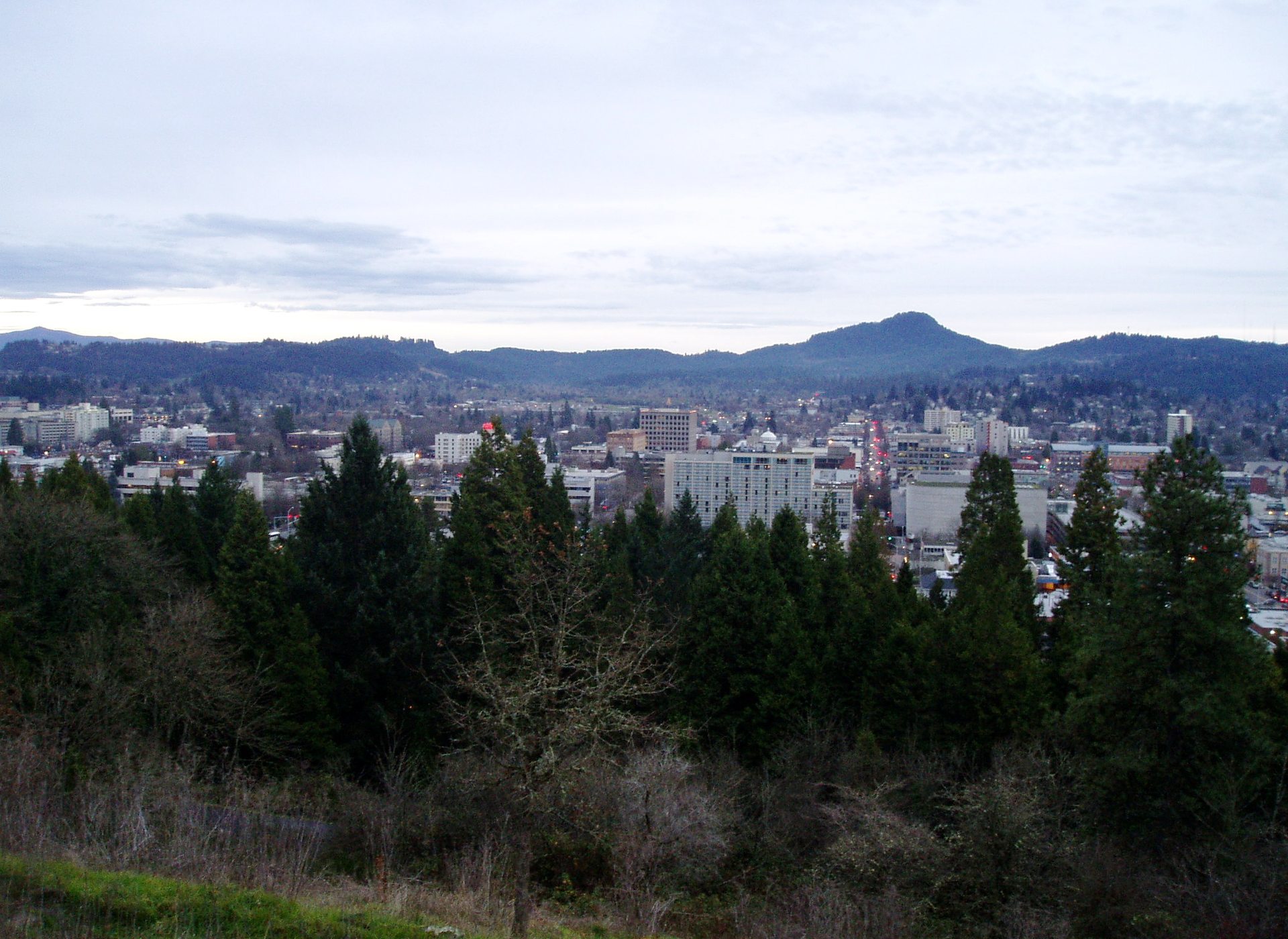
Pictured: downtown Eugene, Oregon and Spencer Butte, seen from Skinner Butte — not a photograph of the reported lights themselves. No rights-clear photograph or video frame of the actual December 7, 2024 sighting is known to exist; the pilots' own cell-phone video and the aircraft's instrument displays were never released for public verification, and this site does not use unverified screen-capture stills circulating on social media.
Theoretical Alignment
Low-to-moderate alignment with the Extraterrestrial Hypothesis: the reported motion (rapid direction changes, "corkscrew" flight, closing and retreating from two separate aircraft) would be striking if instrumentally confirmed, but the case lacks the kind of independent radar or FLIR corroboration that anchors higher-scoring ETH cases. A meaningful Psycho-Social component is plausible given that the sighting broke nationally at the exact moment the concurrent New Jersey drone wave had saturated U.S. media with nighttime-sky anxiety, though the underlying pilot reports themselves were filed with ATC in real time, before any of that national coverage existed — a genuine timing coincidence discussed in detail below, not evidence the pilots were primed by the drone panic.
Background
Eugene, Oregon, sits in the southern Willamette Valley, roughly 110 miles south of Portland and within a wider Pacific Northwest corridor that has an outsized place in American UFO history: Kenneth Arnold's foundational June 24, 1947 sighting near Mount Rainier, Washington — the case that coined the term "flying saucer" — occurred less than 200 miles north, and the celebrated McMinnville photographs were taken on a farm barely an hour's drive from Eugene in May 1950. Portland and Seattle have consistently ranked among the U.S. metro areas with the highest per-capita UFO report volume tracked by the National UFO Reporting Center (NUFORC) since 2000, and both McMinnville and Chehalis, Washington host annual UFO-themed festivals tied to their own local incidents.
December 2024 was an unusually charged month for U.S. aerial-anomaly reporting generally. Beginning November 13, 2024, thousands of nighttime drone and light reports had already swept New Jersey and spread into New York, Pennsylvania, and other Northeastern states — the subject of this site's separate New Jersey / Northeast Drone Wave case file — and by the first week of December that story had become one of the most heavily covered domestic news items in the country, with nightly cable-news segments, a Congressional briefing, and public statements from the outgoing Biden administration. It was against that specific national backdrop, on the far side of the continent and involving an entirely separate set of witnesses, aircraft, and airspace, that the Eugene sightings occurred and were then reported.
Commercial and air-ambulance pilots are not casual observers. Both categories of witness in this case — an airline flight crew and a dedicated medical-transport pilot — hold FAA certifications requiring extensive flight-hour minimums, recurrent training, and a professional culture that discourages unsubstantiated or sensationalized reporting over an open radio frequency shared with dozens of other aircraft and a recorded, permanent air traffic control log.
Complete Timeline
| Date | Event |
|---|---|
| Nov 13, 2024 | The New Jersey / Northeast drone wave begins, an unrelated but concurrent national news story that would dominate U.S. aerial-anomaly coverage through December 2024 and into January 2025. |
| Dec 7, 2024, ~8:39 PM PST | The flight crew of United Airlines Flight 1596, inbound to Eugene from Denver, radios Seattle Air Route Traffic Control Center (ZSE): "Looking straight west to Eugene. We're seeing three or four targets... they're at all altitudes, up and down... even up to the 50s," referring to roughly 50,000 feet. The crew separately asks whether any military activity is occurring in the area. |
| Dec 7, 2024, ~8:46–8:53 PM PST | Life Flight Network pilot Joe Buley, flying a Pilatus PC-12 medical-transport aircraft (tail number N661LF) from the carrier's Aurora, Oregon base toward North Bend with two medics aboard, climbs through roughly 7,000 feet near Corvallis and independently reports a red, circular light "moving at extreme speed," telling controllers: "I just don't know how to describe it." He later described the object—and a second light at a different altitude—moving in what he called a "corkscrew pattern," repeatedly closing to an estimated one to five miles before retreating back out over the Pacific. |
| Dec 7, 2024, ~8:53 PM PST | A Seattle Center air traffic controller, audible on the archived recording, clears Buley's aircraft: "You are clear to maneuver as necessary left and right to avoid the UFO out there." The same controller separately confirms to the United crew that no known military activity is occurring in the relevant airspace. |
| Dec 7–8, 2024 | A Horizon Air flight crew (reported as Flight 2207) also radios a similar description of lights in the same general area, and one Horizon pilot is quoted rejecting the Starlink explanation outright: "No, it's not Starlink, I promise... I know what that looks like." The same crew reportedly indicates having observed a similar phenomenon in the same area at least once in the preceding month. |
| Dec 7–8, 2024 | The full exchange is captured on a publicly archived 44-minute LiveATC.net recording of Seattle Center's frequency, which becomes the primary evidentiary record of the incident. |
| Dec 9–10, 2024 | A separate, unrelated sighting report is logged with the National UFO Reporting Center as sighting #184932, describing the same December 7 event as observed near Eugene at 30,000–50,000 feet, with NUFORC's own preliminary notation reading "Starlink (Racetrack) — Possible." |
| Dec 12–13, 2024 | The ATC recording surfaces publicly on Reddit, TikTok, and YouTube and is picked up by Oregon television stations KGW, KATU, and KEZI, then by national outlets including Newsweek and NewsNation. The FAA confirms to reporters: "A pilot reported seeing unidentified lights while flying in Seattle Air Route Traffic Control Center airspace on Saturday, Dec. 7." Life Flight Network issues a statement confirming Buley's involvement and stating the object "at no time... posed any safety risk to the aircraft or crew." |
| Dec 12, 2024 | Douglas Buettner, deputy chief scientist at the Stevens Institute of Technology's Acquisition Innovation Research Center, who has previously studied Starlink-related misidentifications, tells reporters the lights are likely reflections off SpaceX Starlink satellites during their post-launch orbit-raising maneuvers, while stating his own confidence in that explanation at only "60 to 80 percent." |
| Dec 12, 2024 | Analysts on the skeptic research forum Metabunk, using satellite-tracking software (Sitrec) cross-referenced against ADS-B flight-track data, report that a bright object photographed from United 1596 aligns closely with the predicted position of a Starlink satellite, while cautioning that the perceived "approach and retreat" motion described by the medevac crew is more consistent with a satellite's brightness fluctuating (flaring, then fading) than with genuine physical movement. |
| Dec 13, 2024 | Joe Buley gives an on-camera interview to KGW and KEZI reiterating his skepticism of the Starlink explanation: "Satellites don't typically change directions... I've never seen a satellite move like that." |
| Jan 14, 2025 | Willamette Week publishes a feature situating the Eugene sightings within the broader history of Pacific Northwest UFO reports, from Kenneth Arnold through McMinnville to the present. |
| Sep 12, 2025 | The FAA issues Notice JO 7110.800, formally establishing a standardized procedure for air traffic controllers to report pilot-observed Unidentified Anomalous Phenomena (UAP) to the agency's National Tactical Security Operations Air Traffic Security Coordinator — a protocol that did not yet exist at the time of the December 2024 Eugene exchange, during which the controller's own live use of the word "UFO" over an open frequency was informal, not procedural. |
The Sightings
The exchange began, as far as the public record shows, with the crew of United Airlines Flight 1596, a scheduled passenger flight approaching Eugene from Denver. At approximately 8:39 PM Pacific time, the flight crew radioed Seattle Air Route Traffic Control Center to ask whether any military activity was underway nearby, then described what they were seeing: "Looking straight west to Eugene. We're seeing three or four targets... they're at all altitudes, up and down... even up to the 50s." The reference to "the 50s" meant roughly 50,000 feet — well above the operating ceiling of the United aircraft itself and far above where most air traffic, military or civilian, ordinarily flies. The crew's tone on the recording is notably measured; there is no audible alarm, and the report reads as a straightforward, professional traffic call rather than an emergency.
Roughly seven to fourteen minutes later, a second and independent aircraft entered the exchange: a Life Flight Network medical-transport flight under the command of pilot Joe Buley, flying a Pilatus PC-12 (registration N661LF) from the carrier's Aurora, Oregon base toward North Bend with two medical crew members aboard. Climbing through roughly 7,000 feet in the vicinity of Corvallis, Buley and his crew began seeing what he later described, in interviews with KGW and KEZI, as an "orange-ish red orb" roughly 20 miles distant, and, separately, a white strobing light near his 3 o'clock position. He radioed controllers: "Red in color... moving at extreme speed. I just don't know how to describe how it's moving." In more detailed post-event interviews, Buley elaborated that the primary object appeared to repeatedly close to within an estimated one to five miles of his aircraft before reversing and retreating back out toward the Pacific Ocean — a pattern he called "like a boomerang" and, separately, a "corkscrew pattern." He told reporters the single detail that stood out most was the direction change itself: "Usually, things don't change directions unless it's an aircraft."
Buley's account is also notable for what his instruments showed. He reported that the primary orange light registered as a traffic target on his aircraft's Traffic Collision Avoidance System (TCAS) — the onboard system designed to detect nearby transponder-equipped aircraft and issue resolution advisories to prevent midair collisions — even though air traffic control's own ground-based radar showed no corresponding return in that position. A separate white strobing light he observed was seen visually but did not register on either system. Neither light triggered a collision-avoidance resolution advisory, and at no point did Life Flight Network or its crew report any actual safety incident; the carrier's later public statement was explicit that "at no time did it pose any safety risk to the aircraft or crew."
A third flight crew, reported in later coverage as Horizon Air Flight 2207, is also audible on the same frequency describing a similar phenomenon in the same general airspace. One Horizon pilot is quoted flatly rejecting the satellite explanation that would later be proposed publicly: "No, it's not Starlink, I promise... I know what that looks like." The same crew reportedly told controllers they believed they had observed a similar light in the same area on at least one earlier occasion within the preceding month — a detail that, if accurate, suggests this was not a single, isolated event, though no independent report from that earlier occasion has surfaced in the public record to corroborate it.
The Air Traffic Control Recording
The entire episode is preserved on a single, continuous 44-minute recording of the Seattle Center frequency, archived automatically by the volunteer-run flight-tracking service LiveATC.net and later downloaded and re-shared by numerous individuals and outlets before the underlying frequency's own retention window would have expired. This is one of the case's genuine evidentiary strengths: unlike many UFO reports that rely entirely on after-the-fact witness recollection, the Eugene sightings exist as a real-time, unedited, third-party-recorded transcript of professional aviators describing what they were seeing to air traffic control as it happened, with no opportunity for the account to be shaped or embellished after the fact.
The recording's single most widely quoted line came at approximately 8:53 PM, when the Seattle Center controller handling Buley's aircraft radioed: "You are clear to maneuver as necessary left and right to avoid the UFO out there." The clearance itself was a standard, low-stakes piece of air traffic control phraseology — controllers routinely grant pilots discretion to maneuver around any traffic conflict, known or unknown — but the controller's own casual use of the word "UFO," live and unscripted, is what drove the recording's rapid spread once it became public. It is worth noting explicitly that at the time of this exchange, the FAA had no standing, named procedure for logging pilot-reported "unidentified anomalous phenomena" through air traffic control; that formal protocol, FAA Notice JO 7110.800, was not issued until September 2025, nine months later. The controller's phrasing in December 2024 was informal shorthand, not evidence of an internal government classification system already treating the object as a confirmed anomaly.
The same controller, in a separate exchange audible on the recording, told the United crew that no known military activity was occurring in the airspace in question when they asked. Because that assurance is sometimes cited, including in some of this case's own press coverage, as evidence ruling out a military explanation for the lights, it is worth being explicit about what weight to give it: an on-the-fly, real-time assurance from a single air traffic controller reflects that controller's own immediate situational awareness of scheduled, coordinated military flight activity in their sector at that moment — not a comprehensive, after-the-fact confirmation from the Department of Defense that no classified, unscheduled, or otherwise non-coordinated military asset (flare drop, training exercise, high-altitude balloon, or experimental platform) was operating in the area. Official government and military statements of this kind, offered informally and without a documented investigation behind them, are a genuinely useful data point but not a dispositive one; agencies with an institutional and career interest in the least-alarming available explanation have a documented history — from the Air Force's own Project Blue Book-era "swamp gas" rulings to the CIA's later-acknowledged 1950s-60s practice of quietly letting U-2 and OXCART reconnaissance flights be misreported as UFOs rather than correcting the record — of incomplete or convenient real-time reassurances that were only fully clarified, if ever, much later. That history does not mean the controller's statement here was wrong; it means it should be weighed as one input among several, not treated as proof.
Media Coverage and the Starlink Explanation
Within days of the recording's public circulation, Oregon television stations KGW, KATU, and KEZI ran interviews with Buley, and national outlets including Newsweek, NewsNation, and the Daily Mail picked up the story. The FAA, asked directly for comment, confirmed only the bare fact that a report had been filed: "A pilot reported seeing unidentified lights while flying in Seattle Air Route Traffic Control Center airspace on Saturday, Dec. 7." The agency declined to characterize, explain, or speculate on the nature of the lights.
The most prominent proposed conventional explanation came from Douglas Buettner, deputy chief scientist at the Stevens Institute of Technology's Acquisition Innovation Research Center, who had previously studied a separate 2022 batch of unexplained aerial sightings and attributed a number of them to sunlight reflecting off SpaceX Starlink satellites during the "orbit-raising" period shortly after launch, when a fresh batch of satellites flies in a distinctive, closely-spaced "train" formation that gradually spreads out and climbs to operational altitude over subsequent days. Buettner told reporters the Eugene lights were consistent with this phenomenon — "literally all it is — it's the sun hits the satellite just right, and it is being reflected back into your eye" — but was candid that his own confidence in the explanation, absent clearer video, sat at only "60 to 80 percent."
Independently, analysts on the skeptic research and debunking forum Metabunk conducted a more granular technical analysis, cross-referencing ADS-B flight-track data for both aircraft against satellite ephemeris data using satellite-visualization software (Sitrec) to model exactly where a Starlink satellite would have appeared from each cockpit's perspective at the reported times. That analysis found that a bright object photographed from United 1596 aligned closely with the predicted apparent position of a specific Starlink satellite, and proposed that the "approach and retreat" motion both flight crews described was most likely the visual effect of a satellite's brightness flaring sharply brighter and then fading — not genuine physical movement toward and away from the aircraft. Christian Stepien, chief technology officer of the National UFO Reporting Center, offered a similar general observation to reporters, noting that satellites can "look really bizarre" during their maneuvering phase.
The Starlink hypothesis is a genuinely substantive piece of analysis, not a dismissive wave-off: it rests on a specific, checkable satellite-position calculation rather than a vague appeal to "probably a satellite," and its own strongest evidence — the photographic alignment from the United flight — is real and independently reproducible by anyone with the same ephemeris data. It has real limits, though, that neither Buettner nor the Metabunk analysis fully resolves. First, Buley's report that the primary light registered as a traffic target on his aircraft's TCAS collision-avoidance system is difficult to reconcile with a satellite explanation; TCAS is designed to interrogate and track transponder-equipped aircraft, not to register a distant orbital object, and no source in the case's public record offers a specific technical account of how a satellite flare could produce that particular instrument response. Second, both Buley and the Horizon Air crew — two separately positioned, professionally trained observers with no apparent contact with each other before their independent reports — specifically and consistently described directional change (closing distance, then reversing) as the detail that most stood out to them, and both explicitly rejected the idea that they were looking at a stationary or slowly-drifting satellite. A "brightness flare that looks like it's approaching" is a real and well-documented illusion, but it is an explanation that has to be argued for against the direct, repeated testimony of the people who were actually watching, not simply asserted over it.
The New Jersey Drone Wave Backdrop — A Genuine Coincidence, Not the Same Story
Because the Eugene sightings broke into national media on almost exactly the same days — December 12–13, 2024 — that the New Jersey / Northeast drone wave was reaching its own media peak, a number of outlets covering the Oregon story explicitly framed it as part of the same national moment, and some readers have since conflated the two. It is worth being precise about what is and is not actually connected.
The two incidents are geographically, procedurally, and evidentially distinct. The New Jersey wave involved thousands of ground-based civilian reports of nighttime drone and light activity beginning November 13, 2024, concentrated initially around Picatinny Arsenal in New Jersey and later spreading across multiple Northeastern states, investigated by the FBI, DHS, and FAA, and eventually attributed by federal officials to a mix of lawfully operated commercial and hobbyist drones, misidentified manned aircraft, and stars. The Eugene sightings, by contrast, involved a small number of airborne reports — from professional flight crews, not ground observers — over a single evening in a single, specific stretch of Oregon airspace, investigated (to the limited extent it was investigated at all) by the FAA alone, with no drone, DHS, or FBI involvement reported anywhere in the public record. Nothing in the Eugene case's ATC recording, FAA statement, or witness interviews mentions drones, New Jersey, or any suspected connection between the two events; the pilots' real-time radio reports predate the Eugene story's own national media coverage by five to six days, meaning the crews could not have been reporting a copy-cat or panic-driven perception shaped by the drone-wave coverage that had not yet reached them.
What genuinely is shared between the two stories is timing and atmosphere, not substance: December 2024 was a month in which American aviation and national-security media coverage was unusually primed to treat any unexplained nighttime light as a potential story, and outlets covering Eugene frequently opened their articles by referencing the concurrent New Jersey coverage as a hook, which likely inflated the Eugene story's own national reach beyond what a standalone regional pilot report would typically receive. Readers and researchers revisiting this case should treat the New Jersey drone wave as useful contextual backdrop for why the Eugene sightings received the national attention they did — and, separately, as a genuinely relevant precedent for how a federal investigation of an aerial-anomaly wave can conclude with real evidence (identified drones, misidentified aircraft, stars) but still leave officials publicly unable to agree on a single, complete explanation — without treating the two incidents as a single event or evidence for one another.
Key Witnesses
Joe Buley
The case's central named witness, and the only one to give repeated, on-record, named interviews. Buley has flown for the Oregon-based nonprofit air-medical carrier Life Flight Network since 2013 and has logged more than 6,000 recorded flight hours. Flying a Pilatus PC-12 (N661LF) from Aurora toward North Bend on the night of December 7, 2024, he and his onboard medical crew observed a red-orange light he described as moving in a "corkscrew pattern," registering on his aircraft's TCAS collision-avoidance system even as ATC's own radar showed nothing in that position. Buley's account has remained fully consistent across multiple separate interviews in the days and weeks after the sighting, and he has been explicit and specific in his skepticism of the leading Starlink explanation — "Satellites don't typically change directions... I've never seen a satellite move like that" — while equally explicit that the object never posed any danger to his aircraft or the patient being transported. His professional incentives, like those of any credentialed pilot filing an unusual report on a recorded frequency, cut against fabrication: an unsubstantiated sensational claim carries real reputational and career risk for a working air-ambulance pilot with no corresponding benefit.
United Airlines Flight 1596 Crew (anonymous)
The first crew to report the phenomenon to Seattle Center, at approximately 8:39 PM. Neither the captain nor first officer has been publicly identified by name in any source reviewed for this case file, and United Airlines itself has not issued a substantive public statement beyond what can be inferred from the FAA's own confirmation that a report was filed. To hold either seat on a scheduled U.S. passenger flight, both crew members are required to hold an FAA Airline Transport Pilot certificate — the highest tier of pilot certification, requiring a minimum of 1,500 flight hours and rigorous, recurring simulator and check-ride training. Their transmission is notable for its calm, procedural tone and its specific altitude detail ("even up to the 50s"), delivered in the exact register professional pilots are trained to use for traffic calls.
Horizon Air Flight 2207 Crew (anonymous)
A third flight crew, reported in subsequent coverage as Horizon Air Flight 2207, also radioed a description of lights matching the other two reports and is quoted rejecting the Starlink hypothesis outright once it began circulating: "No, it's not Starlink, I promise... I know what that looks like." The same crew reportedly told controllers they believed they had seen a similar phenomenon in the same area at least once in the preceding month, a claim that, if accurate, would suggest a recurring rather than one-off phenomenon, though it has not been independently corroborated by any other filed report in the public record reviewed for this case file.
The Five Observables Assessment
Assessment: Low Observability is scored Present because the object(s) registered inconsistently across sensor types — visible to the eye and to one aircraft's TCAS, but invisible to ATC's own ground radar — which is a genuinely documented instrumentation discrepancy, whatever its ultimate cause. Anti-Gravity Lift and Instant Acceleration are scored Speculative rather than Present because the "corkscrew" and "boomerang" directional changes described by the witnesses are vivid and consistent across two independent crews, but were never captured by any instrument capable of measuring true velocity or a G-force profile — only human visual perception and an ambiguous TCAS return, neither of which can rule out an optical-brightness illusion of the kind the Starlink hypothesis proposes. Hypersonic and Trans-Medium are not applicable; nothing in the record describes a speed estimate exceeding conventional aircraft performance, and there is no claim of the object entering water, ground, or any medium beyond air.
Evidence Assessment
Supporting Anomalous Origin
- Two, and possibly three, independently positioned professional flight crews reported a matching phenomenon on the same frequency within roughly 15 minutes of each other, with no apparent coordination between them
- The primary account (Joe Buley) is fully on-record, named, and has remained internally consistent across multiple separate media interviews
- The object registered on one aircraft's TCAS collision-avoidance system as a traffic target, while ATC ground radar showed no corresponding return — a genuine, unresolved instrumentation discrepancy
- The leading conventional explanation (Starlink satellite flares) is rated by its own proponent at only 60–80% confidence, not a confirmed identification
- Both named-phenomenon-describing crews explicitly and specifically rejected the satellite explanation based on directly observed motion, not a passing dismissal
- A third crew (Horizon Air) reportedly described observing a similar phenomenon in the same area on a separate occasion within the preceding month, suggesting possible recurrence
- The entire exchange exists as an unedited, contemporaneous, third-party-archived audio record, not reconstructed after the fact from memory
Supporting Conventional Explanation
- A specific, checkable satellite-position analysis (Metabunk's Sitrec-based modeling) found a bright object photographed from United 1596 aligned closely with a predicted Starlink satellite position
- December 2024 Starlink launches placed multiple fresh satellite "trains" in the post-launch orbit-raising phase, a known, well-documented source of misidentified aerial-light reports
- No radar corroboration exists from ATC's own ground-based systems for the primary object
- No physical trace, debris, or independently authenticated photograph/video of the object itself has been produced
- The FAA's own confirmation was limited strictly to the fact that a report was filed; the agency offered no assessment of the object's nature and did not treat the case as requiring further investigation
- Nighttime visual misjudgment of distance, speed, and direction change is well-documented in aviation human-factors literature, particularly for a static or slow-moving light against a featureless dark sky with no reference points
Why "Open"
This case is classified OPEN rather than Disputed, Credible, or Debunked because it presents a real, credible, multiply-corroborated report with a genuinely substantive conventional-explanation candidate that its own proponents have not been willing to call conclusive. Two independently positioned, professionally credentialed flight crews described a consistent phenomenon on a recorded, real-time channel, which is a meaningfully stronger evidentiary foundation than a single uncorroborated account. Against that, the Starlink satellite-flare hypothesis is not a lazy dismissal: it rests on an actual, reproducible satellite-position calculation that produced a real photographic alignment, and represents the kind of falsifiable, checkable analysis this site treats seriously. But Dr. Buettner's own stated 60–80% confidence range, the unresolved TCAS registration that a passive satellite flare does not obviously explain, and the specific, repeated, first-person rejection of the satellite explanation by the two pilots who were actually watching the object move all leave real, unresolved daylight between "the most likely explanation" and "a demonstrated one." Absent either a confirmed satellite pass-time match precise enough to rule out coincidence, or a technical account of how a satellite could trigger a TCAS traffic advisory, the honest state of the evidence is open, not resolved in either direction.
Sensor & Instrumentation Detection Profile
The case's instrumentation record is thin but genuine. The Life Flight Network aircraft's Traffic Collision Avoidance System (TCAS) registered the primary orange-red light as a traffic target, though it never issued a resolution advisory, meaning the system's own collision-risk algorithm never assessed the contact as an imminent threat. Seattle Center's ground-based secondary and primary radar showed no corresponding return in the reported position at any point during the 44-minute recording, a genuine discrepancy between the two systems that no source in the public record has technically resolved. A cell-phone video was reportedly captured by at least one crew member, described in press coverage as showing an "orange speck fading in and out," but it has not been independently authenticated, professionally analyzed frame-by-frame, or released in a form suitable for this site's own verification standards, and is therefore not treated here as confirmed physical evidence. No FLIR, infrared, or dedicated tracking-radar data from any military installation has been reported or released. At the time of the incident, the FAA had no dedicated, named UAP-reporting channel for air traffic controllers to escalate a report through; that formal procedure (Notice JO 7110.800) was not established until September 2025.
Environmental & Geospatial Context
The sightings occurred over the southern Willamette Valley and the Willamette and Siuslaw National Forests west of Eugene, on a clear December night with no reported adverse weather, cloud cover, or precipitation affecting visibility along the relevant flight paths. The area sits within the FAA's Seattle Air Route Traffic Control Center (ZSE) sector, a stretch of Pacific Northwest airspace that handles a mix of commercial, general-aviation, and occasional military training traffic between Portland, Eugene, and the Oregon coast. The reported altitudes ranged from roughly 7,000 feet (the Life Flight aircraft's own altitude) up to an estimated 50,000 feet (the United crew's highest-reported target), a spread that, if the objects were a single coherent phenomenon rather several separate stimuli, would itself be difficult to reconcile with either a single conventional aircraft or a single satellite pass, and is one reason some researchers have suggested the pilots may have been describing more than one distinct light source across the encounter.
Observer Credibility & Occupational Profile
All three flight crews involved in this case are professionally credentialed aviators operating under FAA Part 121 (scheduled airline) or Part 135 (air-ambulance/charter) certification, the two most rigorously regulated categories of civil aviation in the United States. Airline Transport Pilot certification — required of both the United and Horizon Air crews — demands a minimum of 1,500 flight hours, extensive written and practical examination, and recurrent type-specific simulator training every six to twelve months. Joe Buley's Part 135 air-ambulance certification carries its own demanding recurrency and check-ride regime, and his more than 6,000 logged flight hours over an eleven-year career represent a substantial, verifiable track record with no reported disciplinary or credibility issues raised by any source reviewed for this case file. All three crews delivered their reports in the same register: calm, specific, professionally phrased traffic calls to air traffic control, not excited or embellished accounts to a media outlet after the fact — exactly the discipline pilots are trained to maintain under workload, and a real, positive credibility signal. Weighed against that occupational credibility is the same limitation present in nearly every fast-moving nighttime aerial sighting: even the most experienced pilot's naked-eye assessment of a distant point of light's true distance, size, and motion is inherently imprecise without an independent instrument cross-check, and human perception is well-documented to misjudge a brightening/dimming light as an approaching/retreating one under exactly these conditions.
Physical & Material Assays
No physical evidence of any kind — debris, trace material, or recovered object — exists in this case. No landing, close-range encounter, or ground-level effect was reported by any witness. The only tangible artifacts are the archived audio recording, a reported but unreleased and unauthenticated cell-phone video, the FAA's own brief confirming statement, and the NUFORC database entry logged for the event.
Historical Precedents & Archive Matches
The Eugene sightings sit within a dense regional history of Pacific Northwest aerial-anomaly reports. Kenneth Arnold's June 24, 1947 sighting of nine crescent-shaped objects near Mount Rainier, Washington, which coined the term "flying saucer," occurred less than 200 miles to the north; the celebrated McMinnville photographs, taken by Paul and Evelyn Trent on their farm and later published in Life magazine, were captured barely an hour's drive from Eugene in May 1950. NUFORC's own regional data shows Portland and Seattle consistently ranking among the highest per-capita metro areas for UFO reports nationally, and rural Eastern Oregon shows an especially elevated per-capita concentration — a pattern researchers have variously attributed to genuine regional anomalous activity, the area's extensive military and aerospace testing history, or simply a culturally reinforced local awareness that makes residents more likely to notice and report unusual lights.
Within this site's own case files, the Eugene sightings share the most direct structural similarity with the February 2021 New Mexico American Airlines encounter, another case built entirely around a real-time, professionally delivered ATC radio report from a commercial airline crew, subsequently authenticated by the airline and confirmed (in each case only partially) by the FAA, with no radar corroboration and no resolved conventional explanation. Both cases illustrate the same evidentiary pattern: a credentialed pilot's real-time report is much harder to dismiss as fabrication or memory drift than an after-the-fact witness account, but that same immediacy means neither case benefits from the kind of extended, multi-instrument investigation that stronger-evidence cases like the Coyne helicopter incident received. The New Jersey / Northeast drone wave, discussed at length above, is a genuinely relevant precedent for a different reason: it demonstrates that even a federal investigation drawing on FBI, DHS, and FAA resources and reviewing more than 5,000 individual reports can conclude with a real evidentiary basis (identified drones, misidentified aircraft, stars) while still leaving senior officials publicly unable to agree on one single, complete account — a caution against assuming that "a plausible conventional explanation exists" and "the case is fully resolved" are the same thing.
Material Analysis
Because no physical trace, debris, or recovered object exists in this case, "material analysis" here refers instead to the case's instrumented and photographic record — the closest analogue this incident has to physical evidence.
The TCAS Registration
The single most technically interesting data point in the case is Joe Buley's report that his aircraft's TCAS system registered the primary light as a traffic target. TCAS works by interrogating nearby aircraft transponders (or, in newer ADS-B-based implementations, by receiving their broadcast position reports) and calculating a resolution advisory if a collision risk is detected. A conventional satellite, reflecting sunlight from low Earth orbit, has no transponder and broadcasts no ADS-B signal, and no source reviewed for this case file offers a specific technical mechanism by which a Starlink satellite flare could produce a TCAS traffic target. This does not, on its own, rule out the satellite explanation — TCAS systems are known to occasionally generate spurious or "ghost" targets from a range of causes including multipath radio reflections, and Buley's own account of the TCAS behavior was relayed through media interviews rather than a raw data export — but it is a specific, unresolved technical gap in the leading conventional explanation, not a detail that hypothesis's proponents have addressed directly.
The Photographic Evidence
At least one still photograph, apparently taken from the United Airlines flight deck, has circulated in press and forum coverage of this case and was the basis of the Metabunk Sitrec analysis described above. This site has not independently verified the chain of custody of that image, its original file metadata, or its precise capture time against the ATC recording's own timestamps closely enough to treat the Metabunk correlation as conclusively proven, though the underlying methodology — cross-referencing a documented flight track against public satellite ephemeris data — is sound and reproducible in principle by any researcher with access to the same source image.
Supporting Non-Terrestrial Origin
- TCAS registration of the primary object as a traffic target has no established technical explanation under the leading Starlink hypothesis
- Two independently positioned pilots specifically and repeatedly described directional change (closing, then retreating) rather than a stationary or gradually fading light
- The objects' reported altitude range (roughly 7,000 to 50,000 feet) is difficult to reconcile with a single, simple explanation
Supporting Terrestrial/Conventional Origin
- Independent satellite-ephemeris modeling (Metabunk/Sitrec) found a photographic alignment between a documented object and a predicted Starlink satellite position
- No authenticated video or high-resolution photograph of the object in continuous motion has been produced for independent frame-by-frame analysis
- No physical trace, debris, or recovered material exists
- Perceived approach/retreat motion from a brightening/dimming light source is a well-documented visual illusion under nighttime conditions
The Conventional Explanation Candidate (CEC)
Four distinct conventional explanations have been proposed or are reasonably considered for the Eugene sightings, evaluated individually below.
SpaceX Starlink Satellite Flares
The leading and most publicly discussed explanation. Newly launched Starlink satellites travel in a distinctive, closely spaced "train" formation for days to weeks after launch while they gradually raise their own orbits to operational altitude, and their flat solar panels can produce sharp, bright flares of reflected sunlight visible from the ground or from aircraft at dusk and after dark, a well-documented and increasingly common source of modern UFO misidentifications as SpaceX's launch cadence has accelerated. Deputy chief scientist Douglas Buettner proposed this explanation directly, and independent Sitrec-based satellite-ephemeris modeling by Metabunk analysts found a real photographic alignment between an object photographed from United 1596 and a predicted Starlink satellite position, making this the only CEC candidate in this case backed by a specific, checkable technical calculation rather than a general appeal to plausibility. Its central weakness is that its own strongest proponent rates his confidence at only 60–80%, and it does not offer a specific account of how a passive satellite flare could register as a traffic target on an aircraft's TCAS system, a detail both pilots who observed the phenomenon up close specifically and independently rejected as inconsistent with what they saw.
Misidentified Conventional Aircraft
A distant conventional aircraft's anti-collision strobe or navigation lighting, viewed at night against a featureless dark sky with no reference points, can produce a visual impression of erratic movement, particularly if the observing pilot is simultaneously flying their own aircraft and only glancing at the light intermittently. This explanation is weakened significantly, though not eliminated outright, by the fact that both the United and Horizon Air crews are themselves trained, current pilots highly familiar with what standard aircraft lighting looks like from the air, and by ATC's own statement that no known aircraft traffic was in that specific position on radar at the time — though, per the caveat discussed in the Sensor & Instrumentation section above regarding real-time controller assurances generally, an unscheduled, non-transponding, or otherwise uncoordinated aircraft would not necessarily have appeared on that same radar picture either.
Military Flares or an Unannounced Training Exercise
Military flare drops or training exercises are a documented, recurring source of unusual nighttime aerial-light reports near U.S. airspace corridors, and would plausibly account for a light near the coast given the region's proximity to several Pacific Northwest military training areas. This candidate is weakened by the Seattle Center controller's own live statement, in response to the United crew's direct question, that no military activity was occurring in the area at the time. As with any real-time institutional assurance of this kind, it is worth weighing that statement carefully rather than treating it as automatically conclusive: government and military bodies, including air traffic control facilities coordinating with the Department of Defense, have a documented history of incomplete or delayed real-time situational awareness regarding classified, unscheduled, or otherwise non-standard military activity, and a single controller's immediate assurance is not equivalent to a formal after-the-fact confirmation from the relevant service branch that no asset of any kind was operating in the sector. This is not a claim that the controller was wrong, or that the military was concealing anything in this specific instance — no evidence in the public record suggests that — only that the statement should be treated as one input among several rather than a definitive ruling-out of the candidate.
Genuine Unexplained Anomaly
After weighing the available evidence, a residual possibility remains that the sightings reflect a genuinely unidentified phenomenon not accounted for by any of the three conventional candidates above — supported chiefly by the TCAS registration's unresolved technical mechanism and by the specific, repeated, first-person testimony of two separately positioned, professionally credentialed pilots describing directional motion inconsistent with a passive light source. This candidate is necessarily the weakest in terms of positive, independently verifiable evidence, since by definition it explains the case by the absence of a satisfactory conventional account rather than by any confirmed alternative mechanism.
Plausibility Ratings
SpaceX Starlink Satellite Flares
Plausible (as source of the photographed light) Inconclusive (as complete explanation)Plausible as the explanation for at least the specific bright object photographed from United 1596, given the real ephemeris-based photographic alignment. Inconclusive as a full explanation for the case, since it does not account for the TCAS registration or the two pilots' specific, repeated rejection of the motion they observed, and its own leading proponent rates his confidence at only 60–80%.
Misidentified Conventional Aircraft
ImplausibleWeakened by two independent crews of trained pilots explicitly not recognizing the phenomenon as standard aircraft lighting, and by no corresponding radar traffic being reported by ATC in that position, though an unscheduled or non-transponding aircraft cannot be entirely ruled out.
Military Flares / Training Exercise
InconclusiveDirectly contradicted by the controller's real-time statement that no known military activity was occurring in the area, but that single, informal, real-time assurance falls short of a documented after-the-fact confirmation from the relevant service branch, leaving the candidate weakened rather than fully eliminated.
Genuine Unexplained Anomaly
InconclusiveSupported only by the absence of a fully satisfactory conventional account rather than by any positive, independently verified evidence of its own; a residual category rather than a demonstrated conclusion.
Related Cases
Official Records & Reporting Channels
The formal procedure establishing how air traffic controllers escalate pilot-reported UAP observations to the FAA's National Tactical Security Operations Air Traffic Security Coordinator — issued nine months after the Eugene sightings, which predate this standardized process entirely.
UNCLASSIFIEDIndependent civilian sighting-report database entry logging the December 7, 2024 Eugene-area pilot reports, with NUFORC's own preliminary annotation reading "Starlink (Racetrack) — Possible."
UNCLASSIFIED (public database)The Pentagon's official UAP investigation office. No AARO report or public statement specifically addressing the Eugene sightings has been located in the public record as of this case file's publication.
UNCLASSIFIEDSearch Government Archives Directly
Further Reading — Recommended Literature
UFOs: Generals, Pilots, and Government Officials Go on Record
The definitive case for taking credentialed pilot and official testimony seriously, directly relevant to a case built entirely around professional aviators' real-time reports.
Imminent
The former AATIP director's account of the modern UAP disclosure push, including the framework behind the Five Observables applied throughout this case file.
UFO: The Inside Story of the US Government's Search for Alien Life Here—and Out There
A comprehensive modern history of official U.S. government UAP investigation, useful context for how a case like this one moves (or doesn't) through federal channels.
The Coming of the Saucers
Kenneth Arnold's own account of the 1947 sighting that founded the Pacific Northwest's place in UFO history, the direct regional precedent for this case.
Escaping the Rabbit Hole (Revised & Updated)
By the founder of Metabunk, the skeptic research forum whose satellite-ephemeris analysis is the technical backbone of this case's leading conventional explanation.
DISCLOSURE: Some links above are affiliate links. If you purchase through them, OverClassified receives a small commission at no additional cost to you. This helps support independent research.
Essential Viewing
Life Flight Pilot Reports Seeing "UFO" Near Eugene, Oregon
KATU News segment covering pilot Joe Buley's account of the December 7, 2024 sighting.
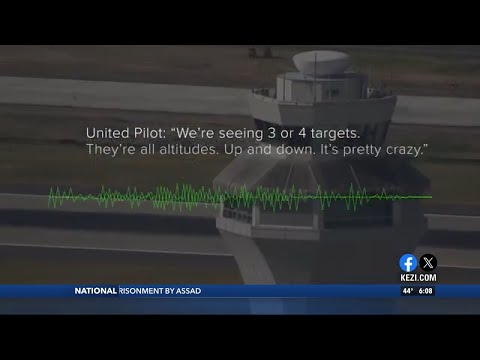
Oregon Pilot Speaks Out After Seeing UFO
KEZI 9 News follow-up interview with Joe Buley detailing his skepticism of the Starlink explanation.
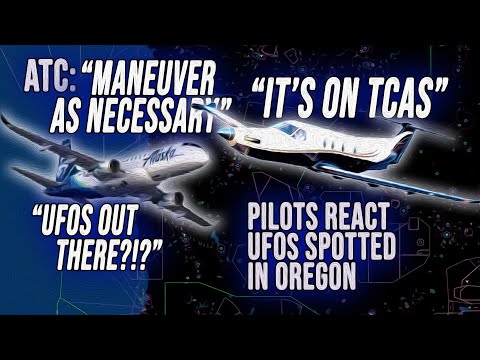
"Buzzed an Aircraft" / "It's on TCAS" — UFOs Spotted Over Oregon (ZSE ARTCC)
Full annotated playback of the archived Seattle Center air traffic control recording covering the incident.
Sources
- Federal Aviation Administration. Public statement confirming a pilot report was filed in Seattle ARTCC airspace, Dec. 7, 2024, as quoted in multiple outlets below.
- KATU News. "Life Flight pilot reports seeing 'UFO' near Eugene." katu.com
- KEZI 9 News. "Pilot speaks on UFO sighting over Western Oregon skies." kezi.com
- KGW. "Pilots report mysterious lights 'moving at extreme speeds' across Oregon skies." kgw.com
- KGW. "Oregon pilot remains 'as curious as everybody else' about mysterious lights in sky." kgw.com
- KPIC/KVAL. "At least one report of UFO sighting over Eugene by commercial pilot, FAA confirms." kpic.com
- Newsweek. "Pilots told to 'maneuver' around Oregon 'UFO' in leaked cabin audio." newsweek.com
- Newsweek. "Pilot encountered mystery objects 'moving at extreme speed': FAA." newsweek.com
- Willamette Week. "A Recent Report of Strange Lights Illuminates a Longer History of UFO Sightings in the Pacific Northwest." Jan. 14, 2025. wweek.com
- Grants Pass Tribune. "Pilots Report UFO Sightings Near Eugene, Oregon: Unidentified Lights and Strange Maneuvers." grantspasstribune.com
- Metabunk. "Oregon UFO Lights seen by pilots [Starlink]." Sitrec-based satellite ephemeris and ADS-B flight-track analysis. metabunk.org
- Daily Mail. Interview with Dr. Douglas Buettner (Stevens Institute of Technology) on Starlink satellite-flare confidence level ("60 to 80 percent").
- National UFO Reporting Center. Sighting Report #184932, December 2024. nuforc.org
- National UFO Reporting Center. "About Us" — organizational background on NUFORC and CTO Christian Stepien. nuforc.org
- Federal Aviation Administration. Notice JO 7110.800, "Unidentified Anomalous Phenomena (UAP) Reports," Sept. 12, 2025. faa.gov
- All-domain Anomaly Resolution Office (AARO), U.S. Department of Defense. Official UAP investigation office. aaro.mil
- FlightAware. Aircraft registration record for N661LF, 2014 Pilatus PC-12/47E, Life Flight Network LLC. flightaware.com
- Life Flight Network. Organizational background, Oregon service area, and fixed-wing fleet. lifeflight.org
- Eugene Airport / Mahlon Sweet Field (KEUG). Airport identifier and location reference. en.wikipedia.org
- NewsNation. "UFO lights over Oregon allegedly encountered by pilots." newsnationnow.com
- Wikipedia. "2024 United States drone sightings" — background on the concurrent New Jersey/Northeast drone wave. en.wikipedia.org
- Military.com. "Drones, Planes or UFOs? Americans Abuzz Over Mysterious New Jersey Sightings." Dec. 14, 2024. military.com
- Wikimedia Commons. "Eugene skyline.jpg," photographed by Jsayre64, Dec. 23, 2005 (CC BY-SA 3.0). commons.wikimedia.org
See something inaccurate? Have additional information or sources?
Suggest an Edit →Last Updated: August 2026