
The February 2021 New Mexico American Airlines Encounter
At roughly 1:19 PM local time on February 21, 2021, the flight crew of American Airlines Flight 2292 — an Airbus A320 cruising at 36,000–37,000 feet on a scheduled run from Cincinnati to Phoenix — radioed the FAA's Albuquerque Air Route Traffic Control Center to ask "do you have any targets up here?" before describing "a long, cylindrical object that almost looked like a cruise missile type of thing, moving really fast right over the top of us" as it crossed northeastern New Mexico near Des Moines and Clayton. The transmission was intercepted independently by veteran radio monitor Steve Douglass, whose broadcast of the recording forced American Airlines through a public denial-then-confirmation reversal within 48 hours, drew an on-record "we have no knowledge of this" from Kirtland Air Force Base spokeswoman Lally Laksbergs and a flat denial of testing from White Sands Missile Range spokesperson Scott Stearns, and pulled a rare acknowledgment from FBI Albuquerque field office spokesman Frank Fisher that the Bureau was "aware of the reported incident" while declining to confirm or deny any investigation. FAA air traffic controllers found nothing on radar. A subsequent Freedom of Information Act fight — in which the FBI told one requester in March 2021 that no records existed, only for a second requester, meteorologist and MUFON investigator William Puckett, to later obtain records that contradicted that denial — kept the case circulating through 2021-era UAP disclosure discourse for years after the initial sighting, right through a December 2024 FAA document release that finally surfaced the raw multi-channel ATC audio, radar tracking data, and video.
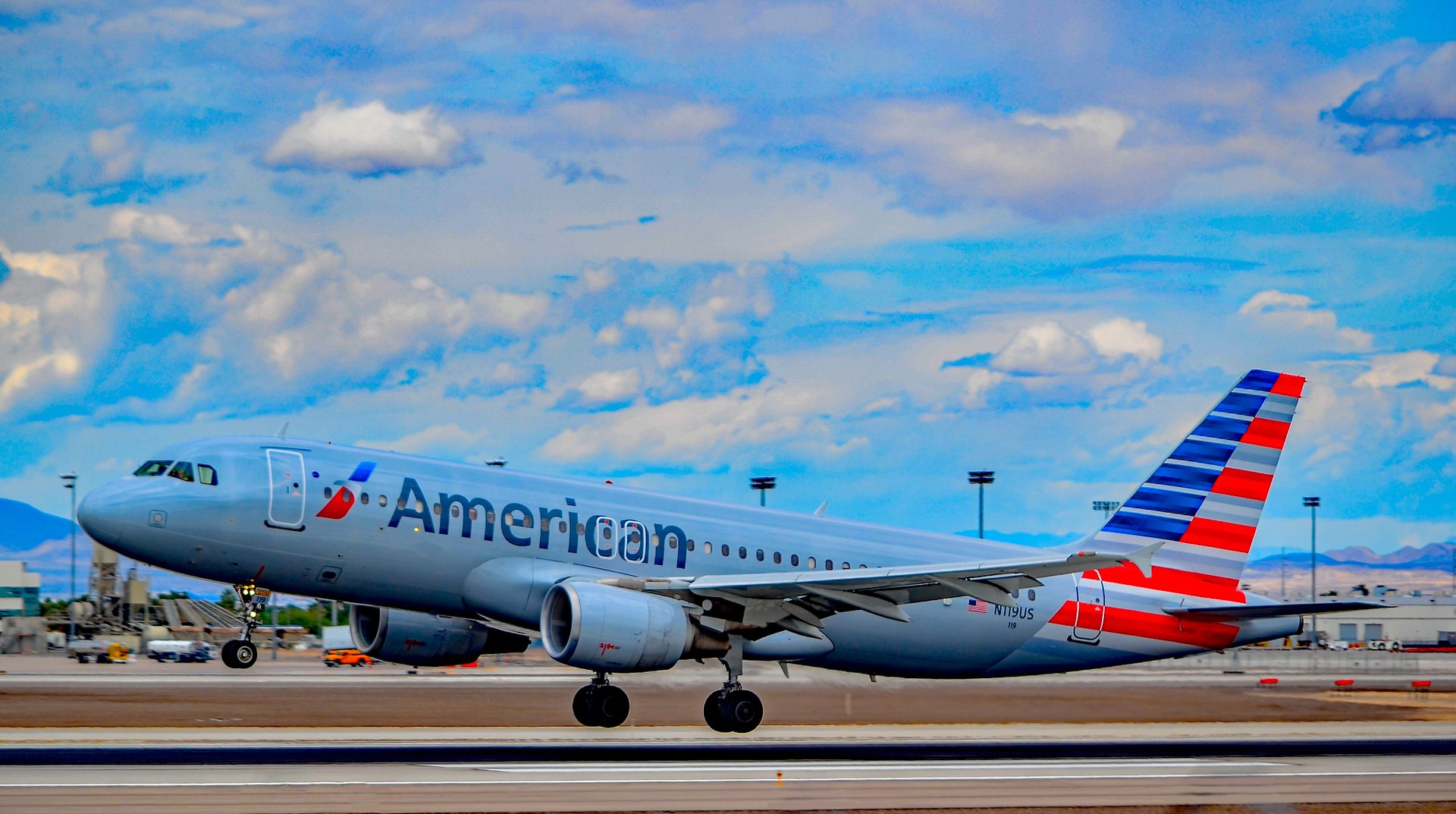
Pictured: an American Airlines Airbus A320-214, the same aircraft type (though not the specific tail number) flown as Flight 2292, photographed at McCarran International Airport, Las Vegas, in April 2016 — not a photograph of the incident itself. This is an audio-only case: no photograph, video, or radar image of the object described by the flight crew is known to exist; the primary artifact of record is the FAA's own multi-channel air traffic control recording.
Theoretical Alignment
Low-to-moderate ETH alignment: the case supplies a brief, credible, professionally-observed report of an anomalous high-speed object with no confirmed conventional identity, but no morphological detail beyond "long" and "cylindrical" survives to support any specific craft classification. IDH alignment is speculative at best and rests on nothing the case itself provides. PSH alignment is low: a two-person, professionally trained flight crew independently agreeing on the same shape, motion, and closing behavior in the seconds available to them is a weak fit for a purely psychological or misperception-driven explanation, though the brevity of the sighting (a single high-speed pass, not a sustained observation) leaves real room for honest misidentification that has nothing to do with psychology at all.
Background
The February 21, 2021 sighting arrived at a specific inflection point in modern American UAP discourse. The Pentagon's Advanced Aerospace Threat Identification Program had been publicly confirmed in December 2017, the Navy's "Tic Tac," "Gimbal," and "Go Fast" videos had circulated for years, and the Senate Intelligence Committee had, in the FY2021 Intelligence Authorization Act, directed the Office of the Director of National Intelligence to produce a public report on unidentified aerial phenomena within 180 days — the document that would become the June 25, 2021 "Preliminary Assessment: Unidentified Aerial Phenomena," released exactly four months after this sighting. National media outlets were primed to run any story involving a named commercial airline, an authenticated cockpit transmission, and a phrase as vivid as "cruise missile type of thing." The result was that a single, brief radio call — the kind of pilot report that in an earlier decade might have gone no further than an internal FAA file — became a nationally covered story within 72 hours, driven not by any government disclosure but by a private radio hobbyist's scanner.
Commercial airline pilots reporting unidentified objects to air traffic control is not new. Eastern Air Lines Captain Clarence Chiles and First Officer John Whitted famously reported a wingless, cigar-shaped object with two rows of windows passing their DC-3 over Montgomery, Alabama in July 1948, and American Airlines Captain Peter W. Killian spent 45 minutes watching three color-shifting lights pace his DC-6B over Pennsylvania in February 1959 — a case discussed at length below under Historical Precedents. What sets the 2021 New Mexico case apart from both of those is duration: where Chiles-Whitted and Killian describe sustained observation lasting minutes, the AA2292 crew described a single, fast, over-the-top pass lasting at most a few seconds, closer in character to a near-miss than an extended sighting. That brevity shapes almost everything else about how this case can and cannot be evaluated.
Complete Timeline
| Date | Event |
|---|---|
| Feb 21, 2021, ~1:19 PM | The transmission. American Airlines Flight 2292, an Airbus A320 flying Cincinnati–Phoenix at approximately 36,000–37,000 feet and 400 knots, crosses the northeast corner of New Mexico near Des Moines and Clayton. The crew radios the FAA's Albuquerque Air Route Traffic Control Center: "Do you have any targets up here? We just had something go right over the top of us — I hate to say this but it looked like a long cylindrical object that almost looked like a cruise missile type of thing — moving really fast right over the top of us." |
| Feb 21, 2021 (same day) | Amarillo-based radio monitor Steve Douglass, chief photojournalist for KVII-TV and a self-described "stealth chaser" who runs the aviation-monitoring blog Deep Blue Horizon, independently intercepts the transmission on a scanner while listening for unrelated air traffic and posts the audio to his blog the same day. |
| Feb 22–23, 2021 | Aviation outlet The War Zone (TWZ) picks up the story. Douglass adds ADS-B tracking screenshots to his post showing no significant identifiable military aircraft in the area at the time of the report. |
| Feb 23, 2021 | American Airlines' initial denial. Asked to confirm the recording, the airline states: "At this time, we do not have any indication the radio transmission was from the flight crew on board American Airlines Flight 2292 on Feb. 21." |
| Feb 23, 2021 (later, same day) | The reversal. Following an internal crew debrief, American Airlines reverses course: "Following a debrief with our Flight Crew and additional information received, we can confirm this radio transmission was from American Airlines Flight 2292 on Feb. 21. For any additional questions on this, we encourage you to reach out to the FBI." |
| Feb 24–25, 2021 | The FAA confirms a pilot report was filed and states its air traffic controllers "did not see any object in the area on their radarscopes." Kirtland Air Force Base spokeswoman Lally Laksbergs tells reporters: "We have no knowledge of this. We're not aware of anything." White Sands Missile Range spokesperson Scott Stearns states the range "never test[s] in that area" and conducted no tests that day; the range sits roughly 400 miles from the sighting location. A Pentagon spokesman tells CBS News national security correspondent David Martin that DARPA, the Missile Defense Agency, and U.S. Strategic Command all report no tests conducted that day. |
| Feb 25–26, 2021 | FBI Albuquerque field office spokesman Frank Fisher states: "While our policy is to neither confirm nor deny investigations, the FBI works continuously with our federal, state, local and tribal partners to share intelligence and protect the public" — widely reported as the FBI being "aware of" the incident without confirming an active investigation. |
| March 2, 2021 | The FBI responds to a Freedom of Information Act request from researcher John Greenewald of The Black Vault, stating no responsive records could be located. |
| June 21, 2021 | The FAA issues an initial Glomar-style FOIA response, declining to confirm or deny the existence of responsive records. |
| July 22, 2021 | On appeal, the FAA releases six pages of records and discloses that the Department of Defense also holds responsive material — directly contradicting the tenor of the FBI's earlier "no records" position on the same underlying incident. |
| 2021–2022 (exact date not publicly fixed) | A separate FOIA request filed by meteorologist and MUFON field investigator William Puckett to the FBI yields responsive records — directly at odds with the "no records" response the Bureau had given a different requester in March 2021 over the identical incident. |
| December 2024 | Following a renewed FOIA push by The Black Vault, the FAA releases the raw multi-channel air traffic control audio (spanning the Apache, Freeway, and Phoenix sectors), radar tracking data, and video footage related to the incident — nearly four years after the sighting itself. |
The Radio Transmission and Its Discovery
Every fact this case rests on traces back to a single audio recording. Steve Douglass did not set out to intercept an anomalous report: he was scanning FAA Albuquerque Center frequencies — the recording itself was not conclusively frequency-stamped, though it falls in the range used by the center's high-altitude sectors, commonly cited as around 127.850 or 134.750 MHz — as part of his long-running hobby of monitoring military and civil aviation traffic out of Amarillo, Texas. What he captured was a single exchange: the AA2292 crew's initial query, "do you have any targets up here?", followed immediately by the now-famous description of the object. Douglass posted the recording to his blog, Deep Blue Horizon, the same day, time-stamped in his own Central time zone (Amarillo observes Central Time; New Mexico observes Mountain Time, one hour behind, which is why some outlets reported "1:19 PM" and others effectively "12:19 PM" for the same moment).
Douglass's background matters to how the recording should be weighed as evidence. He is not a UFO researcher; he is a working broadcast photojournalist (chief photojournalist for KVII-TV, Amarillo's ABC affiliate) with three decades of experience monitoring restricted and classified military communications as a "stealth chaser" — a niche hobby focused on spotting and identifying secretive aircraft programs, for which his radio-intercept work has previously been credited by ABC News, CBS News, CNN, and the Associated Press. That professional monitoring background is precisely why the recording survived and was taken seriously by mainstream outlets within days: Douglass had the equipment, the frequency knowledge, and the reputation to make the intercept credible before American Airlines had said a word.
The Flight, the Route, and the Physics of a High-Speed Pass
American Airlines Flight 2292 was a routine, scheduled domestic run between Cincinnati/Northern Kentucky International Airport and Phoenix Sky Harbor International Airport, flown on an Airbus A320. At the reported cruise altitude of roughly 36,000–37,000 feet (flight level 360–370) and a groundspeed near 400 knots, the aircraft's own great-circle route across the Texas and Oklahoma panhandles into New Mexico passes almost directly over Union County, New Mexico, between the small towns of Des Moines and Clayton — consistent with every contemporaneous account of "the northeast corner of New Mexico."
The phrase "moving really fast" deserves closer scrutiny than it usually receives. At FL370, AA2292 itself was covering roughly 460 knots (400 knots indicated airspeed correcting to true airspeed at altitude) relative to the ground. Any object on a converging or crossing path — even one that is, in absolute terms, moving comparatively slowly — can appear to a pilot to streak past "really fast" purely as a function of closure rate and the brief window in which a cockpit occupant can track something passing directly overhead. This is not a claim that the object was necessarily slow; it is a note of caution that "moving really fast" as reported from a single glancing pass, with no instrument tracking to independently measure velocity, is compatible with a very wide range of true closing speeds, from a nearly stationary object crossed at the airliner's own speed to something genuinely hypersonic relative to the ground. The case simply does not contain the data to distinguish between those possibilities, and no publicly released radar or ADS-B track has ever supplied one.
American Airlines' Reversal: From Denial to Confirmation
The airline's public position changed within a single day, and the reversal is itself one of the case's most concrete data points. On February 23, American Airlines told reporters it had "no indication the radio transmission was from the flight crew on board." Hours later, after what the airline described as "a debrief with our Flight Crew and additional information received," it reversed entirely: "we can confirm this radio transmission was from American Airlines Flight 2292 on Feb. 21." The airline then declined to elaborate further, directing all subsequent questions to the FBI.
Read charitably, the sequence is unremarkable corporate process: a large airline's press office would not confirm a specific crew's private radio call without first verifying it internally, and a same-day reversal after an actual conversation with the flight crew is exactly what a careful confirmation process should look like. Read more skeptically, the initial denial meant that for roughly 48 hours, the only entity capable of authoritatively confirming or denying the recording's authenticity was telling the public it had no evidence the recording was real, while the flight crew themselves were, by the airline's own account, already known internally to have made the call. Both readings are consistent with the public record; the case file cannot resolve which is closer to the truth, and no further internal airline communications about the debrief itself have ever been made public.
The Official Response: FAA, FBI, and the Military
Once American Airlines confirmed the recording, four separate government or government-adjacent entities were asked to comment, and each gave a narrow, carefully bounded answer that neither confirmed nor substantively investigated the object's identity:
- The FAA confirmed only that a pilot report had been filed and that its own air traffic control radar — which is optimized for tracking transponder-equipped aircraft, not necessarily small or non-cooperative objects — "did not see any object in the area on their radarscopes."
- The FBI, through Albuquerque field office spokesman Frank Fisher, offered its standard boilerplate: it does not confirm or deny investigations, but "works continuously with our federal, state, local and tribal partners to share intelligence and protect the public." This has been widely paraphrased in coverage as the FBI being "aware of" the incident — an accurate characterization of what was actually said, but one that should not be inflated into anything approaching a confirmed federal investigation.
- Kirtland Air Force Base, the nearest major military installation to the flight path, disclaimed any knowledge through spokeswoman Lally Laksbergs: "We have no knowledge of this. We're not aware of anything."
- White Sands Missile Range, roughly 400 miles from the sighting location and the most obvious candidate source for a genuinely "cruise missile"-shaped test article in the region, denied any testing that day through spokesperson Scott Stearns: "we never test in that area."
- A Pentagon spokesman, speaking to CBS News national security correspondent David Martin, added that DARPA, the Missile Defense Agency, and U.S. Strategic Command had each separately reported no tests conducted that day.
Taken together, this is an unusually complete chain of denials for a UAP case — five separate government voices, each on the record, each disclaiming knowledge or involvement. It is worth pausing on what that chain of denials can and cannot prove, a point developed further in the Conventional Explanation Candidate section below.
A note on weighing these institutional statements: official government, military, and law-enforcement denials — even when specific, on the record, and issued by named spokespeople, as they were here — are not neutral or infallible evidence that a program did not exist. Agencies investigating or commenting on UAP have a documented history of incomplete, delayed, or later-revised public explanations, from the Air Force's Project Blue Book-era "swamp gas" ruling (later criticized even by Air Force-linked scientists) to the CIA's own 1997 acknowledgment that a substantial share of Cold War-era "UFO" reports were in fact misattributed U-2 and OXCART reconnaissance flights the agency deliberately declined to correct at the time. Public affairs offices also have a structural incentive toward the least-alarming available answer, and a genuinely classified program — by definition — would not be something a base or range spokesperson is authorized to confirm even if it existed. None of this means White Sands, Kirtland, or the Pentagon lied in this specific instance; it means their denials are one input to weigh against the case's other evidence, not a dispositive final word, and a meaningful share of experienced UAP researchers treat this exact category of institutional statement with real, non-conspiratorial caution for precisely these reasons.
The FOIA Record: Redactions, Contradictions, and What Emerged in 2024
The case's second life came almost entirely through the Freedom of Information Act. When John Greenewald of The Black Vault — one of the most prolific FOIA requesters in the UFO research community — filed for FBI records on March 2, 2021, the Bureau responded that it had located no responsive records at all. That would ordinarily be the end of the paper trail. Instead, a separate FOIA request from meteorologist and MUFON field investigator William Puckett, filed to the same agency over the same underlying incident, produced FBI records that plainly contradicted the "no records" response Greenewald had received. The discrepancy between two FOIA responses to the same agency about the same event, rather than any single document's content, is itself one of the most concrete pieces of evidence in the entire case that official statements about this incident cannot be taken purely at face value.
The FAA's own FOIA history followed a similarly halting path: an initial Glomar-style non-confirm/non-deny response in June 2021, followed a month later by an appeal release of six pages of records that, notably, disclosed the Department of Defense also held material related to the incident — a detail the FAA had not volunteered up front. The fullest public accounting did not arrive until December 2024, nearly four years after the sighting, when a renewed Black Vault FOIA effort produced the actual multi-channel ATC audio (spanning the Apache, Freeway, and Phoenix sectors used by Albuquerque Center controllers), radar tracking data, and associated video material. Even that release, per Black Vault's own reporting on the documents, did not include a definitive radar track of the object itself or resolve what the DoD's separately-held material actually contains.
No connection between this incident and any AARO annual or historical report, and no congressional hearing testimony specifically naming this case, has been identified in the course of researching this case file. The All-domain Anomaly Resolution Office's public reporting has referenced other, unrelated "cylindrical object" reports — including a 2010s commercial aircrew report of a cylindrical object off the U.S. Atlantic coast near New York — but that is a distinct incident and should not be confused with AA2292's New Mexico encounter. The 2021 New Mexico case circulated extensively in disclosure-era media and online discourse in the years after it happened, but as of this writing it does not appear to have been formally adjudicated, cited, or resolved by AARO, the Department of Defense, or Congress in any public document.
Key Witnesses
This case presents an unusual evidentiary structure: its central witnesses have never been publicly named, while the person most responsible for the case existing in the public record at all was not a witness to the object.
The Flight Crew of American Airlines Flight 2292 (Unnamed)
Neither the captain nor the first officer of Flight 2292 has ever been publicly identified by name, in contrast to Captain Peter Killian's 1959 case or the 1948 Chiles-Whitted sighting, both of which are built around named, on-record pilots. American Airlines' own statements confirm the crew was debriefed internally and that the recording did originate from their aircraft, but the airline directed all further questions to the FBI and neither agency nor airline has released the crew's identities, ranks, or seniority. This case file follows the honest convention of describing them only by role. Everything known about their account comes from the roughly fifteen-second radio transmission itself: a direct, unembellished description ("a long cylindrical object that almost looked like a cruise missile type of thing") delivered in the terse, information-dense phrasing typical of professional radio discipline, with no elaboration, no estimate of distance or size, and no follow-up transmission describing the object further after the initial exchange.
Steve Douglass
Douglass did not see the object described in the transmission — he is not a witness to the sighting itself — but without his scanner intercept and same-day blog post, this case would likely not exist in the public record at all. A three-decade veteran of monitoring military and classified aviation communications under the "stealth chaser" label, Douglass has previously broken national and international aviation stories credited by ABC News, CBS News, CNN, and the Associated Press. His decision to publish the raw audio immediately, with ADS-B screenshots added within 48 hours to show the absence of identifiable nearby military traffic, gave outside researchers and journalists a verifiable starting point that neither the FAA nor American Airlines had any obligation to provide on their own.
William Puckett
A retired National Weather Service and EPA meteorologist and former MUFON Montana state director, Puckett filed the FOIA request that surfaced FBI records contradicting the Bureau's earlier "no records" response to a different requester — the single most concrete piece of documentary evidence in this case that official statements should not be taken at face value. His broader body of work includes detailed radar and meteorological analysis of other pilot UAP reports, applying the same instrument-data-first methodology that this case's own lack of any released radar track makes impossible to apply here.
The Five Observables Assessment
The Five Observables framework, developed by former AATIP director Luis Elizondo, is used to classify UAP encounters based on performance characteristics that exceed known technology:
Assessment: This case supplies almost none of the instrumented data the Five Observables framework was designed to evaluate. No maneuver, hover, or acceleration was described — the object was seen only in straight, level, high-speed transit, so Anti-Gravity Lift and Instant Acceleration are not applicable. "Moving really fast" is flagged speculative for Hypersonic performance because, as discussed above, the reported speed cannot be disentangled from ordinary closure-rate perception during a brief crossing pass with no instrument backup. Low Observability is flagged speculative rather than present because, while it is genuinely notable that FAA radar showed nothing in the area, this is equally consistent with a small radar cross-section object, a transient or marginal return an operator did not flag in real time, or simply an object that had already passed beyond radar's practical resolution envelope by the time it might have been sought. Trans-Medium is not applicable; no transition between air, water, or space was reported or plausible given the account.
Evidence Assessment
Supporting a Genuine Anomaly
- Two professional flight crew members, in Class A airspace under a heavy workload, independently described the same shape and behavior in a spontaneous, unrehearsed radio call — not a solicited or after-the-fact retelling
- American Airlines ultimately confirmed the recording's authenticity after an internal crew debrief, ruling out a hoaxed or fabricated transmission
- Every government or military entity asked about a known, conventional source — White Sands, Kirtland, DARPA, the Missile Defense Agency, and U.S. Strategic Command — denied testing or operating anything in the area that day
- The FBI's contradictory FOIA responses to two different requesters over the identical incident demonstrate the official record is, at minimum, incomplete or inconsistently administered
- The pilots' own phrasing ("I hate to say this") suggests a crew reluctant to make an extraordinary claim, consistent with professional caution rather than embellishment
Supporting a Conventional Explanation
- FAA radar recorded no corresponding target, removing the single most valuable form of independent, non-testimonial corroboration available for an aviation case
- The sighting lasted at most a few seconds, during a high-workload cruise phase, with no follow-up description, estimate of range, or second look
- No second aircraft, ground observer, or independent sensor platform has ever come forward corroborating the object — unlike the multiply-witnessed 1959 Killian case
- "Moving really fast" is fully explainable by ordinary aircraft-relative closure speed on an object of unknown true velocity, including a comparatively slow or even near-stationary object
- American Airlines' initial 48-hour denial demonstrates that even the one party capable of authoritatively confirming the recording did not do so immediately, leaving room for the possibility the crew's own account evolved somewhat between the radio call and the internal debrief
- No physical evidence, photograph, or video of the object itself exists or has ever been claimed to exist
Why "Open"
This case is classified OPEN rather than Disputed, Credible, or Debunked because the available evidence genuinely does not point cleanly in any single direction, and no party — proponent or skeptic — has produced a specific, falsifiable account of what the object actually was. It is not Debunked: no confirmed mundane identity (a specific balloon, a specific aircraft, a specific test event) has ever been attached to the sighting, and every agency asked to supply one instead issued a blanket denial of involvement. It is not Credible or Verified in the sense those stamps carry elsewhere on this site: the sighting rests on a single flight crew's few-second glimpse, with zero independent instrumented corroboration, zero second witnesses, and zero physical evidence — a much thinner evidentiary base than a case like Killian (multiple aircraft and ground witnesses over 45 minutes) or Coyne (a multiply-corroborated crew plus an instrument-documented anomaly). And it does not fit Disputed in the classic sense of two well-developed, competing narratives fighting over the same body of evidence — there simply is not enough surviving detail for a genuine dispute to form. What OPEN captures accurately is a genuinely real, authenticated event (the recording is not fabricated; American Airlines confirmed it) that remains, on the public record as it stands, unresolved — and unusually so, given how many separate government voices went on record about it without any of them supplying an actual answer.
Sensor & Instrumentation Detection Profile
The only instrument system placed on record for this case is FAA secondary and primary surveillance radar covering Albuquerque Center's high-altitude sectors, which returned no target correlated with the pilots' report. No military radar, satellite, infrared, or acoustic sensor data has ever been publicly disclosed as having detected the object; the December 2024 FAA release included ADS-B/radar tracking data for known air traffic in the area (used to establish AA2292's own position) rather than any confirmed track of an unidentified target. The flight crew's own onboard weather radar, standard equipment on the A320, is not designed to detect small, non-metallic, or low-reflectivity objects and no report of an onboard radar contact has ever surfaced.
Environmental & Geospatial Context
The incident occurred at cruise altitude (FL360–370) over sparsely populated high desert plains in Union County, New Mexico — terrain with very low population density and correspondingly few potential ground witnesses, which helps explain why no independent ground-based sighting from the immediate area has ever surfaced. No contemporary reporting describes adverse weather; the crew's clear, immediate visual identification of the object's shape is itself indirect evidence that visibility was good at the time. The region sits within the broader flight corridor connecting several major transcontinental east-west air routes, meaning any object crossing it perpendicular to those routes would have a comparatively narrow window in which any given eastbound or westbound aircraft would be positioned to see it — a partial explanation, alongside the low ground population, for the absence of any second aircraft report in the public record.
Observer Credibility & Occupational Profile
Commercial airline pilots are among the most rigorously trained and credentialed class of aerial observers that exist. To occupy either seat on an Airbus A320 for a U.S. major carrier, both the captain and first officer are required to hold an FAA Airline Transport Pilot certificate — the highest level of pilot certification, requiring a minimum of 1,500 flight hours, a rigorous written and practical examination regime, and ongoing type-specific simulator and check-ride recurrency training every six to twelve months. Professional pilots are specifically trained in traffic scanning, radio discipline, and precise, unembellished verbal reporting under workload — exactly the register the AA2292 transmission is delivered in. A pilot's professional incentives also cut strongly against fabrication or exaggeration: an unsubstantiated, sensationalized UFO report carries real career and reputational risk with no corresponding benefit, which is consistent with the crew's own reluctant framing ("I hate to say this") and their apparent decision not to elaborate further once the immediate exchange with ATC ended. Weighed against that occupational credibility is the case's central limitation: even the most credentialed observer can only report what a few seconds of glancing observation, with no instrument backup, actually allows them to see — and this sighting supplied only a few seconds.
Physical & Material Assays
No physical evidence of any kind exists in this case, and none has ever been claimed. There is no debris, no photograph, no video frame, and no independently measured radar return of the object itself. The closest thing to a physical artifact of record is the ATC audio recording, discussed in detail under Material Analysis below.
Historical Precedents & Archive Matches
The most direct historical precedent on this site is the 1959 Killian sighting — another American Airlines flight crew, sixty-two years earlier almost to the month, reporting an unexplained aerial phenomenon to air traffic control mid-flight. The parallel is genuinely striking and, as far as this case file's research could determine, coincidental rather than connected: Captain Peter Killian's DC-6B was on a Newark–Detroit run in February 1959 when he and First Officer James Dee watched three color-shifting lights pace their aircraft for 45 minutes, corroborated in real time by two more American Airlines crews, a United Airlines crew, Pittsburgh tower personnel, and roughly a dozen ground observers near Akron, Ohio. AA2292's 2021 sighting shares the carrier and the mid-flight ATC report but differs from Killian in nearly every other evidentiary dimension: duration (45 minutes versus a few seconds), witness count (dozens across multiple aircraft and the ground versus two crew members alone), and corroboration (radar-negative in both cases, but Killian's radar-negative status is offset by the sheer number of independent human witnesses, which AA2292 entirely lacks). The two cases are best read as illustrating opposite ends of what an "airline pilot UAP report" can look like: one thickly corroborated and extensively investigated by NICAP over years, the other a single fifteen-second radio call that never received anything resembling a comparable field investigation.
A second, older precedent is the 1948 Chiles-Whitted sighting, in which Eastern Air Lines Captain Clarence Chiles and First Officer John Whitted described a wingless, torpedo- or cigar-shaped object passing close to their DC-3 near Montgomery, Alabama — the earliest widely-documented case of a commercial airline crew reporting an elongated, wingless object at close range, and a case Project Sign investigators at the time treated seriously enough to draft an "Estimate of the Situation" favoring an extraterrestrial explanation (later ordered destroyed by USAF Chief of Staff Hoyt Vandenberg). The general shape category — elongated, wingless, no visible means of propulsion — recurs across Chiles-Whitted (1948), and, in a more attenuated way, AA2292's "long, cylindrical" description (2021), even though seventy-three years and a fundamentally different sighting duration separate them. A third related case on this site, Japan Air Lines Cargo Flight 1628 (1986), involves a commercial cargo pilot's extended, radar-corroborated sighting over Alaska and is referenced in the Related Cases section below as a third point of comparison for how differently an airline-pilot UAP report can be investigated when ground and military radar are actually available to cross-check the account.
Material Analysis
Because this is fundamentally an audio-evidence case, "material analysis" here means analysis of the recording itself rather than any physical trace. Two separate authentication questions are relevant: whether the recording is a genuine, unaltered capture of a real FAA transmission, and whether the transmission genuinely originated from AA2292 rather than a different aircraft or a hoax.
Authenticity of the Recording
On the first question, the case is on solid ground. Steve Douglass's monitoring credentials and three-decade track record of verified radio intercepts, the recording's consistency with standard FAA ATC phraseology and channel characteristics, and — most importantly — the eventual official FAA release of its own multi-channel recordings of the same event in December 2024 (which corroborated rather than contradicted the originally leaked audio) together establish that a real transmission occurred substantially as reported. This is not a case where the primary audio artifact itself has ever been seriously challenged as fabricated.
Attribution to Flight 2292
The second question — whether the transmission came specifically from AA2292 — was, for about 48 hours, genuinely contested by the one party best positioned to know: American Airlines itself. That the airline's internal process took a day to move from "no indication" to "confirmed following crew debrief" is not, on its own, evidence of anything sinister; large corporations routinely take time to verify operational details before speaking publicly. But it does mean the attribution rests on a single institutional confirmation issued after an internal, non-public process, rather than on any independently verifiable technical marker (such as a released, authenticated flight-specific call-sign audio segment analyzed by a neutral third party). The December 2024 FAA release, which included the Apache/Freeway/Phoenix sector channels, appears to be the first point at which outside researchers gained access to primary-source audio beyond Douglass's original intercept, though public reporting on that release has not described a formal forensic audio-authentication study being conducted on it.
Supporting a Genuine, Anomalous Object
- The recording's authenticity as a real ATC transmission is well-corroborated, including by the FAA's own eventual release of matching multi-channel audio
- American Airlines confirmed the crew and flight after internal debrief, ruling out the possibility this was an unrelated or hoaxed transmission misattributed to AA2292
- No conventional test, launch, or exercise has been confirmed by any of the five government/military entities asked directly
Supporting a Conventional or Unresolved Explanation
- No physical trace, photograph, or independently measured radar track of the object itself exists to analyze
- The attribution of the transmission specifically to AA2292 rests on a single airline's internal confirmation rather than an independently verifiable technical marker
- A "no test conducted" denial from an agency is not equivalent to positive proof no conventional object was present — it only rules out that agency's own acknowledged activity
The Conventional Explanation Candidate (CEC)
Five broad categories of conventional or semi-conventional explanation have been proposed for the AA2292 sighting, either by researchers, journalists, or by process of elimination against the government statements on record. None has been confirmed; each carries genuine strengths and weaknesses.
A Classified Military or Government Test Not Disclosed to the FAA or Airline
The object's own verbal description — "a long cylindrical object that almost looked like a cruise missile type of thing" — is, on its face, the single most literal candidate explanation available: an actual cruise missile, hypersonic test vehicle, or similar guided munition or test article. New Mexico hosts an unusually dense concentration of U.S. military test infrastructure, including White Sands Missile Range, Holloman Air Force Base, and Cannon Air Force Base, along with restricted airspace corridors used for classified flight test work. Every agency asked directly — White Sands, Kirtland, DARPA, the Missile Defense Agency, and U.S. Strategic Command — denied conducting any test that day, and White Sands specifically noted it is roughly 400 miles from the sighting location and does not test in that corridor. Those denials genuinely weaken this candidate, but they cannot fully close it: a program classified at a level where even a base or range public affairs office is not read in would produce exactly this pattern of sincere, on-record denials from officials who may simply not know. See the institutional-reliability caveat under "The Official Response" above for a fuller treatment of why these denials, however specific, should be weighed as one input rather than the final word.
A Weather Balloon or High-Altitude Balloon
A weather or research balloon at or near the airliner's cruise altitude, crossed at AA2292's own ~460-knot true airspeed, would produce exactly the kind of brief, high-apparent-speed "flash past" the crew described, even though a balloon's own true ground speed (driven by wind, not propulsion) is a small fraction of that closure rate. The candidate's central weakness is shape and coherence: a standard weather balloon with its instrument payload does not typically read to a trained observer as a single, continuous "long, cylindrical" form resembling a missile; it more commonly presents as a round or irregular envelope with a separate, distinctly smaller payload package trailing below on a line. A high-altitude research or surveillance balloon (of the kind that drew separate, unrelated national attention in February 2023) can occasionally present a more elongated, rigid-looking silhouette depending on angle and lighting, which keeps this candidate from being ruled out entirely, but no specific balloon launch, flight path, or operator has ever been identified as correlating with this time and location.
Space Debris Re-Entry
A re-entering satellite or rocket body fragment can appear elongated and extremely fast-moving, and re-entries are catalogued events that in principle could be checked against this date. Against this candidate: re-entry events are typically visible, luminous, and often trailed by a visible burn/glow over a wide geographic area with multiple independent witnesses across several states, none of which is reported here; the crew's description contains no mention of glow, fire, smoke trail, or fragmentation, all commonly reported features of a re-entry; and no publicly available space-object tracking catalog match for this specific date, time, and location has been identified in researching this case. This candidate remains open only in the weak sense that it has not been affirmatively disproven, not because any positive evidence supports it.
Another Aircraft Viewed at a Confusing Angle
A military aircraft (fighter, tanker, or other platform) or a general aviation aircraft crossing nearly head-on or at a sharp angle can present a foreshortened, elongated silhouette that a startled observer, glimpsing it for only a second or two, might reasonably describe as "cylindrical." Working against this candidate: FL360–370 sits within Class A airspace, where FAA regulations require every aircraft to carry and operate a functioning transponder and be under positive ATC control — which is precisely why the crew's own first instinct was to ask controllers "do you have any targets up here?" rather than simply identify it as a nearby known aircraft, and why the FAA's negative radar return is more evidentially significant here than it would be at a lower, less tightly controlled altitude. A non-transponding aircraft operating illegally in Class A airspace, undetected by both ATC radar and the FAA's own subsequent investigation, remains possible but would itself be a significant anomaly requiring its own explanation.
A Genuine, Unidentified Anomalous Object
After weighing the four conventional candidates above, a residual possibility remains that the AA2292 crew observed something that does not fit any of them: an object of unknown origin, whether an unrecognized aircraft or drone technology, a foreign platform outside the range of the domestic agencies who were asked to comment, or something genuinely outside the current inventory of known aerial vehicles. The case's own thinness — a single few-second glimpse with no instrumented corroboration — means this candidate cannot be evaluated any more rigorously than the others; it exists by elimination and by the honest observation that "no confirmed conventional explanation currently accounts for this report" is a factually accurate statement about where the public record currently stands, not a claim that the anomalous candidate has been affirmatively demonstrated.
Assessment Summary
Classified Military/Government Test
InconclusiveThe most literal fit for the object's own description, but every directly-asked agency denied it, and those denials — while not dispositive given the nature of classification — leave no positive evidence to weigh in this candidate's favor.
Weather / High-Altitude Balloon
InconclusivePhysically plausible as an explanation for perceived high speed via closure rate, but the "long, cylindrical" shape description is a poor match for a standard balloon envelope, and no specific launch has been identified.
Space Debris Re-Entry
ImplausibleNo glow, trail, or fragmentation was reported, no wide-area corroborating witnesses have surfaced, and no catalog match for this date and location has been identified.
Misidentified Aircraft
ImplausibleClass A airspace requires functioning transponders and positive ATC control on every aircraft present, which is consistent with the FAA's own negative radar return and the crew's immediate uncertainty.
Genuine Unidentified Object
InconclusiveNot affirmatively demonstrated by any specific evidence, but consistent with the honest state of the record: no conventional candidate above has been confirmed, and the sighting itself is authenticated as real.
Related Cases
Confirmed Documents & Official Records
FBI Vault release of records related to the incident, including material obtained via a FOIA request that contradicted the Bureau's earlier "no responsive records" answer to a separate requester.
UNCLASSIFIED (released via FOIA)Consolidated FOIA case file including the FAA's December 2024 release of multi-channel ATC audio (Apache, Freeway, and Phoenix sectors), radar tracking data, and related video material.
UNCLASSIFIED (released via FOIA)The congressionally-mandated intelligence community assessment released four months after this sighting; does not name this specific case but provides the direct policy backdrop against which it was widely covered.
UNCLASSIFIEDSearch Government Archives Directly
Further Reading — Recommended Literature
UFOs: Generals, Pilots, and Government Officials Go on the Record
The definitive case that trained aviators and government officials, not fringe observers, make up a large share of credible UAP witnesses — directly relevant to weighing the AA2292 flight crew's own occupational credibility.
Imminent: Inside the Pentagon's Hunt for UFOs
A first-hand account from the former AATIP director whose Five Observables framework is used to assess this case, covering the same 2017–2021 disclosure window this sighting occurred within.
UFO: The Inside Story of the US Government's Search for Alien Life Here—and Out There
A comprehensive history of official U.S. government UAP investigation from 1947 through the modern AARO era, providing the institutional context for how cases like this one are (and are not) formally reviewed.
Skinwalkers at the Pentagon
An insiders' account of the government's classified AAWSAP/AATIP UAP research effort, published the same year as this sighting and directly relevant to how classified programs are (or are not) disclosed to base-level spokespeople.
American Cosmic: UFOs, Religion, Technology
An academic religious-studies examination of how belief in UAP spread through American institutional and popular culture in exactly the years leading up to this incident's viral spread.
DISCLOSURE: Some links above are affiliate links. If you purchase through them, OverClassified receives a small commission at no additional cost to you. This helps support independent research.
Essential Viewing
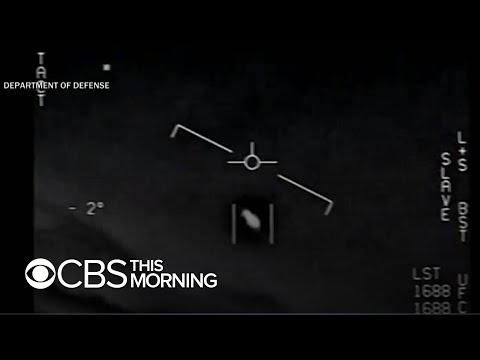
CBS Mornings: American Airlines Pilot Spots Mysterious Object
CBS Mornings' national coverage of the incident, including the authenticated ATC audio and the FAA's confirmation that radar showed nothing in the area.
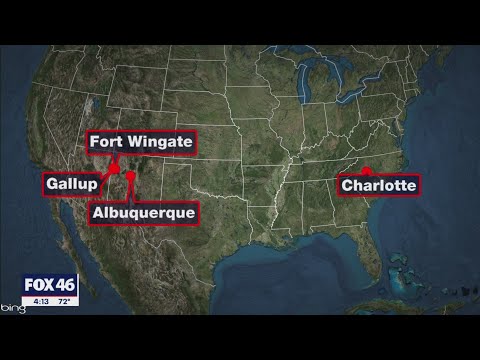
Queen City News: American Airlines Jet's Close Encounter
Local news-affiliate coverage summarizing the pilot's report, the FAA's radar-negative statement, and the FBI's acknowledgment of the incident.
Sources
- Douglass, Steve. "UPDATED: Intercept: American Airlines Flight 2292 reports close encounter with unknown flying object," Deep Blue Horizon, February 21, 2021. deepbluehorizon.blogspot.com
- Rogoway, Tyler. "Airliner Encountered Unidentified Fast-Moving Cylindrical Object Over New Mexico," The War Zone, February 22, 2021. twz.com
- Rogoway, Tyler. "American Airlines Confirms Encounter With Unidentified Cylindrical Object Over New Mexico," The War Zone, February 23, 2021. twz.com
- CBS News. "American Airlines pilot reports 'long, cylindrical object' zoom by while flying over New Mexico," February 25, 2021. cbsnews.com
- NBC News. "American Airlines pilot reports seeing long, cylindrical object fly over New Mexico," February 25, 2021. nbcnews.com
- Kelleher, Suzanne Rowan. "FAA Can't Explain Pilot's UFO Sighting Last Weekend Over New Mexico," Forbes, February 25, 2021. forbes.com
- Military Times / Army Times. "Military has 'no knowledge' of commercial pilot's report of unidentified object in New Mexico skies," February 25, 2021. militarytimes.com
- HuffPost. "American Airlines Pilot Reports Mysterious 'Cylindrical Object' Over Aircraft In New Mexico," February 25, 2021. huffpost.com
- Simple Flying. "A Bird? A Plane? American Airlines Pilot Spots UFO Over New Mexico," February 2021. simpleflying.com
- View From The Wing. "American Airlines Confirms: UFO Contact Over New Mexico On Sunday," February 23, 2021. viewfromthewing.com
- Fox News. "American Airlines not denying possible UFO spotting, says: 'Talk to the FBI'," February 2021. foxnews.com
- The Black Vault. "American Airlines Flight 2292 UFO Encounter, February 21, 2021" (document archive). theblackvault.com
- The Black Vault. "Ep. #78 – American Airlines Flight 2292 UFO Encounter" (podcast & FOIA case notes). theblackvault.com
- Federal Bureau of Investigation. FBI Vault — "American Airlines Flight 2292" record. vault.fbi.gov
- Office of the Director of National Intelligence. "Preliminary Assessment: Unidentified Aerial Phenomena," June 25, 2021. dni.gov
- Facts.net. "35 Facts About Flight 2292 UFO." facts.net
- ABC7 Amarillo (KVII). "Radio picks up close encounter over New Mexico," February 2021. abc7amarillo.com
- All That's Interesting. "American Airlines Pilot Reports 'Missile-Like' UFO While Flying Over New Mexico." allthatsinteresting.com
- YouTube (oEmbed-verified). CBS Mornings, "American Airlines pilot spots mysterious object while flying over New Mexico." youtube.com
- Wikipedia. "Des Moines, New Mexico" (geographic reference). en.wikipedia.org
- Wikipedia. "Clayton, New Mexico" (geographic reference). en.wikipedia.org
- MUFON / UFOs Northwest. William Puckett FOIA case files and radar-analysis methodology (researcher background). ufosnw.com
- Federal Aviation Administration. Public statement on Flight 2292 pilot report, radar review, February 2021 (as reported by Forbes, CBS News, and NBC News).
- American Airlines. Public statements of February 23, 2021 (initial non-confirmation and subsequent confirmation, as reported by The War Zone, Fox News, and View From The Wing).
- Wikimedia Commons. "N119US American Airlines 2000 Airbus A320-214 - cn 1268," photograph by Tomás Del Coro, CC BY-SA 2.0 (hero image source). commons.wikimedia.org
See something inaccurate? Have additional information or sources?
Suggest an Edit →Last Updated: August 2026