
The 1665 Air Battle of Stralsund
At two o'clock in the afternoon on 8 April 1665, six herring fishermen working off the Baltic coast at Stralsund — then a Swedish possession — reported watching flocks of birds over the sea condense into fleets of warships and fight a thunderous battle in the air that lasted for hours. Toward evening, they said, a flat round shape “like a plate,” the colour of the rising moon, came out of the sky and hung motionless above the Church of St Nicholas. The fishermen buried their faces in their hands and fled. A pamphlet describing it was printed in Stralsund two days later; a Swedish colonel and a doctor interrogated two of the six; and within fifteen years the story had been engraved, syndicated and folded into the Theatrum Europaeum. In 2023 the Staatliche Museen zu Berlin built an entire exhibition around it under the title A UFO in 1665.
This entry exists at the intersection of three things that are usually treated separately: a genuinely well-documented early-modern report with a tight paper trail, a phenomenon nobody has ever satisfactorily identified, and a print economy that had every commercial reason to elaborate it. All three are real, and the honest reading of the case has to hold all three at once.
What separates Stralsund from most pre-modern “UFO” claims is the speed and specificity of the documentation. The first surviving account was printed two days after the event, in the town where it happened, and named the alleged witnesses. A newspaper report days later records that named officials had questioned two of them. That is a documentary standard most nineteenth- and twentieth-century sighting reports do not meet. What separates it from a credible modern case is everything else: the fullest narrative source was written fifteen years later by a compiler working from newspapers, its famous illustration was commissioned from an artist who was not there and had never seen the place, and the earliest newspaper account of the affair mentions neither the bird-cloud nor the disc at all.
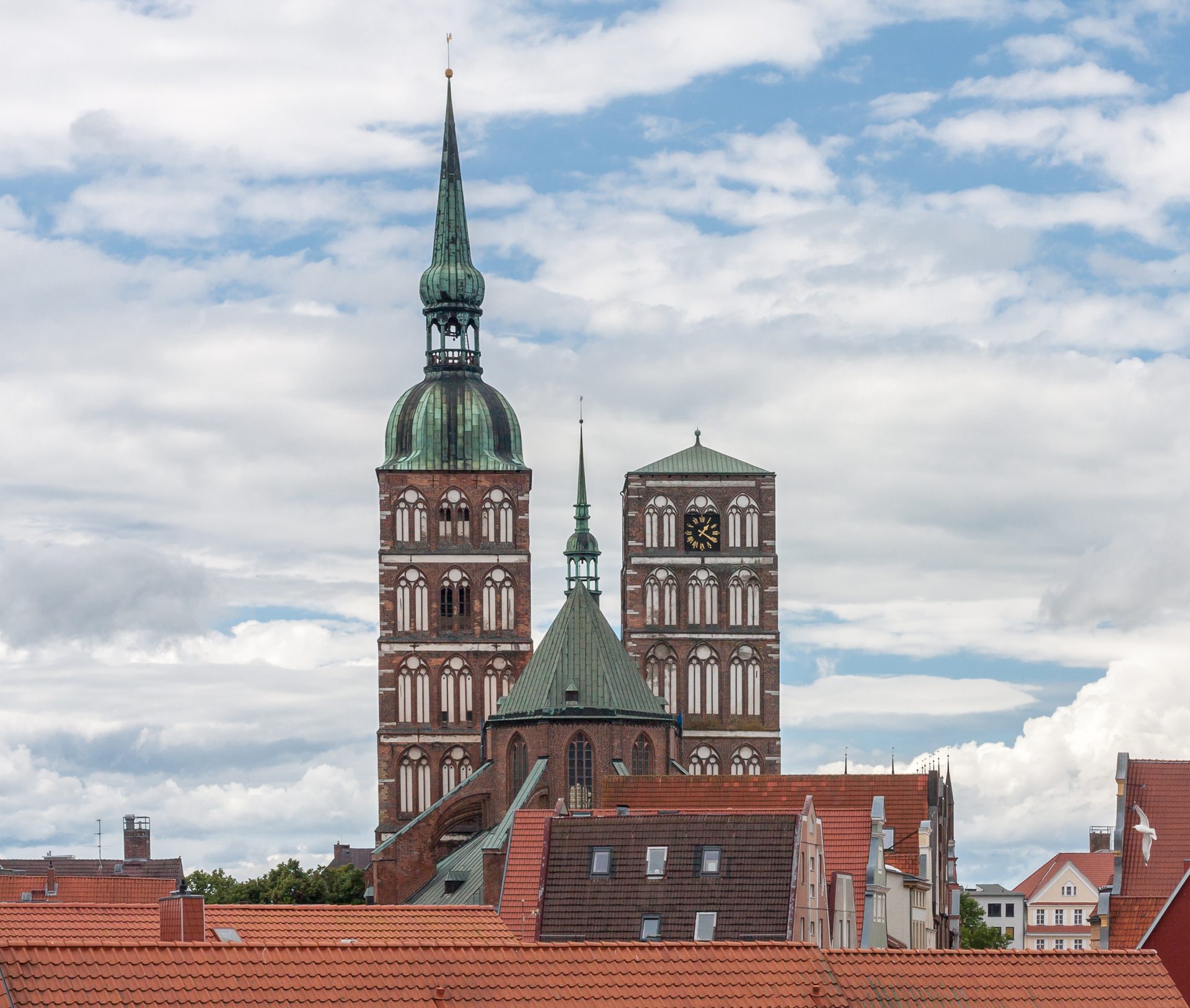
Pictured: the Church of St Nicholas (Nikolaikirche) in Stralsund — the building over which the fishermen said the flat round object hung until evening, still standing today. This is a modern photograph of the church, not a depiction of the 1665 event. The one near-contemporary image of the phenomenon, the copperplate engraving in Erasmus Francisci's 1680 Der Wunder-reiche Überzug unserer Nider-Welt, survives in digitised library copies whose reproduction rights are restricted to non-commercial use and which therefore cannot be hosted here; it was in any case commissioned from an artist fifteen years after the fact who had never been to Stralsund. Photograph by Martin Kraft, CC BY-SA 3.0 via Wikimedia Commons. Note that the south tower's baroque dome, visible here, was added in 1667 — two years after the sighting.
Theoretical Alignment
The Psycho-Social Hypothesis dominates this entry and does so on the strength of the case's own documentary record rather than as a default dismissal. The Stralsund event is one of the best-documented examples anywhere of a sky phenomenon being manufactured into a narrative in real time: the earliest newspaper notice omits both the bird-cloud and the disc; the fullest account was assembled fifteen years later by a compiler working from other people's newsprint; the famous picture was commissioned from a costume-and-genre engraver who had never seen the town and who worked entirely from that compiler's text. The extraterrestrial weighting is not zero because a real, unexplained stimulus of some kind almost certainly occurred — six men reported something, officials questioned them about it, and one of them was reportedly ill afterwards — but nothing in any seventeenth-century source points toward craft or visitors, and, as the Berlin exhibition's curator Moritz Wullen has stressed, nobody in 1665 would have thought to look for them. The extraterrestrial reading is a twentieth-century overlay on a seventeenth-century text.
Sensor & Instrumentation Detection Profile
There is no instrumentation in this case and there could not have been. The entire detection profile consists of six pairs of unaided human eyes on the Baltic in April 1665, at a distance from shore that no source specifies, looking at something in the sky for a period the sources describe as lasting several hours.
What is worth recording is what the era could have brought to bear and did not. Telescopes existed; Stralsund was a significant Hanseatic port with an educated merchant class, and the University of Greifswald — where the earliest surviving pamphlet is held today — lay thirty kilometres down the coast. Nobody appears to have turned an instrument on the phenomenon, nobody took a bearing, and no measurement of any kind survives. The nearest thing to an investigative act in the record is administrative rather than scientific: the interrogation of two of the six fishermen by Colonel von der Wegck and Doctor Gessman, reported in the Ordinari und Postzeitungen. A colonel and a physician questioning witnesses is a seventeenth-century authority check on whether the men were reliable, not an attempt to characterise what they saw.
One physiological datum appears in the sources and functions, for this era, as something like an effects report. Francisci's account states that on the following days the fishermen fell sick, trembling all over with pain in their heads and limbs, and the newspaper adds that one of them had been sick on his feet. Modern UFO writers have read this as a radiation effect. It cannot be assessed — there is no medical record, no description of the symptoms beyond those few words, and trembling with head and limb pain after hours of terror at sea in April on the Baltic has a very long list of ordinary candidates. It is recorded here because it is in the primary sources, not because it establishes anything.
Environmental & Geospatial Context
Stralsund sits at 54.31°N on the Strelasund, the narrow channel separating the German mainland from the island of Rügen, with the open Baltic to the north and east. In 1665 it was the principal fortified port of Swedish Pomerania and one of the strongest positions on the southern Baltic shore — it had famously withstood Wallenstein's siege in 1628, an episode whose own illustrated broadsheet very probably supplied the compositional template for the 1665 print.
The specific environmental conditions matter because they bear directly on the leading conventional explanation. The southern Baltic in early April is a textbook setting for superior mirage. Cold water lies beneath air that warms rapidly on clear spring afternoons, producing a strong temperature inversion in the first tens of metres above the sea surface; light travelling through that inversion is bent downward, so objects below the true horizon appear raised, stretched vertically, inverted, stacked, and sometimes multiplied. The specific form of this — Fata Morgana — renders distant ships, islands and coastlines as towering, shifting, castle-like structures that appear to move, merge and dissolve. It is a routine Baltic phenomenon, well known to sailors on that coast, and it is the explanation the Berlin exhibition itself offers as the modern reading: an optical mirage, possibly of a real military exercise, though the exhibition notes plainly that attempts to identify such an exercise in the record have been unsuccessful.
Two details in the account fit that environment closely. A dense flock of birds over the sea, seen through an inversion layer, is one of the most commonly reported triggers for a mirage that appears to transform into something structured; the account's opening image — a swarm of starlings condensing into a clump that then draws itself out “like a long corridor in a house” before becoming ships — is a remarkably precise description of vertical stretching. And the reported duration of several hours matches an atmospheric process rather than a discrete object; few things stay in one place in the sky for that long, but an inversion layer does.
The evening object is harder to fit. A flat round form the colour of the rising moon, hanging motionless above a specific building in the town until evening, is not a natural fit for a marine mirage, which requires a source object near the horizon. It is a considerably better fit for the rising moon itself, or for a solar or lunar halo phenomenon, seen from a low angle offshore and located by the witnesses against the most conspicuous landmark on the skyline — and the single most conspicuous landmark on Stralsund's skyline, then as now, is the tower of St Nicholas.
Observer Credibility & Occupational Profile
The witnesses were six herring fishermen, working. That occupational profile is worth taking seriously in both directions.
In their favour: Baltic fishermen are among the most experienced sky-and-horizon observers of any pre-modern population. Weather, light, the appearance of distant sails, and the behaviour of bird flocks were matters of professional competence and personal safety for them. They would have known what a flock of starlings looks like, what a distant ship looks like, and what the moon looks like coming up over the water. They were also, unusually for this era's sighting accounts, named: the 10 April pamphlet lists the alleged witnesses by name, which is a real evidentiary commitment for a printer to make about living men in his own town. Two of them were subsequently questioned by a colonel and a physician, and the newspaper's own gloss on that interrogation is that “all of the citizens who have observed this are reliable.”
Against them: familiarity with ordinary sea and sky phenomena is not the same as immunity to an extraordinary one, and Fata Morgana is precisely the category of event that fools experienced mariners — it has done so repeatedly and is the origin of several persistent maritime legends. They were also six men who had shared an experience and then talked about it for two days before it was written down, in a culture that supplied a single ready-made interpretive frame for anything strange in the sky. And the pamphlet, the broadsheet and the compilation that carry their testimony were not neutral transcriptions; they were commercial products in a competitive market for wonder.
The most important credibility observation, though, is one the primary sources make themselves. The Stralsund pamphlet records that learned and sensible people advanced various interpretations but left the correct explanation to God. And Erasmus Francisci, the compiler whose book preserved the fullest version, wrote that when he first read the story he did not believe it — that he thought the fishermen had fished it out of the air, or out of a deceived imagination. He only came to credit it later, and, by his own account, for a reason that has nothing to do with evidence: because in the years that followed, the sea around Stralsund really was coloured with blood.
Historical Precedents & Archive Matches
Stralsund belongs to a dense, well-defined genre, and reading it inside that genre is the single most useful analytical move available.
The direct precedent in this archive is the Nuremberg Celestial Phenomenon of 14 April 1561 — globes, crosses and tubes in apparent aerial combat above a German city, published as an illustrated broadsheet by the printer Hans Glaser, and preserved in the Wickiana collection. The structural parallels are exact: a mass sighting, an aerial “battle,” a printed broadsheet within weeks, a religious reading at the time, and a twentieth-century reinterpretation as craft. The Basel Celestial Phenomenon of 7 August 1566 — black spheres over the city, recorded in a broadsheet by Samuel Coccius — is the third member of the set, and the one that most clearly shows the genre's conventions hardening. All three are habitually cited together in the modern UFO literature as a sequence of sightings; they are better understood as a sequence of publications, each drawing on the visual and rhetorical vocabulary of the last.
The generic category is the German Wunderzeichen broadsheet — the wonder-sign print, a form that flourished from the late fifteenth century into the eighteenth and that treated comets, halos, monstrous births, blood rain, aerial armies and celestial crosses as a single class of divine communication. Conrad Lycosthenes's Prodigiorum ac ostentorum chronicon, printed at Basel in 1557 with more than 1,500 woodcuts, is the genre's great compendium and the direct ancestor of the tradition Francisci was working in. Lorraine Daston and Katharine Park's Wonders and the Order of Nature is the standard scholarly account of how European naturalists moved from treating such events as portents to treating them as problems.
Aerial-army accounts specifically have a much longer pedigree than the print era, and this archive holds several: Josephus's chariots and armies over Jerusalem before the siege of 70 CE, Cassius Dio's omens at Pharsalus, and Livy's Roman prodigia records, which catalogue phantom fleets and armies in the sky with striking regularity. The recurrence is itself the finding: societies under military threat see military formations overhead. Stralsund in 1665 was a Swedish garrison town on a contested sea in the year the Second Anglo-Dutch War broke out.
Two further archive matches are worth flagging for method rather than content. Mortimer's Cross and the three suns of 1461 is this archive's clearest documented case of a real, identifiable atmospheric optical phenomenon — a parhelion — being read as a portent by an army and then entering the historical record as a supernatural event; it is the control case for the whole genre. And the ship over Clonmacnoise is the closest medieval analogue to the specific image at the heart of Stralsund: a vessel sailing in the air above a community, anchor trailing, in a narrative whose earliest recension is considerably less elaborate than its famous later form.
Historical Background
In April 1665 Stralsund had been Swedish for seventeen years. The Peace of Westphalia in 1648 had transferred Western Pomerania to the Swedish crown as an imperial fief, and the town — a Hanseatic trading port since the thirteenth century, and one of the strongest fortresses on the southern Baltic — became a key node in Sweden's empire on the German shore. It stayed Swedish until 1815. Within living memory of 1665, the town had endured Wallenstein's siege of 1628, which it survived, and the broader devastation of the Thirty Years' War, which had ended only a generation earlier.
The spring of 1665 was not a calm one. The Second Anglo-Dutch War was breaking out; England formally declared war on the Dutch Republic in March, and the Battle of Lowestoft — one of the largest naval engagements of the century — would be fought that June. The Baltic was the source of the naval stores on which both fleets depended, and Sweden's position between the belligerents was watched anxiously in every chancery in northern Europe. For a Pomeranian port, the prospect of sea warfare arriving on its own horizon was not abstract.
This is the context in which the account must be read, because it is the context its own seventeenth-century interpreters explicitly read it in. The elaborate 1665 broadsheet's caption interprets the apparition as meaning that terrible war-times lay ahead for the Baltic region. Later authors, including Eberhard Werner Happel, tied it specifically to the Anglo-Dutch war that had begun in the same year. Francisci, writing in 1680, connected it to the battles between Swedes and Brandenburgers that had since been fought in the area. The event was understood as a prophecy and each subsequent writer supplied the war it had prophesied.
The religious frame beneath that was not decorative. In seventeenth-century Lutheran northern Germany the sky was understood as a medium through which God issued warnings, and unusual celestial appearances were read as calls to repentance and as previews of coming judgment. Wullen's formulation for the Berlin exhibition is the sharpest available statement of it: the sky functioned as a communication channel through which God warned of punishment and apocalypse, not as a stadium screen displaying scores. An unexplained phenomenon in 1665 did not raise the question “what was that object?” It raised the question “what is being announced, and what must we do?”
Complete Timeline
| 1648 | The Peace of Westphalia transfers Western Pomerania, including Stralsund, to the Swedish crown. |
| 1662 | Fire destroys the two Gothic spires of the Church of St Nicholas in Stralsund. |
| March 1665 | England declares war on the Dutch Republic; the Second Anglo-Dutch War begins, with the Baltic naval-stores trade at stake. |
| 8 April 1665, 2:00 PM | Six herring fishermen off Stralsund report a large flock of birds coming from the north over the sea, which condenses into a clump and then draws out “like a long corridor” before becoming fleets of warships. |
| 8 April 1665, afternoon | The reported battle continues for hours, with smoke, fire and fresh ships large and small continually appearing. A dark-clothed figure is described on one deck, hat under his right arm and left hand at his side. |
| 8 April 1665, toward evening | A flat round form “like a plate” and “like a big man's hat,” the colour of the rising moon, appears and hangs motionless over the Church of St Nicholas until evening. The fishermen cover their faces and flee. |
| Following days | The fishermen are reported to have fallen sick, trembling, with pain in head and limbs; one is described as having been sick on his feet. |
| 10 April 1665 | A pamphlet is printed in Stralsund, two days after the event, describing the apparition and naming the alleged witnesses. It survives in the Alte Universitätsbibliothek at the University of Greifswald. |
| 10 April 1665 | Ordinari und Postzeitungen No. 65 — a forerunner of the Berlin newspaper — carries a report noting that Colonel von der Wegck and Doctor Gessman have interrogated two of the six fishermen and that the observing citizens are reliable. Neither the bird-clump nor the disc is mentioned. |
| 1665 | An elaborate illustrated broadsheet appears, laying the whole sequence out as a single lettered scene. The disc is drawn as a comical moon-face with eyes, nose and mouth. The caption reads the apparition as a warning of terrible war to come in the Baltic. |
| 1665–1670s | The account is absorbed into the Theatrum Europaeum, the era's monumental illustrated chronicle of European affairs, alongside other wonder-signs of the year. |
| 19 June 1670 | Lightning strikes the Church of St Nicholas in Stralsund. The event is read retrospectively as the fulfilment of the 1665 sign — God striking the church over which the disc had hovered. |
| 1680 | Erasmus Francisci publishes Der Wunder-reiche Überzug unserer Nider-Welt, Oder Erd-umgebende Lufft-Kreys in Nuremberg, carrying the fullest narrative version and a commissioned copperplate engraving. He records that he had not believed the story when he first read it. |
| 1680s | Eberhard Werner Happel reprints the image, reversed, in his popular-science miscellany Relationes Curiosae — the third and last pictorial treatment. After this the event drops out of collective memory. |
| 1926 | Eberhard Buchner reprints period accounts of the affair in Medien, Hexen, Geisterseher, keeping the text in circulation for twentieth-century researchers. |
| 1998 | German physicist Illobrand von Ludwiger includes the case in Best UFO Cases — Europe, published by the National Institute for Discovery Science, reading the plate-with-dome as a craft and the witnesses' illness as a radiation effect. |
| 2010 | Jacques Vallée and Chris Aubeck include the case in Wonders in the Sky, tracing it back through von Ludwiger to Francisci and the 1665 newspaper, and crediting researchers Yannis Deliyannis and Isaac Koi with running down the documentary details. |
| May–Sep 2023 | The Kunstbibliothek of the Staatliche Museen zu Berlin mounts UFO 1665. Die Luftschlacht von Stralsund, curated by Moritz Wullen — the first exhibition devoted to the case, built around the surviving prints and accompanied by a bilingual catalogue. |
The Primary Source Documents
Four distinct seventeenth-century documents carry this case, and they do not say the same thing. Tracking what each one contains, and in what order they appeared, is the most revealing exercise available on this material.
1. The Stralsund Pamphlet, 10 April 1665
The earliest surviving account, printed in Stralsund itself two days after the event, with a title that locates the sighting precisely: it describes what was seen in the sky on 8 April, in the afternoon at two o'clock. A copy is held at the Alte Universitätsbibliothek of the University of Greifswald and was exhibited in Berlin in 2023.
This is the document that matters most and it is the one least often quoted. Its formulations were copied more or less verbatim by later authors, which means much of what reads as independent corroboration in the later literature is in fact this single text propagating. It contains the elements that became canonical: the bird-swarm condensing into a clump that stretches out “like a long corridor in a house”; the dark-clothed man on the deck with his hat under his right arm and his left hand at his side; and the “thing with a form like a plate, and like a big man's hat.” It names the alleged witnesses. And, as the Berlin exhibition's own texts note, it records that learned and sensible people offered various interpretations while leaving the correct explanation to God — an epistemic modesty that is not always retained in retellings.
2. Ordinari und Postzeitungen No. 65, 10 April 1665
Printed the same day, this is the newspaper notice — an issue of the forerunner of the Berlin newspaper — reporting the affair to a wider public within days. Its content is the most evidentially interesting thing about the whole case, for two opposite reasons.
What it adds: an official response. “Yesterday, Herr Colonel von der Wegck and Docter Gessman interrogated two of the 6 fishermen,” it reports, adding that one of the fishermen had been sick on his feet, that all the citizens who observed this are reliable, and closing with a pious hope that God will change this miracle for the best. That is contemporaneous documentation that named authorities took the report seriously enough to question witnesses within about forty-eight hours — a standard of official contemporaneous response that very few historical sighting reports can match.
What it omits: according to the Berlin exhibition's own analysis of the document, neither the bird-clump nor the disc is mentioned. The two most distinctive images in the case — the ones that make it a UFO story rather than a mirage story — are absent from the earliest wide-circulation report, written days after the event by a correspondent drawing on the same Stralsund sources.
3. The Illustrated Broadsheet of 1665
A large printed sheet titled as an illustrated description of the wonderful Stralsund air-wars and ship-battles, which lays the entire sequence out as a single simultaneous scene with lettered keys — the visual convention of the period's battle prints and technical illustrations. In the upper quarter the bird-swarm is shown resolving into a war fleet.
The broadsheet is decisive on one point. Its rendering of the disc is not a machine, a dome or a craft: it is drawn as a comical moon-face, with eyes, a nose and a mouth. The object that would become the case's centrepiece three centuries later was so shapeless and so hard to interpret that the 1665 illustrator resolved it into a face, and several written accounts of the time did not mention it at all. It was, as the exhibition's texts put it, far too amorphous to be interpreted as a portent. The caption instead reads the whole apparition as an omen that terrible war-times lay ahead for the Baltic. The Berlin exhibition also identifies the likely compositional model for the sheet: a broadsheet depicting the 1628 siege of Stralsund by imperial troops under Hans Georg von Arnim.
4. Erasmus Francisci, Der Wunder-reiche Überzug unserer Nider-Welt (Nuremberg, 1680)
The fullest narrative version, and the one every modern retelling descends from. Erasmus Francisci — born Erasmus Finx, a Baroque polymath and one of the period's most prolific compilers of folklore and natural history, working for the Endter house in Nuremberg — gathered contemporary reports of the affair fifteen years after the fact and printed them with a commissioned copperplate engraving. It is from Francisci that the most quoted passage in the whole case comes:
“After a while out of the sky came a flat round form, like a plate, looking like a big man's hat… Its color was that of the rising moon, and it hovered right over the church of St Nicolai. There it remained stationary till evening. The fishermen, worried to death, didn't want to look further at the spectacle and buried their faces in their hands. On the following days they fell sick with trembling all over and pain in head and limbs. Many scholarly people thought a lot about that.”
Francisci is also the source for the case's most honest sentence, and it is his own: “I read it at that time in the usual printed newspaper. But, to tell the truth, I didn't believe in that story, and I thought the fishermen had fished it out of the air or from a deceived imagination.” He printed it anyway, fifteen years later, and explained why in terms that are entirely about hindsight rather than evidence: “After the sea was colored with so much blood after that time, the affair now seems to me believable. What the disk-like thing means to the good city shouldn't be hard to guess, if one remembers how the tower of St Nicolai Church was destroyed in 1670 during wartime.”
That is a compiler telling his readers, in plain language, that he credited the story because subsequent events made it look prophetic. It is the clearest single demonstration in the file of how a wonder-sign account acquires authority: not by being verified, but by being retro-fitted to what happened next.
The Engraving, and Why It Is Not Evidence
The image most reproduced in modern accounts of this case — the one people mean when they say they have “seen” the Stralsund UFO — is the copperplate plate from Francisci's 1680 book. The Berlin exhibition's catalogue is blunt about what it is: a commissioned work by an engraver specialising in costume and genre subjects, produced entirely on the basis of the sources Francisci had collected, by an artist who had not been at Stralsund. Its function, the exhibition argues, is to suggest an immediacy that no longer existed — realism as a media technique rather than as a record. Happel's Relationes Curiosae later traced the original onto a copper plate and printed it in mirror image, producing the third and final period depiction.
Anyone citing the engraving as evidence of what the fishermen saw is citing an illustrator's reading of a compiler's reading of a printer's reading of six men's account of an afternoon fifteen years earlier.
The Paleocontact / Modern UFO Interpretation
The modern reading of Stralsund as a UFO case entered the literature principally through the German physicist Illobrand von Ludwiger, who included it in Best UFO Cases — Europe, published by the National Institute for Discovery Science in 1998. Von Ludwiger is a serious figure — an aerospace physicist who led the MUFON-CES investigation of the 1990 Greifswald Lights thirty kilometres down the same coast — and his reading of the case is specific rather than hand-waving.
His argument runs as follows. What the fishermen described in the evening was a plate with a dome — the “big man's hat” being a description of a domed superstructure on a disc, exactly the morphology of the twentieth-century flying saucer. Its colour, that of the rising moon, indicates an orange or amber self-luminous object. It hovered motionless for a long time, which no natural phenomenon and no seventeenth-century technology can do. And it acted on the witnesses in a way that made them ill, which he reads as an effect of strong radiation.
Jacques Vallée and Chris Aubeck carried the case into Wonders in the Sky in 2010, where it is catalogued under 8 April 1665 as a domed flying saucer over Stralsund. Their treatment is markedly more careful than most: they reproduce Francisci's own scepticism, they name the newspaper and its date, they credit researchers Yannis Deliyannis and Isaac Koi with running down the documentary details, they note the date may be off by a few days, and they record that skeptics have argued for a mirage. Their conclusion is narrow and defensible — that there is no question the account is authentic, meaning the documents are real and the report was genuinely made, not that the interpretation is correct.
What the modern reading does well: it takes the primary text seriously rather than paraphrasing it, and it is right that the evening object is poorly explained. A stationary, self-luminous, flat round form persisting above a fixed landmark for a substantial period is not a comfortable fit for the mirage that plausibly explains the earlier part of the day.
What it does badly, and this is the substantive objection: it selects. The domed-disc reading depends entirely on Francisci's 1680 phrasing, ignores that the 1665 broadsheet drew the same object as a moon-face and that the 1665 newspaper did not mention it at all, and treats a fifteen-years-later compilation as though it were the primary record. The radiation inference rests on eleven words of seventeenth-century German about trembling and aching limbs. And the case is routinely presented in modern accounts as a sighting of a craft by six witnesses, when what the documents actually show is a sighting of something by six witnesses and a craft-shaped account assembled around it by a chain of writers with commercial and theological reasons to shape it that way.
The Mainstream Historical & Art-Historical Interpretation
The scholarly reading, as articulated most fully by the Berlin exhibition and endorsed by the German skeptics' organisation GWUP in its own review of it, is not that nothing happened. It is that the question “what was the object?” is the wrong first question, because the documents are not observation records.
The core argument has three parts. First, the sources are compilations and commercial products rather than eyewitness testimony. The Flugblatt trade was sensation literature: printers combined, recycled and elaborated motifs across sheets for profit, and a rural and small-town readership with monotonous lives consumed them eagerly. The 1665 broadsheet borrowing its composition from a 1628 siege print is a concrete instance of that recycling. Second, the interpretive frame was fixed in advance. Seventeenth-century readers already knew what unexplained sky phenomena meant — divine warning — and the accounts are structured to deliver that meaning, which is why the caption ends on war rather than on identification. Third, and most importantly, the absence of an extraterrestrial reading in the sources is not an oversight to be corrected but a fact about the period. Nobody in 1665 proposed visitors, even though the same decades were fascinated by flight: Francesco Lana de Terzi's vacuum-sphere airship design, which the Berlin exhibition displayed alongside the Stralsund material, is from exactly this era. The seventeenth century could imagine flying machines. It simply did not imagine anyone else's.
On the phenomenon itself the mainstream reading offers the Fata Morgana — a superior mirage over the Baltic, possibly of a real military exercise, which would explain both the transformation of a bird-flock into structured shapes and the prolonged, shifting, architectural quality of what was reported. The exhibition is candid that this remains unproven: research to identify a matching exercise has been unsuccessful. GWUP's review adds the broader point that the whole genre's imagery — crosses, spheres, bowls, multiple suns — maps closely onto halo phenomena, comets and auroras, and that the sources document seventeenth-century mental realities rather than visitations.
The one thing this reading does not fully dispose of is the evening disc, and it is to the exhibition's credit that its own materials treat the object's career as a media artefact rather than claiming to have identified it. The disc had, in the curators' account, real difficulty getting started: garbled into a moon-face in the 1665 broadsheet, omitted from several written reports, too amorphous to be read as a portent at all. It acquired its meaning retrospectively, after lightning struck St Nicholas in 1670, at which point it could be understood as the mark God had placed over the church he would later punish. In the later illustrations it is drawn as a millstone — the instrument of Babylon's destruction in Revelation, thrown down into the sea.
That trajectory — from an unclassifiable smudge, to a face, to a millstone of judgment, to a domed flying saucer — is the actual history of this object, and each stage says more about the observer than about the thing observed.
Five Observables Assessment
Only one of the five observables has any purchase on this account, and it is the weakest of the five as a discriminator. The evening object is described as remaining stationary above a fixed point for a period of hours, which reads as sustained hovering — but a great many ordinary things appear stationary in the sky over a period of hours, including the moon, halo phenomena, and any sufficiently distant light source. The account contains no acceleration of any kind, no speed estimate, no suggestion that anything moved faster than a ship or a bird would, no claim of concealment or invisibility, and no water or ground transition. The aerial “ships” behave, throughout, exactly like ships. That is not an incidental detail: the entire earlier part of the account describes objects doing precisely what the observers' own frame of reference predicted they would do, which is the signature of a perceptual and interpretive phenomenon rather than of an encounter with something outside the observers' experience.
Comparative Analysis
Set Stralsund beside the two cases it is always grouped with and the differences are more instructive than the similarities.
Against Nuremberg 1561. Nuremberg has the better image — Hans Glaser's woodcut was published within weeks by a printer in the city where it happened, and survives in a documented archival collection. Stralsund has the better paper trail — a pamphlet at two days, a newspaper notice at two days, and a documented official interrogation of witnesses inside forty-eight hours, none of which Nuremberg can match. Nuremberg has a strong, specific physical candidate in a complex solar halo display at dawn in April; Stralsund's mirage candidate explains the afternoon well and the evening poorly. Both share the fatal structural feature: the version everyone knows is the illustrated one, and in both cases the illustration is an interpretation.
Against Basel 1566. Basel is the tightest of the three as a documentary object — Samuel Coccius's broadsheet is a single, dated, attributed account of a specific morning, and the black-sphere imagery has an unusually clean atmospheric-optics candidate. Stralsund is looser and longer, spread over an afternoon and an evening, with two distinct phenomena reported rather than one. Where Basel is a snapshot, Stralsund is a narrative — and narratives accrete.
Against the aerial-army tradition. Read against Josephus's chariots over Jerusalem, Cassius Dio's omens before Pharsalus and Livy's prodigia, Stralsund is unremarkable. Aerial armies and phantom fleets appear in the record of every society that expects to be attacked, in the military idiom of that society: chariots for Judaea, legions for Rome, ships of the line for a seventeenth-century Baltic port. That the Stralsund fishermen saw warships rather than anything else is the single most culturally determined element of the entire account.
Against the modern instrumented cases. The comparison most often drawn in popular accounts — Stralsund as a seventeenth-century precursor to the Navy videos — collapses on inspection, and this archive's own recent files show why. In the USS Jackson encounter the dispute is about a timestamped sensor recording with own-ship coordinates that outside analysts can reconstruct; in the RAF Lakenheath police helicopter case the dispute was settled by radar data and a released video. Stralsund has no instrument, no measurement, no bearing and no independent record of any kind. The comparison is rhetorical, not evidentiary.
Material Analysis
There is no physical evidence, and for a case of this age and type there could not be. Nothing landed, nothing fell, nothing was recovered. The single physical trace ever claimed is the reported illness of the fishermen, and as discussed above it consists of eleven words in a seventeenth-century compilation.
The material that does survive is the paper, and it repays being treated as material evidence in its own right. The 1665 pamphlet at Greifswald is a physical object with a date, a place of printing and a set of named witnesses on it; the 1665 broadsheet is a physical object whose composition can be traced to an earlier print of the 1628 siege; Francisci's 1680 volume is a physical object whose title page survives in the Berlin Staatsbibliothek and whose plate can be attributed to a working genre engraver. Establishing what each sheet says, when it was printed, and what it copied from is the closest thing to forensic work this case admits of, and it is the work the 2023 Berlin exhibition actually did.
One further material observation is worth recording because it is checkable and because it constrains any reconstruction of the scene. The church over which the object was said to hang does not look today as it looked in 1665. Fire destroyed St Nicholas's two Gothic spires in 1662; the south tower received its Baroque dome only in 1667, two years after the sighting, bringing the church to a total height of about 103 metres. Any modern illustration that shows the 1665 object hovering over the church's present silhouette is showing an anachronism, and the fishermen's landmark was a lower and differently-shaped one than the skyline in this file's own hero photograph.
Supporting an Anomalous Phenomenon
- Six named witnesses, reporting jointly, with a printed account appearing in their own town within two days of the event.
- Named officials — a colonel and a physician — formally interrogated two of the witnesses inside about forty-eight hours, and a contemporary newspaper recorded that the observing citizens were reliable.
- The evening object — a flat round luminous form remaining stationary above a fixed landmark for hours — is not comfortably explained by the marine mirage that accounts for the afternoon.
- A reported after-effect on the witnesses' health appears in the earliest sources rather than being added later.
- The compiler who preserved the fullest account states plainly that he initially disbelieved it, which is not the behaviour of an author inventing a story.
Supporting a Conventional Explanation
- The two most distinctive elements — the bird-clump transformation and the disc — are absent from the earliest wide-circulation newspaper report of the affair.
- The 1665 broadsheet renders the object as a comical moon-face with eyes, nose and mouth, indicating it was too formless to be read as anything specific at the time.
- The account's opening image — a bird flock condensing and stretching out “like a long corridor” before appearing as ships — is a close description of vertical stretching in a superior mirage, a routine spring phenomenon on the Baltic.
- The reported duration of several hours fits a persistent atmospheric condition far better than a discrete object.
- The aerial objects behave exactly like the warships the observers' own culture expected, in a year when war in the Baltic was an active fear.
- The fullest narrative version was compiled fifteen years after the event from newspapers, by an author who says he did not believe it at the time and credited it only in retrospect, after unrelated later events made it look prophetic.
- The famous engraving was commissioned from a genre artist who was never in Stralsund and who worked solely from that compiler's text.
- The broadsheet's composition appears to derive from an earlier print of the 1628 siege of Stralsund, establishing recycling rather than observation as the source of its imagery.
Conventional Explanation Candidates
Because this is a pre-instrumentation documentary case, its conventional explanation candidates have to address the reported phenomenon and the reporting process separately — and, crucially, the afternoon and the evening separately, since the two halves of the account behave quite differently.
1. Fata Morgana / Superior Mirage over the Baltic
The leading candidate for the afternoon, and the one offered by the Berlin exhibition itself. Cold Baltic water beneath rapidly warming spring air produces the strong low-level temperature inversion that generates superior mirages; distant objects near the horizon appear raised, vertically stretched, inverted, stacked and multiplied, and can take on towering architectural forms that shift and dissolve over hours. A dense bird flock over the sea is a classic trigger. The account's own language — a clump drawing itself out like a long corridor before resolving into ships — describes vertical stretching almost technically. The exhibition notes that attempts to identify a real military exercise as the mirage's source object have been unsuccessful, which leaves the candidate strong as a mechanism and unproven as a specific reconstruction.
2. Lunar Rise or Halo Phenomenon
The best candidate for the evening object, and one the sources hand over almost gratuitously: the fishermen themselves described its colour as that of the rising moon. A moon rising over the Baltic, seen low and reddened through a long atmospheric path, from a boat offshore, would appear as a flat round luminous disc; from the witnesses' viewpoint it could easily be described as standing over the town's tallest landmark, and it would persist “motionless” for a long period in the sense that a naked-eye observer perceives. Solar or lunar halo phenomena — the same family that plausibly explains Nuremberg 1561 and Mortimer's Cross — would produce a comparable impression. This candidate has never been tested against the actual lunar ephemeris for Stralsund, which is a real, tractable piece of work nobody appears to have done and which this file flags as the single most valuable outstanding check available on this case. It comes with a trap worth stating in advance, because it is the kind of error that would quietly invalidate the result: the date in every source is Old Style. Swedish Pomerania, like Sweden and the Protestant estates of the Holy Roman Empire, remained on the Julian calendar until 1700 — Brandenburg-Pomerania and the other Protestant estates moved to Gregorian reckoning only when Sunday 18 February 1700 was followed by Monday 1 March 1700. The Julian 8 April 1665 therefore corresponds to the Gregorian 18 April 1665. An ephemeris run against the unconverted date would be about a third of a lunation adrift, and would be capable of appearing to refute a moonrise that in fact occurred.
3. Broadsheet Elaboration and the Wonder-Sign Trade
Not an explanation of the stimulus but of the account, and on the documentary evidence it is the best-supported candidate of all. The Flugblatt economy rewarded drama; printers combined and recycled motifs; the 1665 sheet lifts its composition from a siege print; the earliest newspaper omits the story's two signature images; the definitive version was assembled fifteen years later by a professional compiler; and the picture everyone knows was made by an artist working from that text. This candidate does not require the fishermen to have lied or hallucinated. It requires only that a real, ambiguous, frightening experience passed through four successive commercial retellings, each with a reason to make it sharper.
4. Deliberate Invention
Assessed and rejected. The pamphlet named living witnesses in their own town two days after the event, and the newspaper recorded that a colonel and a physician had questioned two of them — a hoaxer's account does not usually survive a forty-eight-hour official check, and a printer inventing named neighbours in a fortified garrison town is taking an unusual risk. Francisci's recorded initial disbelief also cuts against invention: the compiler who preserved the story is on record doubting it. Something was reported, by real people, and taken seriously at the time.
Fata Morgana / Superior Mirage
Plausible — Afternoon Inconclusive — EveningThe mechanism is routine on the spring Baltic and matches the account's own description of a bird-flock stretching and resolving into ships, as well as the multi-hour duration. No matching source object or military exercise has been identified, and it does not account for a stationary luminous disc over a fixed landmark.
Lunar Rise or Halo Phenomenon
Plausible — UntestedThe witnesses themselves gave the object the colour of the rising moon. A low reddened moon or a lunar halo seen from offshore would present as a flat luminous disc apparently fixed over the town's tallest landmark. Nobody has checked this against the lunar ephemeris for 8 April 1665 — the most valuable outstanding test on this case.
Broadsheet Elaboration & the Wonder-Sign Trade
Highly Plausible (for the account, not the stimulus)Documented rather than inferred: the earliest newspaper omits both signature images, the 1665 sheet recycles a 1628 siege composition, the definitive narrative is a fifteen-years-later compilation, and the famous engraving was commissioned from an artist who was never there.
Deliberate Invention or Hoax
ImplausibleNamed local witnesses printed two days later in their own garrison town, two of them formally interrogated by a colonel and a physician within about forty-eight hours, and a compiler on record as having initially disbelieved the story. Something was genuinely reported.
Structured Craft under Intelligent Control
Unsupported by the Seventeenth-Century RecordRests entirely on Francisci's 1680 phrasing read through a twentieth-century morphology. The 1665 broadsheet drew the object as a moon-face, the 1665 newspaper did not mention it, and no period source proposes a vehicle or an operator of any kind.
Why “Disputed”
This entry is stamped Disputed rather than Debunked, and the distinction is deliberate.
It is not Debunked because the case has never actually been solved. The leading conventional explanation for the afternoon — a Fata Morgana over the Baltic — is a strong mechanism with no identified source object, and the exhibition that advances it says so. The evening disc has a good candidate in the rising moon or a halo, drawn from the witnesses' own words, but nobody has ever run the ephemeris check that would confirm or kill it. An unexplained report, made by named witnesses, documented within two days, and formally investigated by the authorities of the day, is not the same thing as a debunked one.
It is not credible or verified either, and the reasons are documentary rather than dismissive. The two elements that make this a UFO case rather than a mirage case are missing from the earliest wide-circulation report of it. The object at the centre of the modern reading was drawn as a cartoon face by the illustrator closest to the event and omitted entirely by others. The fullest account is a compilation written fifteen years later by a man who states in the same book that he had not believed it, and who credits it only because subsequent wars made it look prophetic. The most reproduced image is a commissioned reconstruction by an artist who had never been there. Each of those is a documented fact about the sources, not a speculation about the witnesses.
Where that leaves the case: six men saw something on the Baltic on the afternoon of 8 April 1665 that frightened them enough to hide their faces and, by several accounts, made them ill. The record of that is genuine and unusually prompt. Everything that has been built on top of it — the war fleet, the dark-clothed commander, the domed disc, the radiation — belongs to a chain of retellings, each stage of which is visible and datable. That is a case worth keeping open and worth not overselling, which is exactly what Disputed is for.
One further note on institutional framing, consistent with how this archive treats official findings generally. The Staatliche Museen zu Berlin's exhibition is the most authoritative treatment this case has ever received, and its curator's reading — that the sources document a seventeenth-century media event rather than an observation — is followed closely here. That is not deference. It is followed because the exhibition published its documentary working: the specific pamphlet, its holding library, its date, the newspaper's omissions, the broadsheet's borrowed composition, the engraver's commission. An institutional conclusion that shows its sources can be checked, and this one checks out. Its own honest admission that the mirage's source object was never found is the best evidence that it was not simply reaching for the least alarming answer.
Cultural & Scholarly Legacy
For most of its history this case had no legacy at all. After Happel reprinted the image in Relationes Curiosae in the 1680s, the Stralsund air battle drops out of collective memory almost entirely — the Berlin exhibition's texts say so in those terms. It survived as a curiosity inside the Theatrum Europaeum and in antiquarian reprints, notably Eberhard Buchner's 1926 collection of period accounts, which is how the text reached the twentieth century at all.
Its second life began in 1998 with von Ludwiger's Best UFO Cases — Europe, and accelerated when Vallée and Aubeck catalogued it in Wonders in the Sky in 2010, giving it a place in the standard reference work for pre-modern aerial phenomena. From there it entered the general UFO literature, where it is now routinely listed alongside Nuremberg and Basel as one of the three great early-modern sightings — usually illustrated with Francisci's engraving and usually without any indication that the engraving postdates the event by fifteen years.
Its third life is institutional and began in 2023. UFO 1665. Die Luftschlacht von Stralsund at the Kunstbibliothek of the Staatliche Museen zu Berlin, curated by Moritz Wullen and accompanied by a bilingual catalogue from Wienand Verlag, was the first exhibition anywhere devoted to the case. Its significance for this archive is not that a museum validated a UFO story — it did the opposite — but that a major state collection treated a historical UAP report as a serious object of study in its own right, reconstructing how the event was mediated and explicitly drawing the line forward to how modern UAP footage is reported. The exhibition placed the 1665 material alongside Lana de Terzi's vacuum-airship design and contemporary military UAP video, and its stated thesis is that what changes across four centuries is not what people see but the frameworks they have available to interpret it with.
That thesis is, in effect, the argument this archive makes about a great many of its own entries, and it is unusual to find it stated so plainly by a national museum. The Stralsund case's most durable contribution may turn out to be methodological rather than evidential: it is the clearest worked example anywhere of a UAP report whose entire chain of transmission — pamphlet, newspaper, broadsheet, compilation, engraving, reprint, modern reinterpretation — survives and can be read end to end.
Related Entries
Institutional Holdings & Finding Aids
The official record of the first exhibition devoted to this case, curated by Moritz Wullen, giving the date, the witness count, the St Nicholas detail and the exhibition's interpretive thesis. The single best institutional entry point to the material.
The full object-by-object catalogue texts: the 10 April 1665 Stralsund pamphlet and its Greifswald holding, the 1665 illustrated broadsheet and its moon-face rendering of the disc, the newspaper's omissions, the commissioned nature of the Francisci engraving, the 1628 siege print as compositional model, and the Fata Morgana reading.
The holding institution for the earliest surviving document in the case: the pamphlet printed in Stralsund on 10 April 1665, two days after the event, naming the alleged witnesses. Exhibited in Berlin in 2023.
A complete digitised copy of the 1680 volume carrying the fullest narrative account and the commissioned copperplate engraving. Note the rights statement: the digitisation is published under a No Copyright — Non-Commercial Use Only designation, which is why no image from it is reproduced on this page.
Further Reading — Recommended Literature
Wonders in the Sky: Unexplained Aerial Objects from Antiquity to Modern Times
The standard reference catalogue for pre-modern aerial phenomena, and the source that traces this case back through von Ludwiger to Francisci and the 1665 newspaper. Its Stralsund entry is the most carefully sourced treatment in the UFO literature.
Wonders and the Order of Nature, 1150–1750
The definitive scholarly account of how Europeans classified marvels, prodigies and celestial apparitions across exactly the centuries this case sits in — the intellectual history that explains why 1665 asked what the sky was announcing rather than what the object was.
How UFOs Conquered the World: The History of a Modern Myth
The best available account of how historical sky reports get retro-fitted into the modern UFO narrative — the exact process by which a seventeenth-century moon-face became a domed flying saucer.
Flying Saucers: A Modern Myth of Things Seen in the Skies
Jung's treatment of the early-modern broadsheets — Nuremberg and Basel above all — as psychological documents rather than observation records is the direct ancestor of the interpretive approach the Berlin exhibition took to Stralsund.
Passport to Magonia: On UFOs, Folklore, and Parallel Worlds
The book that established the practice of reading pre-modern aerial accounts alongside modern ones. Worth noting for accuracy: it contains no Stralsund entry, and the case entered the literature through other routes.
DISCLOSURE: Some links above are affiliate links. If you purchase through them, OverClassified receives a small commission at no additional cost to you. This helps support independent research.
Essential Viewing
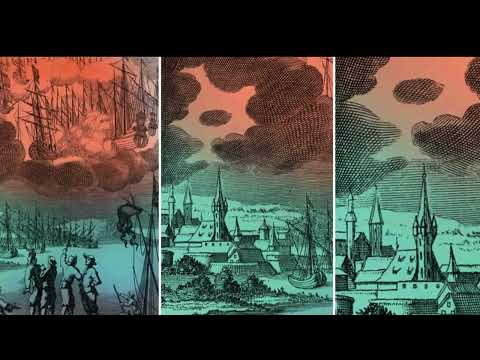
The Kunstbibliothek published its own short exhibition video on the 1665 air battle, but it is hosted on a social-media platform rather than YouTube and cannot be carded under this site's video-thumbnail convention. No broadcast documentary devoted to this case was located.
Sources
- Staatliche Museen zu Berlin, Kunstbibliothek, A UFO in 1665: The Air Battle of Stralsund — official exhibition record, curated by Moritz Wullen, 2023. smb.museum
- Staatliche Museen zu Berlin, UFO 1665 — Ausstellungstexte / Exhibition Texts (bilingual PDF), May 2023 — the object-level catalogue for the 1665 pamphlet, the broadsheet, the newspaper and the Francisci engraving. smb.museum
- Staatliche Museen zu Berlin, Kunstbibliothek — exhibition page (institutional listing). smb.museum
- Jacques Vallée and Chris Aubeck, Wonders in the Sky: Unexplained Aerial Objects from Antiquity to Modern Times (New York: Tarcher/Penguin, 2010), entry for 8 April 1665, Stralsund — including the Francisci and newspaper quotations and the von Ludwiger attribution.
- Erasmus Francisci, Der Wunder-reiche Uberzug unserer Nider-Welt, Oder Erd-umgebende Lufft-Kreys (Nuremberg: Endter, 1680) — the fullest narrative source; digitised copy at the Bayerische Staatsbibliothek. digitale-sammlungen.de
- Ordinari und Postzeitungen, No. 65, 10 April 1665 — contemporaneous newspaper report recording the interrogation of two of the six fishermen by Colonel von der Wegck and Doctor Gessman (quoted in Vallée & Aubeck, Wonders in the Sky, from von Ludwiger).
- Pamphlet printed at Stralsund, 10 April 1665, describing what was seen in the sky on 8 April at two o'clock in the afternoon — earliest surviving account; Universität Greifswald, Alte Universitätsbibliothek. ub.uni-greifswald.de
- Illobrand von Ludwiger, Best UFO Cases — Europe (Las Vegas: National Institute for Discovery Science, 1998) — the source of the domed-disc and radiation-effect readings.
- Eberhard Buchner, Medien, Hexen und Geisterseher (Munich: Albert Langen, 1926), 42–43 — the twentieth-century reprint that kept the period accounts in circulation.
- GWUP (Gesellschaft zur wissenschaftlichen Untersuchung von Parawissenschaften), “‘Ufo 1665 — Die Luftschlacht von Stralsund’ und andere historische Rätsel um Alien-Besuche,” 4 June 2023 — the German skeptics' organisation's review of the exhibition and of the Nuremberg and Basel parallels. blog.gwup.net
- Moritz Wullen, Ufo 1665. Die Luftschlacht von Stralsund (Cologne: Wienand Verlag, 2023), ISBN 978-3-86832-750-2 — the exhibition catalogue, 112 pages, German/English. wienand-verlag.de
- DEEDS.news, “UFO 1665. The Air Battle of Stralsund — Kunstbibliothek,” 2023 — art-historical trade coverage of the exhibition, including the Lana de Terzi and baroque-visual-culture framing. deeds.news
- Enfilade (Historians of Eighteenth-Century Art & Architecture), “Exhibition | UFO 1665,” 6 August 2023 — scholarly-network notice of the exhibition. enfilade18thc.com
- Deutsche Stiftung Denkmalschutz and the Hansestadt Stralsund heritage record — documentation of St Nicholas’s building history in the Swedish period, including the 1662 spire fire and the post-1667 baroque dome. deutsche-stiftung-denkmalschutz.de
- Die Zukunft, “‘Ufo 1665 — Luftschlacht über Stralsund’ — UFOs über Deutschland?” — German cultural-press coverage of the exhibition and the case. diezukunft.de
- St.-Nikolai-Kirche, Stralsund — building history, including the 1662 fire that destroyed the Gothic spires, the 1667 baroque dome on the south tower, and the lightning strike of 19 June 1670. hst-nikolai.de
- Conrad Lycosthenes, Prodigiorum ac ostentorum chronicon (Basel: Heinrich Petri, 1557) — the great compendium of the wonder-sign genre this account belongs to; digitised copy at the Internet Archive. archive.org
- Lorraine Daston and Katharine Park, Wonders and the Order of Nature, 1150–1750 (New York: Zone Books, 1998) — the standard scholarly history of European prodigy culture.
- Adoption of the Gregorian calendar in the Protestant estates of the Holy Roman Empire and in Sweden — the Julian-to-Gregorian transition of 1700 (Sunday 18 February 1700 followed by Monday 1 March 1700), which establishes that all dates in this case’s sources are Old Style. See the Swedish national archives’ and genealogical standard references on Swedish dates and calendars. familysearch.org
- Hansestadt Stralsund — municipal history of the town, its Swedish period from the 1648 Peace of Westphalia to 1815, and the 1628 siege. stralsund.de
- UNESCO World Heritage Centre — Historic Centres of Stralsund and Wismar, inscription documentation for the Hanseatic and Swedish-period fabric of the town. whc.unesco.org
- Deutsche Fotothek / Wikimedia Commons — digitised plates from Erasmus Francisci's illustrated works, and the public-domain title page of Der Wunder-reiche Überzug unserer Nider-Welt (1680). commons.wikimedia.org
- UFO Case Studies, “The Air battle of Stralsund UFO Incident ( Sweden, 1665),” YouTube — the one located video treatment devoted to this specific event. youtube.com
- Visual Space Agency, “UFO 1665” — design and exhibition-communication documentation for the Berlin show. visual-space-agency.com
- Martin Kraft, photograph of the Nikolaikirche, Stralsund, CC BY-SA 3.0 — the source of this page's hero image. commons.wikimedia.org
See something inaccurate? Have additional information or sources?
Suggest an Edit →Last Updated: August 2026