
Cassius Dio's Omens before Pharsalus
On August 9, 48 BCE, Julius Caesar crushed Pompey the Great's much larger army at Pharsalus in Greece, deciding the Roman civil war. Writing roughly 270 years later, the historian Cassius Dio recorded a striking list of omens said to have preceded the battle: thunderbolts striking Pompey's camp, a fire that appeared over Caesar's camp and then fell on Pompey's, bees swarming the standards, sacrificial animals bolting from the altar. This file traces those claims to Dio's actual text, and to two other ancient sources — the poet Lucan and the prodigy-compiler Julius Obsequens — that describe strikingly similar signs. The catch: at least two of these three accounts probably don't corroborate each other independently. They very likely draw on the same lost source.
Theoretical Alignment
This file's central analytical problem is source independence. Three separate surviving ancient texts describe omens clustered around the 48 BCE civil war, and at first glance that looks like strong multiple attestation. But Cassius Dio, writing in the early 3rd century CE, and Julius Obsequens's prodigy list (compiled later still but explicitly excerpted from Livy, who wrote in the same generation as the events), share specific, matching details — a swarm of bees on military standards, and drums or noise heard from a temple at Pergamum — that are unlikely to have arisen twice by coincidence. The most probable explanation is that both authors, directly or indirectly, drew on Livy's now-lost account of these years. Lucan's poetic version, written earlier than Dio but as an epic, not a history, adds an independent literary tradition, but one explicitly not written as a factual record.
Sensor & Instrumentation Detection Profile
As with every case in this site's Ancient Records series, there is no instrumentation record. Every detail rests on three literary texts, none of which names an individual eyewitness for any specific omen. Dio's list (thunderbolts, aerial fire, bees, fleeing sacrificial victims, distant apparitions and sounds) reads as a compiled catalog rather than a first-person account — consistent with the genre conventions this site's Livy's Roman Prodigia Records file already documents at length for the broader Roman prodigy-reporting tradition.
Environmental & Geospatial Context
Pharsalus lies in Thessaly, in central Greece, where the decisive battle was fought on August 9, 48 BCE (by the unreformed Roman calendar; likely closer to early June by the solar calendar). Dio's omens are geographically scattered rather than localized to the battlefield itself: thunderbolts and an aerial fire are placed at the opposing camps, but other signs are reported far away — a nighttime clamor of arms at Antioch in Syria, drums at Pergamum in Asia Minor, and a report of two young messengers appearing and vanishing after announcing the result in Syria, plus birds "acting out" the battle's outcome at Patavium (modern Padua) in northern Italy, hundreds of miles from Greece. This geographic spread across the eastern Mediterranean is itself a marker of the prodigy-catalog genre, which by convention compiled portents from many places into a single retrospective list explaining a major event, rather than reporting a single localized observation.
Observer Credibility & Occupational Profile
Cassius Dio (c. 155 – c. 235 CE) was a Roman senator and consul who wrote an 80-book history of Rome from its founding to his own time, completed in the early 3rd century CE — roughly 270 years after Pharsalus. He was not a contemporary witness and explicitly worked from earlier written sources, including, scholars believe, Livy's account of the period. Julius Obsequens, whose exact dates are uncertain (likely 4th century CE), compiled his Book of Prodigies as an explicit digest of prodigy-lists drawn from Livy's massive, now largely lost Ab Urbe Condita. Lucan (39–65 CE), by contrast, wrote within about a century of the events, but as an epic poet composing the Pharsalia (also called the Civil War), a deliberately literary and rhetorical work, not a historical record — his portents are constructed for dramatic and political effect, not offered as documentary fact.
Historical Precedents & Archive Matches
This case connects directly to this site's Livy's Roman Prodigia Records file, which documents the broader Roman civic institution of formally logging and reviewing sky-prodigies before the Senate. Cassius Dio and Julius Obsequens both sit downstream of that same tradition and, very likely, of Livy's own lost text specifically. This file's "burning shield" and "fire in the air" imagery also echoes this site's Pliny's Burning Shields file, which records a similar bolide-meteor-type sky object dated to precisely the same year, 86 BCE consular year (Marius's death) — a reminder that sky-fires were a recurring, well-attested category of natural event in the ancient Mediterranean, reported across multiple independent contexts.
Historical Background
By 49 BCE, the fragile political alliance between Julius Caesar and Pompey the Great — the so-called First Triumvirate, alongside the now-dead Crassus — had collapsed entirely. When the Senate, backed by Pompey, ordered Caesar to disband his army, Caesar instead crossed the Rubicon River into Italy with his legions, igniting a civil war that would ultimately end the Roman Republic. Pompey and much of the Senate fled east; over the following year, the conflict spread across the Mediterranean. By the summer of 48 BCE, Caesar had pursued Pompey to Greece, where the two armies met at Pharsalus. Despite being significantly outnumbered, Caesar's smaller, more experienced force decisively defeated Pompey's larger but less battle-tested army. Pompey fled to Egypt, where he was assassinated shortly after landing, on the orders of the Ptolemaic court hoping to curry favor with the victorious Caesar.
Writing generations later, Cassius Dio frames the battle's outcome as something the gods had signaled in advance through a wide-ranging set of prodigies — a common device in ancient historiography for imposing a sense of fate and moral order onto a war that Roman writers, across the political spectrum, generally regarded as a catastrophe: Romans killing Romans on an unprecedented scale. Lucan's epic poem makes this framing explicit and central, opening with an extended catalog of cosmic portents interpreted by the Etruscan seer Arruns and the prophetess Phemonoe, presented as unmistakable warnings of civil war's horror. Julius Obsequens's terser, list-format entry for 48 BCE reflects the format of the original Livian source material both he and, indirectly, Dio likely drew from: dry, itemized, year-by-year prodigy records in the tradition already extensively documented in this site's Livy file.
Complete Timeline
| Date | Event |
|---|---|
| Jan. 10, 49 BCE | Julius Caesar crosses the Rubicon River with his army, beginning the Roman civil war against Pompey and the Senate. |
| 49 BCE | Per Cassius Dio 41.14, a fire darts across the sky from west to east, a second fire consumes the temple of Quirinus, the sun suffers a total eclipse, and thunderbolts damage votive offerings on the Capitol. |
| Aug. 9, 48 BCE | Caesar decisively defeats Pompey's larger army at the Battle of Pharsalus in Thessaly, Greece. |
| 48 BCE, per Dio 41.61 | Thunderbolts reportedly strike Pompey's camp; a fire appears over Caesar's camp and falls on Pompey's; bees swarm Pompey's military standards; sacrificial animals flee the altar; distant apparitions and sounds are reported in Syria, Pergamum, and Patavium. |
| Sept. 28, 48 BCE | Pompey is assassinated shortly after landing in Egypt, on the orders of the Ptolemaic court. |
| 27 BCE – 9 CE | Livy composes his massive Ab Urbe Condita, including (in now-lost books) an account of 48 BCE and its prodigies — the probable common ancestor of the Dio and Obsequens accounts. |
| c. 61–65 CE | Lucan composes the Pharsalia (Civil War), opening with an extended poetic catalog of cosmic portents before the war. |
| c. 200–222 CE | Cassius Dio writes Books 41 of his Roman History, recording the omens examined in this file. |
| 4th century CE | Julius Obsequens compiles his Book of Prodigies, digesting Livy's prodigy lists, including the entry for 48 BCE. |
| 1916 CE | Earnest Cary and Herbert Baldwin Foster's standard English translation of Cassius Dio is published in the Loeb Classical Library. |
The Primary Source Documents
Cassius Dio, Roman History 41.61.1–2 (c. 200–222 CE)
"At last, after they had carried on an evenly-balanced struggle for a very long time and many on both sides alike had fallen or been wounded, Pompey, since the larger part of his army was Asiatic and untrained, was defeated, even as had been made clear to him before the action. For thunderbolts had fallen upon his camp, a fire had appeared in the air over Caesar's camp and had then fallen upon his own, bees had swarmed about his military standards, and many of the victims after being led up close to the very altar had run away."
Cassius Dio, Roman History 41.61.1–2, trans. Earnest Cary (based on Herbert Baldwin Foster), Loeb Classical Library, as hosted at LacusCurtius (University of Chicago)
Julius Obsequens, Book of Prodigies, Entry 65a (4th c. CE, from Livy)
"...lightning flashed repeatedly [as Pompey's army moved from Dyrrachium]... A swarm of bees [settled] on the standards... statues in many places turned round of their own accord... a clamour and uproar of arms at Antioch [was heard] by night... the sound of drums was heard [at Pergamum]... in the temple of Victory under the statue of Caesar, between the paving stones, a young palm grew to full maturity."
Julius Obsequens, Liber Prodigiorum, entry for the consulship of C. Caesar and P. Servilius (48 BCE), as translated at Attalus.org
The overlap between "bees had swarmed about his military standards" (Dio) and "a swarm of bees [settled] on the standards" (Obsequens) — along with both texts separately reporting drums or noise from the temple precinct at Pergamum — is the strongest single piece of evidence in this file that these are not independent witnesses to the same event, but two later texts descending from a shared, now-lost written source.
Lucan, Civil War (Pharsalia) 1.526–530 (c. 61–65 CE)
"The angry gods filled earth and air and sea with frequent prodigies; in darkest nights strange constellations sparkled through the gloom: the pole was all afire, and torches flew across the depths of heaven; with horrid hair a blazing comet stretched from east to west."
Lucan, Civil War (Pharsalia), Book 1, lines 526–530, trans. Edward Ridley (1896), as hosted at Wikisource
Lucan's account, though closer in time to the events than Dio's, is a deliberately literary composition, not a historical record, and its imagery (comets, "the pole all afire") does not closely match the specific details in Dio and Obsequens — suggesting it represents a separate, independently developed poetic tradition rather than a third witness to the same original list.
The Witness Record
Cassius Dio (as Later Compiler)
Not a contemporary witness; explicitly working from earlier written sources, most likely including Livy's now-lost account of the period.
Julius Obsequens (as Later Digest of Livy)
States its source relationship openly: a condensed, year-by-year digest of prodigies recorded in Livy's original history, itself written within a generation of the events.
Lucan (as Independent Poetic Tradition)
Closer in time than Dio, but writing deliberate literary epic rather than history; his catalog of portents serves the poem's dramatic and political purposes rather than documentary accuracy.
Confirmed Textual & Archival Holdings
The full text of Book 41, including chapters 14 and 61's accounts of the omens examined in this file.
PUBLIC DOMAIN (freely accessible)The full translated text, including the entry for 48 BCE cited in this file.
PUBLICLY ACCESSIBLEThe full text of Book 1's portent catalog, in Edward Ridley's public-domain translation.
PUBLIC DOMAIN (freely accessible)Search Primary & Institutional Archives Directly
Evidence Assessment
Supporting Some Genuine Underlying Observations
- Thunderbolts striking a military camp during a storm are an entirely ordinary, well-attested meteorological event, not requiring any anomalous explanation
- A brief meteor or bolide ("fire" appearing then falling) is a real, common astronomical phenomenon independently documented in this site's Pliny's Burning Shields file for the same general era
- Roman armies did formally and carefully record prodigies as a matter of religious and civic practice, making it plausible that some genuine, ordinary natural events underlie at least part of this list
Supporting a Retrospective, Compiled Literary Tradition
- No source is contemporary with the battle; the earliest surviving account (Lucan) was written more than a century afterward, and the fullest account (Dio) nearly three centuries afterward
- Dio and Obsequens share specific matching details in a pattern consistent with both drawing on a single common source (Livy) rather than independently corroborating each other
- The prodigies are geographically scattered across the eastern Mediterranean in a pattern typical of retrospective compilation, not a single localized observation
- Ancient historiography routinely retrofit omens onto a war's outcome after the fact, a documented literary convention this site's Livy file discusses at length
Comparative Analysis
Livy's Roman Prodigia Records
This site's Livy's Roman Prodigia Records file documents the formal civic institution behind exactly this kind of prodigy list — phantom ships, sky-shields, and similar reports logged before the Senate and reviewed by the decemviri. Cassius Dio and Julius Obsequens both sit downstream of that same Livian tradition, and this file's central caveat (shared-source dependence rather than independent corroboration) applies with particular force given that Obsequens explicitly excerpts Livy and Dio very likely drew on him as well.
Pliny's Burning Shields
This site's Pliny's Burning Shields file documents a securely dated 86 BCE "burning shield" crossing the sky, generally explained as a bolide meteor. The "fire that appeared in the air over Caesar's camp and then fell upon [Pompey's]" in Dio's account describes a strikingly similar physical event, just 38 years later and embedded in a much less contemporary, much more literary source.
Material Analysis: The Manuscript Evidence
There is no physical trace evidence of any kind associated with the reported phenomena. What exists is the manuscript and editorial history of three separate texts. Cassius Dio's Roman History survives in a fragmentary Greek manuscript tradition supplemented by later Byzantine epitomes; the standard modern English translation is Earnest Cary's Loeb Classical Library edition (1914–1927), based on Herbert Baldwin Foster's earlier work. Julius Obsequens's Book of Prodigies survives as an appendix to manuscripts of Livy, edited in the modern Loeb Livy Volume XIV by Alfred C. Schlesinger. Lucan's Civil War survives through a substantial medieval Latin manuscript tradition; this file's translation follows Edward Ridley's 1896 public-domain English version, cross-checked in content (though not exact wording) against Susan Braund's modern Oxford World's Classics translation. This file confirmed the overlapping "bees on the standards" detail independently in both the Dio and Obsequens texts at their respective online sources before drawing the shared-source conclusion presented above.
The Paleocontact / Ancient-UFO Interpretation
The Pharsalus omens appear occasionally in ancient-astronaut and fringe UFO literature, usually grouped with other "fire in the sky before a battle" reports from classical antiquity. What Dio's account actually describes, however, is a compiled retrospective list explaining a war's outcome after the fact, not a single, sustained, or interactive sky event. The aerial fire is a single sentence fragment among a much longer catalog that also includes thunderbolts, insect behavior, animal behavior, and distant unrelated sounds — a structure far more consistent with the conventions of ancient prodigy cataloging than with a report of a genuine anomalous craft.
The Mainstream Historical Interpretation
The Shared-Source Case
The dominant scholarly reading treats Dio's list of Pharsalus omens as a late compilation drawing on earlier historiographical tradition, most likely including Livy directly, rather than as independent testimony. The specific overlap between Dio and Obsequens on the bee-swarm and Pergamum details is difficult to explain any other way: either both authors independently invented the same unusual specific images, or, far more plausibly, both drew on a shared textual ancestor.
The Retrospective Prodigy Case
Independent of the source-dependence question, ancient historians writing about civil wars had strong literary and religious incentive to present a decisive, terrible outcome as something the gods had foretold. This convention, documented at length in this site's Livy file, does not require that every individual prodigy was invented outright — only that a genuine storm, a real meteor, or an ordinary swarm of bees could be selected, retained, and woven into a list specifically because they were later read as having predicted Pompey's defeat.
Five Observables Assessment
The Five Observables framework, developed decades later by former AATIP director Luis Elizondo to classify modern UAP performance characteristics that exceed known technology, is included here for structural consistency with the rest of OverClassified's case files, but does not meaningfully apply to a text-only ancient source with no measured flight data.
Assessment: As with this site's other pre-modern files, the Five Observables framework is the wrong instrument here. Its inclusion should not be read as suggesting genuine exotic-performance evidence exists for this case.
Conventional Explanation Candidates
Two candidates are assessed below.
1. Retrospective Prodigy Compilation from a Shared Source (Livy)
The leading explanation: Dio and Obsequens's overlapping details indicate both descend, directly or indirectly, from Livy's lost account of 48 BCE, itself likely already shaped by the Roman convention of compiling and interpreting omens after a war's outcome was known. This best explains both the specific detail overlap and the geographically scattered, catalog-like structure of the list.
Plausibility Rating: HIGHLY PLAUSIBLE (best explains the specific overlapping details across sources)
2. Genuine Anomalous / Paleocontact Phenomenon
Included for completeness, per this site's standard framework. No positive evidence, and no serious mainstream scholarship, supports a literal non-natural aerial phenomenon; the individual physical claims (storms, a falling fire) are each ordinary on their own, and the overall list bears every hallmark of retrospective literary compilation rather than direct observation.
Plausibility Rating: SPECULATIVE / UNVERIFIABLE
Why "Disputed"
This case receives a DISPUTED classification because, while the underlying historical event (Caesar's decisive victory at Pharsalus) is entirely uncontroversial, none of the three surviving sources for its associated omens is contemporary with the battle, and the two sources with the most specific overlapping detail (Dio and Obsequens) most plausibly share a single lost common ancestor (Livy) rather than independently corroborating each other. That combination — a real, well-documented historical event, wrapped in a much later, likely non-independent literary tradition about the omens that supposedly foretold it — is exactly the profile DISPUTED is meant to capture on this site, distinct from cases with either stronger independent attestation or a single, better-supported natural explanation.
Related Entries
Further Reading — Recommended Literature
Roman History, Volume IV: Books 41–45
The standard modern scholarly translation of the primary text examined in this file, including the Pharsalus omens.
History of Rome, Volume XIV (incl. Julius Obsequens)
The standard edition of Obsequens's Book of Prodigies, digesting Livy's original prodigy lists including the entry for 48 BCE.
Civil War
A modern scholarly verse translation of Lucan's epic, including Book 1's extended catalog of cosmic portents before Pharsalus.
The Battle of Pharsalus (48 BC)
A modern military-historical study of the campaign and battle that this file's omens are said to have foretold.
Caesar: Life of a Colossus
A comprehensive modern biography of Caesar, situating Pharsalus within the full arc of the civil war and his career.
DISCLOSURE: Some links above are affiliate links. If you purchase through them, OverClassified receives a small commission at no additional cost to you. This helps support independent research.
Essential Viewing
Battle of Pharsalus 48 BC
Kings and Generals — a detailed documentary account of the campaign and battle.
Caesar vs. Pompey: Rome's Greatest Consul
Bellum et Historia — an overview of the rivalry and civil war that culminated at Pharsalus.
Sources
- Cassius Dio. "Roman History," Book 41, chapters 14 and 61 (trans. Earnest Cary). LacusCurtius, University of Chicago. penelope.uchicago.edu
- Julius Obsequens. "Book of Prodigies," entry for 48 BCE. Attalus.org. attalus.org
- Lucan. "The Pharsalia," Book 1 (trans. Edward Ridley, 1896). Wikisource. en.wikisource.org
- "Battle of Pharsalus." Wikipedia. en.wikipedia.org
- "Cassius Dio." Wikipedia. en.wikipedia.org
- "Julius Obsequens." Wikipedia. en.wikipedia.org
- "Lucan." Wikipedia. en.wikipedia.org
- "Julius Caesar." Wikipedia. en.wikipedia.org
- "Pompey." Wikipedia. en.wikipedia.org
- Cassius Dio. Roman History, Volume IV: Books 41–45. Trans. Earnest Cary. Loeb Classical Library 66, Harvard University Press, 1916.
- Livy & Julius Obsequens. History of Rome, Volume XIV. Trans. Alfred C. Schlesinger. Loeb Classical Library 404, Harvard University Press, 1959.
- Lucan. Civil War. Trans. Susan H. Braund. Oxford World's Classics, Oxford University Press.
- Sampson, Gareth C. The Battle of Pharsalus (48 BC). Pen & Sword Military, 2023.
- Goldsworthy, Adrian. Caesar: Life of a Colossus. Yale University Press, 2006.
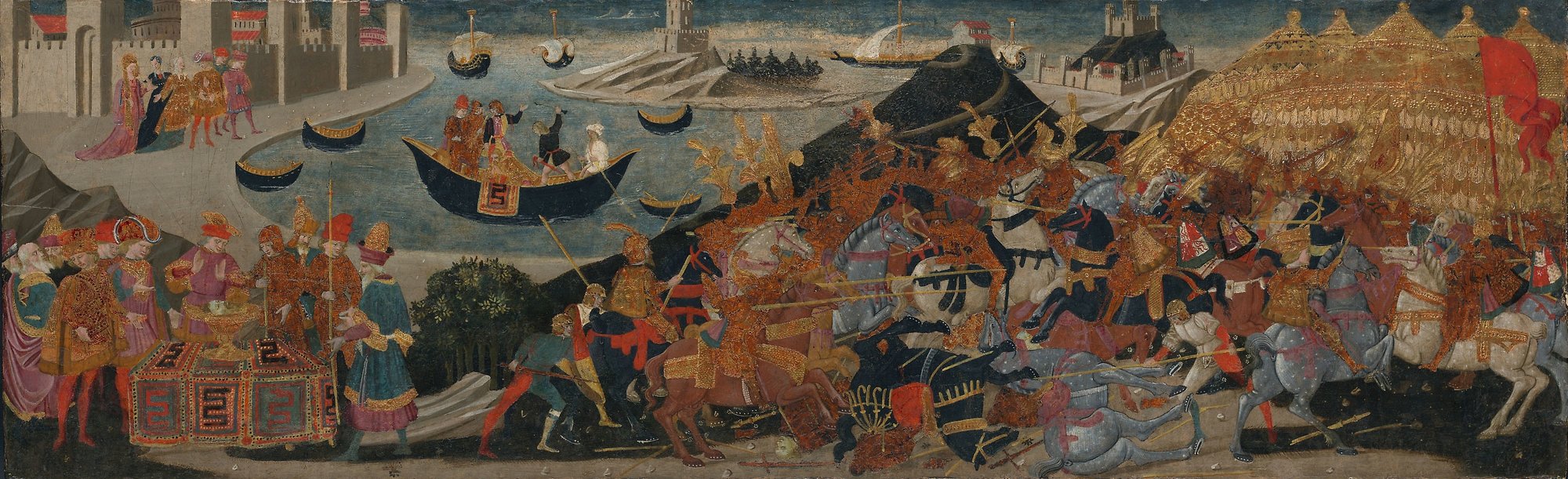
- "File: Apollonio di Giovanni - The Battle of Pharsalus and the Death of Pompey - 1974.394 - Art Institute of Chicago.jpg." Wikimedia Commons (public domain, CC0). commons.wikimedia.org
- "Battle of Pharsalus 48 BC - Caesar's Civil War DOCUMENTARY." Kings and Generals, YouTube. youtube.com
- "Caesar Vs Pompey - Rome's Greatest Consul!" Bellum et Historia, YouTube. youtube.com
See something inaccurate? Have additional information or sources?
Suggest an Edit →Last Updated: August 2026