
Out There
The Government's Secret Quest for Extraterrestrials
Core Thesis
Out There: The Government's Secret Quest for Extraterrestrials is Howard Blum's account of chasing down a source's 1987 tip — received while Blum was finishing an unrelated book about a Navy spy ring — into a genuinely different kind of UFO story than most of this list covers: not a crashed disc, not a leaked document cache, but a classified interagency body Blum calls the Defense Intelligence Agency's "UFO Working Group," a panel of seventeen U.S. intelligence specialists convened at the Pentagon in the winter of 1987 and headed, in Blum's account, by DIA Col. Harold E. Phillips. Blum's own argument is less about whether the group found extraterrestrials than about why a modern national-security bureaucracy keeps this particular subject sealed regardless of what it finds: "keeping secrets is a habit," he writes, "the way officials . . . are taught to behave." He was, by his own description and every contemporary review's, an outsider to ufology — a twice Pulitzer-nominated former New York Times investigative reporter applying beat-reporting method (212 interviews, roughly 200 published sources) to a subject the paper he'd worked for rarely touched. That outsider's method is exactly what makes the book's most disputed choice so consequential: Blum wrote much of it in reconstructed, novelistic scenes and did not disclose his sourcing method for that technique until an author's note after the final chapter — a decision The New York Times' own review at the time called the book's "most distressing demerit."
About the Author
Howard Blum was born in 1948 and attended the Horace Mann School before earning both his undergraduate degree and a 1970 M.A. in government from Stanford University. He worked first as a reporter for The Village Voice before moving to The New York Times, where his investigative reporting earned two Pulitzer Prize nominations. He has been a contributing editor at Vanity Fair since 1994. None of this is ufology pedigree — and that is precisely the credential every review of Out There, sympathetic and critical alike, singled out: a mainstream investigative journalist, with no prior UFO-beat writing and no stake in the subject either direction, running his own source network at it.
Blum's path to this specific book ran through his previous one. I Pledge Allegiance: The True Story of the Walkers, An American Spy Family (Simon & Schuster, 1987) told the story of Navy warrant officer John Walker Jr.'s espionage ring, which sold classified naval codes and technical manuals to the Soviet Union for roughly seventeen years before his ex-wife exposed it. According to Blum's own account, cited across multiple retailer and library descriptions of Out There, it was while reporting that book — deep inside the world of American intelligence sourcing — that an intelligence contact steered him toward the DIA UFO Working Group story instead. Out There, published by Simon & Schuster in September 1990, followed three years later, its dust-jacket copy summarizing the hook directly: "In the winter of 1987, following a series of puzzling events, seventeen members of the U.S. intelligence community were summoned to the Pentagon. Their Top-Secret mission: to determine if there was life . . . Out There."
The UFO subject did not become a recurring beat for Blum the way it did for several other authors on this list. His subsequent books — Gangland: How the FBI Broke the Mob (1993), The Gold of Exodus (1998), The Brigade (2001), and a long run of World War II- and Cold War-era espionage histories including American Lightning (2008, an Edgar Award winner), The Floor of Heaven (2011), Dark Invasion (2014), The Last Goodnight (2016), In the Enemy's House (2018), Night of the Assassins (2020), The Spy Who Knew Too Much (2022), and When the Night Comes Falling (2024) — returned entirely to conventional espionage, crime, and intelligence-history journalism. Out There remains, across a bibliography now numbering more than a dozen books, his only UFO title.
Historical Context & Origins
Blum was reporting and writing Out There in the years immediately after ufology's most consequential internal rupture of the era: the December 1984 surfacing of the MJ-12 documents, their first mass public exposure in Timothy Good's May 1987 Above Top Secret, and the FBI's own November 1988 "completely bogus" finding on the documents' authenticity — a controversy this site covers directly in its own Above Top Secret and Top Secret/Majic entries. Blum's book, arriving in September 1990, is doing something structurally different from either side of that fight: it is not a defense or an attack on a specific leaked document, but a source-driven reporting project into a panel Blum says was real, current, and separate from the MJ-12 dispute entirely.
That method sets Out There apart from the two other government-secrecy books on this list published within roughly a decade of it. Where Stanton Friedman's 1996 Top Secret/Majic built its case from archival document analysis and where Richard Dolan's 2000 UFOs and the National Security State built its case from a declassified-paper-trail chronology, Blum worked the way he'd worked the Walker spy-ring story: cultivating intelligence-community sources and following a specific human tip into a specific classified body. It is closer in method, though a decade and a half earlier, to what this site's Garrett M. Graff entry describes Graff doing in 2023 — a working journalist's contact-and-confirm reporting, rather than a ufology researcher's document or testimony compilation.
The book landed in a commercially active fall for its subject: Kirkus Reviews ran its review on September 10, 1990, ahead of publication, and The New York Times ran Richard Severo's review in its "Books of The Times" column on October 19, 1990. Trade coverage at the time noted first serial rights sold to Penthouse magazine and television-option interest, reflecting the degree to which a mainstream-credentialed reporter's UFO book, arriving three years after the MJ-12 fight had already made national headlines, was treated as a commercially serious property rather than a fringe release.
Core Arguments & Key Concepts
Blum's central claim is narrow and specific rather than sweeping: that in the winter of 1987, following a string of unexplained incidents — contemporary descriptions of the book cite suppressed sighting reports and a radar track attributed to the U.S. Space Command's Space Surveillance Center among the triggers — the Defense Intelligence Agency convened a classified interagency panel of seventeen specialists, drawing on CIA, FBI, and other agency resources, to determine whether the UFO phenomenon warranted renewed official attention. Blum names DIA Col. Harold E. Phillips as the officer who headed the group. Per Kirkus's review, the panel, for all its resources, "uncovered nothing solid" — a conclusion that itself supports Blum's larger argument: that the government's UFO secrecy is sustained less by proof of extraterrestrial contact than by bureaucratic reflex. As Blum put it, describing officials at "the end of history" with a Cold War already winding down, "all that is left for a great nation to protect and believe in is its tattered secrets."
The book's most debated structural choice is its narrative method. Rather than writing conventional attributed reportage throughout, Blum reconstructed many scenes in a fluid, novelistic third-person style and did not explain his method until an author's note following the final chapter, where he wrote that "the book's style and structure were influenced by the narrative pace of popular science fiction" and that he had corroborated the underlying stories wherever possible. Severo's Times review took this as the book's central flaw, arguing the disclosure should have come before the narrative rather than after it, even while crediting Blum's skill as a storyteller and noting there was "no reason to doubt" his corroboration claim.
Structurally, Out There pairs its classified-Pentagon narrative with lighter, more human material, most notably an extended account of Elmwood, Wisconsin, a small town whose residents, convinced UFOs had been "whooshing over their town, following cars, disturbing electrical systems," tried to turn that reputation into tourism — proposing a UFO landing field and, briefly, a giant illuminated depiction of a couple having sex in an alfalfa field to attract attention from the air. Severo's review singled out the Elmwood material as "one of the most engaging parts" of the book, a tonal register several steps removed from its Pentagon reporting.
Blum does not argue for a settled answer on extraterrestrial visitation, and multiple contemporary reviews note the book pointedly includes skeptical voices rather than only believers — among them former Wisconsin Senator William Proxmire, quoted dismissing the whole subject: "The whole idea is nonsense. If there are other creatures out there, where are they? Why haven't they landed on the White House lawn?" Publishers Weekly's contemporary review characterized the book overall as "a curious amalgam of science and apparent science fiction," noting Blum folds legitimate SETI radio-astronomy research together with unverified UFO witness testimony under a single argument about institutional secrecy.
Key Cases & Evidence Discussed
The DIA UFO Working Group's own 1987 Pentagon convening is the book's central and, as far as this site could determine, only extensively reported "case" in the conventional sense — a specific classified body, a specific named officer (Col. Harold E. Phillips), and a specific claimed origin in suppressed sightings and a Space Surveillance Center radar track, all reported through Blum's own source network rather than through a declassified document release or a witness's personal testimony.
The Elmwood, Wisconsin UFO flap and the town's subsequent attempt to build a tourism industry around it functions as the book's secondary set-piece and, per The New York Times' review, its most purely enjoyable stretch — local color that this site could not find covered as its own dedicated case file elsewhere on this site, and which stands here specifically as a Blum-reported episode rather than a claim this article is independently verifying.
Contemporary descriptions of the book — consistent across Publishers Weekly's review and several retailer summaries — frame its secrecy argument as running from 1947 forward, "with one or two hiatuses," which places the book's larger thesis against the backdrop of the same 1947 Roswell Incident and the Air Force's on-again, off-again Project Blue Book investigation that this site covers independently and at length elsewhere. This site was not able to confirm from a primary excerpt how much space, if any, Out There itself devotes to the original 1947 case specifically, and flags that honestly rather than asserting a chapter-by-chapter overlap it could not verify.
Critical Reception & Controversies
The most substantive contemporary review came from Richard Severo in The New York Times' "Books of The Times" column, October 19, 1990 (Section C, Page 32). Severo's verdict was genuinely mixed: he opened by warning readers not to expect the book to "resolve the question of the existence of extraterrestrial beings," praised its "excellent science reporting and lucid explanations," and called the Elmwood material one of its best stretches, but identified the undisclosed reconstruction technique as the book's "most distressing demerit," and flagged an odd, seemingly unfinished tangent in which Blum reports that Jesse Jackson was once investigated by an Air Force intelligence officer searching for damaging material from his ministerial past — a thread Severo noted Blum "uncharacteristically skips away from" without explaining what, if anything, came of it.
Kirkus Reviews (September 10, 1990) called the book "a melodramatic account" told in "relentlessly cliff-hanging fashion," acknowledged much of the underlying ground had already been covered by other UFO writers, and criticized an element of self-promotion in Blum's framing — while still concluding it amounted to "a significant journalistic coup," and quoting one of Blum's own FBI sources telling him, memorably, "Even the government doesn't know what it knows."
Publishers Weekly's contemporary trade review predicted the book "should cause a stir among readers kept far too long in the dark," while characterizing its blend of legitimate science and unverified testimony as "a curious amalgam of science and apparent science fiction" — a description that, read against Severo's reconstruction critique, captures the same tension from a different angle: real reporting delivered in a form built for narrative momentum rather than source-by-source verification.
Reader reception has been modest but steady rather than dramatic: the book holds a 3.67-out-of-5 average on Goodreads across roughly 85 ratings, a considerably smaller sample than several other titles on this list, consistent with a book that made a real commercial splash on release in 1990 but never became a standing reference work the way Dolan's or Friedman's books did within ufology itself.
It is worth stating plainly, in keeping with this site's own editorial standard: this site could not locate any subsequent declassified DIA record, FOIA release, or independent historical account — including in the federal government's own post-2020 UAP records reviews — that corroborates the specific "UFO Working Group" panel or Col. Harold E. Phillips by name as Blum describes them. That does not mean the reporting is false; Blum's sourcing method was built specifically around confidential intelligence contacts of exactly the kind that would not appear in a public paper trail. It does mean the book's central claim rests on Blum's own 1990 reporting and corroboration, not on any document this site was able to independently locate and verify.
Influence & Legacy
Out There made a real, if brief, commercial mark on release: contemporary trade coverage cited first serial rights sold to Penthouse magazine and television-option interest, on top of the mainstream hardcover release from a major publisher — an unusually large platform for a UFO book at the time, driven substantially by Blum's own New York Times and Walker-spy-ring credentials rather than by any existing UFO-community following.
Unlike several other authors on this list, Blum never returned to the subject. He built no ongoing UFO research career, gave no recurring lecture circuit talks on the Working Group, and wrote no sequel or updated edition — a sharp contrast with Richard Dolan's two-volume project or Stanton Friedman's three decades of MJ-12 advocacy. Out There functions today almost entirely as a time-capsule of one specific reporting trip: a mainstream investigative journalist's late-Cold-War-era account of a single classified panel, made and then set aside as its author moved permanently back into conventional espionage and crime history.
Within the specific run of government-secrecy books this site tracks under Essential Reading, Out There's lasting value is less about a claim later validated by declassified material — this site found no such validation — and more about method: it stands as an early example of a non-ufologist investigative reporter treating a specific UFO secrecy claim as a conventional sourcing story, the same basic approach this site's own Garrett M. Graff entry describes being used again, with considerably more institutional cooperation, more than three decades later.
The Book
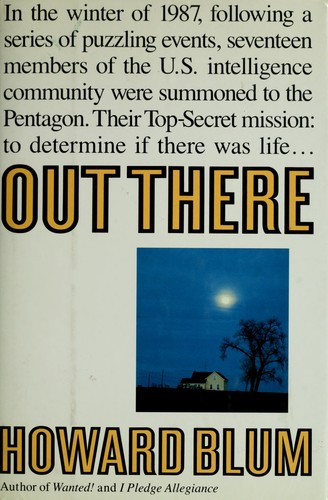
As an Amazon Associate, OverClassified may earn from qualifying purchases made through this link, at no extra cost to you.
Why This Is Essential Reading
Out There earns its place on this list not because its central claim — a DIA-led, seventeen-specialist "UFO Working Group" convened at the Pentagon in the winter of 1987 under Col. Harold E. Phillips — has since been independently confirmed by any declassified record this site could locate, and not because its undisclosed reconstruction technique holds up as a model of sourcing transparency; The New York Times' own 1990 review flagged that second problem plainly. It belongs here instead as a genuinely different kind of source than the rest of this reading list offers: a two-time Pulitzer-nominated New York Times investigative reporter, with no prior stake in ufology in either direction, running his own intelligence-community contact network at the subject the same way he'd just finished running it at a Navy spy ring, and coming back with a specific, named, falsifiable claim rather than a general theory of cover-up. Read it for that reporting instinct and for Elmwood, Wisconsin's small-town charm — and read its central Pentagon claim, honestly, as one journalist's 1990 sourcing that time and subsequent disclosure have neither confirmed nor debunked.
Related Cases & Theories
Sources Cited
- Blum, Howard. Out There: The Government's Secret Quest for Extraterrestrials. Simon & Schuster, 1990 (ISBN 0671662600 / 9780671662608, 300 pp., LC 90038559). amazon.com
- Severo, Richard. "Books of The Times; America's Top-Secret Sky Watch." The New York Times, October 19, 1990, Section C, Page 32 (full contemporary review: reconstruction-technique critique, Elmwood, Wisconsin chapter, Jesse Jackson tangent, Proxmire quote). nytimes.com
- "Out There: The Government's Secret Quest for Extraterrestrials." Kirkus Reviews, September 10, 1990 (contemporary review: DIA UFO Working Group, Col. Harold E. Phillips, "nothing solid" finding). kirkusreviews.com
- "Out There: The Government's Secret Quest for Extraterrestrials." Publishers Weekly (contemporary trade review: SETI/UFO blend, serial and television rights). publishersweekly.com
- "Out there: the government's secret quest for extraterrestrials." Open Library edition record OL1878240M (ISBN 9780671662608, Simon and Schuster, 1990, 300 pp.; cover image source). openlibrary.org
- "Out there : the government's secret quest for extraterrestrials." Internet Archive item outtheregovernme00blum (bibliographic record: publisher, page count, LC number, Easton Press signed-edition note). archive.org
- "Out There: The Government's Secret Quest for Extraterrestrials." Goodreads (reader ratings and review aggregation). goodreads.com
- "Out There." Howard Blum's official author site (author-provided synopsis and contemporary review excerpts). howardblum.weebly.com
- "Howard Blum." Wikipedia (biography: birth year 1948, Stanford B.A./M.A. 1970, Village Voice and New York Times career, two Pulitzer nominations, full bibliography). en.wikipedia.org
- "I Pledge Allegiance: The True Story of the Walkers: An American Spy Family." Amazon.com (Simon & Schuster, 1987 — the prior Blum book during which he received the tip that led to Out There). amazon.com
- "Majestic 12." Wikipedia (for the 1984–1988 MJ-12 controversy that forms this book's contemporary backdrop, distinct from Blum's own reporting). en.wikipedia.org
- This site's own case file: The Roswell Incident, the 1947 case this book's secrecy narrative is framed as running from, per contemporary reviews.
- This site's own case file: Project Blue Book Special Report No. 14, for the official U.S. Air Force UFO investigation whose on-again, off-again history this book's own 1947-forward framing implicitly covers.
- This site's own essential-reading entry: Above Top Secret, for the 1987 MJ-12 controversy running concurrently with Blum's own reporting but never merging with it.
- This site's own essential-reading entry: UFOs and the National Security State, for a document-chronology approach to the same government-secrecy question, contrasted here against Blum's source-driven method.
- This site's own key-figures entry: Howard Blum, for his full biography and further case connections beyond this book.
Have corrections, additional research, or peer-reviewed sources? Help improve this entry.
Suggest an Edit