
Odyssey of the Gods
The History of Extraterrestrial Contact in Ancient Greece — Von Däniken Applies the Chariots Method to the Classical World
Core Thesis
Odyssey of the Gods applies the method of Chariots of the Gods to classical Greece, and it is a useful book precisely because the method is so clearly visible at work on material most readers know. Erich von Däniken's claims are specific: that the Greek gods were extraterrestrial visitors, that the oracular site at Delphi was an aircraft refuelling station, that Jason's pursuit of the golden fleece was a search for an essential aircraft component, that Troy and Atlantis were the same city, and that the Olympians interbred with humans and engineered the centaurs and the Cyclops. Published by New Page Books in 2011 as part of the Erich von Däniken Library, it is his classical volume and it is the clearest demonstration available of what his approach does to a body of texts scholars have studied for two and a half thousand years.
About the Author
Erich von Däniken is the Swiss writer whose Chariots of the Gods? (1968) created the ancient-astronaut genre and sold in tens of millions of copies. This library covers that book separately, and everything in the present volume proceeds from it.
His method has been stable for nearly sixty years and it is worth stating precisely, because the criticism follows from the method rather than from any individual claim. He identifies a feature of an ancient text, artefact or site that seems difficult to explain; he proposes that it records a technology; and he treats the proposal's ability to account for the feature as support for it.
The problem is that the first step is where the work has to be done, and von Däniken does not do it. Establishing that something is genuinely anomalous requires knowing what the ordinary range of ancient practice was, and that is exactly the specialist knowledge his method dispenses with. A great many of the puzzles his books solve are not puzzles to anyone who studies the period.
This particular volume takes on a harder target than his earlier ones. Egyptian and South American material can be presented to a general reader as remote and undocumented; classical Greece cannot. The texts are extant, the scholarship is enormous, the archaeology is continuous, and the reader is likely to have met some of it.
That difficulty is the reason to read this book rather than another of his. When the method is applied to material with a dense professional literature, the gap between what the sources say and what the argument requires them to say is visible to a non-specialist in a way it is not in the Egyptian volumes.
It should also be recorded that von Däniken has been repeatedly caught in fabrication. The most consequential instance concerns material in The Gold of the Gods, and it is documented in the standard critical literature. That history bears on how any specific factual assertion in his books should be treated.
Historical Context & Origins
The ancient-astronaut hypothesis in its modern form dates from Chariots of the Gods? in 1968, and this site treats the general proposition in its own theory file. The idea's commercial life has been enormous and its scholarly reception uniformly negative.
The critical literature is well established and much of it is in this library. Ronald Story's The Space Gods Revealed (1976) went through von Däniken's claims individually; Kenneth Feder's Frauds, Myths, and Mysteries is the standard archaeological textbook treatment of pseudoarchaeology and covers the genre as a category.
Greek myth is the worst possible test case for this method, and that is what makes the book interesting. The Homeric poems, the tragedians, Hesiod, Apollodorus and the mythographers are extant texts with a documented transmission history, a known compositional context and a vast interpretive literature. Nothing about them is lost or mysterious in the way von Däniken's method requires.
Delphi in particular is one of the most thoroughly excavated sites in the Mediterranean. Its history, its cult practice, its architecture, its inscriptions and its finances are documented in detail, and the geological explanation for the oracular phenomena — ethylene and other gases emitted along the fault beneath the temple — has been investigated by geologists and published in the scientific literature.
Atlantis has an even shorter route to resolution. It appears in two dialogues of Plato, the Timaeus and the Critias, as an explicitly framed narrative device in a philosophical argument about ideal states. It has no independent attestation in any earlier source, and the scholarly consensus that Plato invented it is not seriously contested.
The interbreeding material has a straightforward literary explanation that the book does not engage. Greek myth is full of divine-human offspring because Greek aristocratic families claimed descent from gods as a matter of political legitimation, and the genealogies were constructed for that purpose. This is basic classical scholarship.
The book appeared in 2011 into a market that television had substantially rebuilt. Ancient Aliens had begun in 2009 and had reintroduced von Däniken's material to a large new audience, and the Erich von Däniken Library reissues from New Page Books were part of that revival.
Core Arguments & Key Concepts
The Greek gods were extraterrestrial visitors and the myths record it. The book's controlling claim. Its structure is the same as every ancient-astronaut argument: features of the myths are read as garbled descriptions of technology, and the reading's ability to produce a coherent story is offered as support for it.
Delphi was an aircraft refuelling station. The most specific claim and the most easily assessed. Delphi has been excavated for well over a century, its cult practice and physical remains are documented in detail, and the vapours associated with the oracle have a published geological explanation. There is nothing there requiring an aeronautical account.
The golden fleece was an aircraft component. Representative of the method's characteristic move: taking a mythological object whose significance is symbolic and religious and substituting a technological function for it, on the grounds that the technological reading is more concrete.
Troy and Atlantis were the same city. The book's most testable historical claim and the one most decisively answered. Troy is an excavated archaeological site with a stratigraphy running through nine major phases; Atlantis appears only in two Platonic dialogues, as an acknowledged philosophical fiction, with no earlier attestation anywhere.
The gods interbred with humans and engineered hybrid creatures. Read as a record of genetic experimentation. The literary and political explanation for divine-human genealogies in Greek myth is well established and the book does not address it.
The absence of an alternative explanation is treated as support. The method's underlying logical error, visible throughout. That a modern reader finds a mythological detail puzzling establishes something about the reader's familiarity with ancient literature, not about the detail's origin, and the specialist literature very often contains the ordinary explanation.
The book's real value is as a demonstration. Applied to Greece, where the sources are extant and the scholarship is dense, the method's operation is legible in a way it is not when applied to material a general reader cannot check. That makes this the most instructive of von Däniken's books to read critically.
Key Cases & Evidence Discussed
Delphi and the oracle. The Panhellenic sanctuary read as an aircraft facility, against an excavated site with documented cult practice, architecture, inscriptions and a published geological account of the oracular vapours.
Jason and the Argonauts. The voyage for the golden fleece read as a search for an aircraft component — a myth with a documented literary history from Pindar through Apollonius of Rhodes and a well-studied place in Greek colonial ideology.
Troy and Atlantis. The claim that the two are one city, against Troy's excavated stratigraphy and Atlantis's confinement to Plato's Timaeus and Critias.
The divine-human offspring. Heracles, Perseus and the rest of the demigod genealogies read as records of genetic intervention, against the political function of divine descent claims in Greek aristocratic self-presentation.
Centaurs and the Cyclops. Composite and monstrous beings read as engineered hybrids, against their well-documented place in Greek cosmological and ethnographic thinking about the boundaries of the human.
Plato and Aristotle as sources. The book's appeal to the philosophical texts, and the difficulty that both are extant, extensively studied, and say nothing that supports the reading.
The general ancient-astronaut framework. The hypothesis itself, examined in this site's theory file and in Chariots of the Gods, where it was first advanced.
The Nazca lines. Not a Greek subject but von Däniken's most famous single claim, treated on this site's own file on Nazca — the reference point against which his method is usually assessed.
Critical Reception & Controversies
The book received no scholarly attention, which is the standard treatment of von Däniken's output and has been since the 1970s. Classical archaeology and classical philology do not engage with it, and the reasons are not snobbery: the claims do not connect to the evidence base at any point where a specialist could take hold of them.
The general critical position on von Däniken was established fifty years ago and this volume does not alter it. Ronald Story's The Space Gods Revealed worked through the claims of the early books individually and found them to rest on misdescribed evidence, and the pattern has been consistent since.
The fabrication history is the most serious charge and it is documented rather than alleged. Von Däniken has been caught misrepresenting evidence, most notoriously in connection with The Gold of the Gods, and a writer with that record is not entitled to the benefit of the doubt on unverified factual assertions.
The specifically classical criticism is that the book's puzzles are not puzzles. Delphi's oracular practice, the transmission of the Argonaut myth, the political function of divine genealogies and the philosophical framing of Atlantis are all matters on which the scholarship is settled and accessible, and the book proceeds as if none of it existed.
Popular reception has been what it always is for this author: strong sales, an established readership, and a substantial television-driven audience since Ancient Aliens began in 2009. The genre's commercial health has never depended on its scholarly standing.
There is one thing worth saying in the book's favour, and it is about the reader rather than the author. Von Däniken asks why ancient people described what they described, and that is a real question with real answers — answers that classical scholarship has developed at length. A reader who follows the question into the actual literature will learn a great deal, which is more than most books of this kind offer even accidentally.
The fair placement is as a specimen. This is the ancient-astronaut method applied to the best-documented mythological corpus in the Western tradition, where its operation is visible and its failures are checkable by anyone with a library card.
One more comparison is worth drawing, because this library now contains the material for it. Jim Schnabel demonstrated that the way to test an unfalsifiable claim is to produce the thing its holders say cannot be produced. Nothing equivalent is available here — there is no experiment that could show a mythological reading to be wrong — which is why the ancient-astronaut genre has been immune to fifty-eight years of scholarly rebuttal in a way the crop circles were not. A claim about the distant past that rests on reinterpretation rather than on evidence has no failure condition, and that, rather than any individual error, is the genre’s defining problem.
Influence & Legacy
The book's own influence is small; the influence of the framework it belongs to is very large. The ancient-astronaut hypothesis has shaped popular understanding of archaeology for nearly sixty years, and it does measurable harm to public engagement with the actual past — a harm the professional literature on pseudoarchaeology documents in detail.
Its specific contribution is to have extended the method into classical territory, which had been comparatively untouched. Egyptian, Mesoamerican and Andean material had borne the weight of the genre; Greece brought it into a domain where the primary sources are extant and widely read.
That extension has had an unintended benefit for critics. Applied to Greece, the method's structure is unusually easy to demonstrate, and the book is now sometimes used exactly that way — as the clean example of how an ancient-astronaut argument is built and where it fails.
The cautionary legacy is about the manufacture of mystery. The method depends on presenting as inexplicable things that are in fact explained, and it works because most readers do not know the specialist literature and have no reason to. Learning to ask what the relevant discipline actually says before accepting that something is a puzzle is the single most useful habit a reader of this genre can develop, and this book supplies unusually clear practice at it.
For this site specifically the book is a useful boundary marker. The ancient record section here treats reports such as Agobard’s ships from Magonia and Alexander’s flying shields as documents to be read in their own historical context — what the source actually says, when it was written, what genre it belongs to, and what its author was doing — which is the opposite of the method on display here. Comparing the two approaches on similar material is the fastest way to see what the difference amounts to in practice.
The Book
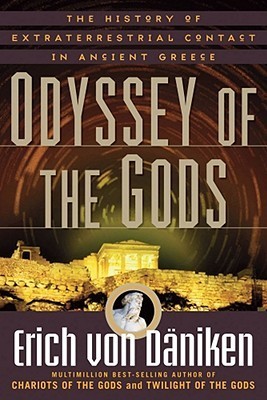
Odyssey of the Gods
The History of Extraterrestrial Contact in Ancient Greece — Von Däniken Applies the Chariots Method to the Classical World
Find on Amazon →As an Amazon Associate, OverClassified may earn from qualifying purchases made through this link, at no extra cost to you.
Why This Is Essential Reading
Read it as a demonstration, not as history. Odyssey of the Gods takes the method Erich von Däniken has used for nearly sixty years and applies it to classical Greece, which is the hardest possible ground for it: the texts are extant, the archaeology is continuous, and the scholarship is enormous and accessible. Delphi is one of the most excavated sites in the Mediterranean with a published geological account of its oracular vapours; Troy has a nine-phase stratigraphy; Atlantis appears in two Platonic dialogues as an acknowledged philosophical fiction and nowhere else; and the divine-human genealogies have a well-documented political function in Greek aristocratic self-presentation. None of that is engaged. What the book offers a critical reader is the clearest available view of how an ancient-astronaut argument is constructed — declare a feature inexplicable, propose a technology, treat coherence as support — on material where every step can be checked. Read it beside The Space Gods Revealed and this site's theory file, and note that its author's record on factual assertions is documented and poor.
Related Cases & Theories
Sources Cited
- von Däniken, Erich. Odyssey of the Gods: The History of Extraterrestrial Contact in Ancient Greece. New Page Books, October 2011, in the Erich von Däniken Library. 224 pp. ISBN-10 1601631928 / ISBN-13 9781601631923. amazon.com
- Open Library edition record, ISBN 1601631928 — bibliographic verification. openlibrary.org
- Goodreads edition record, Odyssey of the Gods — edition data, reader reception, cover-art source, and the publisher description covering the Delphi refuelling-station claim, the golden fleece as an aircraft component, the Troy and Atlantis identification, and the interbreeding and hybrid-creature material. goodreads.com
- Google Books record, Odyssey of the Gods — bibliographic data for the New Page Books edition. books.google.com
- AbeBooks catalogue record, ISBN 9781601631923 — edition and format verification. abebooks.com
- Wikipedia, "Erich von Däniken" — his career, the sales of Chariots of the Gods?, the scholarly reception of his work and the documented instances of misrepresented evidence. en.wikipedia.org
- Wikipedia, "Ancient astronauts" — the hypothesis, its history and the scholarly assessment of it. en.wikipedia.org
- Wikipedia, "Chariots of the Gods?" — the 1968 book that created the genre and established the method this volume applies to Greece. en.wikipedia.org
- Wikipedia, "Delphi" — the sanctuary's excavation history, its cult practice and architecture, and the geological investigation of the vapours associated with the oracle. en.wikipedia.org
- Wikipedia, "Atlantis" — its appearance in Plato's Timaeus and Critias, the absence of earlier attestation, and the scholarly consensus that it is a philosophical fiction. en.wikipedia.org
- Wikipedia, "Pseudoarchaeology" — the category to which the ancient-astronaut genre belongs and the professional literature on its methods and effects. en.wikipedia.org
- Wikipedia, "Kenneth Feder" — the archaeologist whose Frauds, Myths, and Mysteries is the standard textbook treatment of the genre. en.wikipedia.org
- Wikipedia, "Troy" — the excavated site, its stratigraphy and its documented archaeological history, against which the Atlantis identification has to be assessed. en.wikipedia.org
Have corrections, additional research, or peer-reviewed sources? Help improve this entry.
Suggest an Edit