
Round in Circles
Poltergeists, Pranksters, and the Secret History of the Cropwatchers — The Book by a Journalist Who Ended Up Making Circles Himself
Core Thesis
Round in Circles is the definitive account of the English crop circle craze of 1978–1992, and its method is what makes it exceptional. Jim Schnabel embedded himself in the research community — working closely with Terence Meaden, Pat Delgado and Colin Andrews, the principal figures on both sides of the field's internal schism — documented the competing factions and the industry that grew up around the phenomenon, and then, by the book's end, became a circle-maker himself. The result is a book that establishes the circles are hoaxes, tracks down the hoaxers, and treats the people it demolishes with a deadpan generosity that almost no sceptical writing in this area manages. Doug Bower and Dave Chorley's confession arrives late — on page 260 — because the confession was never the point.
About the Author
Jim Schnabel is a science journalist who has written on parapsychology, government-funded psychic research and anomalistics. His other well-known book, Remote Viewers, examines the American military and intelligence remote-viewing programme, and the two volumes share a method: prolonged access to a closed research community, reported from inside, with the author's own position disclosed rather than concealed.
The access here was real and sustained. Schnabel worked closely with Terence Meaden, the meteorologist whose plasma-vortex theory was the field's leading naturalistic explanation, and with Pat Delgado and Colin Andrews, whose books had made the circles internationally famous and who favoured an intelligent-agency reading. Those two camps — the book calls their followers the Meadenites and the Delgadonians — were the whole of serious cerealogy.
What distinguishes the book from every other treatment is what Schnabel did next. Having documented the community, he took part in making circles, working with the hoaxer Rob Irving among others. The book begins with his arrival as an observer and ends with his participation in the fraud, and he says so.
That is not a stunt; it is the only decisive experimental move available. The cerealogists' central claim was that certain formations could not have been made by human beings — too complex, too precise, produced too quickly, showing effects hoaxers could not replicate. The way to test that claim is to make one and see whether it is authenticated, and Schnabel did.
The tone is the book's other unusual asset. Schnabel is not writing an attack: reviewers have specifically noted that this is neither a credulous mystic-centred account nor a more-rational-than-thou assault on the believers, but a candid and deadpan portrait of the earnest eccentrics who led the field. He liked most of these people and it shows.
Historical Context & Origins
The English crop circle phenomenon runs from 1978 to 1992 and it has an unusually precise origin. Beginning in 1978, Doug Bower and Dave Chorley used a plank, a rope and a wire-loop cap sight to flatten circular patterns into cereal fields in Wiltshire, in the country around Warminster, and continued for thirteen years.
Their acknowledged inspiration is documented and connects the phenomenon directly to the UFO literature. When the pair confessed publicly in 1991 they credited newspaper coverage of the 1966 saucer nests at Tully, Queensland, reported by the farmer George Pedley, which Bower had read before emigrating from Australia. The modern crop circle is a deliberate imitation of a claimed UFO landing trace.
What grew from that is the subject of the book. By the late 1980s the circles had produced an international research community, several bestselling books, a heavy tourist trade in the Wiltshire fields, television documentaries, a research industry with instrumentation and funding, and two mutually hostile theoretical camps.
The Meaden camp had the more respectable position. Terence Meaden, a meteorologist, argued for a plasma vortex — a naturally occurring atmospheric phenomenon capable of flattening crop in circular patterns — and the hypothesis had the merit of proposing a physical mechanism that could in principle be tested.
The Delgado and Andrews camp argued for intelligent agency, and their books — Circular Evidence above all — sold in very large numbers and gave the phenomenon its international profile. The circles' increasing complexity through the late 1980s was their central evidence, and it was, as it turned out, a direct response to their own publications.
That feedback loop is the phenomenon's most important structural feature. Bower and Chorley, and later other circle-makers, read the cerealogical literature and made formations that answered it: more complex when complexity was said to be impossible, in configurations the theories predicted, with features the researchers had declared unhoaxable. The researchers were, without knowing it, commissioning the evidence they then authenticated.
The public confession in 1991 did not end the phenomenon and this is the fact most worth carrying away. Bower and Chorley demonstrated their technique to the press, a substantial part of the research community rejected the confession or confined it to a subset of formations, and cerealogy continued. Schnabel was writing in the immediate aftermath of that refusal.
Core Arguments & Key Concepts
The circles are hoaxes, and the book establishes it rather than asserting it. Schnabel's conclusion is unambiguous and it rests on documented hoaxer testimony, on tracked-down circle-makers, and on his own participation. That combination is stronger than any argument from anomaly-absence, and it is why this book settled the question for anyone prepared to read it.
The decisive test is to make a circle and see whether it is authenticated. The book's methodological core and its most important contribution to anomalistics generally. When a research community claims something cannot be faked, producing a fake and submitting it to their own authentication process is the only test that can fail, and it is almost never performed.
The researchers were generating the phenomenon they studied. The feedback argument, and the most analytically interesting thing in the book. Circle-makers read the literature and produced formations answering its claims; researchers authenticated those formations as evidence against hoaxing; the literature grew; the formations grew. The loop is documented and it is a general mechanism, not a peculiarity of cerealogy.
The two camps' hostility did more to sustain the phenomenon than either could alone. Meadenites and Delgadonians spent their energy on each other rather than on the hoax hypothesis, and each side's criticism of the other supplied apparent rigour. A field with two competing serious explanations looks healthier than a field with one, and it is more resistant to the third possibility neither is entertaining.
The people involved were sincere, competent in other domains, and wrong. The book's tonal argument and the reason it persuades where hostile debunking does not. Meaden was a real meteorologist; Delgado and Andrews were diligent and unpaid for most of the period; the community's eccentrics were earnest. Explaining how such people came to authenticate plank-and-rope work is a more interesting problem than mocking them, and Schnabel treats it as one.
Confession does not close a case. The finding the book demonstrates almost incidentally and that has proved the most durable. Bower and Chorley confessed publicly, demonstrated their method, and were substantially rejected by the community whose subject they had created. A field that can absorb its own creators' confession can absorb anything.
The book's own participation is its main vulnerability and it discloses it. An author who became a hoaxer while reporting on hoaxing has a conflict, and the circles he helped make entered the record. Schnabel does not conceal this, but a reader is entitled to weigh whether a participant can be a neutral chronicler of the same events, and the book does not fully address the question.
Key Cases & Evidence Discussed
The origin, 1978. Doug Bower and Dave Chorley's first circles in Wiltshire cereal fields, made with a plank, a rope and a wire-loop cap sight, and the thirteen years of work that followed.
The Tully inspiration. Bower's acknowledged debt to newspaper coverage of the 1966 saucer nests at Tully, Queensland, reported by the farmer George Pedley — the documented link between the modern crop circle and the UFO landing-trace literature.
Terence Meaden and the plasma vortex. The meteorologist's naturalistic hypothesis, its scientific respectability, and the increasingly elaborate formations that eventually broke it.
Pat Delgado, Colin Andrews and Circular Evidence. The books that made the circles internationally famous, the intelligent-agency reading they advanced, and the audience they created for the phenomenon.
The Meadenite–Delgadonian schism. The community's division into two hostile camps, and the way that division absorbed the energy that might have gone into testing the hoax hypothesis.
The escalation of complexity. The formations' development from simple circles through ringed patterns to elaborate pictograms, tracked against the publications that declared each preceding level unhoaxable.
The 1991 Bower and Chorley confession. The public demonstration of the technique, the press coverage, and — the crucial part — the research community's substantial refusal to accept it. It appears on page 260 of a book that is not about it.
Schnabel's own circle-making. The author's participation with Rob Irving and others, the formations they produced, and their reception by the researchers he had been working alongside — the book's decisive experimental content.
Critical Reception & Controversies
The book was published by a trade house in London in 1993 and by Prometheus in the United States the following year, and was well received as journalism. Reviewers consistently identified its distinguishing quality: it is neither credulous nor contemptuous, and its portrait of the cerealogists is candid, deadpan and non-judgemental in a way sceptical writing about this subject almost never is.
That tonal judgement is not a minor observation about style. The standard sceptical book on a paranormal subject fails to persuade its target audience because it signals contempt in the first chapter; Schnabel's does not, and it has consequently been read by people who would not read a debunking.
It is now the standard reference for the English crop circle episode, cited in the sceptical literature and in general treatments of the phenomenon. The Skeptic's Dictionary and the standard reference accounts draw on it, and no competing history of the period has displaced it.
The substantive criticism concerns Schnabel's own participation. An author who makes circles while writing about circle-making has entered his own subject, and the formations he helped produce became part of the record other researchers were studying. He is open about it, which is the minimum requirement, but the conflict is real and the book does not fully reckon with it.
A second and fairer criticism is that the participation was also the point. There was no other way to test the unhoaxability claim, the researchers themselves were not going to run the experiment, and a journalist who declines to test the central claim of the community he is embedded in has not done the work. The conflict and the contribution are the same act.
The circle-research community's response was predictable and instructive. The book was rejected or ignored by the researchers whose work it dismantled, in the same way the Bower and Chorley confession had been two years earlier — which is itself confirmation of the book's central argument about how the field handled disconfirmation.
Its standing has only improved with time. Thirty years on, the crop circle phenomenon is an established case study in the manufacture and defence of an anomaly, it is taught as one, and this is the book that established the record. Very little sceptical writing in this field has aged so well.
Influence & Legacy
The book settled the English crop circle question in the literature, and the case has become the standard example of a manufactured anomaly with a documented origin, a documented feedback mechanism and a documented confession. Anyone arguing about how such phenomena arise and persist reaches for it.
Its methodological legacy is larger than its subject. The insight that the only decisive test of an unhoaxability claim is to produce a hoax and submit it to the claimants' own authentication process is general, it is almost never applied, and this remains the clearest demonstration of what it yields.
The feedback finding has travelled furthest. Researchers publishing criteria for genuineness, and claimants then producing material meeting those criteria, is a mechanism visible across the anomalistics literature — in abduction narratives shaped by published accounts, in photographic cases responding to analytical standards, in testimony conforming to what investigators are known to look for. Schnabel documented it in the cleanest available instance.
The cautionary legacy is about confession, and it is bleak. Bower and Chorley identified themselves, demonstrated their technique publicly and were largely disbelieved by the people whose life's work they had created. Anyone who imagines that a definitive admission resolves a case should read page 260 and then read what happened next.
One further consequence is worth stating for a UFO library specifically. The crop circle phenomenon began as an imitation of a claimed UFO landing trace, ran for thirteen years, generated an international research community with its own instrumentation and theories, and was then resolved completely — origin, method, makers, motive, all documented. That is the only major anomaly of the modern era to have been closed end to end, and it is therefore the only available control against which the field’s handling of its unresolved cases can be measured. The measurement is not flattering.
The Book
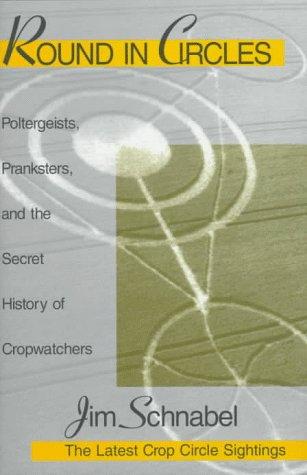
Round in Circles
Poltergeists, Pranksters, and the Secret History of the Cropwatchers — The Book by a Journalist Who Ended Up Making Circles Himself
Find on Amazon →As an Amazon Associate, OverClassified may earn from qualifying purchases made through this link, at no extra cost to you.
Why This Is Essential Reading
Read it, and read it even if crop circles do not interest you. Round in Circles is the best book anyone has written about how an anomaly gets manufactured, authenticated, defended and refused, and it works because Jim Schnabel did the two things this field almost never does: he spent years inside the research community treating its members as intelligent people rather than as marks, and he ran the only experiment that could settle the question by making circles himself and watching them get authenticated. Its central mechanism — researchers publishing what cannot be faked, hoaxers reading that and faking it, researchers authenticating the result as proof — is a general feature of this whole subject and nowhere else so cleanly documented. Its conflict of interest is real and disclosed. And its most useful single fact is what happened after Doug Bower and Dave Chorley confessed on page 260: very little. Read it against this site's Tully saucer nests file, which is where the whole thing started.
Related Cases & Theories
Sources Cited
- Schnabel, Jim. Round in Circles: Poltergeists, Pranksters, and the Secret History of the Cropwatchers. Prometheus Books, 1994 (US); originally published in London, 1993, as Round in Circles: Physicists, Poltergeists, Pranksters and the Secret History of the Cropwatchers. ISBN-10 0879759348 / ISBN-13 9780879759346. amazon.com
- Internet Archive holding, Round in circles: poltergeists, pranksters, and the secret history of the cropwatchers — the full scanned text. archive.org
- Open Library edition record, ISBN 0879759348 — bibliographic verification and cover-art source. openlibrary.org
- Google Books record, Round in Circles — the Penguin London 1994 imprint and the description of the book as covering the English crop circle craze of 1978–1992. books.google.com
- Goodreads edition record, Round in Circles — edition data and reader reception. goodreads.com
- ThriftBooks catalogue record — independent bibliographic listing, and the assessment that the book looks at the history of crop circles, the individuals investigating them and the industry that grew around the phenomenon, that Schnabel makes clear the circles are hoaxes, that the Bower and Chorley revelations appear on page 260, and that the treatment of the field's earnest eccentrics is candid and deadpan rather than judgemental. thriftbooks.com
- The Skeptic's Dictionary, "crop circle" — the standard sceptical reference account of the phenomenon, its origins and its resolution. skepdic.com
- Wikipedia, "Crop circle" — Bower and Chorley's 1978 start, their method, the 1991 confession, the international spread of the phenomenon and the research community that grew around it. en.wikipedia.org
- Wikipedia, "Cerealogy" — the study of crop circles as a field, its practitioners and its internal divisions. en.wikipedia.org
- Wikipedia, "Terence Meaden" — the meteorologist whose plasma-vortex hypothesis was the field's leading naturalistic explanation and with whom Schnabel worked. en.wikipedia.org
- Wikipedia, "Colin Andrews" — the researcher who, with Pat Delgado, made the circles internationally famous and argued for intelligent agency. en.wikipedia.org
- Wikipedia, "Remote viewing" — the subject of Schnabel's other major book on a government-funded anomalistics programme, and the comparison that establishes his method. en.wikipedia.org
- Wikipedia, "Stargate Project" — the American military and intelligence remote-viewing effort Schnabel reported on in Remote Viewers. en.wikipedia.org
Have corrections, additional research, or peer-reviewed sources? Help improve this entry.
Suggest an Edit