
Frauds, Myths, and Mysteries
Science and Pseudoscience in Archaeology
Core Thesis
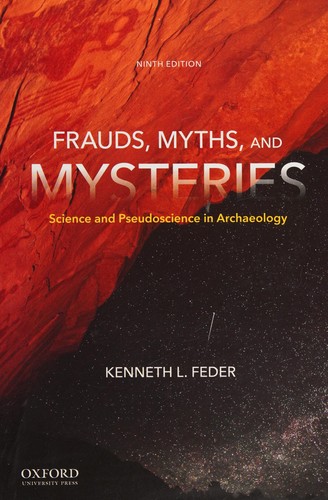
Frauds, Myths, and Mysteries: Science and Pseudoscience in Archaeology is Kenneth L. Feder's long-running textbook, first published in 1990 and continuously revised into a tenth edition by 2019, applying the actual tools and probabilistic reasoning of scientific archaeology to popular claims about ancient astronauts, lost civilizations, and archaeological hoaxes. Rather than simply asserting outright that such popular claims are false, Feder's own method -- as reviewer Gordon Stein noted in The Skeptical Inquirer -- uses "the tools of modern scientific archaeology to show why probability is greatly against the authenticity of the particular claim," engaging directly with the evidence rather than dismissing it outright. This site's own research draws on it for three pages: the Baalbek Trilithon and Nazca Lines as "Landing Strips" case studies, and the Ancient Astronaut Hypothesis theory page, which cites Feder directly for his argument that the ancient-astronaut framework "collapses into a small number of sub-claims, each of which is either 'transparently ludicrous or thoroughly falsified' once checked against the archaeological and documentary record."
About the Author
Kenneth L. Feder is Professor Emeritus of Anthropology at Central Connecticut State University, born in Brooklyn, New York, who earned his BA in anthropology from the State University of New York at Stony Brook in 1973, his MA from the University of Connecticut in 1975, and his PhD in anthropology, also from the University of Connecticut, in 1982. He is a Fellow of the Committee for Skeptical Inquiry and the founder and longtime director of the Farmington River Archaeological Project, which studies the prehistory of northwest Connecticut.
Feder's own account of the book's origin is genuinely personal: as a teenager, a book called The Morning of the Magicians -- which he has described as "essentially Erich von Däniken before Erich von Däniken" -- introduced him to ancient-astronaut claims, and, in his own words, "I knew it was crap and it got me really pissed off," a reaction that grew into a career-long interest in researching the claims themselves. After becoming a professor, Feder asked his own students what they wanted to learn, and found they shared his own teenage fascination with exactly this material -- but he could not find an existing book that seriously addressed these pseudoscience topics, which directly led him to write Frauds, Myths, and Mysteries as his first book.
Beyond this title, Feder has written Human Antiquity (1989, with co-author Michael Alan Park), A Village of Outcasts (1993), an archaeological study of a mixed Native American, formerly enslaved African American, and European settler community in Barkhamsted, Connecticut, Encyclopedia of Dubious Archaeology: From Atlantis to the Walam Olum (2010), and Ancient America: Fifty Archaeological Sites to See for Yourself (2017), the last based on his own personal odyssey visiting all fifty sites in person.
Feder has also carried his skepticism directly into broadcast media: he appeared in the ancient-astronauts episode of National Geographic Channel's Is It Real? and in BBC's Horizon documentary series discussing Atlantis and the Peruvian city of Caral, and spoke at the 2004 World Skeptics Congress in Italy. In April 2001, a producer preparing an ABC documentary about Atlantis, timed to follow Disney's animated Atlantis: The Lost Empire, consulted Feder specifically seeking a credentialed anthropologist willing to support a claimed historical connection between Atlantis and native New World civilizations; Feder declined to participate, later criticizing the finished program as "packaging a television program to look like a science documentary that... amounted to an infomercial for a cartoon."
Feder has continued this same media engagement well into the streaming era, including a 2025 conversation with archaeologist and science communicator Flint Dibble specifically about the frauds and hoaxes catalogued in this book, and earlier public comments alongside neurologist and podcaster Steven Novella addressing claims about an artificial origin for Bosnia's Visočica hill, which Feder assessed plainly as a natural geological formation rather than a buried pyramid, stating that "it's all about physical evidence... ancient pyramids don't build themselves" and that pseudoarchaeologists promoting the claim lacked the professional training to properly evaluate what they had actually found.
Historical Context & Origins
The book's first edition appeared in 1990, and Feder has continued revising it roughly every three years since; by 2019 it had reached its tenth edition, a publication run spanning nearly three decades that this site's own research treats as itself a notable data point -- few skeptical-archaeology titles remain continuously in print and actively updated across three full decades, a sustained market demand this site's research reads as evidence of the book's ongoing use as a genuine classroom standard rather than a one-time popular title.
The book's publisher changed across its long run, moving from Mayfield Publishing at its 1990 launch through McGraw-Hill and eventually to Oxford University Press by the edition this site's own research verified (the ninth edition, 2017) -- a publisher trajectory this site's own research treats as consistent with the book's graduation from a niche introductory-course supplement to a mainstream academic-press title.
The book's origin coincided with the broader early-1990s peak of ancient-astronaut and lost-civilization popular publishing that had built steadily since Erich von Däniken's own 1968 Chariots of the Gods?, meaning Feder's first edition entered a publishing landscape already saturated with the exact popular claims his own book was written specifically to address using the discipline's actual evidentiary standards.
The book's later editions also had to reckon with an entirely new distribution channel for the same underlying claims: cable television, and specifically the History Channel's long-running Ancient Aliens series, which began airing in 2010 and reintroduced von Däniken-style arguments to a mass television audience decades after the original 1970s paperback wave had faded from mainstream visibility -- a resurgence this site's own Ancient Astronaut Hypothesis theory page documents directly and which Feder's own later editions had to directly address in ways the book's original 1990 text, written well before that specific television format existed, never needed to.
Core Arguments & Key Concepts
The book's central methodological argument is that pseudoarchaeological claims should be evaluated using the same evidentiary and probabilistic standards applied to any other archaeological question, rather than dismissed by simple appeal to authority or accepted on the strength of dramatic presentation alone -- the specific quality Gordon Stein's Skeptical Inquirer review credited Feder with bringing to material "not often examined critically in the popular literature."
A second, recurring argument concerns interpretive method: this site's own Nazca Lines case file directly cites Feder's characterization of Erich von Däniken's broader interpretive approach as resembling a Rorschach test -- revealing more about the author's own preconceptions than about the ancient culture actually under study -- a critique Feder applies consistently across the book's many individual case studies rather than as a one-off observation about a single claim.
A third argument, drawn directly from this site's own Ancient Astronaut Hypothesis theory page's citation of the book, is that the entire ancient-astronaut framework, once broken into its individual component claims, collapses: each sub-claim is, in Feder's own words, either "transparently ludicrous or thoroughly falsified" once checked directly against the archaeological and documentary record, rather than the framework representing one single coherent hypothesis that must be evaluated as a whole.
A fourth, more socially pointed argument identifies what Feder and other critics describe as an implicitly racial double standard running through ancient-astronaut claims specifically: monumental architecture built by non-European civilizations -- Egyptian, Andean, Cambodian, Rapa Nui -- is repeatedly treated by ancient-astronaut proponents as too sophisticated to have been built without outside help, while comparably monumental European achievements such as the Parthenon or the Colosseum are essentially never subjected to the same doubt.
A fifth argument, developed through the book's own site-by-site case method, replaces vague dismissal with specific, positive alternative explanations: at Nazca, for instance, Feder points to the Nazca elite's own well-documented capacity to organize large-scale communal labor -- evidenced at the ceremonial center of Cahuachi and in the broader hierarchical social structure recovered through burial and settlement archaeology -- as a simpler, evidence-grounded explanation for how the geoglyphs could have been built without requiring any external technological input, treating a credible mundane explanation as a necessary companion to any rebuttal rather than optional.
A sixth argument concerns the book's own comparative method across dozens of individual case studies spanning the Cardiff Giant, Piltdown Man, the Bermuda Triangle, Atlantis, and ancient astronauts alike: Feder treats each as belonging to a shared underlying pattern of pseudoscientific reasoning -- selective evidence use, unfalsifiable claims, and an unwillingness to submit findings to peer review -- rather than as unrelated curiosities, letting a single analytical toolkit developed for one case transfer directly to evaluating the next.
A seventh argument, reflecting Feder's own personal favorite example within the book, uses the Cardiff Giant -- an 1869 hoaxed "petrified giant" that fooled thousands of paying visitors before its manufacture was exposed -- as a case study in how quickly and thoroughly a fabricated archaeological claim can achieve mass public credibility absent any genuine scientific vetting, a cautionary historical parallel Feder returns to repeatedly when discussing more recent claims.
Key Cases & Evidence Discussed
This site's own Baalbek Trilithon page cites the book directly for "examining how ancient-astronaut and lost-civilization claims about sites like Baalbek are constructed and why they persist despite specialist rebuttal," treating Feder's general analytical framework as directly transferable to this specific Lebanese megalithic quarrying puzzle even where the book's own text may not devote a dedicated chapter to that exact site.
This site's own Nazca Lines as "Landing Strips" case file, covering the geoglyphs etched into the desert plateau at Nazca, Peru, draws on the book most extensively of the three citing pages, using Feder's Rorschach-test critique of von Däniken's interpretive method and his Cahuachi-based communal-labor explanation together as its central rebuttal of the aerial-origin claim, while separately noting that Feder himself, as "Professor Emeritus of Anthropology at Central Connecticut State University, has spent a career specifically documenting how pseudoarchaeological claims like this one are constructed and why they persist."
This site's own Ancient Astronaut Hypothesis theory page cites the book as its primary academic source for rejecting the framework broadly, quoting Feder's "transparently ludicrous or thoroughly falsified" formulation and his racial-double-standard critique, and separately credits "Kenneth Feder's textbook treatment" alongside Walter van Beek's Dogon fieldwork and Gregory McIntosh's Piri Reis map scholarship as part of "a level of dedicated scholarly rebuttal most fringe theories never receive."
Critical Reception & Controversies
This book carries a genuinely strong Goodreads record: 4.04 out of 5 stars averaged across 756 ratings and 78 written reviews, checked August 2026 -- by a wide margin the largest review base of any title this site's research has checked this session, consistent with the book's own three-decade run as an actively assigned university textbook rather than a niche popular-press title.
This site's research also attempted to verify an Amazon rating for this title, but Amazon's bot-detection system blocked automated requests to the listing during this session, the same persistent pattern encountered across every title checked this session; per this site's own Amazon Rating Display Protocol, this gap is disclosed honestly here rather than fabricated or silently omitted.
Gordon Stein's review for The Skeptical Inquirer offers the book's most detailed early critical endorsement, noting that while some of Feder's individual case studies -- Piltdown Man among them -- "have been covered by many previous authors, few have tried to use the tools of modern scientific archaeology to show why probability is greatly against the authenticity of the particular claim," crediting Feder with uncovering material "not often examined critically in the popular literature."
The book's continued institutional use -- reaching a tenth edition by 2019 across multiple academic publishers -- functions as its own form of sustained peer validation distinct from a star rating: a textbook that failed to serve its actual classroom purpose would not survive repeated adoption decisions by independent instructors across three decades, a form of ongoing professional vetting few popular-press skeptical titles ever receive, since instructors have no institutional obligation to keep reassigning a title that no longer genuinely serves its own students well.
Reader response on Goodreads specifically also skews toward describing the book as genuinely readable and entertaining rather than dryly academic, a quality this site's own research treats as directly relevant to the book's own long classroom life: a textbook students actually enjoy reading cover to cover is considerably more likely to be reassigned by instructors edition after edition than one merely tolerated as required coursework nobody actually finishes.
Influence & Legacy
Within this site's own essential-reading library, this book stands as the most institutionally established and longest continuously updated title this site's research has documented, its ten editions spanning 1990 to 2019 giving it a documented track record of staying current with each successive wave of ancient-astronaut media, from the original von Däniken paperbacks through the History Channel's Ancient Aliens franchise this site's own Ancient Astronaut Hypothesis theory page separately documents.
Feder's direct, named citation across three separate pages of this site's own research -- two ancient-site case studies and one broader theory page -- reflects the book's genuine utility as a general-purpose skeptical-archaeology reference rather than a single-claim rebuttal, letting this site's research draw on the same underlying source for cases as geographically and thematically distinct as Lebanese megalithic quarrying and Peruvian desert geoglyphs.
Feder's own broader media presence -- his Committee for Skeptical Inquiry fellowship, his television appearances, and his willingness to publicly decline participation in productions he judged scientifically dishonest, as in the 2001 ABC Atlantis case -- gives this book's own classroom-textbook authority a documented public-skepticism track record extending well beyond the printed page itself.
The book's evolution alongside its own subject matter is itself part of its legacy: each successive edition has had to incorporate newer pseudoarchaeological claims as they emerged, from Bosnian-pyramid claims Feder has separately addressed in media appearances to the continued popularity of Ancient Aliens-style television programming, meaning the book functions less as a fixed historical document and more as an actively maintained reference work updated in near-real-time against its own subject's continued cultural output.
The Book
As an Amazon Associate, OverClassified may earn from qualifying purchases made through this link, at no extra cost to you.
Why This Is Essential Reading
Frauds, Myths, and Mysteries earns its place on this list as the single most institutionally established, longest-running, and most broadly and genuinely applicable skeptical reference this site's own library documents -- a textbook whose ten editions across three decades give it a depth of sustained classroom vetting no popular-press UFO or paranormal title in this site's library can match. Its direct citation across this site's own Baalbek Trilithon, Nazca Lines, and Ancient Astronaut Hypothesis pages, combined with its genuinely large and consistently positive Goodreads reception, together support this site's own judgment that the book has earned lasting reference status as the standard general-purpose skeptical-archaeology source against which any specific ancient-astronaut or lost-civilization claim discussed elsewhere on this site should ultimately be checked, and against which future claims not yet catalogued here will likely need to be checked as well.
Related Cases & Theories
Essential Viewing
Sources Cited
- Feder, Kenneth L. Frauds, Myths, and Mysteries: Science and Pseudoscience in Archaeology, 9th edition. Oxford University Press, 2017 (ISBN 978-0-19-062965-6, cited here).
- "Frauds, Myths, and Mysteries." Goodreads (4.04 average rating, 756 ratings, 78 reviews, checked August 2026). goodreads.com
- "Kenneth Feder." Wikipedia (biography, career, and skepticism sections). en.wikipedia.org
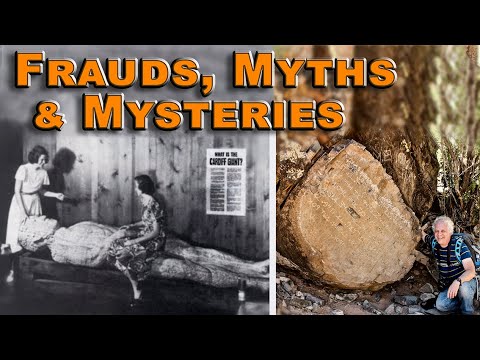
- "Dirty Frauds in Archaeology with Dr Ken Feder." Archaeology with Flint Dibble, YouTube (interview discussing the book directly; video verified via oEmbed). youtube.com
- Ohio History Connection. "Archaeologist Ken Feder Blasts the Fantasy of Ancient Astronauts at SunWatch Village Program." ohiohistory.org
- This site's own resources library: Full Reading List, where this exact title is cited across 3 separate pages.
- This site's own key-figures entry: Kenneth Feder, for his full biography and site-wide connections.
- This site's own ancient-connections entry: The Baalbek Trilithon's "Impossible" Platform.
- This site's own ancient-connections entry: The Nazca Lines as "Landing Strips".
- This site's own theory page: Ancient Astronaut Hypothesis.
- This site's own essential-reading entry: Why People Believe Weird Things, another skeptical-movement classroom staple for comparison.
- This site's own essential-reading entry: Bad Astronomy, a comparable discipline-specific skeptical textbook treatment.
Have corrections, additional research, or peer-reviewed sources? Help improve this entry.
Suggest an Edit