
Bad Astronomy
Misconceptions and Misuses Revealed, from Astrology to the Moon Landing "Hoax"
Core Thesis
Bad Astronomy is professional astronomer Phil Plait's systematic, chapter-by-chapter catalog of twenty-four common astronomical misconceptions, organized across five parts that deliberately escalate from the harmless to the consequential: household and classroom myths (equinox egg-balancing, bathtub-drain Coriolis lore, misused astronomical idioms), genuine optical and physical phenomena people routinely misunderstand (why the sky is blue, the Moon illusion, star twinkling, tides), and finally what Plait groups under the heading "Artificial Intelligence" — claims that persist not from simple misunderstanding but from motivated reasoning and media amplification: Apollo moon-landing hoax claims (Chapter 17, "Appalled at Apollo"), Immanuel Velikovsky's catastrophist cosmology (Chapter 18), young-Earth creationism (Chapter 19), astrology (Chapter 21), and, in the chapter most directly relevant to this site's own subject matter, Chapter 20, "Misidentified Flying Objects: UFOs and Illusions of the Mind and Eye," which argues that camera artifacts, lens flares, out-of-focus insects and birds, and ordinary misjudged distance and scale account for the overwhelming majority of anomalous aerial-object reports without requiring any exotic explanation. Unlike this site's usual case-study or ancient-astronaut subjects, Bad Astronomy is not itself a UFO book and stakes out no position on the broader UAP question; its relevance here is methodological rather than evidentiary — it is the working toolkit of a trained astrophysicist applied, chapter after chapter, to exactly the kind of misperception, camera artifact, and motivated-reasoning problems this site's own case files have to weigh in nearly every genuinely unresolved sighting, and three of this site's own case files already cite this specific book, by name and by chapter title, for exactly that reason.
About the Author
Philip Cary Plait was born September 30, 1964, in Washington, D.C., and has said he decided he wanted to be an astronomer at age five, after first seeing Saturn's rings through a department-store telescope. He earned his undergraduate degree at the University of Michigan and his Ph.D. in astronomy from the University of Virginia in 1995, with a dissertation on Hubble Space Telescope observations of the circumstellar ring around Supernova 1987A — a real, peer-reviewed research credential in exactly the discipline this book's subject matter draws on, distinguishing Plait's professional background from most of the popular-audience UFO- and paranormal-book authors already covered in this site's library. He went on to spend roughly a decade working with the Hubble Space Telescope program at NASA's Goddard Space Flight Center, in successive roles as an observer, a programmer, and a calibration scientist on the Space Telescope Imaging Spectrograph, before moving in December 2000 to Sonoma State University, where he ran web-based public-outreach programs for NASA missions (including the Fermi Gamma-ray Space Telescope) through the university's EdEon STEM Learning group until May 2007.
In 1998, while still working in professional astronomy, Plait launched badastronomy.com specifically to debunk the same kind of popular astronomical misconceptions this book catalogs. The site's readership jumped sharply in early 2001 after he published a detailed rebuttal of Conspiracy Theory: Did We Land on the Moon?, a Fox television special arguing NASA faked the Apollo landings, which drew a large national audience and, per Fox's own subsequent claims, measurably increased public doubt about the Moon landings. Plait has said his traffic "jumped — a lot" after that piece ran, and that the response included an email from Apollo 16 moonwalker Charlie Duke, which he called "pretty amazing." That 2001 rebuttal fed directly into this book's Chapter 17, "Appalled at Apollo," published the following year, and the badastronomy.com blog itself was later hosted successively by Discover magazine (2008–2012), Slate (2012–2017), and SYFY Wire (2017–2022), continuing to run under Plait's own byline since.
Plait's subsequent public-science career grew directly out of this book's success: he wrote two further books, Death from the Skies! (2008), on cosmic extinction-level scenarios, and Under Alien Skies (2023); hosted the Discovery Channel series Phil Plait's Bad Universe (2010); and wrote and narrated all 47 episodes of the YouTube series Crash Course Astronomy (2015–2016). He has also served as a paid consultant and science advisor to planetarium shows and, since leaving SYFY Wire, has continued the Bad Astronomy newsletter on Beehiiv.
Within organized scientific skepticism specifically, Plait served as president of the James Randi Educational Foundation from 2008 to 2009 and remains a frequent speaker at skeptics' conferences including The Amazing Meeting and the Northeast Conference on Science and Skepticism. In 2013 the National Capital Area Skeptics gave him their Philip J. Klass Award for "outstanding contributions in promoting critical thinking and scientific understanding" — the same award named for the aviation journalist and career UFO skeptic whose own 1974 book this site covers in its own UFOs Explained entry, making Plait a direct, documented, if much later, member of the same organized-skepticism lineage that produced Klass's work. Accepting the award, Plait said, "Being a skeptic is hard, it really is. It's so much easier to simply accept a warm, fuzzy lie than it is to embrace a cold, sharp-edged truth." His other honors include the 2007 Weblog Award for Best Science Blog, a spot on TIME's 25 Best Blogs of 2009, the 2016 David N. Schramm Award for high-energy astrophysics science journalism, and an asteroid, 165347 Philplait, named in his honor.
Historical Context & Origins
Bad Astronomy was published by John Wiley & Sons on March 1, 2002, as the first title in Wiley's short-lived "Bad Science" series (followed the next year by Christopher Wanjek's Bad Medicine). The book grew directly out of badastronomy.com's four years of accumulated material, and its timing was not incidental: Plait's viral 2001 rebuttal of Fox's Conspiracy Theory: Did We Land on the Moon? special had just given his moon-hoax material an unusually large, ready-made audience, and by his own account he already had a manuscript underway when the show aired, giving him time to fold the fresh material directly into what became Chapter 17.
The book entered a popular-science landscape already shaped by Carl Sagan's The Demon-Haunted World (1995), this site's own entry for which documents a closely related project: a working scientist applying a systematic skeptical toolkit to pseudoscience and paranormal claims for a general readership. Where Sagan's book worked at the level of a broad epistemological "baloney detection kit" across many fields, Plait's is narrower and more concrete — a single astronomer's own discipline, worked chapter by chapter through specific, nameable claims — and it arrived into a media environment that had, if anything, gotten more hospitable to those claims since 1995: cable "mystery" programming and tabloid specials like the Fox moon-hoax show were drawing large audiences through the late 1990s and into the early 2000s, the exact trend Plait's introduction and Chapter 17 respond to directly.
Structurally, the book's five parts — "Bad Astronomy Begins at Home," "From the Earth to the Moon," "Skies at Night Are Big and Bright," "Artificial Intelligence," and "Beam Me Up" — are organized as a deliberate escalation, opening with essentially harmless household misconceptions (an equinox egg-balancing myth, bathtub-drain Coriolis-effect folklore, misused astronomical idioms like "light years ahead") before moving through genuine, if commonly misunderstood, physical phenomena, and only in Part IV, "Artificial Intelligence," reaching the media-driven and motivated-reasoning claims — the moon-landing hoax, astrology, creationism, Velikovskian catastrophism, and misidentified flying objects — that make up this book's most direct overlap with the subject matter this site covers.
Core Arguments & Key Concepts
Part I, "Bad Astronomy Begins at Home," and Part II, "From the Earth to the Moon," cover the book's least controversial ground: the equinox egg-balancing myth, the (non-)effect of the Coriolis force on a household drain, astronomical idioms used incorrectly in everyday speech, why the sky is blue, the actual cause of the seasons (axial tilt, not orbital distance), the Moon's phases and the well-documented "Moon illusion" that makes a rising Moon look larger near the horizon than it really is, and the Moon's genuine tidal effect on Earth's oceans. These chapters establish Plait's basic method — take a specific, widely repeated claim, walk through the actual physics or geometry, and show precisely where and why the popular version goes wrong — before the book applies that same method to higher-stakes claims later on.
Part III, "Skies at Night Are Big and Bright," extends the method to observational astronomy proper: why stars appear to twinkle (atmospheric scintillation) and why planets generally do not, the real color and brightness differences among stars, the difficulty of spotting stars in broad daylight, Polaris's genuinely modest brightness relative to its outsized cultural reputation as "the brightest star," solar eclipses and safe sun-watching, the "Great Planetary Alignment" doomsday scare of May 2000 (which Plait shows produced no measurable gravitational or tidal effect on Earth despite widespread public anxiety), the physical distinction between meteors, meteoroids, and meteorites, and common misunderstandings of Big Bang cosmology.
Part IV, "Artificial Intelligence," is the book's most direct engagement with claims sustained by media amplification and motivated reasoning rather than simple misunderstanding, and it is the section most relevant to this site's own subject matter. Chapter 17, "Appalled at Apollo: Uncovering the Moon-Landing Hoax," works through the specific claims of Apollo-hoax proponents — the waving flag, the absence of stars in lunar-surface photographs, apparently inconsistent shadows — and rebuts each with the underlying physics and photographic conditions involved; the Astronomical Society of the Pacific's own review of the book specifically recommended this chapter as "good ammunition for debunking the notion that NASA never went to the Moon." Chapter 18, "Worlds in Derision," and Chapter 19, "In the Beginning," take on Immanuel Velikovsky's catastrophist cosmology (the 1950 bestseller Worlds in Collision, which proposed that Venus was ejected from Jupiter in ancient historical times and caused Biblical-era catastrophes during a close pass by Earth) and young-Earth creationism, respectively, in each case working through the specific astronomical claims made rather than treating the broader religious or historical questions those movements raise.
Chapter 20, "Misidentified Flying Objects: UFOs and Illusions of the Mind and Eye," is this book's direct point of contact with UFO/UAP research, and the specific chapter this site's own case files already cite by name. Plait's argument here is narrower than a general case for or against extraterrestrial visitation: he catalogs the specific mechanisms — out-of-focus insects and birds passing near a camera lens, internal lens reflections and flares, misjudged distance and scale for a real but ordinary object (a planet, a satellite, an aircraft), and the perceptual tendency to assume an unfamiliar light is both larger and farther away than it actually is — by which real photographic and visual evidence can produce a genuinely puzzling anomalous-object impression without requiring anything exotic to explain it. Chapter 21, "Mars Is in the Seventh House, But Venus Has Left the Building," closes out Part IV with a case-by-case rebuttal of astrology, including a discussion of the astronomical precession that has shifted the zodiac's traditional sun-sign dates out of alignment with the actual constellations since they were first assigned in antiquity.
Part V, "Beam Me Up," is the book's lightest section: Hubble Space Telescope misconceptions (drawing directly on Plait's own decade working the instrument), a debunking of commercial star-naming registries (illustrated, per one reviewer, with an anecdote about Plait's own brother buying him a star name as a gift), and a closing "Top-Ten Examples of Bad Astronomy in Major Motion Pictures" chapter cataloging Hollywood's most common astronomical errors — audible explosions in the vacuum of space chief among them.
Key Cases & Evidence Discussed
Bad Astronomy is not built around real-world UFO case files the way this site's usual subjects are, but this site's own case-file library already draws directly on it in three separate places. The Angoulême Daylight Ovoid (Case File #263, 2009), Maffliers Dawn Object (Case File #261, 2012), and Rixheim Course-Changing Light (Case File #262, 2009) case files each cite this exact book, by title and by chapter, in their own "Further Reading" sections, specifically recommending Chapter 20, "Misidentified Flying Objects: UFOs and Illusions of the Mind and Eye," as directly relevant to weighing a single witness's account of a genuinely unresolved daylight or dawn sighting against ordinary explanations — real, existing, pre-dating cross-references this entry did not invent, and the clearest available evidence that this specific chapter's framework is still treated as working analytical infrastructure on this site, not simply historical reading.
The book's Chapter 17, "Appalled at Apollo," grew directly out of Plait's viral 2001 rebuttal of Fox's Conspiracy Theory: Did We Land on the Moon? special, and the Astronomical Society of the Pacific's contemporary review specifically singled the chapter out as practical debunking material for exactly that claim — a case this site does not itself carry a dedicated case file on, since it concerns Apollo-hoax conspiracy claims rather than a reported anomalous sighting, but one central enough to the book's own genesis and reputation that it cannot be left out of any honest account of what the book actually covers.
Beyond the book itself, Phil Plait has directly applied this same skeptical, mechanism-first method to one of this site's own most significant historical photographic cases: the Bonilla Solar Transit Photographs (Case File #219, 1883), in which José Bonilla, director of the Zacatecas Astronomical-Meteorological Observatory, photographed hundreds of dark objects crossing the Sun. Writing on his Bad Astronomy platform in 2011, Plait raised specific, still-unresolved physical objections to a UNAM team's proposed comet-fragment explanation — the total absence of any accompanying meteor shower, and a debris corridor implausibly narrow given how visible a genuinely fragmenting comet's material should have been from nearby Mexico City and Puebla — concluding "color me very skeptical," and favoring flocks of birds or an unidentified atmospheric phenomenon instead, while explicitly agreeing that Bonilla genuinely photographed something he could not himself explain. This site's own key-figures entry on Plait documents that rebuttal directly, making the Bonilla case the clearest example on this site of this book's underlying methodology — weigh mundane, checkable explanations before reaching for an exotic one — being applied by its own author to a specific, still-unresolved sighting decades after the book's publication.
The book's Chapter 18 and 19 material on Immanuel Velikovsky's catastrophist cosmology and young-Earth creationism does not connect to any specific case file in this site's library, since neither is itself a UFO or UAP claim; it is included here only because an honest account of what Bad Astronomy actually argues requires naming all of Part IV's targets, not only the one (Chapter 20) most directly relevant to this site's own subject matter.
Critical Reception & Controversies
Contemporary trade reception was strongly positive. Publishers Weekly called the book "knowledgeable, lighthearted," praised Plait's "avuncular humor" and his critique of how "advertising and media reinforce bad science," and forecast that "if every entry in the series is as entertaining as Plait's, good science may have a fighting chance with the American public." Universe Today's Fraser Cain called it "a great book, not Bad Astronomy at all," praising the Hollywood-errors chapter specifically, though he offered the book's clearest piece of substantive criticism in the same review: that Plait "spends a little too much time explaining how to balance an egg in any season," giving an entire chapter to a genuinely minor claim at some cost to the book's pacing, even if Cain allowed this may have served Plait's broader pedagogical purpose of starting with the easiest possible misconceptions first.
The Skeptic's Dictionary's Robert Todd Carroll gave the book an enthusiastic review, praising its ability to teach "science as something that has a history and is inquiry-based and problem-driven," while noting one specific, concrete limitation worth reproducing here: Plait's chapter on commercial star-naming services (Chapter 23) explains that names sold by companies like the International Star Registry carry no official standing with professional astronomers, illustrated, Carroll noted, by Plait's own account of his brother buying him such a star name as a well-meaning but scientifically meaningless gift — a small, honest example of the book occasionally turning its skeptical lens on harmless consumer commerce rather than only on more consequential claims.
The Astronomical Society of the Pacific specifically recommended Chapter 17 as practical debunking material against moon-landing-hoax claims, and the National Science Teachers Association's Deborah Teuscher called the book "interesting, accurate, and fun to read" — both endorsements from organizations with direct professional stakes in accurate science communication rather than general trade reviewers. Plait has himself stated that the book's reviews were overwhelmingly positive and that its only genuinely negative review came, in his own characterization, from a UFO believer objecting to Chapter 20's conclusions — a claim this entry reports as Plait's own account of his reception rather than as independently verified by this site's own research, since the specific review in question could not be independently located and confirmed during this entry's research.
The most defensible criticism of the book today is simply its age: Bad Astronomy was written in 2001 and published in 2002, predating Pluto's 2006 reclassification as a dwarf planet, the exoplanet-detection boom that followed the Kepler mission's 2009 launch, and the post-2017 shift in mainstream media and U.S. government treatment of unidentified aerial phenomena that this site's own case files on more recent sightings, including all three that cite this book directly, were written against. Its core physics and its Chapter 20 debunking method have not dated in any way that undermines them, but readers encountering the book today should understand its UFO and moon-hoax chapters as products of the specific, pre-UAP-disclosure-era media landscape — tabloid cable specials and early-2000s internet forums — that Plait was writing directly against, not as an account calibrated to the more institutionally engaged UAP discourse that has developed in the decades since.
Influence & Legacy
Bad Astronomy launched Wiley's short-lived "Bad Science" series and, more importantly, launched Plait's career as a full-time public science communicator: badastronomy.com's blog went on to be hosted successively by Discover, Slate, and SYFY Wire over the following two decades, and the book's success led directly to Death from the Skies! (2008), the Discovery Channel series Phil Plait's Bad Universe (2010), all 47 episodes of the YouTube series Crash Course Astronomy (2015–2016), and Under Alien Skies (2023) — a career this book's methodology and public reception set in motion more than any single subsequent project of Plait's own.
Within organized scientific skepticism, the book's reputation and Plait's subsequent public profile fed directly into his 2008–2009 presidency of the James Randi Educational Foundation and his 2013 Philip J. Klass Award from the National Capital Area Skeptics — the same award named for the career UFO skeptic covered in this site's own UFOs Explained entry, and one Plait accepted by saying, "Being a skeptic is hard, it really is. It's so much easier to simply accept a warm, fuzzy lie than it is to embrace a cold, sharp-edged truth" — a direct, documented link placing Plait within the same organized-skepticism institutional lineage this site already tracks through Klass and, at one remove through Klass's own CSICOP UFO Subcommittee co-founder, this site's Bad UFOs entry on Robert Sheaffer.
Read alongside Carl Sagan's The Demon-Haunted World, already in this site's library, Bad Astronomy represents a narrower, single-discipline version of the same basic project: a credentialed working scientist applying his own field's specific toolkit, rather than a general epistemological framework, to popular misconceptions in that field — a model later echoed, within this site's own skeptical-works shelf, by Philip J. Klass's engineering-specific approach to UFO radar and photographic cases and Robert Sheaffer's case-reopening method.
Within this site's own catalogue specifically, this book's most concrete, durable legacy is its direct citation footprint: three separate, still-live case files — Angoulême Daylight Ovoid, Maffliers Dawn Object, and Rixheim Course-Changing Light — each independently cite this exact 2002 edition by title and chapter for its "Misidentified Flying Objects" framework, and Plait's own key-figures entry on this site documents him applying the same underlying method directly to the 2011 comet-fragment debate over the Bonilla Solar Transit Photographs. That is a working citation record, not merely a claimed historical influence, and it is the clearest evidence this site's own research turned up that this book's chapter-level method remains treated as live analytical infrastructure for evaluating real, still-unresolved sightings decades after publication.
The Book
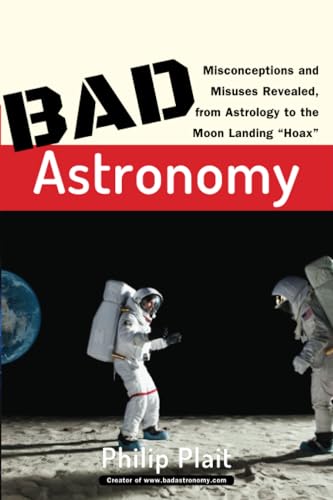
Bad Astronomy
Misconceptions and Misuses Revealed, from Astrology to the Moon Landing "Hoax"
Find on Amazon →As an Amazon Associate, OverClassified may earn from qualifying purchases made through this link, at no extra cost to you.
Why This Is Essential Reading
Bad Astronomy earns a place on this list not as a UFO book — it is not one, and stakes out no position on the broader UAP question — but as a rigorous, professionally credentialed methodological reference this site's own case files already lean on in practice. Phil Plait's decade on NASA's Hubble Space Telescope program and his subsequent two-decade public-science career give Chapter 20's "Misidentified Flying Objects" framework real professional weight, and three of this site's own case files — the Angoulême Daylight Ovoid, the Maffliers Dawn Object, and the Rixheim Course-Changing Light — already cite that exact chapter by name for exactly the reason this entry exists to document: that separating a genuine anomaly from a misjudged planet, a lens artifact, or a bird passing near a camera is real, specific, checkable work, not a matter of general disbelief. Read against Plait's own subsequent direct application of the same method to this site's Bonilla Solar Transit Photographs case — where he concluded "color me very skeptical" of an exotic comet-fragment explanation while still affirming that something genuinely unexplained was photographed — this book stands, twenty-plus years after publication and despite its now-dated moon-hoax and pre-UAP-disclosure-era framing, as a working toolkit this site's own research has independently found itself reaching for again and again, rather than a museum piece of early-2000s skepticism.
Related Cases & Theories
Essential Viewing
Sources Cited
- Plait, Philip C. Bad Astronomy: Misconceptions and Misuses Revealed, from Astrology to the Moon Landing "Hoax". John Wiley & Sons, 2002 (ISBN 0471409766 / 9780471409762). amazon.com
- "Bad Astronomy." Wikipedia (book's publication history, five-part/24-chapter structure, contemporary reviews). en.wikipedia.org
- "Phil Plait." Wikipedia (biography: education, Hubble Space Telescope career, Sonoma State, badastronomy.com history across Discover/Slate/SYFY Wire, books, TV work, skepticism honors). en.wikipedia.org
- "BAD ASTRONOMY: Misconceptions and Misuses Revealed, from Astrology to the Moon Landing 'Hoax'." Publishers Weekly (contemporary trade review: "knowledgeable, lighthearted," "avuncular humor"). publishersweekly.com
- Cain, Fraser. "Book Review: Bad Astronomy by Phil Plait." Universe Today (review: "a great book, not Bad Astronomy at all"; egg-balancing-chapter pacing criticism). universetoday.com
- Carroll, Robert Todd. "Bad Astronomy by Phil Plait." The Skeptic's Dictionary, skepdic.com (review: teaching-style praise, star-naming-registry chapter discussion). skepdic.com
- "Bad Astronomy: Misconceptions and Misuses Revealed." AstronomyTrek (review summarizing 24-chapter structure and topics covered). astronomytrek.com
- "Bad astronomy." Open Library, edition record OL3581180M (bibliographic record: Wiley, 2002, ISBN 0471409766 / 9780471409762, cover art source). openlibrary.org
- "How I busted the Apollo hoax conspiracy - and why we SHOULD fear asteroids." Yahoo News UK (Plait's own account of his 2001 Fox moon-hoax-special rebuttal, the traffic surge, and Charlie Duke's email). uk.news.yahoo.com
- "Skeptical honor: The Philip J. Klass award." Slate, March 24, 2014 (2013 NCAS Philip J. Klass Award to Plait; direct quote: "Being a skeptic is hard, it really is..."). slate.com
- This site's own case file: The Bonilla Solar Transit Photographs, and its companion key-figures entry on Phil Plait, documenting his direct 2011 rebuttal of the comet-fragment hypothesis ("color me very skeptical").
- This site's own case file: The Angoulême Daylight Ovoid, which cites this exact book and its Chapter 20 by name in its own Further Reading section.
- This site's own case file: The Maffliers Dawn Object, which cites this exact book and its Chapter 20 by name in its own Further Reading section.
- This site's own case file: The Rixheim Course-Changing Light, which cites this exact book and its Chapter 20 by name in its own Further Reading section.
- This site's own essential-reading entry: UFOs Explained, for Philip J. Klass, whose namesake award Plait received in 2013.
- This site's own essential-reading entry: Bad UFOs, for Robert Sheaffer's parallel case-by-case skeptical method.
- This site's own essential-reading entry: The Demon-Haunted World, for Carl Sagan's earlier, broader popular-science skepticism project.
- This site's own key-figures entry: Phil Plait, for his full site-wide biography and case connections.
Have corrections, additional research, or peer-reviewed sources? Help improve this entry.
Suggest an Edit