
The Gdynia Harbor UFO Incident
Before dawn on January 21, 1959, a burning, luminous object fell into Basin No. IV of the harbor at Gdynia, communist Poland's principal naval and commercial port on the Baltic coast. Named dockworkers watched it strike the water; the evening paper Wieczór Wybrzeża printed their accounts within days; Polish Academy of Sciences meteoriticist Jerzy Pokrzywnicki proposed a meteorite and the Academy offered a cash reward for it that nobody ever collected. That much is real and documented. What Gdynia is actually known for — a burned humanoid found on the beach, six-fingered hands, a body flown to Moscow — appears nowhere in any of that 1959 record. It surfaces for the first time nearly a decade later in a British paperback, then again in a Romanian–Belgian survey of Eastern Bloc ufology, and grows more elaborate with each retelling. No primary source for the humanoid story has ever been produced, in Polish or any other language, and this file treats it accordingly — as a documented legend layered onto a real, unexplained, but far more modest event.
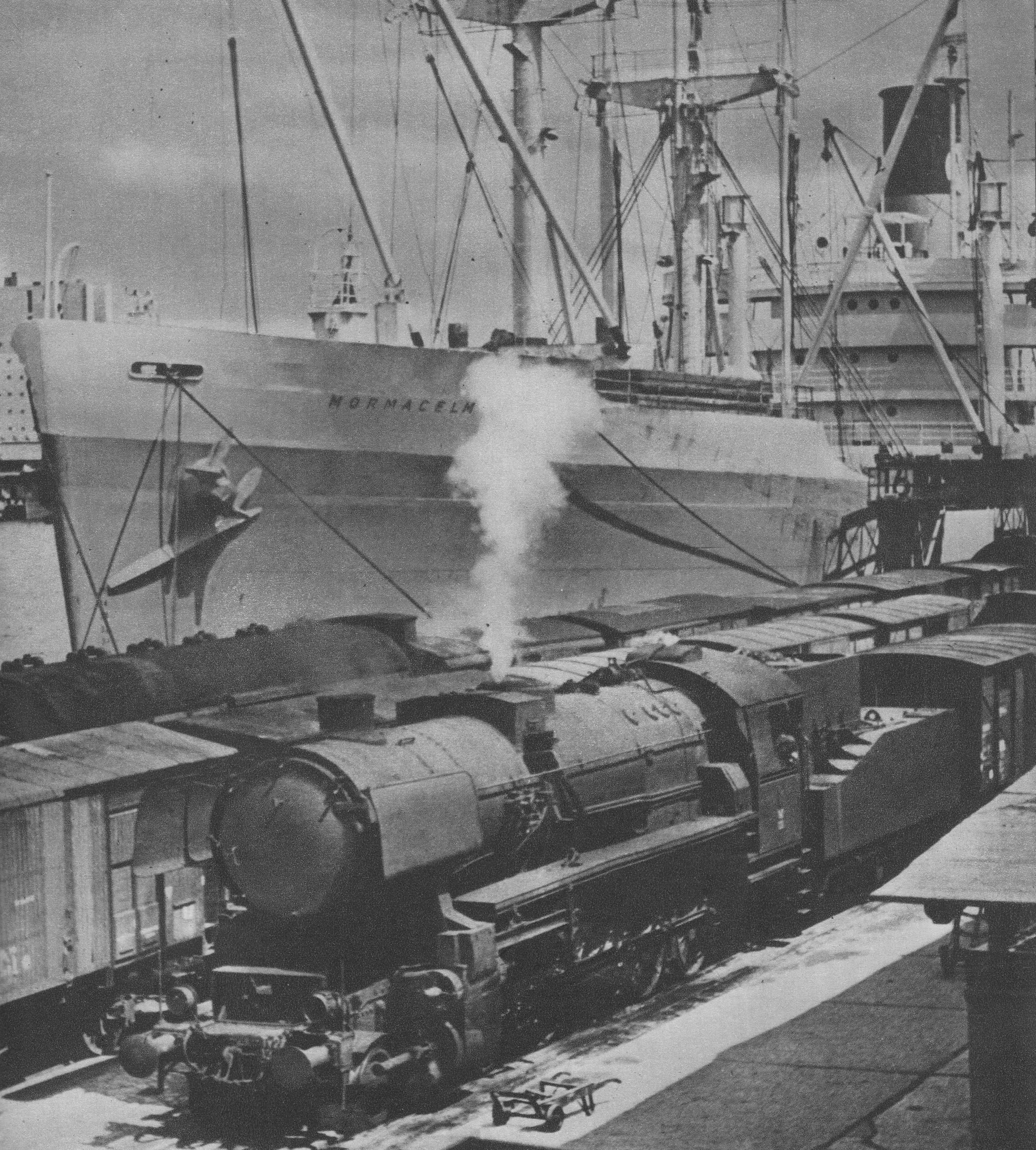
Pictured: the Port of Gdynia photographed circa 1952, seven years before the incident — a public-domain image from Piękno Polski Ludowej (Warsaw, 1952), via Wikimedia Commons. This is not a photograph of the January 1959 event, the recovered fragment, or any alleged craft or occupant — no such photograph is known to exist. It shows the harbor itself, in the same era, to ground the case in its real physical setting rather than illustrate a claim that cannot be illustrated honestly.
Theoretical Alignment
Gdynia scores lowest on this site's ETH scale of almost any case in the archive: the 1959 event as documented is a falling luminous object with a plausible meteor or satellite-debris origin, and nothing resembling structured craft behavior was ever reported by a named witness. The high PSH (Psycho-Social Hypothesis) alignment reflects something more specific than generic skepticism — this is one of the clearest documented cases on the site of a real, minor, unexplained event being retroactively elaborated into a "recovered craft and body" narrative by later writers with no connection to the original witnesses, a process folklorists call legend accretion. The case is a better test of how UFO legends are manufactured than of what fell into Gdynia's harbor.
Background
Gdynia was not an ordinary Polish town in January 1959. Built almost entirely from scratch on fishing-village land after 1926 specifically because the nearby port of Gdańsk (then the Free City of Danzig) lay outside Polish sovereign control, Gdynia had grown by the 1950s into the largest port on Poland's Baltic coast and the home of the Polish Navy's principal surface fleet base. Under the People's Republic of Poland (PRL), it sat inside one of the most heavily monitored strips of territory in the entire Eastern Bloc: a militarized harbor, a shipbuilding center, and a listening post on NATO's Baltic flank, all patrolled by the Polish Navy, the Citizens' Militia (MO), and the Security Service (Urząd Bezpieczeństwa, UB) simultaneously.
The Cold War space race had, by coincidence, just delivered a genuine source of unidentified falling debris to the region. The United States had launched Project SCORE — the world's first active communications satellite, carried on an Atlas booster — from Cape Canaveral on December 18, 1958. Twelve days of orbital broadcast later, SCORE's decaying orbit brought its spent Atlas stage back into the atmosphere. NASA's own tracking record for the object states plainly that it re-entered on January 21, 1959 — the identical calendar date, halfway around the world in UTC terms, as the night something burning fell into Gdynia's harbor. Satellite and rocket-body re-entries were still a genuinely novel, poorly understood phenomenon to the general public in early 1959 (Sputnik 1 had flown less than sixteen months earlier), and Poland, like the rest of the world, had no public tracking network capable of confidently ruling a specific re-entry in or out for a specific sighting.
Eastern Bloc citizens in this period had no independent press, no freedom to publicly speculate about foreign military hardware, and no ufological infrastructure of the kind that existed in Western Europe and the United States (no NICAP, no APRO, no Blue Book). What reporting did occur passed through state-controlled regional papers, and any object recovered from a militarized harbor by an Academy of Sciences investigator was, by definition, also of interest to state security. This is the actual environment the harbor event happened in — a modest, real, and quickly forgotten local mystery in the domestic Polish press, existing eleven time zones away from the country where a wholly different, far more dramatic version of the story would later be constructed.
Complete Timeline
| Date | Event |
|---|---|
| December 18, 1958 | Project SCORE launched. The U.S. Atlas satellite carrying the SCORE communications payload launches from Cape Canaveral. Its spent Atlas booster stage remains in a low, decaying orbit. |
| January 21, 1959, ∼5:00 AM | The harbor event. A burning, red-orange object — variously described as cone-shaped, hemisphere-shaped, or roughly cylindrical, about 1–4 meters long — is seen falling toward Gdynia's Basin No. IV from the direction of the city. Dockworker Jan Blok, watching from the deck of the freighter Jarosław Dąbrowski, reports nearly being struck. Engineer Alojzy Data reports a metallic, grinding sound at the moment of impact. The object strikes the water with a sound witnesses compare to sheet metal scraping, and columns of steam rise from the basin. |
| January 21, 1959 | Project SCORE's Atlas stage re-enters. Per NASA's own orbital tracking record, the SCORE satellite's booster stage decays out of orbit and re-enters the atmosphere on this date — the same calendar date as the Gdynia sighting. |
| January 21–23, 1959 | Polish Navy and Maritime Rescue divers search Basin No. IV. They recover only a small, corroded metal fragment. Security Bureau (UB) officers reportedly take custody of it at the scene. |
| January 23, 1959 (reported) | A second, separate sighting is later attributed to residents Włodzimierz and Jadwiga Ponczas, who describe an orange, disc-like light hovering over the city before the harbor splash — the couple most consistently named across later retrospective accounts as the first to spot the object in the sky. |
| Late January 1959 | The Gdynia/Tricity evening paper Wieczór Wybrzeża publishes the first press account, carrying quotes from dockworkers and port staff. This is the earliest identified contemporary documentary source for the event. |
| 1959 (spring, exact date undocumented) | Astronomer and meteoriticist Jerzy Pokrzywnicki of the Polish Academy of Sciences writes up the case in the journal Postępy Astronomii ("Progress in Astronomy"), proposing that a meteorite struck the harbor and became embedded in the basin floor. The Academy reportedly offers a 1,000 złoty reward for its recovery. No meteorite is ever found. |
| 1960 | The regional paper Dziennik Bałtycki revives public interest in the case with a retrospective, speculative feature — already treating the 1959 event as an unsolved local mystery rather than a closed matter. |
| 1968 | First known appearance of a humanoid element. British paranormal writer Arthur Shuttlewood — a Warminster-based journalist who would go on to chronicle that town's own Warminster Thing flap the following year — publishes Warning from Flying Friends (Portway), which includes some version of a Gdynia entity story. Shuttlewood cites no source for the claim. |
| 1972 | Romanian science-fiction critic Ion Hobana and Belgian writer/publisher Julien Weverbergh publish UFO's in Oost en West, Deel II (Ankh-Hermes, Dutch), an early version of what becomes their best-known Eastern Bloc UFO survey, reportedly including a Gdynia entry. |
| 1974 | Hobana and Weverbergh's survey reaches the English-language market as UFO's From Behind the Iron Curtain (Souvenir Press) — the single most consequential publication in this case's history, since it is this edition that carried the Gdynia humanoid story into the mainstream English-language ufology bibliography for the first time. |
| 1976 | A French edition, Les OVNI en URSS et dans les pays de l'Est (Robert Laffont), places the Gdynia case on pages 23–25, with the date given there as "February 21" rather than January 21 — an inconsistency across the book's own printings that is itself a small piece of evidence for how loosely sourced the retelling chain was even at its origin. |
| 1977 | In an interview later reprinted by the Belgian literary site Tzum, Flemish author Jeroen Brouwers states that he, not Weverbergh, had actually ghostwritten Weverbergh's UFO books — a claim that, if accurate, adds a further layer of authorial distance between the Gdynia story's most consequential English-language source and anyone who could plausibly have done original Polish-language research. |
| March/April 1988 | French researcher Bronisław Rzepecki catalogs the case in the French humanoid-sightings journal Lumières Dans La Nuit, issue #285–286, p. 25, as part of a survey titled "Rencontres Rapprochées en Pologne 1947/1986" — folding Gdynia into a broader inventory of alleged Polish close encounters, with Hobana & Weverbergh as the cited source rather than any new Polish research. |
| 1990s | A Japanese television crew from NHK reportedly travels to Poland to investigate the case for a documentary segment. According to secondary accounts of their trip, the crew found no corroborating witnesses, no supporting documents, and no one able to confirm the humanoid story beyond repeating what they had read in Western books. |
| ∼2001 | American humanoid-sightings cataloger Albert Rosales includes Gdynia in his compiled 1959 Humanoid Sightings reference list, again citing Hobana & Weverbergh and Shuttlewood as the sources — not any new investigation. |
| July 22, 2009 | French case-cataloger Patrick Gross publishes his URECAT-000112 entry for the case, explicitly flagging "no primary source available" and "no investigation report available," and assessing that the story "seems to be exaggerated as time passes." |
| 2010s–2020s | Polish regional press (Dziennik Bałtycki, RMF24, Interia, Trójmiasto.pl, Polskie Radio) revisits the case repeatedly as "Poland's Roswell" folklore, drawing on Gdynia City Museum historian Michał Miegoń for factual grounding and generally treating the humanoid element as unverified legend rather than history. |
| 2020s | Novelist Łukasz Orbitowski fictionalizes the incident in his novel Chodź ze mną ("Come with Me"), and the National Maritime Museum in Gdańsk (Narodowe Muzeum Morskie w Gdańsku) produces a two-part public documentary examining the case's real historical record. |
The Harbor Event, January 21, 1959
Every detail in this section comes from Polish press retrospectives that themselves draw on the original Wieczór Wybrzeża coverage and on named local witnesses — it is the one layer of the Gdynia story with a genuine documentary trail. In the pre-dawn darkness of January 21, 1959, at approximately 5:00 AM, several people in and around the port of Gdynia reported a bright, burning, red-to-orange object crossing the sky from the direction of the city center toward the harbor. Dockworker Jan Blok, aboard the freighter Jarosław Dąbrowski, said the object came close enough that he thought it might strike the ship. He and other witnesses described its shape inconsistently — some called it roughly conical, others hemisphere-shaped or barrel-like, most agreeing on a length of somewhere between one and four meters.
Engineer Alojzy Data reported hearing a high-pitched, grinding sound — described by multiple retrospectives as resembling sheet metal being scraped — at the moment of the object's impact with the water in Basin No. IV. Witnesses described water spraying as much as 1.5 meters into the air and clouds of steam rising off the surface, consistent with something very hot striking cold winter harbor water. A couple identified in most retrospective accounts as Włodzimierz and Jadwiga Ponczas are credited with an earlier sighting of the object in flight — describing it, in one widely repeated quote, as "a flying saucer with orange coloring and pink edges" — and a further, separate sighting on January 23 of an orange disc hovering over the city is sometimes attributed to the same couple, though the sourcing for this second date is thinner than for the main event.
Within days, port and Naval Rescue divers were sent into the harbor basin to search for the object. What they recovered was modest: a single small fragment of corroded metal, later reported by multiple sources to contain iron, aluminum, magnesium, and silicon. Gdynia's own Polytechnic examined the piece, though accounts describe portions of it as subsequently "lost" during the analysis process — whether through simple loss of a small physical sample, bureaucratic mishandling, or state security's own interest in the find is not established in any source consulted for this file. Security Bureau (UB) personnel are reported to have taken possession of material recovered at the scene, consistent with the harbor's status as a militarized, security-sensitive site rather than any specific claim about what the material was.
Contemporary Press Coverage and the Official Investigation
The evening paper Wieczór Wybrzeża, serving the Tri-City area of Gdańsk, Sopot, and Gdynia, is the earliest identified press source for the story, publishing witness accounts within roughly a week of the event. This detail matters more than it might first appear: it directly contradicts the "no primary source available" assessment that later Western case cataloging applies to the Gdynia story as a whole. A contemporary, named, dated regional newspaper account of the harbor splash does exist and has been independently confirmed by multiple Polish-language retrospectives researched for this file. What does not exist in that coverage, in Dziennik Bałtycki's 1960 follow-up, or in any Polish-language source identified during this research, is any mention of a humanoid occupant, a recovered body, or a transfer to Moscow.
Jerzy Pokrzywnicki, a Warsaw-based lawyer-turned-geologist who worked as an adjunct at the Polish Academy of Sciences' Department of Geological Sciences from 1957 to 1962 and authored well over a hundred papers on meteoritics over his career, wrote up the Gdynia case in the specialist journal Postępy Astronomii. His conclusion was unglamorous: a meteorite, probably embedded in the mud and silt of the basin floor, deep enough that ordinary diving searches could not locate it. The Polish Academy of Sciences reportedly backed the hypothesis with a practical incentive — a 1,000 złoty reward, a meaningful sum in the 1959 PRL economy, for anyone who could recover the object. Nobody ever collected it.
The meteorite hypothesis has never been confirmed, but it has also never been definitively ruled out; contemporary Gdynia City Museum historian Michał Miegoń has publicly pushed back on it in modern retrospective coverage, arguing that a meteorite of the size and energy witnesses described striking a busy, structurally developed harbor basin should have left more infrastructure damage than anyone actually reported. This is a real, substantive objection, and it is one of the reasons this file does not simply adopt Pokrzywnicki's 1959 finding as a closed case — the honest position is that the harbor event has two serious, unresolved candidate explanations (addressed in full under the Conventional Explanation Candidate section below), and Polish sources spanning six decades have consistently described the matter as unresolved rather than settled.
How the Humanoid Legend Entered the Record
The version of this case that gives it the nickname "Poland's Roswell" — a burned, six-fingered humanoid found on the beach days after the splash, dying in custody after a bracelet or arm-band is removed, its body flown frozen to the USSR, with a possible second occupant surviving in a coma at a facility near Solnechnogorsk — does not appear in any 1959 Polish source. It does not appear in Wieczór Wybrzeża. It does not appear in Dziennik Bałtycki's 1960 revival piece. It does not appear in Pokrzywnicki's Postępy Astronomii writeup. As far as this file's research was able to establish, it does not appear in any Polish-language document, archive, or named individual's testimony at any point.
What it does appear in, for the first time identified by any researcher consulted for this file, is a 1968 British paperback: Arthur Shuttlewood's Warning from Flying Friends. Shuttlewood — a Warminster Journal features writer who would go on to become the central chronicler of England's own Warminster Thing flap the following year — included some version of the Gdynia entity story in this book without citing any source for it at all. This absence of sourcing is not this file's characterization; it is the explicit finding of the most detailed case catalog available on the incident, which states plainly that Shuttlewood "provides no reference of any source for his account."
The story's next and most consequential appearance came from Ion Hobana, a Romanian science-fiction critic and historian, and Julien Weverbergh, a Belgian writer, critic, and later publisher who developed a specialty in Eastern Bloc UFO reporting. Their survey of Soviet and Eastern European UFO cases appeared first in Dutch in 1972 as UFO's in Oost en West, then reached its widest audience in the 1974 English edition, UFO's From Behind the Iron Curtain (Souvenir Press), and again in a 1976 French edition, Les OVNI en URSS et dans les pays de l'Est, which placed the case on pages 23–25 — but dated it to "February 21," not January 21, an inconsistency that survives across the book's own printings and that later compilers appear simply to have not noticed or reconciled. It is Hobana and Weverbergh's book, not Shuttlewood's, that is cited by nearly every subsequent English-language reference to the case, including, in the village of Emilcin, this site's own existing citation of the same volume on the Emilcin Abduction case file for its general context on Eastern Bloc UFO reporting culture.
A genuinely striking complication surfaced during this file's research: in a 1977 interview later reprinted by the Belgian literary criticism site Tzum, Flemish novelist Jeroen Brouwers stated that he, not Weverbergh, had actually written Weverbergh's UFO books. If that claim is accurate — and it comes from a specific, dated, on-the-record interview rather than a rumor — it means the book most responsible for internationalizing the Gdynia humanoid story may not have been written by either of the two men credited as its authors, let alone by anyone who had done independent research in Poland. This detail does not itself confirm or refute anything about the underlying Gdynia claims, but it is exactly the kind of authorial distance between a "source" and any actual on-the-ground investigation that legend scholars look for when tracing how an unverifiable claim achieves the false appearance of documented pedigree.
From there, the chain is a textbook case of secondary-source compounding. French humanoid-sightings researcher Bronisław Rzepecki folded the case into a 1988 survey of Polish close encounters in the journal Lumières Dans La Nuit, citing Hobana and Weverbergh, not any new research. American cataloger Albert Rosales included it in his own compiled list of 1959 humanoid encounters around 2001, again citing the same chain. By the time French researcher Patrick Gross assembled his own detailed case catalog entry in 2009, the story had been repeated across at least five English, French, and Dutch-language publications spanning four decades — and every single one of them traced back to the same two uncorroborated 1968 and 1972–76 starting points. Gross's own assessment, after laying out this exact chain, is blunt: "It is difficult to see the least credibility with these stories that seem to be exaggerated as time passes, whereas it is not even known where they come from exactly, no witness being cited or indicated and no primary source having been documented." His catalog flags both "no primary source available" and "no investigation report available" as severe defects, and closes with a final evaluation of "extraterrestrial beings or hoax or baseless rumors. Insufficient information."
The Search for Confirmation That Never Came
This file's own research supports Gross's conclusion for the humanoid layer specifically, while meaningfully revising it for the harbor event itself — a distinction worth stating precisely, since collapsing the two together in either direction (dismissing the whole case as invented, or treating the whole case as equally well-attested) would misrepresent the actual state of the record.
The most concrete attempt at independent verification came in the 1990s, when a television crew from Japan's national broadcaster, NHK, reportedly traveled to Poland specifically to investigate the Gdynia story for a documentary segment. According to secondary accounts of the trip, the crew could not locate any witness, document, or local source able to corroborate the humanoid narrative beyond simply repeating what they had already read in Western ufology books — the same closed loop this file's own research kept running into. No Polish state archive, including the Institute of National Remembrance's (IPN) holdings on Communist-era security service records, has been identified as containing any file referencing a recovered body, a hospital transfer, or a shipment to the USSR connected to this incident.
Modern Polish retrospective journalism treats the case the same way. RMF24, Interia, Trójmiasto.pl, and Polskie Radio coverage researched for this file consistently narrates the real, documented harbor splash — named witnesses, the newspaper account, the Academy of Sciences investigation, the recovered fragment — and then explicitly frames everything involving a humanoid occupant as later "urban legend" (miejska legenda) or unverified rumor, not as an established part of the local historical record. Gdynia City Museum historian Michał Miegoń, consulted by multiple outlets as the closest thing this case has to an institutional custodian of its factual record, is quoted rejecting the meteorite explanation on physical grounds but is not quoted anywhere endorsing the body-recovery story either. The 2020s two-part documentary produced by the National Maritime Museum in Gdańsk treats the case in the same register: a real, unresolved local mystery about a falling object, presented alongside — and clearly distinguished from — the folkloric embellishments that grew up around it decades later.
Gdynia in Polish Memory
Whatever fell into the harbor in January 1959, the story it spawned has become a genuine piece of Polish popular culture in its own right — which is itself part of why this file spends as much space tracing the legend's growth as it does the original event. Novelist Łukasz Orbitowski used the incident as the basis for his novel Chodź ze mną ("Come with Me"), a work of explicit fiction rather than journalism or investigation, but one that has done more than any single newspaper article to keep the "Poland's Roswell" label in circulation. Regional Tri-City media returns to the story on a near-annual cycle, usually around its January anniversary, and it is reliably one of the most-cited examples whenever Polish outlets discuss the country's own UFO history — alongside cases like the Emilcin Abduction nearly two decades later, which by contrast does have a named, on-the-record primary witness and a contemporary sociological field investigation behind it.
That contrast is instructive. Both cases are commonly invoked as "Poland's Roswell" in different framings, but only one of them has an actual named person who claims to have experienced anything extraordinary, on the record, in their own country, at the time. Gdynia's central, most dramatic claim — the recovered humanoid — has never had that. It has had one British paranormal writer with no cited source, two foreign authors whose own authorship is itself contested, and a fifty-year chain of secondary citation in which nobody ever went back to check.
Key Witnesses
The witnesses below are limited entirely to the documented harbor event of January 21, 1959. No named witness of any kind has ever been produced, by any source in any language, for the humanoid or body-recovery elements of the story — that absence is itself one of the central findings of this case file, not an oversight in the research.
Jan Blok
Observed the burning object from the deck of the freighter Jarosław Dąbrowski and reported that it passed close enough to the ship that he feared a collision. His account, describing "a blinding flash in cone shape" accompanied by a distinctive metallic sound, is one of the two most consistently cited primary witness accounts across independent Polish retrospective coverage of the case.
Alojzy Data
Reported hearing a high-pitched, grinding sound — compared by multiple sources to sheet metal scraping — at the exact moment the object struck the water of Basin No. IV. His account is cross-referenced across independent Polish news retrospectives and, in at least one English-language secondary account, describes a cylindrical container recovered from the water as appearing to be "made of glass foil, filled with a rusty liquid," a detail not corroborated elsewhere and treated with appropriate caution here.
Włodzimierz and Jadwiga Ponczas
Credited in most retrospective accounts as the first to spot the object in the sky, before it reached the harbor, describing "a flying saucer with orange coloring and pink edges." A further sighting attributed to the couple on January 23 — an orange disc hovering over the city — rests on thinner sourcing than the main January 21 account and should be treated as less well-established.
The Five Observables Assessment
Assessment: Every witness account of the harbor event describes a straight, ballistic-looking fall from sky to water — the single observable most consistent with a natural or artificial object under gravity alone, not a controlled craft. The one observable arguably "Present" is trans-medium transit (the object visibly entered the water), but this is equally consistent with a meteorite or falling satellite debris and carries none of the diagnostic weight it does in a case involving sustained underwater maneuvering. No witness reported anti-gravity behavior, sudden directional changes, or any attempt at controlled flight. "Hypersonic" is marked speculative only because no instrumented velocity data exists at all — period Poland had no public radar tracking network capable of measuring it, and the witness descriptions are consistent with ordinary meteoric or re-entry velocities. This is, observably, one of the least "craft-like" cases in the OverClassified archive; its notoriety comes entirely from the unsourced humanoid narrative layered on afterward, not from anything in the original sighting reports.
Evidence Assessment
Supporting an Anomalous/Unexplained Event
- Multiple independently named witnesses (Jan Blok, Alojzy Data, the Ponczas couple) described the same basic event on the same night, before any embellished narrative existed to shape their testimony
- Contemporary press coverage (Wieczór Wybrzeża) exists and predates any humanoid claim by nearly a decade — this was not retrofitted mythology from the start
- A state scientific institution (the Polish Academy of Sciences) took the report seriously enough to investigate and offer a cash reward for physical recovery
- A real, physically recovered metal fragment (Fe/Al/Mg/Si) was examined at the Gdynia Polytechnic, indicating something tangible was present, not purely a light in the sky
- No meteorite has ever been recovered despite a genuine search and a monetary incentive, leaving the object's ultimate identity formally unresolved sixty-plus years later
Supporting a Conventional/Overstated Explanation
- A real, independently confirmed satellite re-entry (Project SCORE's Atlas stage) occurred on the exact same calendar date as the sighting
- Witness descriptions (a falling, burning, roughly cylindrical or conical object, straight trajectory, loud impact) are fully consistent with ordinary meteoric or artificial re-entry phenomena and describe no controlled flight behavior whatsoever
- The single recovered physical fragment is small, was partly lost during analysis, and its material composition (iron, aluminum, magnesium, silicon) is not inherently exotic
- The case's most sensational claim — a recovered humanoid — is entirely absent from the 1959 contemporary record and first appears nine years later in a foreign publication that cites no source
- Every subsequent citation of the humanoid story, across five decades and at least four languages, traces back to the same two uncorroborated originating publications, with no independent confirmation ever added at any stage
- A dedicated Japanese television investigation in the 1990s found no supporting witnesses or documents for the humanoid narrative
- No Polish state archive, including declassified security-service records, has yielded any document referencing a recovered body
Why "Disputed"
Gdynia earns a DISPUTED classification, but the reasoning behind it is unusually two-layered, and this file's low numeric score reflects that structure directly rather than splitting the difference. The underlying harbor event of January 21, 1959 is genuinely, if thinly, documented: named witnesses, a contemporary regional newspaper, an Academy of Sciences investigation, and a small recovered physical fragment all exist in the real historical record, and the object's exact identity — meteorite, satellite debris, or something else — has never been conclusively settled by anyone, in 1959 or since. That alone would justify a modest, honestly labeled "unresolved" case file, likely scoring in a similar range to other unidentified-falling-object cases on this site.
What actually drives Gdynia's score down further is the second layer: the "Poland's Roswell" humanoid-recovery narrative that gives this case its public notoriety is not merely under-evidenced — it is, on the best available research, a fabrication with a traceable literary origin and zero connection to any primary Polish source, witness, or document at any point across more than sixty years. This is a stronger and more specific finding than simple "insufficient evidence," and this file's editorial judgment is that presenting the case's score as if it reflected a single, unified event would overstate its credibility. The score here is calibrated primarily against that second layer, since it is the layer that gives the case its name and its public claim to significance; the real but modest harbor mystery underneath it, evaluated on its own, would not by itself be remarkable enough to warrant a case file at all.
Sensor & Instrumentation Detection Profile
No radar, sonar, or other instrumented detection of the falling object is documented in any source. Communist Poland in 1959 had no public civilian air-traffic radar network comparable to Western systems, and any military radar coverage of the Baltic coast remains classified or unpublished. The only independent instrumented data point relevant to this case is external to Poland entirely: NASA's own orbital tracking record for Project SCORE's Atlas booster stage, which places its atmospheric re-entry on the same calendar date as the sighting — itself imprecise as a location match, since re-entry ground tracks for a decaying orbit are not narrow, single-point events.
Environmental & Geospatial Context
The event occurred in the pre-dawn hours of a Baltic coast January night, with the harbor basin's water near its winter minimum temperature — consistent with witness reports of intense steam generation where the hot, falling object struck the water. Gdynia's harbor is a heavily built, actively working commercial and naval port, meaning any object falling into a specific basin had a realistic chance of being witnessed by the shift workers, crews, and security personnel who staff such a facility around the clock, which is consistent with the small number of independently named witnesses this case actually has.
Observer Credibility & Occupational Profile
The named 1959 witnesses — a dockworker, an engineer, and a married couple identified as local residents — are ordinary working observers with no known connection to ufology, no book deals, and no apparent motive to embellish; their accounts also predate the humanoid legend by nearly a decade, which rules out contamination from that later narrative. Jerzy Pokrzywnicki, the case's one credentialed investigator, was a genuine, prolific meteoritics researcher with an institutional Academy of Sciences affiliation, giving his meteorite hypothesis real if unconfirmed scientific weight. By sharp contrast, every source responsible for the humanoid narrative — Shuttlewood, Hobana, Weverbergh, Rzepecki, Rosales — wrote from outside Poland, in a foreign language, without documented fieldwork in Gdynia, and without ever naming a single witness of their own.
Physical & Material Assays
The only physical evidence associated with this case is a single small metal fragment recovered by Naval Rescue divers from Basin No. IV, examined at the Gdynia Polytechnic and reported to contain iron, aluminum, magnesium, and silicon. Multiple sources describe portions of the sample as having been lost during the analysis process, and the fragment's present location, if it survives at all, is not documented in any source consulted for this file. No modern forensic re-analysis has been possible, and no other physical trace — biological, metallurgical, or otherwise — has ever been produced in connection with any part of this case, including the humanoid narrative, for which zero physical evidence of any kind has ever been claimed to exist in any primary or credible secondary source.
Historical Precedents & Archive Matches
Gdynia belongs to a specific, recognizable category of Cold War-era case: a real but modest and ambiguous falling-object sighting, occurring in a security-conscious authoritarian state with a controlled press, that later became a vehicle for a much more dramatic Western-authored "crash and recovery" narrative it never originally contained. The closest domestic precedent on this site is the Emilcin Abduction of 1978, also in Poland, which shares Gdynia's "Poland's Roswell" popular nickname but differs in a crucial way: Emilcin has a named, on-the-record primary witness (Jan Wolski) and a contemporary field investigation by Polish sociologist Zbigniew Blania-Bolnar, neither of which Gdynia's humanoid layer has ever had.
Internationally, Gdynia's narrative shape — a falling object, a security cordon, a recovered body transferred to a distant, unreachable authority, and a story that grows more elaborate the further it travels from its origin point — directly echoes the structure of the Roswell Incident itself, and of the Kecksburg Incident's own acorn-shaped-object-and-military-recovery legend. The comparison is instructive rather than flattering to Gdynia's case: both Roswell and Kecksburg retain at least some witnesses who were demonstrably present at the actual event and later made extraordinary claims, however contested. Gdynia's humanoid layer has never had even that much — no participant, named or anonymous, has ever come forward from Poland itself to describe seeing a body, only foreign authors describing what they say others told them, with the chain of who-told-whom never actually specified.
The broader Eastern Bloc pattern is also relevant: in Petrozavodsk, as documented on this site's Petrozavodsk Phenomenon case file, Soviet-era UFO reports were frequently entangled with genuine, later-declassified military and space activity (a Kosmos satellite launch, in that case), producing sightings that were simultaneously "real" (something genuinely unusual was seen) and mundane (a known human technological event) at once — precisely the structure this file argues is most likely for Gdynia's own harbor event, independent of what happened to the story afterward.
Material Analysis
Stripped of the humanoid narrative, Gdynia's entire physical evidentiary record consists of one small, corroded, partially-lost metal fragment. This section evaluates that fragment on its own terms, separate from the folkloric material examined above.
The Recovered Fragment
Naval Rescue and Polish Navy divers, searching Basin No. IV in the days following the January 21 event, recovered a single piece of corroded metal. Multiple independent Polish retrospectives describe its composition, following spectral analysis, as primarily iron with detectable aluminum, magnesium, and silicon. This is not an exotic or unusual alloy signature by the standards of either natural meteoritic material (iron meteorites commonly show nickel-iron composition with trace elements) or mid-20th-century aerospace hardware (aluminum-magnesium alloys were standard in American rocket and satellite construction by 1958). The composition, in isolation, cannot distinguish between the two leading conventional explanations addressed below.
The Analysis Gap
The Gdynia Polytechnic's examination of the fragment is reported, but the results were apparently never published in a form any of the sources consulted for this file could locate, and portions of the sample are described as lost during the analysis process itself. This is a genuine, unresolved gap in the record rather than a resolved negative finding — it is not that the fragment was tested and found to be terrestrial or mundane; it is that the full analysis, if it was ever completed and documented, has not survived or resurfaced in any accessible archive. Given the Polish Academy of Sciences' own continued interest (the standing 1,000 złoty reward implies the fragment itself was not considered conclusive proof of a meteorite, or the reward would have been unnecessary), this file treats the fragment's origin as genuinely unresolved rather than quietly settled.
The Absence of Evidence for the Humanoid Claim
No physical evidence of any kind — biological material, clothing fragments, medical records, mortuary records, or transport manifests — has ever been produced, cited, or claimed to exist by any source for the alleged humanoid recovery. This is worth stating plainly because it distinguishes Gdynia from cases like Roswell, where contested but real physical debris, contested photographs, and named affidavits at least exist for researchers to argue over. Gdynia's humanoid layer has generated no comparable body of contested material in sixty-plus years — only prose description, repeated and elaborated across a small number of secondary sources.
Supporting Non-Terrestrial or Genuinely Anomalous Origin
- The recovered fragment's full analysis results were apparently never published, leaving its origin formally undetermined rather than confirmed mundane
- The Polish Academy of Sciences' continued reward offer implies the fragment alone was not considered sufficient proof of a natural meteorite
- No meteorite has ever been physically recovered despite a genuine, incentivized search effort
Supporting Terrestrial or Artificial Origin
- The fragment's reported composition (iron, aluminum, magnesium, silicon) matches both ordinary meteoritic material and standard mid-century aerospace alloys, with nothing anomalous reported
- A confirmed real-world source of falling debris — Project SCORE's Atlas booster re-entry — occurred on the identical calendar date
- No biological, medical, or documentary evidence of any kind has ever been produced for the humanoid claim across sixty-plus years and multiple independent research efforts, including a dedicated 1990s television investigation
- The humanoid narrative's own citation chain traces to zero primary sources at any point, which is the single strongest form of negative evidence available for a claim of this age
The Conventional Explanation Candidate
Gdynia has not one but three distinct candidate explanations to weigh, corresponding to the case's own layered structure: two competing mundane accounts for the real January 21 harbor event, and a separate, non-astronomical explanation for how the case acquired its famous humanoid narrative. Treating all three together, rather than picking a single "the answer," is the most accurate way to represent what the actual record supports.
Meteorite Impact (the 1959 Polish Academy of Sciences Hypothesis)
Jerzy Pokrzywnicki's original, contemporary explanation remains a serious candidate. A meteorite falling into a harbor basin would plausibly produce a bright, burning fall; a loud impact; steam generation on contact with cold water; and a fragment too small and too deeply embedded in silt to recover by ordinary means — consistent with everything witnesses actually reported. Its weakness is that despite a genuine, incentivized search (the Academy's 1,000 złoty reward), no meteorite has ever been recovered, and modern Gdynia City Museum research disputes whether a meteorite of the implied size and energy would have caused as little collateral damage to harbor infrastructure as was actually reported.
Project SCORE Satellite Re-Entry Debris
The competing mundane explanation, favored by at least one ufologist researcher (Anton Anfalov) cited in secondary accounts, holds that the object was debris from the re-entry of Project SCORE's spent Atlas booster stage — which NASA's own record confirms re-entered the atmosphere on the identical calendar date as the Gdynia sighting. This date match is a striking coincidence, but this file's own verification of SCORE's orbital parameters raises a much harder problem than mere timing precision: the Atlas booster flew a roughly 32° inclination orbit, and a prograde orbit's ground track cannot exceed its inclination in latitude — meaning SCORE's booster could not, at any point in its orbital life, have passed over Gdynia's ~54.5°N latitude at all. One of this file's own cited sources even places the official re-entry burn-up over the Atlantic near St. Helena, close to the equator and consistent with that low-inclination orbit, not the Baltic.
Folkloric Accretion (the Humanoid/"Poland's Roswell" Narrative)
This is not an explanation for what fell into the harbor — it is the explanation for why this case is remembered as a body-recovery incident at all. The evidence trail assembled in this file's "How the Humanoid Legend Entered the Record" section traces the claim to a single uncorroborated 1968 source and a single uncorroborated 1972–76 source, both foreign, both citing no Polish witness or document, both subsequently copied without independent verification by every later compiler up to and including this case's own most detailed prior catalog entry. Combined with a documented decades-long absence of any Polish primary source, a 1990s television investigation that found nothing, and zero physical or documentary evidence of any kind, this file's own assessment is that the humanoid narrative is best explained as a legend that accreted onto a real but much smaller local mystery — the same mechanism folklorists have documented in unrelated contexts (see the Further Reading section below) and one this site has now identified operating clearly in its own archive.
Meteorite Impact
InconclusiveConsistent with all witness descriptions and backed by a contemporary credentialed investigator, but never confirmed — no meteorite was ever recovered despite a genuine, incentivized search, and a modern local historian disputes the physical plausibility on infrastructure-damage grounds.
SCORE Satellite Re-Entry Debris
InconclusiveAn exact same-date re-entry event, but this file's own check of SCORE's ~32° orbital inclination indicates its ground track could never have reached Gdynia's ~54.5°N latitude at all — a likely geometric impossibility, not merely an imprecisely documented track.
Folkloric Accretion of the Humanoid Narrative
Highly PlausibleThe single best-evidenced conclusion in this entire case file. A fully traceable, uncorroborated citation chain, a documented decades-long absence of any Polish source, a failed independent investigation, and zero physical evidence together make this explanation for how the "alien body" story came to exist far stronger than any explanation for what actually fell into the harbor.
Related Cases
Confirmed Documents & Official Records
NASA's National Space Science Data Center Coordinated Archive record for Project SCORE, confirming its December 18, 1958 launch and January 21, 1959 atmospheric re-entry — the independently verifiable data point behind this file's satellite-debris explanation candidate.
UNCLASSIFIED (public record)Poland's national archive of Communist-era security service (UB/SB) and state records. No IPN file specifically referencing a humanoid recovery, hospital transfer, or Soviet body transfer connected to this case has been publicly identified to date; researchers with Polish-language access may search directly here.
UNCLASSIFIED (public search)The CIA's full declassified UFO document collection, including Cold War-era reports on sightings behind the Iron Curtain generally; no document specifically referencing Gdynia by name has been identified, but the collection remains the standard first stop for any U.S. intelligence angle on Eastern Bloc UFO activity in this period.
UNCLASSIFIED (declassified)Search Government Archives Directly
Further Reading — Recommended Literature
UFO's From Behind the Iron Curtain
The single most consequential source in this case's history — the 1974 English edition of the survey that carried the Gdynia humanoid story into the mainstream Western UFO literature, cited by nearly every account since without independent verification.
The Soviet UFO Files: Paranormal Encounters Behind the Iron Curtain
Regional and political context for why a case like Gdynia, occurring in a militarized Cold War harbor under a state-controlled press, generated so little contemporary documentation and so much later foreign speculation.
Passport to Magonia: On UFOs, Folklore, and Parallel Worlds
Vallée's landmark study connecting UFO entity narratives to older folkloric traditions — directly relevant to understanding how a real, modest 1959 event became host to a fully-formed "recovered being" story with no witness of its own.
The Vanishing Hitchhiker: American Urban Legends and Their Meanings
The foundational academic study of how contemporary legends form, travel, and mutate through retelling — the exact mechanism this case file argues best explains how Gdynia acquired its humanoid-recovery narrative decades after the fact.
The UFO Encyclopedia, 4th Ed.
The definitive UFO reference work, useful for situating Gdynia's evidentiary standards against hundreds of other cataloged cases and for cross-checking how thin-sourced Cold War-era Eastern Bloc claims are handled by mainstream ufological scholarship.
DISCLOSURE: Some links above are affiliate links. If you purchase through them, OverClassified receives a small commission at no additional cost to you. This helps support independent research.
Essential Viewing
UFO Crash in the Port of Gdynia — Part 1 (National Maritime Museum, Gdańsk)
Part one of a two-part documentary produced by Poland's National Maritime Museum, examining the real historical record of the January 1959 harbor event using museum and archival sources.
UFO Crash in the Port of Gdynia — Part 2 (National Maritime Museum, Gdańsk)
Part two of the National Maritime Museum's documentary, continuing its examination of the case and its place in Polish popular memory as "Poland's Roswell."
Sources
- Gross, Patrick. "January 21, 1959, Gdynia, Gdanskie, Poland — beach guards and doctors" (URECAT-000112), v1.1, July 22, 2009. ufologie.patrickgross.org
- RMF24 / RMF Trojmiasto. "To jedna z największych zagadek PRL. Co wpadło do basenu portowego w Gdyni?" rmf24.pl
- Interia Historia. "21 stycznia 1959 r. UFO nad Gdynią?" historia.interia.pl
- Trójmiasto.pl. "Historia: UFO nad Gdynią. A może meteoryt lub amerykański satelita?" trojmiasto.pl
- Polskie Radio 24. "UFO nad Gdynią. To tu po raz pierwszy w Polsce zaobserwowano niezidentyfikowany obiekt latający." polskieradio24.pl
- Dziennik Bałtycki. "UFO w Gdyni. Kosmici w porcie i na plaży, czy zwykły meteoryt? Oto historia polskiego Roswell." dziennikbaltycki.pl
- UFOAC. "Roswell incident in Gdynia? Who stole an alien and a flying saucer from the Poles?" ufoac.com
- Undevenis. "The Mystery of Gdynia Harbor: The UFO Incident That Shook Poland." undevenis.com
- NASA Space Science Data Coordinated Archive (NSSDCA). "SCORE (1958-006A)" spacecraft record — launch and re-entry data. nssdc.gsfc.nasa.gov
- Wikipedia. "SCORE (satellite)." en.wikipedia.org
- Hobana, Ion & Weverbergh, Julien. UFO's From Behind the Iron Curtain, Souvenir Press, London, 1974.
- Hobana, Ion & Weverbergh, Julien. Les OVNI en URSS et dans les pays de l'Est, Robert Laffont, Paris, 1976, pp. 23–25.
- Shuttlewood, Arthur. Warning from Flying Friends, Portway, London, 1968.
- Rzepecki, Bronisław. "Rencontres Rapprochées en Pologne 1947/1986," Lumières Dans La Nuit, #285–286, p. 25, March/April 1988.
- Rosales, Albert. 1959 Humanoid Sightings (compiled catalog), circa 2001.
- Tzum. "Interview: Jeroen Brouwers bevestigde in 1977 dat híj het was die de ufo-boeken van Julien Weverbergh schreef." tzum.info
- Wikipedia. "Ion Hobana." en.wikipedia.org
- Wikipedia (Dutch). "Julien Weverbergh." nl.wikipedia.org
- Wikipedia (Polish). "Ernest Jerzy Pokrzywnicki." pl.wikipedia.org
- Wiki.Meteoritica.pl. "Bibliografia/Pokrzywnicki Jerzy." wiki.meteoritica.pl
- VRT NWS. "Schrijver en uitgever Julien Weverbergh overleden." April 4, 2023. vrt.be
- Locus Magazine. "Ion Hobana (1931–2011)." locusmag.com
- YouTube (Narodowe Muzeum Morskie w Gdańsku). "Katastrofa UFO w porcie gdyńskim - część 1." youtube.com
- YouTube (Narodowe Muzeum Morskie w Gdańsku). "Katastrofa UFO w porcie gdyńskim - część 2." youtube.com
- Wikimedia Commons. "File:Port w Gdyni lata 50.jpg" (K. Komorowski, Piękno Polski Ludowej, Warszawa, 1952, public domain). commons.wikimedia.org
- This site's own case file, "The Emilcin Abduction (1978)," for comparative Polish-case sourcing standards. overclassified.org
See something inaccurate? Have additional information or sources?
Suggest an Edit →Last Updated: August 2026